
Ascent Passport
- Ascent class — rock
- Ascent area — Western Alps, Mont Blanc massif
- Grand Capucin (3838 m) — via the center of the West face
- Complexity category — 6B. W. Bonatti route
- Height difference — 450 m. of which: rock part — 350 m. Length — 720 m, incl. rock part (after traverse) — 420 m. Length of sections with 5–6 complexity category — 330 m, of which 6 category — 270 m. Average steepness of the wall — 84°
- Pitons used (utilized):
| Rock | Bolt | Chocks | Ice |
|---|---|---|---|
| 185/140 | 3/0 | 40/35 | 3/0 |
- Team's climbing hours: 16 (1.5 days)
- Overnight stay — lying — separate — on a large ledge
- Mixed team of All-Union Central Council of Trade Unions (AUCCTU)
- Team leader — V.S. Balyberdin — Master of Sports of International Class (MSIC). Participants — A.N. Rozhkov — Candidate for Master of Sports (CMS) — N.B. Shustrov — Master of Sports (MS) — Yu.I. Beylin — Master of Sports (MS)
- Team coach — K.B. Kletsko — MSIC
- Departure to the route: September 11, 1987. Summit reached: September 12, 1987. Return: September 12, 1987.

PARETE EST DEL GRAND CAPUCIN 3838 м
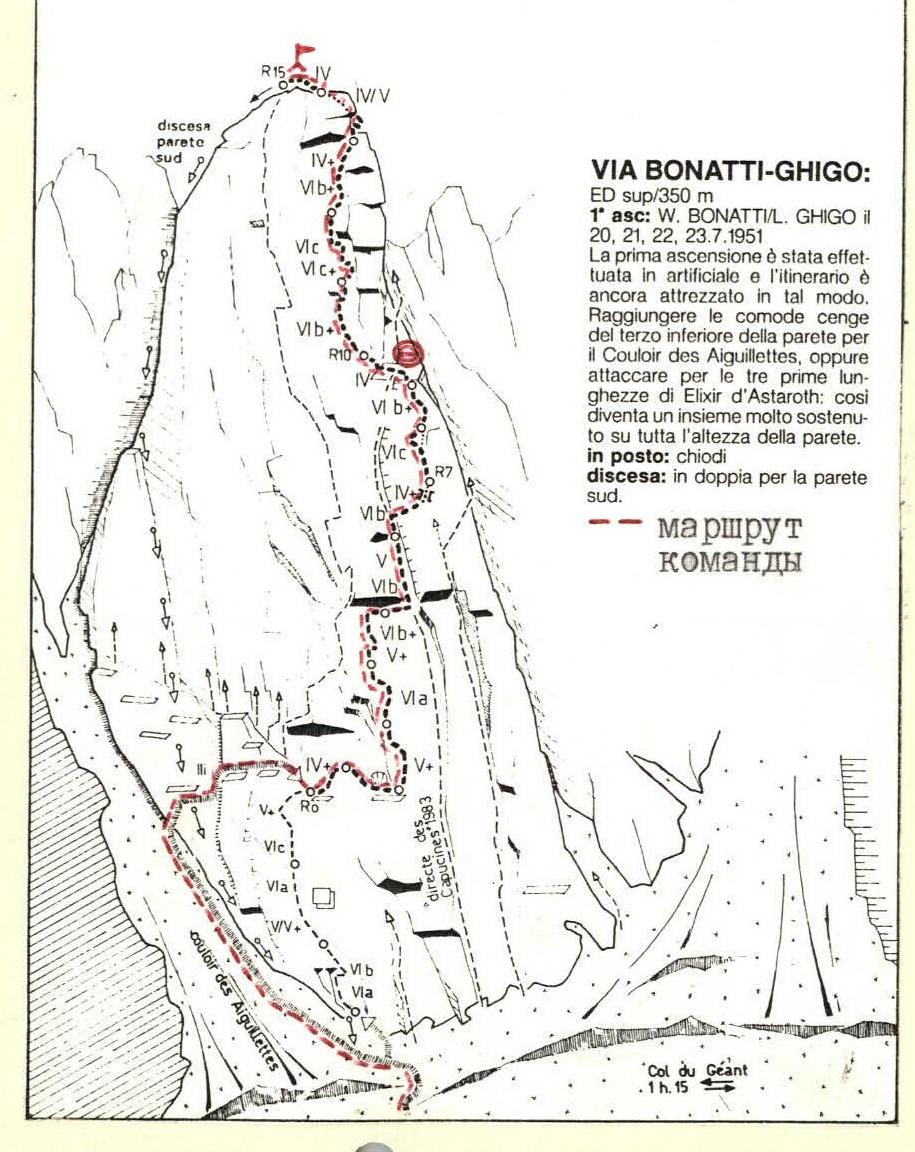
The "Grand Capucin" peak, 3838 m high, is located in one of the eastern spurs of "Mont Blanc du Tacul" (French Alps, "Mont Blanc" area).
A team of four Soviet climbers completed an ascent to the "Grand Capucin" peak via the route first traversed in 1951 by a duo of climbers — Walter Bonatti and Luciano Ghedi. This route goes through a sheer 500-meter rock wall. The "Mont Blanc" area is considered the most challenging region in the Alps, characterized by:
- extensive glaciation,
- solid monolithic and sheer cliffs,
- capricious and treacherous weather.
Soviet climbers have ascended this wall several times:
- 1964 — V. Shataev, K. Kletsko, G. Agranovsky, Kavunenko team
- 1968 — V. Onishchenko, M. Khergiani
- 1969 — B. Korablin, Yu. Chernoslivin
- 1974 — K. Pavlenko, A. Nezametdinov
Training ascents and climbs made by the group in France in August 1974.
August 6–7, 1974 — Training ascent on Petit Dru via the normal route and traverse of Grand Dru – Petit Dru. August 13–15, 1974 — Ascent on Petit Dru via Bonatti's route.
Ascent plan.
August 16, 1974 — Rest day and preparation for departure. August 17, 1974 — Approach to the route with an overnight stay on the wall in a grotto. August 18, 1974 — Ascend the wall and descend. August 19, 1974 — Reserve day in case of bad weather.
Route description
August 17, 1974 — Departure from Aiguille du Midi (3842 m) at 12:30. Descent to the glacier and along the glacier towards the spurs of "Mont Blanc du Tacul". The glacier is relatively flat and almost crevasse-free. We reach the foot of "Grand Capucin" wall in 1.5 hours. Here, we rope up and begin the ascent via a steep snow-ice couloir to the left of the wall.
We cross the couloir from right to left, overcoming a bergschrund (section R0–R1), and exit onto a ledge under overhanging rocks, where we rest and have lunch for 1.5 hours.
Then, we cross the couloir again from left to right and upwards (section R1–R2) and approach a large internal corner. The ascent through this corner leads to a rock platform (section R2–R3), from which we ascend a wall (section R3–R4) ending in a large ledge.
Further:
- right along the ledge and down (section R4–R5)
- to a spiral concave wall, which is traversed rightwards and upwards to overhanging rocks
- then right and down to a rock grotto (section R5–R6)
We stop for the night in the grotto as it's 18:00 and the weather starts to deteriorate.
August 18, 1974 — Departure at 6:00. The weather is excellent. From the rock grotto, a rock ledge goes right (section R6–R7). After traversing the ledge, we need to ascend via a less noticeable crack. Here begins the challenging part of the route, with extensive use of ladders.
The ascent goes through a sheer wall (section R7–R8). Upon reaching a large cornice with a niche, we ascend into the niche and crawl through it leftwards to an internal overhanging corner. This section is done using free climbing (section R8–R9).
The internal corner (section R9–R10) is initially ascended using ladders. It then transitions into a chimney (section R10–R11), above which the first cornice overhangs. The cornice (section R11–R12) is traversed via its right part using ladders, straight up.
Further — upwards along a convex wall directly to a small platform (section R12–R13). The movement involves ladders and difficult free climbing. Then, upwards under the second cornice, which is ascended directly using ladders (section R13–R14). Next, there's a narrow slit straight up to a huge cornice, which is initially ascended using difficult free climbing and then using ladders (section R14–R15). After that, we traverse right to an internal corner (section R15–R16). This is a very challenging traverse as the enormous sheer slab has very few holds.
Further, we ascend the internal corner under the right part of the large cornice (section R16–R17). The cornice is traversed using ladders (section R17–R18).
After it, there's a platform where the entire group can gather. From the platform, we ascend leftwards and upwards, bypassing an overhanging rock using ladders (section R18–R19), and then using difficult free climbing directly under the fourth cornice.
The fourth cornice is traversed using ladders to the right, to a small ledge (section R19–R20). Further, leftwards and upwards to three small platforms (section R20–R21). The climbing is free but challenging.
Then, through a short slit (section R21–R22) to the fifth cornice. The cornice (section R22–R23) is ascended using ladders via its right part, straight up, exiting under an indistinct narrow chimney.
Further, a horizontal traverse rightwards along a sheer rock wall using ladders to a large chimney (section R23–R24). The beginning of the chimney is ascended using a ladder, and then using free climbing (section R24–R25). The chimney ends on a very small rock ledge, from which the path goes straight up using ladders along a sheer wall to an overhanging slab (section R25–R26).
Further, a short traverse rightwards and then upwards to an overhanging short internal corner (section R26–R27). It's ascended using ladders (section R27–R28). We caught up with a French duo and overtook them.
We reached a large ledge with snow. At 10:00, we stopped to rest as the path ahead was occupied (we caught up with 3 groups and couldn't bypass them yet).
We spent 1.5–2 hours having tea. We departed further at 12:00.
From the left part of the platform, a short wall with a flake ascends (section R28–R29) to a small ledge, from which the path goes left. Further, a traverse leftwards (section R29–R30) to an internal corner. It's done using free climbing.
The internal corner (section R30–R31) is ascended using ladders to the sixth cornice, which is traversed rightwards using ladders (section R31–R32) to a narrow rock ledge, from which we ascend straight up a wall (section R32–R33) under the seventh cornice.
The seventh cornice is traversed via its left part (section R33–R34). Further upwards, there's a convex rock wall leading to a niche under the eighth cornice (section R34–R35). All these sections are done using ladders. The cornice is ascended using ladders from the left (section R35–R36).
We caught up with a team of climbers from Kiev (3 people) and a German duo from West Germany. We overtook them while ascending an internal corner (section R36–R37) and a convex wall (section R37–R38), which has a narrow crack leading to a sheer cracked rock slab.
These sections are ascended using ladders.
The cracked slab (section R38–R39) is traversed using free climbing to the right and upwards under the eighth cornice. The cornice (section R39–R40) is traversed leftwards using ladders, and further, the path goes upwards along a sheer wall using ladders (section R40–R41) under the last, ninth cornice.
The cornice (section R41–R42) is traversed rightwards using ladders, exiting onto steeper but easier rocks, which lead to a platform (section R42–R43), 5 meters below the summit.
Further, a traverse rightwards. Initially, rocks, then a snow-ice ledge lead to the location of the first rappel.
The first rappel is 30 m, the second is 40 m, descending on a rope to the saddle between "Grand Capucin" and "Mont Blanc du Tacul".
From the saddle, rightwards along a rocky couloir (5 rappels using the "sporting" method) to the saddle between "Grand Capucin" and "Petit Capucin". Further rightwards and downwards, following the rocks of "Petit Cap Grucin" and descend to the "Giant" glacier.
Further along the glacier to the hut, the path to which took 4 hours from the summit.
Group composition
| № | Last name, First name | Year of birth | Nationality | Party affiliation | Alpine experience | Sport rank |
|---|---|---|---|---|---|---|
| 1. | Vasiliev B.P. | 1937 | Russian | b/p | since 1959 | MS |
| 2. | Gavrilov G.A. | 1941 | -"- | -"- | since 1965 | MS |
| 3. | Grachev A. | 1938 | -"- | -"- | since 1959 | MS |
| 4. | Manoylov Yu.S. | 1937 | -"- | -"- | since 1959 | CMS |
Additional data
- The rope teams were distributed as follows: — Vasiliev — Gavrilov — Grachev — Manoylov
- The group evaluates the route as 6B complexity category (according to the USSR classification) and considers it one of the most challenging routes traversed by Soviet climbers in various mountain regions and ranges.
Table of main characteristics of the ascent route
Ascent route: "Grand Capucin" via the East-Southeast face Height difference of the route: 463 m Including complex sections: 395 m Steepness of the route: 85° of which complex sections: 90°
| Date | Sections traversed | Average steepness of section, ° | Height of section, m | Relief characteristics | Technical difficulty | Insurance method | Weather conditions | Departure time | Overnight stay | Overnight conditions | Number of pitons |
|---|---|---|---|---|---|---|---|---|---|---|---|
| 17.08 | R0–R1 | 50 | 68 | Snow-ice slope | medium | simultaneous | good | 14:00 | 1 | ||
| R1–R2 | 50 | 60 | -"- | -"- | piton | -"- | 2 | ||||
| R2–R3 | 75 | 22 | rock corner | difficult | -"- | -"- | rock grotto | 8 | |||
| R3–R4 | 85 | 8 | rock wall | very difficult | -"- | -"- | some snow | 6 | |||
| R4–R5 | 35 | - | snow ledge | easy | -"- | -"- | rain | 3 | |||
| R5–R6 | 85 | - | rock ledge | very difficult | -"- | -"- | 17:00 | 5 | |||
| R6–R7 | 85 | 18 | rock ledge | -"- | -"- | -"- | 6:00 | 1 | |||
| R7–R8 | 90 | 18 | rock wall-internal corner | difficult | -"- | -"- | 18 | ||||
| R8–R9 | 90 | 2 | rock niche | -"- | -"- | 6 | |||||
| R9–R10 | 80 | 18 | rock corner | challenging | -"- | -"- | 12 | ||||
| R10–R11 | 75 | 10 | rock chimney | very difficult | -"- | -"- | 7 | ||||
| R11–R12 | 75 | 2.5 | rock cornice | -"- | -"- | -"- | 6 | ||||
| R12–R13 | 85 | 20 | rock wall | -"- | -"- | -"- | 18 | ||||
| R13–R14 | 100 | 8 | rock wall | challenging | -"- | -"- | 13 | ||||
| R14–R15 | 90 | 26 | rock slit | very difficult | -"- | -"- | 22 | ||||
| R15–R16 | 80 | 6 | rock wall | challenging | -"- | -"- | 2 | ||||
| R16–R17 | 70 | 5 | rock corner | very difficult | -"- | -"- | 6 | ||||
| R17–R18 | 75 | 2.5 | rock cornice | challenging | -"- | -"- | 7 | ||||
| R18–R19 | 85 | 25 | rock wall | very difficult | -"- | -"- | 27 | ||||
| R19–R20 | 95 | 2.0 | rock cornice | -"- | -"- | -"- | 5 | ||||
| R20–R21 | 85 | 22 | rock wall | challenging | -"- | -"- | 11 | ||||
| R21–R22 | 90 | 6 | rock slit | -"- | -"- | -"- | 6 | ||||
| R22–R23 | 75 | 3 | rock cornice | -"- | -"- | -"- | 9 | ||||
| R23–R24 | 90 | - | rock wall, traverse | -"- | -"- | -"- | 12 | ||||
| R24–R25 | 70 | 10 | rock chimney | difficult | -"- | -"- | 4 | ||||
| R25–R26 | 90 | 25 | rock wall | very difficult | -"- | -"- | 20 | ||||
| R26–R27 | 85 | 22 | -"- | -"- | -"- | -"- | 18 | ||||
| R27–R28 | 92 | 8 | rock corner | -"- | -"- | -"- | 9 | ||||
| R28–R29 | 90 | 4 | rock wall | -"- | -"- | -"- | 3 | ||||
| R29–R30 | 90 | - | rock wall | challenging | -"- | -"- | 3 | ||||
| 18.08 | R30–R31 | 85 | 10 | rock corner | very difficult | piton | deteriorating | 9 | |||
| R31–R32 | 95 | 25 | rock cornice | challenging | -"- | deteriorating on descent | 7 | ||||
| R32–R33 | 90 | 9 | rock wall | -"- | -"- | deteriorating on descent | 8 | ||||
| R33–R34 | 100 | 2 | rock cornice | -"- | -"- | deteriorating on descent | 5 | ||||
| R34–R35 | 85 | 20 | rock wall | very difficult | -"- | deteriorating on descent | 20 | ||||
| R35–R36 | 75 | 1.5 | rock cornice | challenging | -"- | deteriorating on descent | 18 | ||||
| R36–R37 | 85 | 10 | rock corner | very difficult | -"- | deteriorating on descent | 11 | ||||
| R37–R38 | 85 | 15 | rock wall | -"- | -"- | deteriorating on descent | 16 | ||||
| R38–R39 | 80 | 6 | rock slab | -"- | -"- | deteriorating on descent | 3 | ||||
| R39–R40 | 100 | 2.5 | rock cornice | challenging | -"- | deteriorating on descent | 6 | ||||
| R40–R41 | 85 | 20 | rock wall | very difficult | -"- | deteriorating on descent | 18 | ||||
| R41–R42 | 70 | 3 | rock cornice | challenging | -"- | deteriorating on descent | 8 | ||||
| R42–R43 | 70 | 20 | rock wall | medium | -"- | deteriorating on descent | 12:00 | in the hut | 5 |
In total, around 350 pitons were hammered and used on the route. The wall from the overnight stay to the grotto was traversed by the group in 6 hours.

Comments
Sign in to leave a comment