
Ascent Passport
- Ascent class: High-altitude.
- Ascent area: Himalayas, Tibet.
- Peak, route: Chomolungma (Everest 8848 m) via the North-East Ridge.
- Complexity category: 5B.
- Height difference:
- including 2348 m of actual wall section
- total route length — 2168 m
- wall section length — 5900 m
- including 4300 m of 5th complexity category
- average steepness of wall section — 50°
- average steepness of route — 40°
- Number of pitons driven:
| Rock | Ice | Snow |
|---|---|---|
| 43 | 27 | 59 |
- Number of climbing hours/days — 31 h 15 min/5
- Night halts:
- "Camp 7050 m"
- "Camp 7600 m"
- "Camp 8200 m"
- Leader: Kazbek Borisovich Khamitsaev, CMS (candidate master of sports), captain-participant. Participants: Evgeny Mikhailovich Vinogradsky, EMS (honored master of sports), Sergei Georgievich Bogomolov, EMS, Yuri Viktorovich Proyaev, 1st sports category.
- Coach: Vladimir Nikolayevich Shataev, TMS (trainer-master of sports), 1st category instructor, Honored Coach of the Russian Federation.
- Departure to the route: May 10, 1995. Summit: May 13, 1995. Return: May 14, 1995.

Tactical Plan
- Day 1: 12:30 — departure from the assault base camp; 14:00 — approach to the ice wall of the North Col; 17:30 — reaching the North Col. Establishment of "Camp 7050 m", overnight stay.
- Day 2: 12:00 — departure on the route; 16:00 — approach to the start of the rock section. Establishment of "Camp 7600 m", overnight stay.
- Day 3: 10:30 — departure on the route; 13:00 — end of the rock section, start of the steep snow-ice ascent; 16:00 — end of the last snow ascent, establishment of "Camp 8200 m", overnight stay.
- Day 4:
- 9:15 — start of the assault
- 11:00 — reaching the ridge
- 12:30 — passing the first snow-ice ascent
- 14:00 — passing the second vertical rock ascent
- 15:15 — start of ascent on the vertical snow-ice slope
- 16:00 — Summit
- 17:00 — descent
- 19:00 — "Camp 8200 m"
- Day 5:
- 12:00 — descent
- 14:15 — "Camp 7600 m"
- 16:30 — "Camp 7050 m"
- 19:00 — assault base "Camp 6500 m"
Safety Measures
To ensure the safety of the team ascending via the 5B category route on Everest via the North-East Ridge, the following rescue team (callsign "Ossetia-3") is deployed to the ascent area.
It will:
- monitor the team's progress on the route through a spyglass;
- relay radio information to the base "Camp 5200 m" (callsign "Ossetia") if necessary.
The rescue team is located at the assault base "Camp 6500 m". In emergency situations, the "Inmarsat-M" satellite communication system will be used. The team also receives systematic weather forecasts from the Russian Hydrometeorological Center via the same communication channel. The team (callsign "Ossetia-7") maintains constant radio contact with the base "Camp 5200 m".
Rescue team members:
- Gudenko V.P. — rescue team leader, CMS.
- Rubayev V.M. — CMS — doctor.
- Zelensky A.L. — CMS.
- Volkov V.N. — CMS.
- Egorin S.V. — CMS.
- Ivanov V.V. — CMS.
- Zevakhin G.Yu. — CMS.
Technical and Tactical Actions of the Team
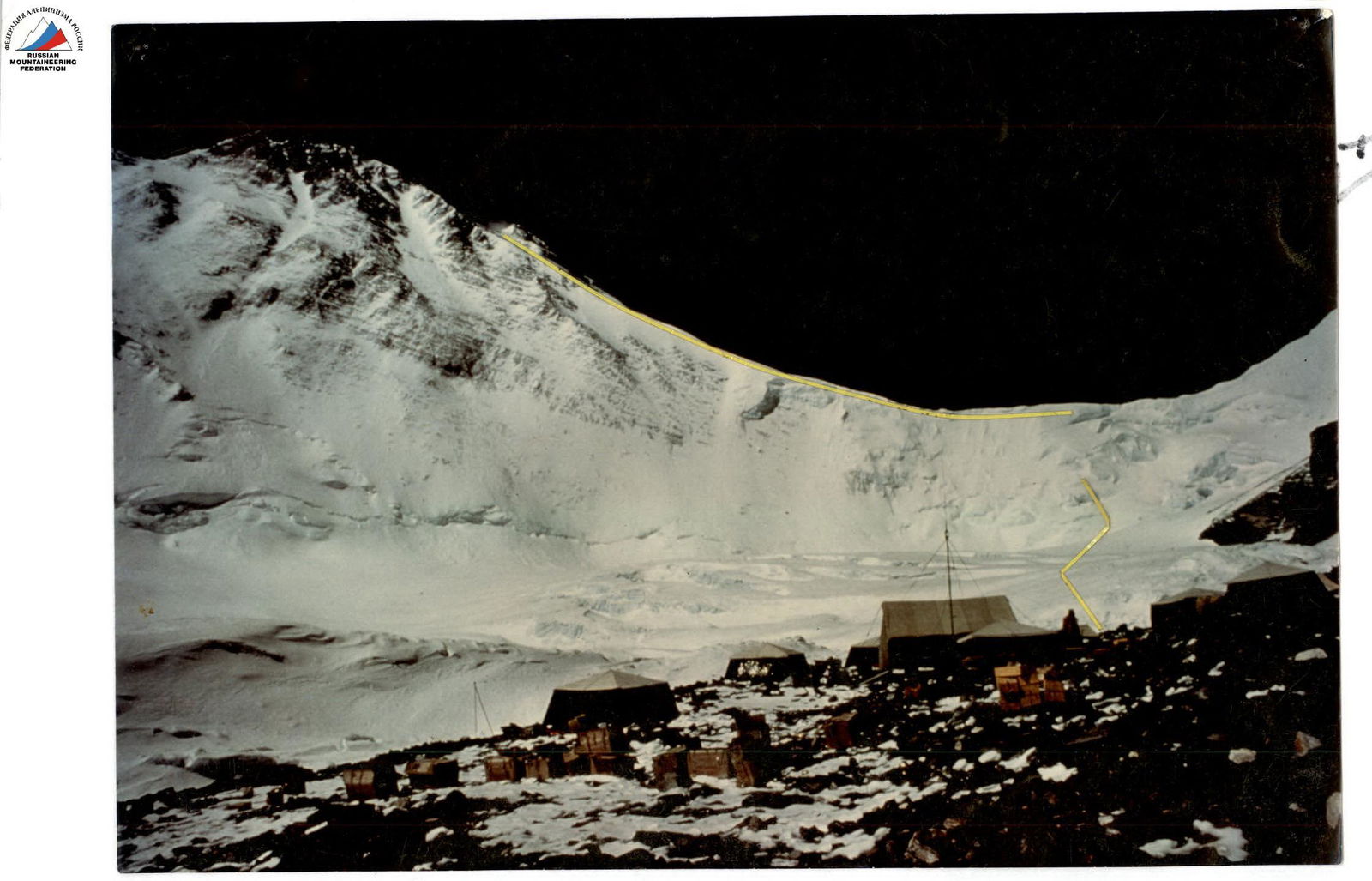
May 10: at 12:30, the team consisting of Khamitsaev K.B., Vinogradsky E.M., Proyaev Yu.V., and Bogomolov S.G. headed from "Camp 6500 m" towards the North Col. At 14:00, they approached the start of the ice wall. They formed two rope teams: Khamitsaev K.B. — Vinogradsky E.M.; Proyaev Yu.V. — Bogomolov S.G. The second rope team started working first. Proyaev Yu.V. was the lead, and they fixed the first rope using ice screws. On the second rope, Khamitsaev K.B. was the lead. On the third rope, Bogomolov S.G. was the lead. Then, they proceeded up a snow-ice slope for three ropes. The team worked using the classical system: alternating lead and rope teams. Near the ice niche, they moved left along the ice wall with a steepness of up to 75° and a length of two ropes. The first half was passed by the Khamitsaev-Vinogradsky rope team, with Vinogradsky leading and using 7 intermediate ice screws. The second rope team followed using these fixed ropes and then proceeded to work on the second half, with Proyaev Yu.V. leading and using the same number of ice screws. After that, they traversed a 150 m ledge and reached the North Col at 17:30. They ascended the entire wall in crampons and established "Camp 7050 m" for the night.
May 11: at 12:00, they departed on the route and continued up snow ascents of moderate steepness. The rope teams moved independently. At 14:30, they encountered the last snow-ice ascent with a steepness of over 45°. Here, they began working with alternating leads. Initially, the Proyaev-Bogomolov rope team led, followed by Vinogradsky-Khamitsaev. After each fixed rope, the lead changed, using snow anchors and jumar ascenders. At 16:00, they stopped at the start of the rock section and established "Camp 7600 m" for the night.
May 12: at 10:30, they departed on the route, as the upcoming section was the most challenging. Initially, they ascended the rock section. On the second rope section, they encountered icy areas of great steepness, which they navigated with alternate protection: first, the first rope team led, then the second, with Khamitsaev and Bogomolov leading. The next six ropes were ascended independently by the rope teams, using rock anchors, boxes, and outcrops for protection, and jumar ascenders. At 13:00, they reached a steep snow-ice ascent. Proyaev-Bogomolov led first, followed by Vinogradsky-Khamitsaev, with Proyaev and Vinogradsky leading. They continued with alternate lead changes, using ice screws, snow anchors, jumar ascenders, and crampons. Then, they traversed several rock sections independently. This was followed by a prolonged, steep snow section, with alternate work and protection. At 16:00, they reached a narrow snow ledge, excavated a cave, and established "Camp 8200 m" for the night.
May 13: at 9:30, they began the assault. They moved independently up steep combined terrain. After an hour, they roped up and ascended a steep snow-ice section, using ice screws for alternate protection, with Bogomolov and Khamitsaev leading. At 10:00, they reached a rock wall and worked with alternate lead changes. At 11:00, they emerged onto the ridge and proceeded towards the summit. The rope teams moved independently. At 12:30, they encountered the first ascent (snow-ice, steepness up to 60°). Proyaev-Bogomolov led the first fixed rope, with Bogomolov leading, and Vinogradsky-Khamitsaev led the second, with Vinogradsky leading. They continued along the ridge, which was moderately steep. At 14:00, they encountered the second ascent, a vertical rock face for 15 minutes, followed by 30 m of boulders. The passage was complicated by an unsecured aluminum ladder left by Chinese climbers. Proyaev led, using rock anchors and jumar ascenders. At 15:15, they approached the summit snow ascent. The movement was very challenging due to the steepness and deep snow. They proceeded with alternate lead changes, using snow anchors and jumar ascenders. The temperature was −28 °C, wind speed 12 m/s, and the sky was clear. For the second half of the ascent, they traversed slightly to the right, with Vinogradsky leading. They encountered a vertical rock section of 40 m. Khamitsaev led, using steel anchors for protection. The movement was challenging but maintained a relatively high pace. Suddenly, the wall ended, and Khamitsaev reached a short, narrow snow platform resembling a hollow, followed by another similar hollow, and finally, the summit. At 15:54, they reached the summit of Chomolungma!!! They filmed the entire route using a professional video camera and took many color photographs. They raised flags of Russia, North Ossetia-Alania, China, Nepal, the Banner of the World, and the Victory Banner. They played an audio cassette with "The Appeal of Akhsarbek Galazov to all peoples of planet Earth, to people of good will" for broadcast through all mass media. At 17:15, they began their descent and returned to "Camp 8200 m" at 19:00.
May 14: at 12:00, they began their descent. At 14:15, they reached "Camp 7600 m", at 16:30 — "Camp 7050 m", and at 19:00 — the assault base "Camp 6500 m".
Review of the ascent by the team from the Republic of North Ossetia-Alania on Chomolungma (Everest 8848 m) via the North-East Ridge, counted towards the 13th Open Championship of Russia in mountaineering 1995, high-altitude class.
Present:
- Senior coach Vladimir Nikolayevich Shataev,
- Coach Vladimir Petrovich Gudenko,
- Team captain Kazbek Borisovich Khamitsaev,
- Liaison officer of the mountaineering federation of the Tibet Autonomous Region of the PRC, Sё-O-Tu.
Participants:
- Sergei Georgievich Bogomolov
- Evgeny Mikhailovich Vinogradsky
- Yuri Viktorovich Proyaev
Speakers:
K.B. Khamitsaev: The ascent began 4 days later than planned due to a sharp deterioration in weather conditions, with heavy snowfalls, hurricane-force winds of up to 40 m/s, and temperatures dropping to −45 °C. On May 10, the day of departure, there was a lot of snow on the route, but the temperature rose to −28 °C, the sun appeared, and the wind speed was 12 m/s. The ascent proceeded without deviations from the tactical plan. The rope teams and participants worked on the route with alternate leads, following the classical system to evenly distribute their strength. The availability of high-quality equipment meeting international standards from firms like "Salewa", "Koflach", the Alpinism Center "Himalayas", and "Petzl" significantly facilitated their progress. Portable Japanese UHF radios and satellite communication equipment enabled high-quality, systematic communication. All participants demonstrated good physical, sports, and moral preparedness. I have no complaints. The team's years of experience on Pamir and Tian Shan seven-thousanders and their extensive organizational, physical, and sports preparation for the Himalayan expedition played a significant role. I would like to particularly note the team's work on the ice wall of the North Col (7050 m), on the icy rocks after Camp 7600 m, on the 1st and 2nd steps after Camp 8200 m, and finally, during the summit ascent. Thank you to all participants.
E.M. Vinogradsky: The good organization of the expedition contributed to our success. Many people and firms were involved, resulting in a high level of equipment and gear. The tactical plan was detailed, and there were no deviations. The team's preparation was at a high level. As a doctor, I believe the medical support was good, with an adequate supply of medications, oxygen equipment, and a high-altitude doctor among us. All participants had experience with high-altitude ascents, and Kazbek Khamitsaev demonstrated his leadership qualities both in organizing the expedition and on the route.
Yu.V. Proyaev: I am very pleased with our success. I saw what we had been working towards for several years, gaining high-altitude experience on the seven-thousanders of the Pamirs and Tian Shan. In challenging conditions, I was convinced of our team's cohesion. The core of the team decided the fate of the ascent and the entire expedition. I enjoyed the ice section leading to the North Col and the second ascent. Of course, I must note the great contribution of our leader, both on the route and in organizing the expedition, which allowed us to travel to the Himalayas.
S.G. Bogomolov: Kazbek Khamitsaev's experience in organizing and conducting high-altitude expeditions is evident. I am grateful to have been included in the expedition. Our joint ascents began in 1987, and I would like to continue them. Due to certain circumstances, Everest had been my unfulfilled dream until now. The technique used by each participant on the route deserves high praise. The final guarantee of success was the healthy moral climate within the team. I particularly want to note the cohesion of the leading rope team, K.B. Khamitsaev-E.M. Vinogradsky, who set the tone on the route.
Sё-O-Tu: I recall the first days of the North Ossetia-Alania team's stay at Base Camp "5200 m". I said then that this was the only team capable of becoming the leading one. Now, I am pleased to say that I was not mistaken. Along with other liaison officers from Tibet, we monitored the ascent continuously. No violations or deviations from the rules were observed. The movement was in full accordance with the given tactical plan and the overall organizational plan. I must note the healthy moral climate and, most importantly, the ability of your leadership to establish friendly relations with athletes from other countries, particularly our interactions. We are ready to continue cooperating with your republic in the field of international mountaineering.
V.N. Shataev: I have known the team since 1989 when we worked on Lenin Peak. I personally participated in the preparation of the 1st North Ossetian Himalayan expedition. All issues were resolved in full accordance with the "Rules for Ascents in the Mountains". As the releasing coach, I note the team's good preparedness. The tactical plan was competently drawn up, and there were no deviations from it. The North Ossetian team's success garnered significant attention among all other teams. The team was recognized as the best. My opinion is to count the ascent for the participants and the leadership for the captain.
V.P. Gudenko: Starting from the first high-altitude expedition, I have been the team's constant coach, and the core of the team has remained the same to this day. Frankly, despite some difficulties, I counted on success. I believe the ascent was successful, without any violations, and fully in accordance with the tactical plan's schedule. The physical and sports aspects were at a very high level. The healthy moral climate within the team also contributed to the success. I support the releasing coach's opinion — to count the ascent for the participants and the leadership for the captain.
Chairman K.B. Khamitsaev
Secretary V.A. Korenkov
Representative of the Russian Mountaineering Federation V.N. Shataev

Comments
Sign in to leave a comment