
- Rock climbing.
- Pamir-Alai, Turkestan Ridge, Karavshin river basin.
- Peak Slesova (4240 m) — via SW wall.
- 6A category of difficulty, presumably, first ascent.
- Height difference: 1200 m, length 1590 m, average steepness 61°, steepest parts 72°, length of sections
- 5th category of difficulty 550 m
- 6th category of difficulty 336 m
- Pitons driven:
| Rock pitons | Nuts | Bolt pitons | Ice pitons |
|---|---|---|---|
| 60 | 85 | 2 | 0 |
| 25 | 20 | 2 | 0 |
- Climbing hours 35+ (5 hours descent), days 3.
- Overnight stays: comfortable in a tent.
- Leader: An P.V. — Master of Sports
Team members:
- Baskakova S.V. — Candidate for Master of Sports
- Petrov A.A. — Candidate for Master of Sports
- Rybkin E.I. — Master of Sports
- Selyaev V.V. — Master of Sports
- Chugunov V.I. — Candidate for Master of Sports
Coaches: Shabanov A.V., Kudakaev T.Z.
- Approach to the route July 26, 1992, summit July 28, 1992, descent July 29, 1992
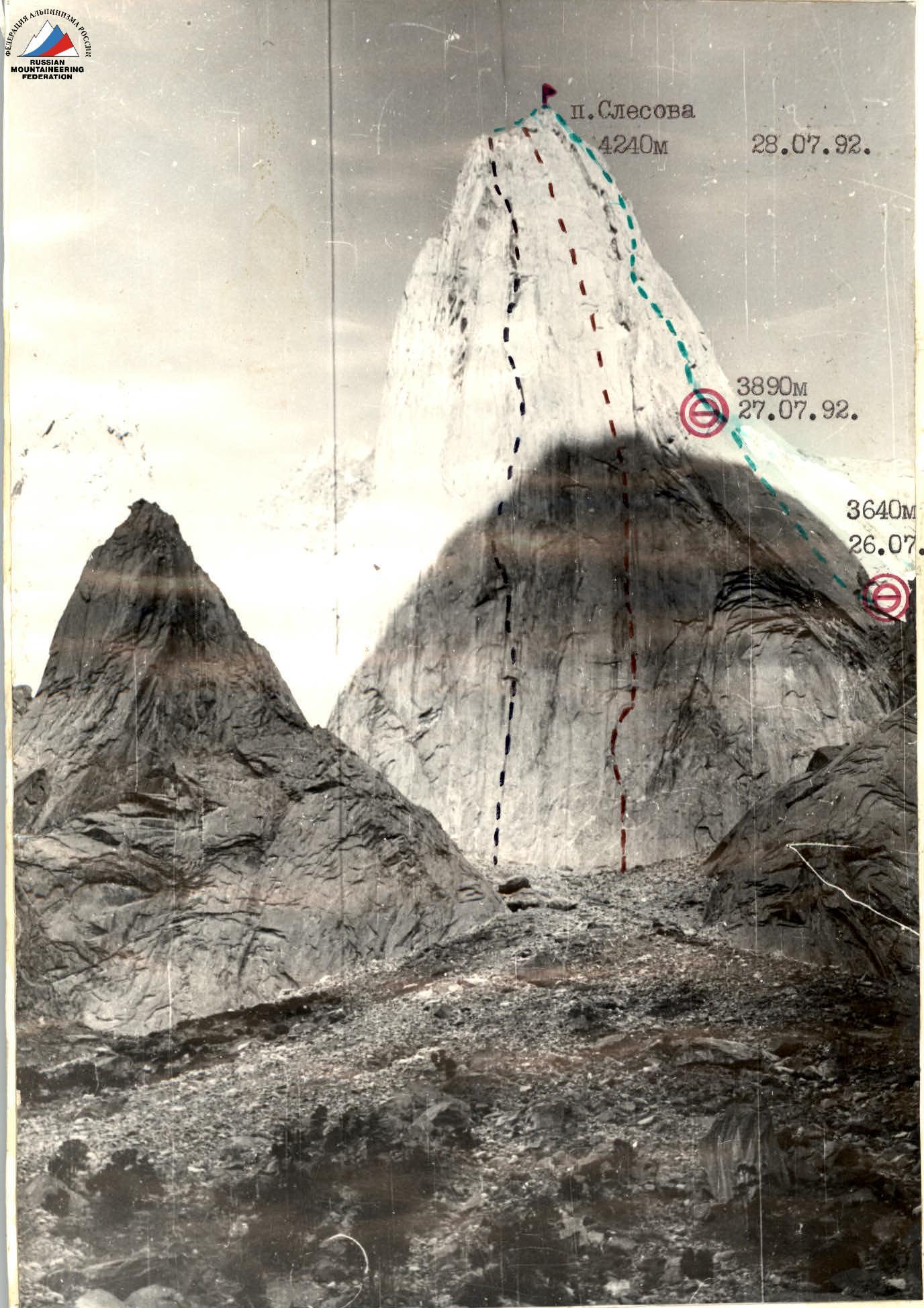
General photograph of the route
— Moroz's route — Pogorelov's route — Team's route
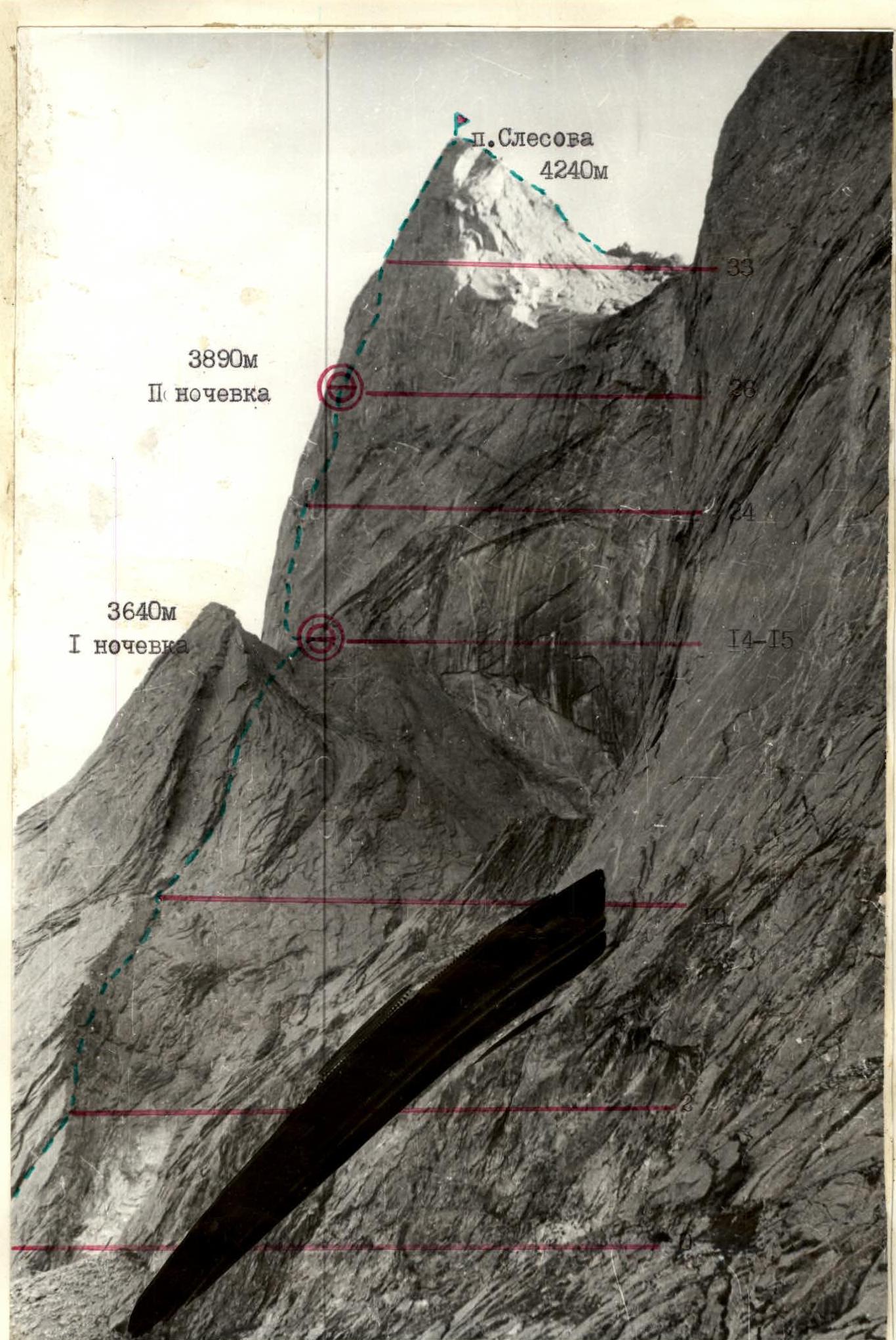
Route profile on the right
| Section | Rock pitons | Nuts | Bolt pitons | Ice pitons | Length, m | Steepness, ° | Category of difficulty | Note |
|---|---|---|---|---|---|---|---|---|
| R0 | - | - | 2 | - | 60 | 60 | 4 | |
| R1 | - | - | 2 | - | 50 | 70 | 5 | |
| R2 | - | - | 2 | - | 50 | 55 | 4 | |
| R3 | - | 1 | 2 | - | 50 | 40 | 4 | |
| R4 | - | - | 2 | - | 30 | 30 | 3 | |
| R5 | - | - | 1 | - | 50 | 45 | 3 | |
| R6 | - | - | 2 | - | 35 | 45 | 3 | |
| R7 | - | - | 3 | - | 50 | 55 | 4 | |
| R8 | - | 1 | 2 | - | 50 | 60 | 4 | |
| R9 | - | 1 | 2 | - | 50 | 60 | 4 | |
| R10 | - | - | 1 | - | 50 | 50 | 4 | |
| R11 | - | - | 2 | - | 50 | 50 | 4 | |
| R12 | - | - | 2 | - | 50 | 45 | 3 | |
| R13 | - | - | 3 | - | 50 | 45 | 3 | |
| R14 | - | - | - | - | 50 | 0 | 1 | |
| R15 | - | - | - | - | 30 | 30 | 2 | July 26, 1992, 3640 m |
| R16 | 5 | 3 | - | - | 45 | 80 | 5 | |
| R17 | 3 | 2 | - | - | 40 | 65 | 5 | |
| R18 | 2 | 2 | - | - | 45 | 80 | 5 | |
| R19 | 2 | 3 | - | - | 45 | 80 | 5 | |
| R20 | 2 | 2 | - | - | 45 | 75 | 5 | |
| R21 | 5 | 5 | 1 | - | 45 | 75 | 5 | |
| R22 | 4 | 4 | 0 | - | 40 | 80 | 6 | |
| R23 | 2 | 2 | - | - | 45 | 60 | 5 | |
| R24 | 3 | 3 | - | - | 45 | 75 | 6 | July 27, 1992, 3890 m |
| R25 | 3 | 2 | - | - | 50 | 75 | 5 | |
| R26 | 4 | 2 | - | - | 45 | 70 | 6 | |
| R27 | 3 | 3 | 2 | 1 | 45 | 75 | 6 | |
| R28 | 4 | 2 | - | - | 40 | 75 | 6 | |
| R29 | 5 | 4 | - | - | 35 | 80 | 6 | |
| R30 | 5 | 4 | - | - | 35 | 75 | 6 | |
| R31 | 3 | 2 | - | - | 50 | 75 | 4 | Possible overnight stay |
| R32 | 2 | 3 | - | - | 45 | 55 | 5 | |
| R33 | 2 | 4 | - | - | 45 | 80 | 6 | |
| R34 | 1 | 4 | - | - | 45 | 70 | 5 | |
| R35 | - | 1 | - | - | 50 | 45 | 2 | July 28, 1992, 4240 m peak Slesova |
R0–R16. The beginning of the route follows the SW counterfort, leading under the SW wall of peak Slesova, mostly 4th category of difficulty, left of a wide couloir with water and a waterfall in the lower part, mainly along the right wide part of the internal angle with crevices, less often — chimneys, "ram's foreheads". The steepness of this part of the route varies from 30 to 70°, more often (45–50)°. The counterfort leads to a wide scree shelf under the SW wall. Here is a comfortable platform for a lying overnight stay. To the right of the platform, you can rappel down to the water, which is important since there is no water throughout the rest of the route to the summit. The first control cairn is built on the platform under the wall.
R16–R17. From the cairn, 30 m along a steep 75° curved internal angle. Before reaching the rock cornice, a 5 m pendulum to the left, then into another shallow locking internal angle (similar to a flake), steepness 80°, 5th category of difficulty.
R17–R18. From the internal angle, ascend left-up along a narrow vertical crevice with uneven edges on a smooth wall, 65° 5th category of difficulty.
R18–R19. Then the route follows the continuation of this crevice, which overhangs here, expanding to the size of a chimney 60 cm wide and up to 8 m long in the middle part of the section. The steepness of the section reaches up to 75–80°. Difficult climbing. There is a problem with organization. In the upper part of the section, the crevice is inclined to the left at an angle of 50°, then the crevice narrows. The wall's steepness does not change. Climbing is on the right off-width.
R19–R20. Continuation of the uncomfortable narrow crevice, inclined at 45°, with uneven edges along a steep smooth wall 75–80°, 5–6 category of difficulty. Climbing is difficult in the off-width on the right.
R20–R21. Continuing movement along the crevice, the steepness remains the same — 75–80°, 5–6 category of difficulty.
R21–R22. Ascend along the continuation of the same crevice for 20 m, 70°, to a small 1 m cornice, which is passed on its left side using artificial climbing techniques (skyhook). Then up along the vertical wall 75°, towards a large rock protrusion resembling a finger, to the right of which a bolt piton is driven (French). It should be noted that on the route, in sections R16–R22 and R28–R30, bolt pitons are driven at belay points.
R22–R23. One of the key sections. Transition to the left into a vertical internal angle to the right of a large rock overhang, movement along the wall with cracks using artificial climbing techniques. Up along the internal angle to a vertical 80°, 5 m crevice, then along the left part of this internal angle, leading to the edge of a large overhang to the left of the internal angle, 6th category of difficulty.
R23–R24. Then along a deep crevice to the left-up, the wall becomes less steep (55–60°). The crevice turns into an internal angle, and behind the internal angle, a chimney begins. To the left, 10 m away, there is a horizontal shelf convenient for overnight stay. No water! The overnight stay is comfortable, lying down.
R24–R26. From the shelf, along a narrow chimney 75–80° with two plugs in the upper part:
- The first plug is bypassed on the left.
- The second plug is bypassed on the right.
On the first plug, it is convenient to organize a belay point. Further movement up along the crevice 50 m, 75°, 5th category of difficulty, to a small ledge.
R26–R27. Continuation of the wall with small cornices 2 m and 1 m, which are passed on the left, 6th category of difficulty.
R27–R28. Move right-up using artificial climbing techniques along a crevice 15 m under a triangular cornice, which is passed on the left, then along a wall with a crevice, almost overhanging, very difficult climbing. Above, the cornice is bypassed along a narrow internal angle. Steepness up to 80°. Then the internal angle ends with a cornice. 6th category of difficulty.
R28–R29. From the bolt, first left up under the cornice, then along the vertical reddish wall and further along the internal 75° angle.
R29–R30. First, a vertical 75–80°, 15 m, 6th category of difficulty — a wall with a narrow crevice with uneven edges, then into an internal 15 m, 5th category of difficulty.
R30–R31. One of the most difficult and interesting sections. First, move straight up along a narrow locking crevice, then along a smooth vertical wall with micro-holds 7 m. Bolt pitons are driven for organizing belay points. Then exit onto a wall with a crevice, leading to a horizontal shelf. Here, a sitting overnight stay is possible. Steepness 75–80°, 6th category of difficulty.
R31–R32. From the shelf up along a vertical wall with crevices 15 m, 75°, 6th category of difficulty. (Be cautious, loose rocks!). Then a series of parallel cracks, 30 m, steepness 60°, 5th category of difficulty, leads to a small scree shelf with convenient ledges for belaying.
R32–R33. A more gentle 50–60° section 5th category of difficulty, along an internal angle and cracks (loose rocks present!), approach under an extended internal angle.
R33–R34. First, up along a crack to the left of the beginning of the internal angle, then a 5 m pendulum to the right, transition into the aforementioned internal angle with rare "loose rocks". The right part of the internal angle is very steep, 75–80°, passage using artificial climbing techniques, 5–6 category of difficulty, 45 m.
R34–R35. Continuation of the internal angle, 20 m, 70°, 5th category of difficulty, to a cornice 5 m high, which is bypassed on the left. Above the cornice, continuation of the internal angle, which abuts a vertical, almost overhanging wall 3 m high. The wall is passed right-up along a crevice, leading to broken rocks.
From section R35 to the pre-summit ridge — 50 m of broken rocks. Here is a comfortable horizontal scree shelf with snow. On the entire wall route, this is the first water. On the shelf and further along the ridge, there are convenient platforms for lying overnight stays. Along the ridge to the summit — 50 m of broken rocks. On the summit, a control cairn. Descent from the summit takes 5 hours, occurs:
- first along the eastern ridge;
- then to the SW along a scree couloir, staying above the wide scree slope to the right (south of peak Slesova), which ends with large rock falls towards the Ak-su river. You need to ascend above this scree slope to the scree couloir and broken rocks and then descend in a southerly direction along this couloir, which has water in its lower part and ends with a waterfall flowing into the Ak-su river above the camp.
Along the stream:
- first, one rappel along "ram's foreheads";
- then two rappels to the left of the waterfall.

Comments
Sign in to leave a comment