
Report
on the ascent to the summit of Odessa (4810 m) via the center of the northwest wall, category 6B complexity, by a combined team from Tomsk-Leningrad and Kemerovo regions from 29.07.2018 to 04.08.2018 g.
I. Ascent Report
| 1. General Information | ||
|---|---|---|
| 1.1 | Team Leader | Temerev Ivan Mikhailovich, MS |
| 1.2 | Participants | Aldyn-Kherel Timur Valerievich, 1st sports category; Kashevnok Anton Aleksandrovich, CMS; Suzdaltsev Egor Evgenievich, CMS |
| 1.3 | Coach's Full Name | Temerev Ivan Mikhailovich |
| 2. Characteristics of the Ascent Object | ||
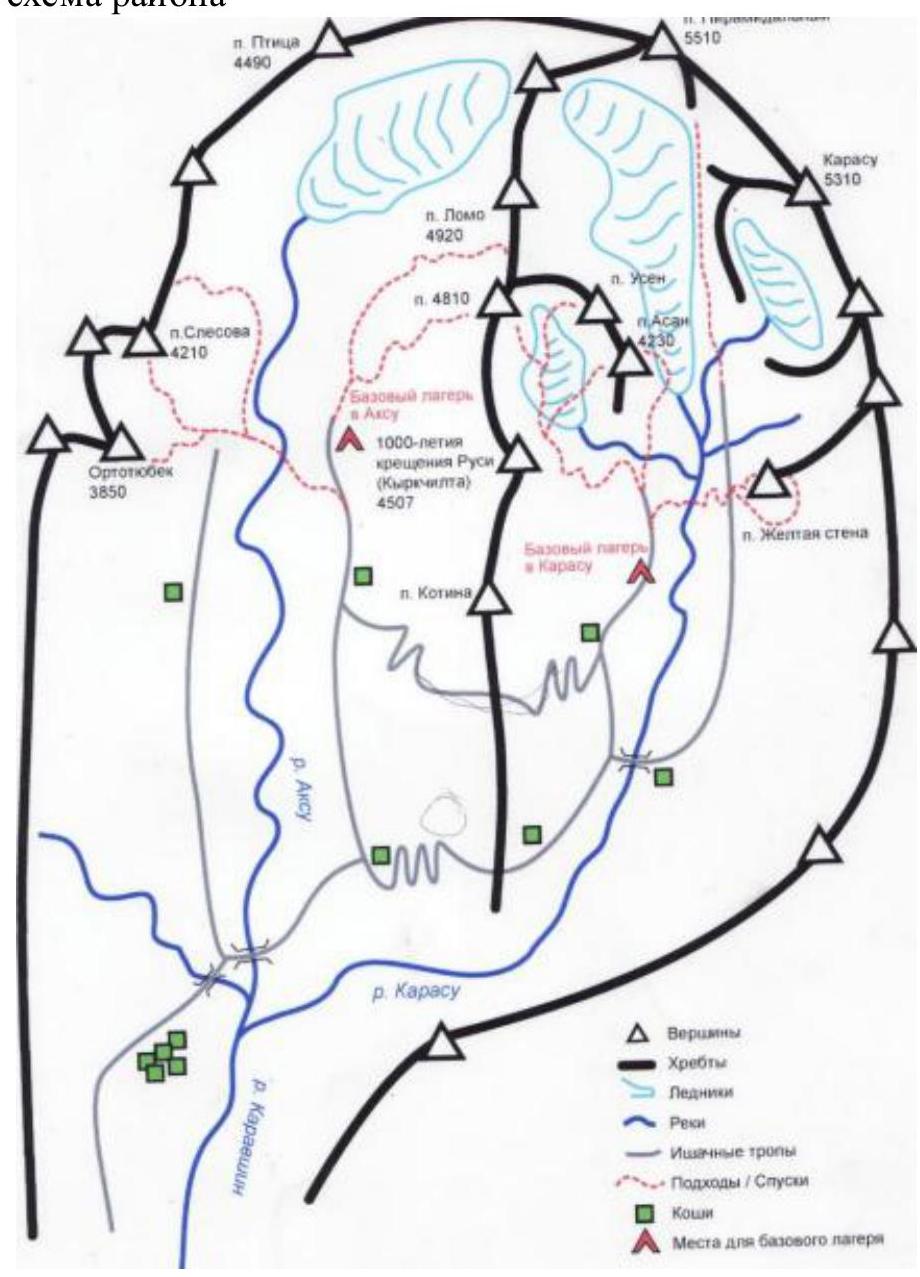
| 2.1 | Region | Gissar-Alay |
| 2.2 | Valley | Karavshin |
| 2.3 | Section Number according to the 2013 Classification Table | 5.4.3.24v |
| 2.4 | Name and Height of the Summit | Odessa, 4810 m. |
| 3. Route Characteristics | ||
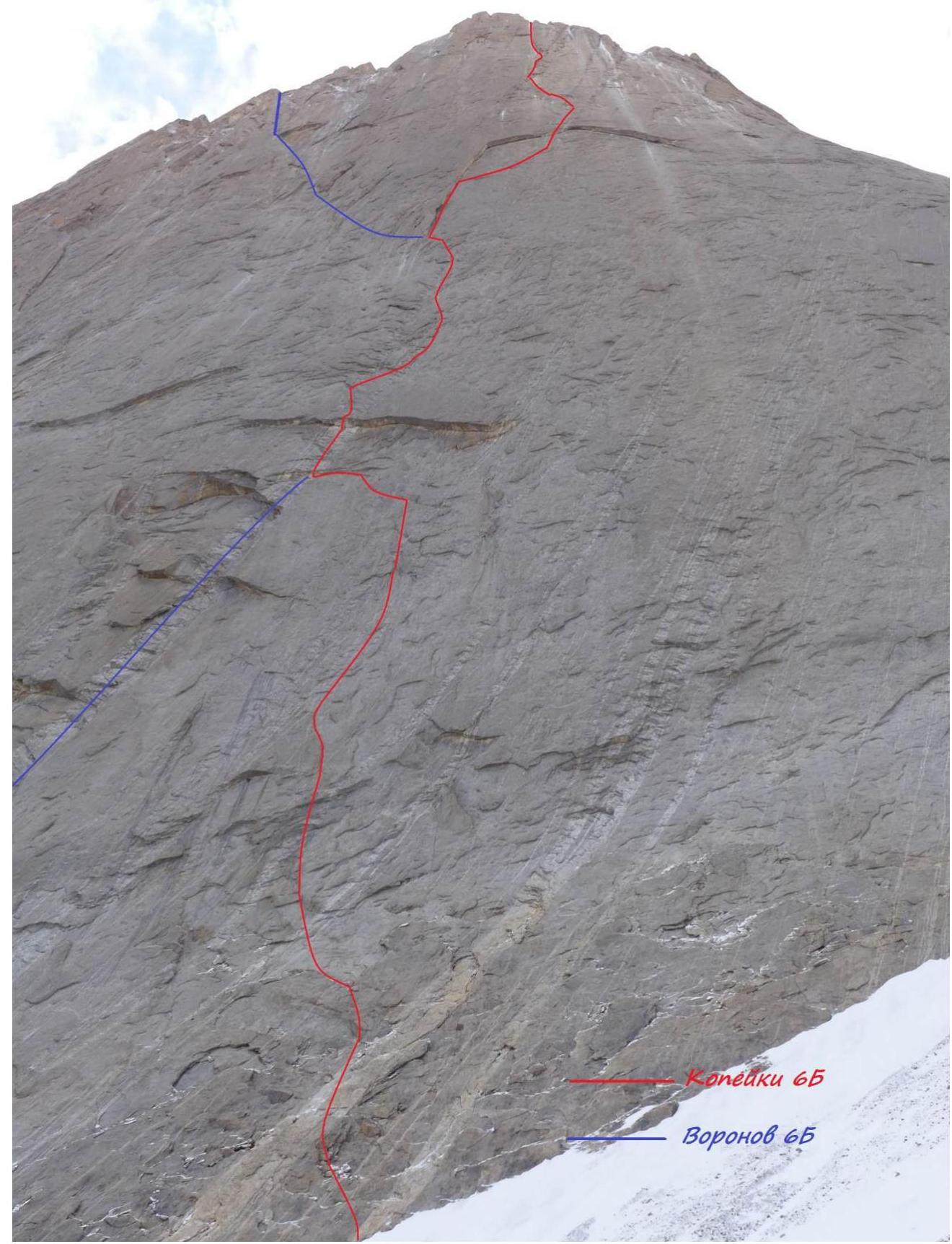
| 3.1 | Route Name | Via the center of the northwest wall (Kopeyki) |
| 3.2 | Proposed Category of Complexity | 6B |
| 3.3 | Degree of Route Exploration | – |
| 3.4 | Nature of the Route Terrain | Rock |
| 3.5 | Elevation Gain of the Route | 1000 m |
| 3.6 | Route Length (in meters) | 1050 m |
| 3.7 | Technical elements of the route (total length of sections of varying complexity, indicating the nature of the terrain: ice-snow, rock) | III cat. rock — 50 m. IV cat. rock — 180 m. V cat. rock — 195 m. VI cat. rock — 305 m. Rock A2 — 110 m. Rock A3 — 190 m. |
| 3.8 | Average Steepness of the Route, (°) | 75° |
| 3.9 | Average Steepness of the Main Part of the Route, (°) | 83° |
| 3.10 | Descent from the Summit | Via the Nazarov route and the Ovcharenko route |
| 3.11 | Additional Route Characteristics | All overnight stays on the wall are on a platform above narrow shelves. After bad weather, there is snow on the shelves and on the "roof". |
| 4. Characteristics of the Team's Actions | ||
| 4.1 | Time in Motion (team's walking hours, in hours and days) | 57 h, 7 days. Of these, 17 h, 3 days — preparation in bad weather. Descent — 9 h. |
| 4.2 | Overnight Stays | Overnight stays on platforms |
| 4.3 | Route Preparation Time | 17 h |
| 4.4 | Start of the Route | 8:00, August 1, 2018 |
| 4.5 | Reach the Summit | 20:30, August 4, 2018 |
| 4.6 | Return to Base Camp | 15:00, August 5, 2018 |
| 5. Meteorological Conditions | ||
| 5.1 | Temperature, °C | 29.07 — +1–+3 °C; 30.07 — +1–+7 °C; 31.07 — +3–+8 °C; 01.08 — +3–+5 °C; 02.08 — –2 °C (until 12:30) – +8 °C; 03.08 — –2 °C (until 12:30) – +12 °C; 04.08 — –2 °C (until 12:30) – +12 °C |
| 5.2 | Precipitation | 29.07 — wet snow; 30.07 — rain; 31.07 — occasional rain; 01.08 — snow, light rain in the evening |
| 6. Person Responsible for the Report | ||
| 6.1 | Full Name, e-mail | Suzdaltsev E.E., [email protected] |
II. Ascent Description
1. Characteristics of the Ascent Object
1.1. General photo of the summit
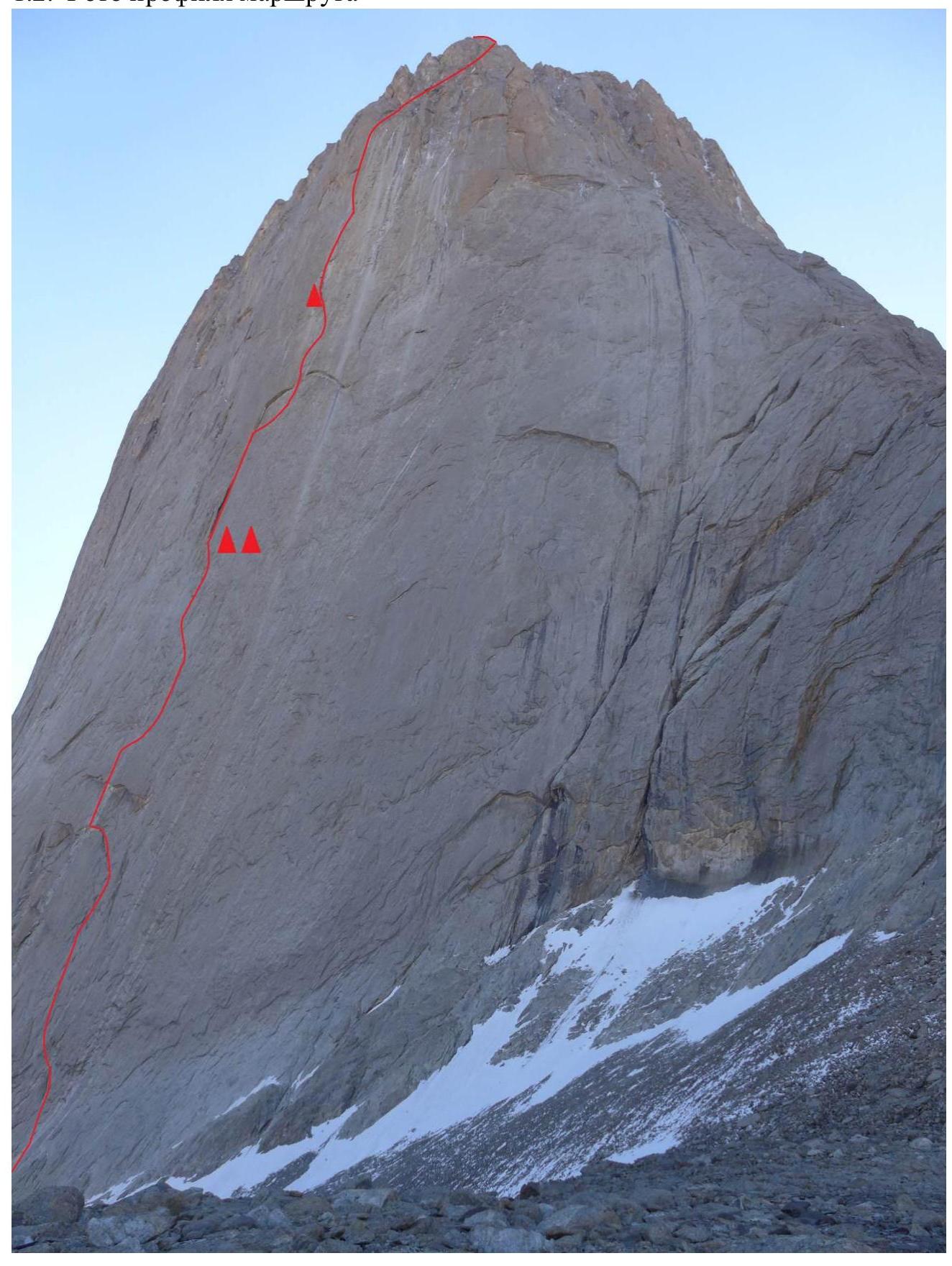
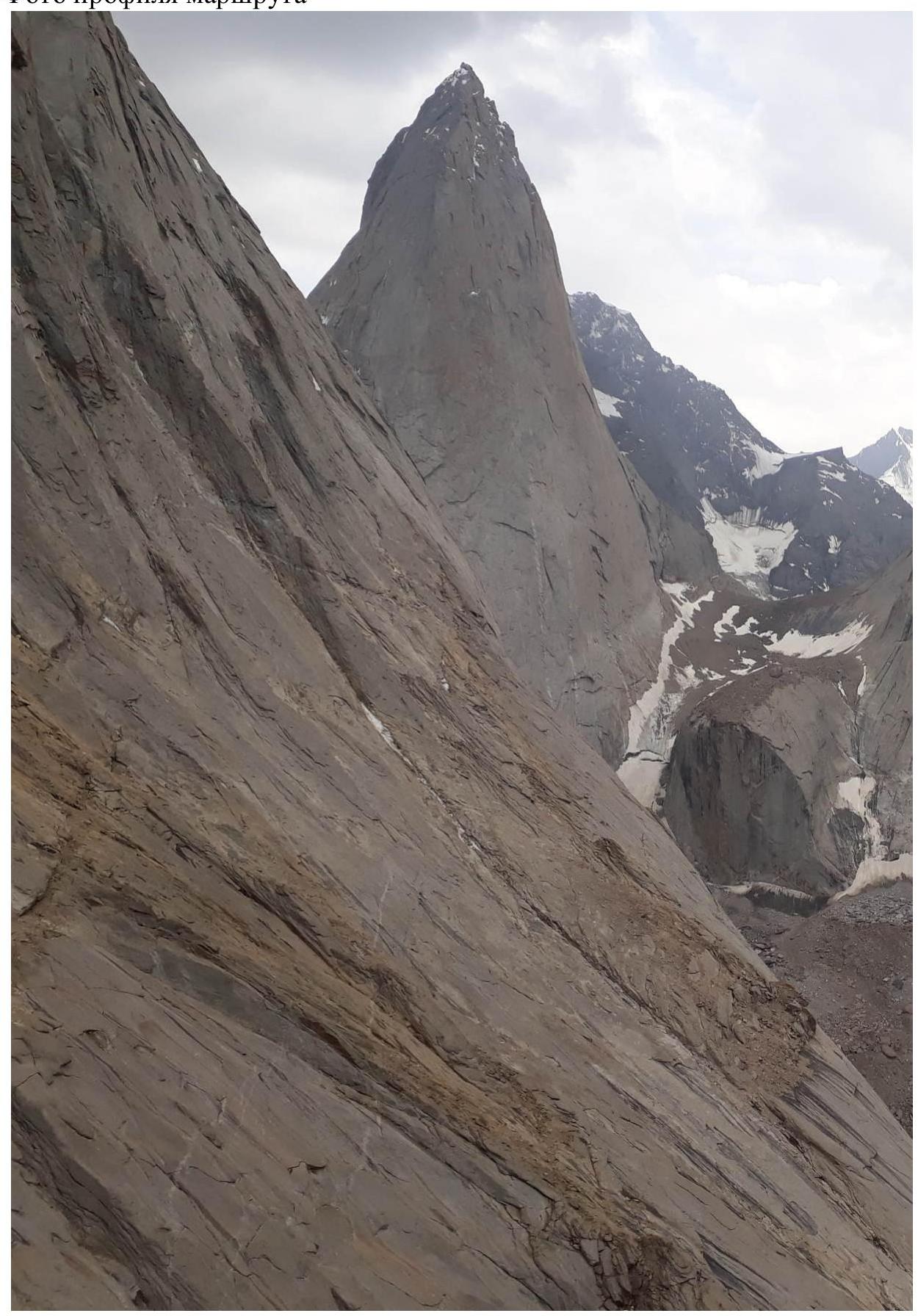
1.2. Photo of the route profile
1.4. Panoramic photo of the area
 View from the summit of the Yellow Wall
1.5. Map-scheme of the area
2. Route Characteristics
2.1. Technical photograph of the route
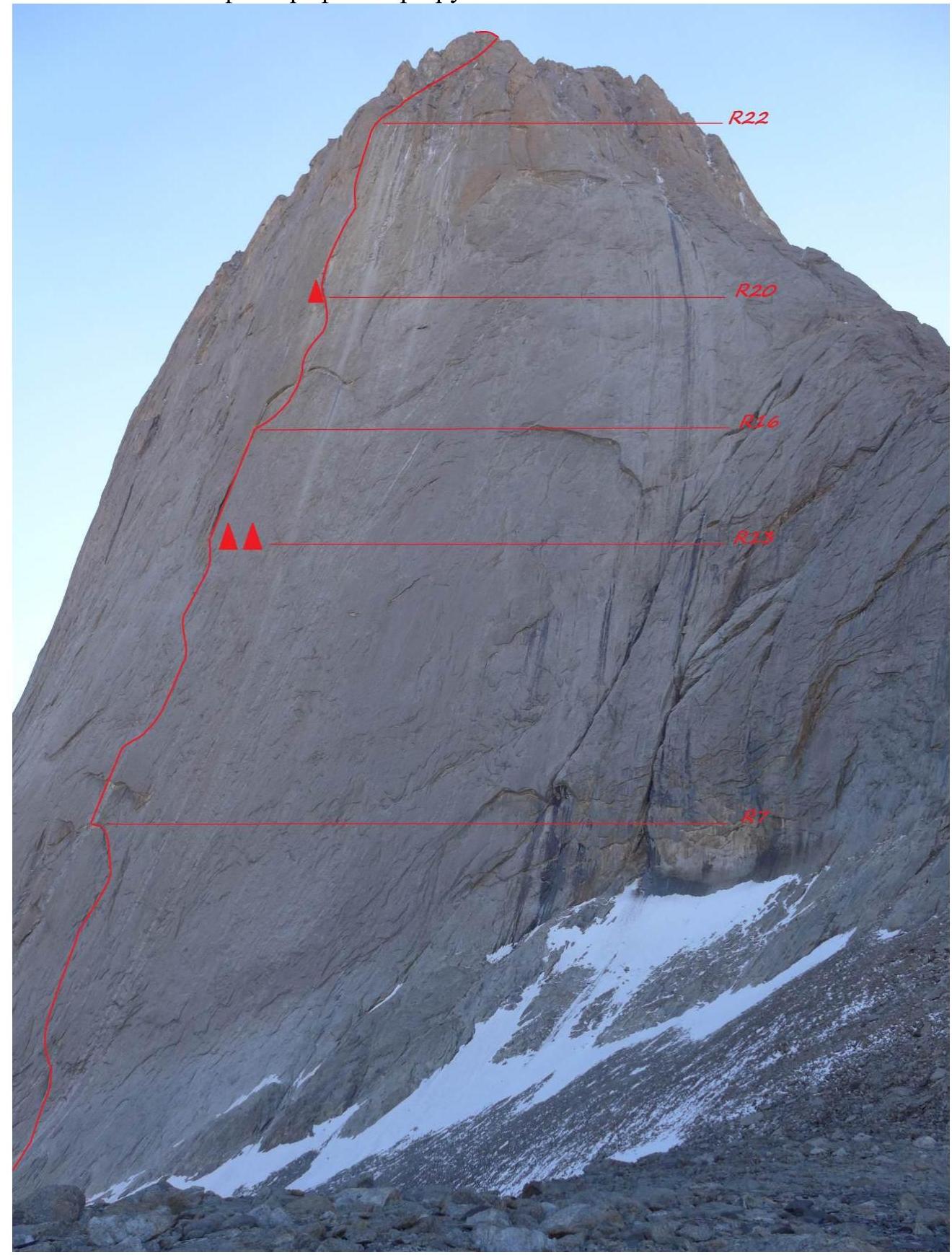
2.1.2. Photo of the route profile
2.2. Route diagram in UIAA647 symbols
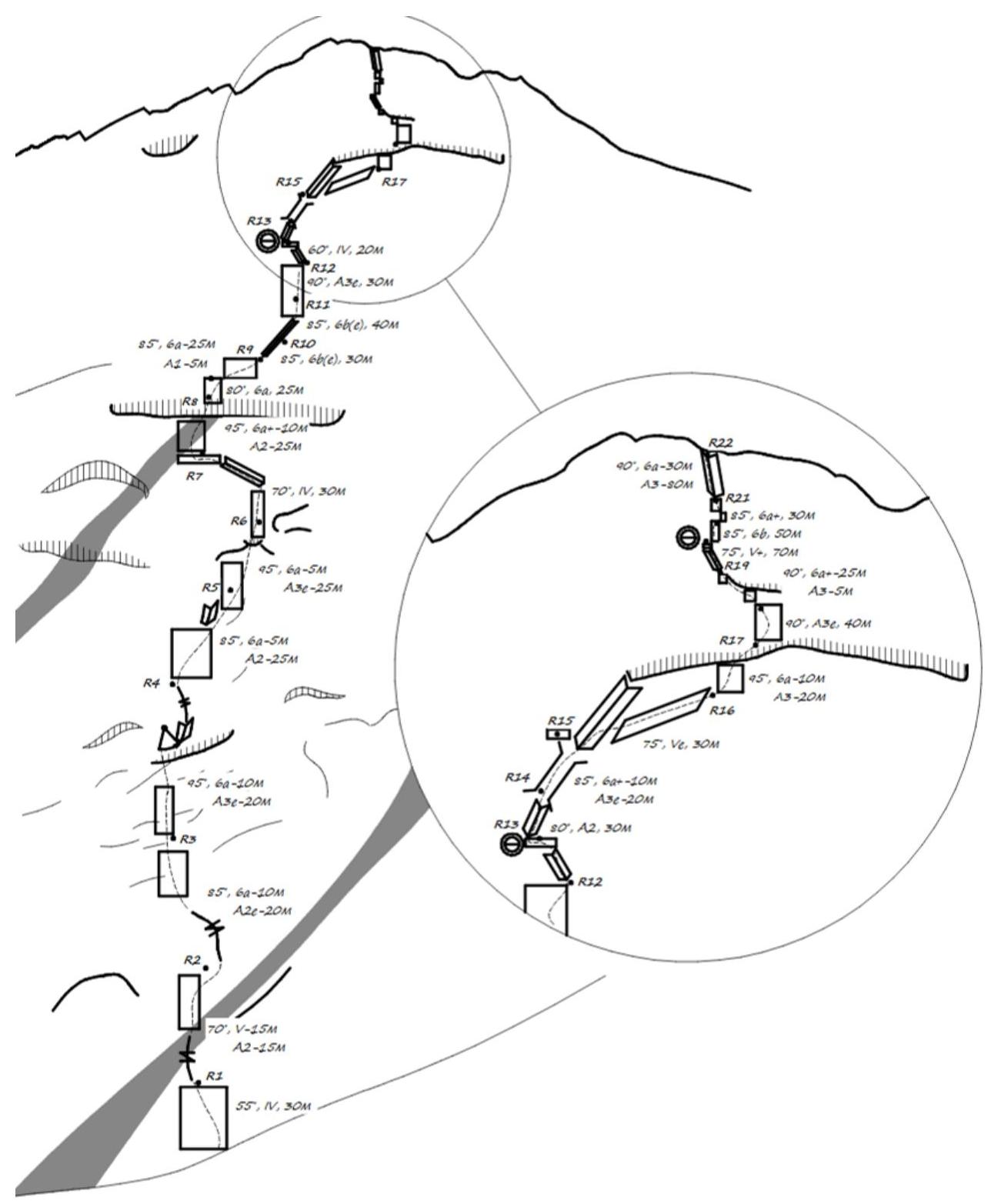
- The designation of the sections corresponds to the designation in the report by the first ascenders
3. Characteristics of the Team's Actions
3.1. Brief Description of the Route Passage.
July 29.
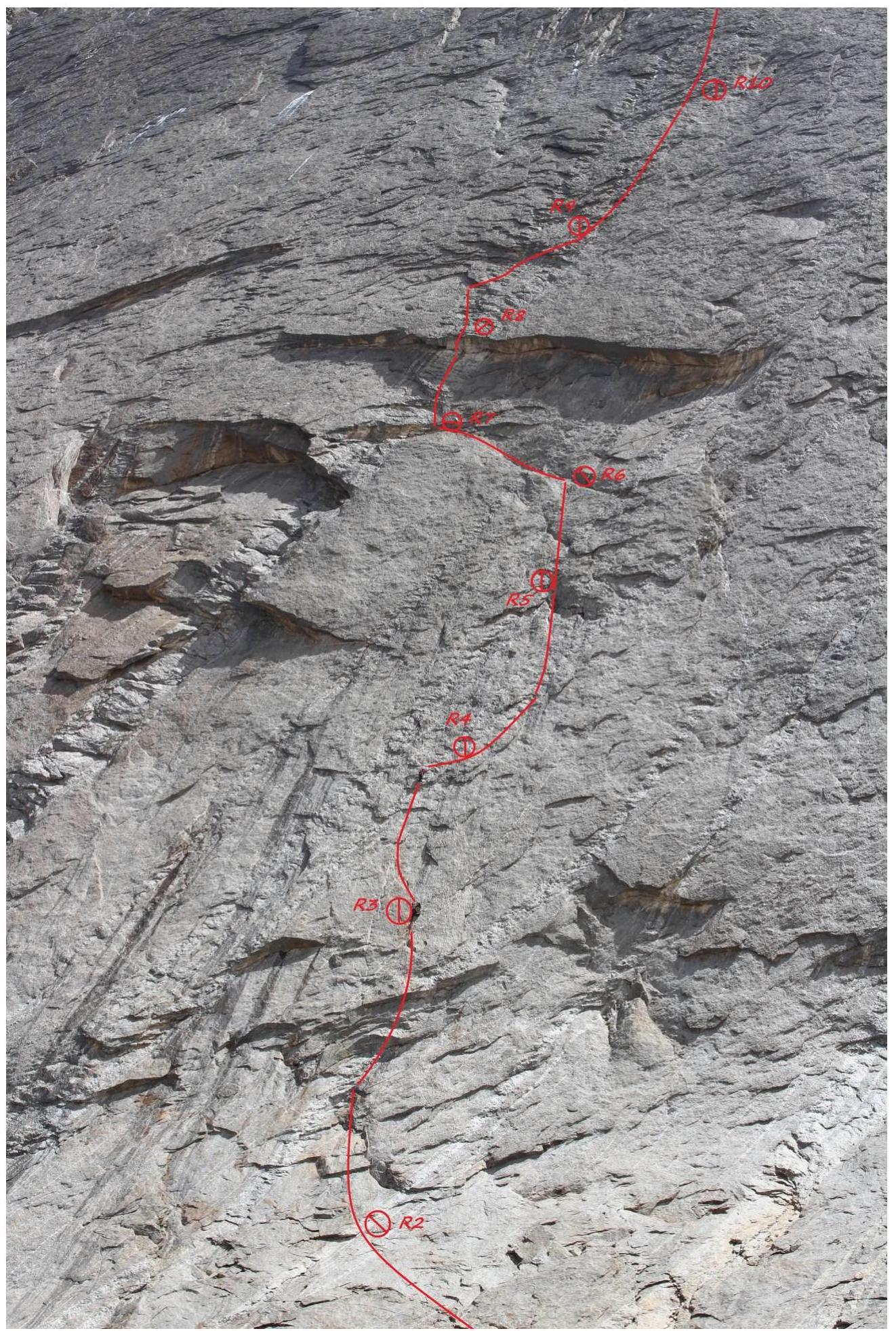
R0–R3. +1–+3 °C
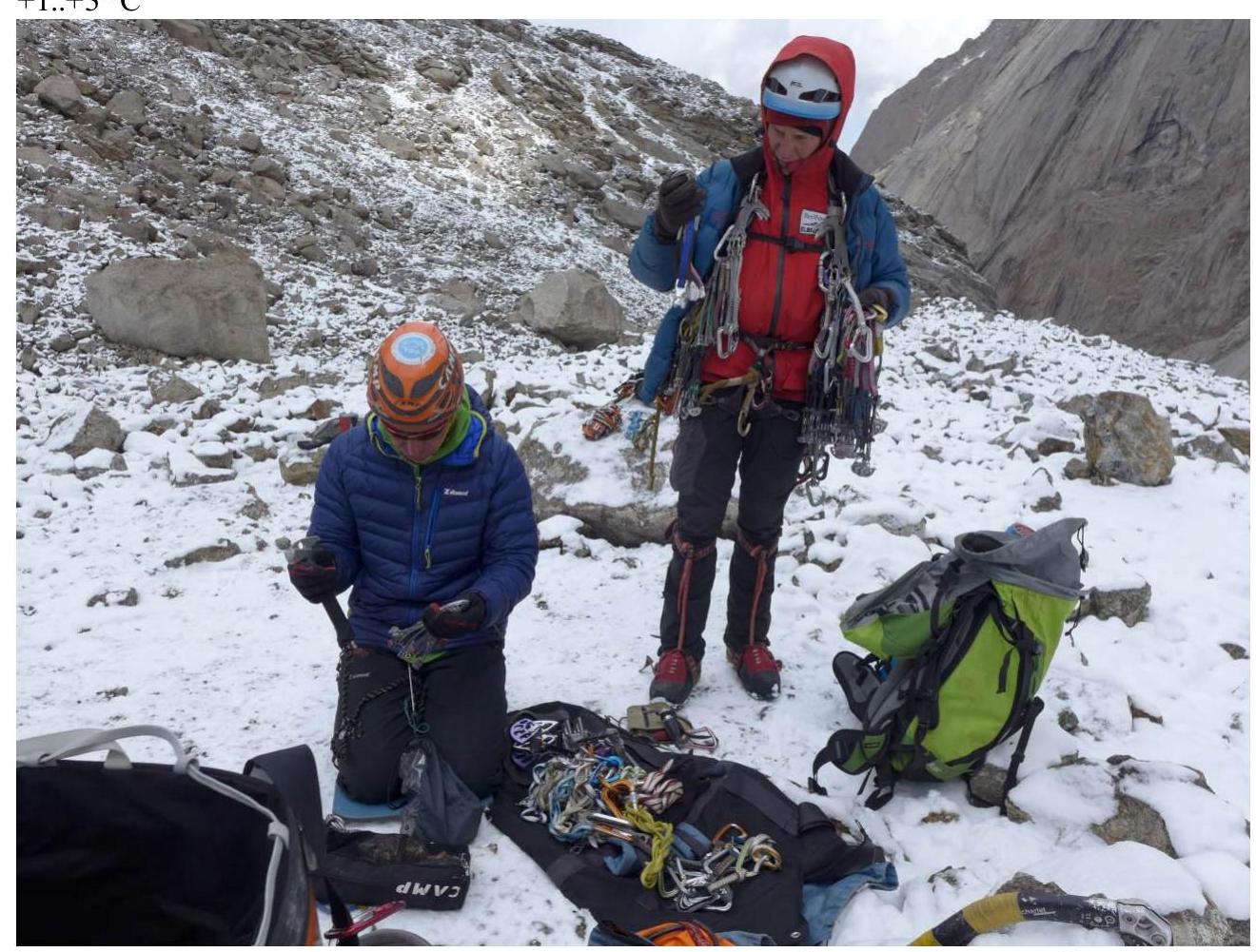
We move from the overnight stay point in the cirque under the Sakharov route to the upper cirque (above the berg). We start processing the route. Anton Kashevnok leads. He passes 2 ropes for the first small cornice. The weather worsens, snow, a lot of ITO.
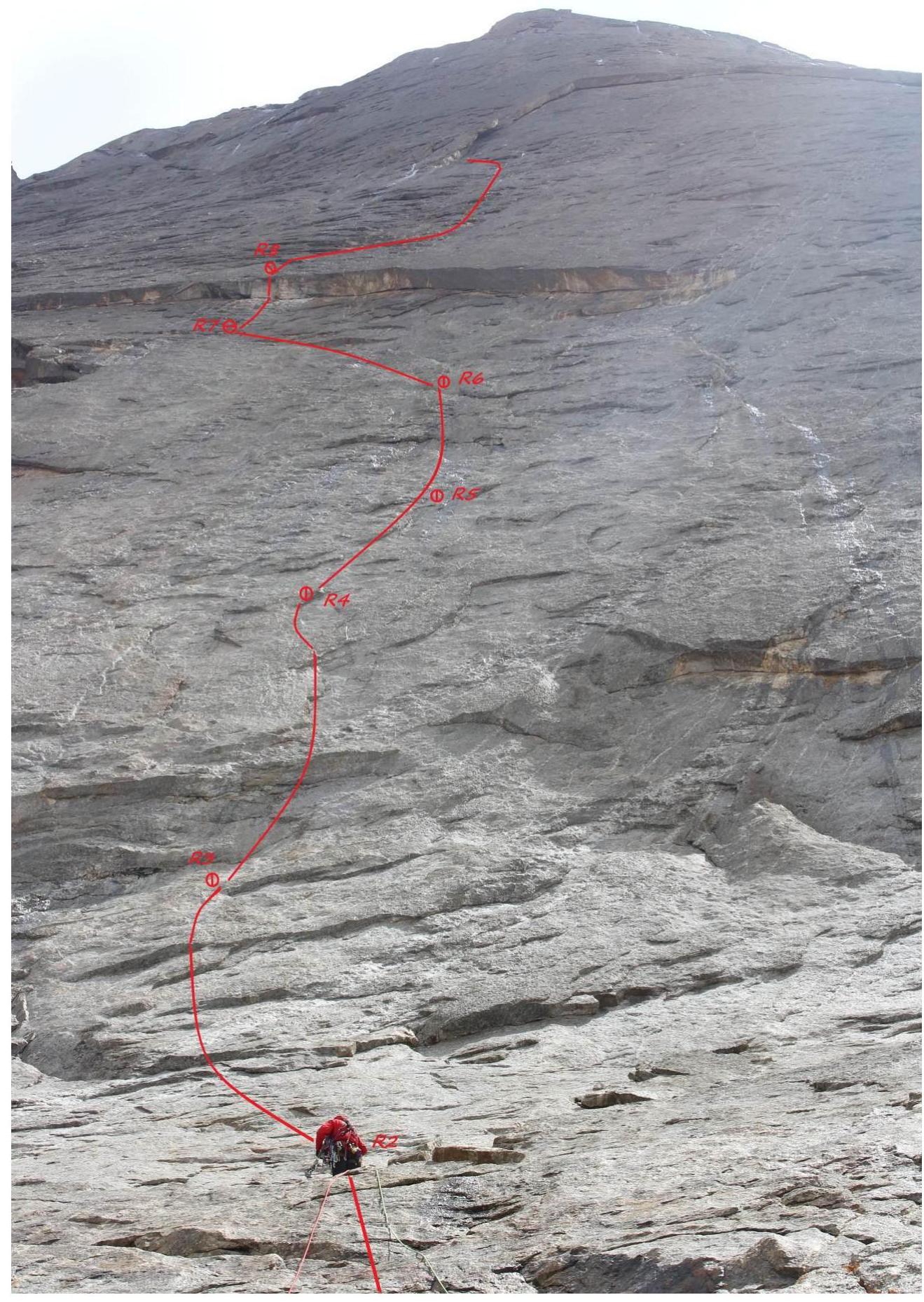
Digitized using Google
July 30.
R3–R5. +1–+7 °C Kashevnok continues processing. Timur Aldyn-Kherel provides backup. It's cold in the morning. Precipitation occurs in the middle of the day, snow. Complex ITO and challenging logistics in finding the route thread. One rope is passed during the working period.
July 31.
R5–R7 (partially R8). +3–+8 °C. Anton and Egor return to base camp for supplies because we didn't plan for such a long start. Ivan Temerev leads, Timur Aldyn-Kherel provides backup. It's cold, but precipitation only occurs in the evening. ITO is complex. We reach the shelf on the Voronov route. We hang half a rope under the cornice.
August 1.
R8–R13. +3–+5 °C.
We take a break from the ground and move to the shelf.
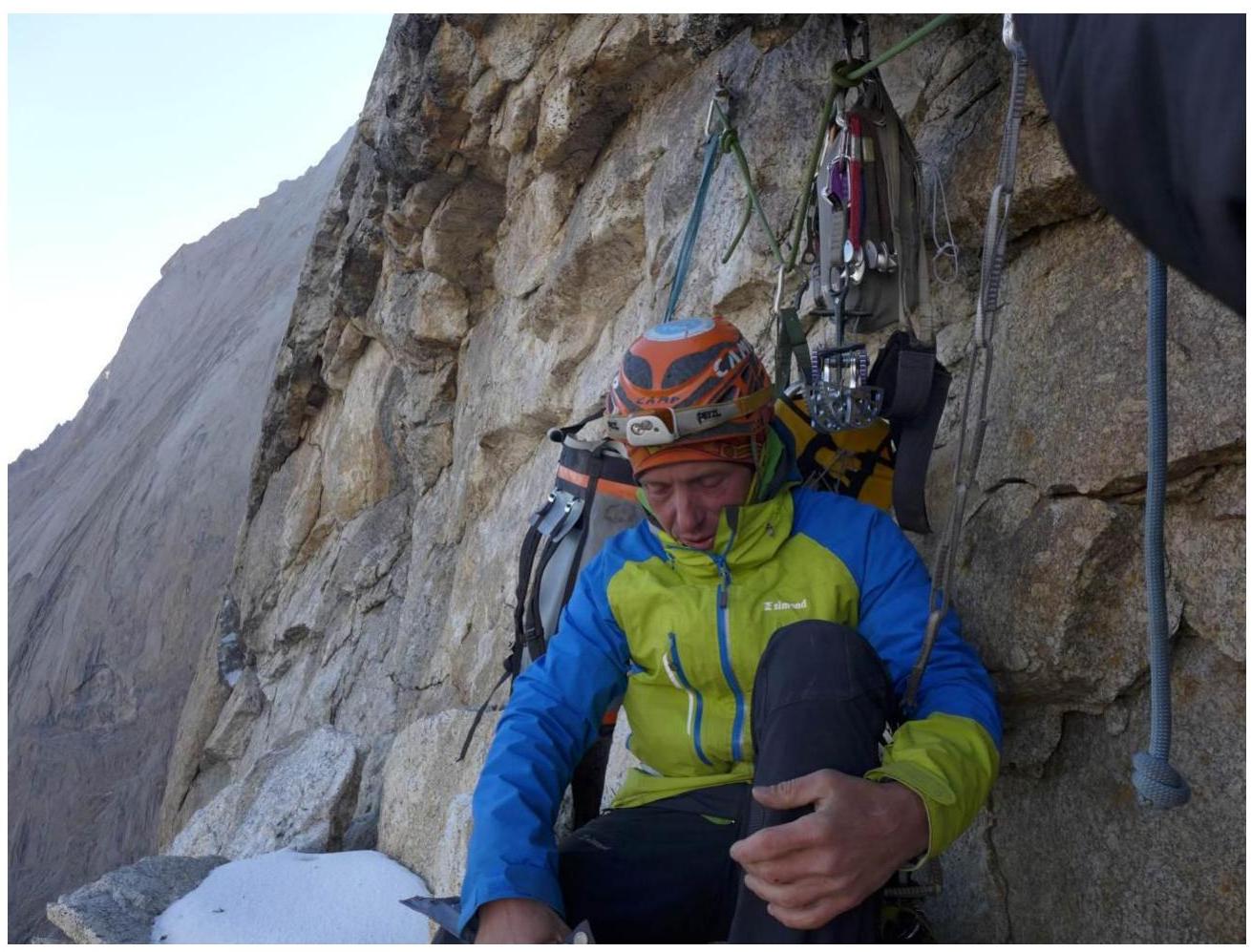
In the morning, it's very cold — we warm up our feet in boots. We wear all warm clothing. Egor Suzdaltsev leads, Temerev provides backup. Despite the temperature, after the cornice, Egor puts on rock shoes and continues with challenging climbing in many places. It snows regularly.
R7–R8 — approach from the shelf to under the cornice. Coincides with the Voronov route.
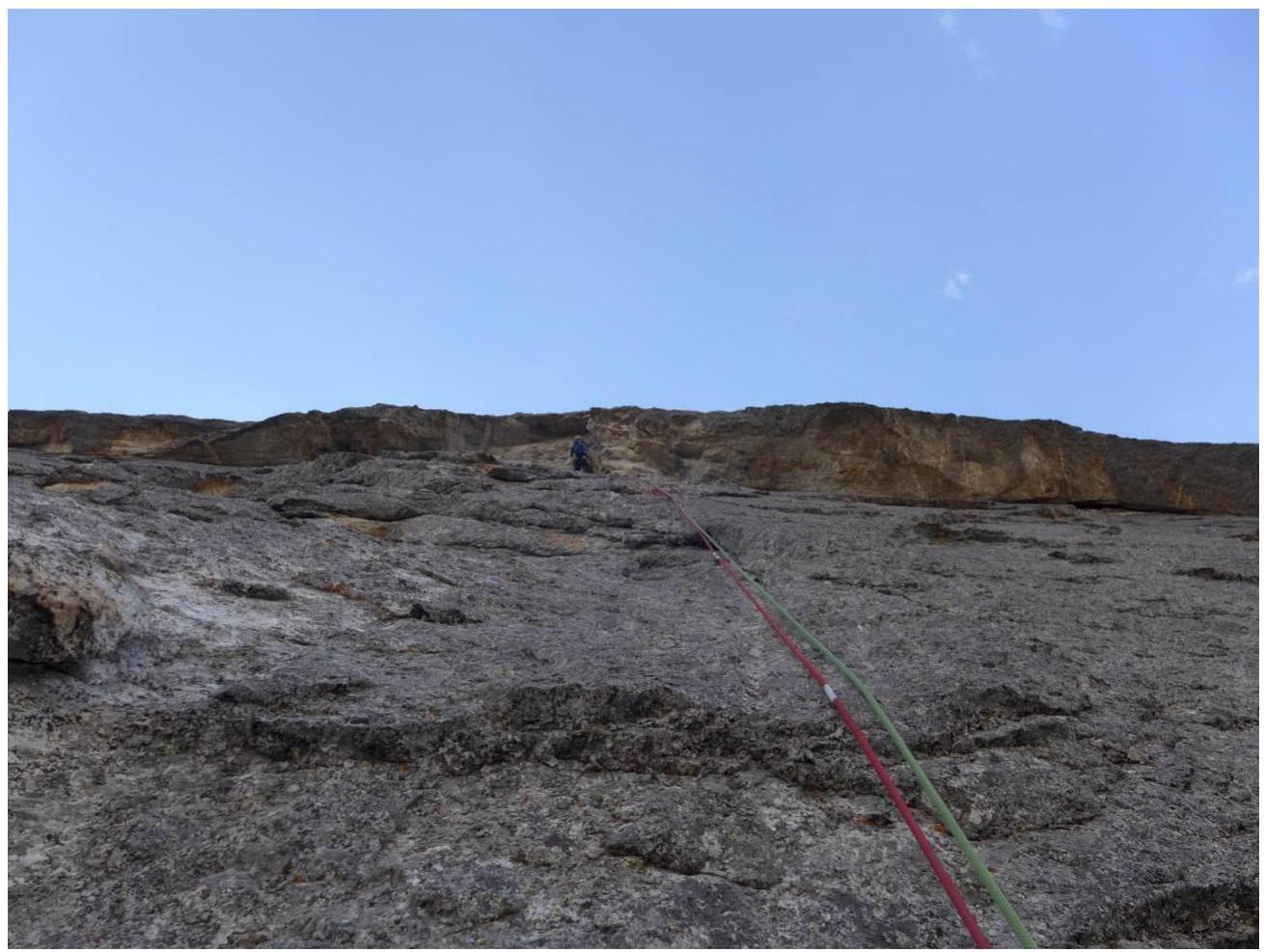
R7–R8 — crossing the cornice.
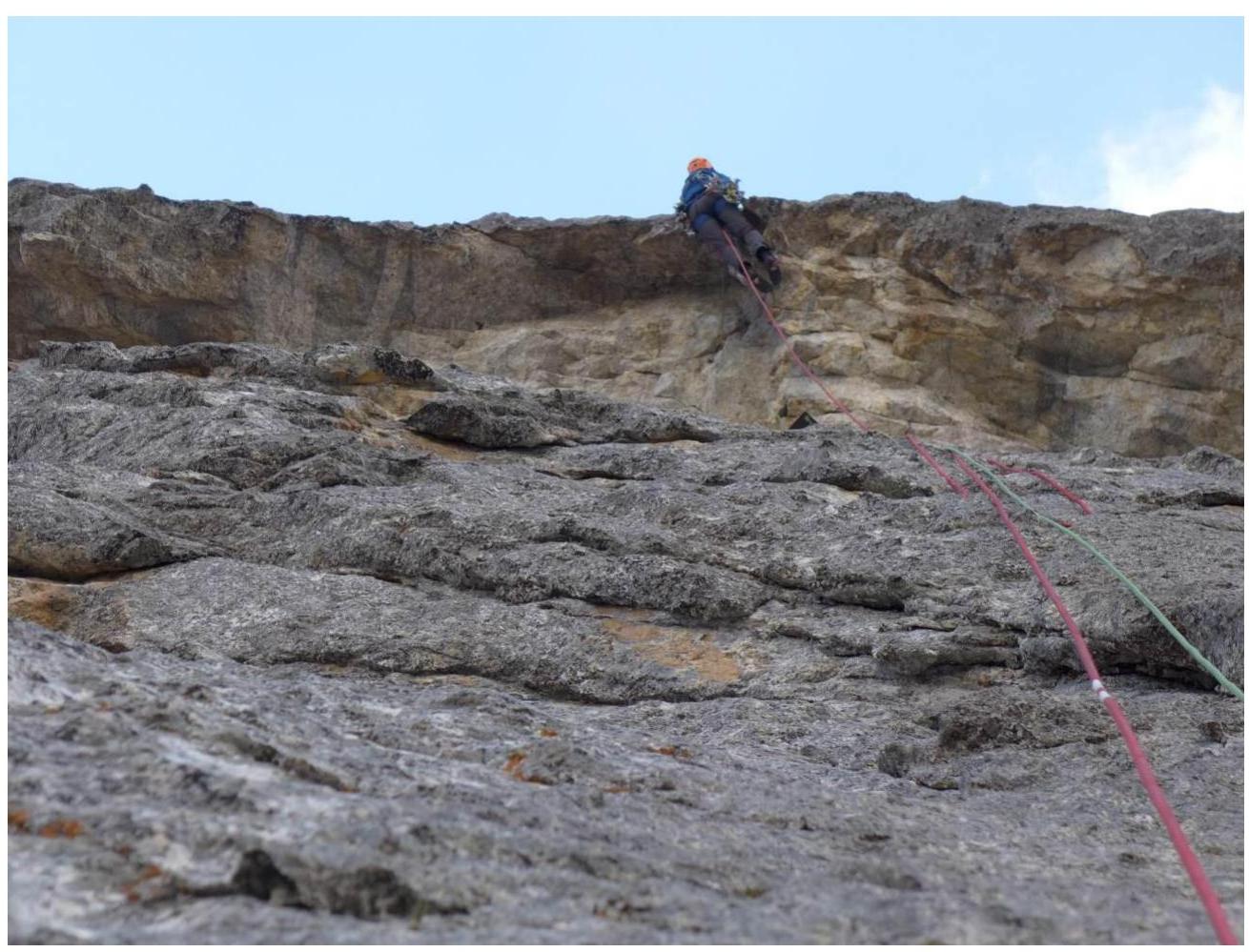
The line of movement constantly pulls to the right. It's very challenging for the second and subsequent climbers on the belay. Everyone moves with top-rope belay.
R8–R9

R9–R10

R10–R11
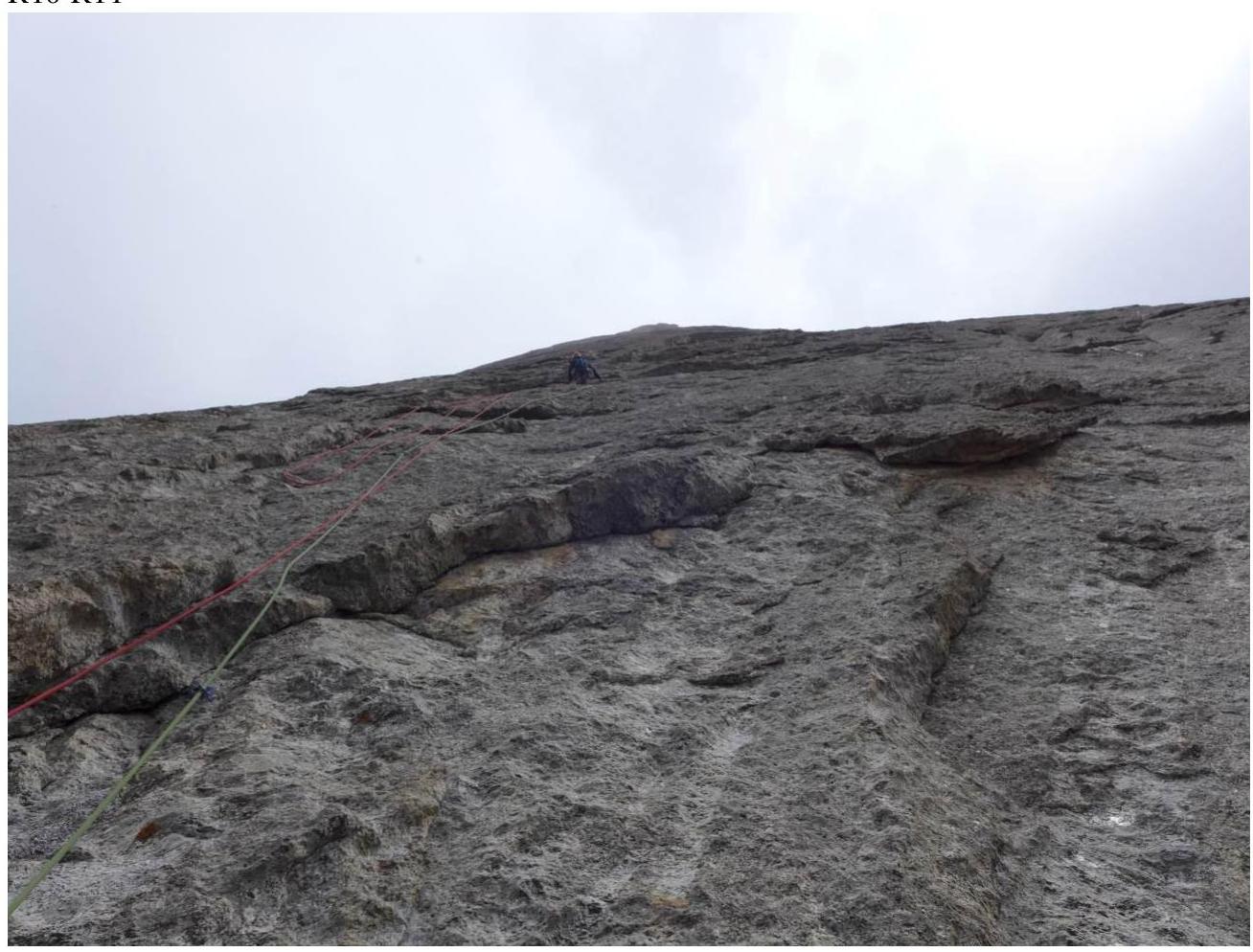
R10–R11
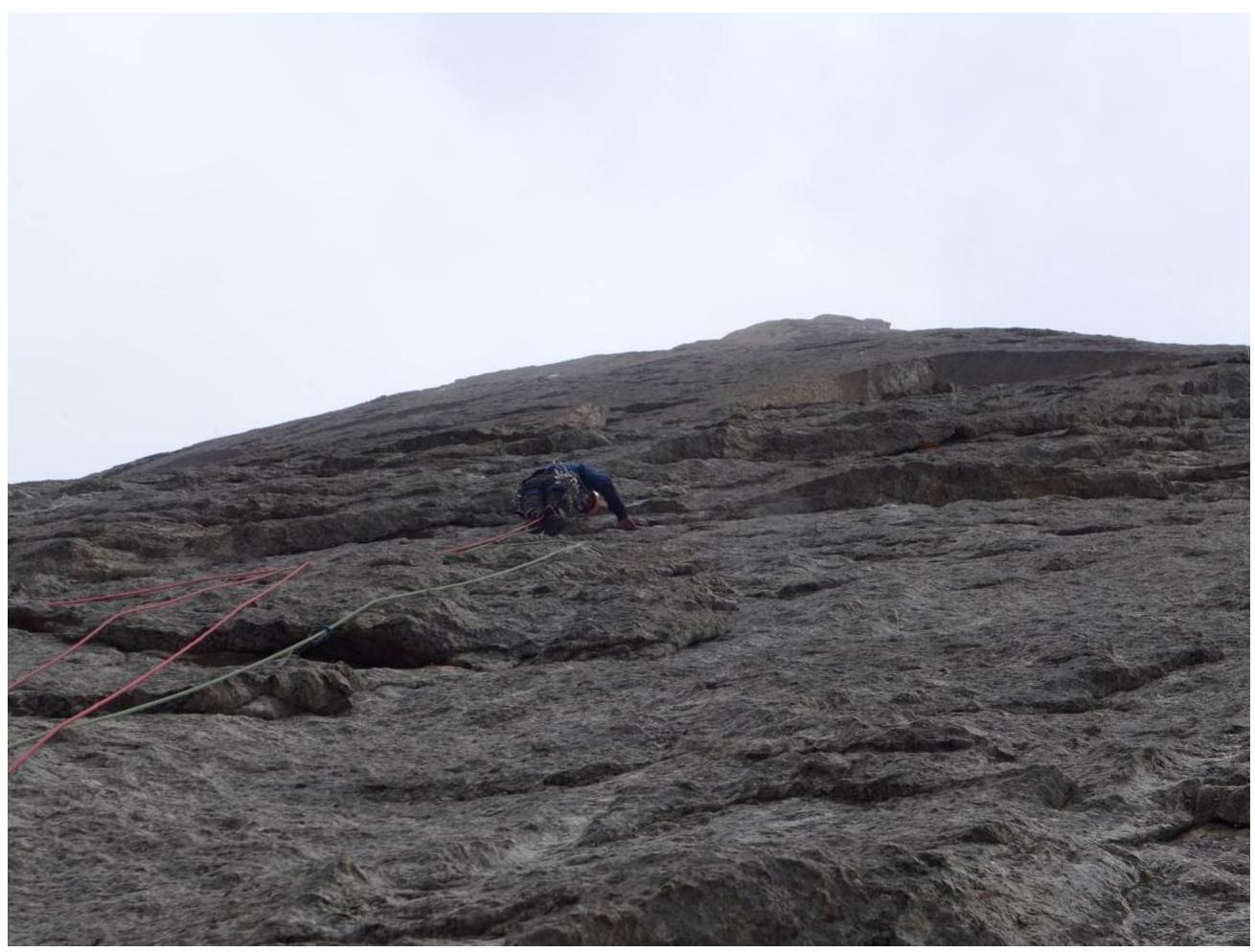
After the third rope, Egor passes the lead to Temerev. ITO, skyhooks, sometimes it's necessary to make own holes.
R11–R12
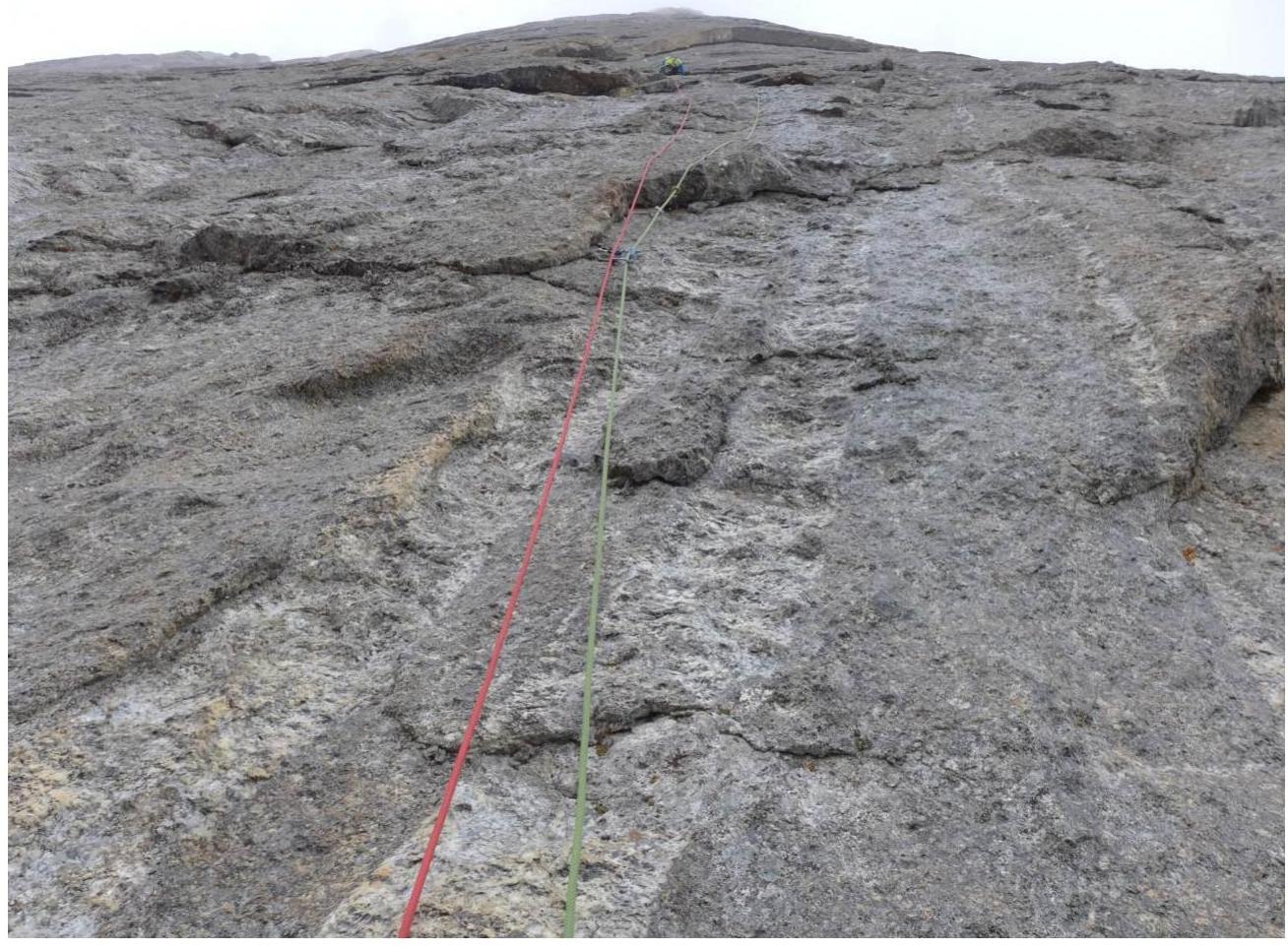
R11–R12
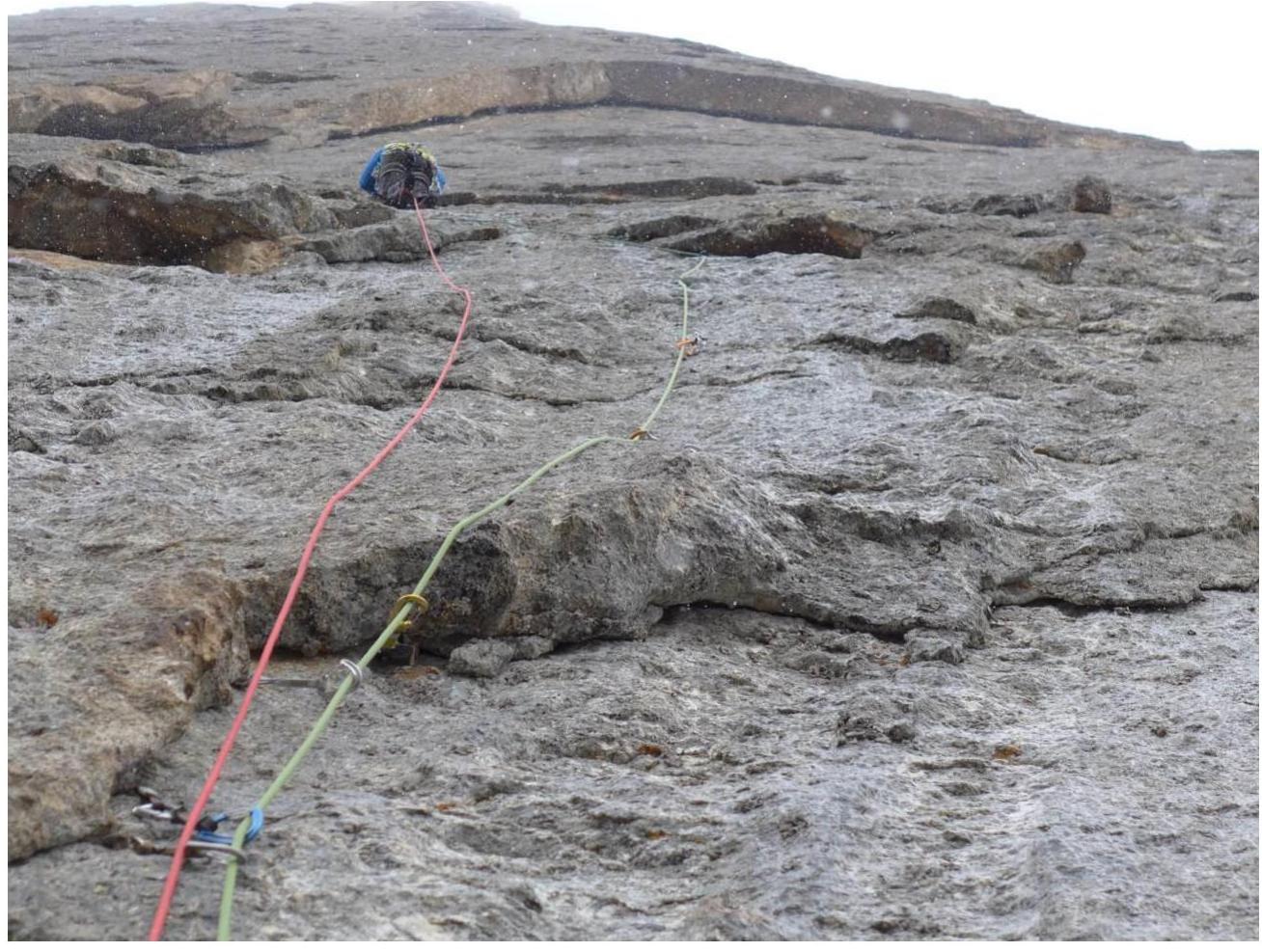
By around 18:00, we reach a shelf where the Voronov route goes left, and Kopeyki goes up the macro-angle.
By 20:00, we move with haul bags. We spend the night on a platform. First overnight stay on the wall. R13.
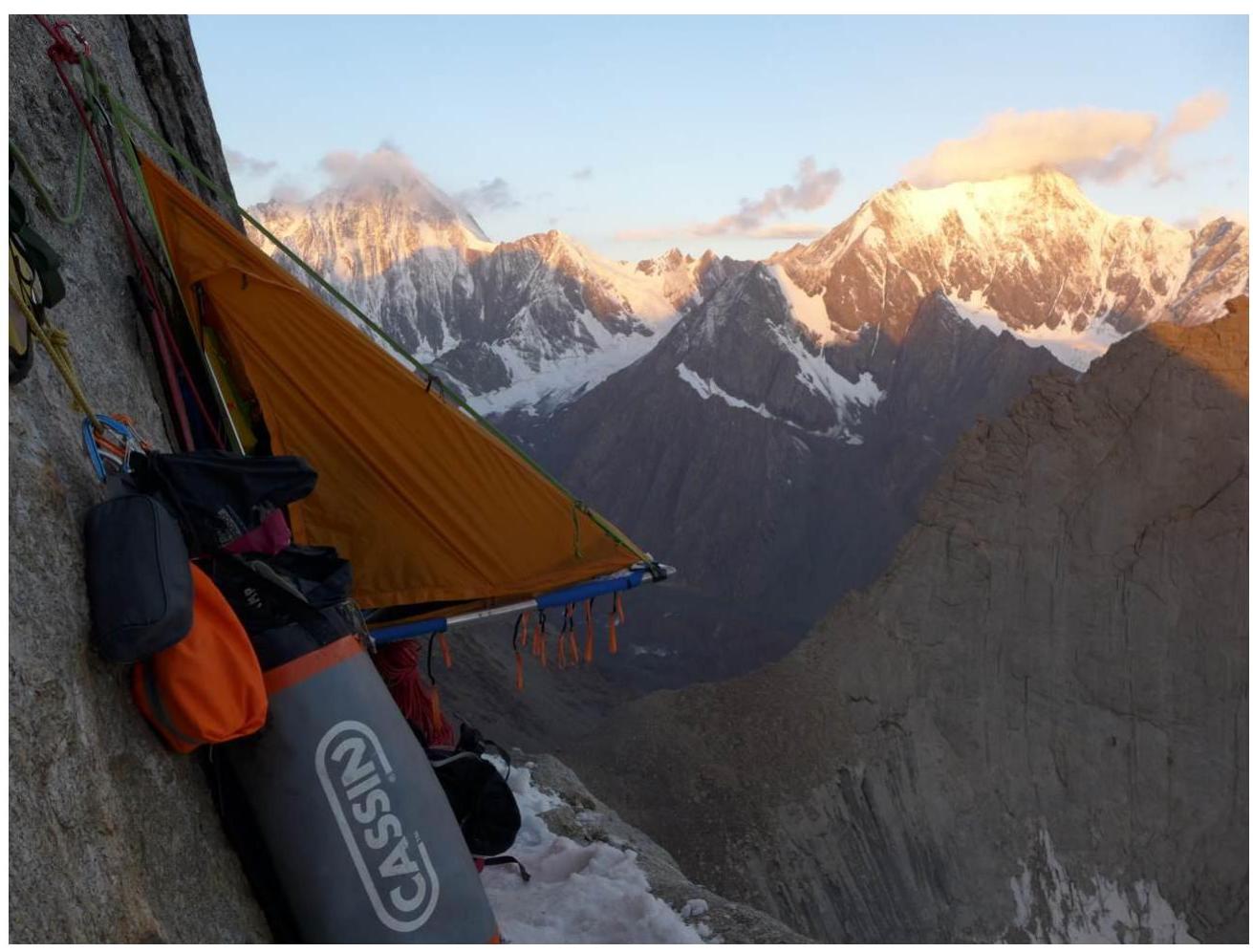
August 2.
R13–R17. –2 °C (until 12:30) – +8 °C In the morning, it's extremely cold. Temerev provides backup for Kashevnok. Anton climbs with ITO.
R13–R14
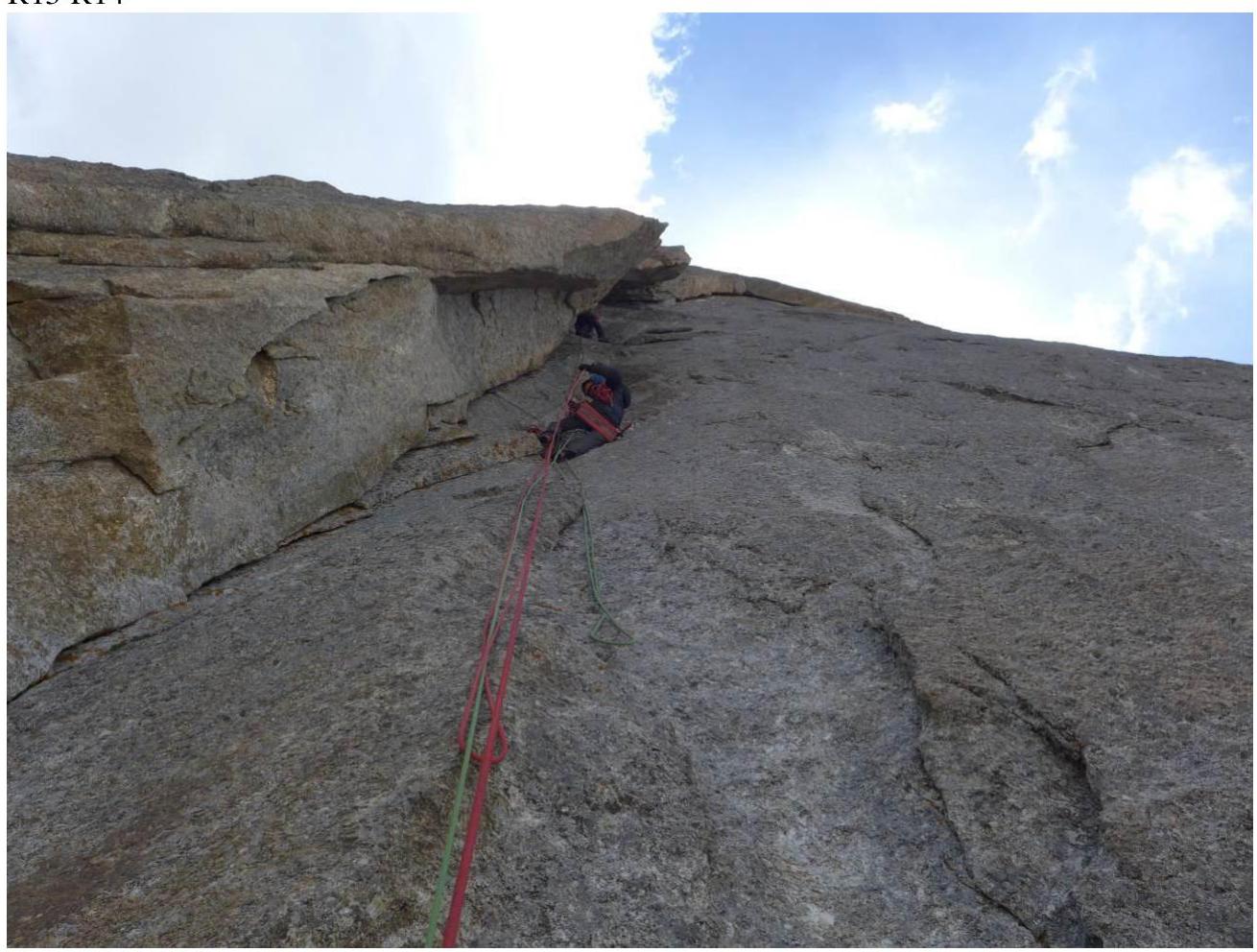
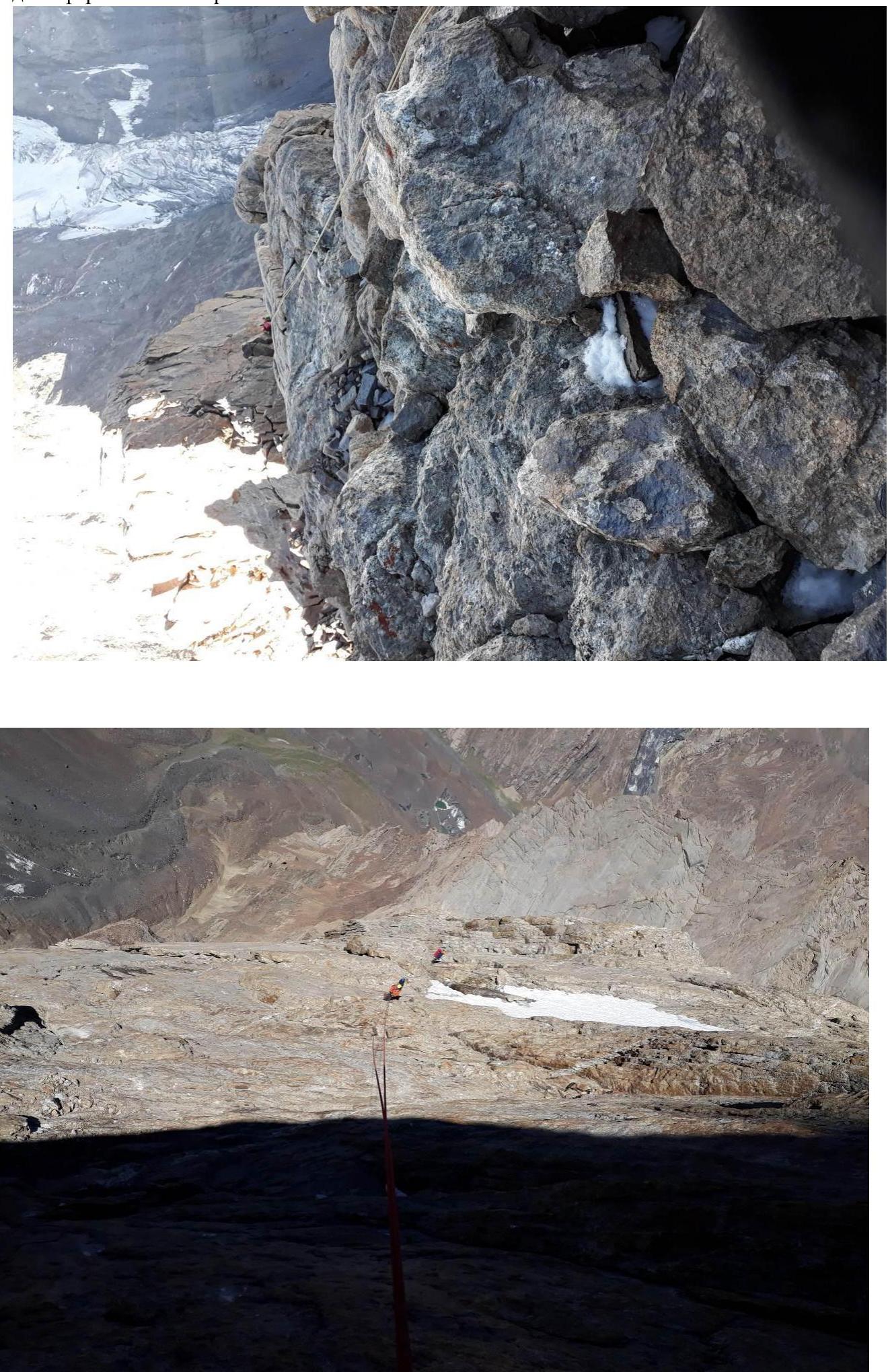
View from R13–R14 downwards
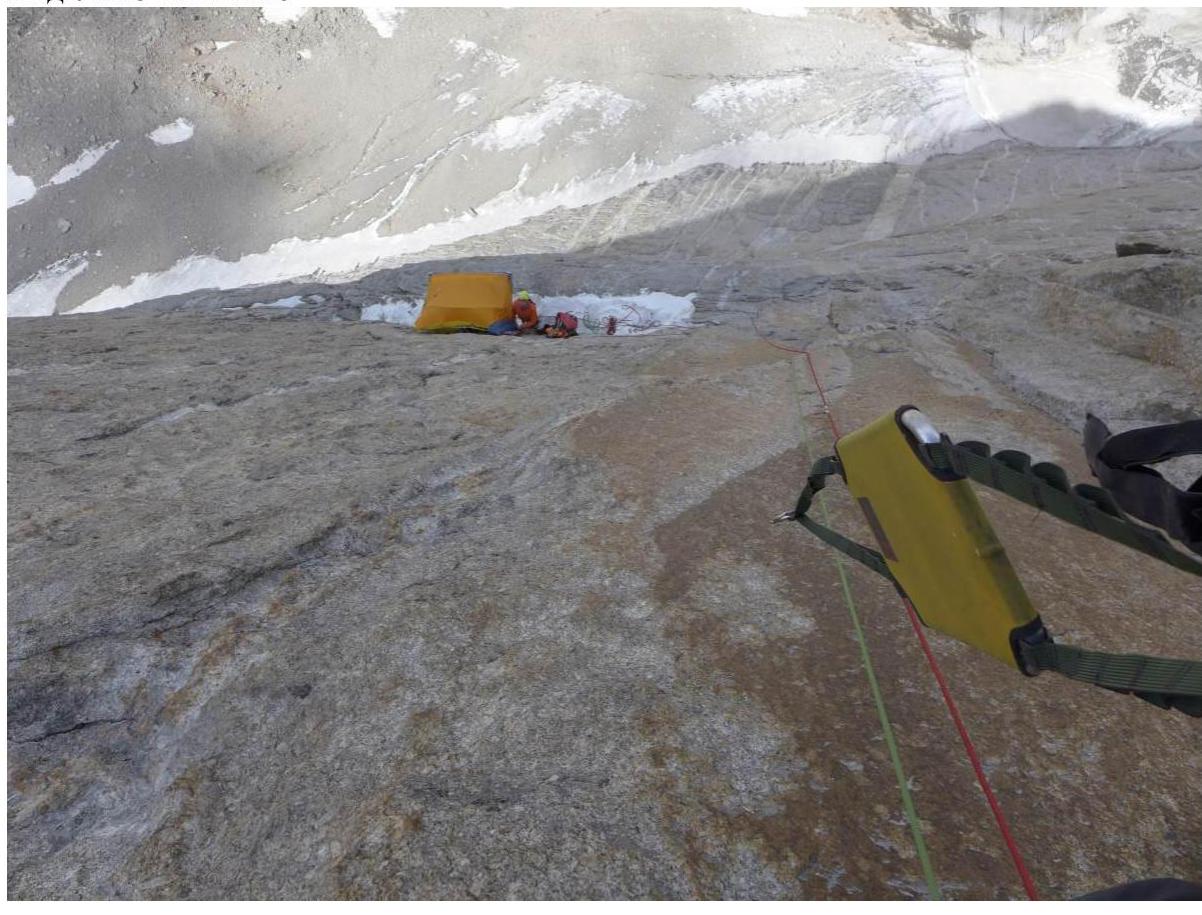
By 12:00, the sun comes out and it warms up a bit. Anton Kashevnok passes the section up to the start of a huge chimney, Ivan Temerev puts on rock shoes and leads. The chimney is challenging — regularly using hole skyhooks, with poor protection. At the end of the section, there's a ledge on the left — on top of a giant slab forming an angle.
R14–R15
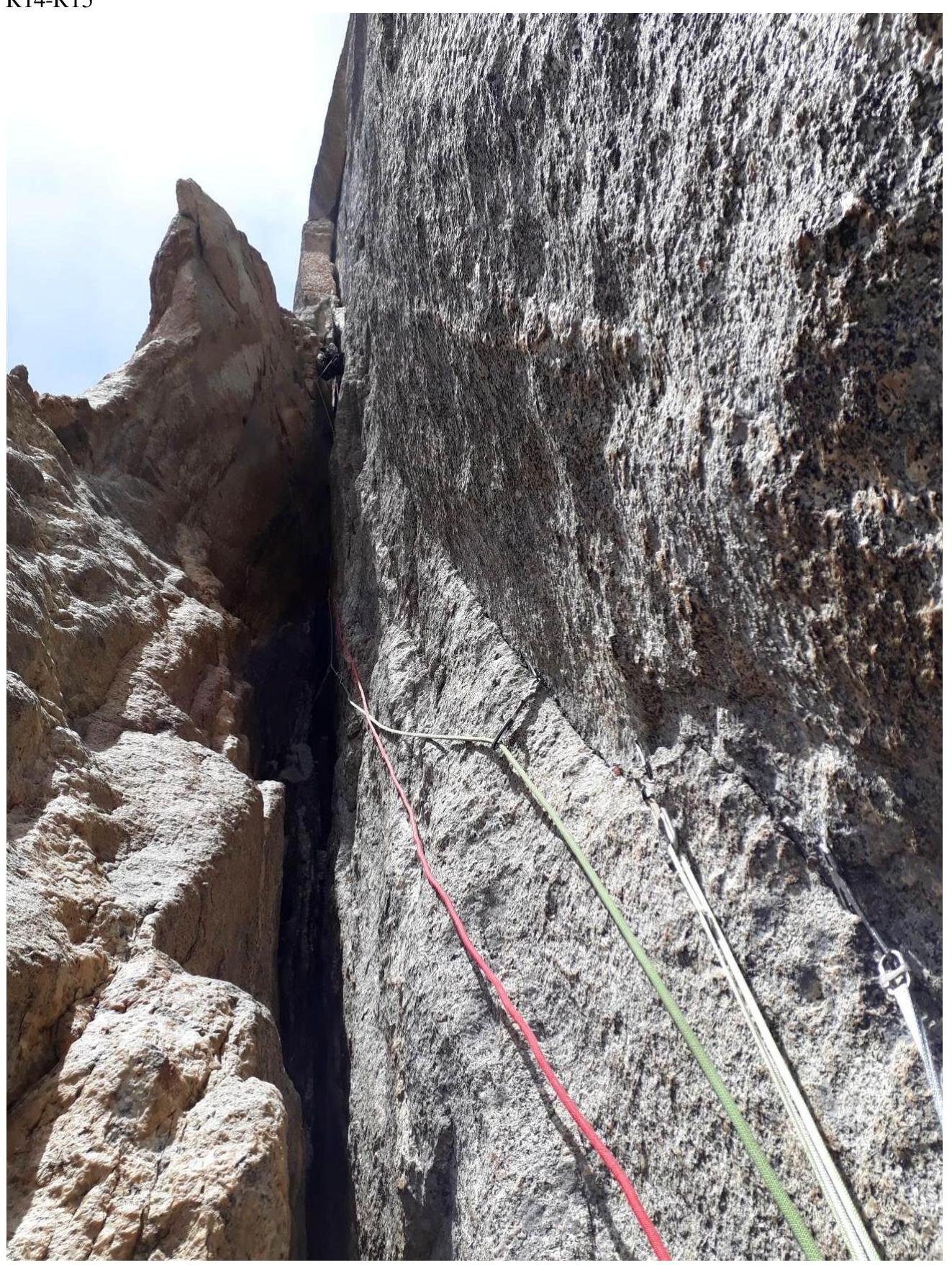
It warms up significantly, and for the first time, climbing doesn't feel like an ordeal. Movement is upwards, then strongly to the right along micro-relief, which is hard to see from below.
R15–R16
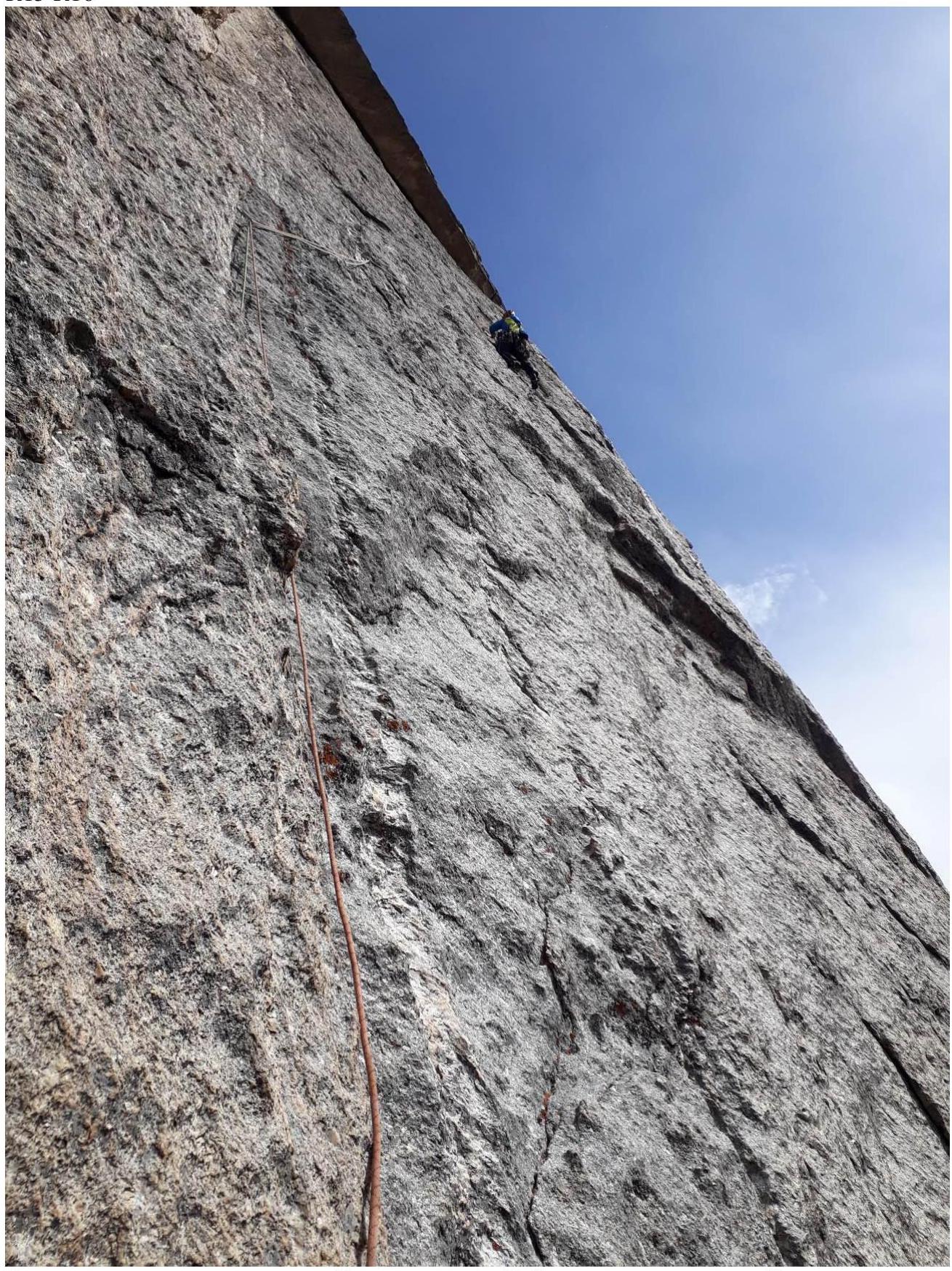
It's categorically bad for the second climber. There are 2 such sections. Then upwards into a cornice. The rock is loose, but regularly something breaks off.
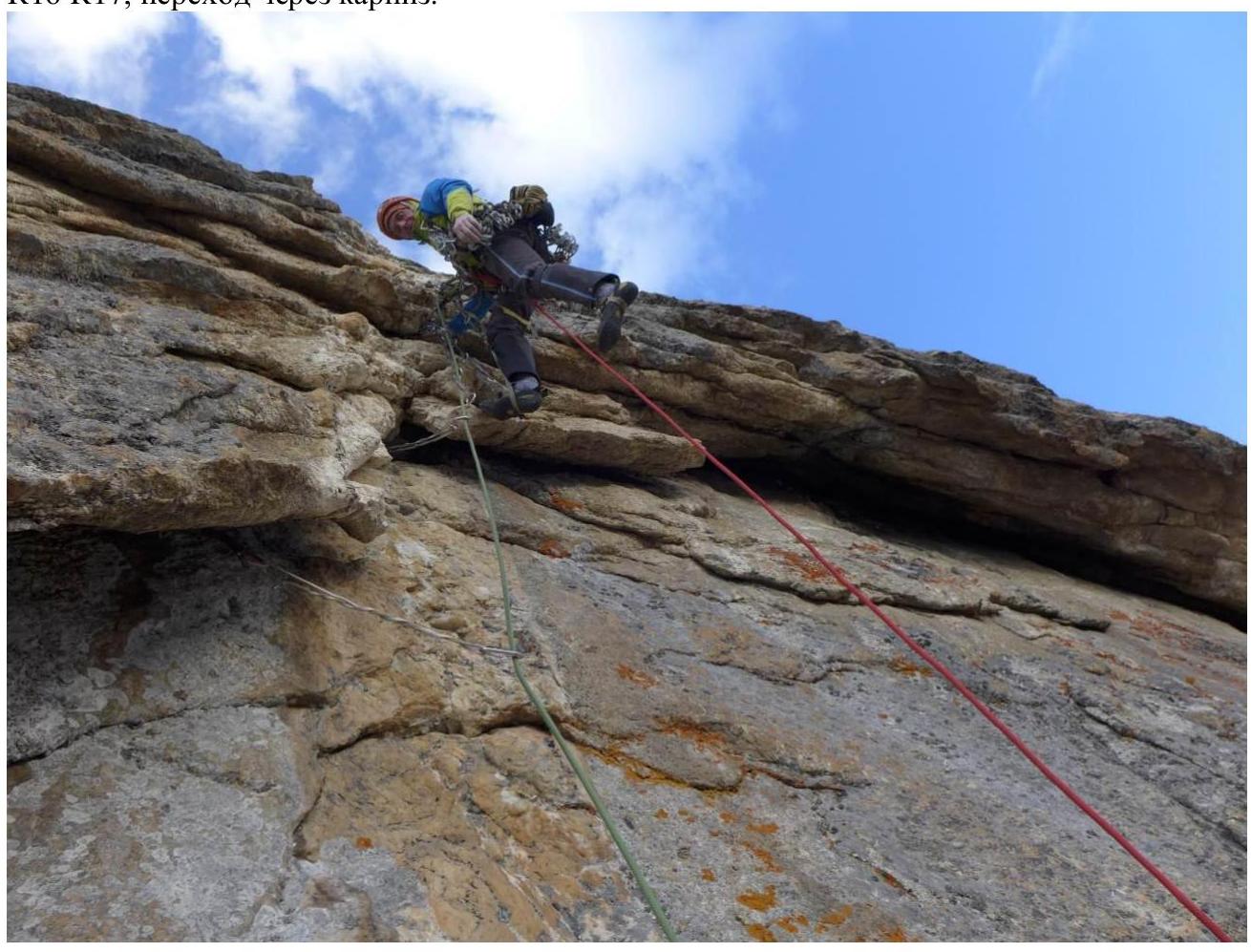
After the undercling, Ivan Temerev crosses the cornice on ITO and extends the belay 5 meters up to a depression in the rock. The anchor is inconvenient. It's strange that there are no bolts above.
R16–R17, crossing the cornice.
August 3.
R17–R21. –2 °C (until 12:30) – +12 °C
It's cold in the morning, but without wind, it's quite bearable. We move along processed sections. Sloping belays along the cornice take a lot of time. Egor Suzdaltsev leads, Anton Kashevnok provides backup. We choose a direction slightly to the right of the anchor. A rope and a half after the cornice are very challenging. Regularly ITO on skyhooks, sometimes on our own holes.
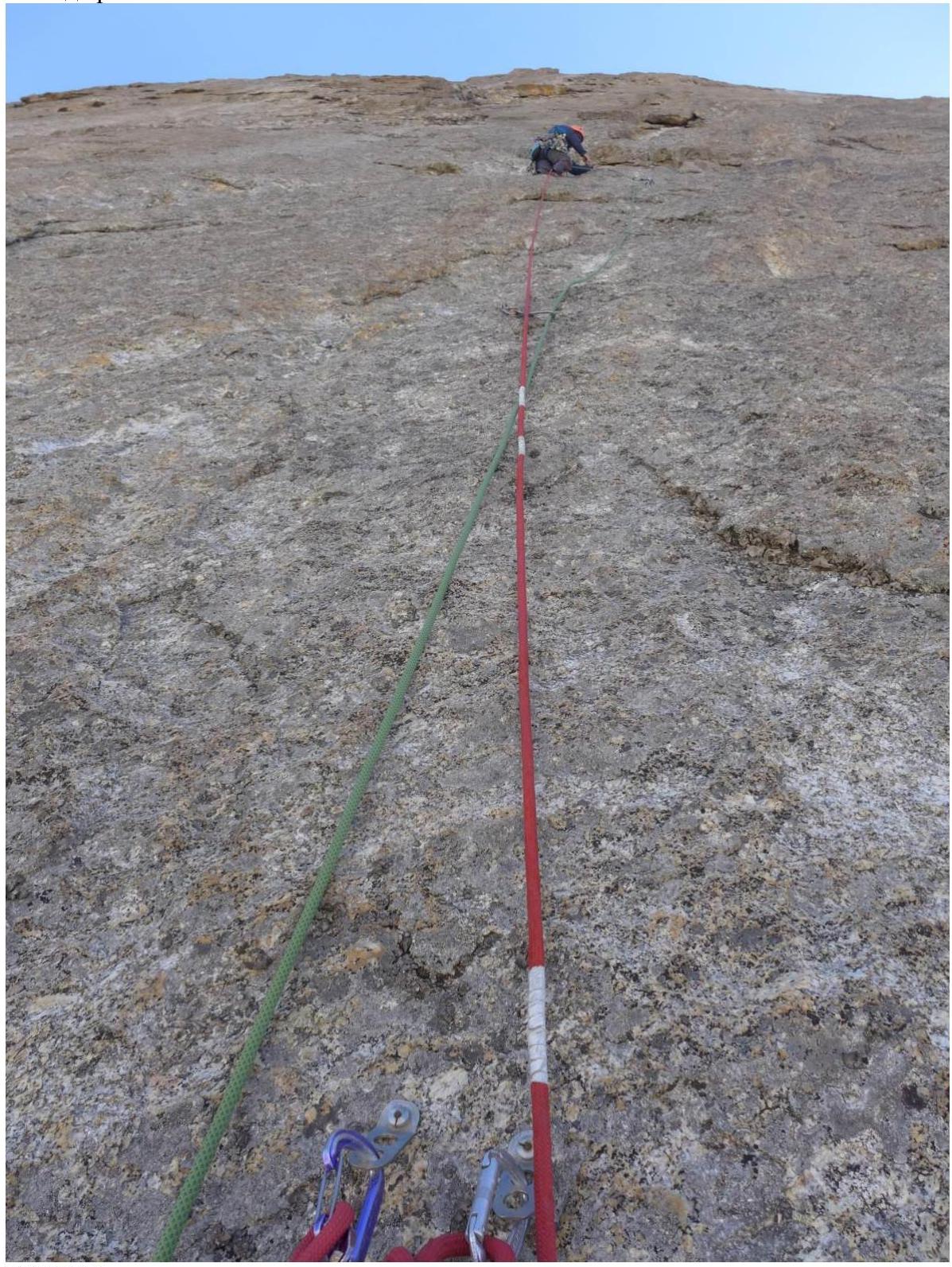
R17–R18. Then we turn sharply left into an internal angle. The sun hits the wall, it warms up, and sometimes ice falls from above.
R18–R19
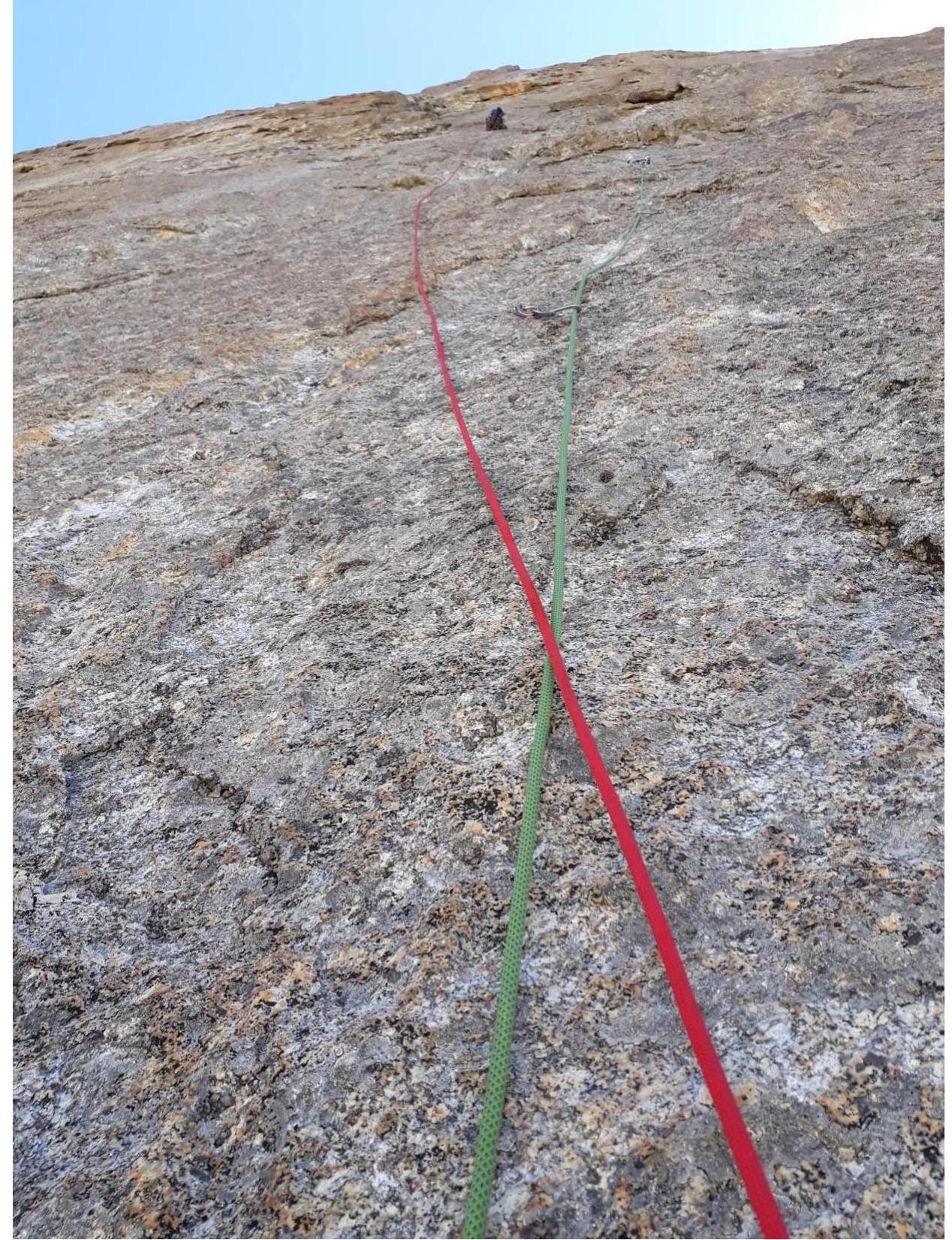
Through the angle, we climb one rope to a shelf R20. We take a break. Egor and Anton continue upwards. Regularly, local ice avalanches fall from the right of the shelf. Egor gets hit on the hand.
Start of R20–R21
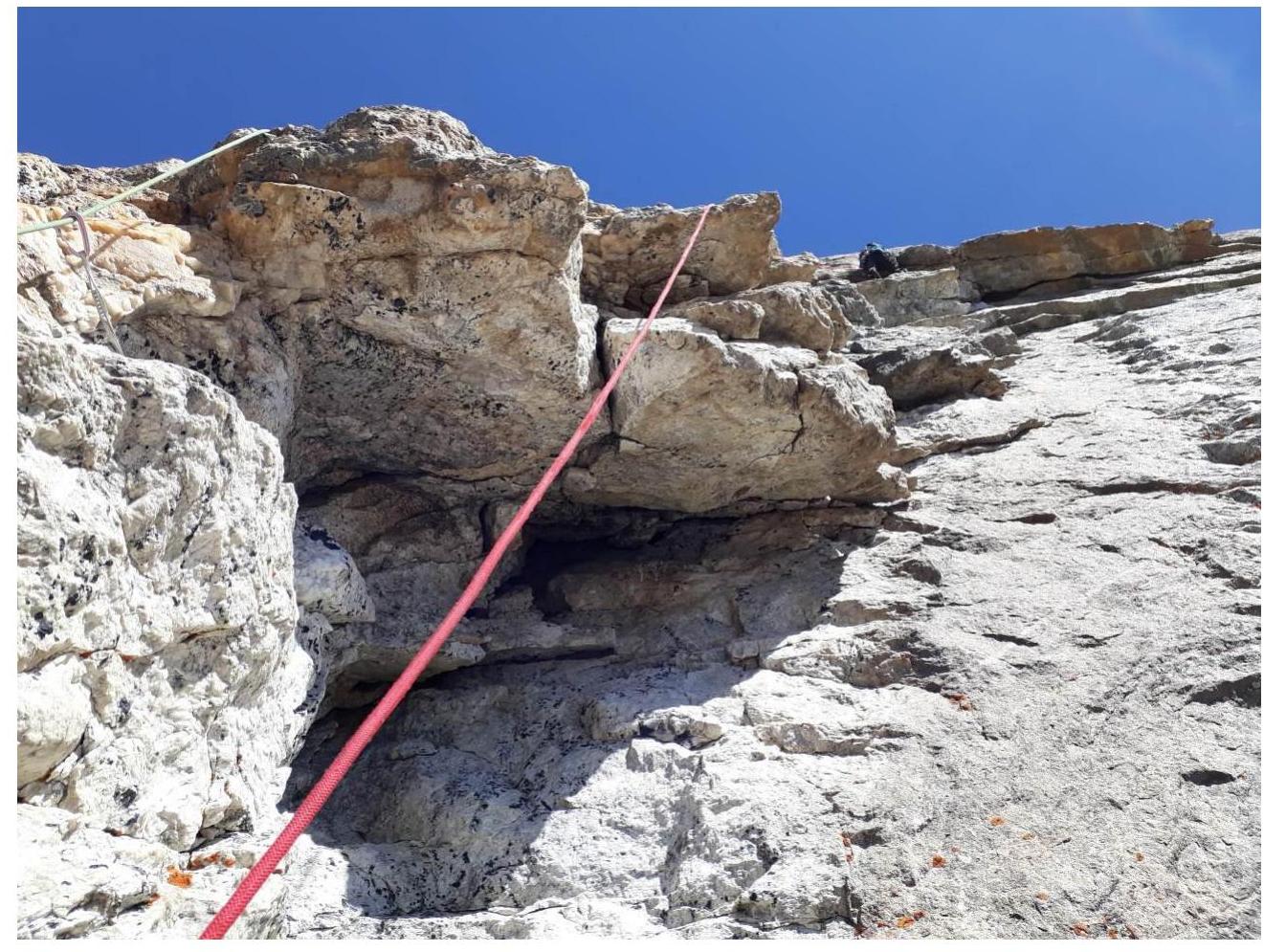
R20–R21
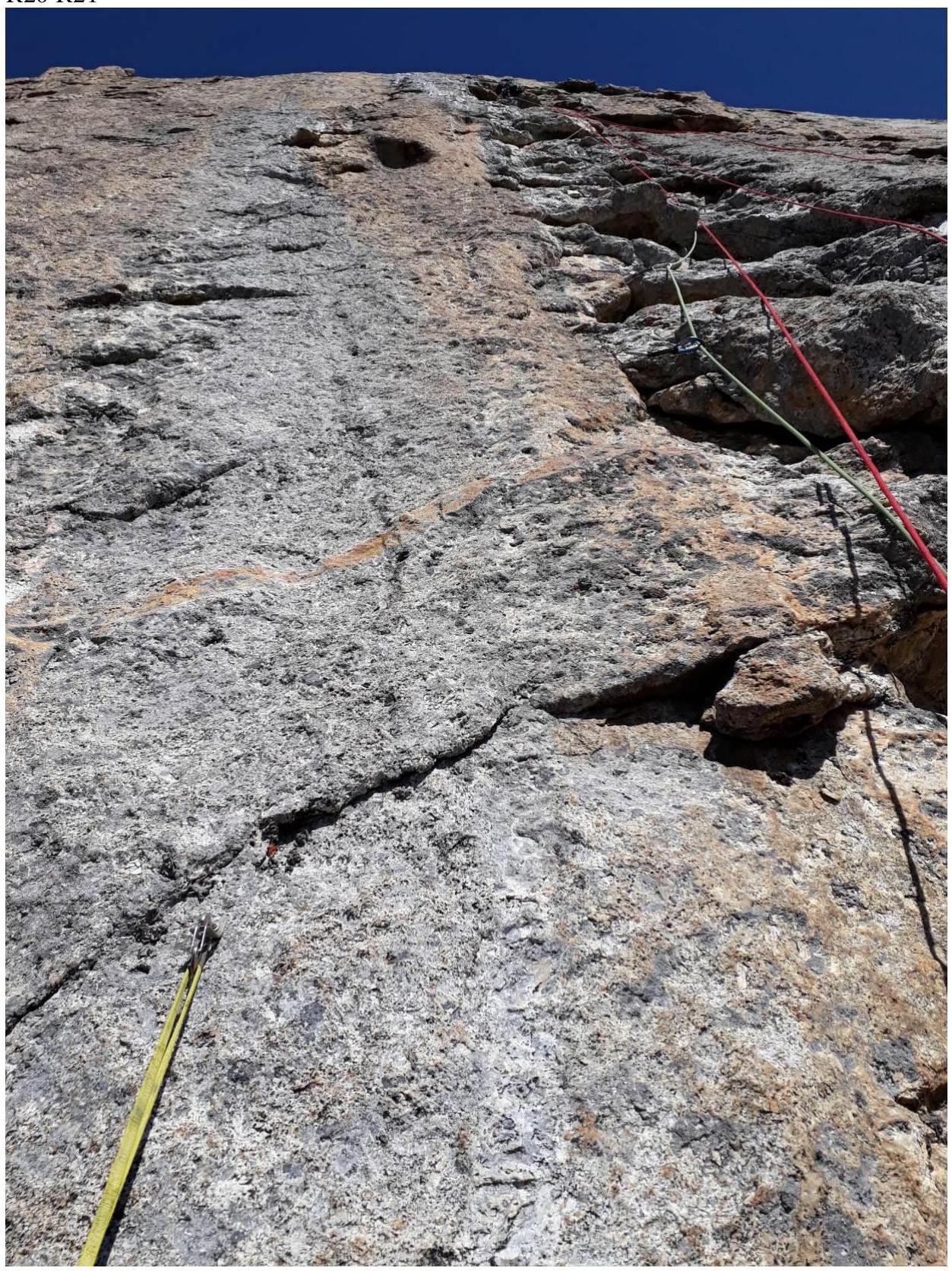
Ivan and Timur melt water from snow, drill holes for a platform, and prepare dinner. It starts dripping from the cornice above the shelf onto the wall near the shelf. We move to the edge and wait for over an hour for the waterfall to stop. The sun sets, it cools down. We set up a platform, fortunately, the water doesn't leak through the tent.
August 4.
R21 – summit. –2 °C (until 12:30) – +12 °C.
It's cold in the morning, the rock is dry, but the platform tent is icy.
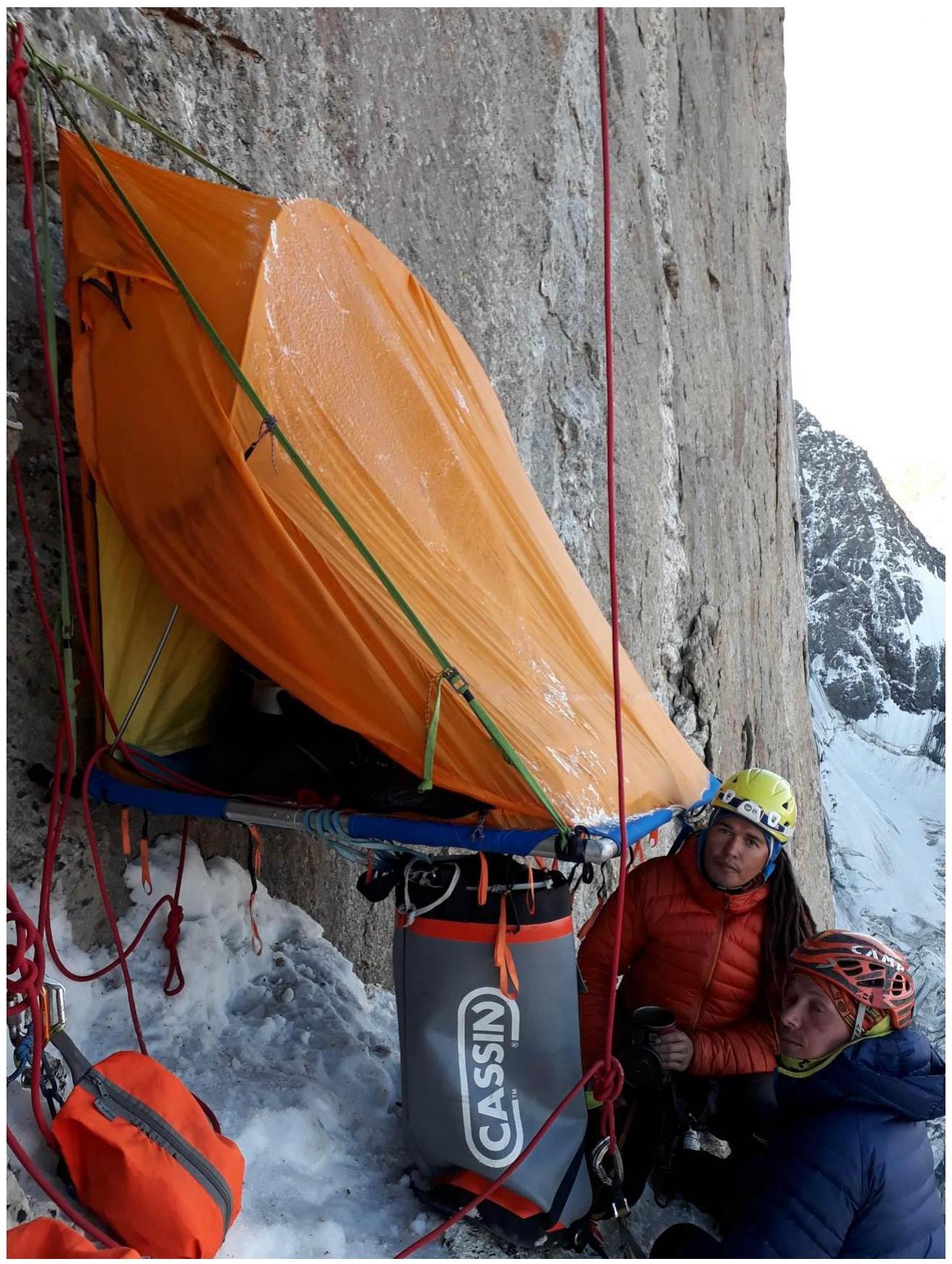
We gather and move 2 ropes up to the start of an internal angle. Ivan Temerev leads with ITO. The start is slightly icy.
R21–R22
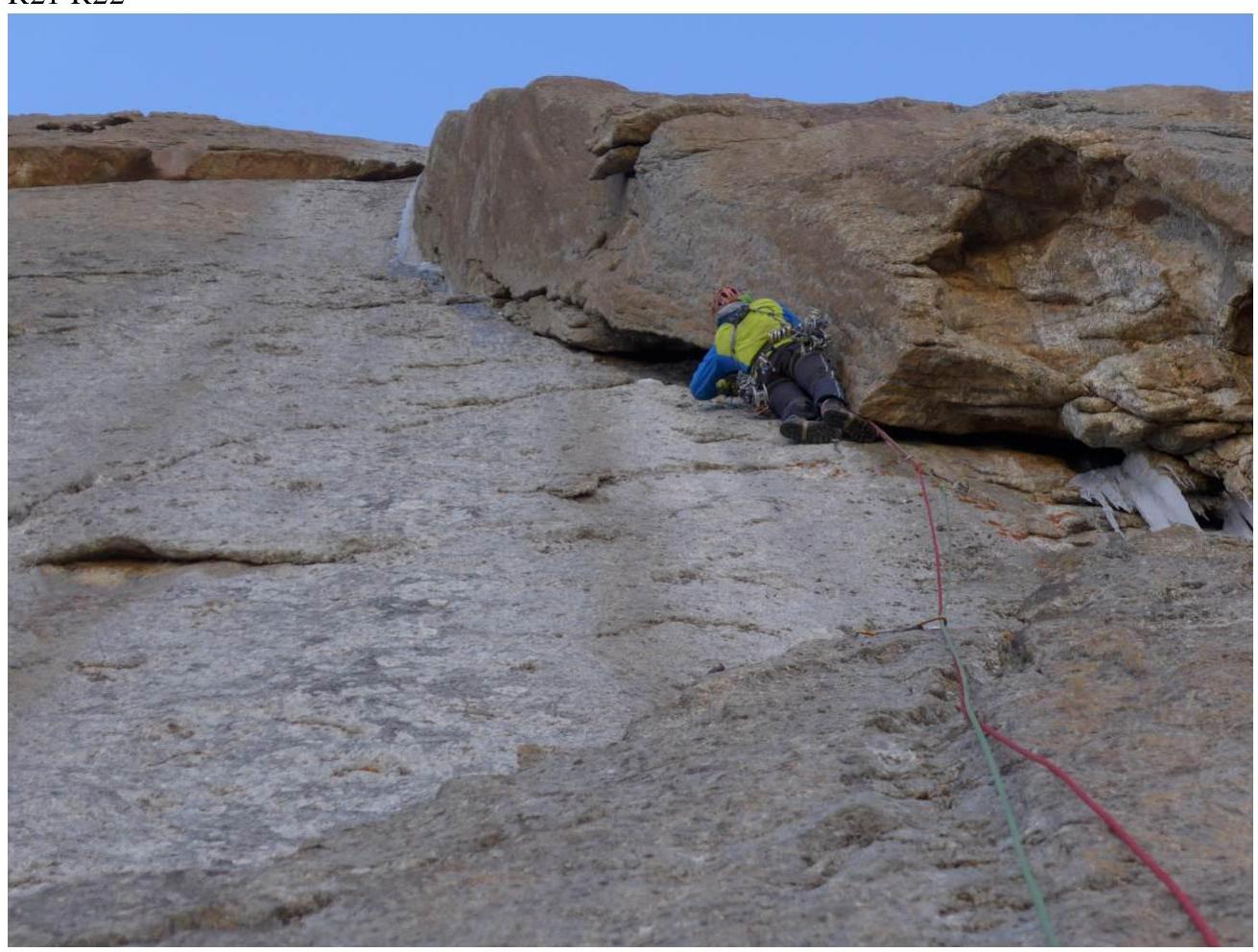
Higher up, the icing is more significant — we have to constantly clear it to set an anchor and to prevent anything from falling on the team. On the command "Ice!" the guys cover themselves with haul bags. We pass 110 m in 6 h, damaging a rope with falling ice; nothing else is damaged.
R21–R22
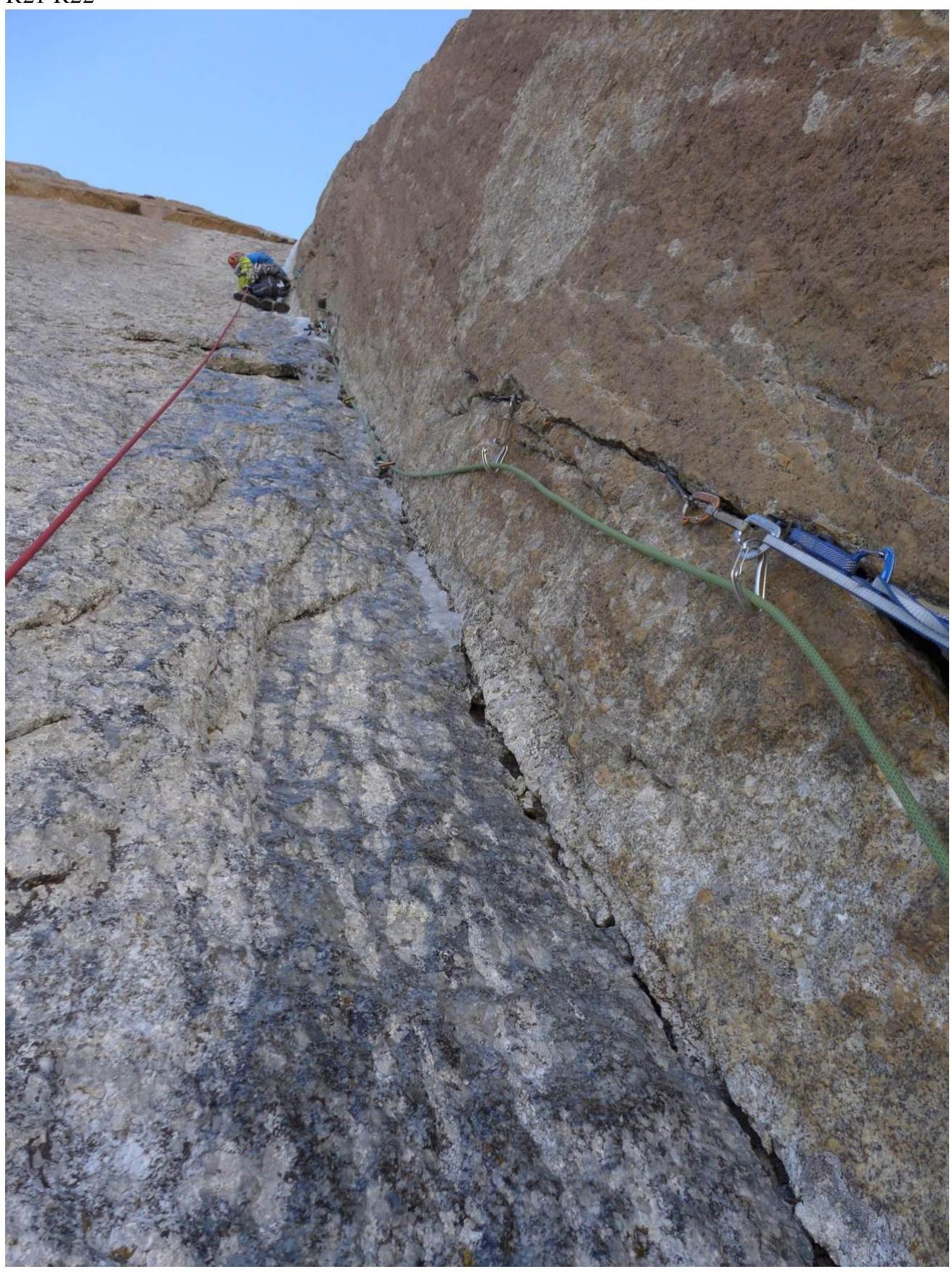
At the end of the angle, Ivan Temerev in rock shoes goes right and in one rope at 14:00 reaches the roof. The wall is passed.
R23–R24
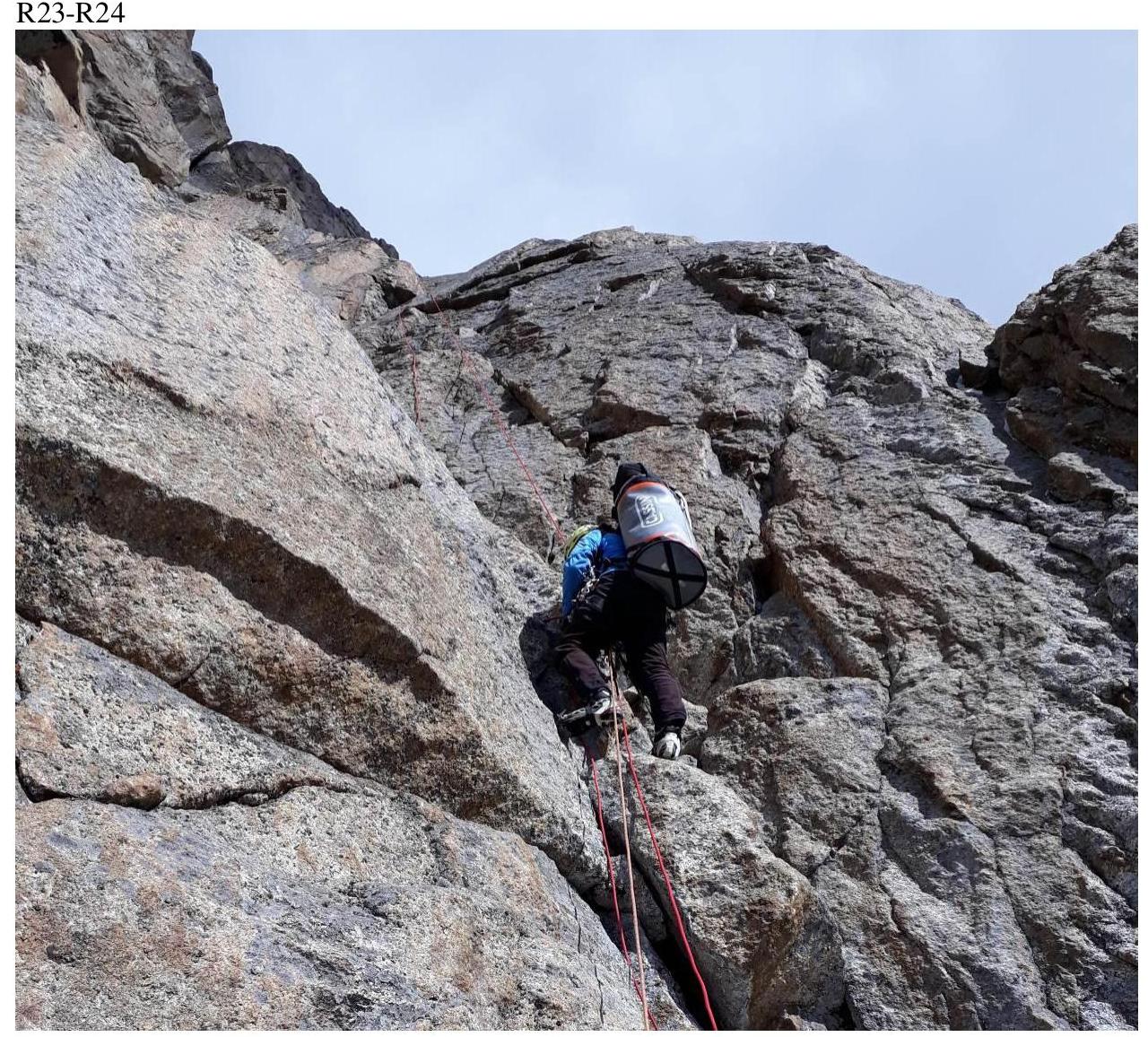
For the first time in 10 days, it warms up so much that we have to remove our warm clothes. Climbing becomes much easier, but the pitch remains significant. The leader passes a rope in 10–15 minutes, the second — in 30–40 minutes. There's a lot of destruction. Setting anchors every 30 m is very challenging, so we abandon the simultaneous movement scheme.
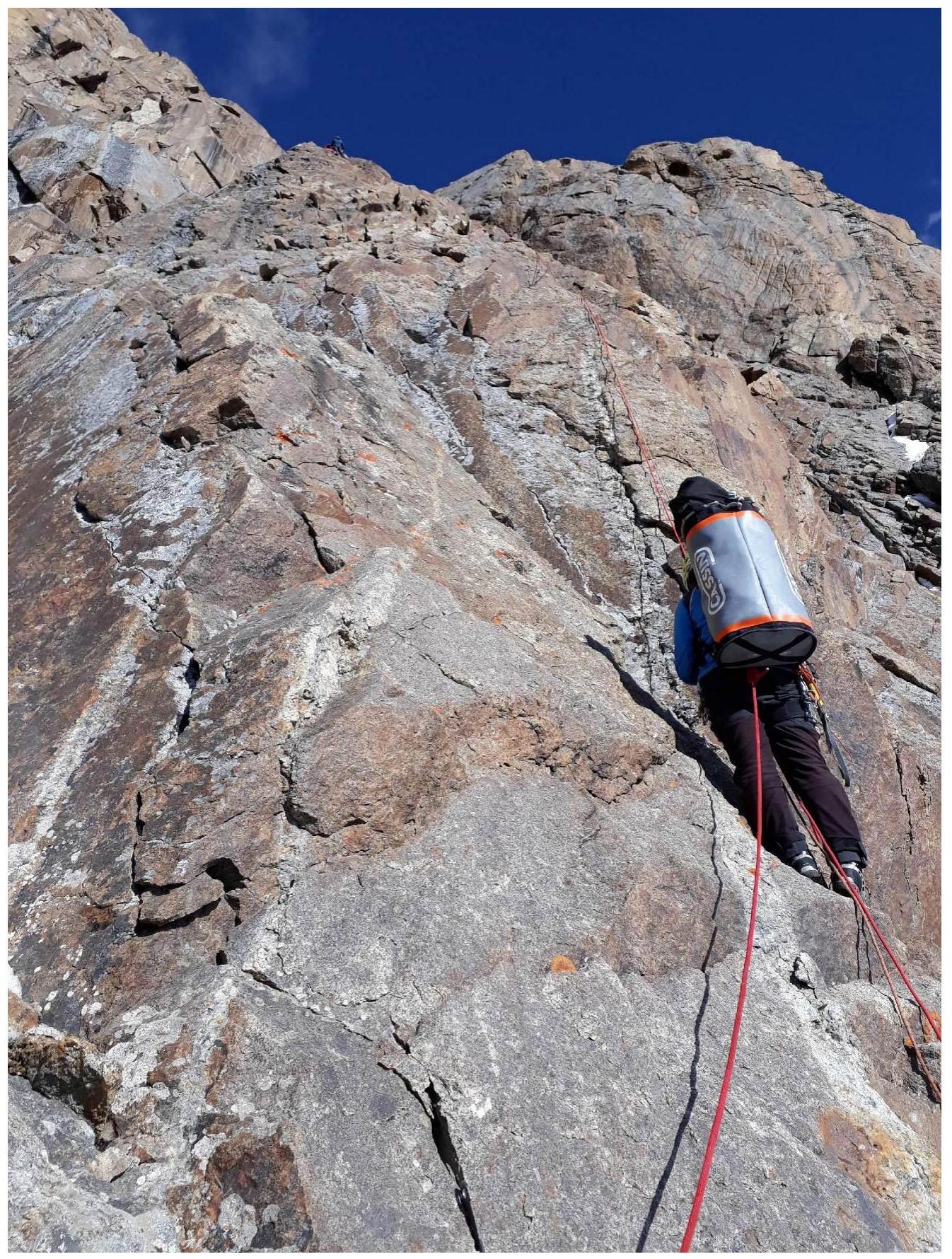
R24–R25
3.2. Photo of the team on the summit with the control post
In total, we passed 6 ropes to the summit in 6 hours — at 20:00, just after sunset, the entire team gathered on the summit.
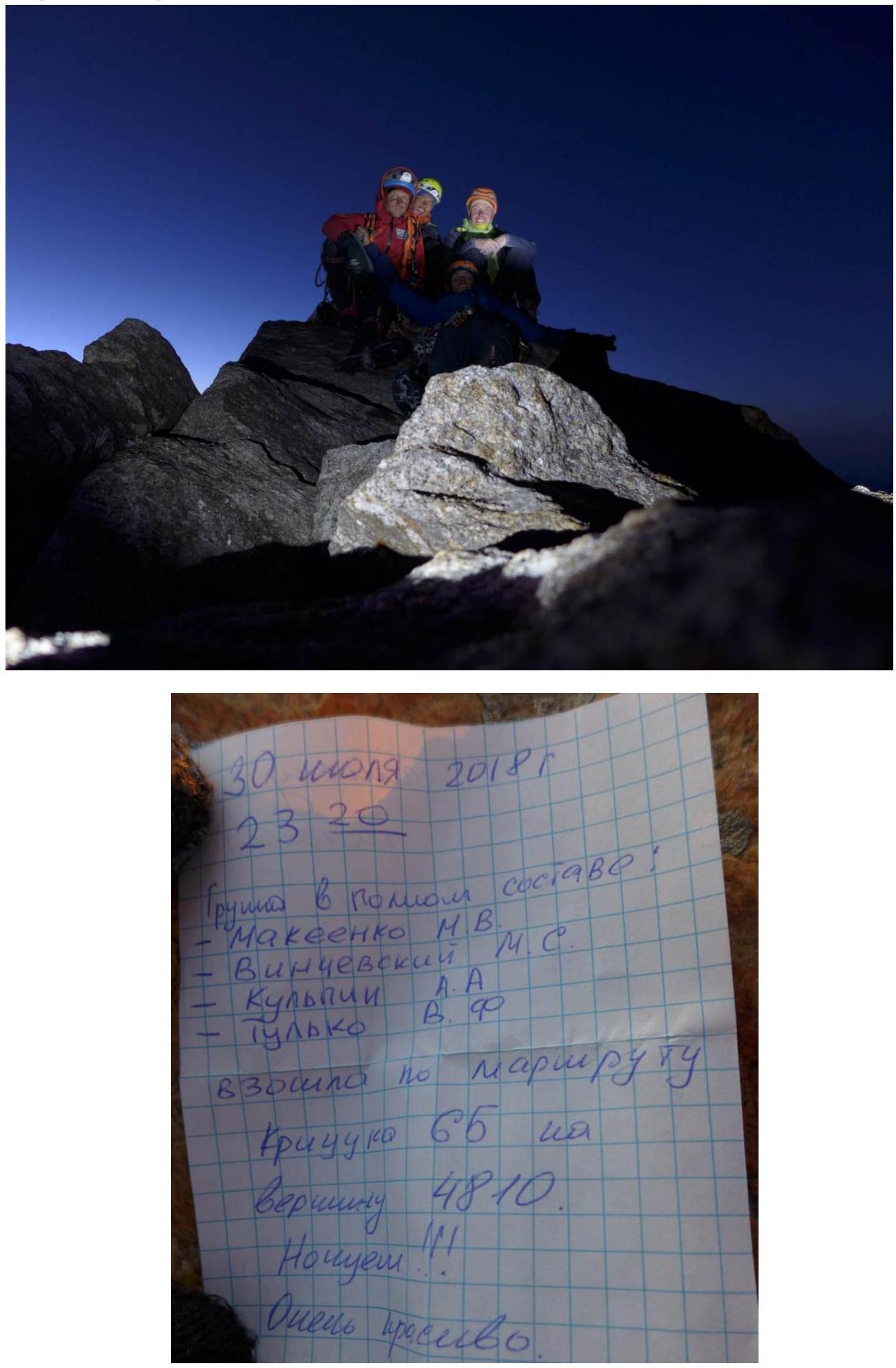
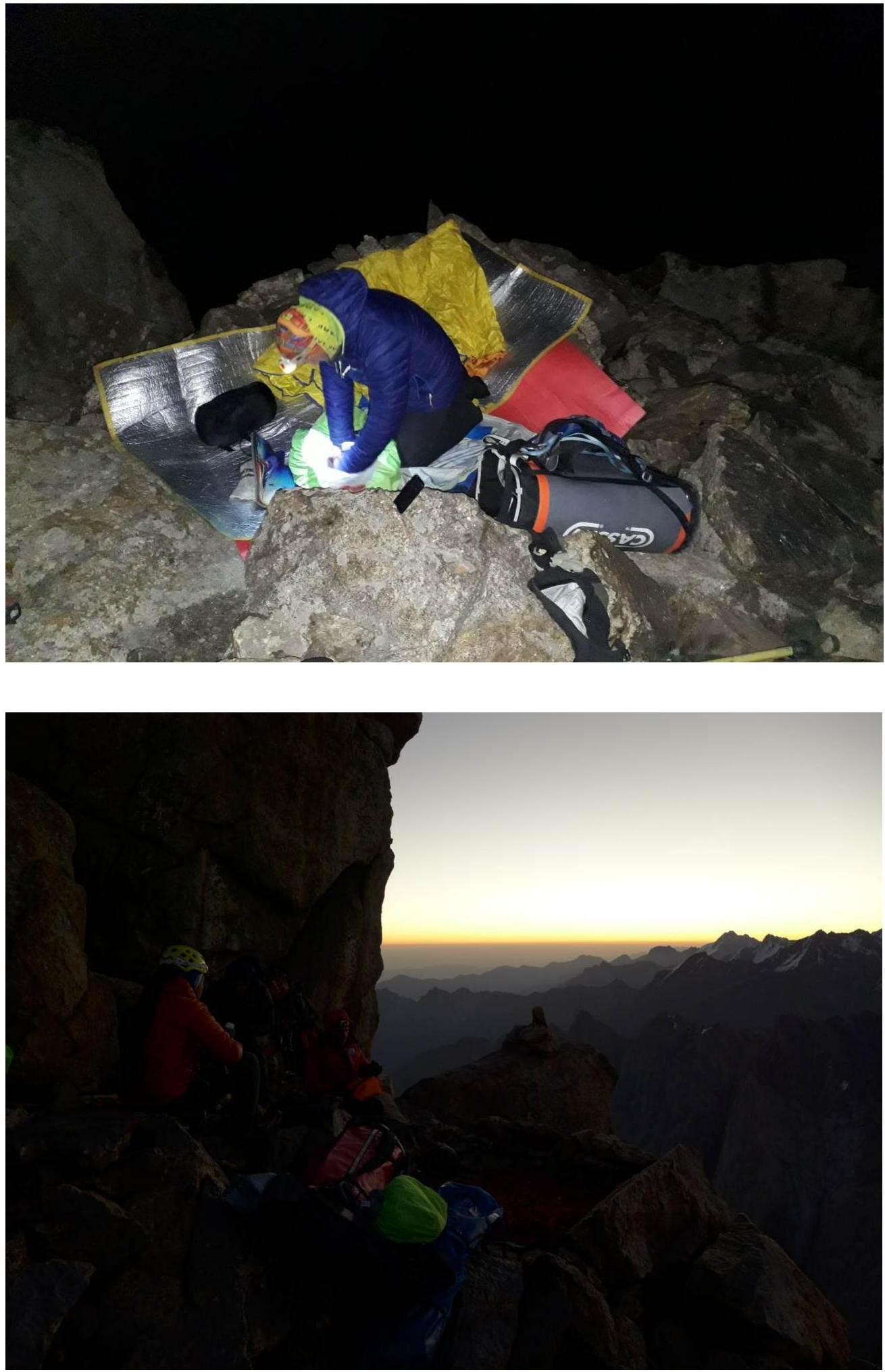
For the overnight stay, we moved 200–250 m along the ridge to an excellent shelf, where we settled under the vast Milky Way.
August 5.
+3–+15 °C
In the morning, the sun shines immediately, and it's warm. We descend via rappels on the Nazarov route, then on the Ovcharenko route.
3.3.1. Route Safety Assessment.
The route seemed sufficiently safe to us, except for the upper part where significant ice chunks can fly out from internal angles and the roof (and possibly rocks too). There are opportunities to spend the night sitting on shelves.
3.3.2. Communication Availability on the Route.
We used Baofeng radios with Nagoya antennas for communication with Base Camp from the valley of Kara-Su. Without the antenna, communication in Base Camp was intermittent. When we installed extended antennas on both radios, communication became stable. We conducted communication sessions every 4 hours, starting at 7:00. There is no cellular communication; satellite communication is possible.
3.3.3. Recommendations for Subsequent Climbers.
In good weather, it's possible to climb a lot with free climbing and much faster than our speed. However, in that case, there likely won't be snow on the roof, and we'll have to carry water, which will complicate movement.
It's possible to spend the night sitting on shelves, but the rest will be questionable. On the roof (6 ropes), there are many places for overnight stays, but there's a risk of falling rocks and ice during evening thawing.
Removable bolts are encountered on the route, but rarely. We installed 12 Hilti 8mm studs:
- 8 studs — to update old anchors and for platforms;
- 4 studs — because old 30-year-old bolts don't inspire confidence.
From the second shelf onwards, we mostly left ears on the bolts, but they started to run out, so we began to remove them. We recommend taking:
- a supply of ears;
- a supply of nuts;
- an adjustable wrench.
Bolts from the first ascenders get older every year; possibly, it's logical to replace or duplicate them in some places.
3.3.4. Detailed Information about the Descent from the Summit with Landmarks.
To get to the rappels on the Nazarov route from the summit, we move simultaneously with easy climbing ~300 m. We turn right and search for the first loops. Then down and to the right. After 2.5 ropes, we reach a wall bend (need to rise 10–15 m to the anchor from the gully). 2 ropes down, and we start to move right along the line of descent. Sections are 45–50 m. From the wall, the descent turns right — very oblique rappel — and we reach a shelf at the exit from the internal angle on the Ovcharenko route. We descend along it.
Approximately:
- 8 sections to the exit onto the Ovcharenko route;
- about 12 sections on the Ovcharenko route.
3.3.5. Conclusion on the Preliminary Assessment of the Route Compared to Classified Routes of the Same Category of Complexity in the Team Members' Climbing Experience.
The Kopeyki route seemed:
- more challenging than the Sakharov and Kritsuk routes on Pik 4810;
- but easier than the Mogila route on Pik Aksu;
- and easier than the route we climbed last year on Great Trango Tower.

Comments
Sign in to leave a comment