
CHAMPIONSHIP OF THE ALPINISM FEDERATION OF THE USSR 1988
ROCK CLIMBING CLASS
1st place.
Report
On the ascent to the summit 4230 m (Asan)
via the center of the Northwest wall
Team of the Alpine Club of the 12th Sports Club of the SAVO
Team leader: Ovcharenko S.V. Senior coach: Ilyinsky E.T., Honored Coach of the USSR Coaches: Sedelnikov V.N., Honored Coach of the Kazakh SSR Aigistov G.A., Honored Coach of the Kazakh SSR
ALMA-ATA 1988
Organization address: 480051, Alma-Ata, 12th Sports Club of the Army Club head: Novikov Pavel Maksimovich Phone: 63-56-39 Team leader's address: 480051, Alma-Ata, 12th Sports Club of the Army Coach's address: 480003, Alma-Ata, Dzerzhinsky St., 24, apt. 36, home phone: 39-37-63 Sedelnikov Viktor Nikolaevich

Photo #2. Profile of the NW wall of peak 4230, right. July 3, 1988. Shooting point #4. "Xenar" lens, F-105 mm. Distance 1.5 km, shooting height 3500 m.
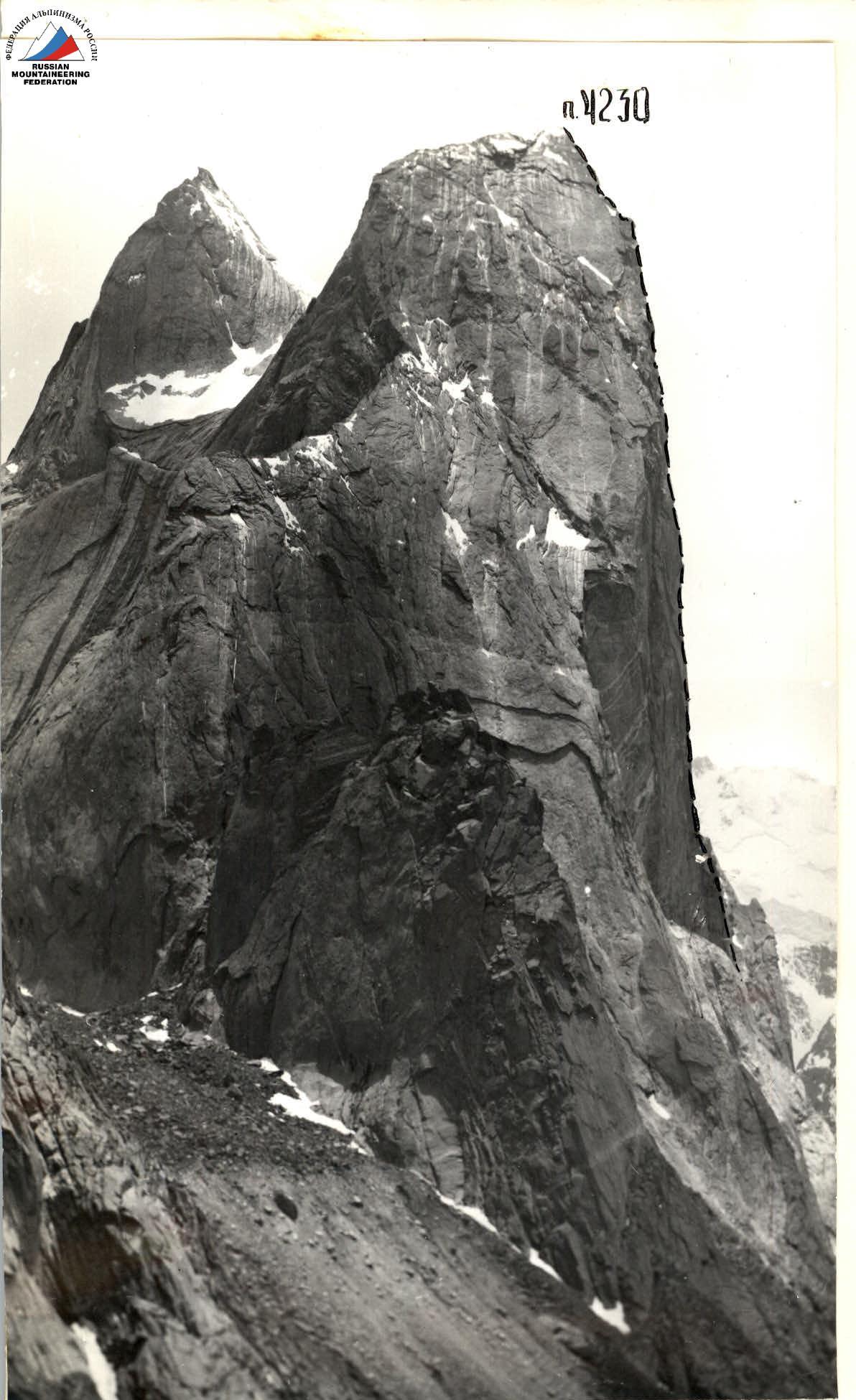
Photo #3. Profile of the NW wall of peak 4230, left. June 27, 1988. Shooting point #1. "Tessar" lens, F-250 mm. Distance 5000 m, shooting height 3000 m.
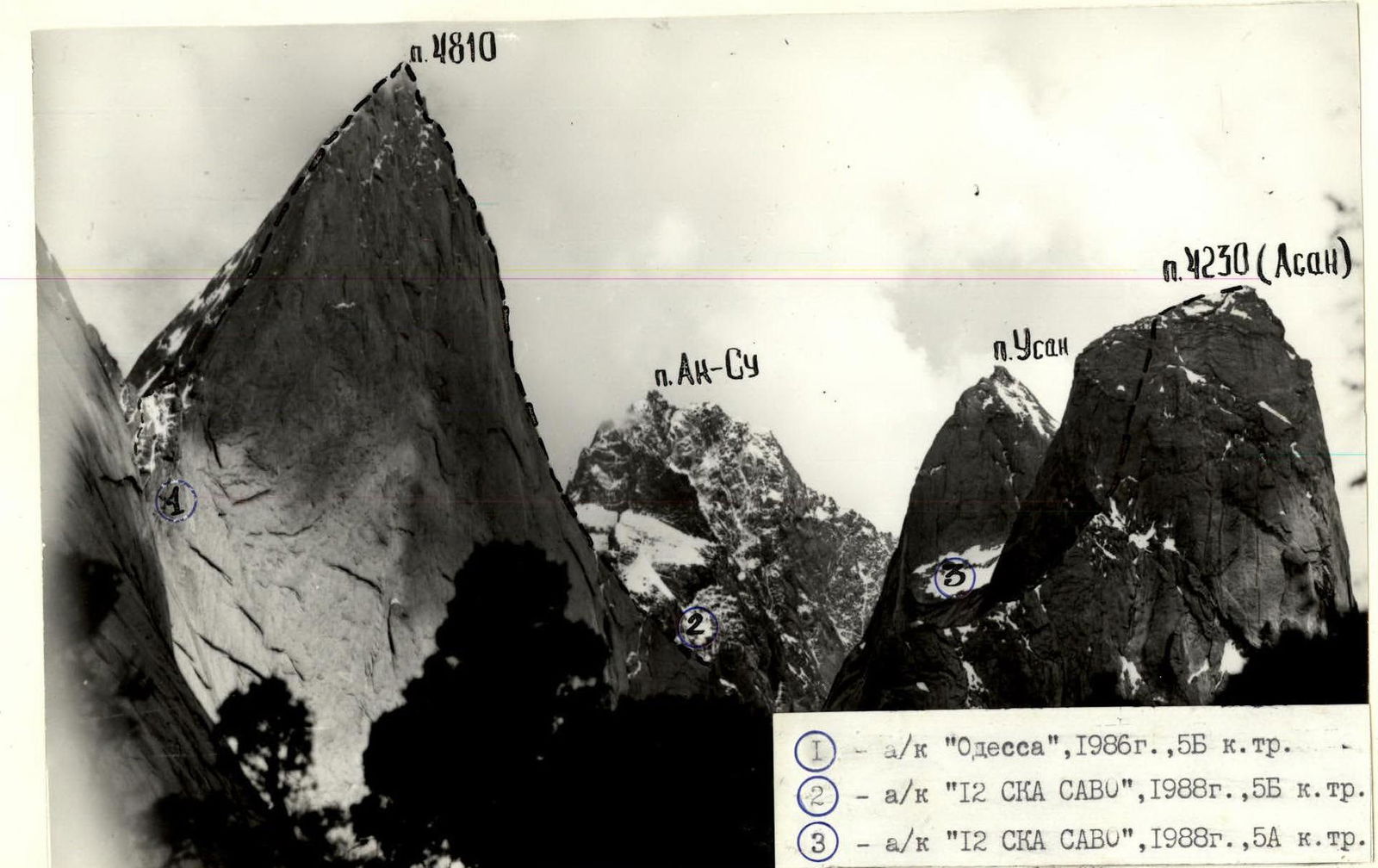
Photo #4. Panorama of peaks 4810–Ak-Su–Asan–Usan. July 1, 1988. Shooting point #3. "Tessar" lens, F-150 mm. Distance 3000 m, shooting height 3000 m.
- a/c "Odessa", 1986, 5B category of difficulty
- a/c "12th SCA SAVO", 1988, 5B category of difficulty
- a/c "12th SCA SAVO", 1988, 5A category of difficulty
The tactical plan for the ascent was made for two days, taking into account:
- an altitude difference of 850 m,
- a 12-13 hour working day,
- estimated length of sections 5–6 km, 800–870 m,
- features of the wall relief (e.g., "mirror", "cornices", "ram's foreheads"),
- weight of backpacks,
- 10 liters of water,
- compliance with safety measures.
The team was to start the route on August 2, 1988, but upon approaching the route, we saw that the team from Leningrad had not yet departed from their planned overnight stay, so in agreement with the coach of the Leningrad team, V. Glushko, our departure on the route was rescheduled for August 3, 1988. The tactical plan still had to be changed because on the second day of work on the route, we caught up with the Leningrad team transporting a participant with a broken leg down our route.
Our team provided assistance by hanging fixed ropes to the ledge (sections 10-6) and helped lower the injured climber. After the rescue work, we were only able to ascend to section 4, where we spent the night - this was an unplanned overnight stay. On the third day, it was planned to complete the remaining wall in the first half of the day and descend to the base camp by evening. This plan was fully implemented.
Tactical actions of the team
The team's tactical actions throughout the route were as follows:
The leader's departure via free climbing or using artificial aids (AIDs), organization of an insurance point and fixed ropes, ascent with top rope or on double fixed ropes for team members. Passing "mirrors" (sections 4-9) with a small number of holds and cracks was achieved by using skyhooks and extremely difficult free climbing. Skyhooks were used in conjunction with micro-relief and some pre-drilled holes 5 mm deep and 8 mm in diameter.
Without the use of skyhooks, this part of the route is impassable (in our opinion).
Passing all types of cornices required the use of the entire arsenal of mountaineering techniques.
For the convenience of the belayer and on hanging bivouacs, a "sitting platform" (a rigid platform) was used as an additional platform.
The advancement of the first rope team forward with an autonomous bivouac at the top of the last rope allowed us to reduce the time taken to pass the "mirrors".
The team's movement schedule is reflected in the graph (sheet, reverse side).
Communication with observers and coaches was maintained constantly, both visually and using a UHF radio station. One of the team's coaches and a group of two observers were constantly located under the route, which allowed us to resolve all issues related to the team's movement and make adjustments on the route.
During the movement of the rope teams on the route, the following safety measures were taken:
- belaying everyone on a double rope
- plus the first climber on shock absorption.
Bivouacs were protected by cornices.

Comments
Sign in to leave a comment