
Ascent Passport
38a
- Ascent class — traverse class
- Ascent area — Pamir-Alay, Turkestan Range, Ak-Su gorge
- Iskander S. (5000 m) via the right part of the Eastern wall, first ascent — Iskander Gl. (5120 m) — Petrovgradets (5163 m)
- Complexity category — approximately 6A category, first ascent
- Height difference of Iskander S. Eastern wall — 950 m
- including the wall section — 460 m
Length of Iskander S. Eastern wall:
- total — 4030 m
- wall section — 1140 m
Length of sections with 5–6 category difficulty:
- on Iskander S. Eastern wall — 490 m
- Total on the route — 810 m
Average steepness:
- Iskander S. Eastern wall — 62°
- wall section — 80°
- Iskander Gl. Eastern slope — 40°
- Petrovgradets Eastern ridge — 52°
- Pitons driven: Rock 98 (II); Nuts 170 (17); Ice screws 37 (0); Bolts 3 (0);
- Climbing hours on Iskander S. Eastern wall — 15, on traverse — 18. Total — 33. 4 days.
- Overnights:
- on Iskander S. Eastern wall — 1 bivouac in a tent;
- on traverse: 4 bivouacs in tents
- Team leader: Mityukhin Fyodor Petrovich — Master of Sports
Team members:
- Vareikis Vladimir Alexandrovich — Master of Sports
- Gumenny Andrey Tikhonovich — Candidate for Master of Sports
- Andreytso Alexander Petrovich — Candidate for Master of Sports
- Coach: Zagirnyak Mikhail Vasilyevich — Master of Sports
- Start of the route: — August 12, 1990 Iskander S. — August 13, 1990 Iskander Gl. — August 13, 1990 Petrovgradets — August 16, 1990 Return — August 17, 1990
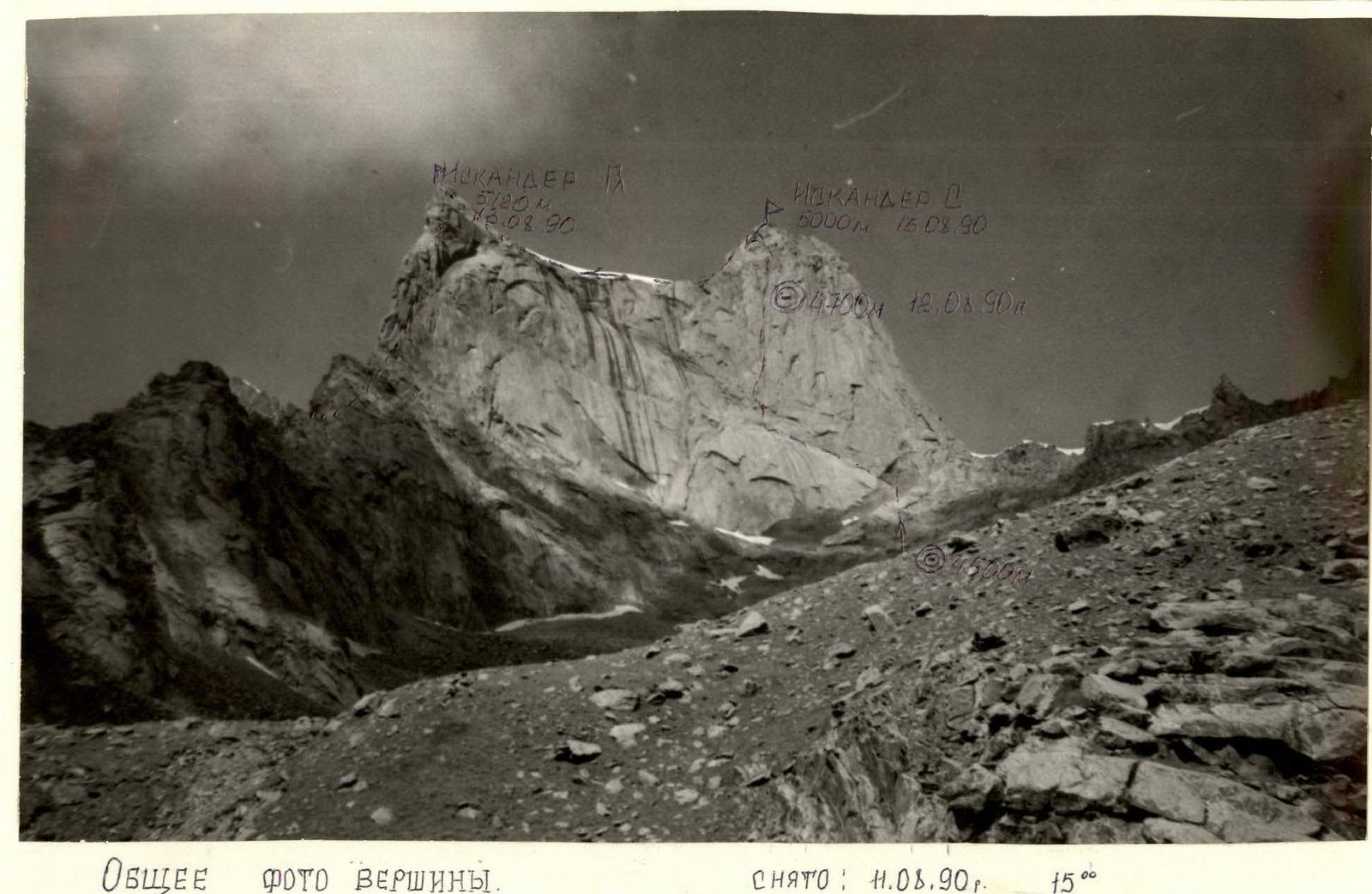
General photo of the summit. Team's route. Taken: August 1, 1990. "GENNOV-44" lens. Point #1. H=3000 m, S = 1000 m.
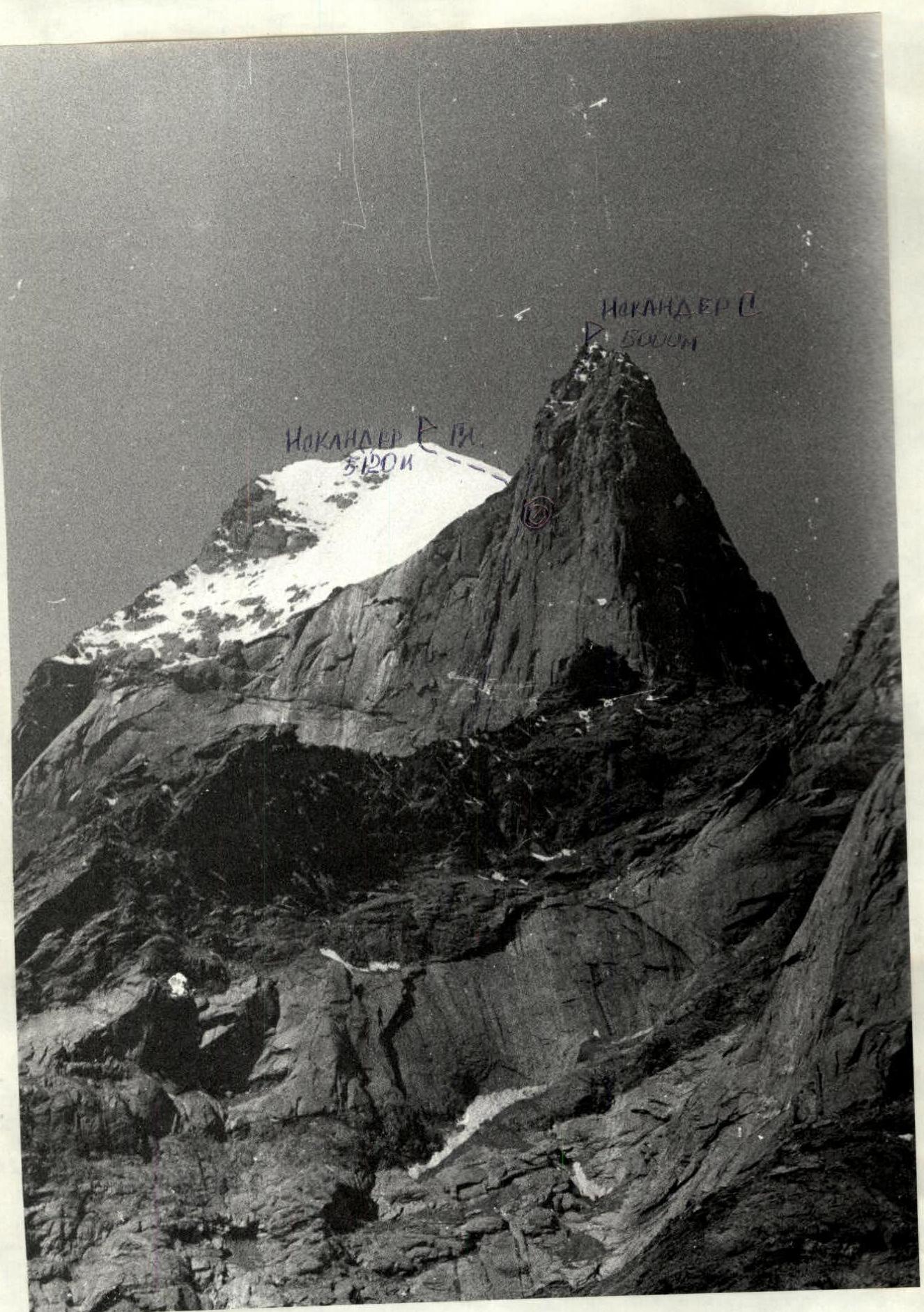
Profile of Iskander S. wall from the right. Taken: August 7, 1990, 10:00. "GELNOS-44" lens. F=58 mm. Point #2. H=3000 m, S ≈ 3000 m.
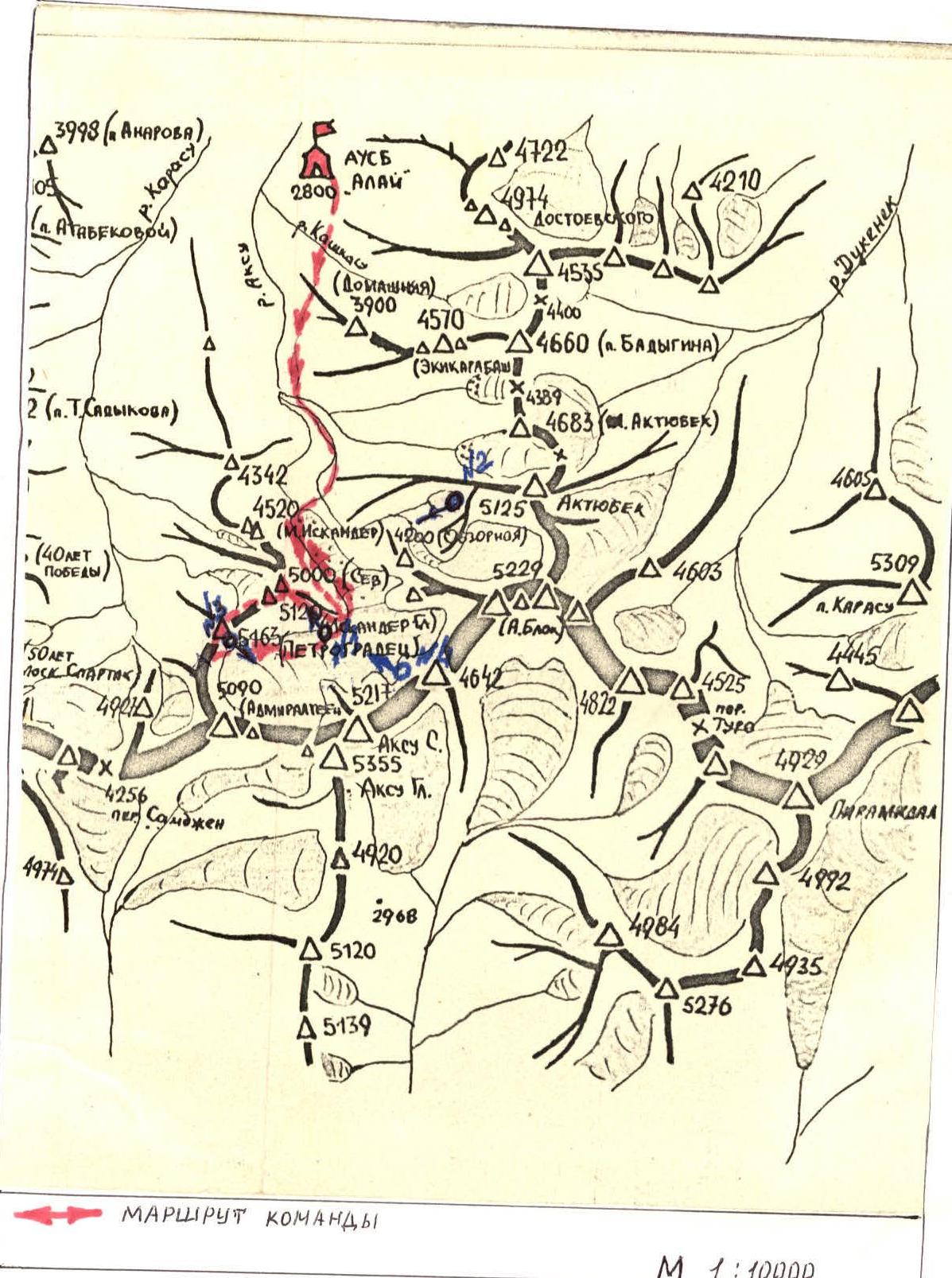
Konakham route (3. Iskander S. via the right part of the Eastern wall, first ascent)
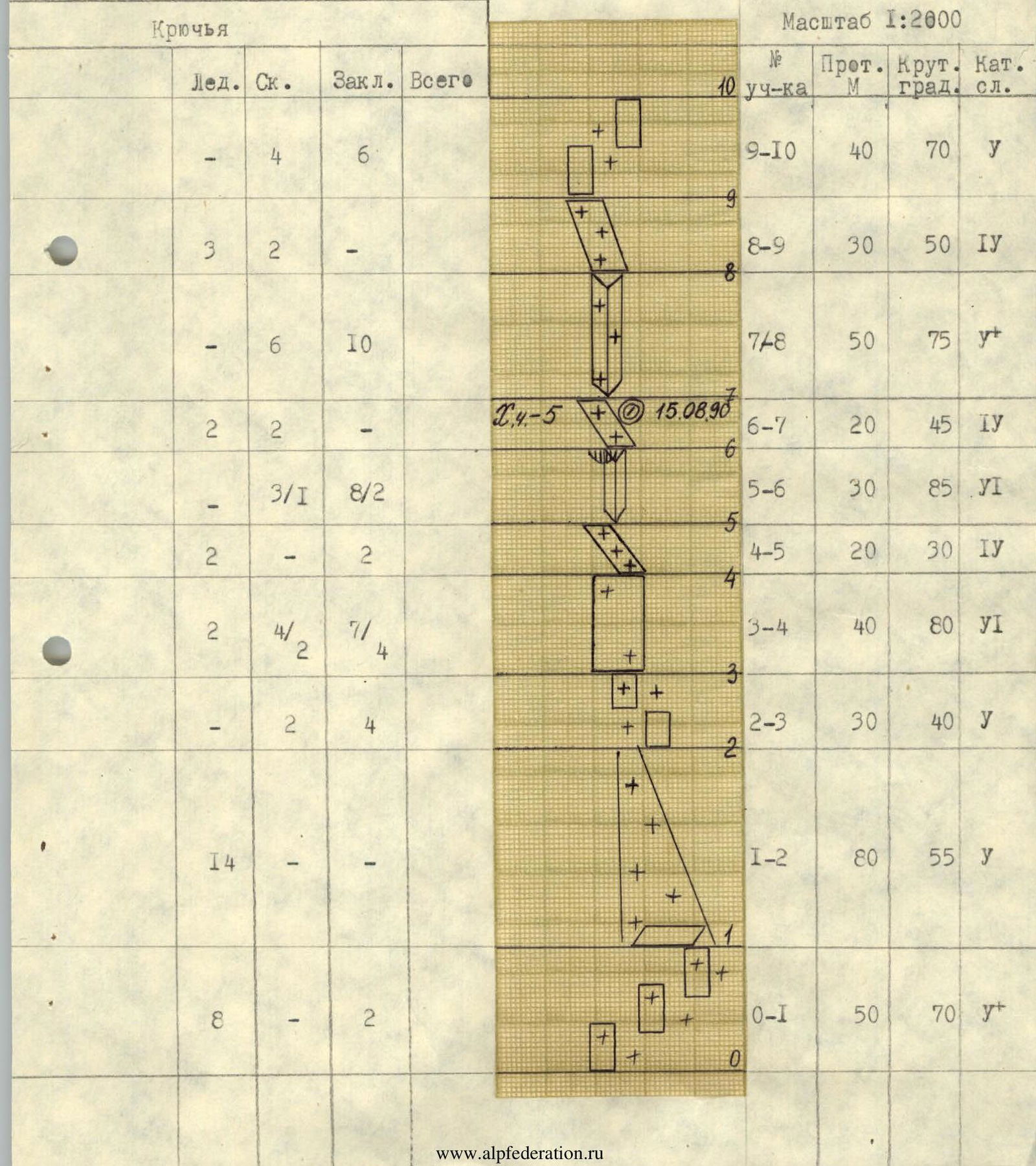
(Iskander S. Eastern wall via the right part, first ascent). Route diagram in UIAA symbols. Scale 1:2000.
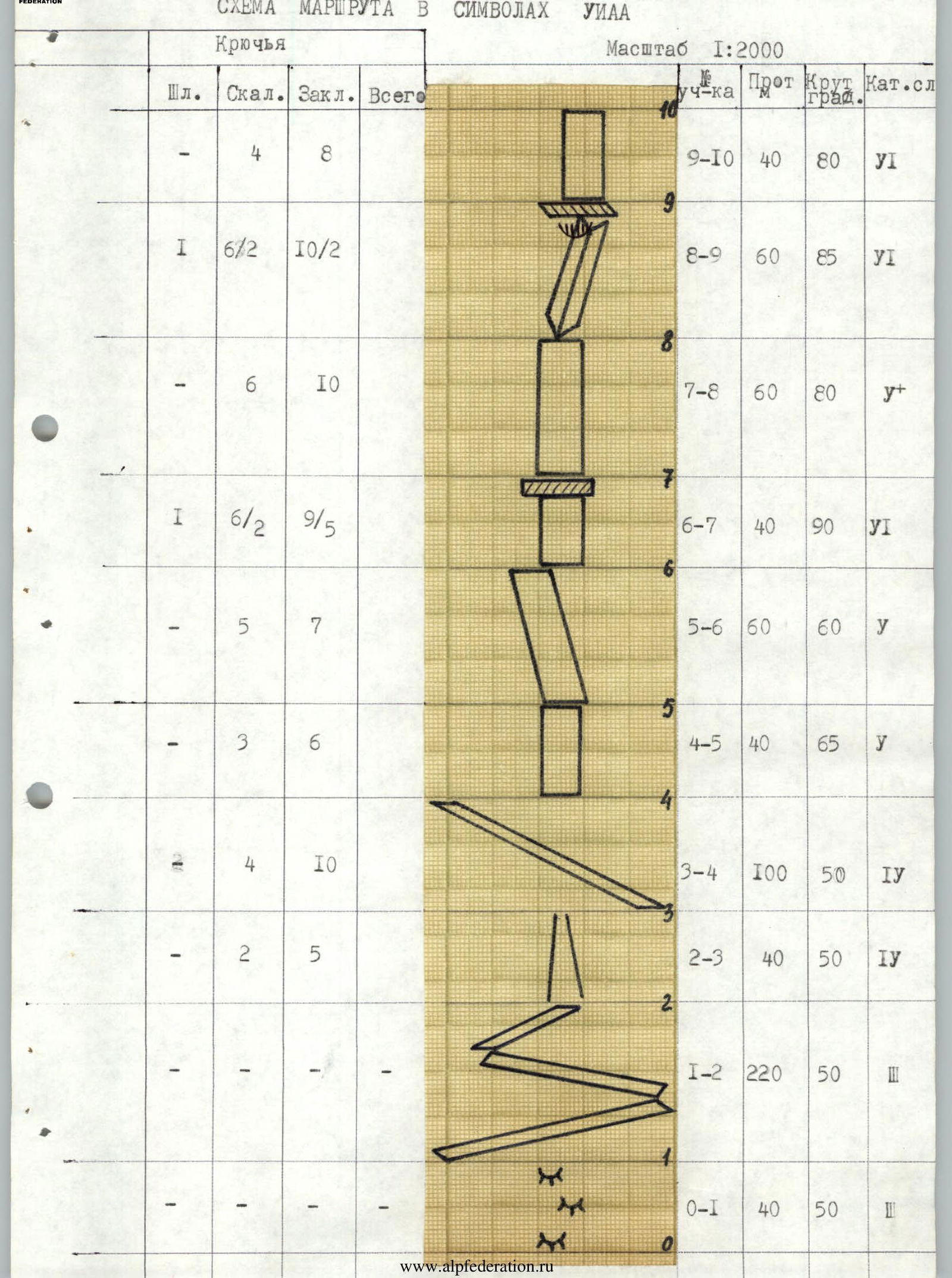
Team's route. Scale 1:10 000.
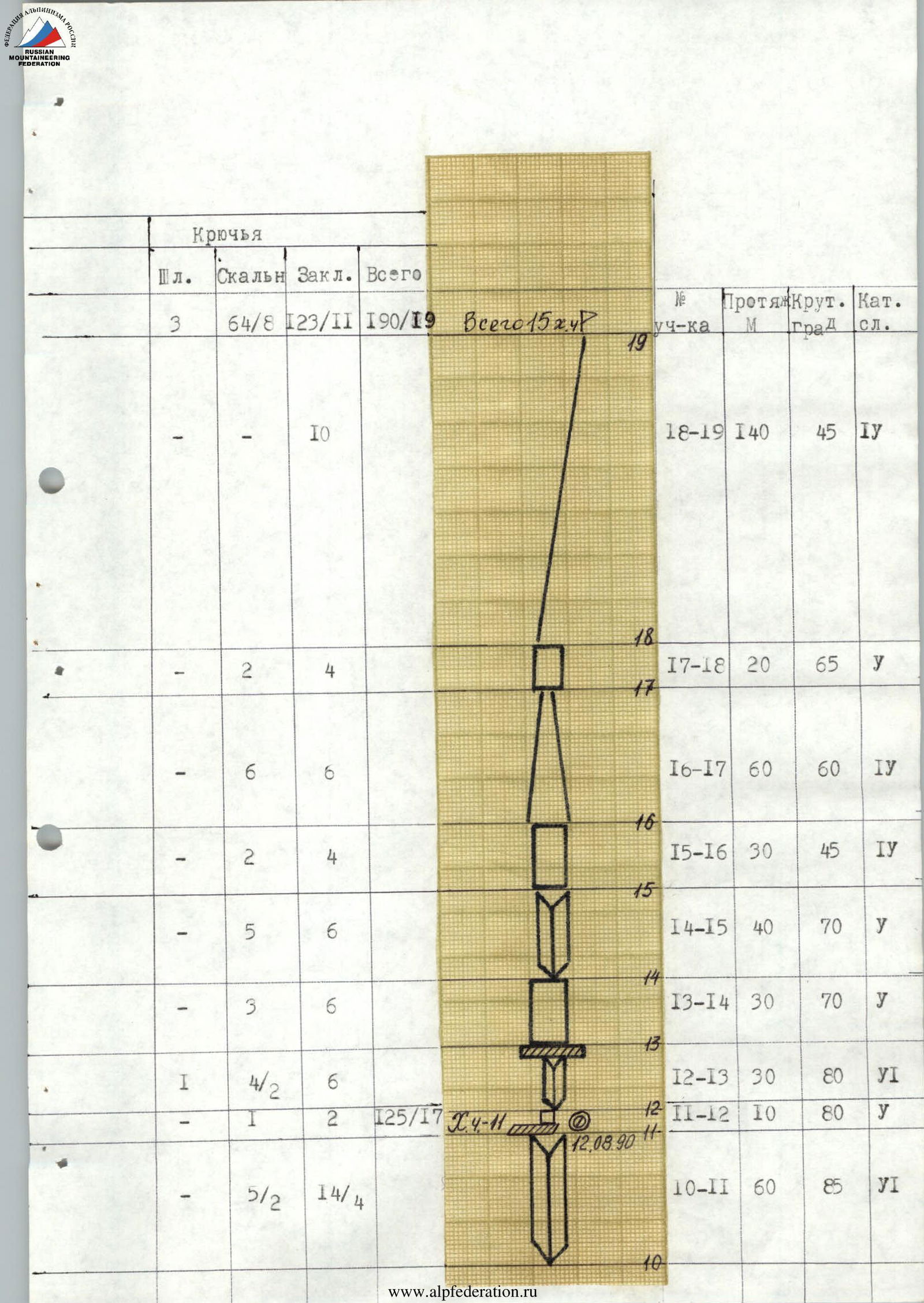
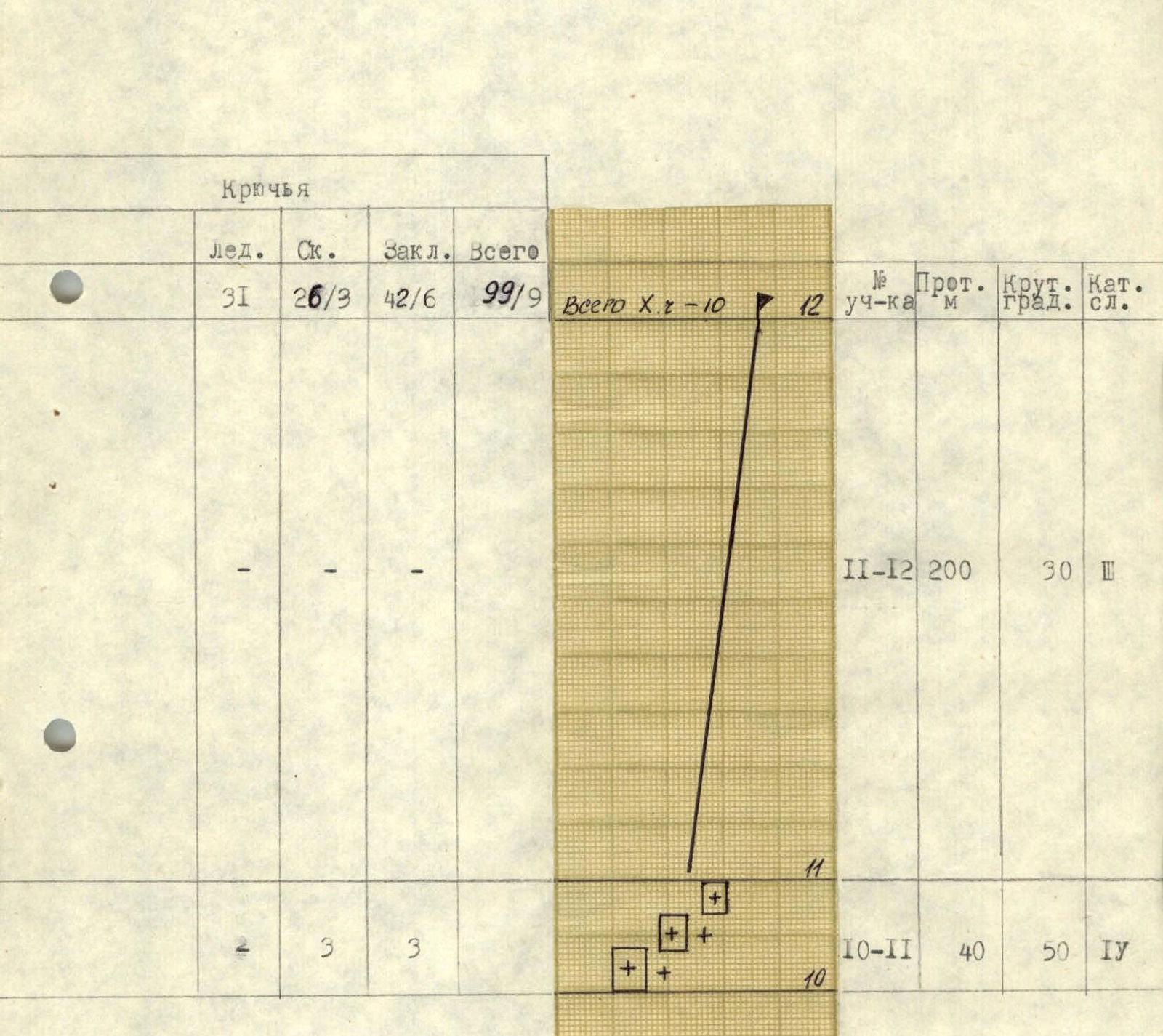
Route diagram in UIAA symbols (Petrovgradets via Eastern ridge, 5A category).
Route description by sections
Iskander S. via the right part of the Eastern wall:
- Section R0–R1 "Ram's foreheads". When dry, the rocks are climbed simultaneously.
- Section R1–R2. Smooth slabs, ledges. When dry, the rocks are climbed simultaneously.
- Section R2–R3. Couloir. Climbed with piton protection.
- Section R3–R4. Inclined ledge. Climbed with piton protection.
- Section R4–R5. Monolithic rocks. Climbed with free climbing. Medium-sized nuts fit well.
- Section R5–R6. Long inclined slab. Leads to a vertical wall with a cornice.
- Section R6–R7. Wall with a cornice at the top. The cornice is climbed head-on. ITC is used.
- Section R7–R8. Monolithic rocks. Climbing is difficult. Medium and large nuts fit well. The wall leads to a large internal angle.
- Section R8–R9. Along the internal angle up and to the right under an overhang. Very difficult climbing. ITC is used. The overhang is bypassed on the right and leads to a ledge.
- Section R9–R10. From the ledge straight up — a wall. Climbed with free climbing. Climbing is difficult. Wedges and small nuts fit. The wall turns into a large internal angle.
- Section R10–R11. Along the internal angle straight up. Very difficult climbing. ITC is used. The internal angle leads to a wide ledge.
- Section R11–R12. Ledge with a 10-meter sheer wall. Overnight on the ledge. The wall is climbed with free climbing and leads to an internal angle.
- Section R12–R13. Internal angle with a cornice at the top. Rocks are monolithic, smooth. The cornice is climbed head-on using ITC.
- Section R13–R14. Wall. Rocks are monolithic, smooth. Climbed with free climbing.
- Section R14–R15. Internal angle, climbed with free climbing and leads to a gentle wall.
- Section R15–R16. Along the wall straight up. The relief is rugged.
- Section R16–R17. Couloir. Rocks are crumbling. The couloir leads to a short wall.
- Section R17–R18. The wall is climbed with free climbing and leads to a ridge.
- Section R18–R19. Along the ridge to the right and up, exit to the summit.
- The belay spot is inconvenient (belay in stirrups).
Iskander Gl. via the Eastern slope. From the saddle to the summit of Iskander Gl., ascent along a snow-ice slope. Average steepness — 40°. Length — 360 m.
Petrovgradets via the Eastern ridge:
- Section R0–R1. From the saddle, a difficult traverse to the right and up along steep rock walls covered with ice, exit to a ledge.
- Section R1–R2. Steep ice slope. Climbed using ice axes.
- Section R2–R3. System of walls, slabs. Climbed with free climbing.
- Section R3–R4. Snow-covered steep wall. Very difficult climbing. Due to previous bad weather, rocks are partially covered with ice. ITC is used. From the wall, exit to a snow-covered ledge.
- Section R4–R5. Along the ledge, traverse to the left 20 m under a sheer internal angle.
- Section R5–R6. Along the internal angle straight up. Rocks are partially covered with ice. Very difficult climbing. The overhang at the top of the internal angle is climbed on the right using ITC and leads to a snow-ice ledge.
- Section R6–R7. Overnight on the ledge. Along the ledge to the left and up under a large internal angle.
- Section R7–R8. Along the internal angle straight up. Rocks are snow-covered. (The left side of the internal angle is heavily damaged, with loose rocks, no spots for belay). The internal angle leads to an ice-snow slope.
- Section R8–R9. Along the ice-snow slope to the left and up under a wall that leads to a ridge.
- Section R9–R10. Wall with alternating ledges. Due to snow cover, climbing is difficult.
- Section R10–R11. System of walls, slabs, leading to a ridge.
- Section R11–R12. Along the ridge 200 m, exit to the summit.
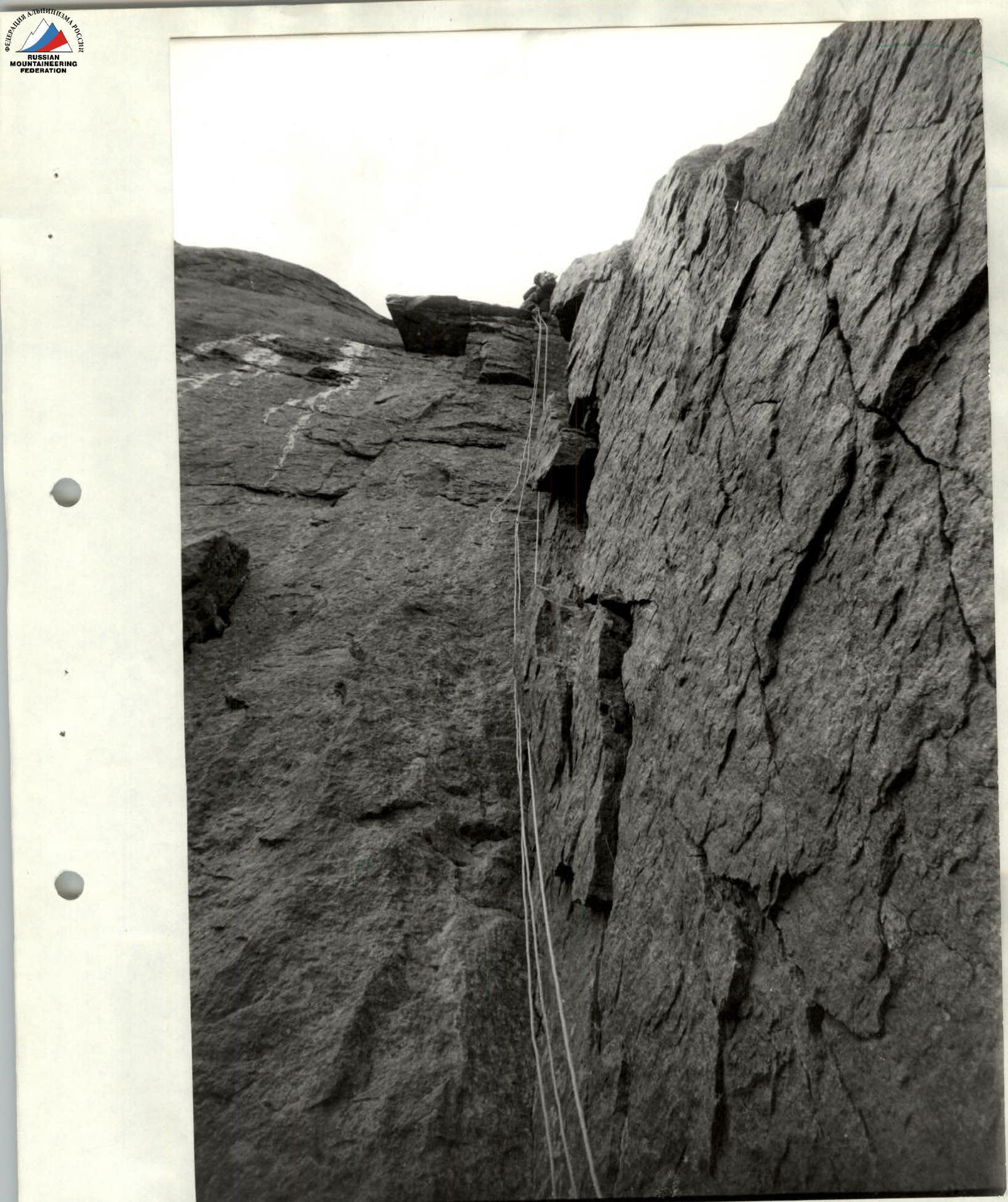
Section R10–R11. Internal angle. Exit to the overnight spot.
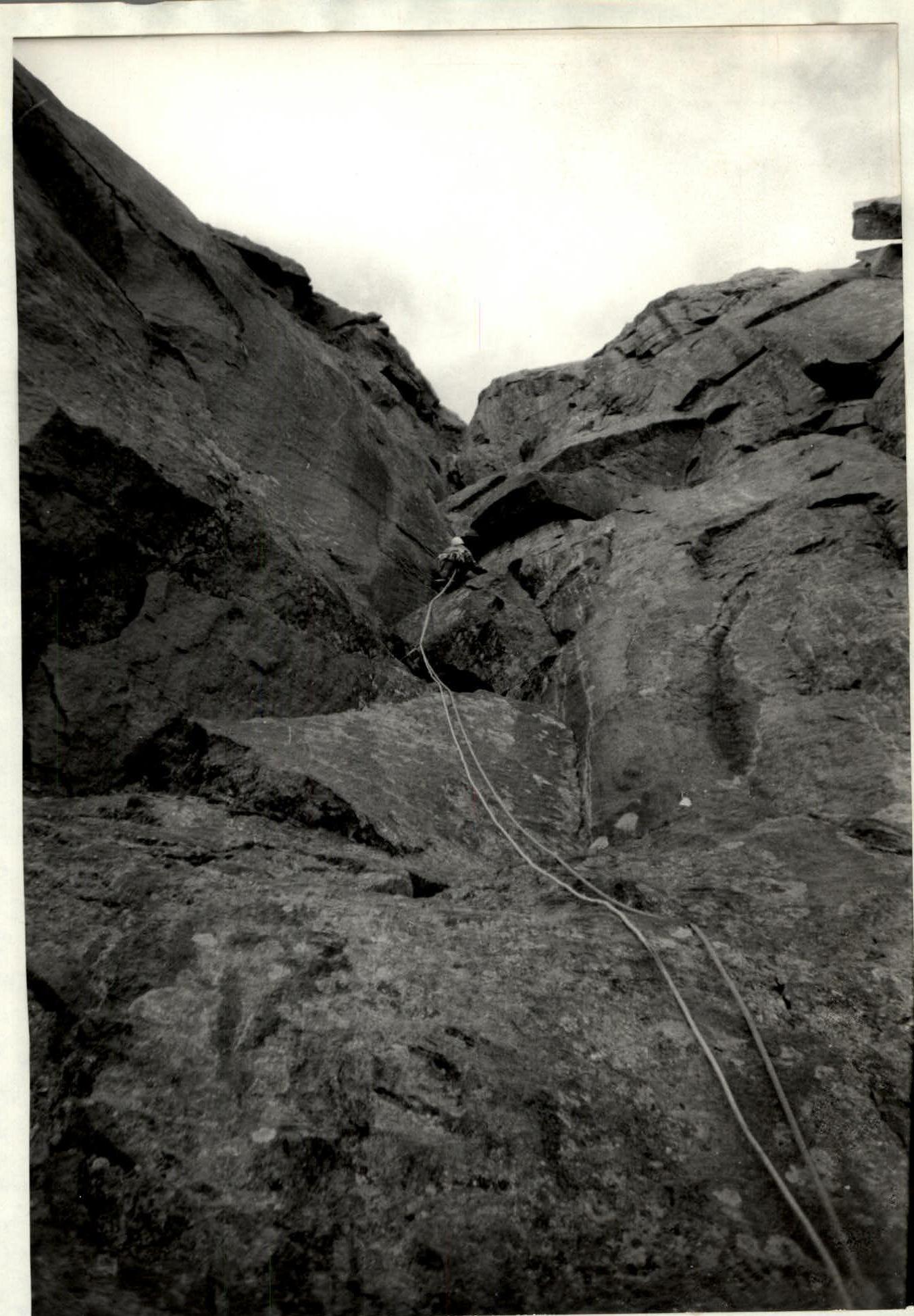
Section R12–R13. Internal angle. Exit after overnight to the cornice.
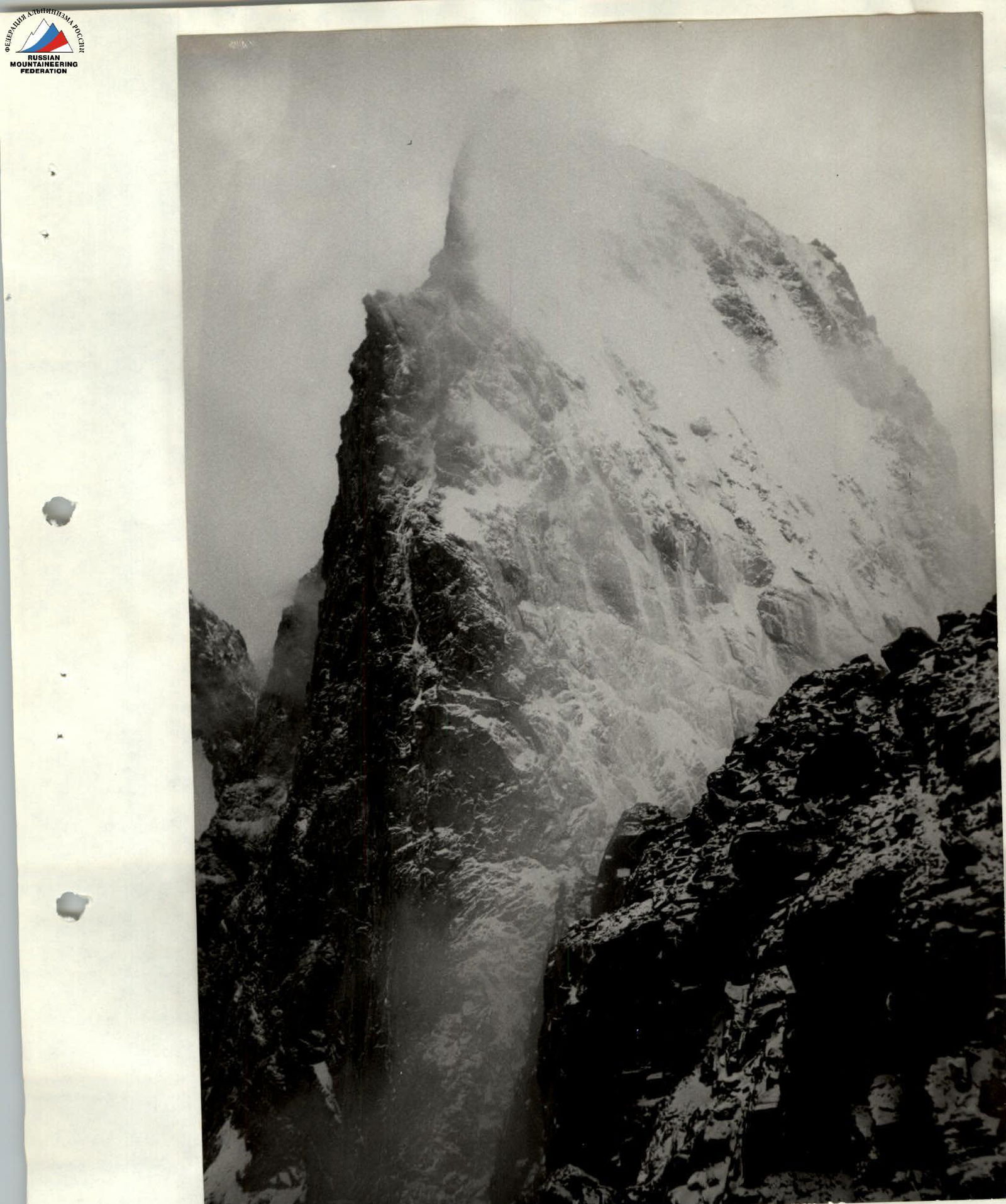
Exit to Petrovgradets from the SW ridge. Taken: August 14, 1990, 11:00.