
Russian Mountaineering Championship, High-Altitude Class
Report on the Ascent of Peak Iskander via the South Face
Team from Moscow
| 5. Height difference of the route: | 1030 m, wall 625 m (by altimeter) |
| Length of the route: | 1320 m |
| Length of sections: | V cat. diff. – 345 m, VI cat. diff. – 245 m |
| Average steepness: | |
| main part of the route | 85°, total route – 65° |
| 6. Pitons left on the route: | |
| total 0; | including bolted pitons 0 |
| Pitons used on the route: | |
| bolted stationary 0 | including artificial climbing aids (ITC) 10 |
| bolted removable 0 | including ITC 0 |
| Total artificial climbing aids (ITC) used | 84, including fifi-hooks |
| Chocks and friends 126 | including ITC 27 |
| Pitons 47 | including ITC 15 |
| 7. Team's climbing hours: | 48 hours, 6 days |
| 8. Team leader: | Ivanov Alexander Sergeyevich, Master of Sports |
| Participants: | |
| Shulgin Maxim Alexandrovich, 1st sports category | |
| 9. Coach: | Ivanov Alexander Sergeyevich, Master of Sports |
| 10. Departure to the route: | 15:00, August 6, 2011 |
| Arrival at the summit: | 16:00, August 11, 2011 |
| Return to Base Camp: | 23:00, August 12, 2011 |
| Descent: | via the South face |
| 11. Organization: | Federal Agency for Physical Education and Sports, Moscow |
| 12. Responsible for the report: | Ivanov Alexander, ivanov@vdnk.ru, 8 (963) 992-11-35 |
ISKANDER, 5120 m
Photo #1. General photo. Taken from Lake AkSu on August 6, 2011, distance 2.5 km, height 3900 m
- GRISHCHENKO, 6A
- GOLUBEV, 5B
- ZHILTSOV, 6A
Photo #2. Route profile from the right. Taken on August 6, 2011, from Lake AkSu. Distance 4 km, height 3600 m
August 6, 2011, 4350 m. Hand-drawn profile
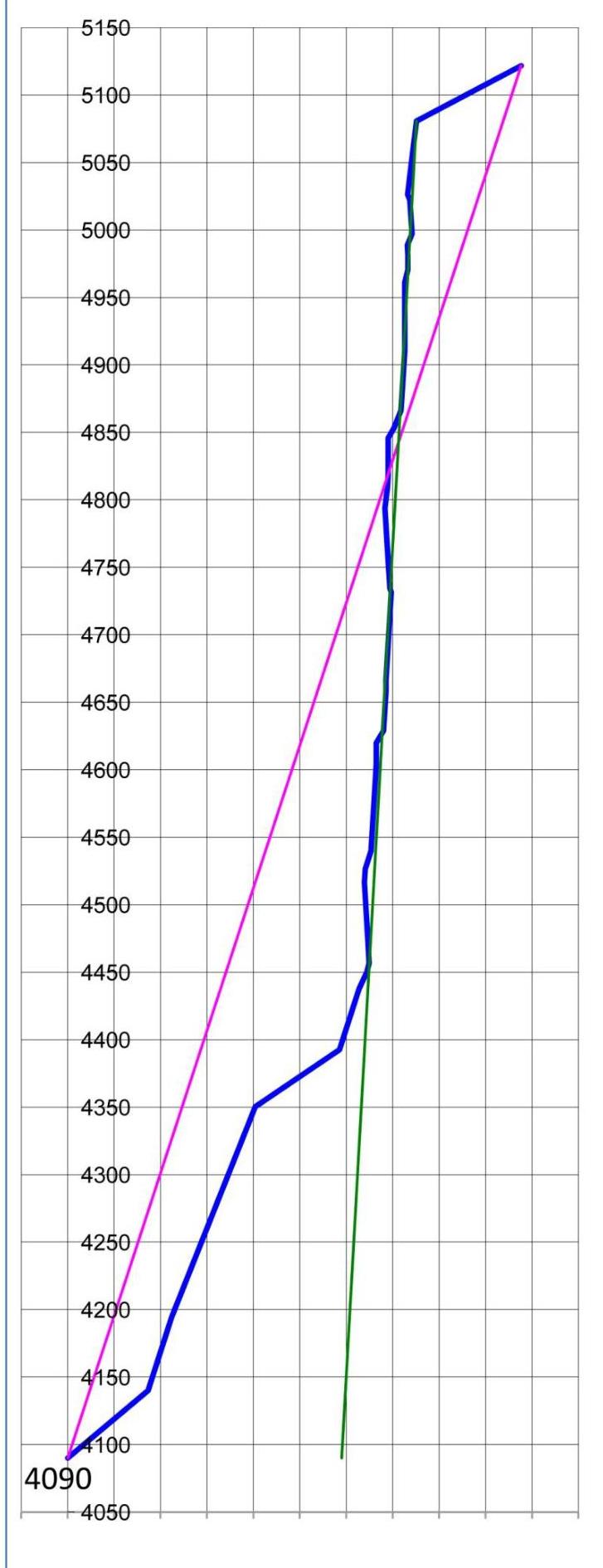
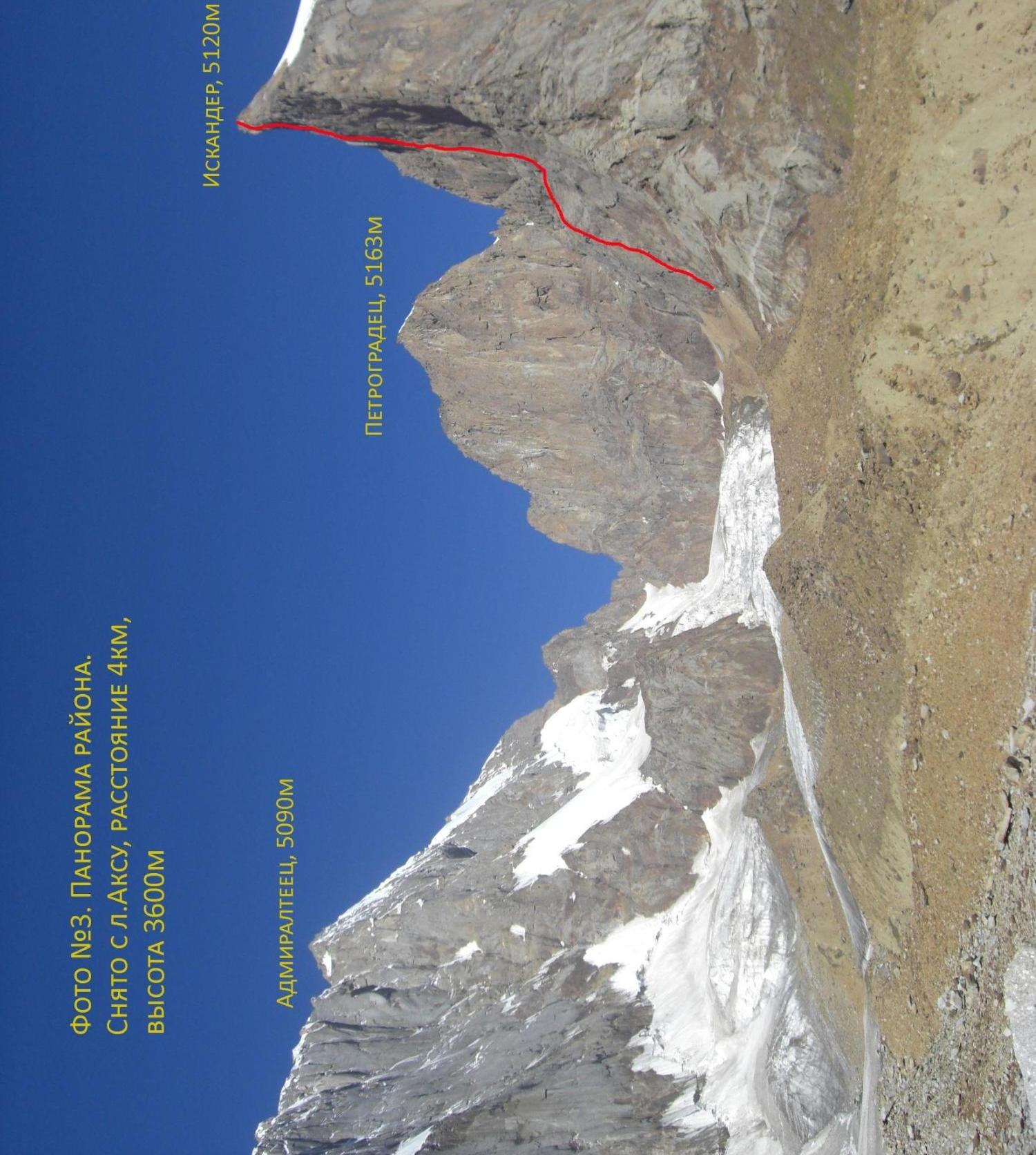
Photo #3. Panorama of the area. Taken from Lake AkSu, distance 4 km, height 3600 m
- ADMIRALTEETS, 5090 m
- PETROGRADETS, 5163 m
- ISKANDER, 5120 m
- S. ISKANDER, 5000 m
| Pitons | Chocks | ITC | Section # | Length, steepness, difficulty |
|---|---|---|---|---|
| 0 | 100 m, 25°, I | |||
| 2 | 4 | 1 | 60 m, 65°, IV | |
| 2 | 3 | 2 | 60 m, 60°, III+ | |
| 1 | 6 | 3 | 60 m, 60°, IV | |
| 2 | 6 | 4 | 60 m, 30–90°, III–V | |
| 5 | 100 m, 25°, I | |||
| 6 | 100 m, 0–65°, I–III | |||
| 1 | 5 | 7 | 50 m, 65°, V | |
| 4 | 8 | 15 m, 55°, IV | ||
| 1 | 9 | 7 m, 70°, III | ||
| 10 | 15 m, 95°, VI+, A3 | |||
| 11 | 12 m, 95°, VI, A2, tricky | |||
| 2/2 | 7/7 | 25 | 12 | 45 m, 95°, VI, A2 |
| 13 |
| Pitons | Chocks | ITC | Section # | Length, steepness, difficulty |
|---|---|---|---|---|
| 1 | 13 | 10 m, 85°, VI | ||
| 1 | 4 | 14 | 15 m, 65°, IV | |
| 2 | 12 | 15 | 65 m, 85°, V | |
| 4 | 1 | 16 | 15 m, 90°, V+, A1 | |
| 1 | 17 | 10 m, 50°, III | ||
| 5 | 18 | 30 m, 85°, V | ||
| 1 | 19 | 8 m, 90°, V+ | ||
| 2 | 6 | 20 | 45 m, 85°, V | |
| 4 | 4 | 12 | 21 | 20 m, 85°, VI+, A3 |
| 2 | 22 | 3 m, 120°, VI, A2, pendulum 1.5 m | ||
| 2 | 23 | 15 m, 80°, V | ||
| 1 | 2 | 24 | 10 m, 85°, VI | |
| 2/2 | 2/2 | 7 | 25 | 12 m, 90°, VI+, A2 |
| 4/4 | 4/4 | 10 | 26 | 15 m, 90°, VI+, A3 |
| 27 | 10 m, 50°, III | |||
| 1 | 28 | 15 m, 60°, IV | ||
| 29 | 45 m, 85°, V | |||
| 1 | 5 | 30 |
| Pitons | Chocks | ITC | Section # | Length, steepness, difficulty |
|---|---|---|---|---|
| 1 | 3 | 30 | 15 m, 90°, V+ | |
| 2 | 4 | 31 | 35 m, 90°, V+ | |
| 1 | 32 | 10 m, 70°, V | ||
| 1 | 3 | 33 | 10 m, 90°, VI+ | |
| 2 | 2/1 | 1 | 34 | 8 m, 95°, VI, A1 |
| 1 | 35 | 10 m, 60°, IV | ||
| 2/2 | 5/3 | 10 | 36 | 25 m, 95°, VI, A2 |
| 5/4 | 4 | 37 | 5 m, 120°, VI+, A2 | |
| 3 | 6 | 38 | 55 m, 80°, VI | |
| 39 | 120 m, 20°, II | |||
| 40 |
Photo #4. Technical photo
- Taken from Lake AkSu
| Section | Date |
|---|---|
| R39 | August 11, 2011 |
| R37 | August 10, 2011 |
| R33 | August 10, 2011 |
| R28 | September 6, 2008 |
| R23 | August 7, 2011 |
| R18 | August 6, 2011 |
| R15 | August 7, 2011 |
| R9 | August 6, 2011 |
| R7 | August 6, 2011 |
| R6 | August 6, 2011 |
| R5 | August 6, 2011 |
| R4 | August 6, 2011 |
| R3 | August 6, 2011 |
| R2 | August 6, 2011 |
| R1 | August 6, 2011 |
| R0 | August 6, 2011 |
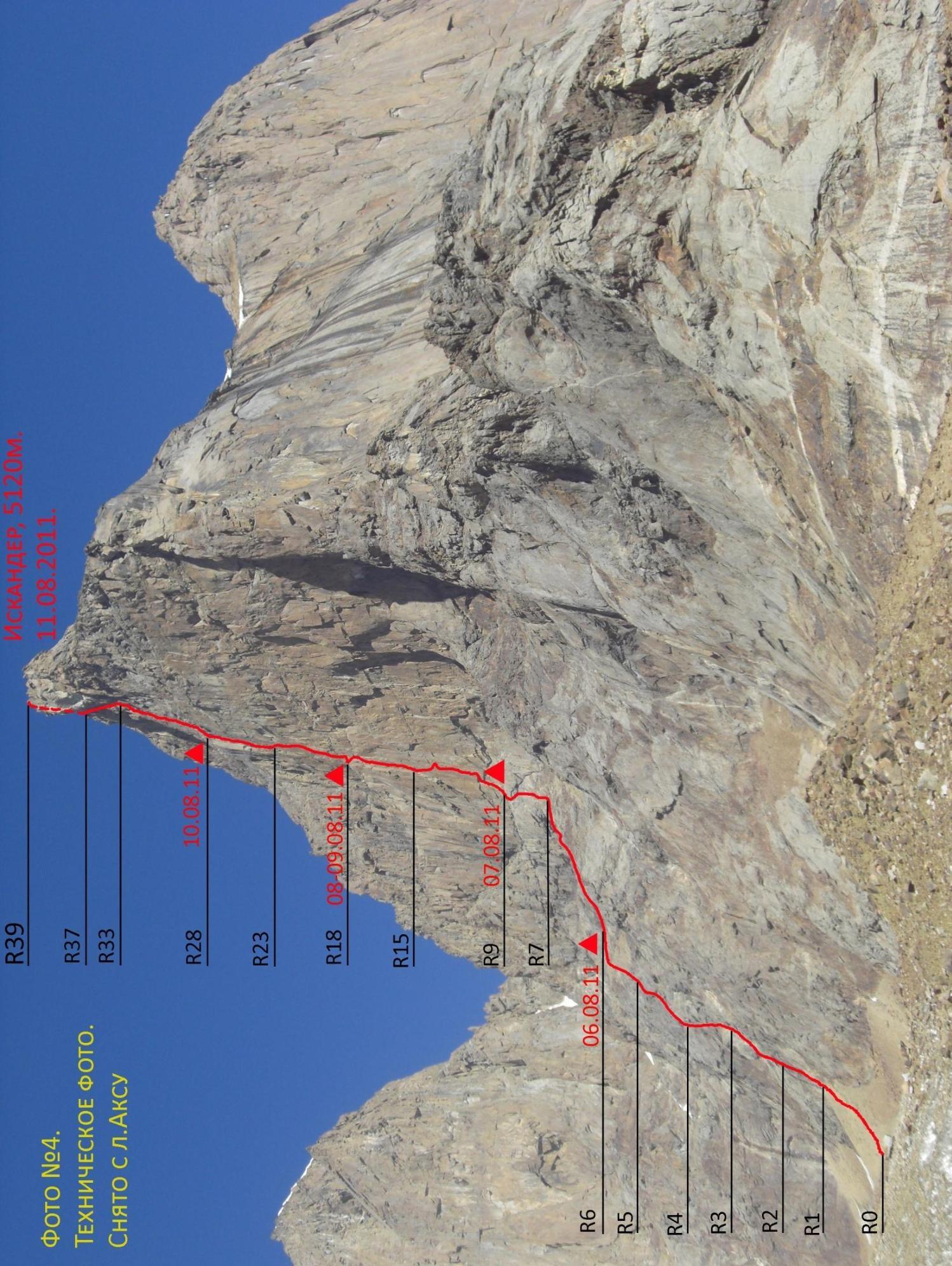
Photo #5. Technical photo. Taken on August 12, 2011, during descent from the lower part of the route.
Photo #6. Technical photo of the upper part of the route. Taken from bivouac R28 on August 10, 2011.
Photo #7. Taken from R9. Inner corner and traverse under the cornice. Difficult climbing and ITC.
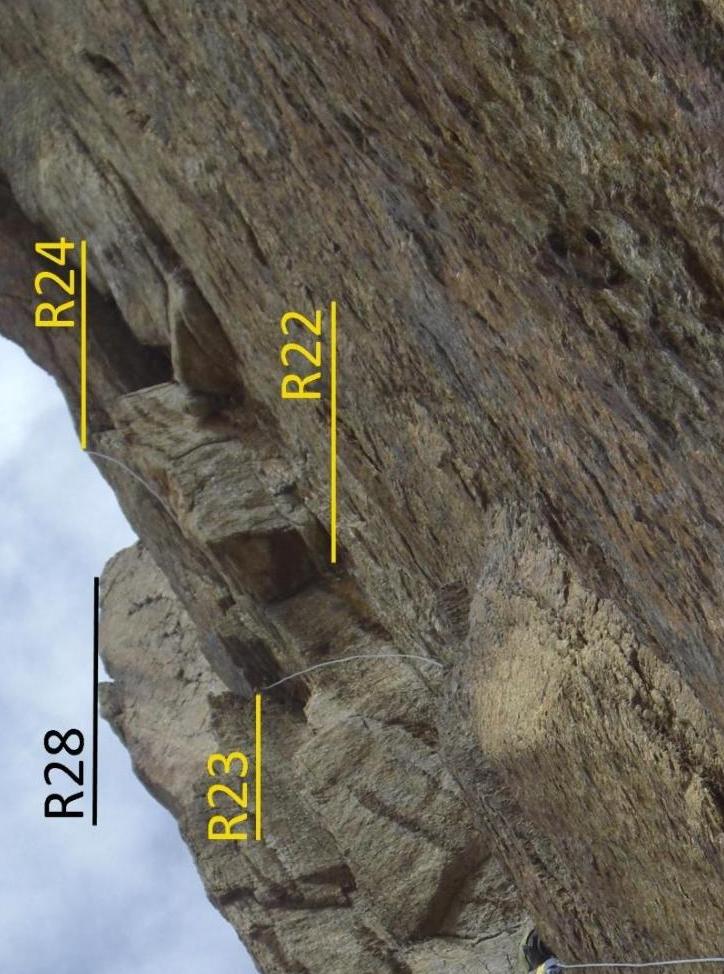
Photo #8. On the belay.
Photo #9. On the belay. Taken from R20–R21.
Photo #10. Taken from R30. Under the summit tower.
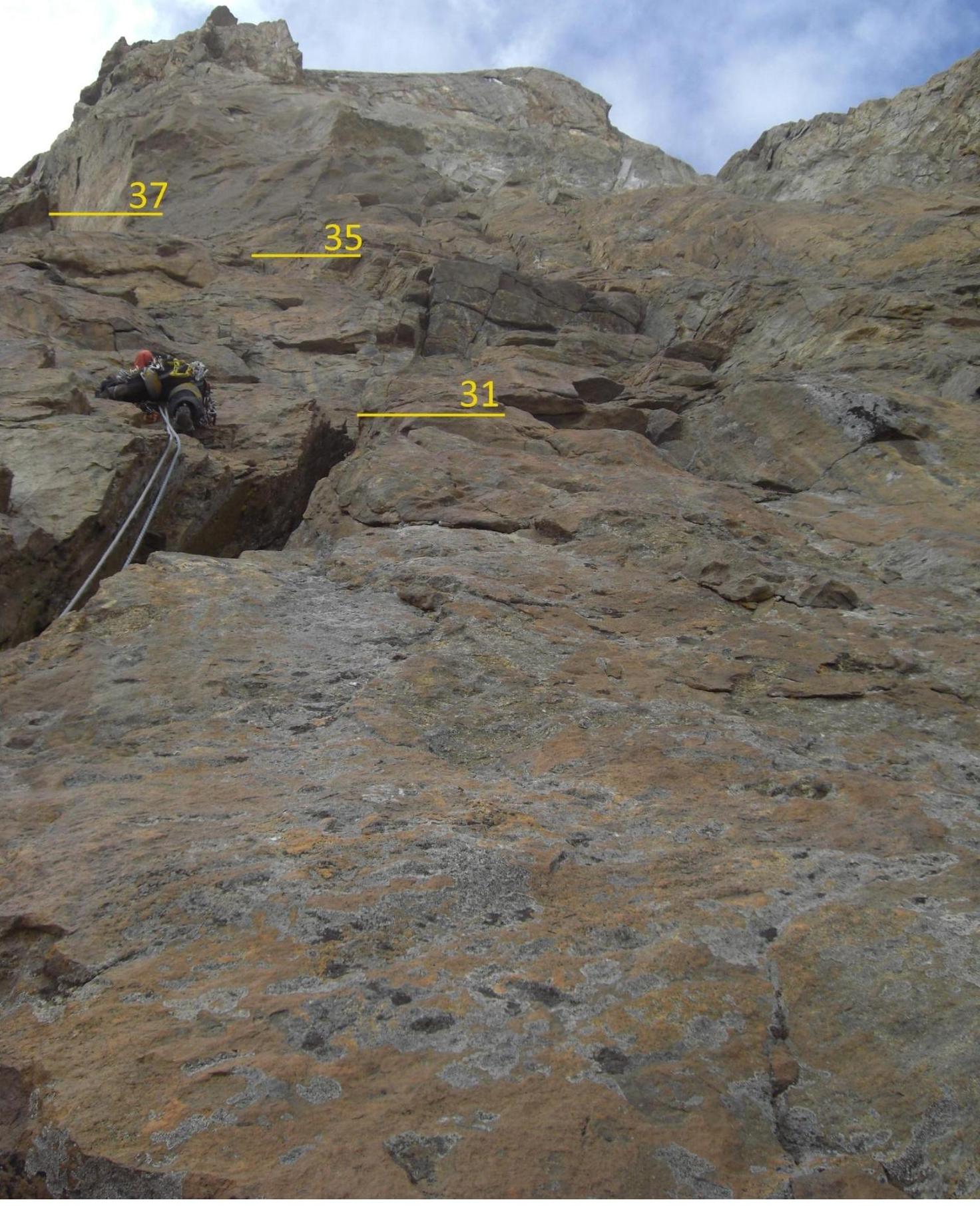
Photo #11. Inner corner and cornice. ITC.
Photo #12. Taken from R38. Final rope on the wall. Ice in some places.
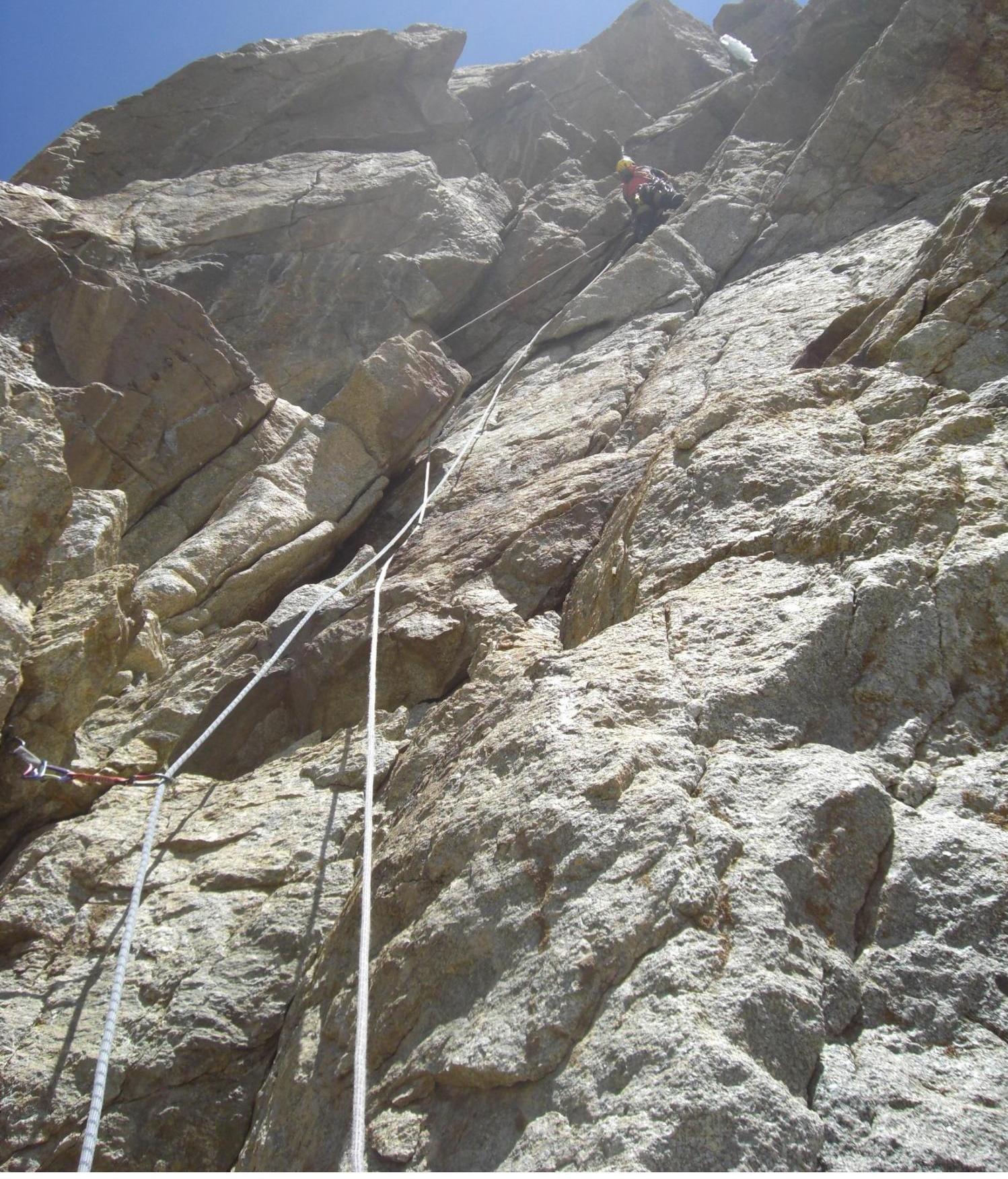
Photo #13. Summit. In the background - Admiralteets.
Photo #14. Summit.
Description by sections
- R0–R1: Scree leading to the base of the couloir.
- R1–R2: To the left of the vaguely defined couloir is a system of inner corners. Climbing of moderate difficulty.
- R2–R5: Movement to the left of the couloir along alternating ledges and walls. First climber wore crampons with a backpack.
- R5–R6: Scree slope leading to the wall. Under the wall is a wide ledge, a comfortable bivouac.
- R6–R7: Along the ledge, move right under the slab, above which is a cornice.
- R7–R9: Along the slab under the cor, bypass it on the left along the inner corner, after which is a wide ledge. In the right part of the ledge is a convenient and safe bivouac under the protection of the cornice.
- R9–R11: Along a simple wall to the inner corner. Overhanging inner corner. ITC along cracks (fifi-hooks, anchors). Cracks are filled with "scale", need to be cleaned.
- R11–R12: Difficult traverse climbing under the cornice to the base of a large overhanging inner corner. At the end of the traverse, ITC on chocks and fifi-hooks along the crack at the base of the cornice.
- R12–R13: ITC along the inner corner. The belay station is best made in the upper part of the inner corner, as the relief afterwards is very poor for belaying. Mainly chocks and fifi-hooks.
- R13–R14: Along the slab up to the left, then up to the right. Careful climbing, managed to anchor only at the very beginning of the slab with an anchor.
- R14–R15: A simple inner corner leads to the base of a large inner corner.
- R15–R17: Along the wall with rich relief for belaying and climbing, to the right of the inner corner. In the middle of the corner is a control cairn. Further - along the chimney with a plug. Chocks, fifi-hooks.
- R17–R18: Along simple rocks, exit to a large ledge. On the ledge is a constructed bivouac area for 3 people. Possibly, the ledge can accommodate 2-3 more people.
- R18–R21: Steep wall. Pleasant climbing. Good belaying, used a little of everything. At the end, at the base of the inner corner - a control cairn.
- R21–R23: A heavily clogged crack running along the overhanging inner corner. ITC on fifi-hooks, anchors, chocks, small fifi-hooks. The entire crack needs to be cleaned of "scale". Belaying is not always reliable.
- The key to the route. In the upper part of the inner corner, cross it through a relatively simple cornice.
- R23–R24: Along the wall up to the right to a convenient place for a belay station opposite the beginning of a large inner corner. Do not enter the inner corner and the vague couloir filled with ice to the right of it.
- R24–R27: From the belay station, moved upwards. Difficult ITC. Many cracks are blind. Rocks are wet, partly icy, climbing is possible only in some places. Second key to the route. First ascenders likely bypassed this section to the right (probably correctly).
- R27–R28: Easy climbing to a large ledge, convenient for a bivouac.
- R28–R33: Wall with rich large relief to the base of the summit tower. There are loose rocks. Large chocks, medium and large fifi-hooks.
- R33–R35: Vertical wall, then a slightly overhanging crack ending in a small cornice. One ITC move.
- R35–R36: Climbing along the inner corner to an inclined ledge, which is also reached by Golubev's route.
- R36–R38: Along the inner corner, bypassing the summit tower under the cornice. First climbing, then ITC with down-climbing. Cornice on ITC, belay station behind the cornice. Large, medium chocks, fifi-hooks.
- R38–R39: Steep inner corner, ice in some places. Pleasant climbing to a large ledge. Bivouac possible.
- R39–R40: Easy ridge leads to the summit.
Approach
- Peak Iskander is located in the Turkestan Range in the upper reaches of the Laylyak valley, in its left branch - the AkSu valley. Approach from village Ozgurysh up the Laylyak valley, then up the AkSu valley to the base camp at the site of the former Alay camp - 5-6 hours.
- From the base camp, ascend the left bank of the AkSu river, climb the moraine to the cirque of Lake AkSu. Cross the stream flowing from the slopes of Peak Blok. Enter the cirque of the AkSu glacier. Approach the wall of AkSu. 3.5 hours from Base Camp.
- Along the wall of AkSu and the "pillar" of Admiralteets, approach Peak Iskander. From the bivouacs under AkSu - 3-4 hours.
Schedule
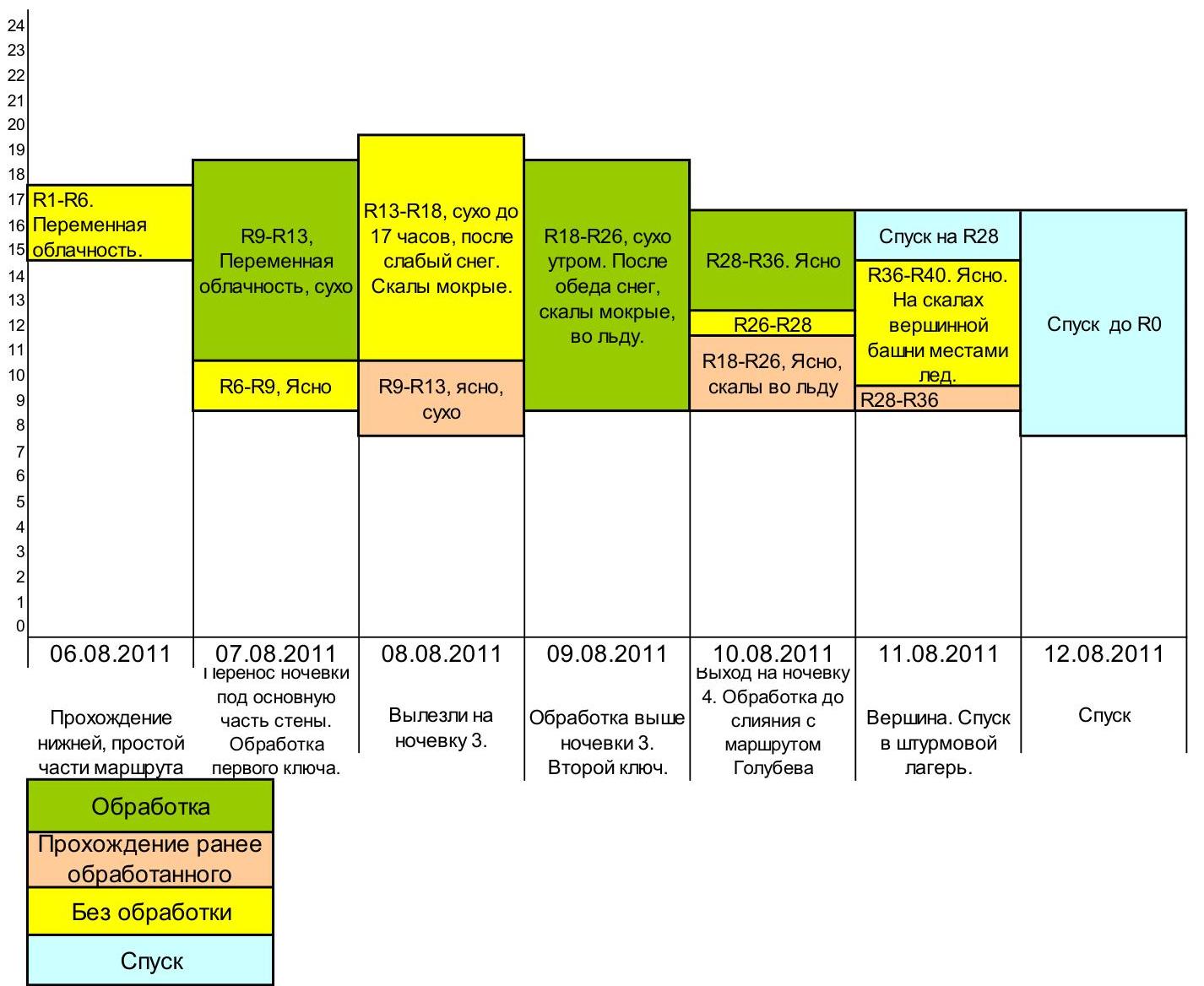
Height gain chart
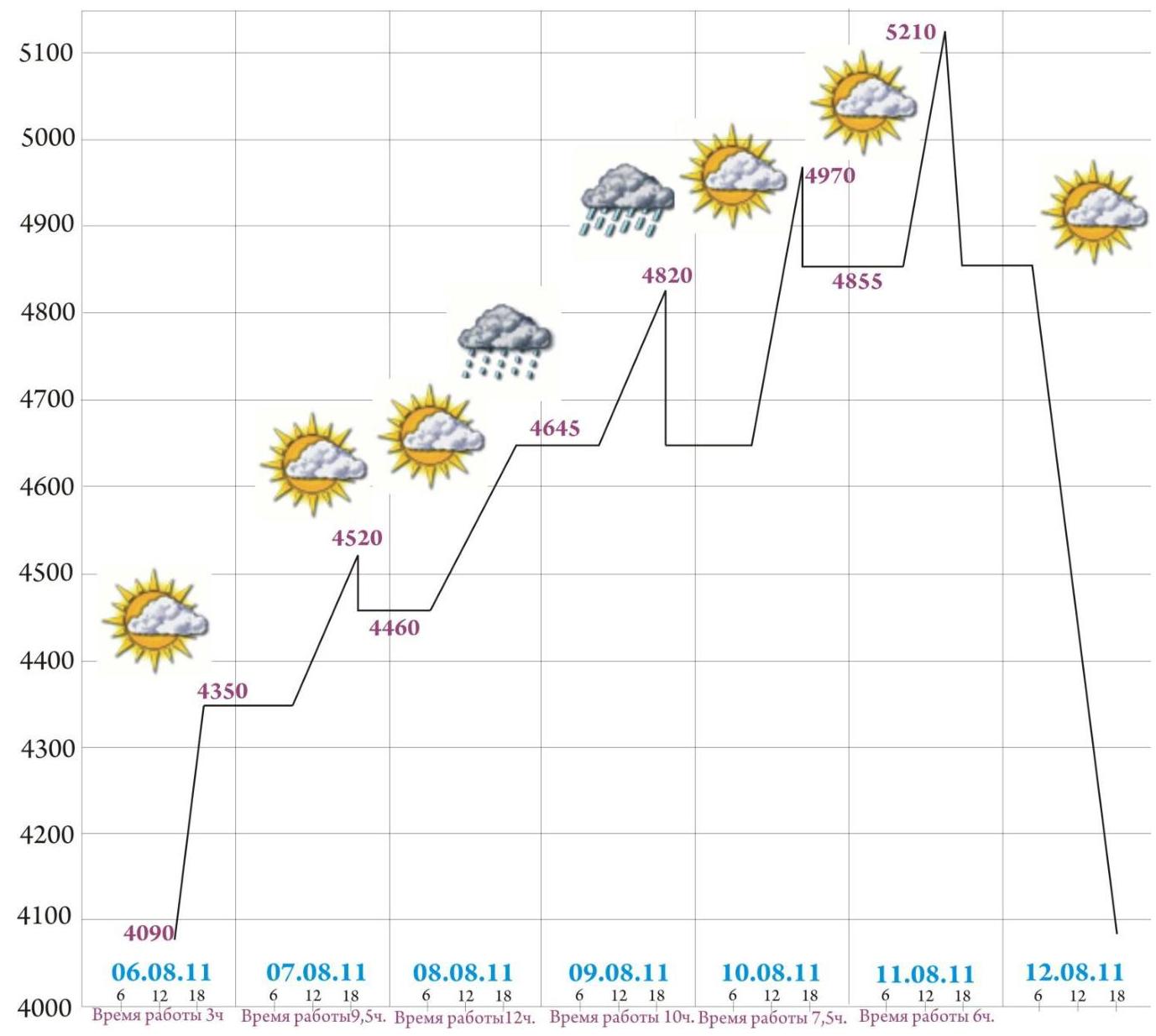
General characteristics of the route
- The route was first (and only once) climbed in 1998 by a team of 3 people in 7 days. The route starts to the left of a large, vaguely defined couloir.
- The route can be divided into 2 unequal parts: a simple beginning R0–R7 and a complex wall section R7–R39, which leads almost to the summit.
- In terms of complexity, the route can be compared to Pogorelov's route on Asan. Zhilin's route is a bit more complicated due to more destroyed rock in certain sections (R10–R11, R21–R22).
- Compared to other routes of the 6th category of difficulty, I believe this route is more complex than Forostyan's route on Chegem, Khokhlov's route on Sugan. However, it is less complex than Voronov's route on Peak Odessa (4810 m), Maksimen's route on Peak Blok, Voronin and Dorro's route on Erydag. In general, the route can be considered a complex 6A.
- I believe it is acceptable to climb this route as a first 6th category route.
- The route was mainly climbed using free climbing. ITC was used on sections R10–R13, R21–R23, R24–R27 (due to ice and snow), R36–R38. The team passed sections R23–R27 in bad weather. Further to the summit, some sections still had remnants of this bad weather (wet rocks, ice).
- The most difficult sections of the route: R10–R12 - overhanging inner corner, ITC fifi-hooks, anchors. After that - a difficult traverse climbing without reliable belaying, then ITC. R21–R22 - crack heavily clogged, many points unreliable, ITC on large chocks, small fifi-hooks. R25–R27 - ITC along blind cracks.
- The ascent tactic was capsule style. The team used 3 ropes: 2 main dynamic ropes of 60 m and a dynamic half-rope - 8 mm. The first climber climbed on two ropes - main and half, both used for belaying the first. The main rope was left for the belay, and the half-rope was used only for belaying the first. On all sections, Ivanov A. climbed first.
- Initially, the team did not bring skyhooks or a piton hammer.