Ascent Passport
- CLASS — technical
- Turkestan Range, Ak-Su gorge
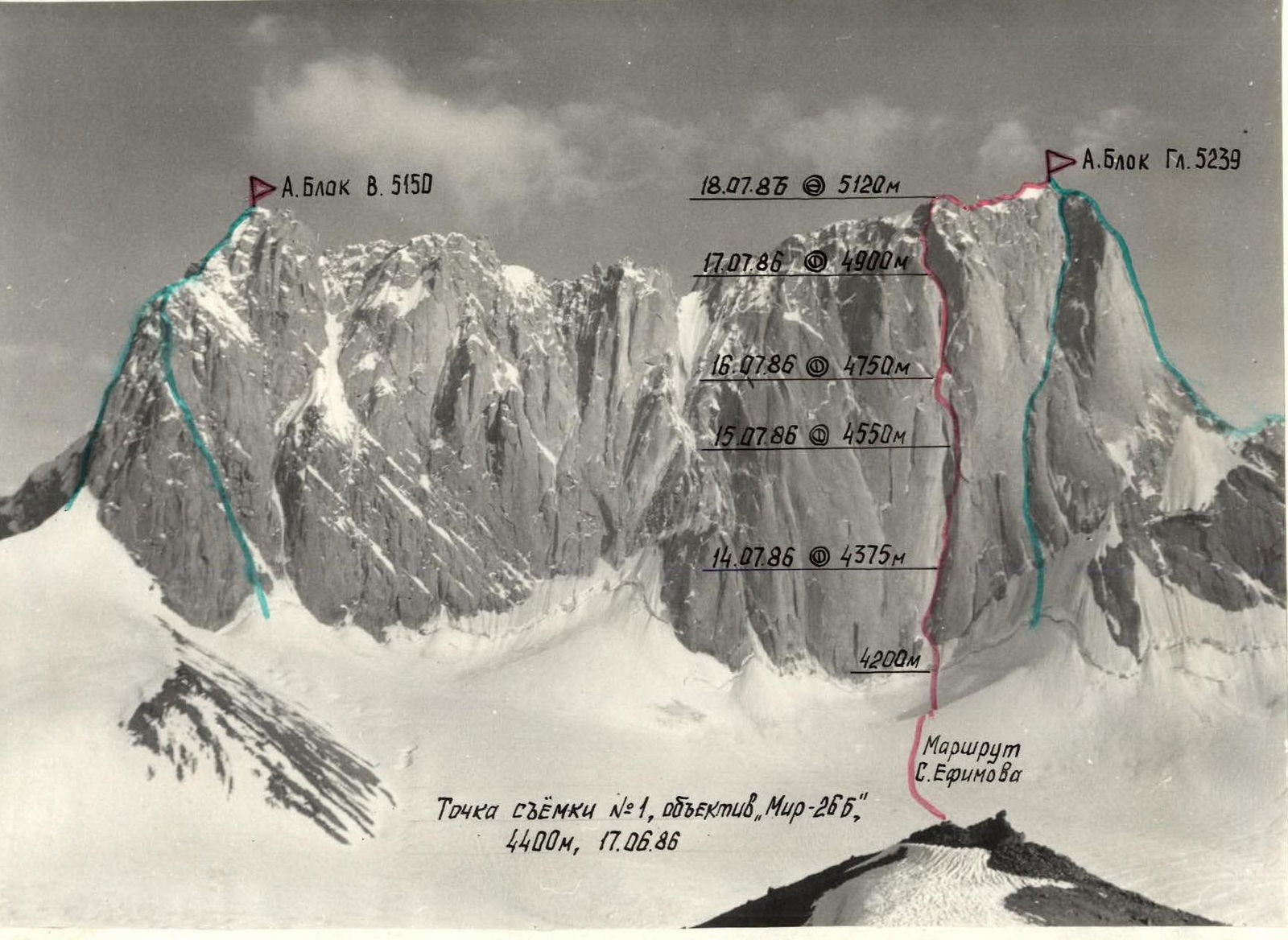
- Peak A. Blok (5239 m) via the central bastion of the northern wall (route by group of S. Efimov)
- DIFFICULTY CATEGORY — 5B, fourth ascent
- HEIGHT DIFFERENCE — 1039 m, length of sections with 6th cat. diff. — 583 m, 5th cat. diff. — 325 m. AVERAGE STEEPNESS of the main part of the route — 80°
- NUMBER OF PITS: rock — 138 (31), bolt — 8 (53), chocks — 156, ice — 28 (9)
- CLIMBING TIME — 77.5 hours, days — 6. 1 day of preparation
- NIGHTS: four sitting and hammock bivouacs, one lying on a ridge
- LEADER: Oshé Eduard Andreevich, Master of Sports
PARTICIPANTS:
- Kozyrev Vladimir Nikolaevich, Candidate for Master of Sports
- Litvinov Anatoly Nikolaevich, Candidate for Master of Sports
- Robikov Dmitry Grigorievich, Candidate for Master of Sports
- Korotkova Natalia Vasilievna, Candidate for Master of Sports
- COACH:
- Antipenko Ernest Stepanovich, Master of Sports
- START OF THE ROUTE — July 14, 1986, SUMMIT — July 19, 1986. Return — July 20, 1986. REPORT BY PHOTO VERSION
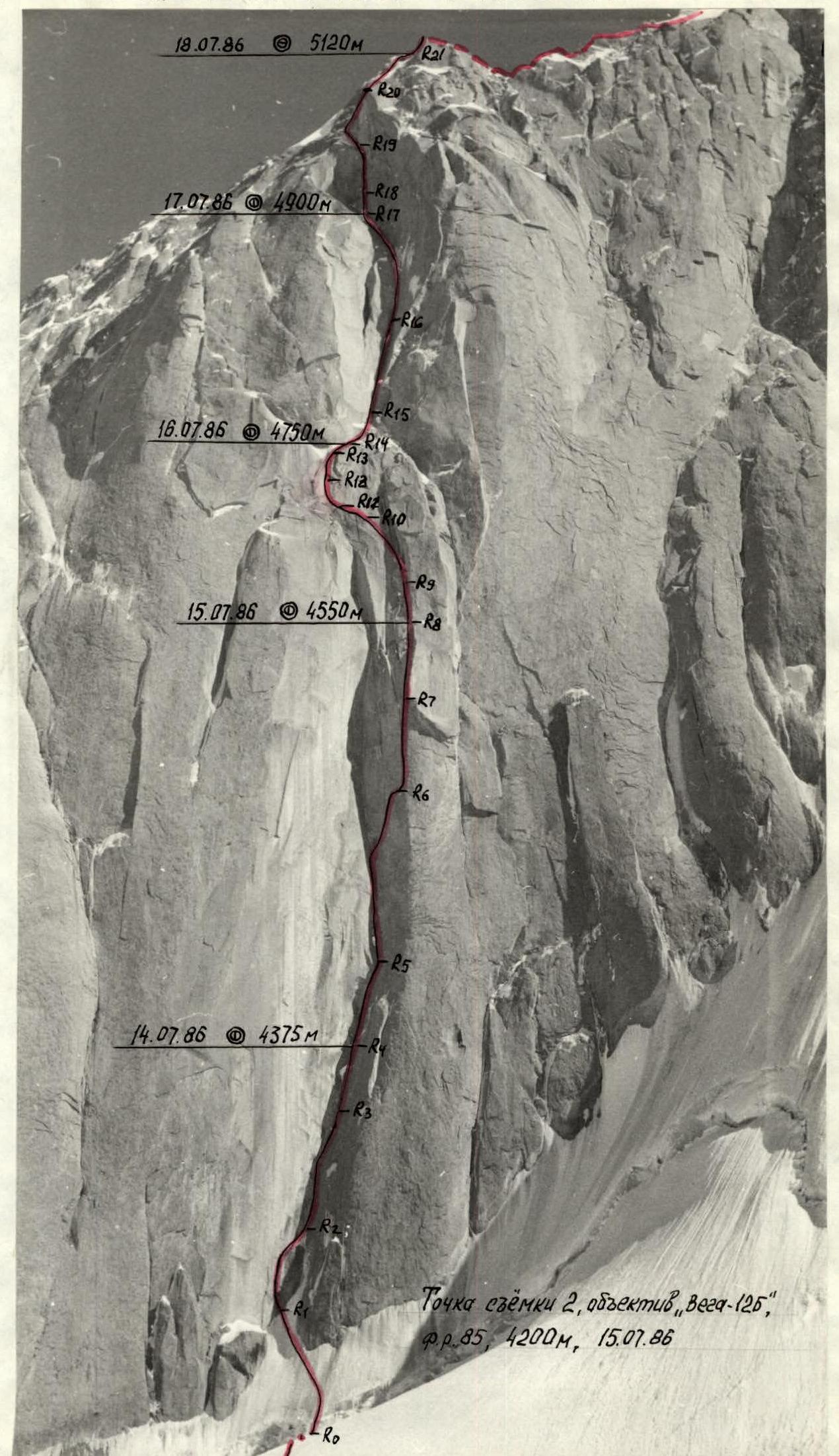
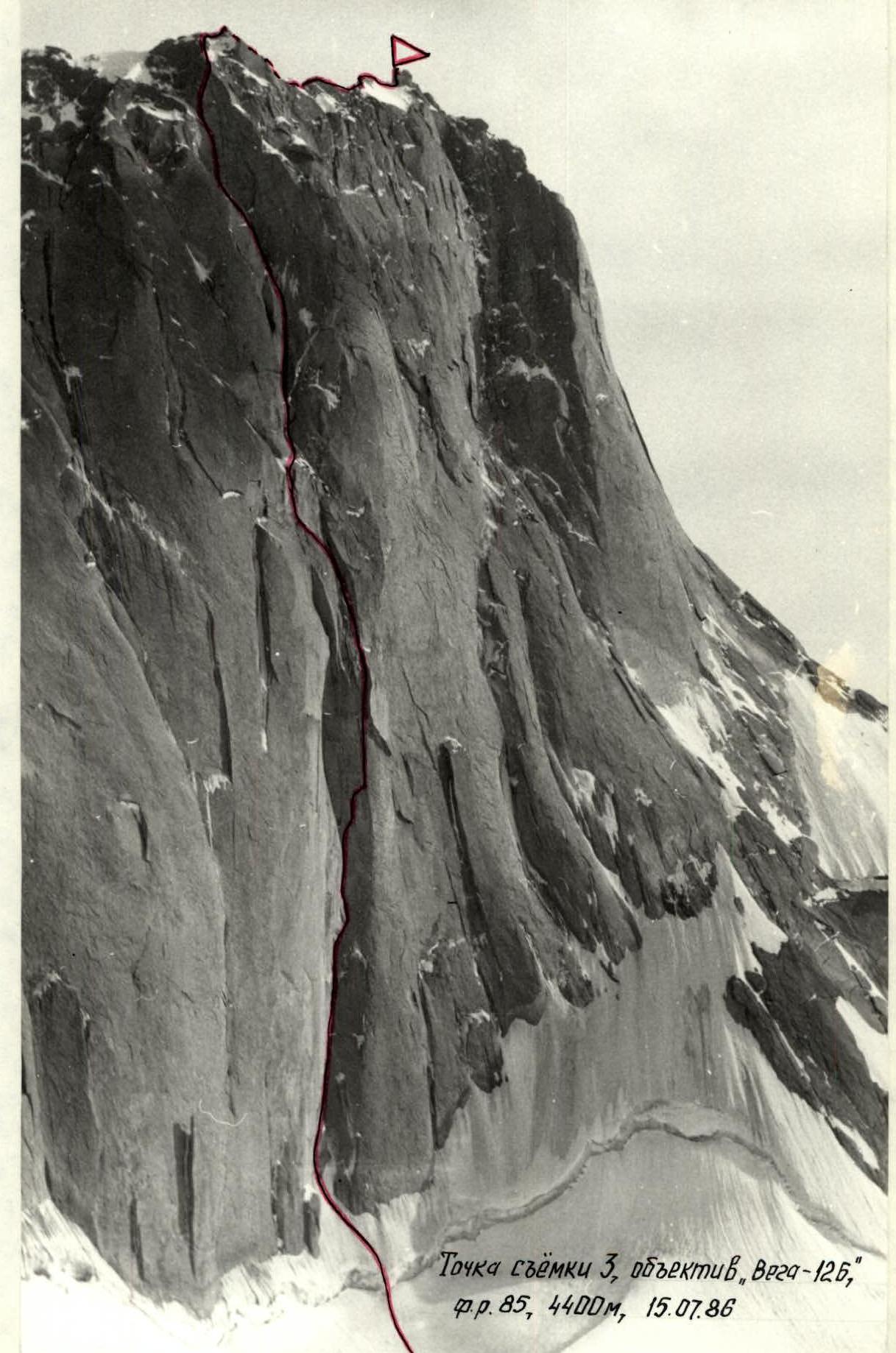
Route Profile from the Left
Tactical Actions of the Team
- Choosing the Tactics for the Route Ascent
When drawing up the tactical plan for the route ascent, the team took into account the following factors:
- Lack of relatively good bivouac sites on the wall.
- Shaded route.
- Unstable weather in the area during this period (rain, snow, cold snap, especially in the second half of the day). These factors predetermined the tactics of ascending the route with 5 bivouacs. The bivouac locations remained largely unchanged compared to the planned ones.
- Solving Tactical and Technical Problems by the Team During the Ascent
During the ascent, the team had to solve the following tasks and problems:
- Completing the first 175 m of the route without organizing additional bivouacs.
- Organizing hammock bivouacs.
- Passing нависающих and cornice sections without bypassing them directly.
- Ascending part of the route in bad weather.
- Possibility of reaching the planned bivouac sites within a working day in bad weather.
The team solved these tasks and problems, which allowed:
- To ascend the route without additional bivouacs in bad weather.
- Ensuring absolute safety during the ascent.
The following actions of the group contributed to the successful solution of tactical and technical problems:
- Relatively even workload distribution among the rope teams and leaders throughout the route (and throughout the day).
- Preliminary processing of the R0–R4 section.
- Significant work on organizing bivouacs on narrow ledges (in hammocks), which provided sufficient rest for the climbers.
- Using modern, lightweight equipment on the route.
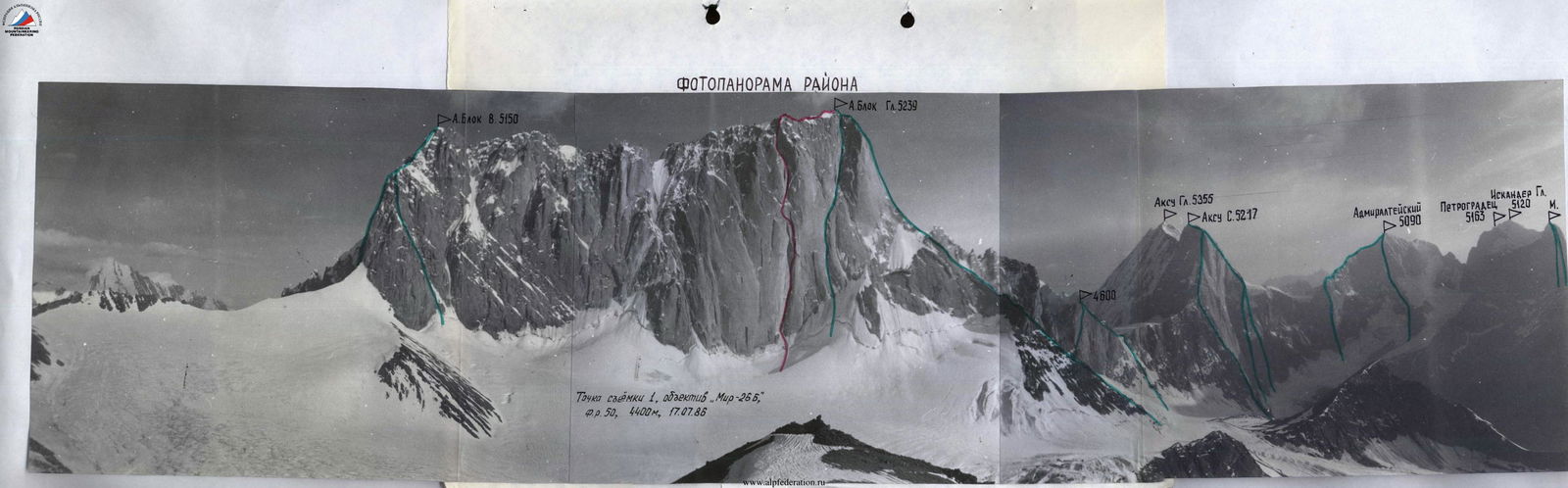
Photopanorama of the Area
- Selecting duplicated food products, which minimized their weight.
- High level of rock climbing preparation among the participants, allowing them to switch leading roles within the group and rope team and to climb most of the route using free climbing techniques.
- Ensuring reliable and regular radio communication with the base camp and visual communication with observers.
- Using "kroogernogi" for accelerated rope movement.
- On the most challenging sections, backpacks were attached to the harness using the American method.
- All participants climbed on a double rope.
Ascent Scheme in Symbols
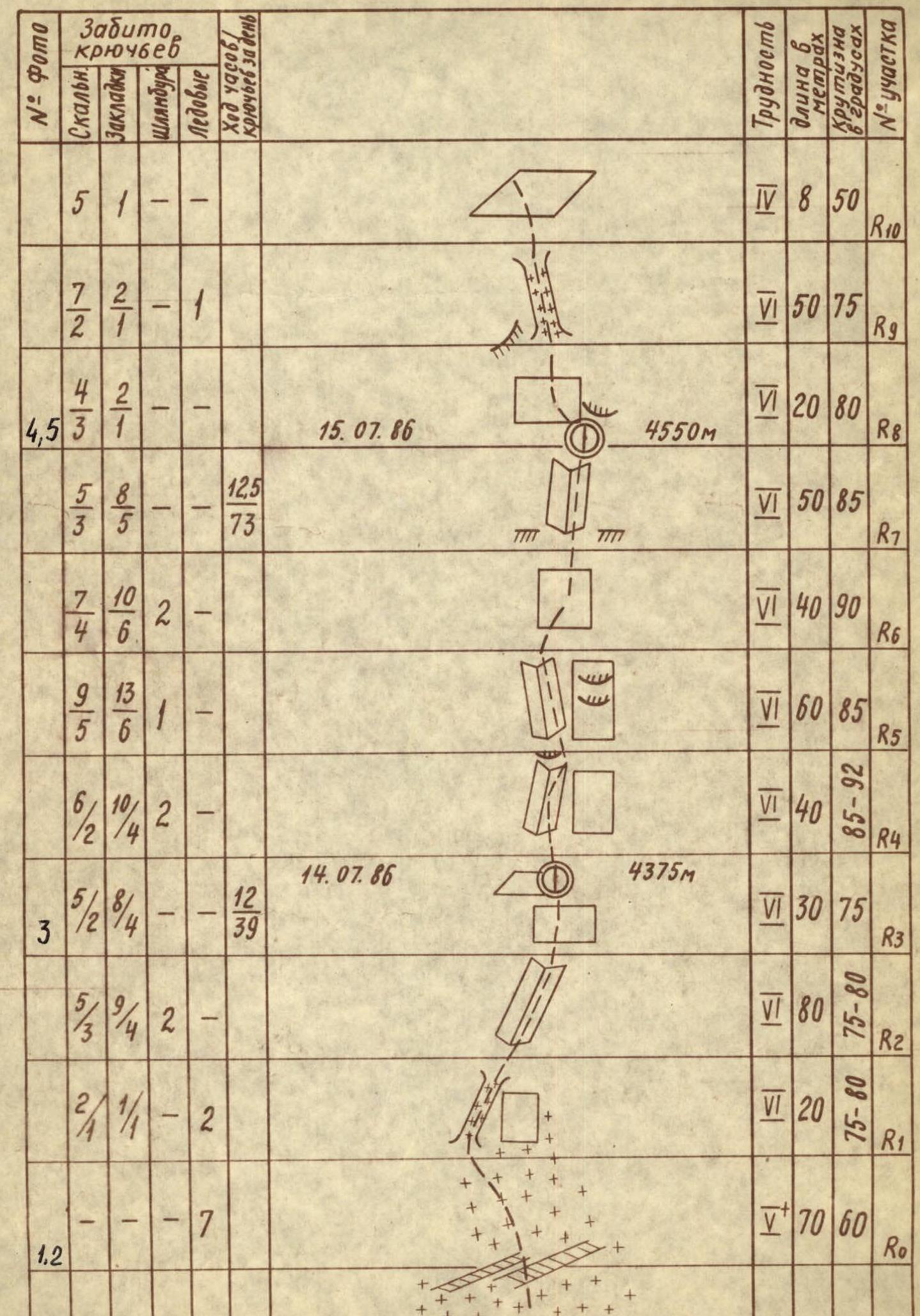
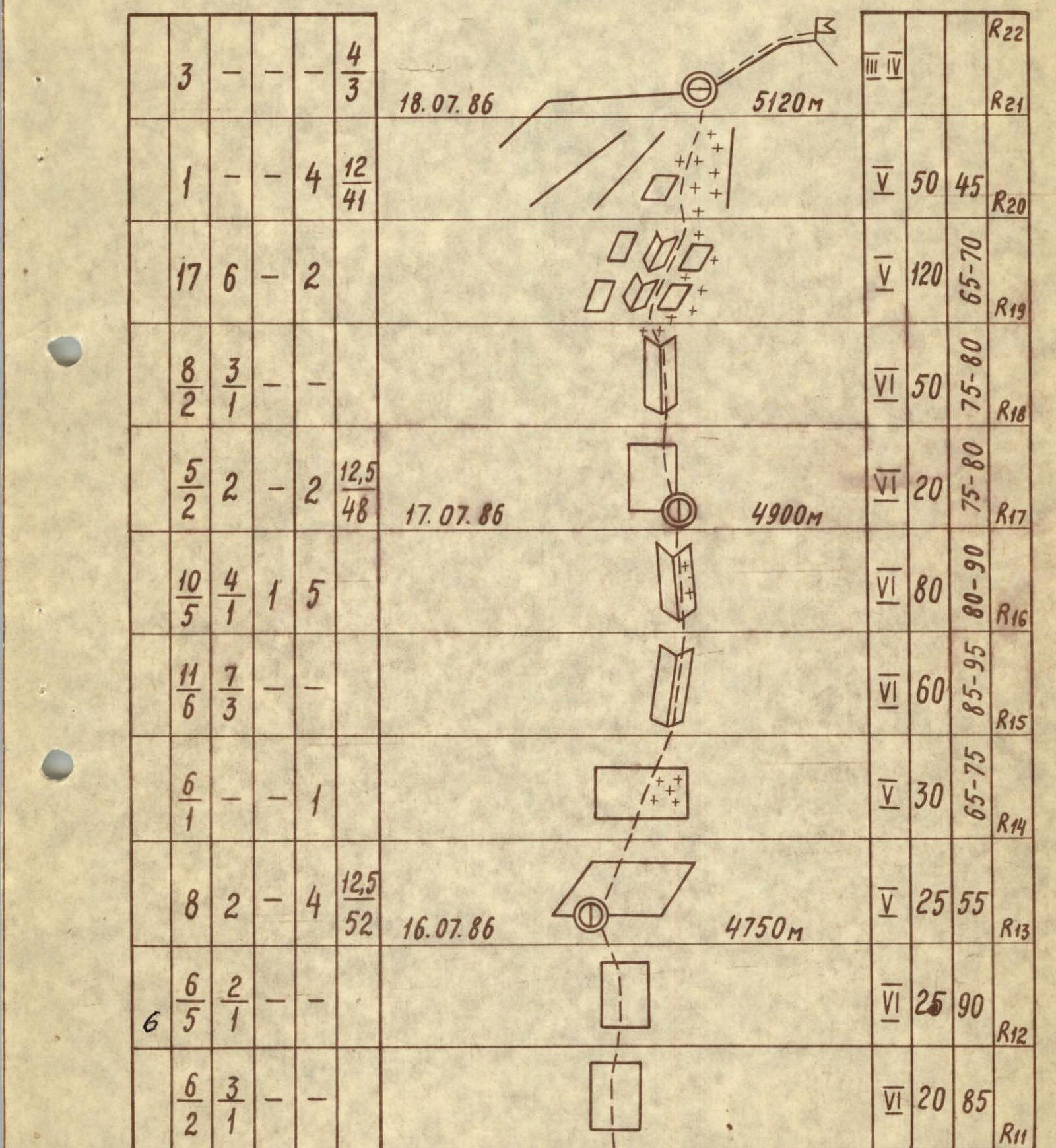
Route Description by Sections
July 12. The climbers left the base camp at 2900 m and approached the central bastion of the Northern wall, where they set up an intermediate camp. July 13. Early in the morning, the Robikov–Litvinov rope team ascended via firm firn to the bergschrund at the base of the bastion. They crossed the bergschrund and then climbed a steep ice slope (70 m) using ice axes and crampons. They followed a snow-filled chimney (20 m) to enter a steep internal corner (section 2, 80 m). The smooth granite had micro-ledges, virtually no cracks. Extremely difficult climbing using ladders, platforms, etc., with the first climber requiring high technical skill. They exited onto a 30-meter wall. The wall's character was the same — monolithic. Completing section 3 required using the entire arsenal of alpine equipment. After processing it, the rope team descended to the intermediate camp. July 14. The whole group traversed the previously processed sections via hanging ropes. By 15:00, everyone gathered at the intended bivouac site. The Kozyrev–Oshé rope team continued processing the route, while the others set up a hammock bivouac. The ascent continued up a steep internal corner (40 m), which led to a cornice. They bypassed the cornice on the wall to the right. The smooth granite had minimal ledges. They climbed the corner using étriers, ladders, etc. Further, extremely difficult climbing led them left into a steep internal corner (60 m) using étriers. They ascended the corner, which was partly overhanging, and then moved right onto the wall. On sections 4–5, they used 3 bolt anchors (two left by a previous group) to organize belay stations. From here, the rope team descended to the prepared bivouac. July 15. The task for the day was to ascend via hanging ropes, enter the "gates," and reach the next bivouac site. The Litvinov–Robikov rope team led. They climbed a smooth (40-meter) granite wall right-upwards towards two rock cornices forming the "gates." Extremely difficult climbing. Few ledges were available; often, they used platforms. From the "gates," they entered the right internal corner (50 m), partly filled with ice. Climbing was extremely challenging: using étriers and the entire arsenal of alpine equipment. The first climber required high climbing technique. Sections 6–7 were among the key locations on the route. Passing these required the highest climbing technique from the team members. They reached the bivouac site. Two participants sat on a narrow ice ledge; three were in hammocks. On sections 2–7, all belay stations were organized in a hanging position. July 16. At 8:00, the first Oshé–Kozyrev rope team started moving from the bivouac site left-upwards on a 20-meter wall. Difficult climbing towards a chimney filled with ice. They ascended the ice-filled chimney (50 m) left-upwards using ice screws, chocks, and rock anchors. They exited onto a narrow rock ledge (8 m) below a steep rock wall. The leader changed within the rope team. From the left part of the ledge, they climbed a vertical rock wall (45 m). Extremely difficult climbing using:
- rock anchors,
- chock stones,
- kroogernogi.
They moved slightly right along a spall and then up a narrow crack to a slab. They traversed the slab, which ended in an inclined snow ledge at the bivouac site, an uncomfortable sitting position. Control tour. Processing of the ice section 13. From here, the rope team descended to the bivouac prepared by the "three." July 17. At 7:30, the Robikov–Litvinov rope team climbed 30 m via a hanging rope and continued along the route. They traversed a slab to enter an internal corner. Difficult rock climbing. Icefall. They ascended a steep 60-meter internal corner (80 m), partly filled with ice, left-upwards. Extremely difficult climbing on rock and ice using:
- ice axes,
- crampons.
The traversed sections R15–R16 were key on the route. They reached the bivouac site. Bivouac in hammocks. July 18. The task for the day was to reach the pre-summit ridge. At 8:00, the Kozyrev–Oshé rope team started ascending left-upwards on a 20-meter slab (section 17), then right into an internal corner. Difficult free climbing. They climbed a steep internal corner (50 m), partly filled with ice. Climbing was extremely challenging: using étriers, kroogernogi, and platforms. From the internal corner, they traversed left on ice. Internal corners alternated with walls (section 19). Difficult free climbing. A steep, complex ice slope (section 20) led to the ridge approaching the summit. Bivouac on the ridge in a snow depression. All belay stations on sections 15–19 were in a hanging position. July 19. Movement along the ridge from the bivouac to the summit was alternating, presenting no technical or tactical difficulties. Gendarmes were bypassed on the left; one was climbed directly. On the ridge, there were snow cornices. Before reaching the summit tower, there was натёчный ice. By noon, the group gathered at the summit. At 13:00, they began descending via the Southwest ridge (12 rappels) and stopped for a bivouac on the ridge between Peak A. Blok and Peak 4600 m at 21:00. July 20. At 6:00, the group continued descending to the glacier and by 9:00, everyone was at the moraine in the observers' camp.
Technical Photograph of the Route