
Report of the team from the Republic of Bashkortostan and Novosibirsk region on the ascent of Pik Asan via the Northwest wall, Pogorelov's route, 6A category of difficulty.
Climbing Passport
- Region, gorge, section number according to the classification table: Pamir-Alay, Karavshin gorge, Turkestan range
- Name of the peak, route name: Asan via the left part of the western wall (Pogorelov's route)
- Category of difficulty: 6A
- Route type: rock climbing
- Height difference of the route: 1000 m (wall section 670 m)
Route length: 1270 m. Average steepness of the wall section: 78°
-
Equipment used on the route:
- anchor pitons — 80 pieces
- camalots — 60 pieces
- nuts — 20 pieces
- Pitons left on the route — 1 bolt on the descent
-
Team's total climbing hours: 42 h 30 min
-
Team leader: Kotenko Viktor Mikhailovich, Candidate for Master of Sports
Team members: Sharafutdinov Dinislams Rashidovich, 1st sports category, Nikonov Maxim Anatolyevich, 1st sports category
- Coach: Minibaev Akhmadulla Akhmetgarievich, Candidate for Master of Sports
- Departure to the route: July 25, 2022, at 6:20
Reached the summit: July 27, 2022, at 15:00. Returned to the base camp: July 27, 2022, at 23:00
- Organization: FARB
General photo of the summit
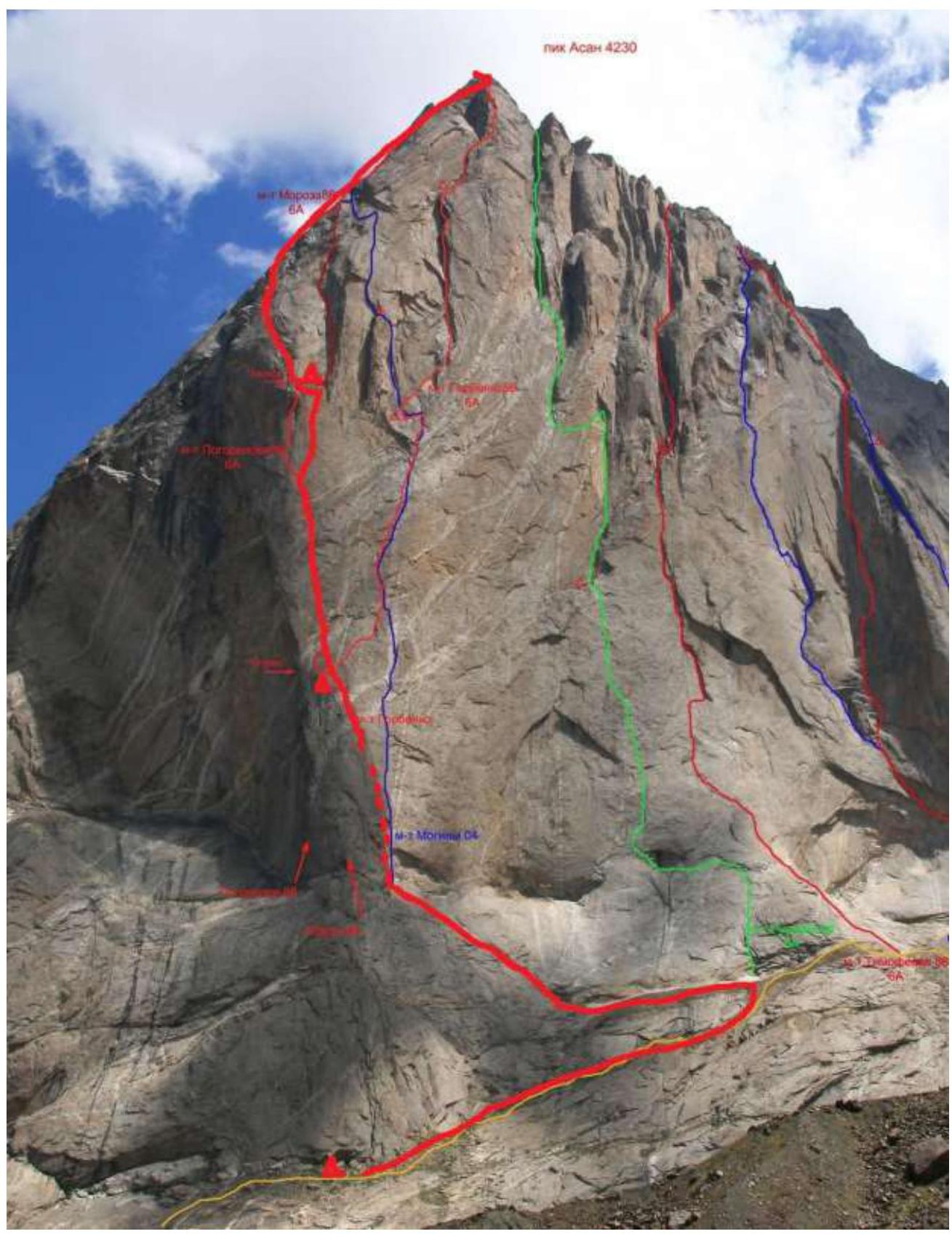
The team's route is marked with a bold red line.
Characteristics of the climbing area and object
Pamir-Alay is a mountain system intermediate between the Pamir and Tian Shan. It includes several ranges stretching latitudinally, bordering the Fergana valley to the south. The main range is the Alay range, which then branches into:
- Turkestan range
- Zeravshan range
- Gissar range
The Karavshin area is geographically located in the Turkestan range, west of the Matcha mountain node. Politically and administratively, it is in the Batken district, Osh region, Kyrgyzstan.
The area can be accessed:
- by helicopter
- on foot
The watershed of the Ak-Suu and Kara-Suu rivers, which includes peaks 4810, 1000-letiya krestcheniya Rusi, Kotina, Asan, Usen, and others, is located in the northern spur of the Turkestan range. The Kara-Suu gorge is closed to the south by Pik Pyramid (5503 m) with a powerful glaciation, feeding the Kara-Suu glacier and determining the microclimate in the gorge.
On the left orographic side of the Kara-Suu glacier are snow peaks with heights up to 5300 m, and on the right is a whole system of peaks with heights from 4200 to 4900 m, among which Pik Asan and Pik 4810 stand out with their powerful monolithic sheer walls.
All peaks on this side have a slight snow cover and are composed mainly of granitoids.
Climbers began to explore the area in 1980, when three routes of 6B category of difficulty were first ascended on the northwest wall of Pik Asan as part of the USSR Championship. The northwest wall of Pik Asan presents a complex kaleidoscope of rock difficulties. In the same year, a route of 5B category of difficulty was ascended on the western ridge of Pik 4810. In 1987, teams from Leningrad and Odessa attempted to tackle the NW wall of Pik 4810 but were forced to retreat due to harsh weather conditions. In subsequent years, the problem of ascending both the NW and E walls of Pik 4810 was solved. Leningrad and Odessa teams ascended several challenging routes. Today, the most logical and expressive routes on the NW wall are considered to be those of Moshnikov and Rusyaev.
The most popular peaks have been and remain:
- Asan
- Slesova
- 4810
They stand out both in terms of the number of routes laid on their walls and the number of ascents made on them.
Each of these peaks has at some point determined the fashion for climbing in its class. Asan was the "visiting card" of the area in 1986–1988. Currently, nine routes have been laid on the summit, eight of which pass along the sheer NW wall, which has a height difference of over 900 m.
Route diagram in UIAA symbols
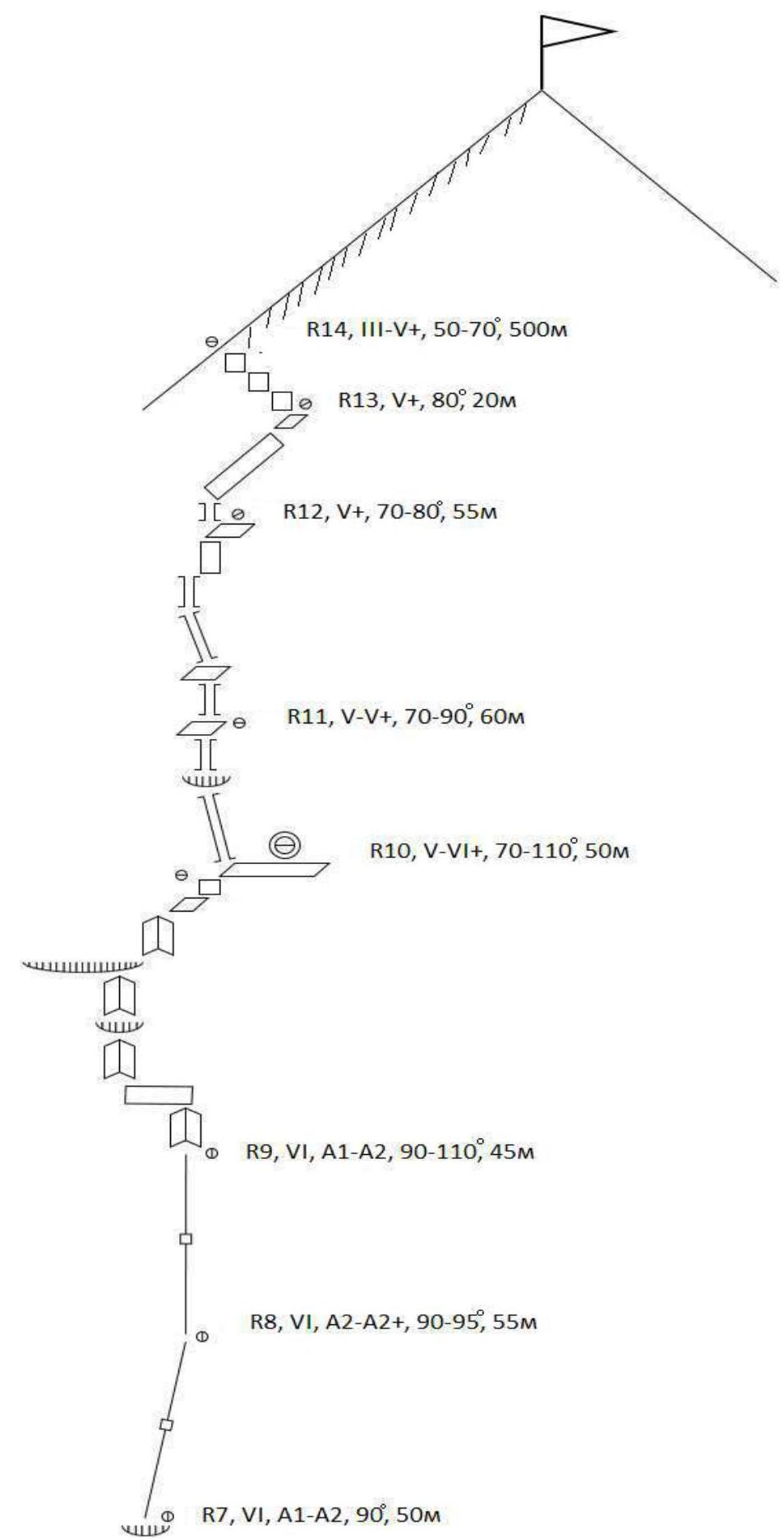
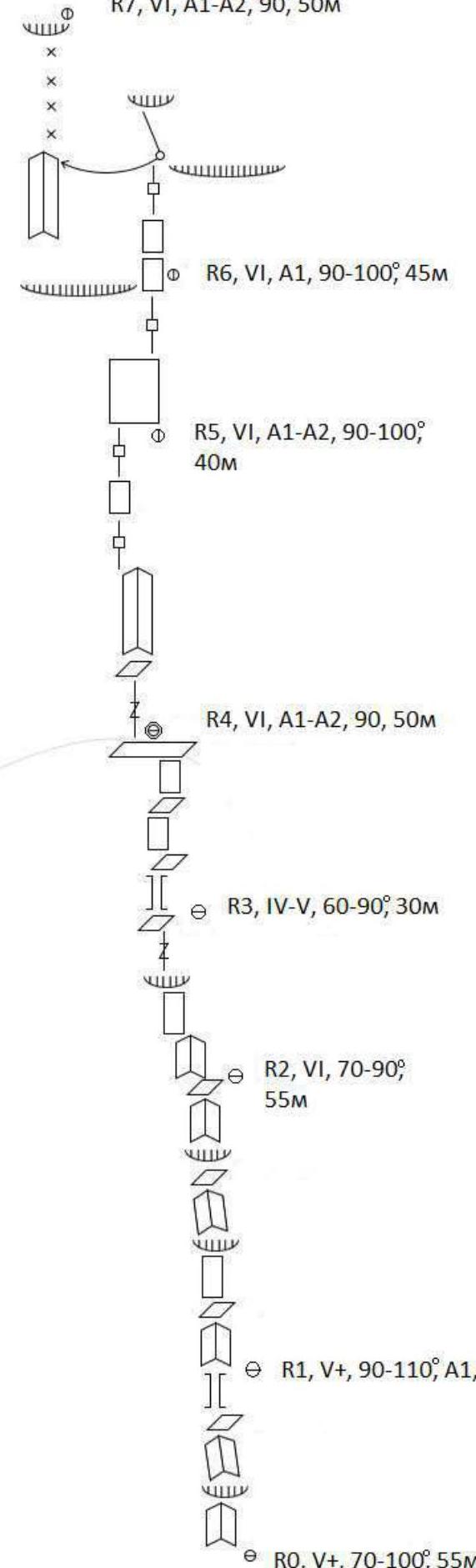
R14, III–V+, 50–70°, 500 m R13, V+, 80°, 20 m R12, V+, 70–80°, 55 m R11, V–V+, 70–90°, 60 m R10, V–VI+, 70–110°, 50 m R9, VI, A1–A2, 90–110°, 45 m R8, VI, A2–A2+, 90–95°, 55 m R7, VI, A1–A2, 90°, 50 m R6, VI, A1, 90–100°, 45 m R5, VI, A1–A2, 90–100°, 40 m R4, VI, A1–A2, 90°, 50 m R3, IV–V, 60–90°, 30 m R2, VI, 70–90°, 55 m R1, V+, 90–110°, А1, 60 m R0, V+, 70–100°, 55 m
Technical description of the route
From the camp in the Kara-Suu gorge, follow the trail under the slopes of Maly Asan, then along the terraces under the wall of Asan, veering right. Overnight stays are possible:
- under a large overhang almost under the "Gherkin" bastion
- or under Alperin's route 5B, but from there, you will need to descend a bit to the start of the route.
From under the overhang, go right and up, bypassing the "Gherkin" on the right, then left along the lying internal corner and scree shelves (II–III category of difficulty, 90 m) to approach the start of the route. The time taken to approach from the Kara-Suu camp is 2.5–3 hours.
R0–R1 V+ 55 m. Climb up the slabs, initially slightly to the right, then up through a series of walls and corners. There are some overhangs. There is an old bolt. Exit onto a small ledge. There, you can set up a station on two old bolts and your own gear. From the ledge, go slightly left, then up through a chimney. Station on a small ledge before an overhang.
R1–R2 V+–VI, A1 60 m. From the station, climb up initially along the right wall, then through "feathers" into an overhang, and onto a small ledge.
From the ledge:
- climb up the wall to the right
- then move into the internal corner on the left
- climb up to another overhang.
Then, move left towards a sloping ledge. Station on the sloping ledge on your own gear. There is a local bolt.
R2–R3 VI 55 m. Climb right along a small wall onto a sloping slab, then left and up through a vertical crack (free climbing, some overhangs). Station on a ledge before a chimney on a local bolt and your own points.
R3–R4 V–IV 30 m. Climb up the chimney, then through a series of walls and ledges to the top of the "Gherkin." Here, an overnight stay is possible. The bivouac site is in a rockfall-prone area (dangerous if someone is working on the roof — everything falls here).
The team's bivouac site (managed to process two more ropes that day) R4–R5 VI, 50 m, A1–A2.
From the bivouac site on the "Gherkin":
- Climb up the wall to the right of the crack onto a slightly smaller ledge directly under the wall.
- From the ledge, go left and up through a series of walls and internal corners to approach a large crack (about a fist wide, expanding and overhanging towards the top).
- Climb up using IT0 on large camalots.
- In the upper part of the crack, move to the left wall through an overhang.
The station is an uncomfortable hanging one on old local bolts, backed up by your own gear.
From there, you can climb up another 10 m through a narrow crack on anchors (ITO A1–A2), where there is a station on two new foreign certified bolts with a small ledge for one or two people (this is the team's chosen route). R5–R6 VI 40 m, A1–A2.
From the station on two bolts:
- Climb right and up a wall with cracks, passable by free climbing towards an overhang.
- Then, climb straight up through a crack using IT0 to a hanging station. There is a local bolt.
The station is uncomfortable.
R6–R7 VI, 45 m, A1. From the station, climb up initially along a slab, then through a crack to a local piton with a loop.
From the piton:
- Make a pendulum left for 8–10 m into the upper part of an internal corner.
Then:
- Climb straight up through a simple IT0 on old bolts and your own gear through a small overhang.
- At the fork of two cracks, turn into the right one.
Station at the base of a thin crack on four anchors.
R7–R8 VI 50 m, A1–A2. Climb up through the thin crack using IT0 on anchors and small nuts. Hanging station on local bolts on a slab.
R8–R9 VI 55 m, A2–A2+. Vertical rope IT0 through a thin, deep crack on "fifi" and anchors.
There is one old local bolt with an "Irbit" carabiner.
Insurance is complex.
The station is hanging on two local bolts before a large flake.
R9–R10 VI 45 m, A1–A2. From the station, climb straight up through the flake (camalots 4 and 5), then left, traversing along the wall behind the bend under an assumed internal corner. Climb up through the internal corner through overhangs using IT0 or free climbing. From under the overhang, go right and up through an internal corner leading to a small ledge. From the ledge, climb up and right along a small wall — a "balcony."
The ledge:
- is a bivouac site for 3 people;
- can accommodate up to 6 people with separate bivouacs;
- has a station at the base of a chimney on the team's gear on the left side of the ledge;
- has local bolts in the middle part of the ledge where you can set up a bivouac;
- has a control cairn — a tin can on a local piton.
The team's bivouac site.
R10–R11 V–VI+ 50 m. From the left part of the ledge:
- Climb up through a chimney
- through overhangs
- and a "plug." There is a bolt. Station on a ledge.
R11–R12 V–V+ 60 m. Climb up through a series of chimneys and walls to approach a large overhang visible from the Kara-Suu camp. Station in an uncomfortable location on anchors. Many loose rocks. Rockfall-prone area.
R12–R13 V+ 55 m. From the station, traverse left for 5 m behind the bend, then along a series of sloping walls and small overhangs, go right and up to bypass the large overhang.
- There is local gear
- One bolt
Station in an uncomfortable location, just short of the "roof."
R13–R14 V+ 20 m. Climb left and up behind the bend along a vertical wall and a series of sloping ledges. Station in a comfortable location on the "roof."
R14–summit, III–V+, 500 m. Climb up, following the right edge of the "roof." The large overhang (apparent but actually illusory summit) in the upper part of the "roof" is better bypassed on the right (there is local gear). Many loose rocks.
Route features:
- Almost all stations on this section are on foreign bolts, backed up by the team's gear.
- Two to three ropes before reaching the "roof," immediately after passing a large sentinel, the bolts run out (or lead somewhere else).
Tactical actions of the team
For two participants, this was their first 6A category climb in the high mountains. Therefore, the team focused primarily on the reliability of the insurance. They took provisions for three days and insurance gear with a reserve.
- The first participant worked without a backpack.
- The second participant carried a backpack with water, snacks, warm clothing, and additional gear.
- The third participant pulled a haul bag with the main supply of water, food, and bivouac gear for the entire team.
Up to the "roof," the haul bag was pulled using a 2:1 pulley system. The team took:
- One double sleeping bag
- One single sleeping bag
- Two sleeping pads
- A tent tarp in case of rain
Water was collected in the base camp — 20 liters (there is no water on or under the route). Another bottle of water was found under the route. All team members took turns working as the leader, each contributing according to their abilities.
The team was not entirely satisfied with the route. Although this line is considered the easiest 6A category route in the area, it was challenging for them, mainly due to their low level of free climbing and slow work on IT0. They finished work each day in the dark.
July 24. At 18:00, they departed from the Karavsu alpine camp towards the base of Pik Asan's wall (overnight stay under the "Gherkin").
July 25. At 6:30, they approached the sloping internal corner, which they overcame with simultaneous insurance. Then, they worked on the "Gherkin" using the classic alternating scheme. At 13:30, they reached the top of the "Gherkin" and began processing the key ropes on the wall. By 21:30, the leader had fixed two ropes, and the team returned to the top of the "Gherkin" for an overnight stay.
Leaders worked:
- Nikonov
- Sharafutdinov
Kotенко spent the day on the haul bag.
July 26. Started moving at 8:00. By 21:30, they climbed to a bivouac on the "balcony." Leaders worked: Kotenko and Sharafutdinov. Nikonov spent the day on the haul bag.
July 27. Began moving along the chimney at 8:00. Reached the "roof" by 10:30. Then, they moved along sloping slabs using the following scheme:
- The first participant climbed an entire rope with insurance.
- Reached a local bolt, set up a station.
- Accepted the rest of the team with top insurance.
They did not use simultaneous insurance due to sparse protection and a heavy haul bag with one of the participants. Reached the summit at 15:10. Leaders worked: Kotенко and Nikonov. Sharafutdinov worked as the second.
The descent involved rappelling on 16 ropes from the ridge leading towards the Pik 4810 cirque. After traversing about 40 m, they had to leave the local loops on the "balda" and move left along the descent route. Then, they rappelled 11–16 ropes towards the Pik 4810 cirque. Further, they descended along ledges towards the bivouac sites under Gorbenko's route 5B.
Finished rappelling at 21:30. Returned to the base camp in the Kara-Suu gorge at 23:00.
The route was completed without incidents. Key sections were ascended using free climbing and IT0.
The first participant worked on a double rope, and the second and third participants ascended on fixed ropes with top insurance.
The team took:
- 20 liters of water (+1.5 liters found under the start of the route)
- instant noodles
- dehydrated food
- sweets
- tea.
Photo illustrations
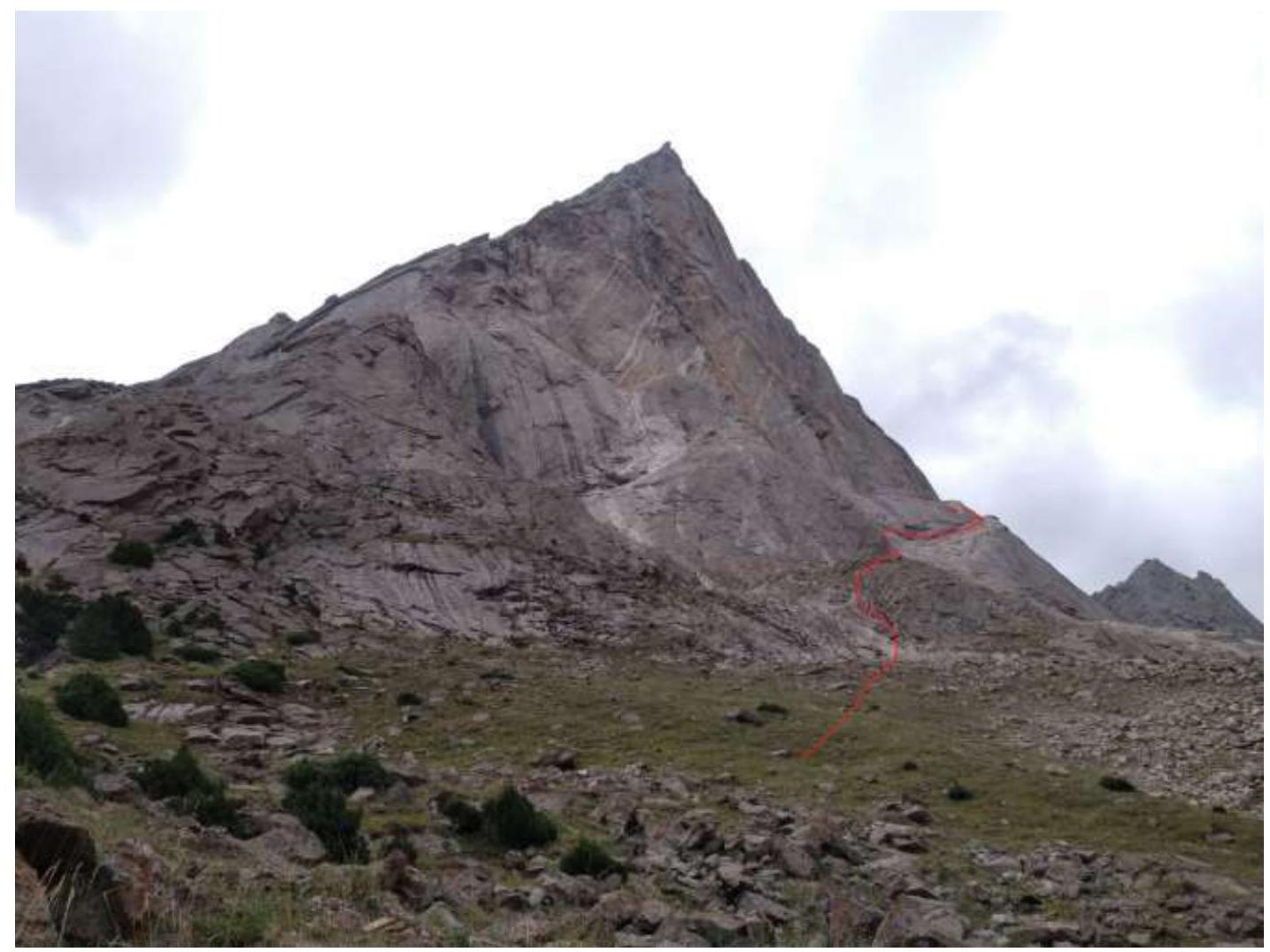
Approach to the route.
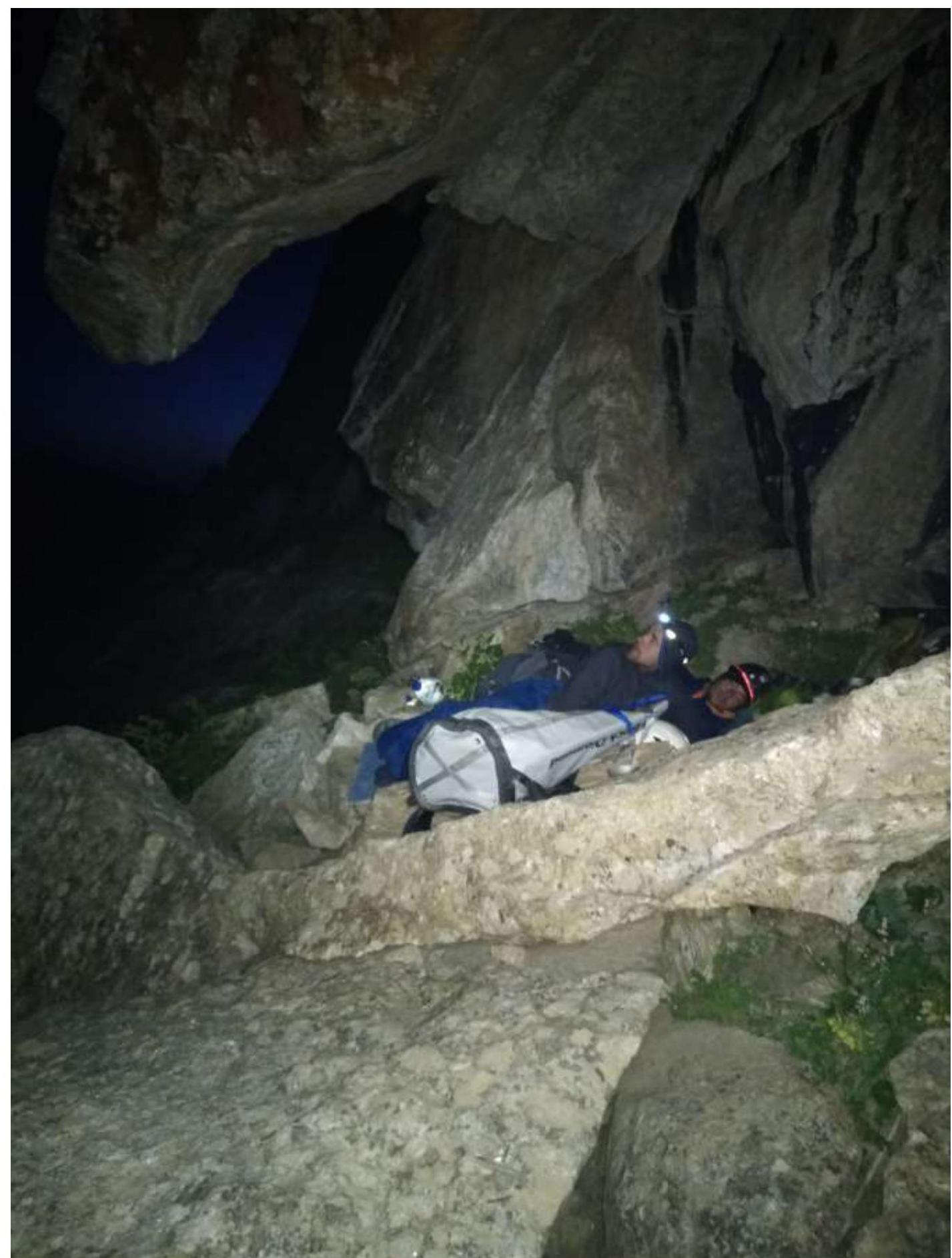
Bivouac site under the start of the route.
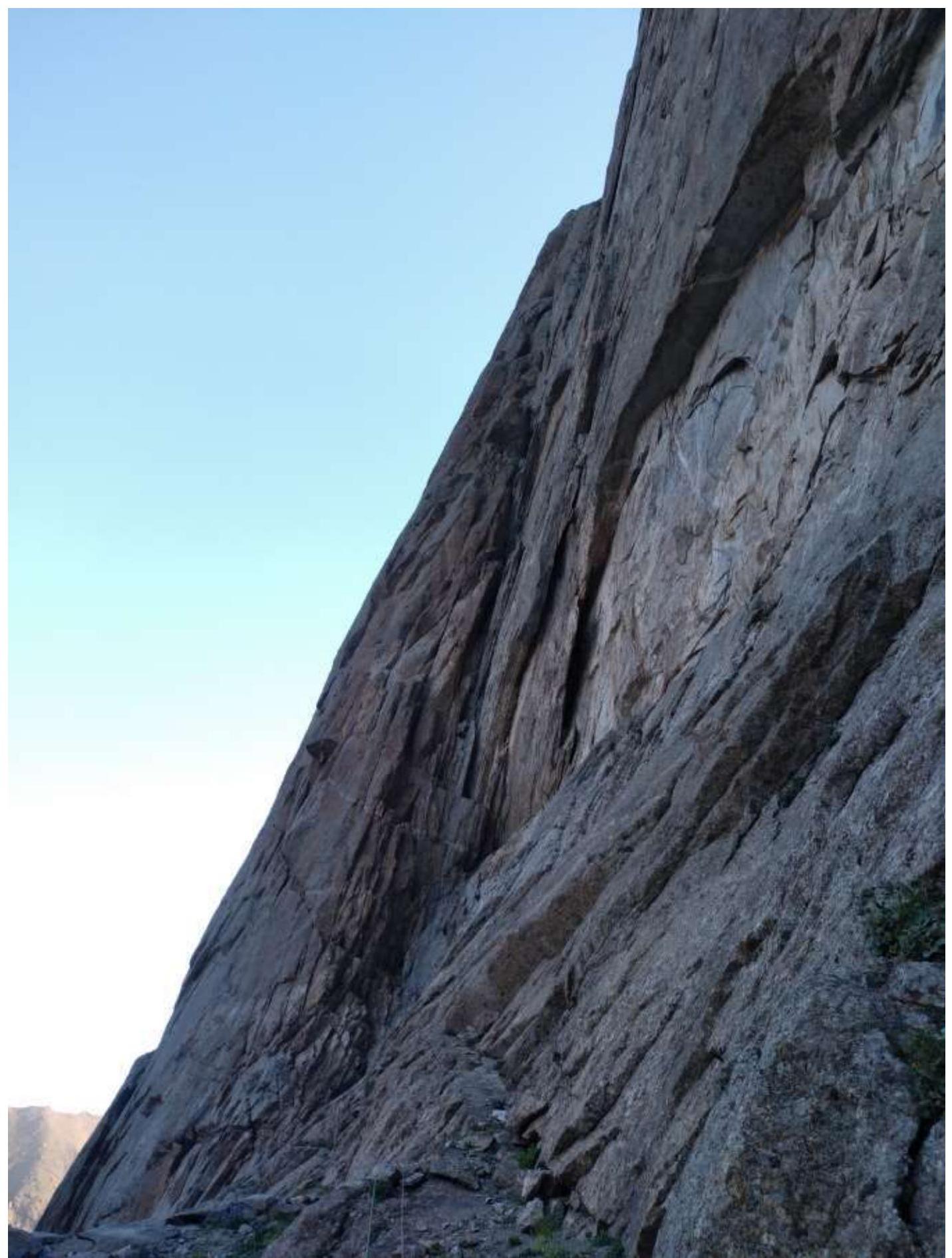
View of the start of the route (part of the gentle ledge is visible where simultaneous insurance can be used).
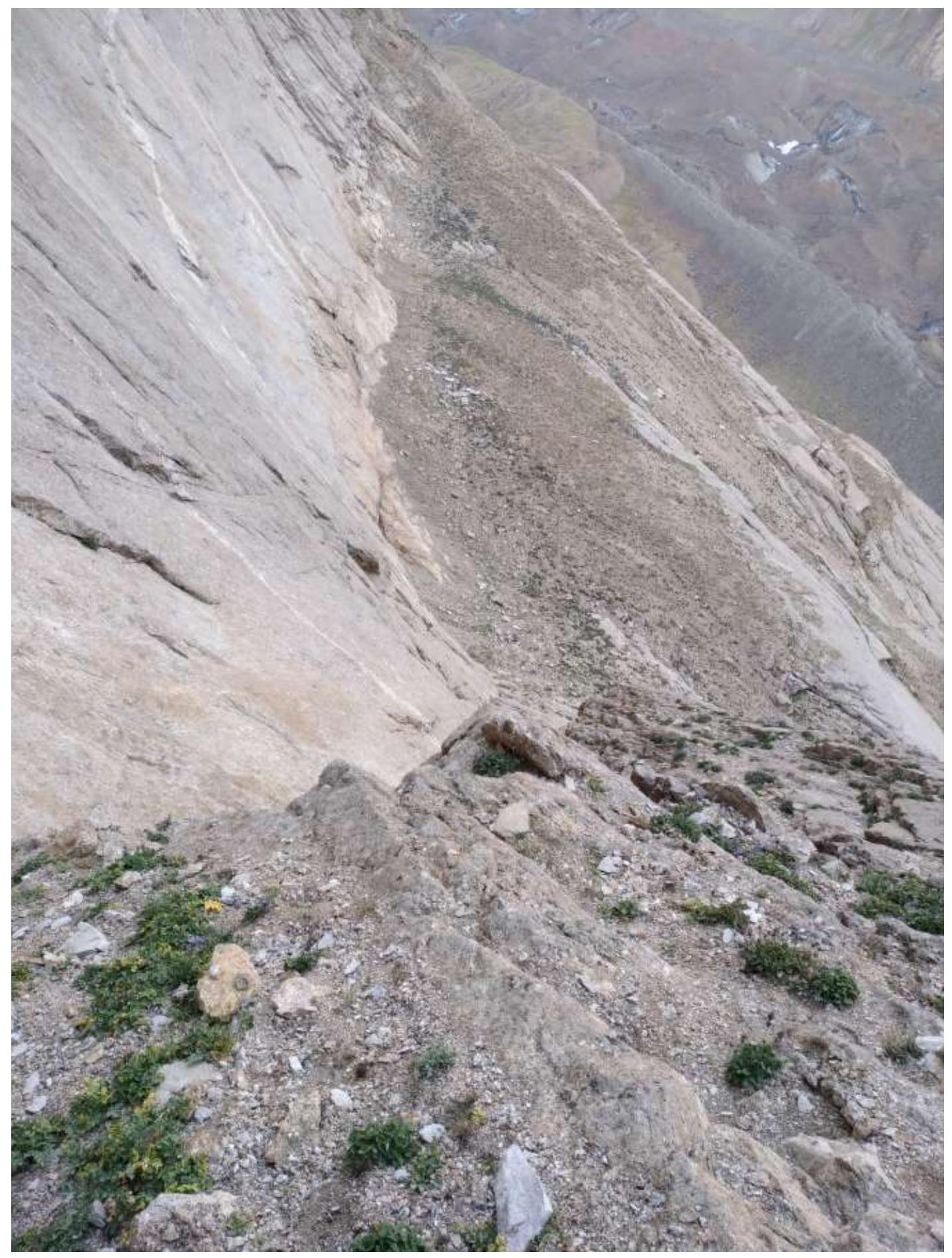
View down from the same ledge.
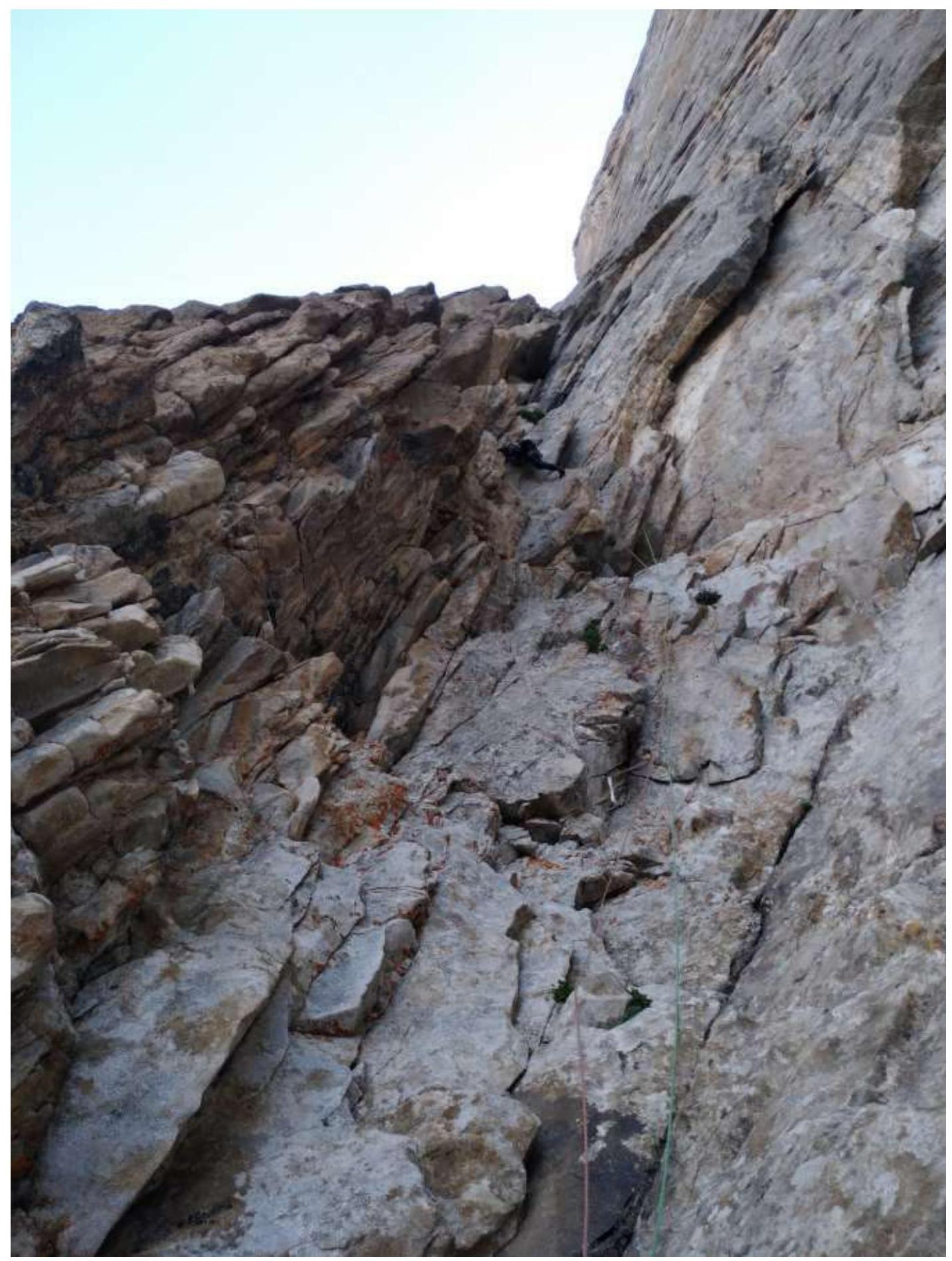
Leader working on the first rope on the "Gherkin" (R0–R1).

View down from the fourth rope on the "Gherkin" (section R3–R4).
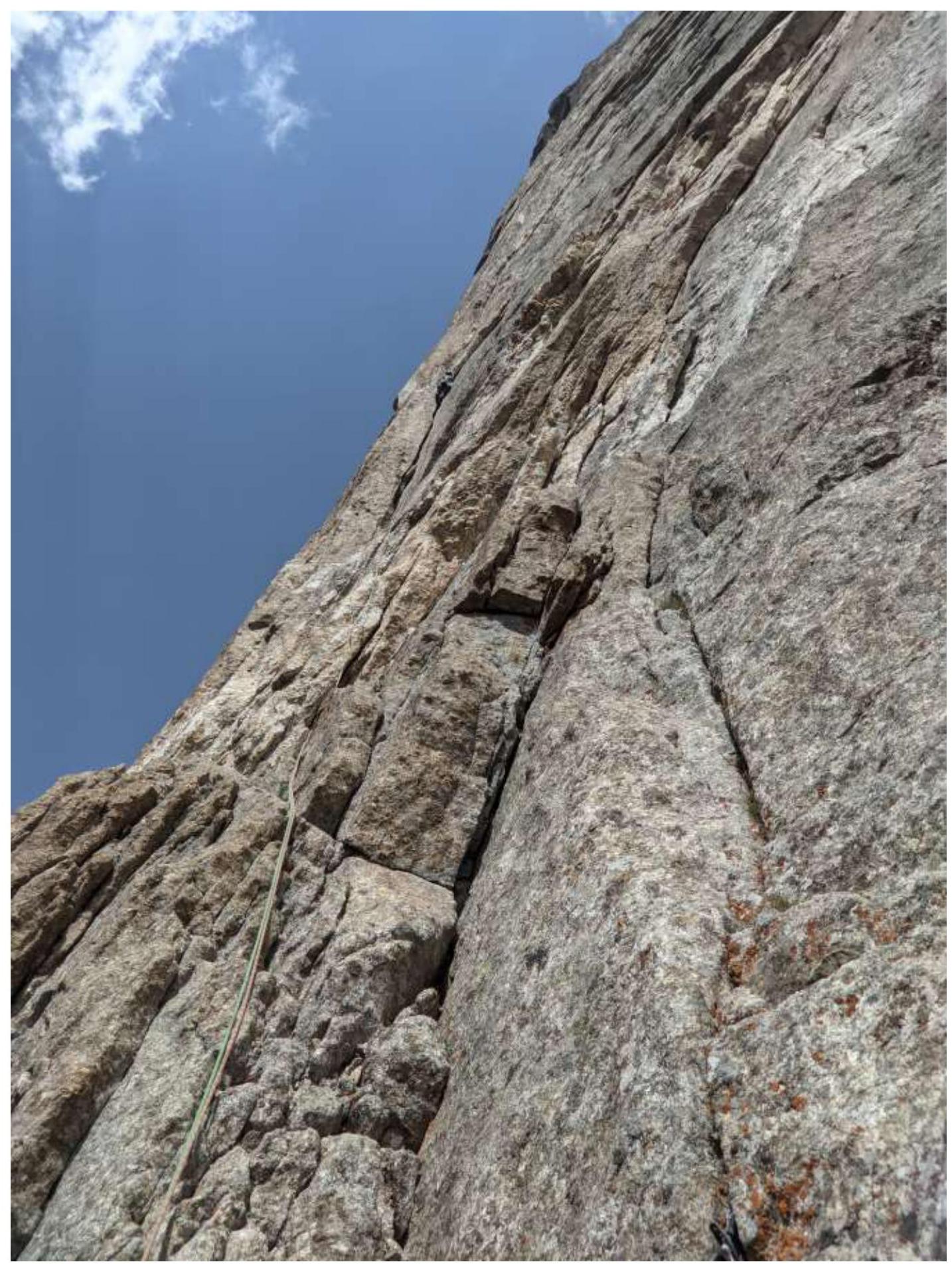
Leader working on the first rope after the "Gherkin" (section R4–R5).
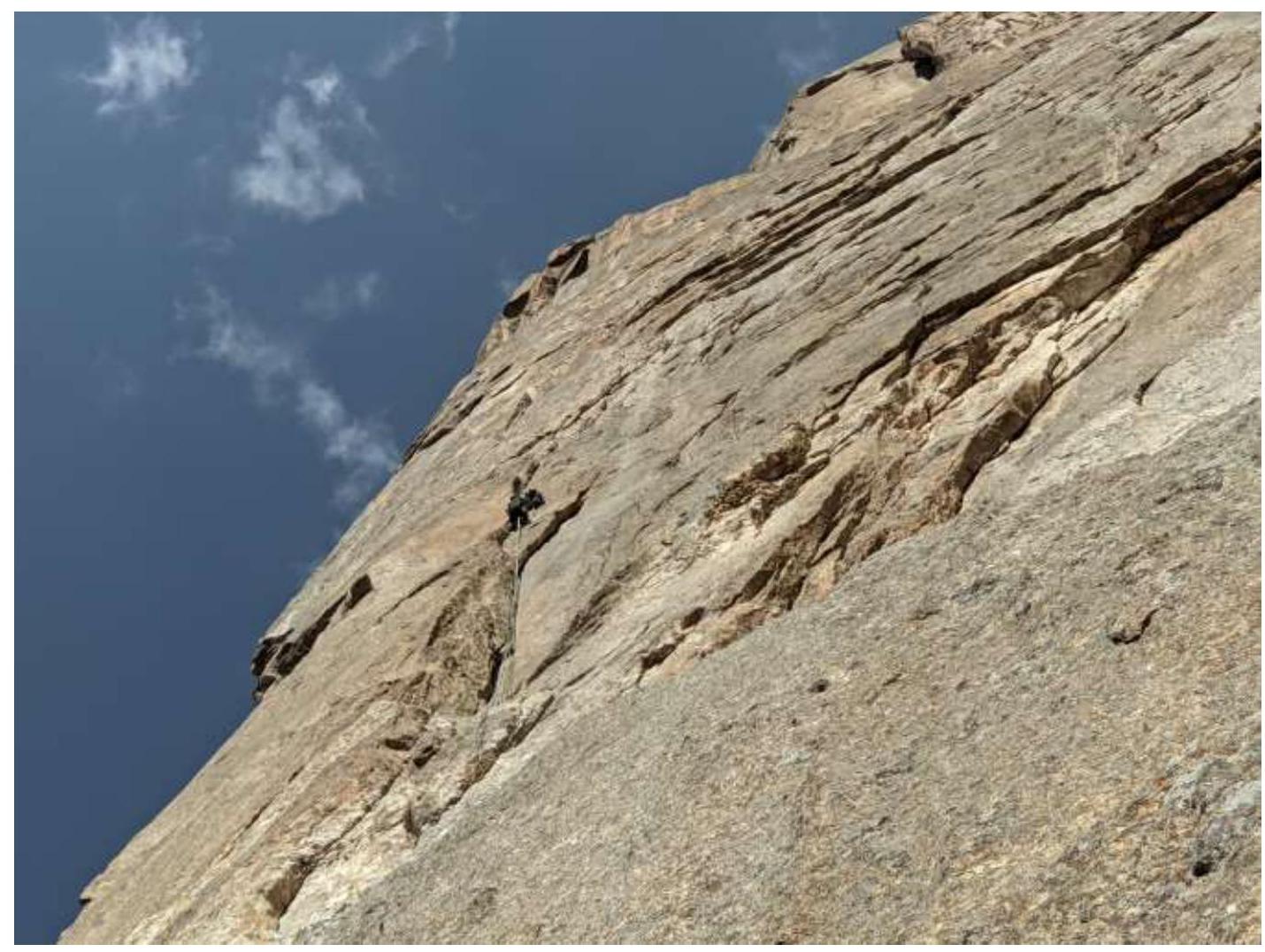
Processing a section of a deep crack towards a station on new bolts, after a station on old bolts (R4–R5).
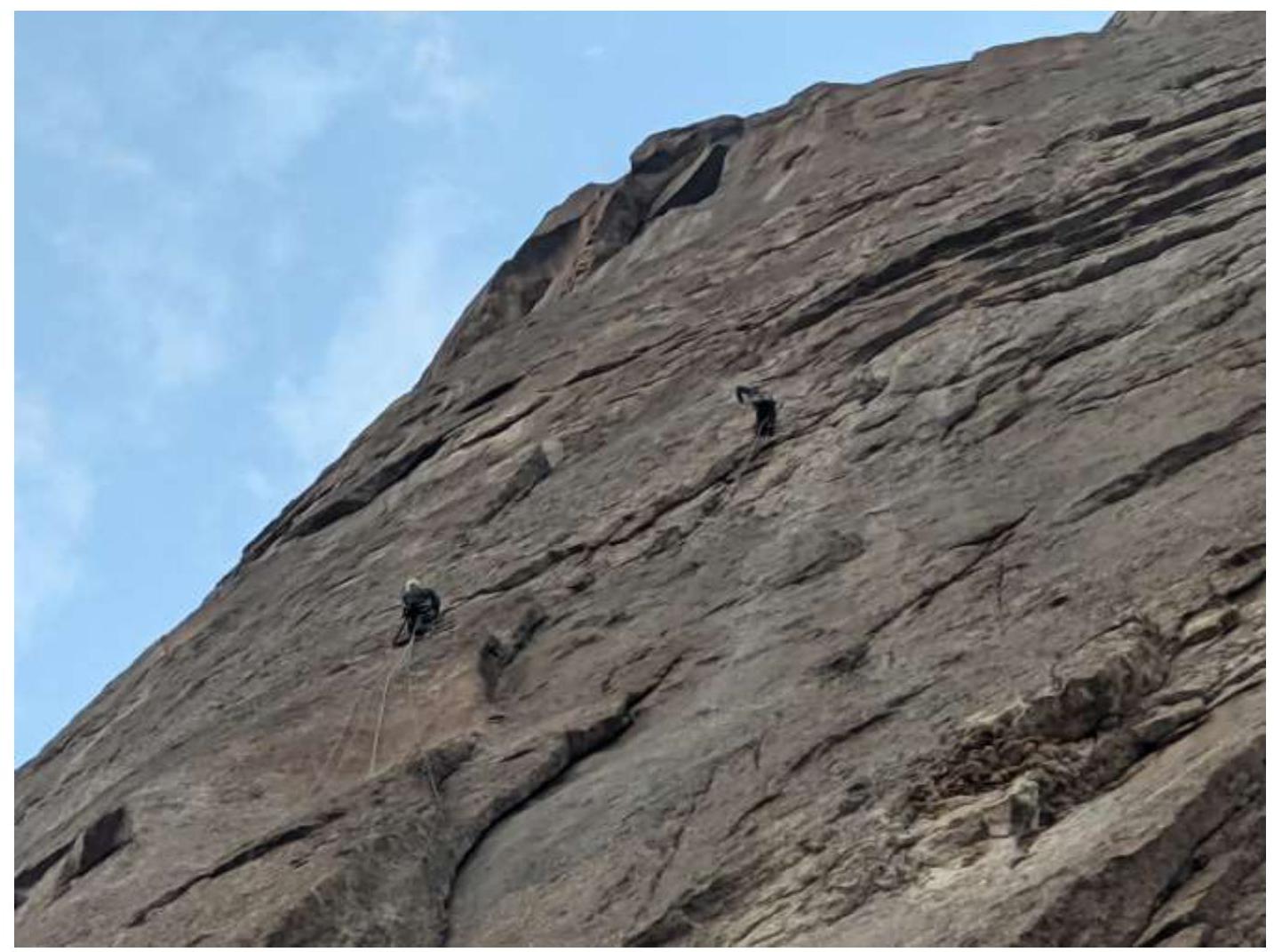
Processing section R5–R6. The leader is almost at the station. It is located on the left side of a large overhang above his head.
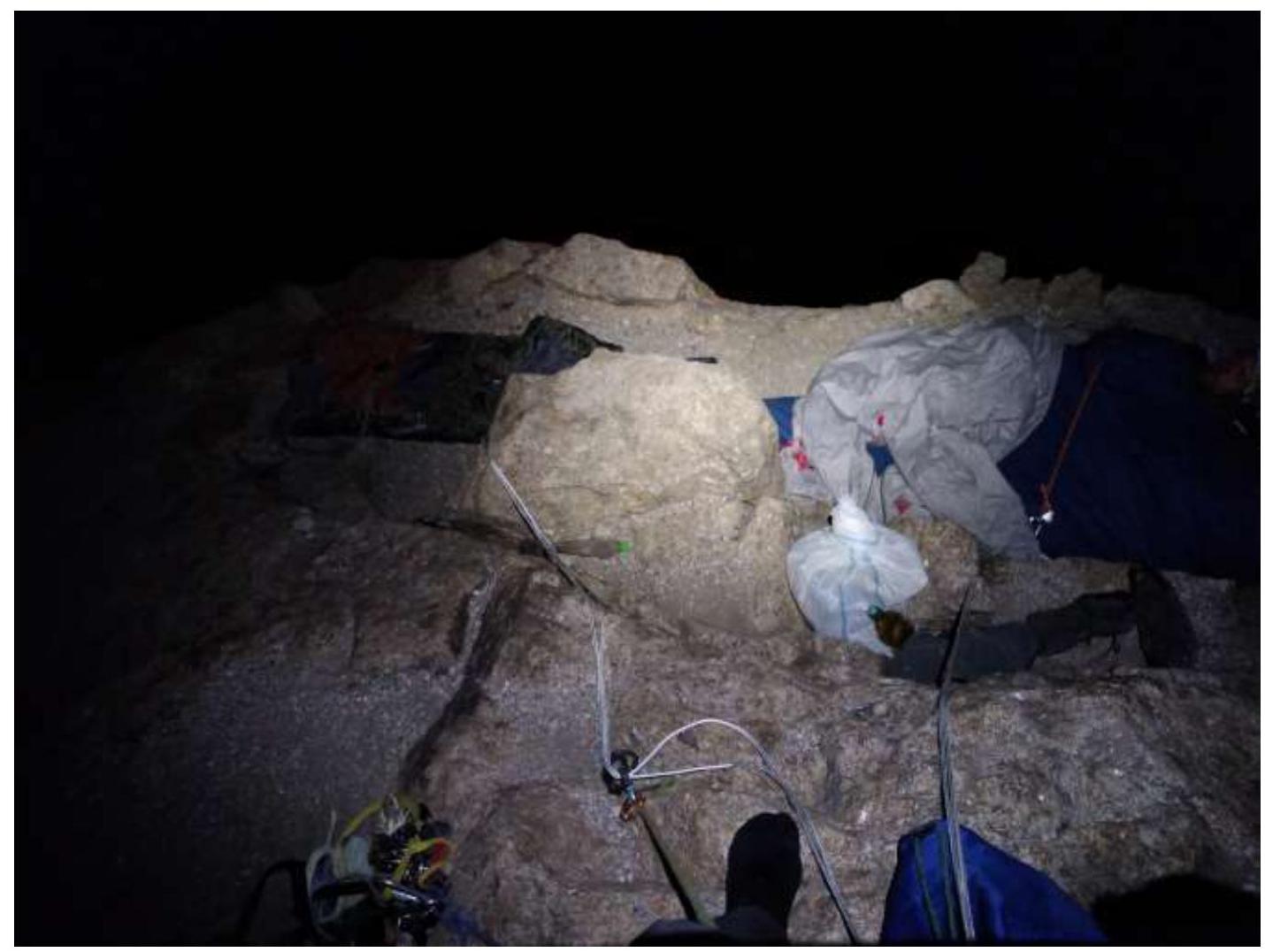
Overnight stay on top of the "Gherkin."
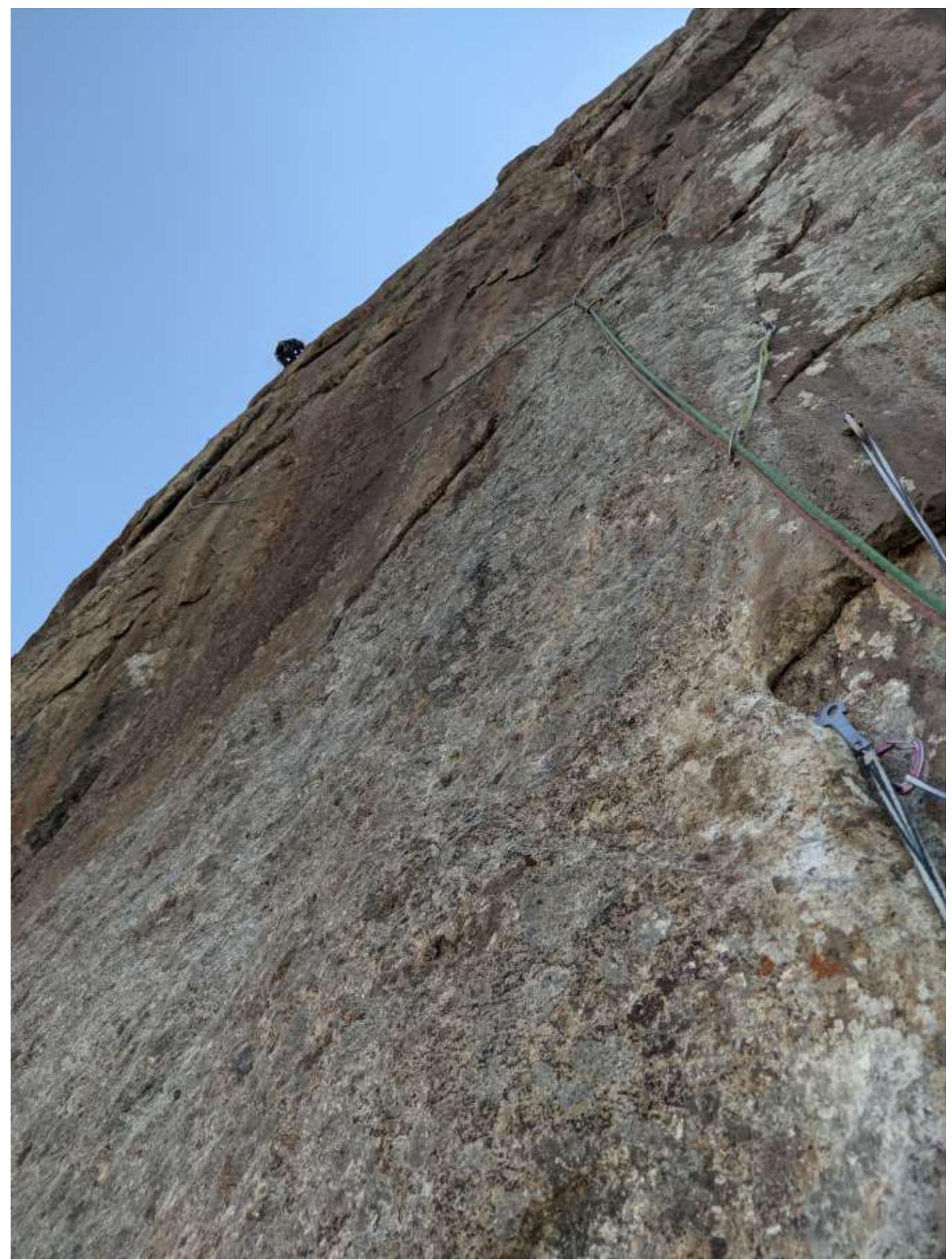
View from the station on section R6–R7. The orange rope goes to a piton with a loop, from where a pendulum was made. The green rope goes to a crack that is passable on IT0.
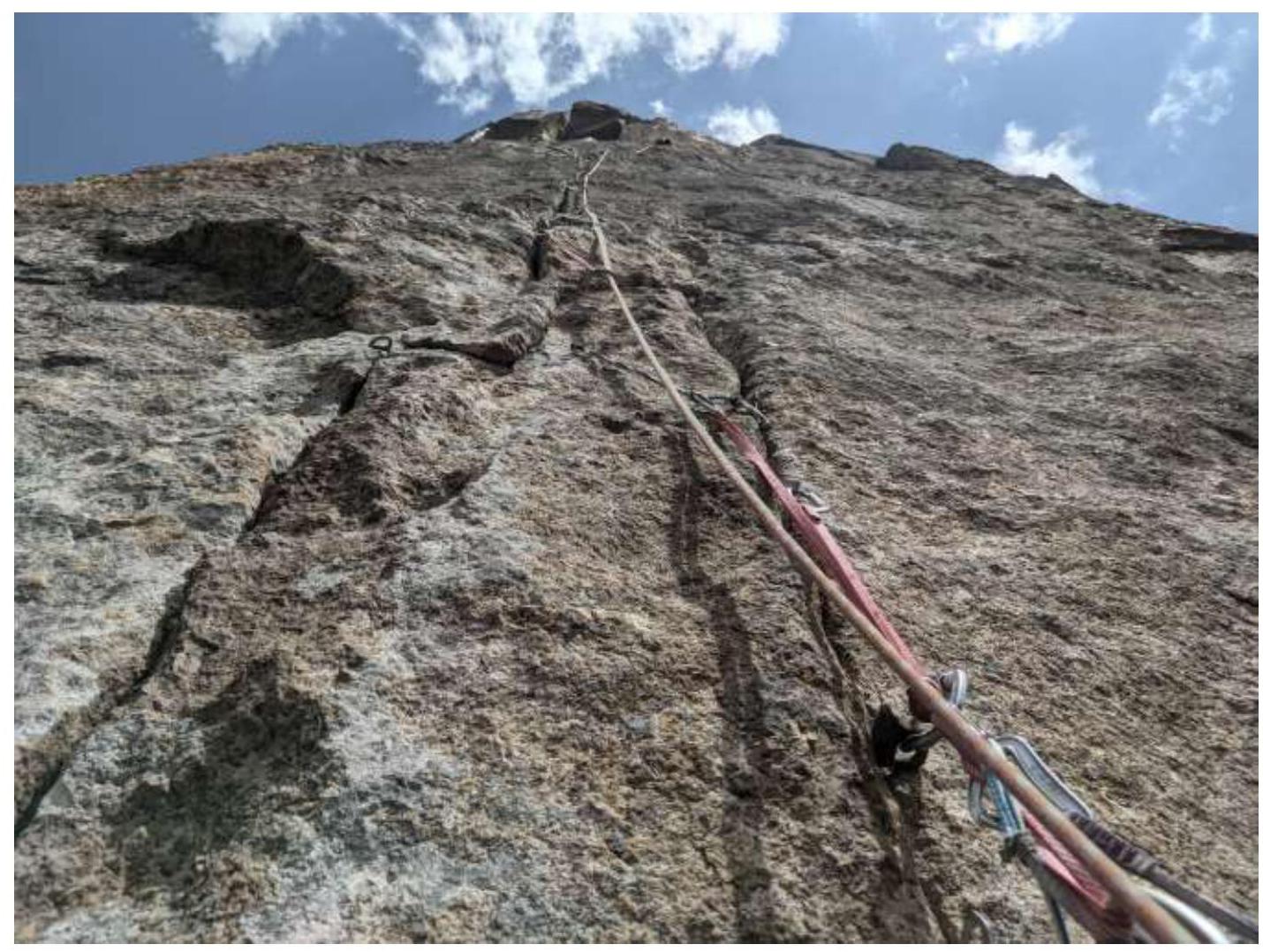
View from the station on section R7–R8. The cornices of section R9–R10 are visible, after which you reach the "balcony."
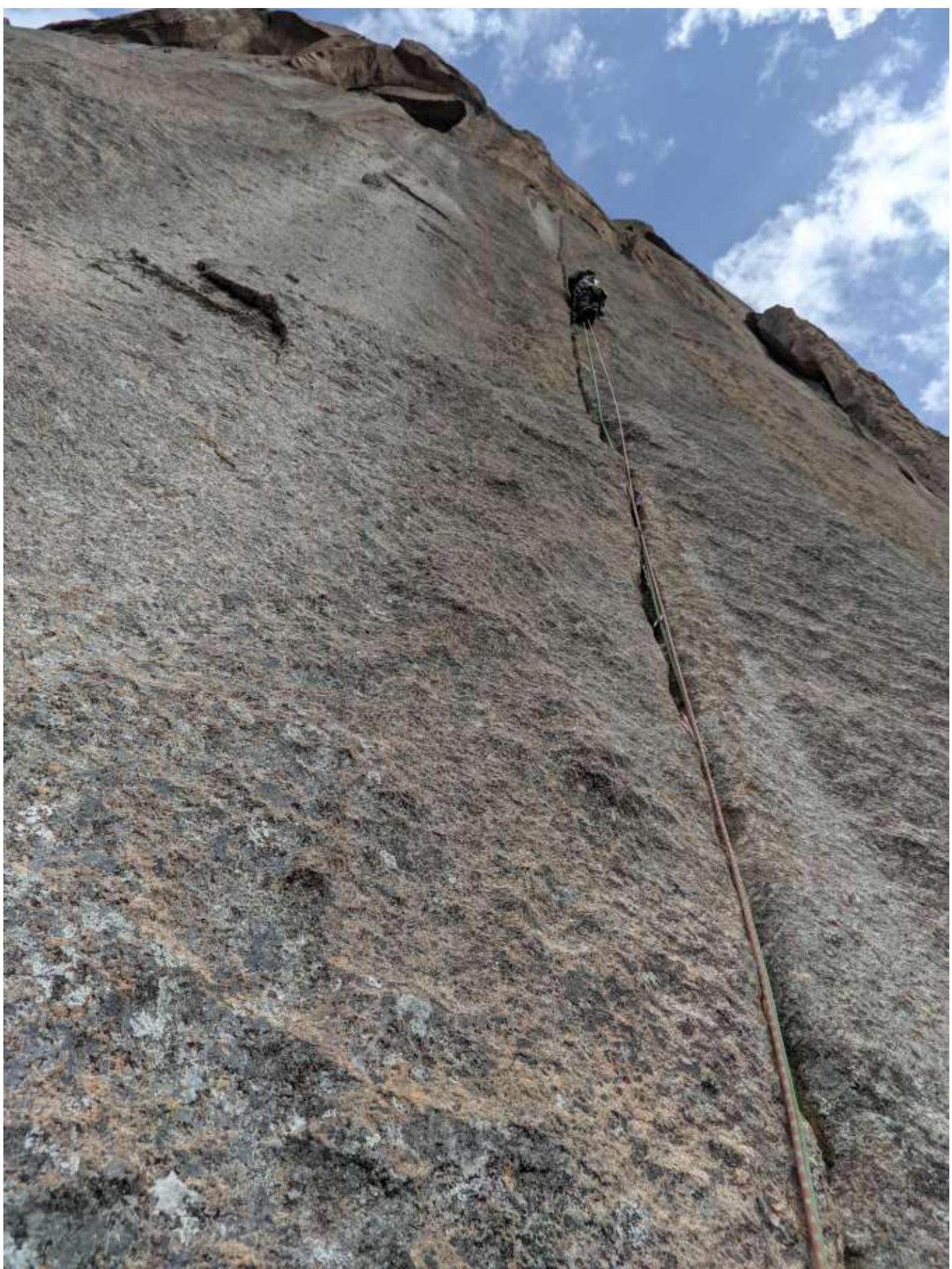
View from the station on section R8–R9. A deep and narrow crack passable on "fifi" and anchors. Future climbers are recommended to take more anchors with bends for this section, as well as anchors with a long nose.
From station R9, you need to:
- Climb onto a ledge,
- Traverse left behind the bend under an overhang,
- And pass through an internal corner, exiting through an overhang onto a system of walls and ledges.
- Climb up to the "balcony."
On this section, it is recommended to take duplicate large camalots, which will be needed under the overhang in the internal corner. Due to darkness, photos of this section were not taken.
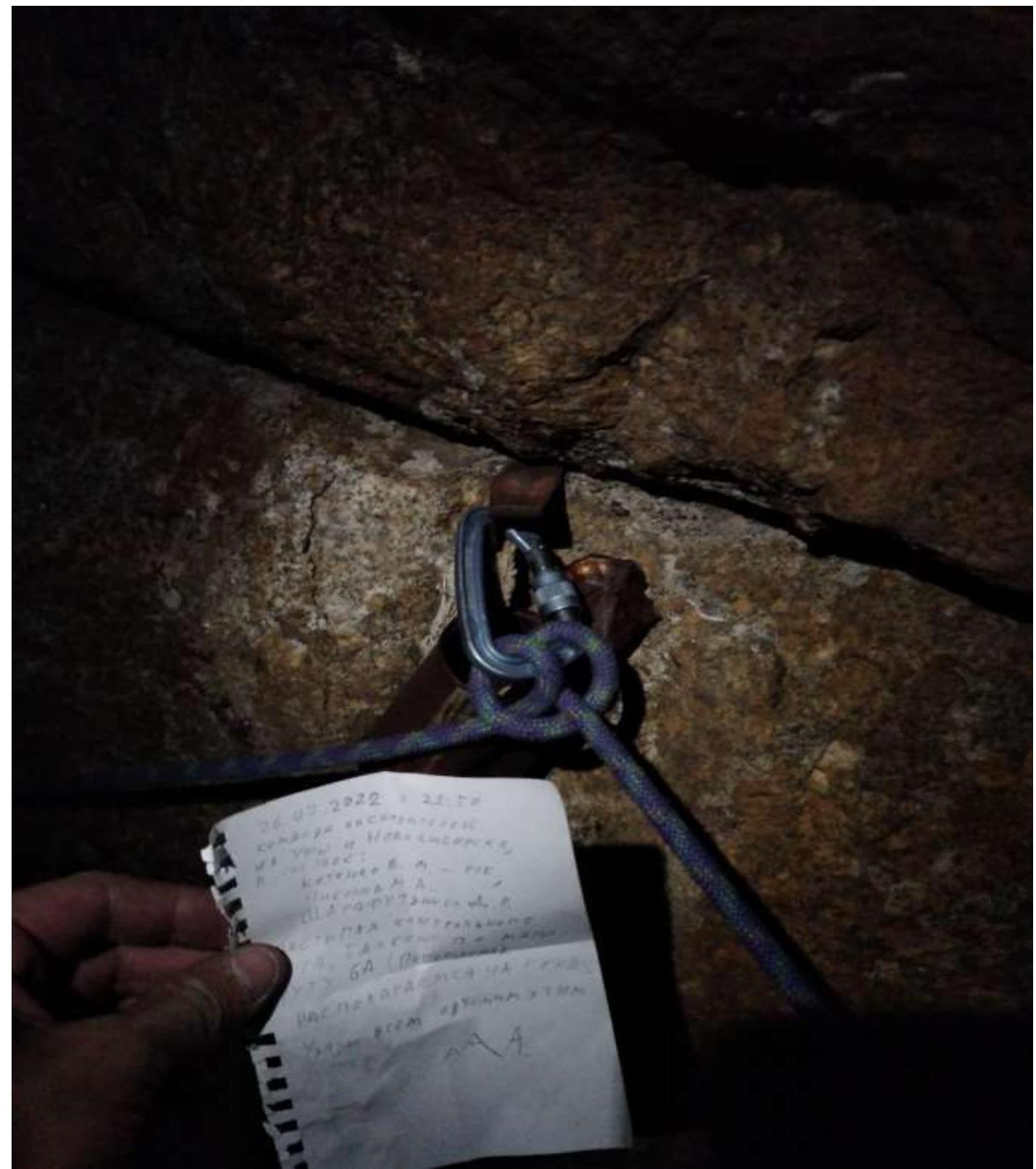
Cairn on the "balcony" ledge and the team's note.
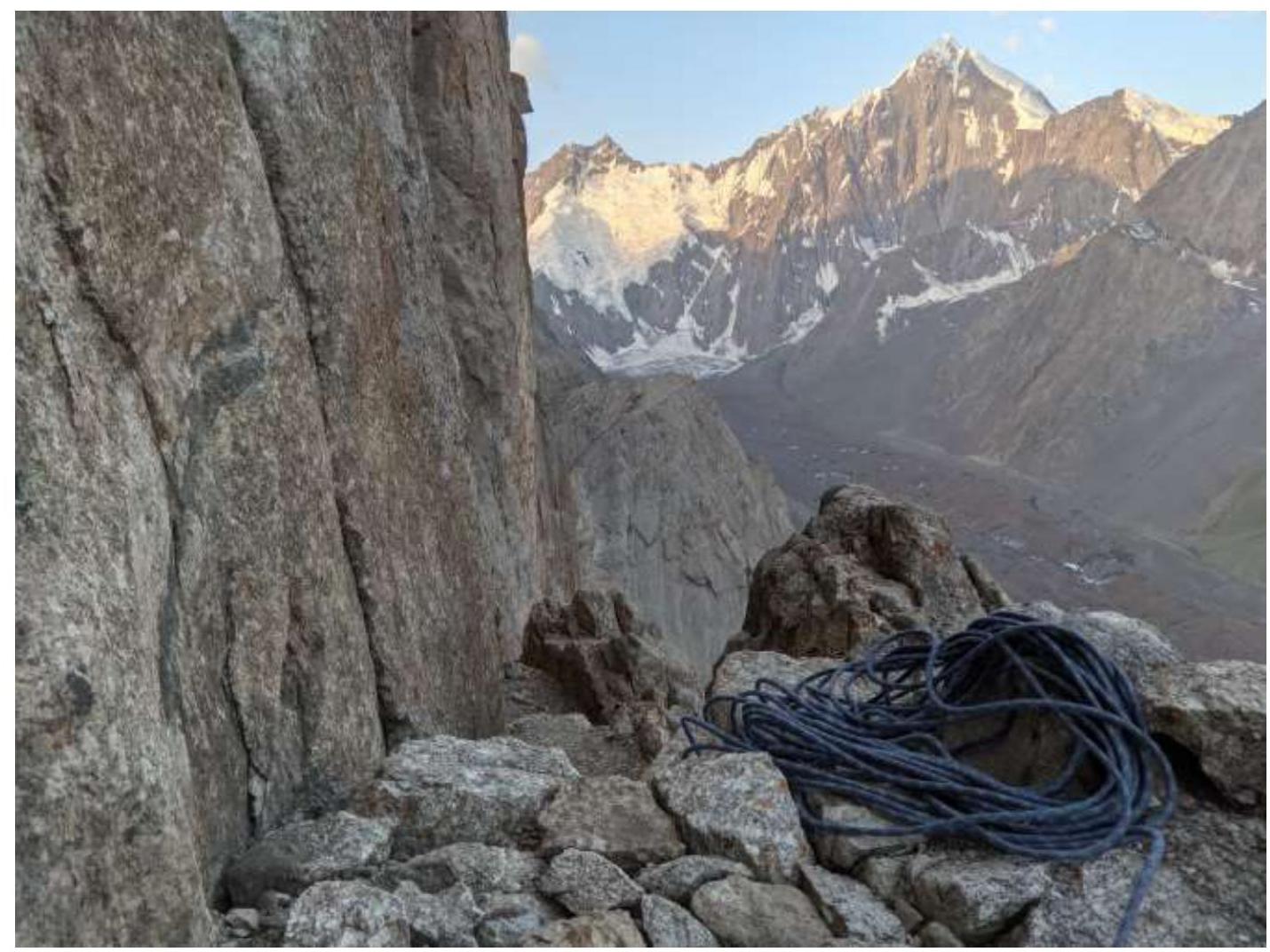
Bivouac site on the "balcony."
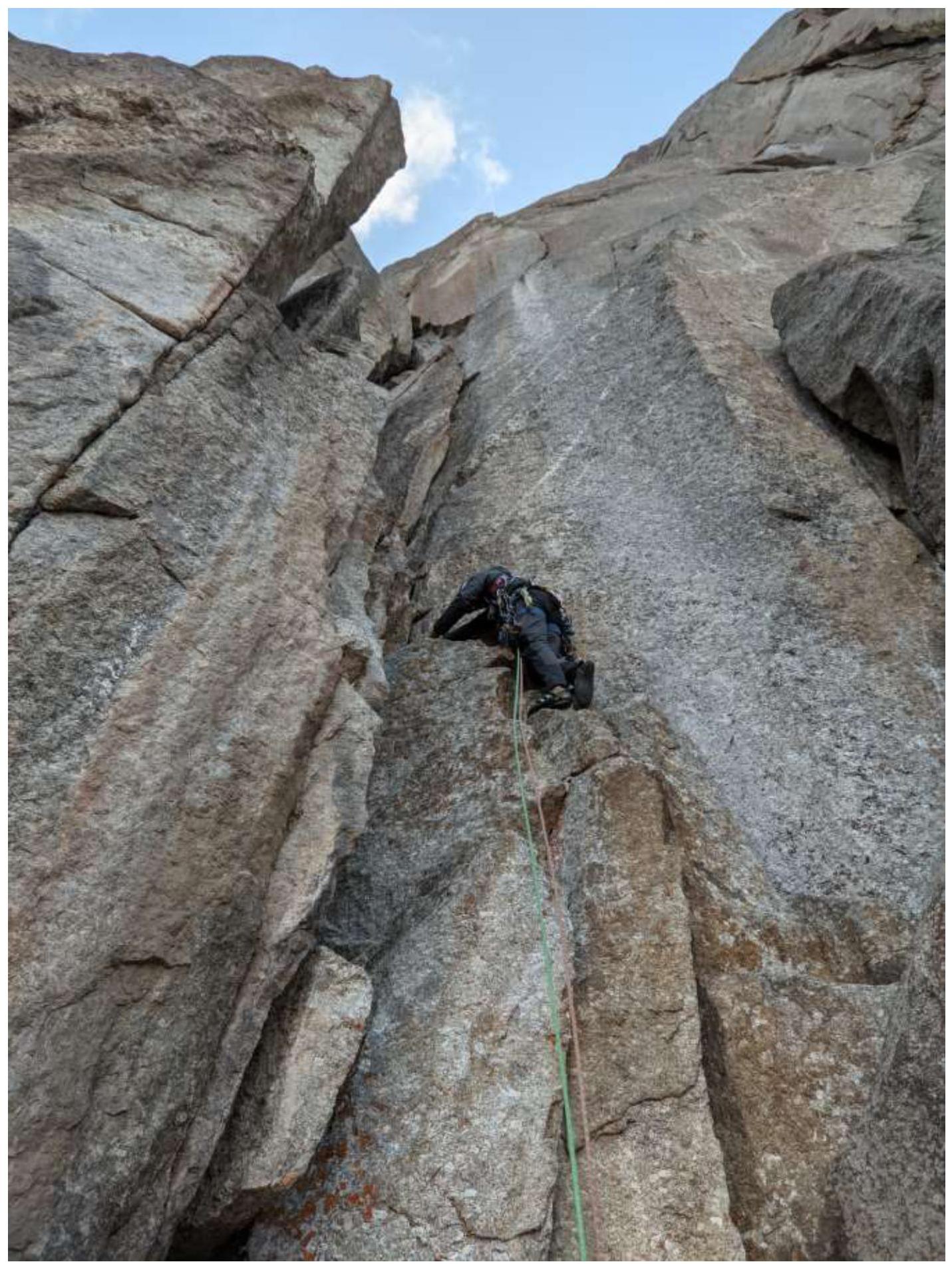
Leader working on section R10–R11. View from the station on the large ledge.
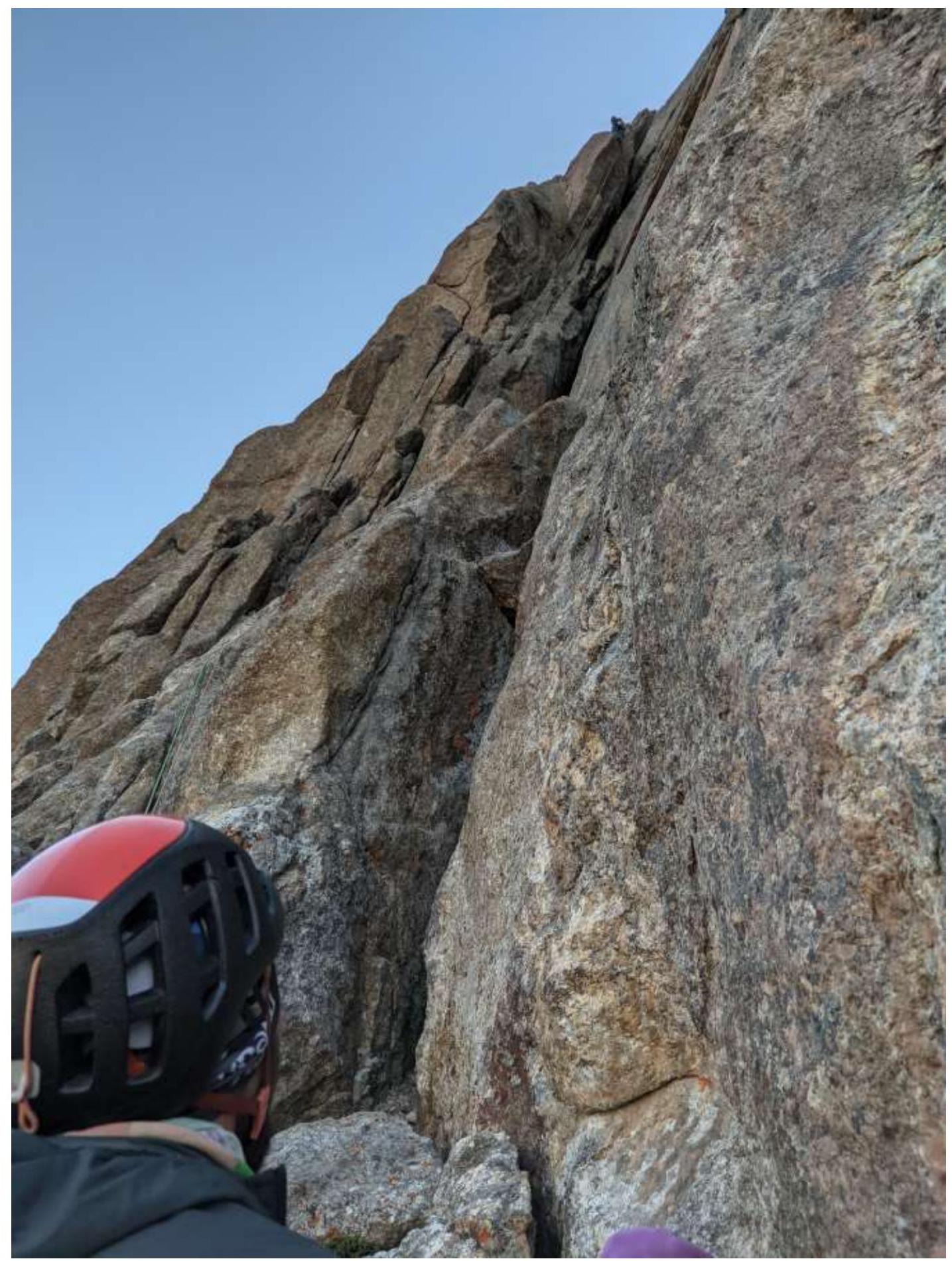
Leader working on section R11–R12. View from the station on the "balda," backed up with nuts.
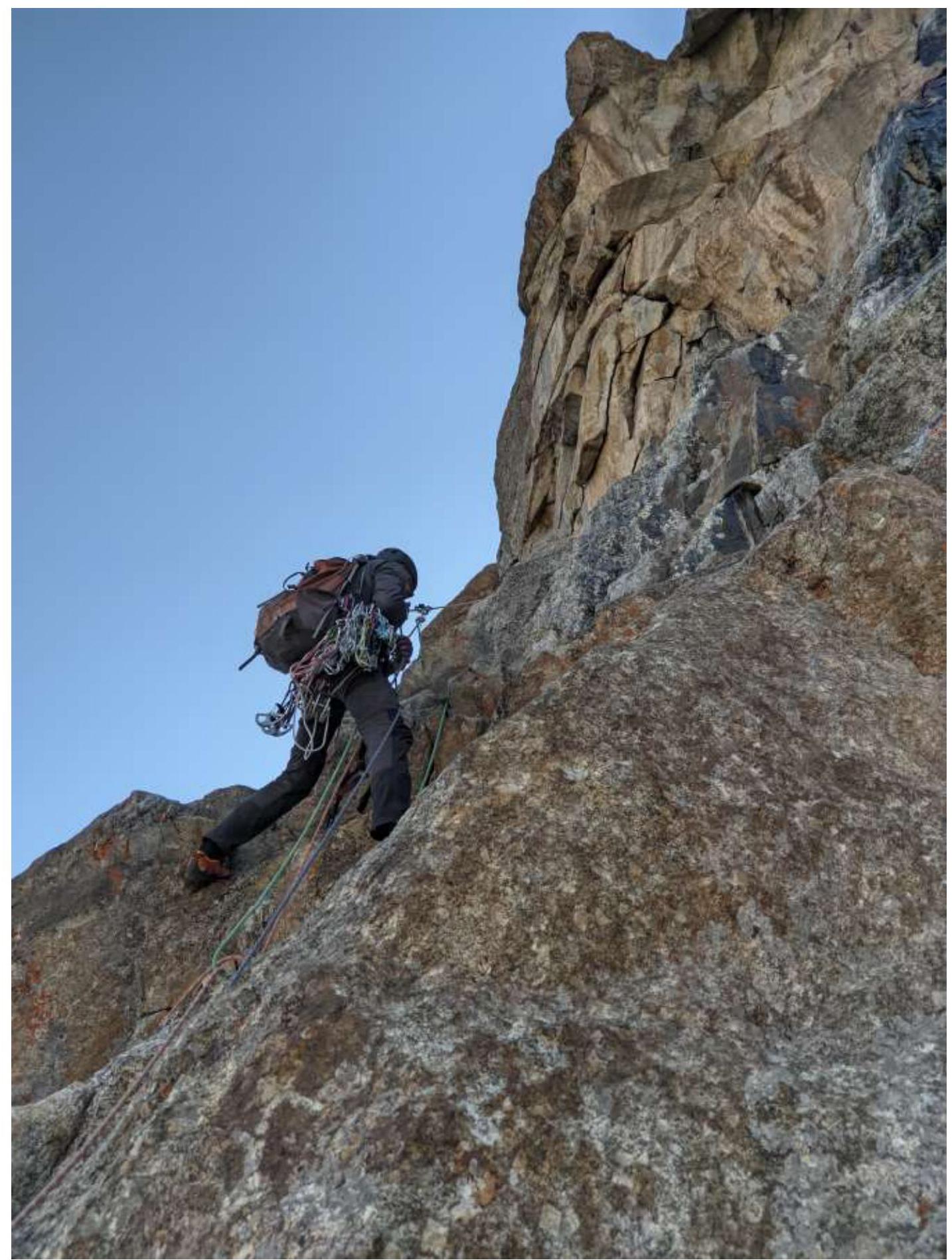
Second participant descending on fixed ropes on section R12–R13. The station is uncomfortable on slabs, just short of the "roof."
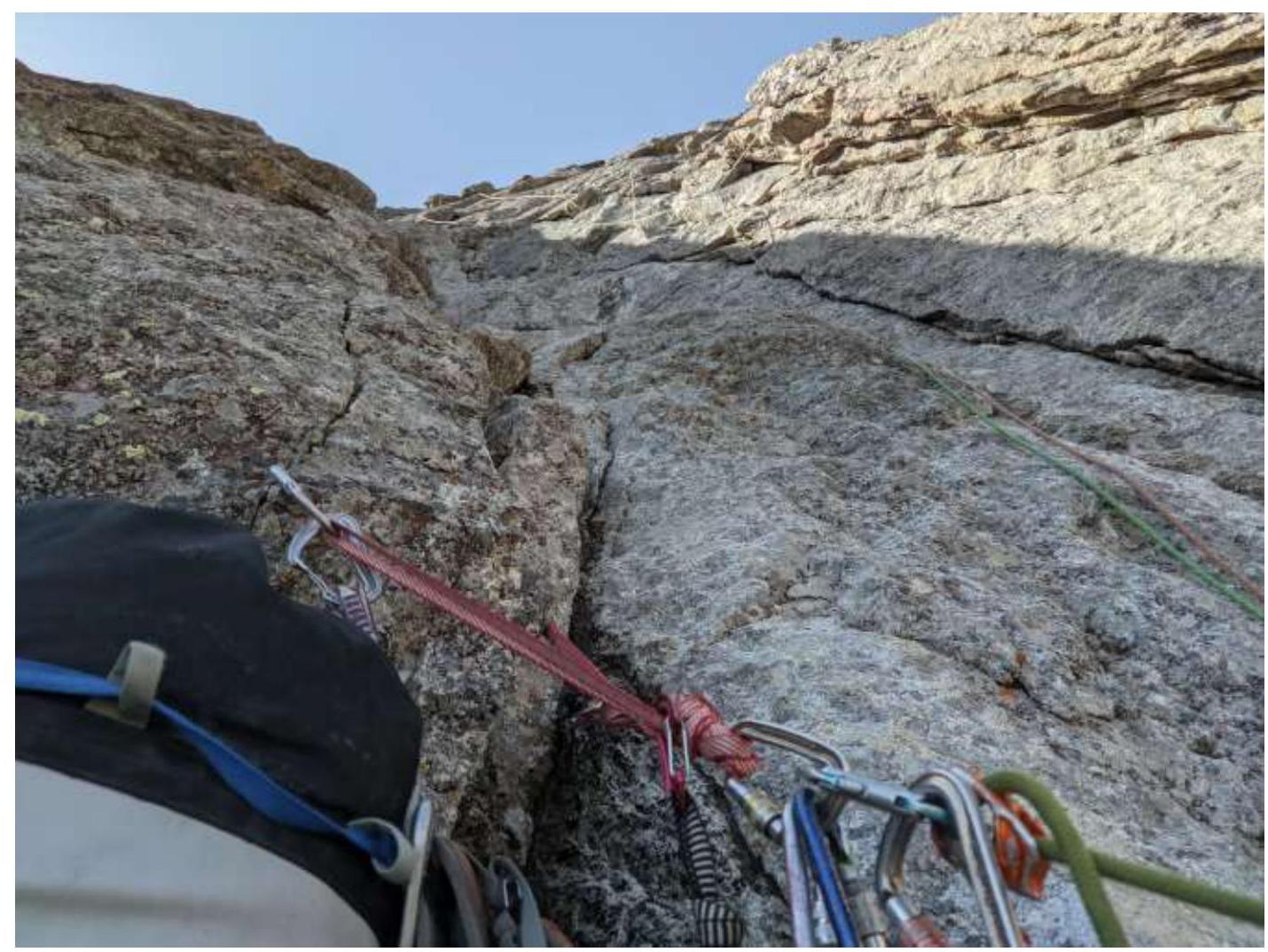
View from the station on section R13–R14, after which the "roof" begins.
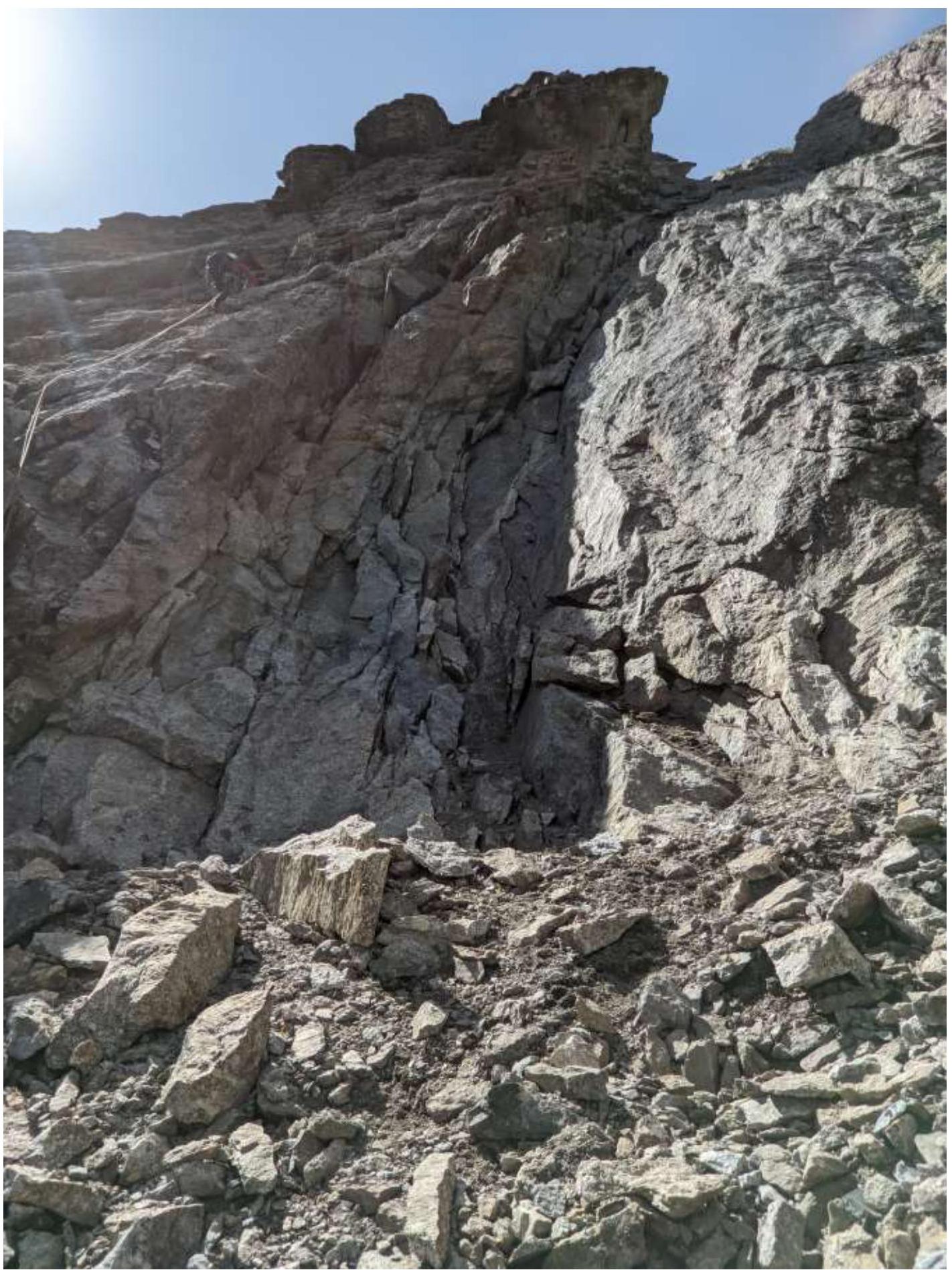
Leader working on the first rope of section R14–R15 (better to pass on the right wall). They climbed alternately. A series of photos from the "roof" will follow.

1. Introduction
This document provides an overview of the key concepts and methodologies used in the study of quantum mechanics. It covers:
- Fundamental principles
- Mathematical formulations
- Practical applications
2. Fundamental Principles
2.1 Wave-particle duality
Quantum mechanics introduces the concept of wave-particle duality, where particles such as electrons and photons exhibit both wave-like and particle-like properties. This duality is central to understanding the behavior of quantum systems.
2.2 Superposition
The principle of superposition states that a quantum system can exist in multiple states simultaneously until it is measured. This is mathematically represented by a wave function, denoted as |ψ⟩.
2.3 Uncertainty Principle
The Heisenberg Uncertainty Principle states that it is impossible to simultaneously know the exact position and momentum of a particle. This is expressed as: Δx ⋅ Δp ≥ ℏ/2 where
- Δx is the uncertainty in position,
- Δp is the uncertainty in momentum,
- ℏ is the reduced Planck constant.
3. Mathematical Formulations
3.1 Schrödinger Equation
The Schrödinger equation is a fundamental equation in quantum mechanics that describes how the quantum state of a physical system changes over time. It is given by: iℏ ∂/∂t Ψ(r, t) = Ĥ Ψ(r, t) where:
- Ĥ is the Hamiltonian operator,
- ℏ is the reduced Planck constant.
3.2 Dirac Notation
Dirac notation is a convenient way to represent quantum states and operators. It uses bra-ket notation, where the ket is represented as |ψ⟩ and its bra is represented as ⟨ψ|.
4. Practical Applications
4.1 Quantum Computing
Quantum computing leverages the principles of superposition and entanglement to perform computations that are infeasible for classical computers. Quantum bits, or qubits, are the fundamental units of quantum information.
4.2 Quantum Cryptography
Quantum cryptography uses the principles of quantum mechanics to secure communication. Quantum key distribution (QKD) is a cornerstone of quantum cryptography, where key distribution is based on the state of the system.
5. Conclusion
Quantum mechanics is a cornerstone of modern physics, providing a framework for understanding the behavior of particles at the smallest scales. Its principles and mathematical formulations have led to groundbreaking technologies and continue to drive innovation in various fields.
6. References
- Griffiths, D. J. (2005). «Introduction to Quantum Mechanics». Pearson.
- Shankar, R. (2012). «Principles of Quantum Mechanics». Plenum Press.

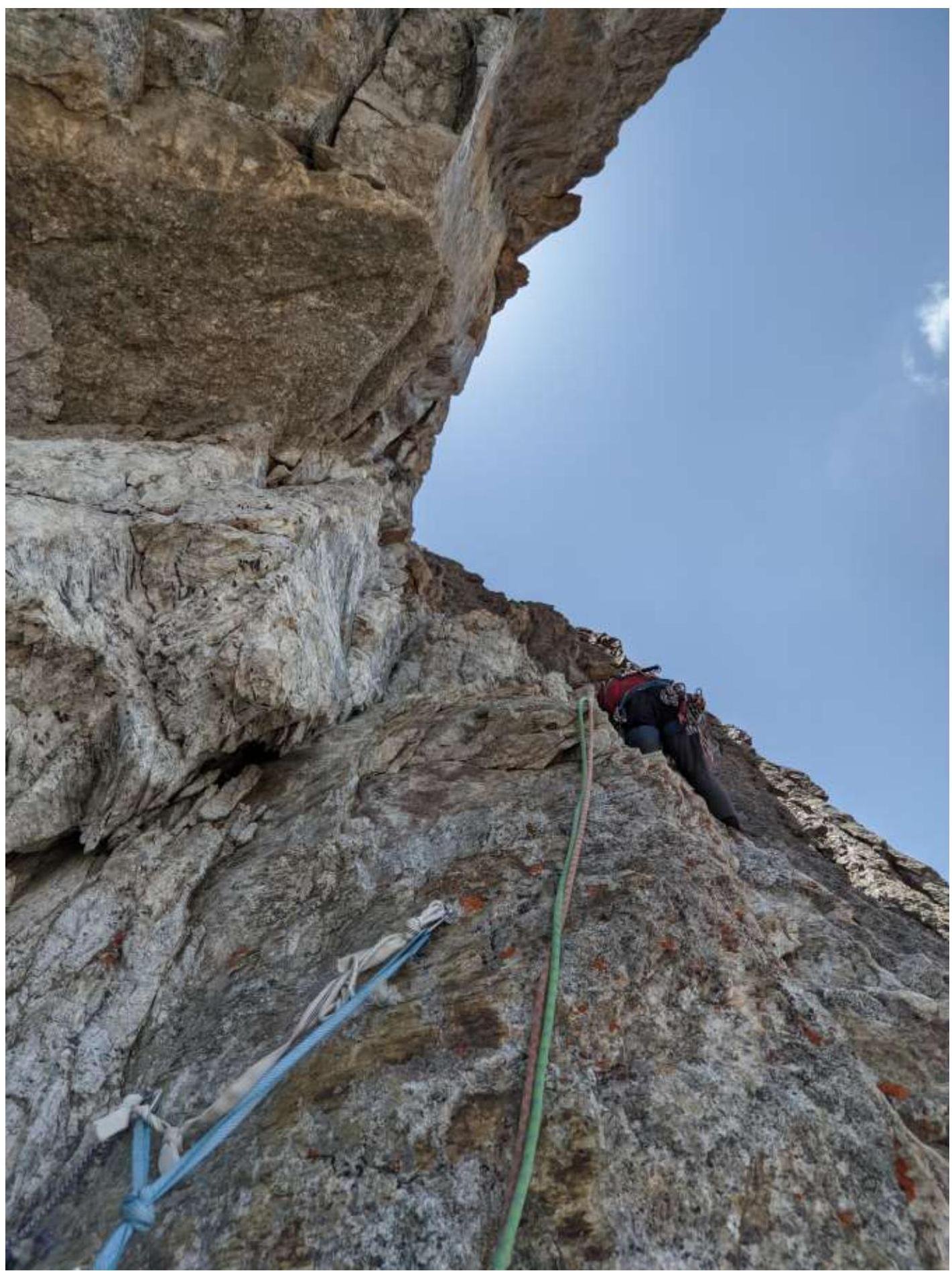
False summit (and not even the large sentinel visible from the yellow wall).
1. Introduction
This document provides an overview of the key concepts and methodologies used in the study of quantum mechanics. It covers:
- Fundamental principles
- Mathematical formulations
- Practical applications
2. Fundamental Principles
2.1 Wave-Particle Duality
Quantum mechanics introduces the concept of wave-particle duality, where particles such as electrons and photons exhibit both wave-like and particle-like properties. This duality is central to understanding the behavior of quantum systems.
2.2 Superposition
The principle of superposition states that a quantum system can exist in multiple states simultaneously until it is measured. This is mathematically represented by a wave function, denoted as |ψ⟩.
2.3 Uncertainty Principle
The Heisenberg Uncertainty Principle states that it is impossible to simultaneously know the exact position and momentum of a particle. This is expressed as: Δx ⋅ Δp ≥ ℏ/2 where Δx is the uncertainty in position, Δp is the uncertainty in momentum, and ℏ is the reduced Planck constant.
3. Mathematical Formulations
3.1 Schrödinger Equation
The Schrödinger equation is a fundamental equation in quantum mechanics that describes how the quantum state of a physical system changes over time. It is given by: iℏ ∂/∂t Ψ(r, t) = Ĥ Ψ(r, t) where Ĥ is the Hamiltonian operator, and ℏ is the reduced Planck constant.
3.2 Dirac Notation
Dirac notation is a convenient way to represent quantum states and operators. It uses bra-ket notation, where the ket is represented as |ψ⟩ and its bra is represented as ⟨ψ|.
4. Practical Applications
4.1 Quantum Computing
Quantum computing leverages the principles of superposition and entanglement to perform computations that are infeasible for classical computers. Quantum bits, or qubits, are the fundamental units of quantum information.
4.2 Quantum Cryptography
Quantum cryptography uses the principles of quantum mechanics to secure communication. Quantum key distribution (QKD) is a cornerstone of quantum cryptography, where key distribution is based on the state of the system.
5. Conclusion
Quantum mechanics is a cornerstone of modern physics, providing a framework for understanding the behavior of particles at the smallest scales. Its principles and mathematical formulations have led to groundbreaking technologies and continue to drive innovation in various fields.
6. References
- Griffiths, D. J. (2005). «Introduction to Quantum Mechanics». Pearson.
- Shankar, R. (2012). «Principles of Quantum Mechanics». Plenum Press.
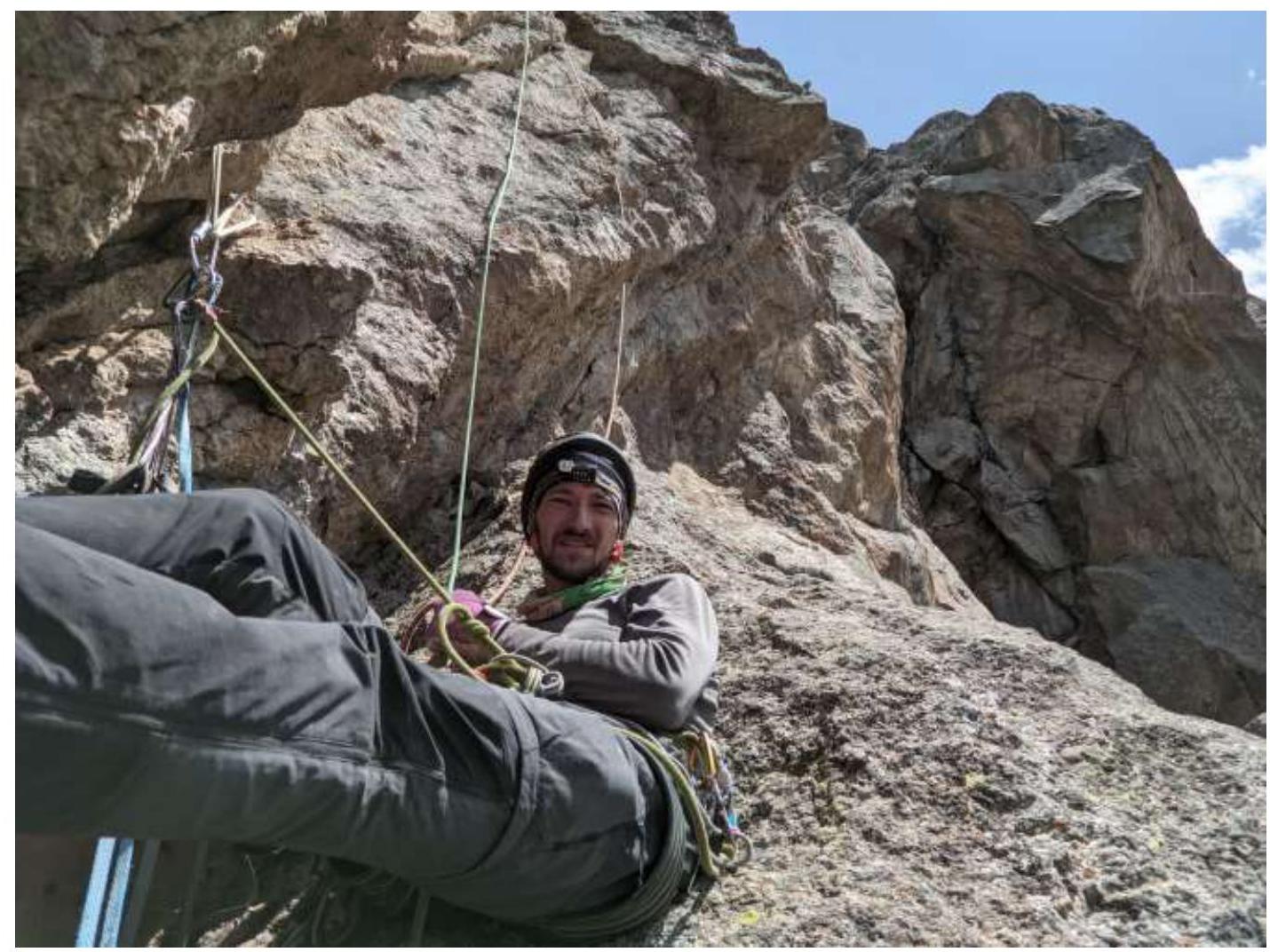
Station after bypassing the large sentinel.
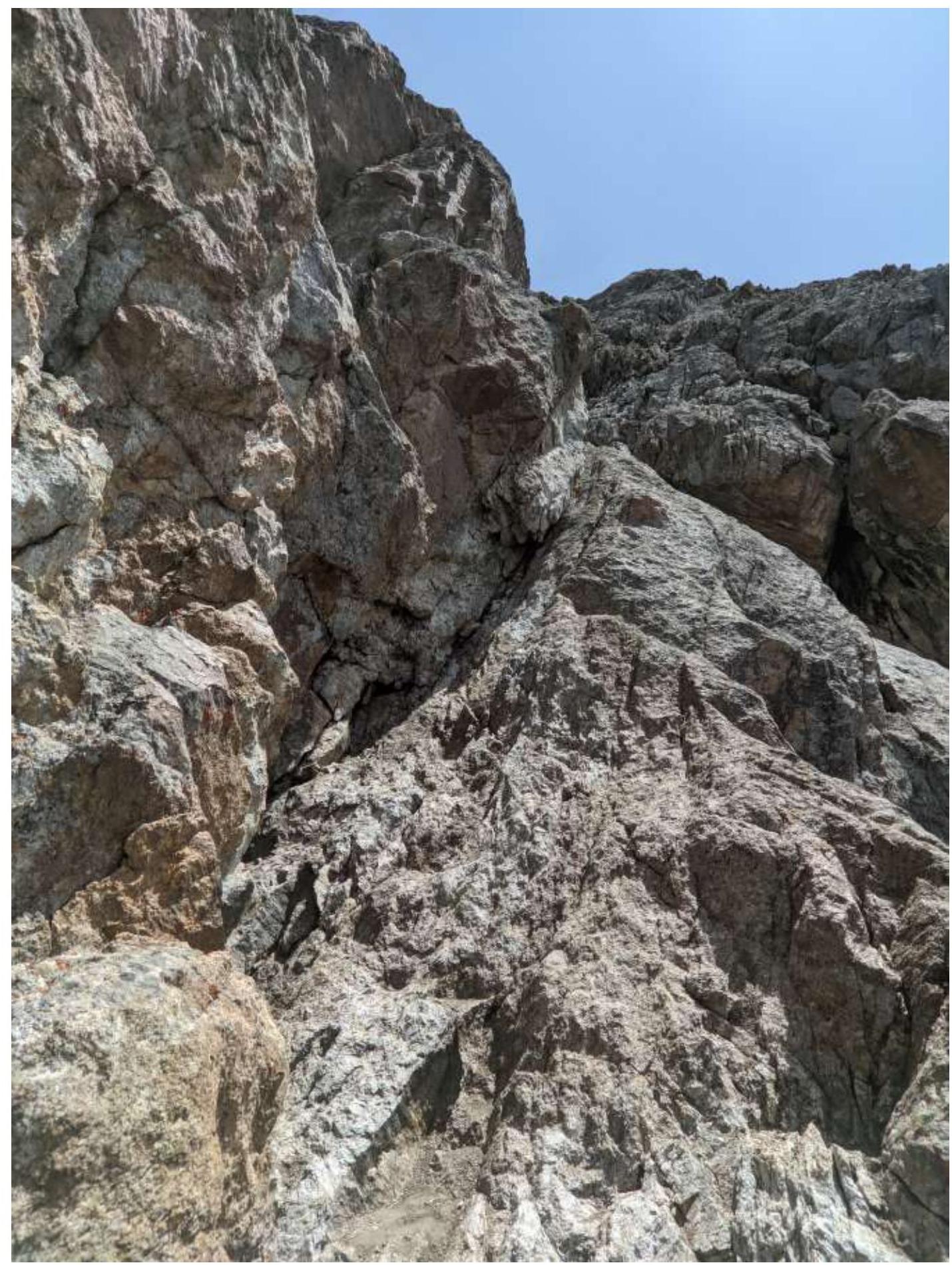
From here, move into the scree couloir and exit onto the pre-summit ridge.
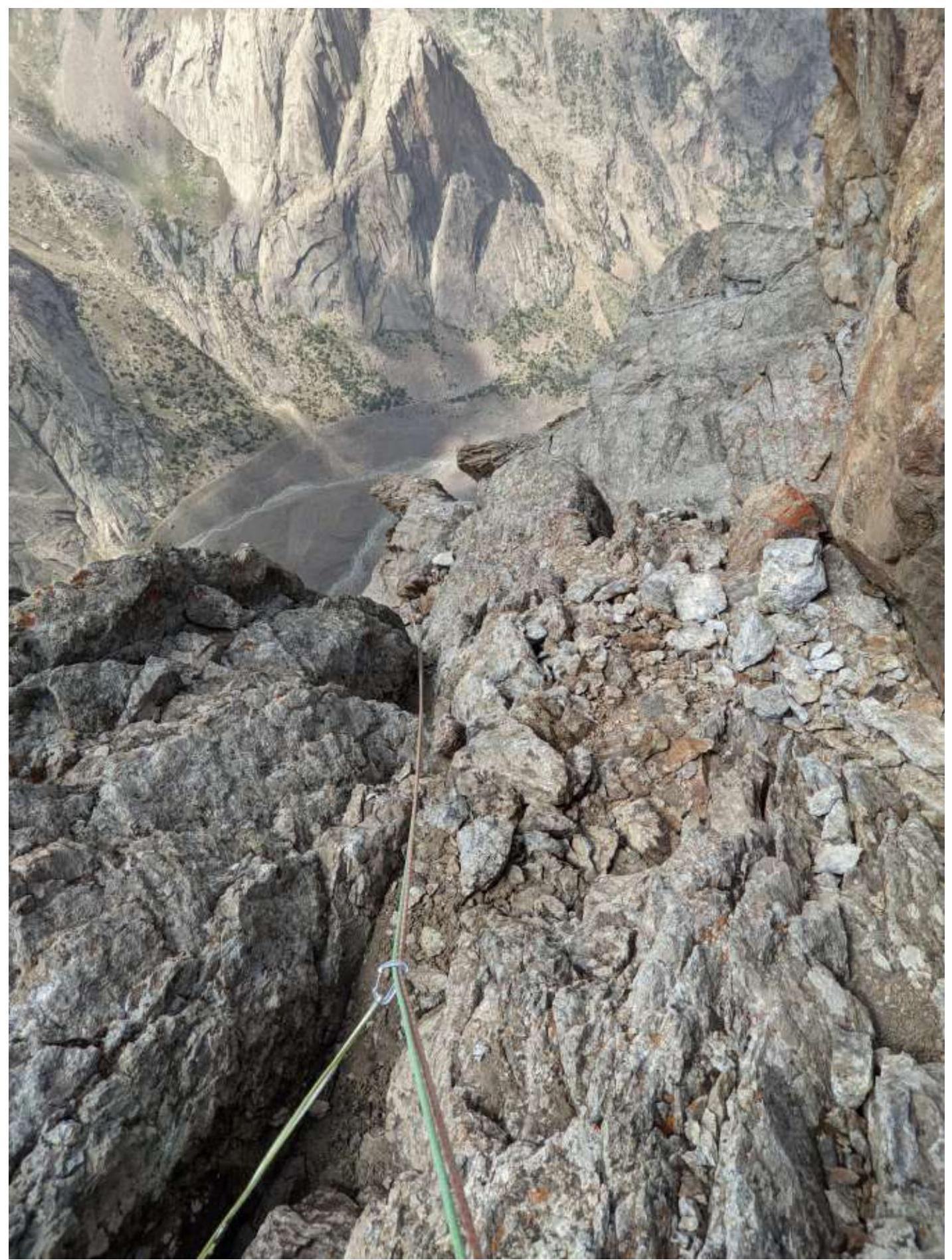
Exit onto the ridge. View down.
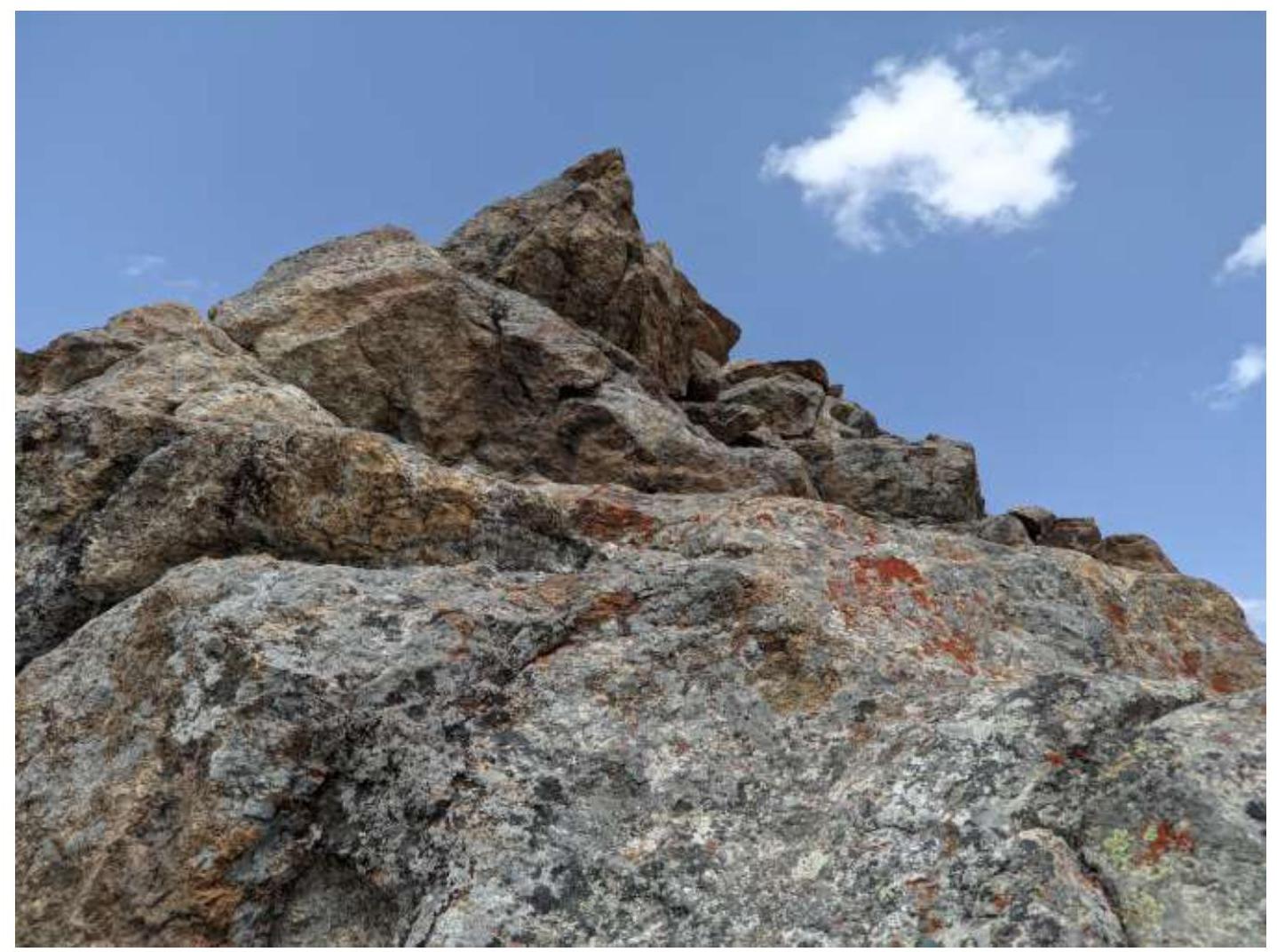
Ridge. View towards the summit.
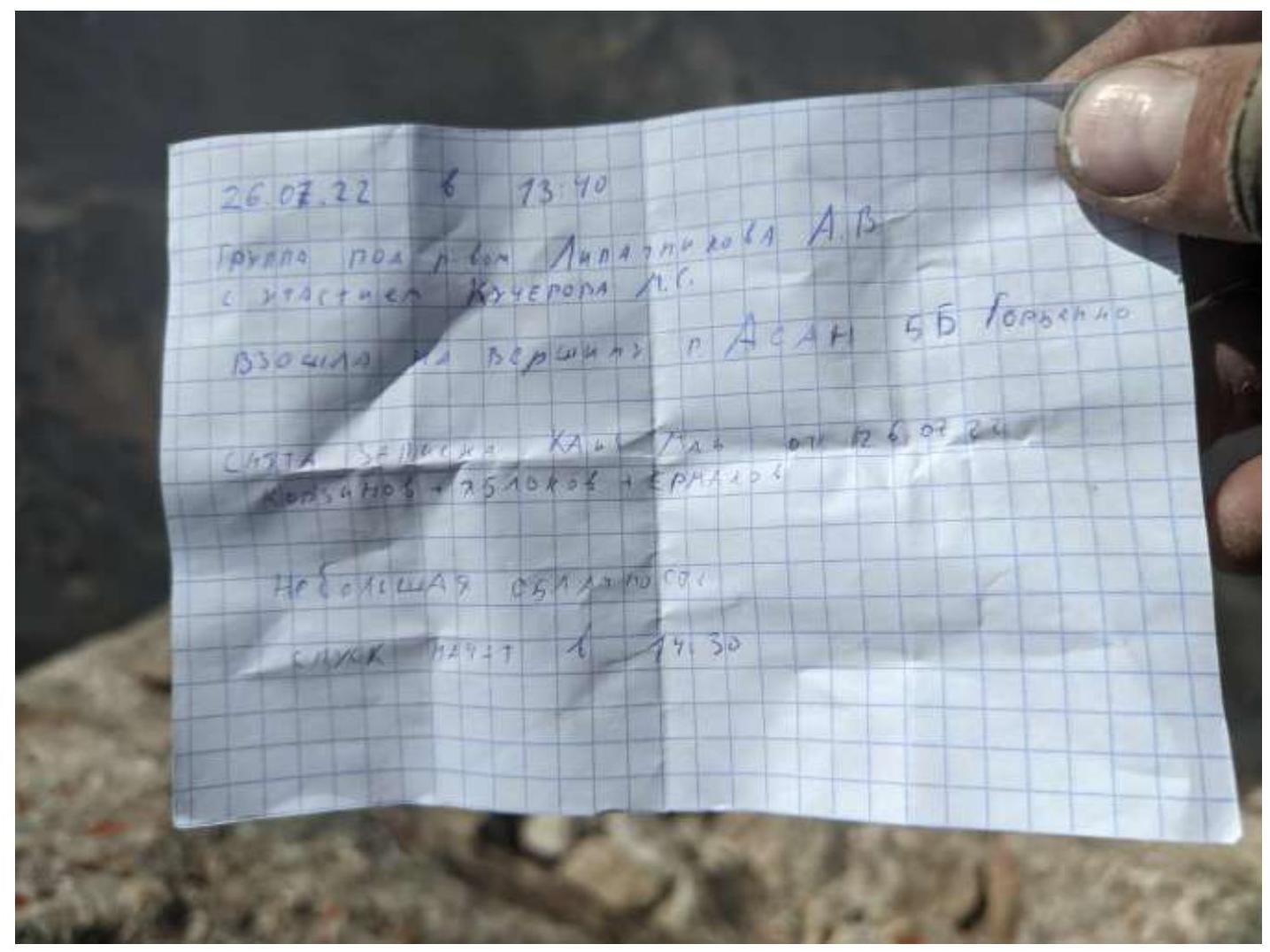
Note found on the summit in the cairn.
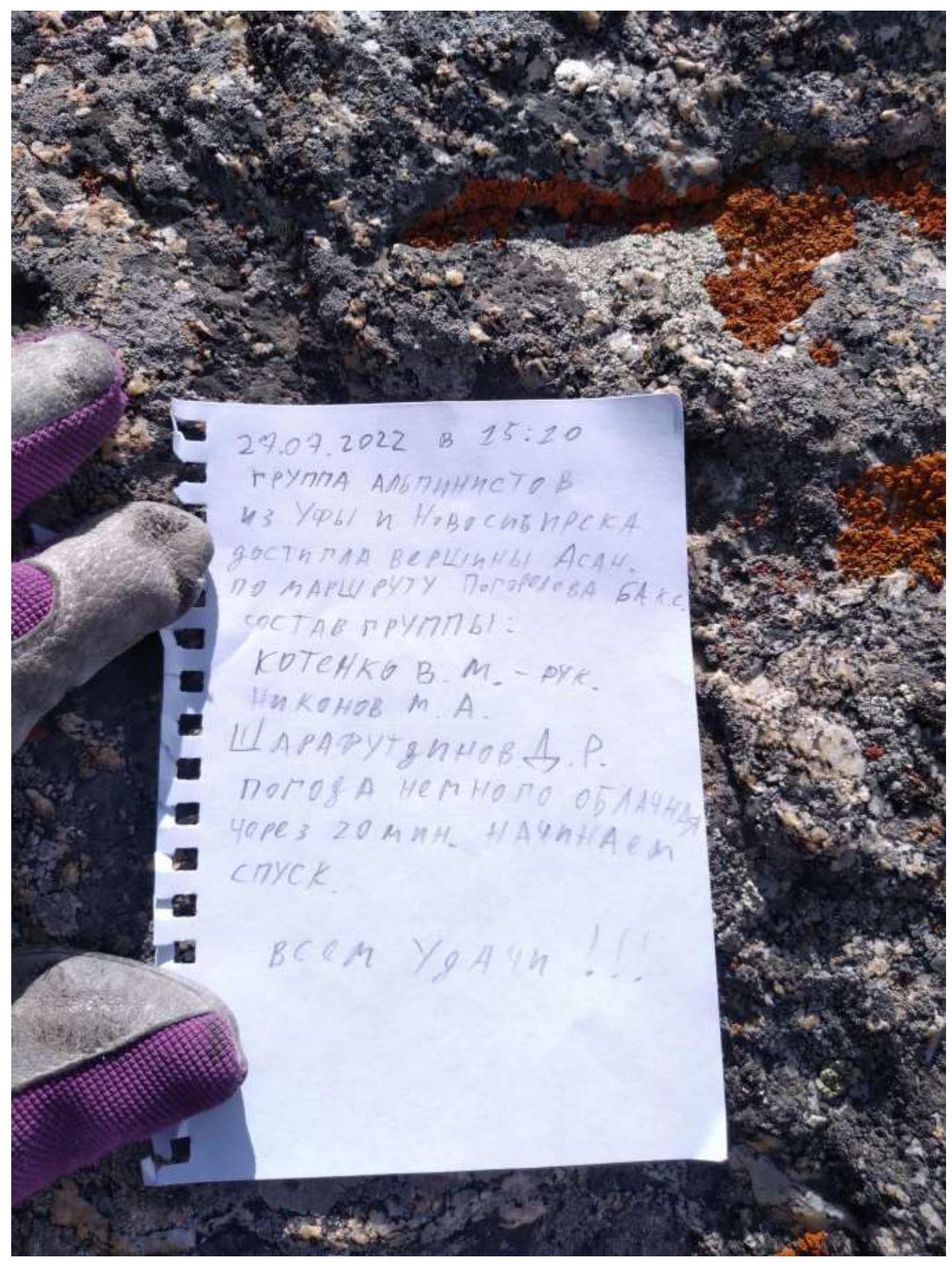
The group's note.
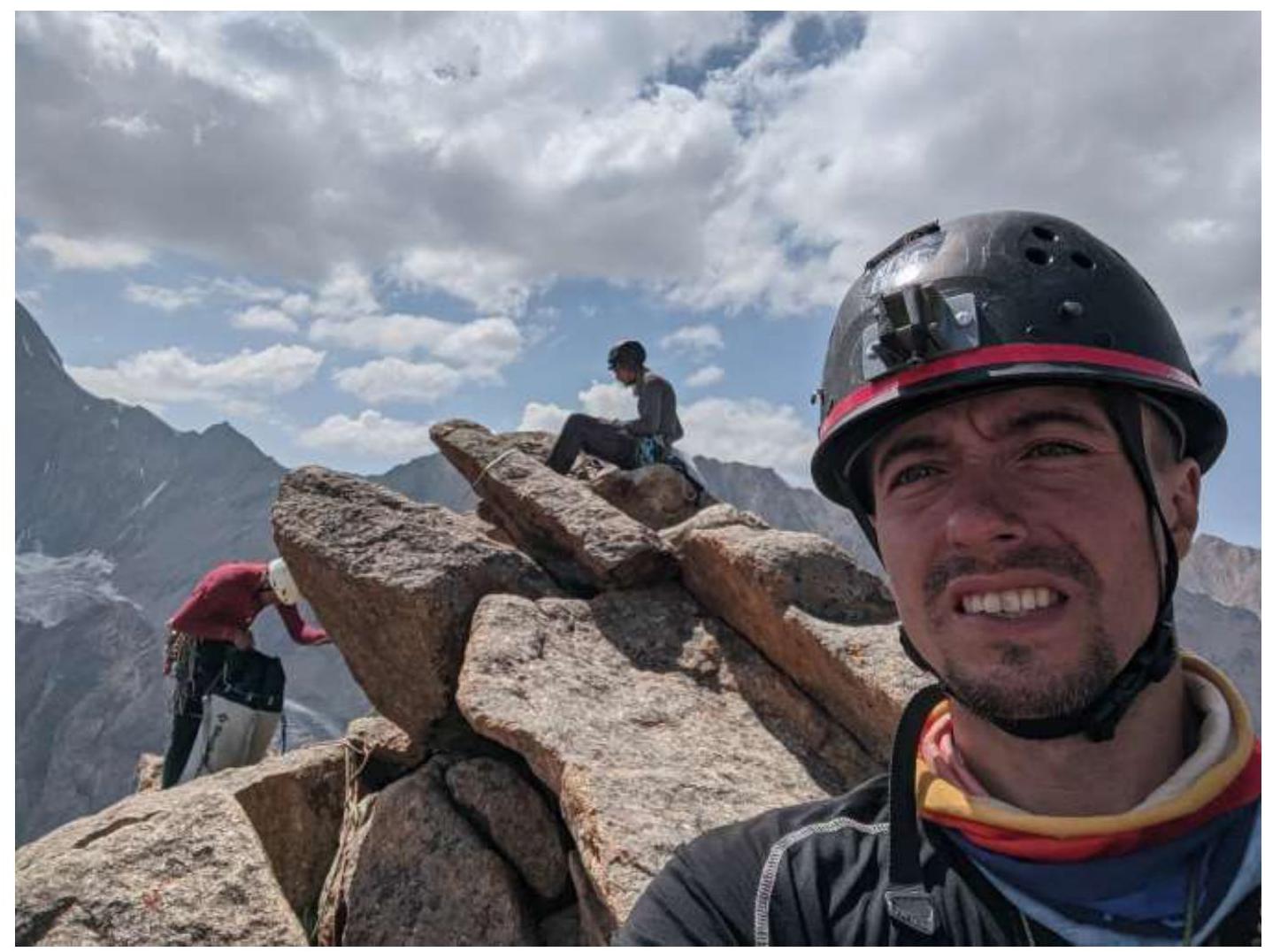
Group on the summit.
Photos from the descent.
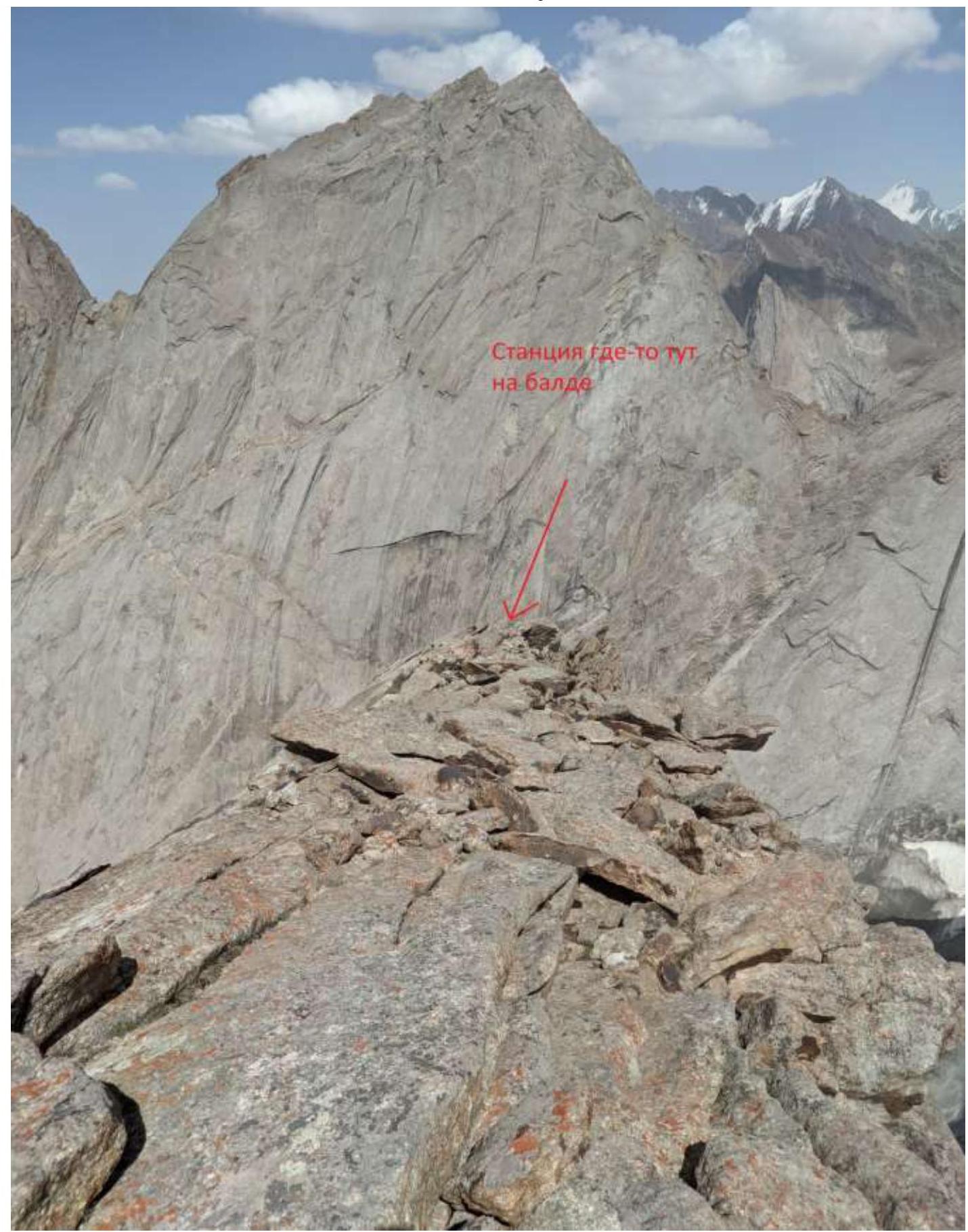
Start of the descent — "balda" with many colored loops. From it, rappel left towards the camp for 40 m to the next cluster of colored loops.
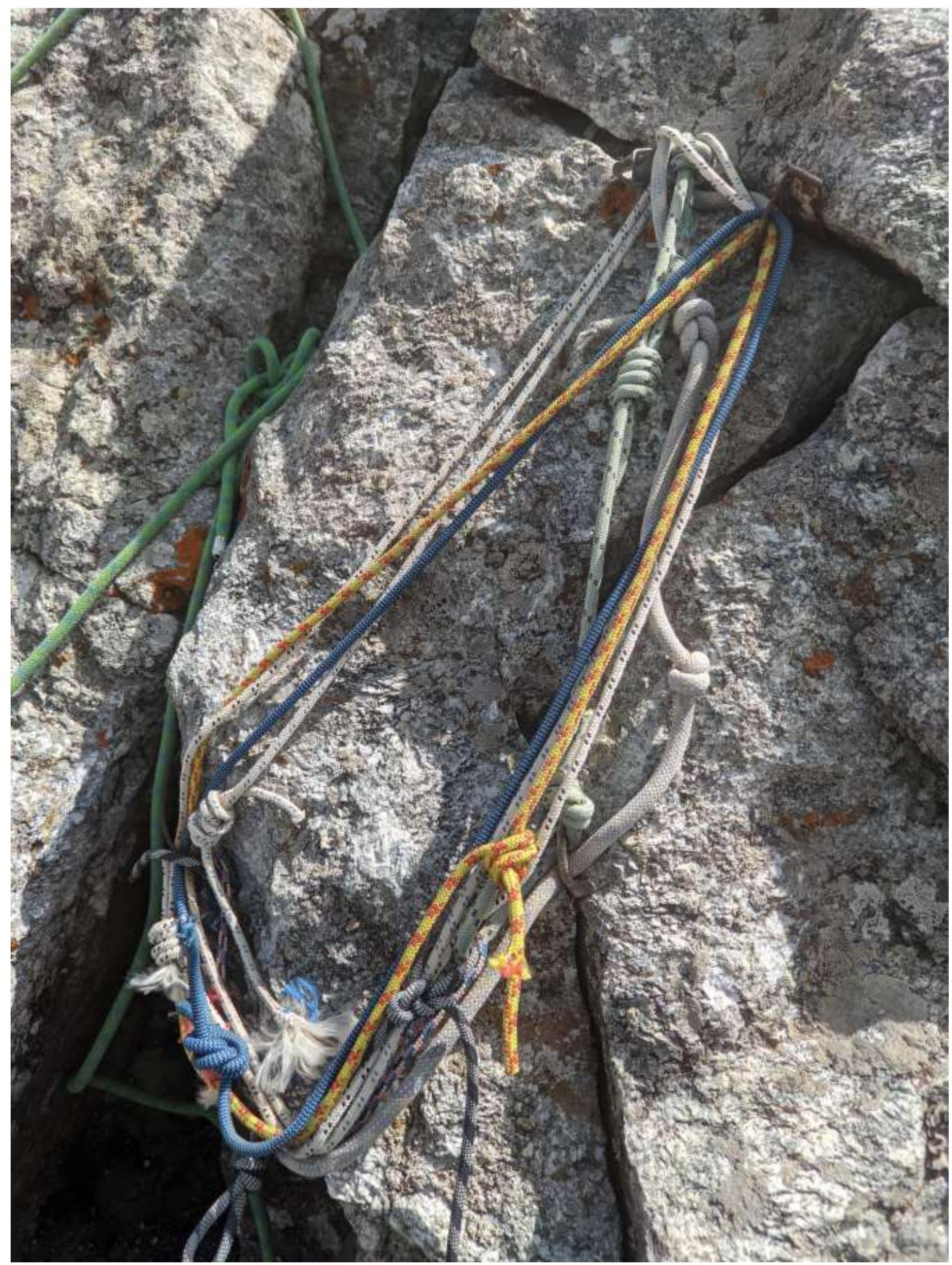
Second station. From it, rappel down and slightly right (if facing the cliff).
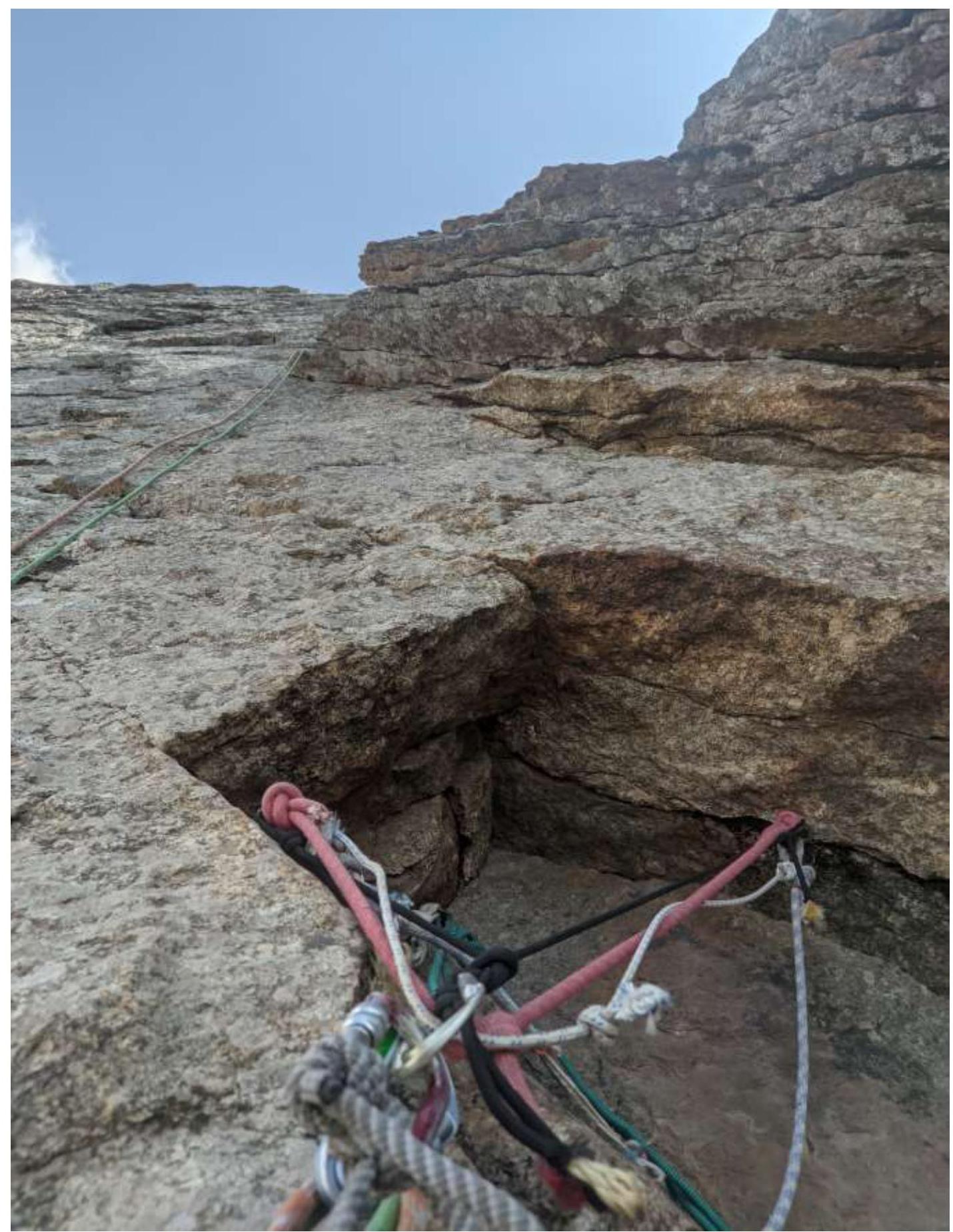
Third station. Under a small overhang. From it, rappel straight down along slabs, veering slightly left.
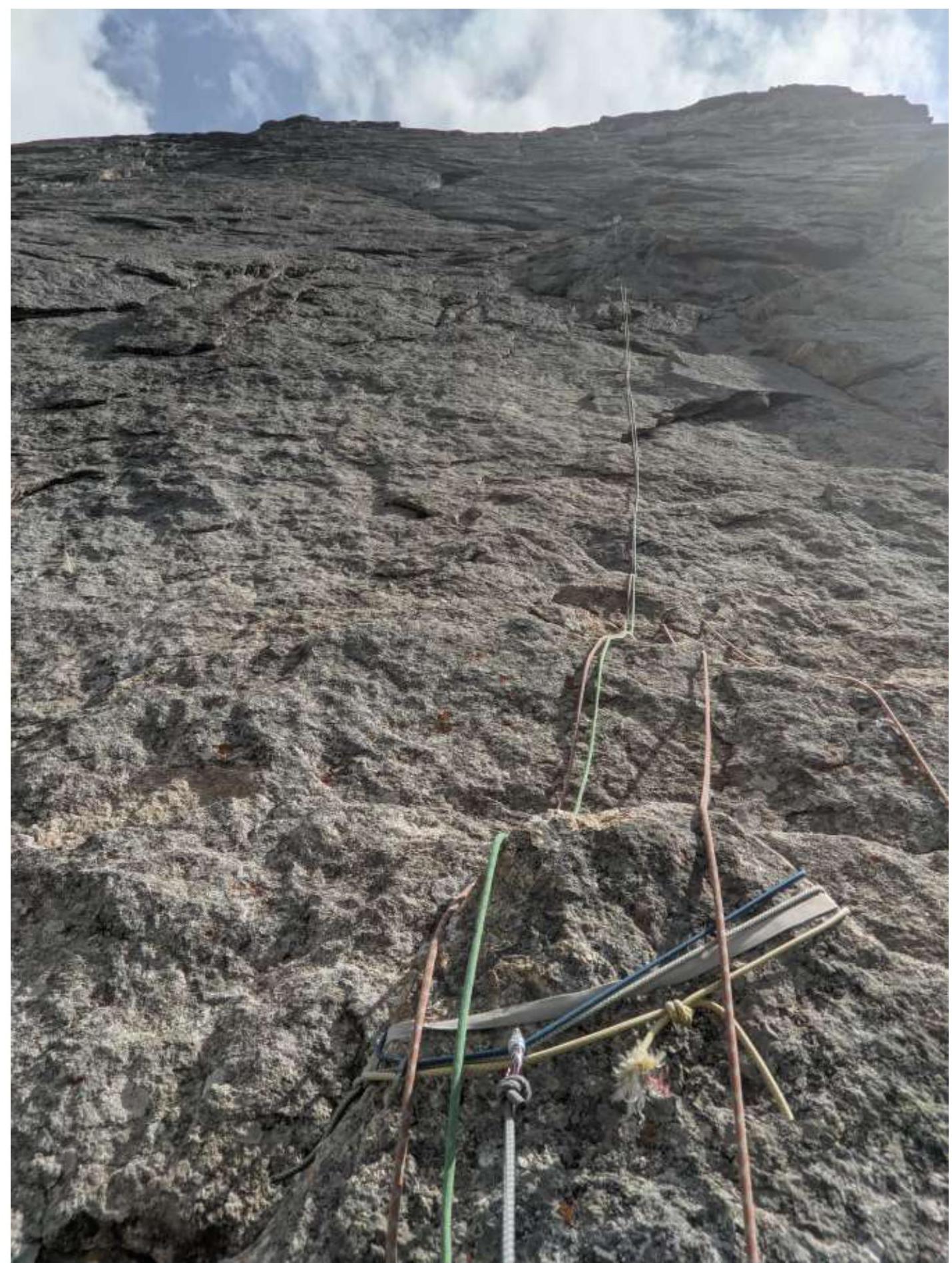
Fourth station. From it, rappel slightly left, entering a small fracture.
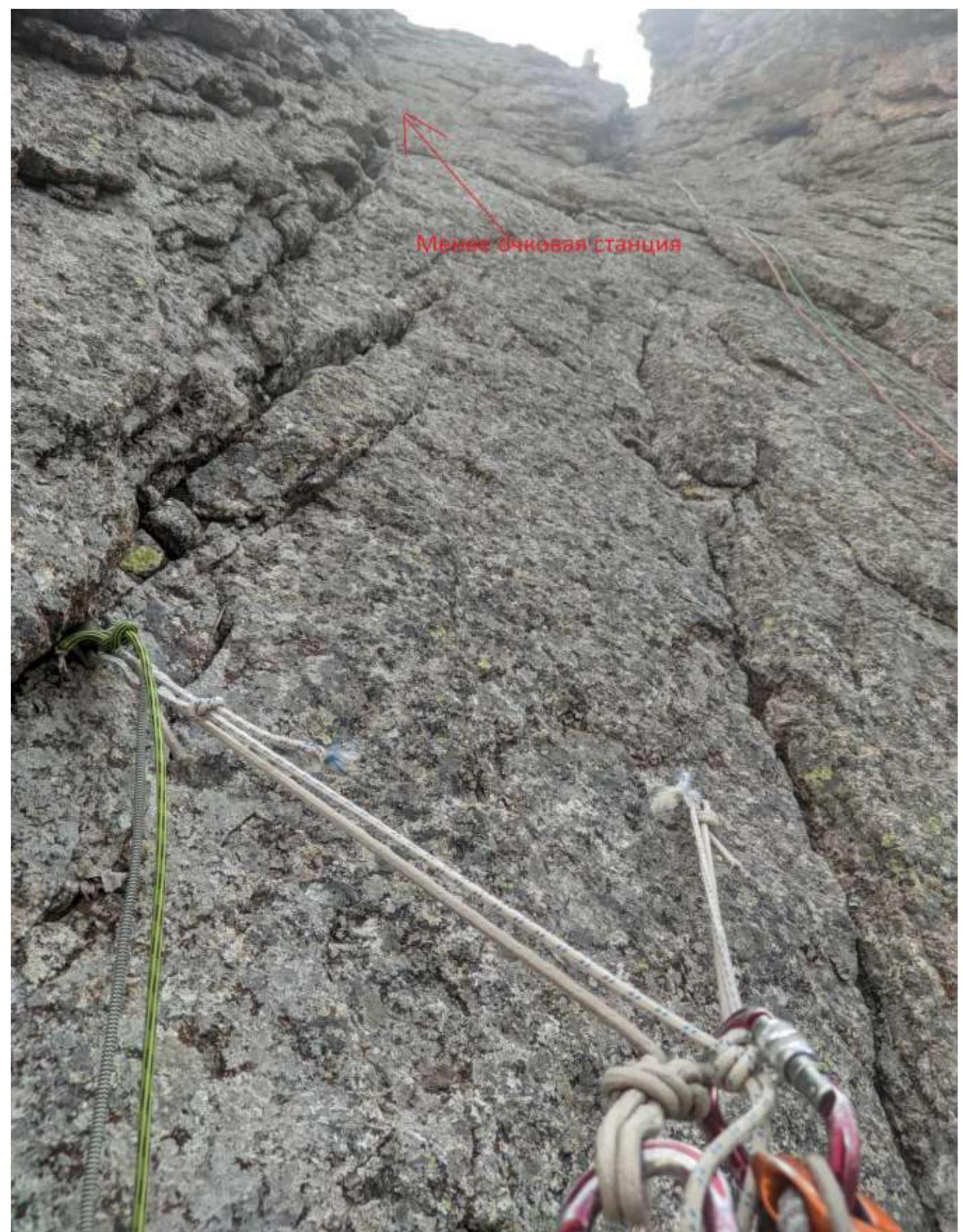
Fifth station. The arrow indicates the location of the station, which is exactly within rope length. The next one is about a meter out of reach if rappelling on sixty-meter ropes.
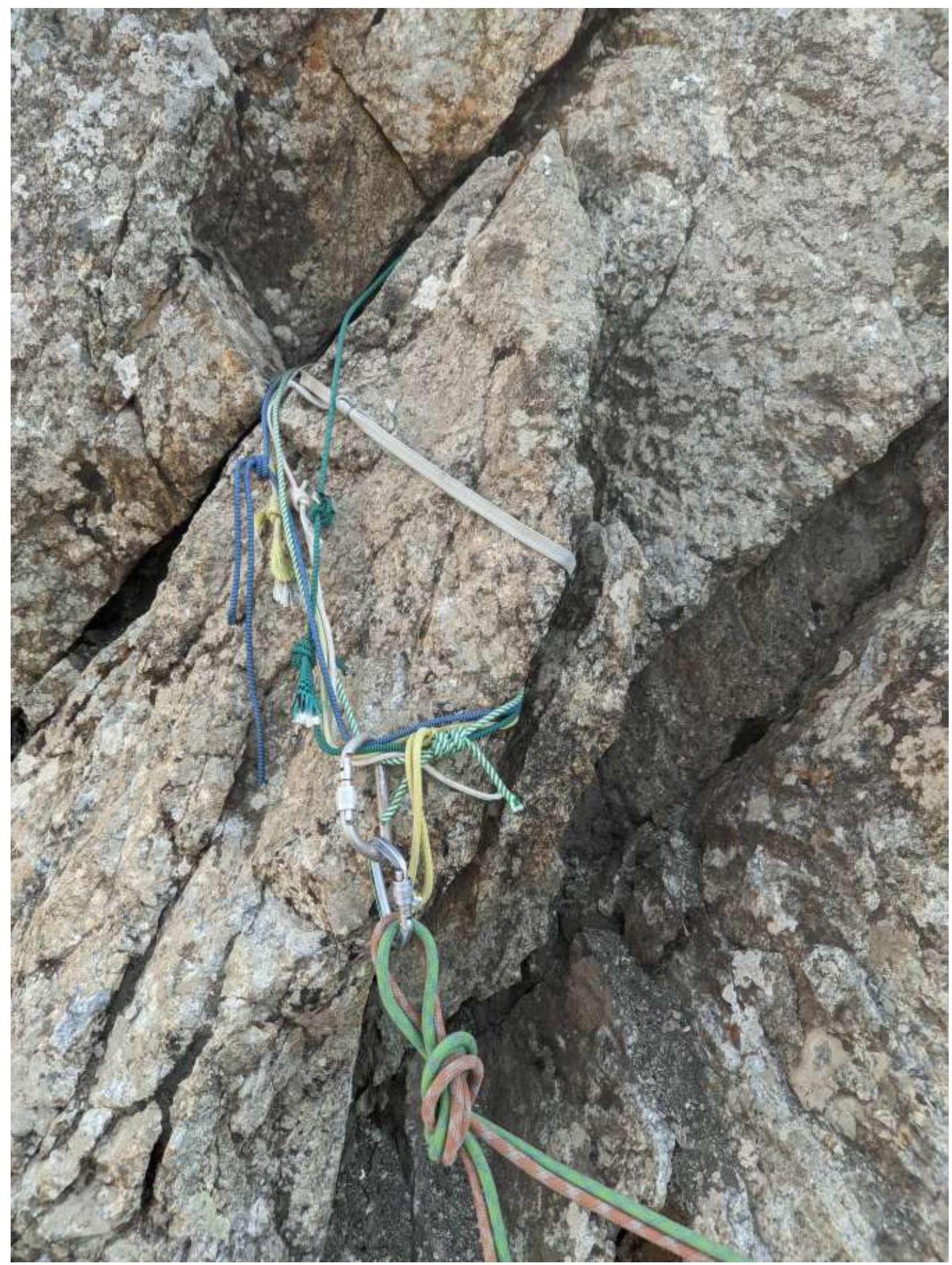
Sixth station. Located in a spot where, theoretically, one could spend the night. There is space for a tent.

Comments
Sign in to leave a comment