
PASSPORT
-
Technical class
-
Pamir-Alai, Turkestan Range, Laiyak gorge area
-
Peak Ak-su via N wall
-
Category 6B (presumably 4th ascent)
-
Height difference: 1447 m, length: 2149 m, including bastion: 1040 m and 1297 m respectively. Length of sections with 5th category difficulty: 539 m. 6th category difficulty: 389 m. Average steepness of the main part of the route is 70°, bastion is 79°.
-
Pitons driven:
Rock Chocks Bolt Ice 120+7*/27+1* 278/44 24*+ I/21*+ I 4 *reuse of previously driven pitons Pitons left on the route: 0. Reused previously driven (not removed): 7 rock and 24 bolt pitons.
-
Team's total climbing hours: 57.5, and 6 climbing days.
-
Overnights: 1st - 2 people lying down, 2 people sitting on a ledge; 2nd - 3 people lying in a tent, one person lying on a nearby ledge; 3rd - a platform carved into an ice slope for 4 people - semi-reclining; 4th - 5th - lying on platforms in a tent.
-
Team leader: GARIN ALEXANDER YUREVICH - Candidate for Master of Sports Team members:
- MALAMA GEORGIY ANATOLIEVICH - Candidate for Master of Sports
- SHABUNYA STANISLAV IVANOVICH - Master of Sports
- MASHKANOV ALEXANDER MIKHAILOVICH - Candidate for Master of Sports
-
Coach: LOZOVSKY LEONID IVANOVICH - 2nd sports category.
-
Departure to the route: August 7, 1990 Summit: August 12, 1990 Return: August 13, 1990
-
Sports Alpine Club "KROK" Minsk, under the trade union committee of MPO named after Lenin.
Sections: R3-R5, R6-R28, R30-R31, R33-R45. Later, this tactic was used episodically: sections R48-R49, R50-R51, R52-R53, R57-R59, R66-R67.
On other sections of the bastion, the rope teams moved with variable protection on a double rope, the leader also - without a backpack and in galoshes. Sections:
- R0-R3, R5-R6, R28-R30, R31-R33, R46-R48.
On the ridge part of the route, a similar method of advancement was combined with simultaneous movement with protection through a piton, chocks, and ledges. Sections:
- R51-R52, R56-R57, R60-R64, R67-R69, R72-R73, R73-R74.
All belay points were organized on the principle of blocking 2-4 reliable elements (piton, chock, loop on a ledge or "flange" or in "hourglass", bolt piton left by previous groups).
Rappel work on a complex route was predominant, so the movement regime was continuous (without stops for rest and food). Team members rested while another team member was on a rappel section ("pocket" nutrition), and the leader - while the second team member was ascending. Full rest, as much as possible on such a route, was obtained only during overnight stops, which were chosen almost all in safe places (on ledges under overhangs or on a ridge).
Each overnight stop took 1.5-2.5 hours to:
- "build" a platform for the tent;
- or to sit, lie down - together or apart.
The terrain of the route, as we assumed, having studied the materials and after visual observations, allowed us to do without the "traditional" means of organizing overnight stops for routes on the N wall of Ak-su - hammocks, tent-platforms. There were enough convenient places for bivouacs on the route.
The team's ascent was without "working" falls or any injuries.
The most difficult key section of the route was the passage of the "Blin" plug in the chimney of the II "Integral" R8-R10, which required the leader to exert maximum effort and demonstrate all the skill he was capable of. At the same time, only one bolt piton was used, driven by him when passing the final exit of the section. The rest - even very
Technical Actions of the Team
During the passage of the route, the team made minor deviations from the tactical plan:
-
On the second day of the ascent, the team finished working on passing the wall 1 hour earlier than planned, not reaching 1 rope length to the control tour. At this time, the sun was shining on the wall, and water was flowing through it in this place (R23-R25). There was no problem passing the bolt route in the morning on frozen streams on ITO, so in order not to get wet before the overnight stay, it was decided not to process this section, but to pass it the next morning. Overnight stay - in the planned location.
-
On the third day, the team coped with the plan - reached the ridge and processed another 1 rope length upwards 1 hour earlier. Some sections on the route on this day turned out to be a bit weaker than expected:
- R26-R27;
- R31-R32;
- R33-R34 (compared to the report by Kuzovov, 1988).
- Fourth day - 1 hour longer than planned. The reason is the poor condition of this part of the route (left side of the bastion's edge, R35-R43):
- a lot of ice and snow.
-
Fifth day - a 2-hour delay in reaching the summit ridge - the inner corner (R52-R53) was in very poor condition - heavily iced and very cold in the morning. We stopped for the night, not reaching the summit by 2 hours 30 minutes at the planned time - we found a very convenient large platform on the ridge (R65). The group had no information about the availability of convenient platforms above.
-
Reached the summit on the morning of the sixth day and subsequently fit into the descent and return to camp schedule in worsening weather conditions, without using the reserve day of August 14, 1990. When passing the bastion, before reaching its ridge, rappel belay was used on almost all sections (the first hangs the rappel, and the rest move on two jammers "chest-leg", rucksack - "American style"). Everyone moved on a double rope. The first - with an "Elite", in galoshes without a backpack, with a shock absorber.
The complex sections were not problematic for the team. Regular reliable communication was maintained with the base camp using the R-59 radio station, in accordance with the schedule. There were no missed sessions.
It should be noted that the number of chocks taken on the route was somewhat excessive. Their number can be reduced (for a team of 4 people) to 20-22 pieces.
The route turned out to be within the team's capabilities, and the style of passage corresponded to the level of training of the participants. Practically on any section and on the route as a whole, the team had a good reserve of strength and means (reserve) in case of bad weather and other unforeseen circumstances.
Among the non-traditional technical means used on the route, we note:
- construction dowels with a titanium eye for ITO on narrow, deep cracks, where the use of petal pitons is impossible.
Route diagram in UIAA symbols.
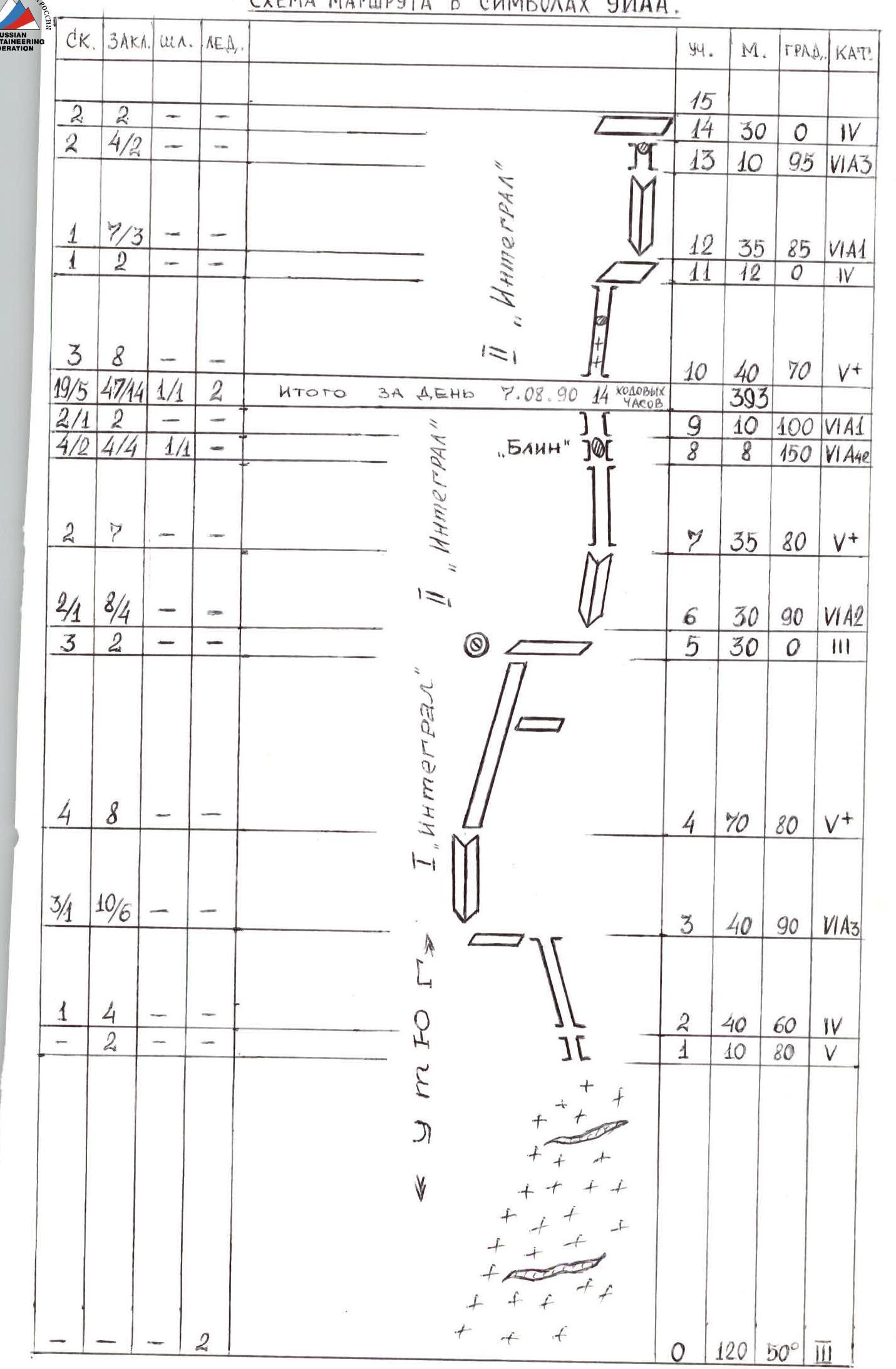
**TOTAL FOR THE ROUTE:** Total on the route: 127/28 rock pitons, 278/44 chocks, 24/4 bolt pitons, 4 ice pitons. Total length: 2149 m. Total 57.5 climbing hours.
**TOTAL FOR August 7, 1990:** 19/5 rock pitons, 47/14 chocks, 1/1 bolt pitons, 2 ice pitons. Total length: 393 m. Total 14 climbing hours.
**TOTAL FOR August 8, 1990:** 21/3 rock pitons, 54/10 chocks, 6/4 bolt pitons. Total length: 227 m. Total 10 climbing hours.
**TOTAL FOR August 9, 1990:** 35/9 rock pitons, 53/9 chocks, 17/6 bolt pitons, 2 ice pitons. Total length: 357 m. Total 10 climbing hours.
**TOTAL FOR August 10, 1990:** 20 rock pitons, 50 chocks, 1+ bolt piton. Total length: 320 m. Total 11 climbing hours.
**TOTAL FOR August 11, 1990:** 24/11 rock pitons, 53/10 chocks. Total length: 517 m. Total 10 climbing hours.
**TOTAL FOR August 12, 1990:** 8 rock pitons, 21 chocks. Total length: 335 m. Total 2.5 climbing hours.
| ROCK | CHOCKS | BOLT | ICE | SECTION | M | DEG | CAT |
|---|---|---|---|---|---|---|---|
| - | - | - | - | R74 | |||
| 1 | 3 | - | - | R73 | 150 | 15 | 3 |
| - | 2 | - | - | R72 | 40 | 60 | 3 |
| - | 3 | - | - | R71 | 25 | 65 | 4 |
| 2 | 2 | - | - | R70 | 25 | 60 | 4 |
| 2 | 4 | - | - | R69 | 25 | 80 | 5 |
| 1 | 2 | - | - | R68 | 20 | 70 | 4 |
| 2 | - | - | - | R67 | 20 | 40 | 3 |
| 2 | 3 | - | - | R66 | 30 | 80 | 5 |
| 1 | - | - | - | R65 | 15 | 0 | 2 |
| - | 4 | - | - | R64 | 40 | 65 | 4 |
| 1 - | - | R63 | 15 | 45 | 4 | ||
| 1 | 5 | - | - | R62 | 40 | 45 | 3 |
| - | 2 | - | - | R61 | 20 | 65 | 3 |
| - | 1 | - | - | R60 | 10 | 10 | 2 |
| - | 3 | - | - | R59 | 30 | 70 | 4 |
| 1 | 4 | - | - | R58 | 20 | 85 | 5 |
| - | 3 | - | - | R57 | 20 | 65 | 4 |
| - | 5 | - | - | R56 | 40 | 30 | 3 |
| 1 | 4 | - | - | R55 | 40 | 45 | 4 |
| 1 | 2 | - | - | R54 | 10 | 80 | 5 |
| - | 2 | - | - | R53 | 20 | 50 | 3 |
| 6/4 | 6/4 | - | - | R52 | 50 | 85 | 6 |
| 4 | 2 | - | - | R51 | 80 | 40 | 3 |
| 1/4 | 5/4 | - | - | R50 | 12 | 90 | 6 |
| - | - | - | - | R49 | 25 | 15 | 2 |
| 7/6 | 3/2 | - | - | R48 | 20 | 60 | 6 |
| 1 | - | - | - | R47 | 20 | 35 | 3 |
| 1 | 2 | - | - | R46 | 10 | 60 | 4 |
| 2 | - | - | - | R45 | 10 | 0 | 2 |
| 1 | 7 | - | - | R44 | 30 | 75 | 5 |
| - | 5 | - | - | R43 | 35 | 75 | 5 |
| 1 | 3 | - | - | R42 | 20 | 40 | 5 |
| 1/4 | 3/4 | - | - | R41 | 20 | 85 | 6 |
| 2 | 5 | - | - | R40 | 40 | 75 | 5 |
| 3 | 1 | - | - | R39 | 15 | 70 | 5 |
| 2 | - | - | - | R38 | 10 | 70 | 5 |
| 1 | 1 | 1+ | - | R37 | 15 | 65 | 5 |
| 2 | 10 | - | - | R36 | 60 | 65 | 5 |
| 3 | 6 | - | - | R35 | 20 | 75 | 6 |
| 3 | 5 | - | - | R34 | 35 | 80 | 5 |
| 4 | 3 | - | - | R33 | 40 | 70 | 4 |
| 1 | 0 | - | 2 | R32 | 10 | 10 | 2 |
| 4 | 18 | - | - | R31 | 100 | 60 | 3 |
| 7/4 | 10/6 | - | - | R30 | 40 | 95 | 6 |
| 1 | 1 | - | - | R29 | 40 | 10 | 3 |
| 2 | 6 | - | - | R28 | 40 | 40 | 4 |
| 2 | 3 | - | - | R27 | 15 | 70 | 5 |
| 4 | 5 | - | - | R26 | 20 | 60 | 4 |
| 3 | 2 | 1+ | - | R25 | 20 | 0 | 2 |
| 4/2 | 3/2 | - | - | R24 | 7 | 90 | 6 |
| 3/3 | 2/1 | 16/6 | - | R23 | 25 | 95 | 6 |
| 2/1 | 6/3 | 2/0 | - | R22 | 15 | 95 | 6 |
| 2 | 7/2 | - | - | R21 | 20 | 80 | 6 |
| 2/1 | 4/2 | - | - | R20 | 7 | 95 | 6 |
| 2 | 2 | - | - | R19 | 20 | 0 | 3 |
| 2 | 3 | - | - | R18 | 15 | 85 | 5 |
| 2/1 | 5/3 | 4/4 | - | R17 | 20 | 85 | 6 |
| - | 2 | - | - | R16 | 10 | 0 | 4 |
| - | 2 | - | - | R15 | 8 | 70 | 4 |
| 2 | 2 | - | - | R14 | 30 | 0 | 4 |
| 2 | 4/2 | - | - | R13 | 10 | 95 | 6 |
| 1 | 7/3 | - | - | R12 | 35 | 85 | 6 |
| 1 | 2 | - | - | R11 | 12 | 0 | 4 |
| 3 | 8 | - | - | R10 | 40 | 70 | 5 |
| 2 | 1 | 2 | - | R9 | 10 | 100 | 6 |
| 4 | 2 | 4/4 | 1/1 | - | R8 | 8 | 150 |
| 2 | 7 | - | - | R7 | 35 | 80 | 5 |
| 2 | 1 | 8/4 | - | - | R6 | 30 | 90 |
| 3 | 2 | - | - | R5 | 30 | 0 | 3 |
| 4 | 8 | - | - | R4 | 70 | 80 | 5 |
| 3/4 | 10/6 | - | - | R3 | 40 | 90 | 6 |
| 1 | 4 | - | - | R2 | 40 | 60 | 4 |
| 2 | - | - | - | R1 | 10 | 80 | 5 |
| - | - | - | 2 | R0 | 120 | 50° | 3 |