
Ascent Passport
-
Ascent class — technical.
-
Ascent area, ridge — Fann Mountains, Zarafshan Ridge.
-
Summit, its height, ascent route — Moscow-Zerafshanskaya peak, 5183 m, via the NNE wall, first ascent.
-
Proposed difficulty category — 5B category.
-
Route characteristics:
total elevation gain — 1383 m. elevation gain of the wall section — 1250 m. total route length — 2400 m. wall section length — 1530 m. length of sections with 5th category difficulty — 1090 m. length of sections with 6th category difficulty — 225 m. average steepness of the wall section — 73°.
- Pitons driven for protection:
- rock pitons — 160
- chocks — 80
- ice screws — 30
- Total climbing hours — 58.
- Number of bivouacs and their characteristics:
- four bivouacs, three semi-reclined, one sitting.
- Team leader, participants, and their qualifications:
Fevziev R.F., Master of Sports of the USSR — team leader
Team members:
- Smirnov G.K., Master of Sports of the USSR
- Valiulin E.A., Master of Sports of the USSR
- Gornostaev V.V., Candidate for Master of Sports
- Tishchenko V.I., Candidate for Master of Sports
- Murzin A.V., Candidate for Master of Sports
-
Team coach — Mumdzhi T.M., Master of Sports of the USSR, 1st category instructor-methodologist.
-
Date of departure and return:
departure — August 1, 1981 return — August 5, 1981
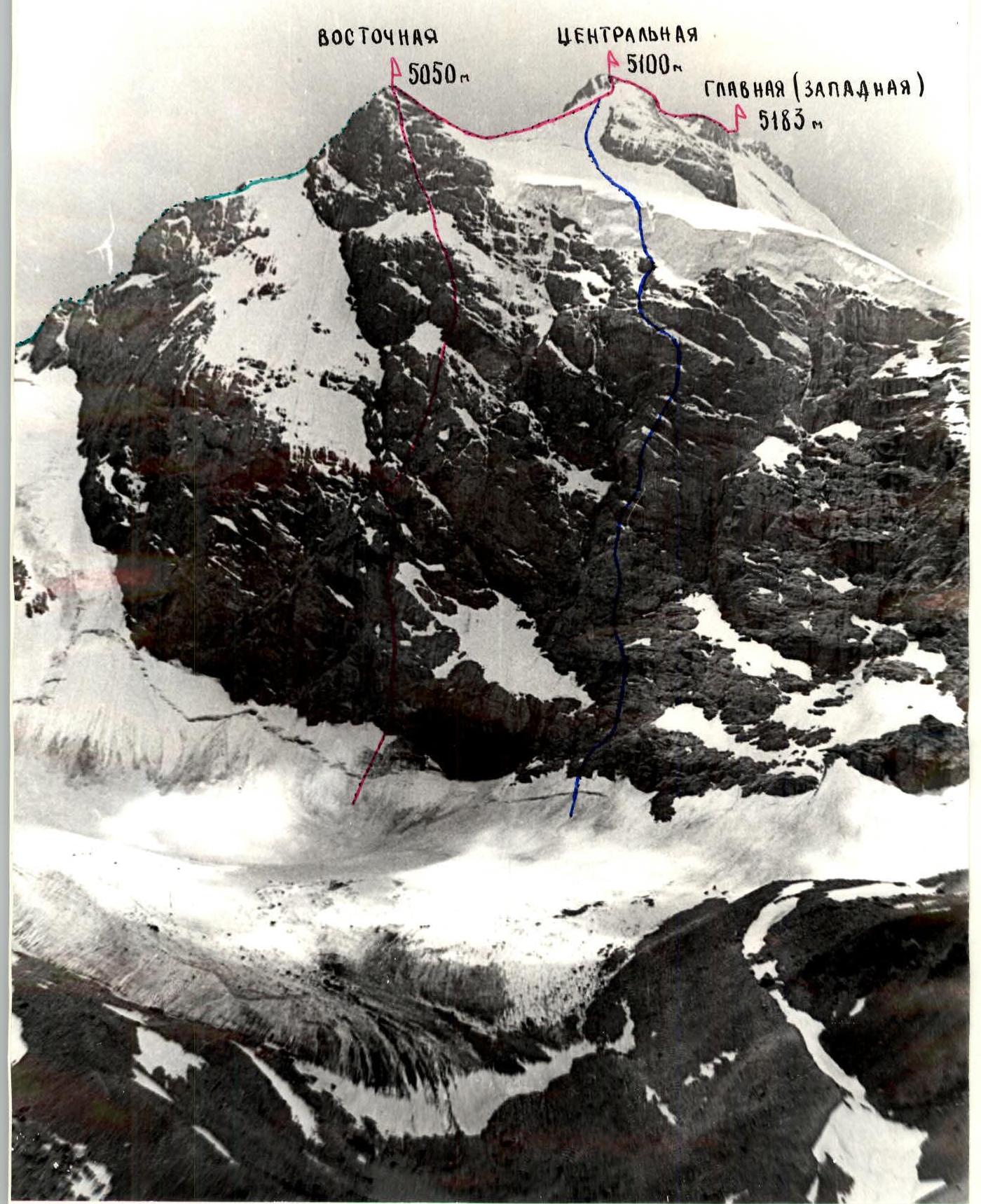
- Route via the NNE wall, completed by the team in 1981.
- Route via the N wall, through the hanging glacier, completed in 1980 by the ARTUCh team, 5B category.
- Route via the E ridge, 3B category.
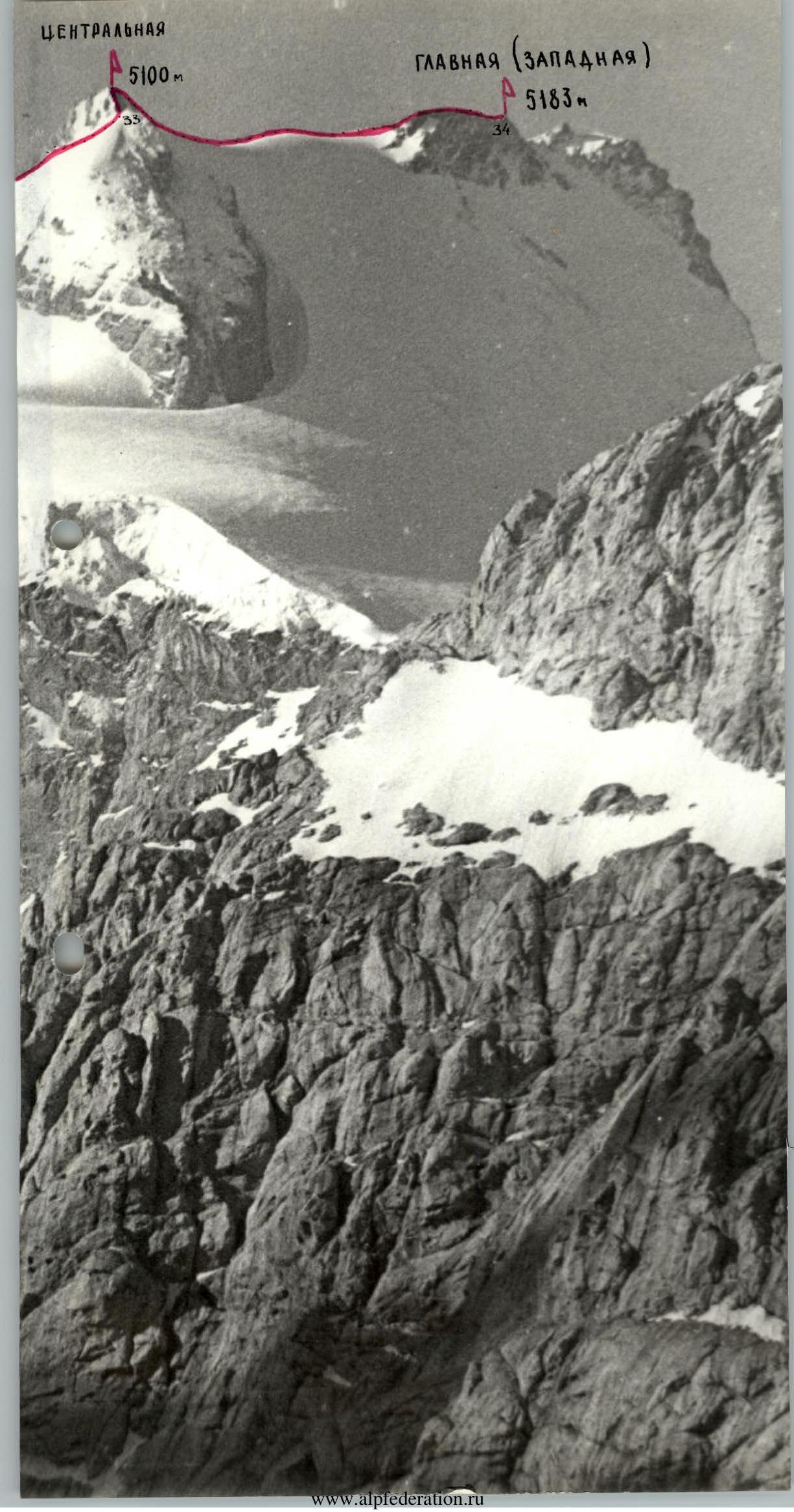
Moscow-Zerafshanskaya Peak
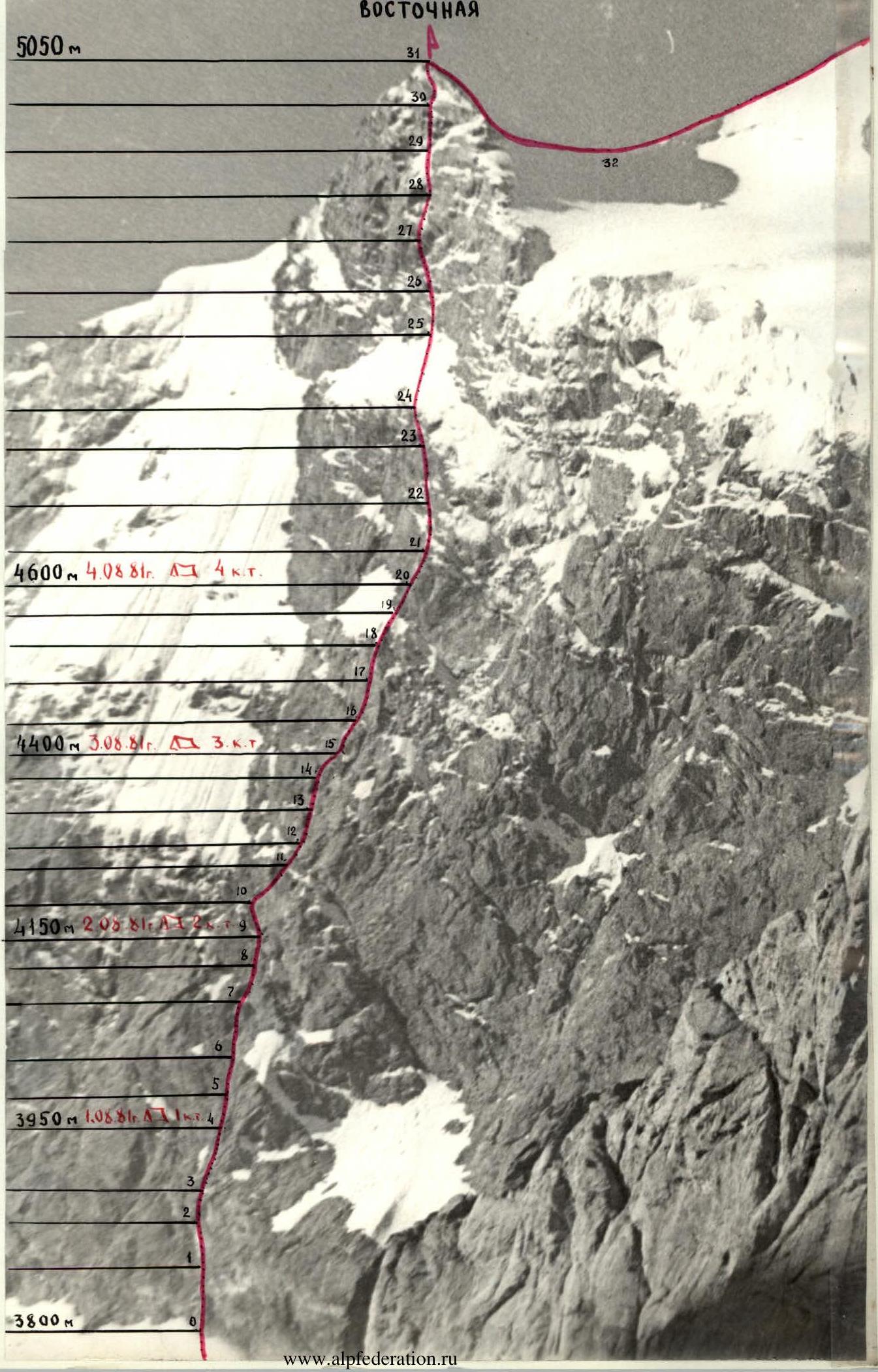
Description of the Ascent Route
The base camp, which was also the assault camp, was set up approximately 500 m from the base of the route. The camp tents were installed on the medial moraine formed at the confluence of glaciers descending from the northern and northeastern slopes of the Amshut and Moscow-Zerafshanskaya peaks.
August 1. Early rise, and at 6:00, three team members — Fevziev R.F., Tishchenko V.I., and Murzin A.V. — set out towards the route — the NNE wall of Moscow-Zerafshanskaya peak. Half an hour later, it is fully daylight, and from the base camp, it is visible that the trio has already crossed the bergschrund. At this time, the remaining climbers also depart.
The firn slope at the base of the route is quite steep, but it is easy to ascend to the bergschrund. At the bergschrund, Fevziev Rishat puts on crampons and, using an ice axe and ice hammer, first crosses the snow bridge and then the 2–2.5-meter ice wall. Then, via a steep firn slope with lower belay through an ice axe driven into the firn at the lower edge of the bergschrund, he approaches the start of the route — the right edge of the lower rock triangle.
The Tishchenko-Murzin pair waits impatiently; they are "cold and want to get to the wall quickly." They are the first to begin work on the route today.
From below, the others are already approaching. The rope is in place, and Valera and Sasha quickly ascend under the wall.
After a brief consultation, Valera Tishchenko puts on crampons and begins to climb the steep, complex wall. The climbing is immediately very difficult, but Valera enjoys and is skilled at leading complex walls.
The following are used:
- pitons
- chocks
- double rope belay — nylon and capron
Valera works very focused and confident. Soon, he reports that he is approaching the start of the internal corner-chimney. The entire R0–R1 section is climbed "free solo."
The rope is in place. Via the fixed capron rope, with a nylon rope attached to himself, Rishat ascends, pulling up the second nylon rope. Along the way, he only removes the sling-loops and chocks, securing the rope with a karabiner where necessary.
While Rishat prepares to climb the steep, vertical internal corner, Smirnov Gennadiy ascends via the fixed rope with lower and upper belay, bringing another capron rope.
On a double rope, Rishat begins to climb the vertical internal corner 

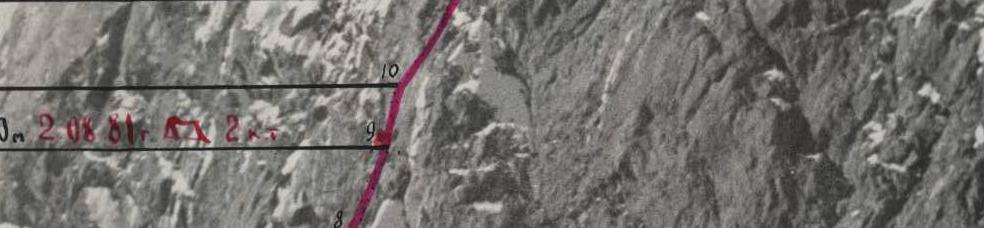
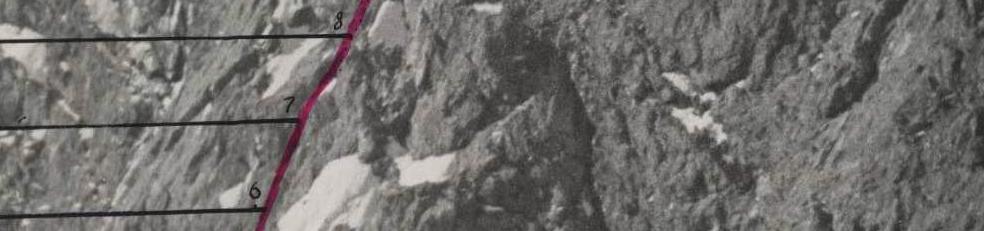

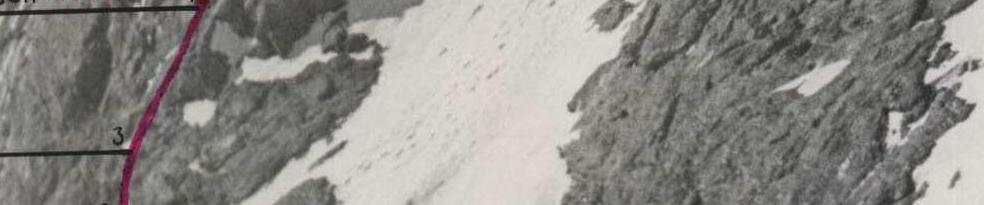
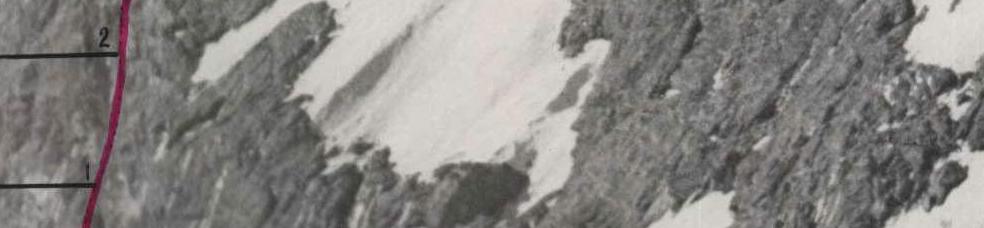
Main Characteristics Table
Ascent Route to Moscow-Zerafshanskaya Peak via the NNE Wall.
| Date | Section | Average Steepness (degrees) | Length (m) | Terrain Type | Difficulty | Condition | Weather | Rock Pitons | Chocks | Ice Screws | Departure Time, Bivouac, Climbing Hours, Bivouac Conditions |
|---|---|---|---|---|---|---|---|---|---|---|---|
| August 1, 1981 | R0–R1 | 80 | 40 | wall | 6 | monolithic | good | 8 | 4 | – | Departure from bivouac — 6:00. |
| R1–R2 | 85 | 40 | internal corner | 6 | monolithic | good | 8 | 6 | – | – | |
| R2–R3 | 90 | 20 | chimney | 6 | monolithic | good | 3 | 4 | – | – | |
| R3–R4 | 80 | 80 | wall | 5 | monolithic | satisf. | 10 | 6 | – | Stop — 17:00 (bad weather). Climbing hours — 11. Bivouac — semi-reclined, satisf. | |
| August 2, 1981 | R4–R5 | 80 | 40 | slab, internal corner | 5 | monolithic | good | 4 | 4 | – | Departure from bivouac — 7:00. |
| R5–R6 | 85 | 50 | wall | 5 | monolithic | good | 6 | 2 | – | – | |
| R6–R7 | 70 | 50 | slab | 5 | monolithic | good | 4 | 2 | – | – | |
| R7–R8 | 80 | 40 | wall | 5 | monolithic | satisf. | 5 | 2 | – | Stop — 15:00 (bad weather). Climbing hours — 8. Bivouac — semi-reclined, satisf. | |
| R8–R9 | 75 | 40 | wall | 5 | monolithic | bad | 6 | 2 | – | – | |
| August 3, 1981 | R9–R10 | 65 | 60 | slab | 5 | icy | good | 7 | 3 | 2 | Departure from bivouac — 7:00. |
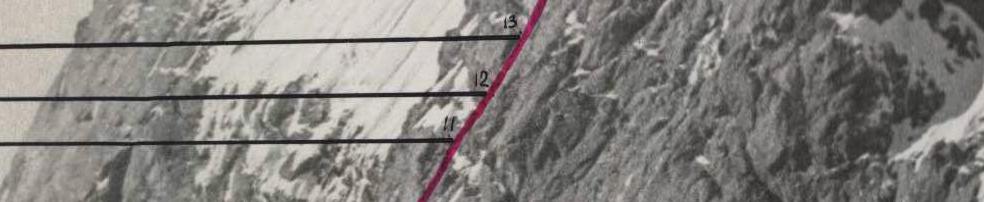
| R10–R11 | 75 | 80 | wall, internal corner | 5 | monolithic | good | 8 | 5 | – | – | |
| R11–R12 | 55 | 30 | slab | 4 | icy | good | 4 | 2 | 1 | – | |
| R12–R13 | 85 | 35 | wall | 6 | monolithic | good | 5 | 1 | – | – | |
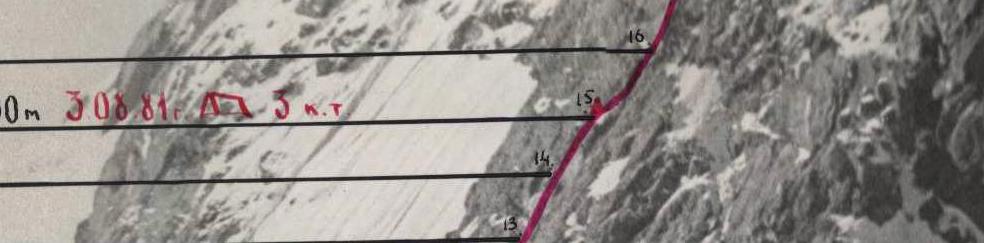
| R13–R14 | 80 | 40 | wall | 5 | monolithic | good | 6 | 2 | – | Stop — 18:00. Climbing hours — 11. Bivouac — sitting, satisf. | |
| R14–R15 | 70 | 60 | wall | 5 | monolithic | good | 4 | 4 | – | – | |
| August 4, 1981 | R15–R16 | 70 | 50 | wall | 5 | monolithic | good | 5 | 4 | – | Departure — 7:00. |
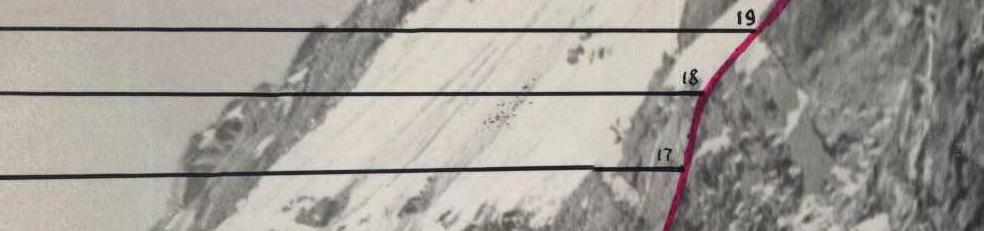
| R16–R17 | 65 | 40 | wall | 5 | icy | good | 4 | 2 | 2 | – | |
| R17–R18 | 75 | 60 | internal corner | 5 | monolithic | good | 6 | 2 | – | – | |
| R18–R19 | 55 | 50 | ice-firn slope | 4 | icy | good | 2 | – | 4 | Stop — 20:00. Climbing hours — 13. Bivouac — semi-reclined, satisf. | |
| R19–R20 | 60 | 40 | slab | 5 | monolithic | good | 5 | 2 | – | – | |
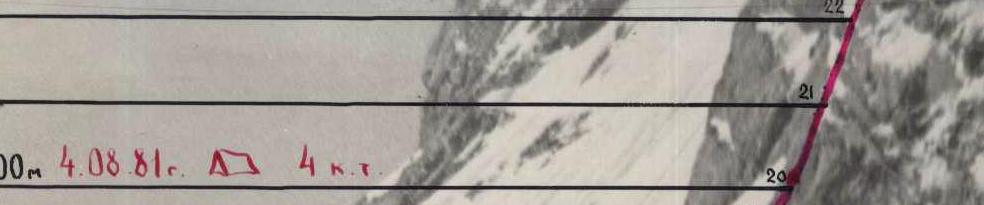
| August 5, 1981 | R20–R21 | 90 | 40 | wall | 6 | monolithic | good | 8 | 2 | – | Departure — 6:00. |
| R21–R22 | 85 | 50 | wall | 6 | icy | good | 9 | 3 | 3 | – | |
| R22–R23 | 75 | 60 | wall | 5 | icy | good | 8 | 3 | 3 | – | |
| R23–R24 | 60 | 40 | internal corner, gully | 5 | icy | good | 1 | – | 4 | – | |
| R24–R25 | 55 | 80 | ice-firn slope | 4 | icy | good | 2 | – | 4 | – | |
| R25–R26 | 75 | 40 | internal corner | 5 | icy | good | 4 | 3 | 1 | – | |
| R26–R27 | 70 | 40 | wall | 6 | destroyed, monolithic, icy | good | 3 | 4 | – | – | |
| R27–R28 | 60 | 60 | couloir | 5 | icy | good | 2 | 1 | 3 | – | |
| R28–R29 | 70 | 55 | slab | 5 | icy | good | 4 | 2 | 1 | – | |
| R29–R30 | 60 | 60 | wall | 5 | destroyed, icy | good | 6 | 1 | 2 | – | |
| R30–R31 | 60 | 60 | slab, wall | 5 | icy | good | 4 | 2 | 1 | – | |
| R31–R32 | 30 | 200 | slope, ridge | 2 | firn | good | – | – | – | – | |
| R32–R33 | 40 | 260 | slope, ridge | 3 | firn | good | – | – | – | Arrival at the summit — 17:00. | |
| R33–R34 | 20 | 400 | ridge | 2 | firn | good | – | – | – | Climbing hours (including descent) — 15. |
Climbing hours (including tea, descent) — 15.
Total:
- 160
- 80
- 30
Climbing hours — 58
Bivouacs — 4, one sitting, three semi-reclined.
The internal corner with an overhang in the upper part (R1–R2). Climbing is again very complex, and chocks are used effectively. The internal corner then transitions into a chimney with an overhang in the middle section. Tishchenko climbs it again (R2–R3). The weather begins to deteriorate. To reach the planned bivouac site, we need to climb another wall. The wall is quite steep, but the microrelief is rich, and some places have rimaye ice (R3–R4).
Sleet starts falling. When Valera reaches a small horizontal ledge-crack with snow, protected from above by a cornice, the weather finally deteriorates. But this is no longer a concern, as everyone is moving on fixed ropes with upper belay.
We manage to set up two tents on the ledge. We also build the 1st control cairn here.
August 2
The weather is clear in the morning. There was enough time to rest. At 7:00, the Valiulin-Gornostaev pair departs to work first.
Ahead lies a steep, smooth slab covered with rimaye ice. The slab ends in an internal corner transitioning into a chimney with a carnelian plug at the top (R4–R5).
Next, we climb a steep monolithic wall cut by a vertical crack. Shovel-shaped pitons and small chocks fit well into it, but the ascent is mostly done on friction (R5–R6).
A short traverse to the right, avoiding the carnelian, and then vertically up the slab between large triangular niches (R6–R7). The right niche has an excellent spot for a sitting bivouac. However, we have only covered half the distance to the planned bivouac.
Again, we climb up the wall, along its right edge, and exit onto a small snow ledge. From the ledge, we ascend diagonally to the right via a narrow crevice to an inclined slab-ledge to the right of large carnelians (R7–R8). Then, we climb another wall, but with a richer relief. It's steep, but the ascent is relatively easy (R8–R9). Ahead, a sheer bastion is visible, at the base of which lies a horizontal rock ledge where we plan to bivouac. As we approach the rock bastion, it starts to drizzle, but the working day is soon to end.
We organize a bivouac. The ledge behind the rock ledge is narrow, but we manage to fit two tents. Again, we spend the night semi-reclined. On the bivouac site, we leave the 2nd control cairn.
August 3, 1981. The departure is early again. The Tishchenko-Murzin pair begins to move up the icy slab from left to right. On the left, it is cut by a chimney, almost completely filled with ice. Edik Valiulin carefully advances up along the chimney. For belay, ice screws are used, screwed into the ice of the chimney (R9–R10). Then, we ascend diagonally to the right via an inclined internal corner to a snow ledge and again climb vertically up an icy slab (R10–R12). The slab is not very steep, but the rimaye ice greatly hinders its passage.
Ahead lies a sheer bastion, the most complex part of the second rock belt. The work is very tense. We are helped by the fact that there are places to drive pitons and chocks are used effectively. Twice, Valera asks to be pulled up on two ropes — he uses "Zalzug." We spend the entire third day working to overcome this bastion (R12–R15).
Under the protection of a large sheer wall, we organize the third bivouac. At this site, we set up the 3rd control cairn.
August 4. In the morning, the Valiulin-Gornostaev pair heads out first. Edik begins to climb a steep monolithic wall. It's very cold in the morning. He approaches an indistinct internal corner. The movement accelerates somewhat. But ahead lies another sheer wall — the upper part of the second rock belt (R16–R17).
The wall is climbed along its right part, exiting onto a small rib, and then along the right part of the wall, we approach the base of a large ice-firn slab (R17–R18).
Vladimir Gornostaev puts on crampons and, using an ice axe and ice hammer, climbs the slab along its right edge. Another rope up the rock edge of the slab (R19–R20), and we exit to a grotto formed right in the monolithic wall. It's an excellent, safe spot for a bivouac.
Ahead lies another sheer bastion of icy rocks. This is the start of the 3rd rock belt — one of the most complex sections of the route. The Fevziev-Smirnov pair leads. Fevziev moves slowly forward, often driving pitons. After 40 m, he reaches icy, sheer rocks. The movement is hampered by the fact that sections of rocks not covered in ice are wet. The ascent continues with thorough piton protection, but as before, "free solo."
The rock bastion (R20–R24) leads to a large ice-firn slab at the base of the pre-summit (Eastern summit) bastion. At the end of section R22–R23, a bivouac was planned. However, there is no suitable spot for a bivouac here. It's already late. We decide to descend to the rock grotto and bivouac there.
Meanwhile, the Gornostaev-Valiulin pair climbs:
- the ice-firn slab,
- another 40 m of rocks at the base of the pre-summit bastion (R24–R26).
At 20:00, the entire team gathers at the bivouac.
The next day, we plan to start climbing the processed part of the route at 6:00 to make up for the time lost due to the late bivouac setup. In the grotto, we set up the 4th control cairn.
August 5. It's still dark when the Murzin-Tishchenko pair begins to ascend via the fixed ropes. At 7:30, the last climber leaves the bivouac. The upper end of the ropes is fixed at the base of an icy and snowy slab, transitioning into an inclined internal corner, also filled with ice (R26–R27).
Next, we climb a snowy couloir transitioning into a gully, from left to right (R27–R28), to an inclined slab covered with firn and ice. When passing the slab along its right part, both rock and ice pitons are used for belay (R28–R29).
After another two rope lengths of work on icy and snowy rocks, we reach the Eastern summit. The time is 15:00.
After a short rest, we begin our descent to the saddle, where our last bivouac is planned. Here, we have a good snack. Leaving everything unnecessary behind and traveling light with minimal gear, we head to the Central summit and then to the Main (Western) summit. This path is familiar to us from last year.
Around 18:00, we are back on the saddle. We discuss for a few minutes and decide to descend down today and return to the base camp. At 18:00, we contact the base camp via radio "Vitalka" and receive permission to descend.
Around 21:30, we return to the base camp.
Team captain — R. Fevziev
Coach — T. Mumdzhi
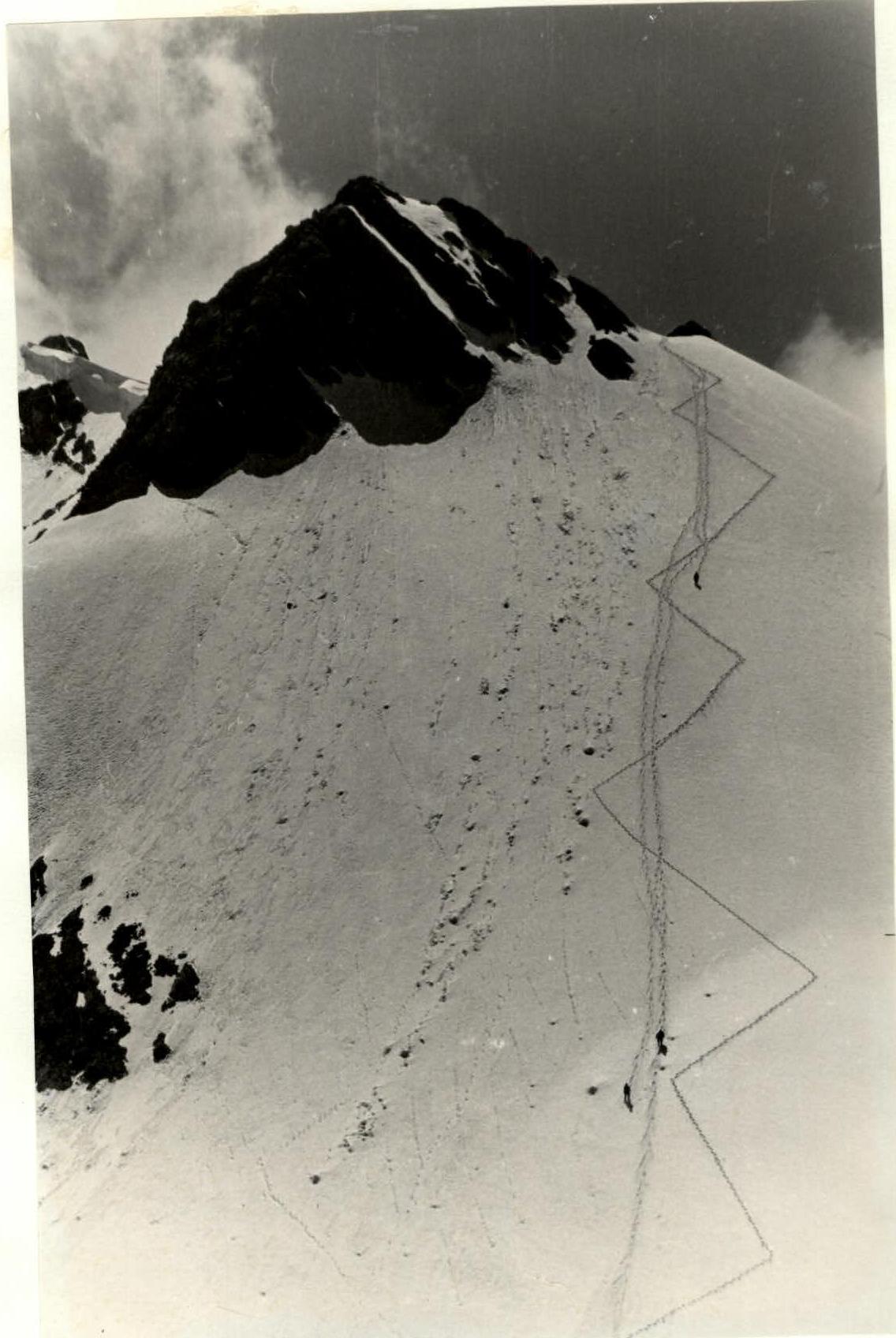
Section R32–R33
Ascent to Moscow-Central summit


