
Ascent Logbook
Completed in the 1974 USSR Alpine Climbing Championship.
- Ascent category — technically challenging
- Ascent region — Pamir-Alay, Fan Mountains
- Ascent route — via the western wall of Chimtarga peak (5494 m)
- Ascent characteristics: height difference — 1150 m, average steepness 86°–87°, length of complex sections — 1020 m
- Pitons used:
- rock pitons — 318
- ice pitons (in rock) — 10
- ice screws — 5
- wooden wedges — 15
- bolt pitons — 4
- Total climbing hours — 83
- Number of bivouacs and their characteristics — eleven; seven bivouacs:
- 4 — on platforms laid on inclined ledges,
- 1 — sitting on a narrow ledge,
- 1 — semi-sitting at the base of an inclined angle,
- 1 — on the summit.
- Team name — combined team of the Krasnoyarsk Regional Council of the Spartak Sports Society, entered by the Central Council of the Spartak Sports Society.
- Surname, name, patronymic of the team leader, participants, and their qualification:
- PRUSAKOV Sergey Mikhailovich — Master of Sports, captain
- BYCHKOV Vladimir Mikhailovich — Candidate for Master of Sports, deputy captain
- YANOV Vitaly Fedorovich — Candidate for Master of Sports, participant
- GAVRYUSHKIN Valery Vladimirovich — Candidate for Master of Sports.
- Team coach — SVETLAKOV Valery Andreevich, Master of Sports of the USSR, senior alpinism instructor.
- Dates of departure and return — August 3 to August 14, 1974

Prus. Chimt
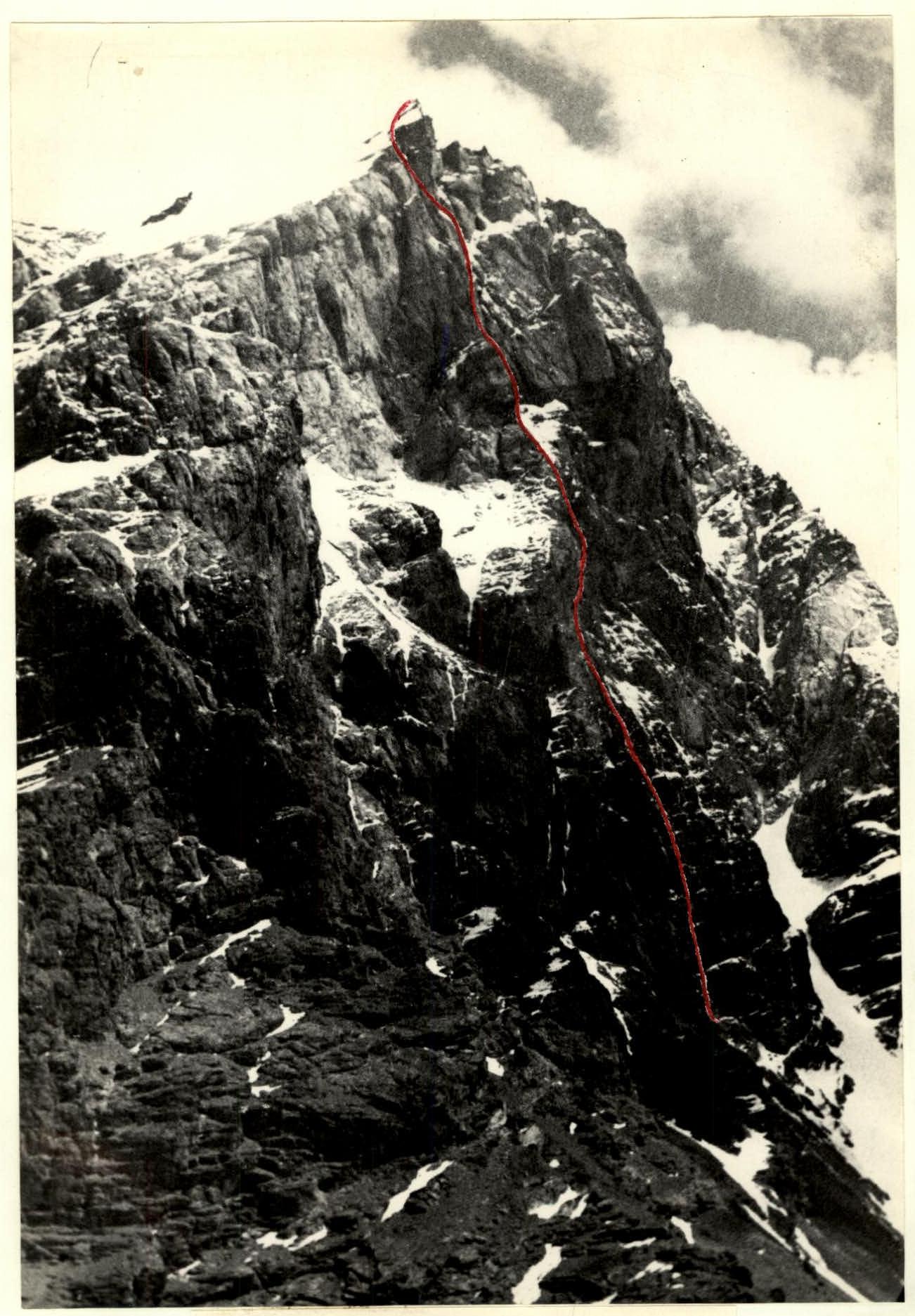
Route taken by the team
4. Ascent Description
August 2, Day one — After breakfast, by 10:00, all rucksacks for the ascent were packed, and final preparations were completed. Warm farewell wishes from fellow climbers, handshakes, and numerous camera shutters clicking away.
In addition to the five climbers, the assault camp was also vacated by:
- the senior team coach,
- a pair of observers.
We ascended to the upper camp (fig. II) via a familiar trail in 3 hours and settled into tents for lunch.
A trio of climbers, Prusakov, Yanov, and Reutov, set off under the wall to the start of the route to re-examine the lower part of the wall, which was poorly visible from below.
Those remaining below observed the route through binoculars and camera telephoto lenses.
The weather was typical for recent days:
- sunny below,
- cloudy here, with the sun rarely peeking through the clouds, and parts of the wall and its peaks shrouded in clouds.
Only towards evening did the wall "open up" for a few minutes, looking very effective in the soft evening light, with numerous details of the planned route clearly visible. We hastened to capture a few more frames.
The weather worsened, the peaks were enveloped in fog, and light snow began to fall. The team returned in the twilight, exchanging impressions. We lamented the weather and retired to bed early.
August 3 — The ascent began early. Everything was ready to go, but the weather was not cooperating, with heavy clouds hanging low. Rucksacks were packed, weighing between 20 and 25 kg. The processing pair, Yanov and Prusakov, departed from the assault camp at 8:00, while the rest of the team left at 10:00. We listened once more to the coach's advice and the good wishes of our fellow climbers.
The ascent under the wall via the talus slope was:
- quite steep and tiring,
- with fine scree that slid from underfoot, causing us to slip.
- We reached the slope's inflection point, leaving the rocky outcrops to the right.
- We continued along the left snow tongue descending from under the wall.
- Occasionally, we had to venture onto the snow.
- In the upper part, ice was exposed.
- We traversed a wide (40 m) ice "tie" via steps cut by the first pair.
They emerged to meet us.
It was clear we wouldn't be working on the route today — snow pellets were trickling down the sheer wall, visibility was very poor, and fog surrounded us.
The team had already found a bivouac site 40 m left of the route's start on a narrow ledge beneath a powerful overhanging cornice. Ropes were already strung there along a fairly steep rocky wall with narrow shelves (fig. 13).
The ascent to the route's start with rucksacks in poor weather conditions took 5.5 hours, whereas reaching the wall without packs could be done in 3 hours from the moraine. We set up the tent on a low and inconvenient platform but safe nonetheless. We leveled the snow and prepared lunch. Only by 17:00 did the weather improve, with the sun melting the fallen snow and causing water to flow down the wall. We reported the situation down the mountain via evening radio communication.
August 4, Day three — At 8:00, the first rope team, Prusakov and Yanov, began work on the route. Sergey, leading, navigated a несложная стеночку (section R0–R1, fig. 14) towards a large cornice with an outcrop of about 5 m (section R1–R2, figs. 15, 16).
It was impossible to bypass it:
- to the right — smooth, overhanging walls devoid of cracks,
- to the left — similarly smooth and overhanging.
The cornice was overcome with extremely difficult climbing from right to left (fig. 17). We employed:
- 6 ladders,
- a platform,
- diverse hook shapes,
- a wooden wedge.
Toes clad in galoshes probed for the slightest holds on the wall.
After clearing the cornice, we moved left to right across a sheer wall beneath an overhanging slab (section R2–R3). The climbing was challenging, with very small holds, leading to the base of an internal angle (8 m) that transitioned into a chimney. Both the angle and chimney were coated with a thin layer of ice, significantly complicating the already extremely difficult climb. At the base of the chimney was the belay point for the second climber in the rope team; V. Yanov took the lead.
The weather from the start of the day didn't bode well. The fog hadn't dissipated, it was very damp and cold, and galoshes kept slipping on the wet rock. Around 12:00, the weather turned from bad to worse: graupel began to fall, followed by wet snow. By this time, the first rope team, having processed the chimney and climbed a small (8 m) rocky wall (section R5–R6), reached a narrow ledge beneath an overhanging eave. A reliable system of pitons was emplaced, a free rope was hung, and a decision was made to descend to the bivouac site. By 13:00, the pair, soaked from head to toe and covered in snow, returned to the tent. Again, by around 17:00, the weather improved, with water flowing down the wall. It seemed we'd have to spend another night at the route's start. Our luck with the weather remained unfavorable, and we were pressed for time, with return tickets booked.
August 5, Day four — The weather was good in the morning, with a clear sky and clouds gathering lightly on the western horizon. On the wall, however, it was still cold, with damp rocks covered in a layer of ice overnight. Today, the Bychkov — Gavrushkin rope team began on the route. They quickly covered the sections processed the previous day, R1–R5. From the ledge, they started to bypass the cornice to the right via an ice-covered internal angle (section R6–R7), emplacing 4 pitons over 12 m.
Next, they traversed a 30-meter grey wall (section R7–R8) in a leftward and upward direction. The climbing was difficult, complicated by:
- sections of rime ice,
- small holds.
At the top of the wall, a narrow (10–15 cm) ledge was found, allowing for a belay point to be established for the second rope team and for the rucksacks to be pulled up from the first bivouac. The pull was significantly hindered by:
- numerous eaves,
- overhanging sections,
- the need to lower one person on a rope to pull the rope clear.
G. Reutov was the last to ascend, tasked with extracting pitons today. The weather turned bad again, with a completely overcast sky, strong wind, and wet snow.
Further movement proceeded along an angle with a series of small cornices, accomplished through both free climbing and artificial aids (section R8–R9). Then, a wall with small ledges was traversed leftward and upward (section R9–R10). There were very few cracks; V. Bychkov managed to emplace 4 petal-shaped pitons with great difficulty.
The wall led to the base of a sheer chimney (section R10–R11), with a belay point established while sitting in a ladder. The middle section of the chimney was blocked by wedges; to bypass these, about 20 m of climbing was done to the right and upward along the wall (section R11–R12).
The bad weather ceased, the snowstorm subsided, the sun reappeared, and the snow on the wall began to melt again, with water cascading down. It wasn't always possible to avoid getting wet. The rucksacks, suspended from pitons, got soaked, as did the climbers. The planned bivouac (a ledge with snow) was still half a rope length away, involving very difficult climbing across:
- an overhanging wall,
- a vertical chimney (section R12–R13).
On the ledge, we managed to construct a tolerable platform for the tent and pulled up the rucksacks. Reutov was the last to ascend by 20:00, visibly exhausted and chilled to the bone, having had the toughest time down below. With numb hands, he removed his soaked clothing and climbed into his sleeping bag. We warmed him with hot tea and had supper.
August 6, Day five — The weather was relentlessly bad from the morning:
- Wet snow continued to fall throughout the night.
- We periodically had to clear the tent's canopy.
- Forced inactivity.
Gennady's condition was not good; he complained of a headache and coughed. We treated him with our first-aid kit, gave him hot milk tea, and consulted with the expedition doctor via radio.
The bad weather had engulfed the entire valley; even the base camp received snow. Visibility was zero. We spent the night.
August 7, Day six —
- No change in the weather; it seemed to have gotten even worse.
- Emerging from the tent was immediately met with armfuls of wet, sticky snow.
- All ledges and non-steep walls on the rock face were whitened.
- It was fairly warm, and slush was creeping down the wall.
- Reutov's condition worsened: cough, throat pain — apparently, a result of catching a cold.
We discussed the situation and decided to wait until evening. If there were no improvements, we would arrange for Reutov's descent down the mountain via evening radio communication. At 18:00, we decided with the senior coach that a pair of observers would meet under the route by 9:00–10:00 to escort the ailing climber down. Towards evening, the bad weather subsided, the sky began to clear, and it cooled down.
August 8, Day seven. The weather was perfect in the morning. Although the sun hadn't yet reached the wall, the sky was cloudless. The recent snowfall was evident in the snow-dusted rock walls and the white blanket covering the moraine. At 8:30, the observers announced their arrival under the wall with a shout. With careful upper belay, we lowered G. Reutov to the start of the route, from where he departed downwards accompanied by the observers.
After a forced two-day delay, we resumed work on the route. From the bivouac, directly upwards, lay a grey wall with two small cornices. Climbing was complicated by the snow-covered rocks. Around 11:00, the wall was illuminated by the sun, and the snow began to melt. We navigated a 25-meter extremely difficult section (fig. 19), followed by a complex exit via an internal angle, and continued rightward and upward through a series of internal angles spanning about 4 m, leading to the base of another wall with an obligatory cornice (section R15–R16). Here, ladders and platforms were employed, and a wooden wedge was lodged into a wide crevice.
Upon reaching the top, V. Yanov established a belay point at the base of a short (8 m) chimney (section R16–R17). The chimney was traversed with challenging climbing; its walls were coated with rime ice, necessitating the use of a hammer to clear ice and find a spot to emplace a piton.
The next section (R17–R18) consisted of three vertical walls with a total length of about 50 m:
- light grey rocks with a checkered structure,
- quite brittle,
- with small cracks for piton placement; mostly petal-shaped pitons with wide blades were used.
At the end of the section, there was a narrow, inclined ledge, unsuitable even for a sitting bivouac.
We decided to return to the previous bivouac site, unpacked the already packed rucksacks, and re-established the tent. Over dinner, we discussed the day's progress and shared observations.
With Reutov's departure from the route, we had to alter our tactical ascent plan, shifting from a 2–2–1 system (a pair of processors, a pair pulling rucksacks, and the last extracting pitons) to a less convenient 2–2 system, with:
- the first pair assisting in pulling rucksacks,
- one from the second rope team acting as a liaison,
- performing tasks such as extracting intermediate pitons and carrying equipment.
August 9, Day eight. In the morning, before the sun hit the wall, it was very cold, especially affecting the hands. We set out at 8:30 under good weather conditions. We traversed the processed section via fixed ropes. To avoid rucksacks getting stuck in corners, chimneys, and under overhangs, we pulled them up in two stages. On the ledge, we left the I Control Tour — a tin can with a note attached to a rock piton, just above the ledge (fig. 31).
From the inclined ledge, the further path was visible directly upwards, under a massive overhanging section of smooth wall, beneath which a small ledge (potential bivouac site) was visible. The V. Gavrushkin — V. Bychkov rope team reached this ledge, having climbed about 40 m of very complex rock (sections R18–R21).
In this segment, particularly in the 10-meter groove, there were many loose rocks, necessitating extreme caution and attention to avoid causing them to fall.
S. Prusakov ascended, and together we pulled up the rucksacks, received V. Yanov, and discussed the situation. The ledge allowed us to gather together; it was 3 m long but only 15 to 40 cm wide, with a significant incline (fig. 22). The wall directly above us was completely monolithic — without any cracks or fissures. In the limestone mass with patches of chalk inclusions, many weathered shells were visible (where jackdaws nested), and scaly rock delamination was observed. Movement here was only possible with artificial aids and bolt pitons.
We attempted to find a way to bypass the overhanging, more than 100-meter massive wall section.
To the left, the ledge ended abruptly without continuation; to the right, the path proceeded rightward and upward via indistinct ledges on steep rocks resembling "ram's foreheads."
Through challenging climbing, we covered 60 m to bypass the wall (sections R21–R22).
Attempts to find a bivouac site were fruitless. The decision was made to return under the wall and settle on the only available ledge.
Much time was spent organizing a sitting bivouac. For the handrail, we emplaced:
- 2 bolt pitons (absolutely necessary),
- several rock pitons,
- an aluminum wedge.
The tent was suspended at the widest point (fig. 21).
Everything was securely attached to the handrail; the stove had to be held in hand. The comfort level was minimal, to say the least.
August 10, Day nine. Fairly early, the S. Prusakov — V. Yanov rope team departed onto the route.
After a processed section, 40 m of climbing followed along steep "ram's foreheads" (sections R22–R23) towards the central groove of the wall. The climbing was very complex; the rocks were practically crack-free (only 8 petal-shaped pitons were emplaced), and the holds were microscopic.
Along the right (orographically) side of the groove:
- reddish-brown layered rocks with cornices (sections R23–R24),
- the ascent was very cautious and challenging (many loose rocks),
- long channel pitons and wooden wedges were effective for belaying.
- Rocks and ice fragments frequently fell from the top of the wall down the groove.
A belt of destroyed cornices was traversed with ladders (sections R24–R25); further (sections R25–R27), movement proceeded leftward and upward, exiting onto the top of the overhanging bastion (the shoulder of the peak, see fig. 7). Here, there was a good scree ledge, a convenient site for the tent.
The third climber (V. Gavrushkin) extracted intermediate pitons. Rucksacks were pulled up using a linked 150-meter rope directly from the sitting bivouac.
Along the smooth, cornice-free overhanging wall of the bastion, rucksacks were pulled relatively freely.
V. Bychkov ascended to the bivouac site via vertical handrails with upper belay on jammers.
At the ledge, a note was left in a tin can on a bolt piton (II Control Tour).
August 11, Day ten. The comfortable bivouac allowed for good rest. The weather was good, but cold in the morning.
From the bivouac site, a snow-ice couloir with a width of 40–50 m and a slope of 60° led leftward and upward; numerous falling rocks were evident.
Above the couloir:
- the third rock belt spanned 350–400 m.
- The left wall was grey, with cavernous weathered openings — heavily smoothed.
- The right wall had a reddish-brown hue, with more fragmented rocks and cracks; a possible route continuation was visible.
The wall, with a slope of 65°–70°, was divided into steps with flattening ledges. Movement with rucksacks was possible. Along the left (orographically) side of the couloir, 120 m was traversed via destroyed rocks with piton belay (sections R27–R29); many loose rocks were present (fig. 25). The V. Bychkov — V. Gavrushkin rope team led. On a very challenging, sheer wall (sections R29–R30), rucksacks were pulled.
The ascent exited onto a snow-ice slope (fig. 27) beneath the wall of red rocks of the III belt. Sections R30–R32 were traversed with:
- rock pitons (in rock outcrops) and ice pitons,
- step-cutting in the upper part.
The red rock belt was bisected a vertical groove with rime ice, which on the right side of the slope turned into a steep couloir continuing to the base of the wall. The left part of the red rock belt formed a vertical angle with the transverse wall, where a triangular cave was discovered at a height of 35–40 m. It was situated in the direction of the possible route continuation.
The ascent proceeded along steep, firm rocks (sections R32–R33), with much rime ice present (fig. 28).
The cave offered a comfortable bivouac site. Although it was filled with snow, requiring considerable effort to clear. Rucksacks were pulled up; the first rope team worked on establishing the bivouac, while the V. Yanov — S. Prusakov rope team processed the further path.
The exit from the cave was blocked by a large cornice (sections R33–R34), followed by a sheer wall with small cornices (sections R34–R35), leading to a small, destroyed rock ridge at the base of the monolithic wall of the III belt.
By evening, the "processors" descended into the cave, where the tent was set up, and supper was prepared.
August 12, Day eleven. From 8:30, the ascent proceeded along the previously processed section with rucksacks, as pulling them up was impossible due to the large eave above the cave. The first climber ascended with a lightened rucksack via double ropes; the others were pulled up using a safety rope attached to their rucksacks to prevent them from being overturned. It was challenging, but there was no other way.
The rock ridge with snow abutted against the monolithic 100-meter wall of the pre-summit "table" (sections R36–R41). This was arguably one of the key sections of the western wall. The most experienced climber, the captain, led.
In the middle part of the overhang, there was a huge cornice. To the left of it, the rocks were heavily smoothed, weathered, with many small cavities and shells — the rock was soft, making bolt pitons unreliable. To the right of the cornice, the rocks were firmer, but cracks were very scarce and inconvenient for piton placement (shallow and short). Movement here was exclusively on artificial aids. In the middle part of the wall, due to a complete lack of cracks, 4 bolt pitons were emplaced. The belay point was established in ladders.
The next rope length was traversed towards a vertical 40-meter crack, employing wooden and aluminum wedges, with sections of the crevice filled with rime ice. Again, artificial aids were used. In the upper part of the crevice, the wall's steepness decreased; the passage across smoothed slabs with rockfall-prone ledges (sections R40–R41) was accomplished with free climbing and piton belay.
The top of the "table" presented a steep (45°–50°) destroyed ledge about 40 m long (sections R41–R42), with ice in the upper part, leading to the pre-summit rock belt. There were no suitable sites for a bivouac. Moreover, the weather worsened towards evening, with light snow falling. We descended onto the ridge and established a bivouac.
It was impossible to set up a tent on the ridge due to its narrowness and strong winds. From the ridge, we descended (5 m) along an inward-sloping angle and constructed a makeshift platform at its base. After 2 hours of strenuous "rock-breaking" work, we managed to create a horizontal ledge for half of the tent. We settled in, in the dark. It was uncomfortable but safe and windless. The fatigue of nearly ten days of climbing was evident, compounded by the high altitude — already well over 5000 m.
August 13, Day twelve. At the bivouac site, the III Control Tour was left. The ascent began in the morning along the previously processed wall, with rucksacks being pulled up to the destroyed ledge and approaching the pre-summit wall (sections R41–R42). The wall was challenging and didn't allow for relaxation after many days of work. We planned to traverse the right part, where a series of diagonal (left to right) long crevices was visible (sections R42–R43).
Movement along one of these crevices led to a ledge with an overhanging cornice (sections R43–R44), which was overcome "head-on" to the base of a detached block. A traverse under the block to the left and an ascent along a wall with rime ice followed (sections R45–R46). Another traverse leftward and upward led to the base of a wide rock chimney.
Rucksacks were pulled up. From here, we exited onto the pre-summit ridge (sections R47–R48). The chimney's walls were composed of solid slate, resembling large brickwork.
The weather had significantly deteriorated by this time. Dense fog obscured visibility, and a snowstorm began. Under heavy weather conditions, we traversed the last complex section with rucksacks and reached the snow of the pre-summit ridge (sections R48–R49).
The prolonged period of bad weather had turned the snow slope into a layered "pie" — thin crusts of thawed firn alternated with layers of loose, fluffy snow. We sank up to our necks until reaching the rocky base. The fog thickened; we proceeded in the direction of the snow slope's rise. At 18:00, we transmitted via radio that we had reached the top, and by 18:30, we were forced to stop for a bivouac due to a lack of orientation.
In a tent set up under a rocky ridge, we spent a very cold and restless night (gusty winds tore at the tent), which, as it turned out later, was very close to the summit.
August 14, Day thirteen:
- At dawn, without breakfast, we ascended to the summit.
- Left a note.
- Took several photos.
- Began descent to the saddle via the classified route 2B category of difficulty (the path to Chimtarga taken by A. S. Gusev and V. F. Mukhin).
By 12:00, we were at the observers' camp.
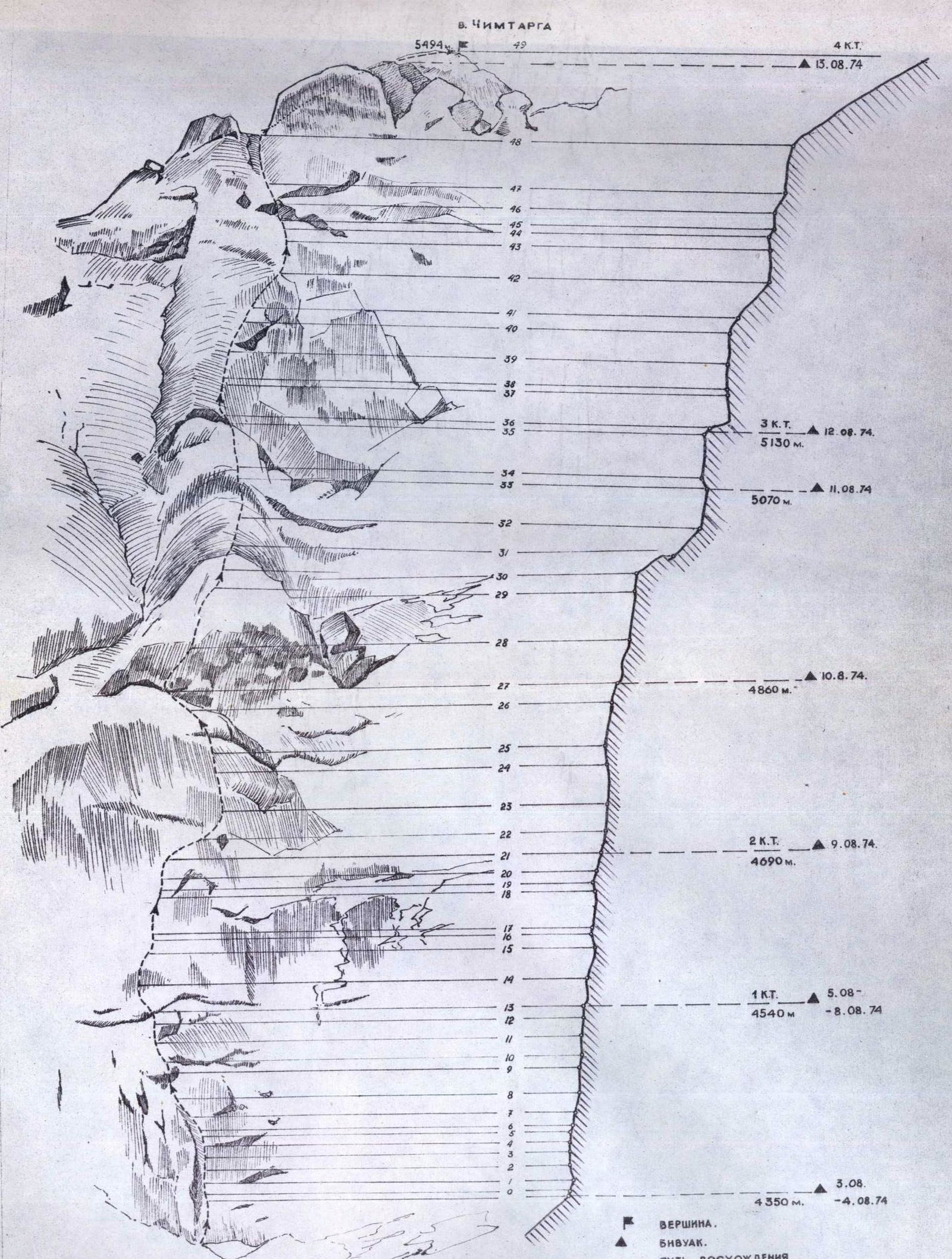
Fig. 37. Route map and profile.
TABLE of main characteristics of the ascent route.
Ascent route — Chimtarga via the center of the western wall. Height difference of the route — 1150 m. Including the most complex sections — 1020 m. Steepness of the route — 86°–87°.
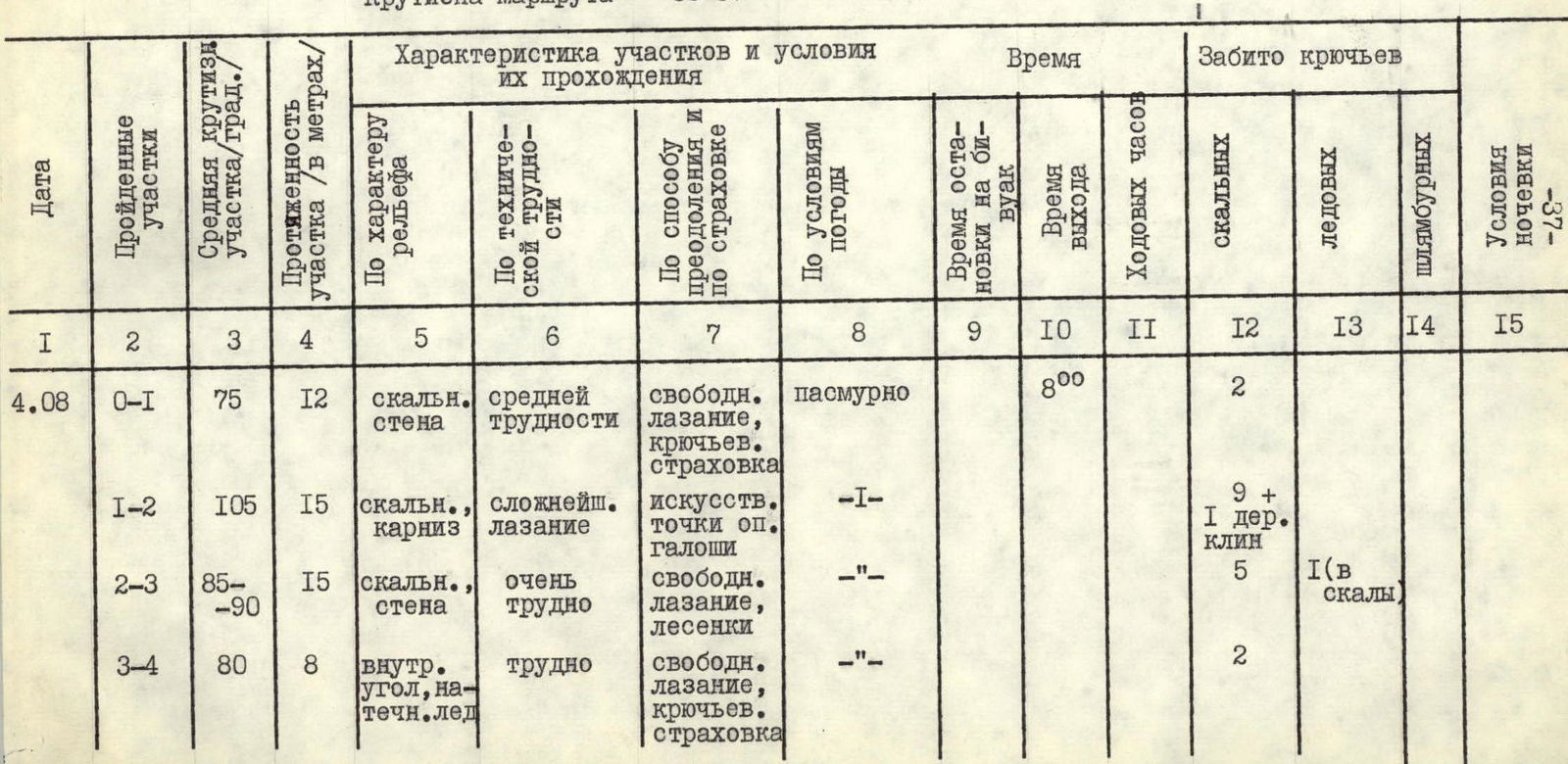
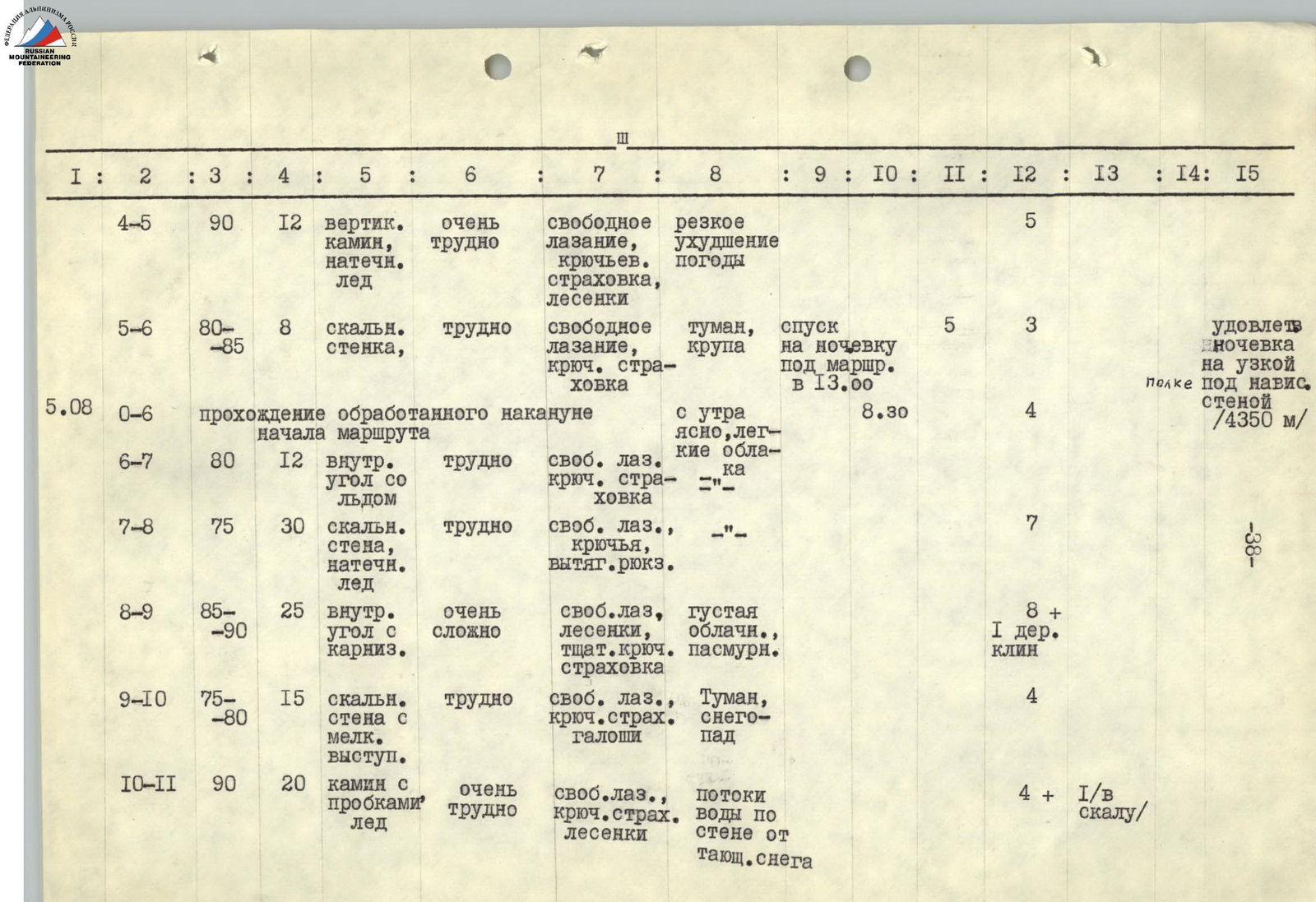
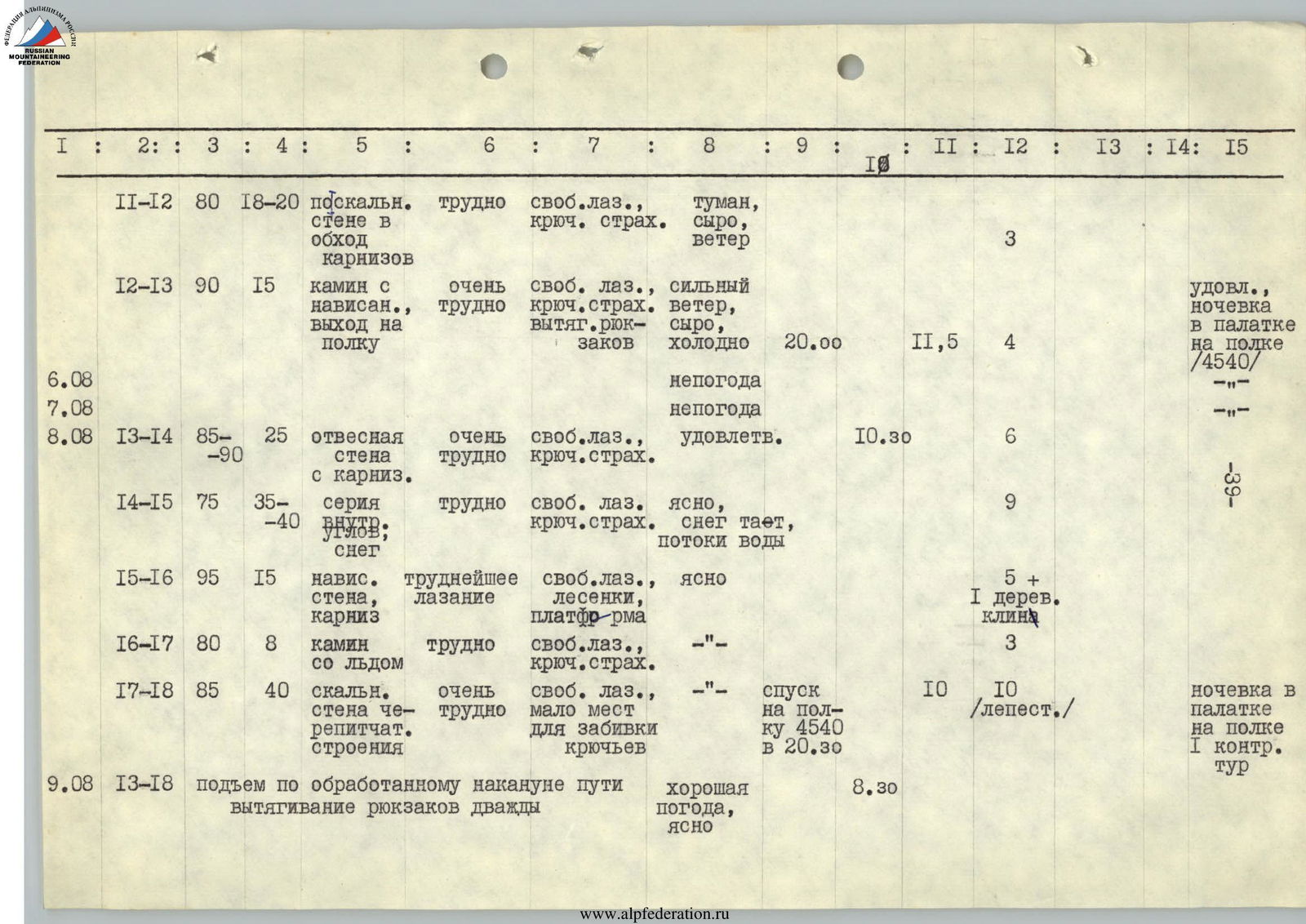
| Date | Sections traversed | Average steepness of section/degrees | Length of section /in meters/ | Terrain characteristics | Technical difficulty | Method of traversal and belay | Weather conditions | Bivouac time | Departure time | Climbing hours | Pitons emplaced (rock) | Pitons emplaced (ice) | Pitons emplaced (bolt) | Bivouac conditions |
|---|---|---|---|---|---|---|---|---|---|---|---|---|---|---|
| 4.08 | R0–R1 | 75 | 12 | Rock wall | Medium difficulty | Free climbing, piton belay | Overcast | 8:00 | 2 | 2 | ||||
| R1–R2 | 105 | 15 | Rock cornice | Extremely difficult | Artificial aids, galoshes | — | 9 + 1 wooden wedge | |||||||
| R2–R3 | 85–90 | 15 | Rock wall | Very difficult | Free climbing, ladders | — | 5 | 1 (in rock) | ||||||
| R3–R4 | 80 | 8 | Internal angle, rime ice | Difficult | Free climbing, piton belay | — | 2 | |||||||
| R4–R5 | 90 | 12 | Vertical chimney, rime ice | Very difficult | Free climbing, piton belay, ladders | Sharp weather deterioration | 5 | 5 | ||||||
| R5–R6 | 80–85 | 8 | Rock wall | Difficult | Free climbing, piton belay | Fog, graupel | Bivouac under the route at 13:00 | 3 | 3 | Satisfactory bivouac on a narrow ledge under an overhanging wall (4350 m) | ||||
| 5.08 | R0–R6 | Traversed section processed the day before | Clear in the morning, light clouds | 8:30 | 4 | |||||||||
| R6–R7 | 80 | 12 | Internal angle with ice | Difficult | Free climbing, piton belay | — | 7 | |||||||
| R7–R8 | 75 | 30 | Rock wall, rime ice | Difficult | Free climbing, pitons, rucksack pull | — | 7 | |||||||
| R8–R9 | 85–90 | 25 | Internal angle with cornice | Very complex | Free climbing, ladders, thorough piton belay | Overcast, cloudy | 8 + 1 wooden wedge | |||||||
| R9–R10 | 75–80 | 15 | Rock wall with small ledges | Difficult | Free climbing, piton belay | Fog, snowfall | 4 | |||||||
| R10–R11 | 90 | 20 | Chimney with wedges, ice | Very difficult | Free climbing, piton belay, ladders | Water flow on the wall from melting snow | 4 + 1 (in rock) | |||||||
| R11–R12 | 80 | 18–20 | Rock wall bypassing cornices | Difficult | Free climbing, piton belay | Fog, damp, wind | 3 | |||||||
| R12–R13 | 90 | 15 | Chimney with overhang, exit to ledge | Very difficult | Free climbing, piton belay, rucksack pull | Strong wind, damp, cold | 20:00 | 4 | Satisfactory bivouac in a tent on a ledge (4540 m) | |||||
| 6.08 | Bad weather | |||||||||||||
| 7.08 | Bad weather | |||||||||||||
| 8.08 | R13–R14 | 85–90 | 25 | Sheer wall with cornice | Very difficult | Free climbing, piton belay | Satisfactory | 10:30 | 6 | |||||
| R14–R15 | 75 | 35–40 | Series of internal angles with snow | Difficult | Free climbing, piton belay | Clear, snow melting, water flow | 9 | |||||||
| R15–R16 | 95 | 15 | Overhanging wall, cornice | Extremely difficult | Free climbing, ladders, platform | Clear | 5 + 1 wooden wedge | |||||||
| R16–R17 | 80 | 8 | Chimney with ice | Difficult | Free climbing, piton belay | — | 3 | 3 | ||||||
| R17–R18 | 85 | 40 | Rock wall of checkered structure | Very difficult | Free climbing, few places for piton emplacement | Descent to ledge 4540 m at 20:30 | 10 | 10 (petal-shaped) | Bivouac in a tent on a ledge, I Control Tour | |||||
| 9.08 | R13–R18 | Ascent via the route processed the day before, pulling rucksacks twice | Good weather, clear | 8:30 | ||||||||||
| R18–R19 | 90 | 10 | Sheer rock wall | Very difficult | Artificial aids, piton belay | Clear | 5 | |||||||
| R19–R20 | 70 | 10 | Rocky groove, loose rocks | Difficult | Free climbing, piton belay | — | 3 | |||||||
| R20–R21 | 75–80 | 20 | Rock wall, exit to narrow ledge | Difficult | Rucksack pull | — | 5 | 1 (in rock) | ||||||
| R21–R22 | 75–80 | 60 | Small ledges on "ram's foreheads" | Difficult | Free climbing, piton belay | — | Descent to narrow ledge at 20:00 | 8 | 2 | Poor, sitting bivouac on a ledge (4690 m), II Control Tour | ||||
| 10.08 | R21–R22 | Traversed section processed the day before | Clear, calm | |||||||||||
| R22–R23 | 80 | 40 | Microscopic ledges on smoothed rocks | Very difficult | Free climbing, piton belay | — | 10 (petal-shaped) | |||||||
| R23–R24 | 80–85 | 65 | Wall along the groove, |

Comments
Sign in to leave a comment