
CENTRAL COUNCIL "SPARTAK" SPORTS SOCIETY ALPINISM CHAMPIONSHIP
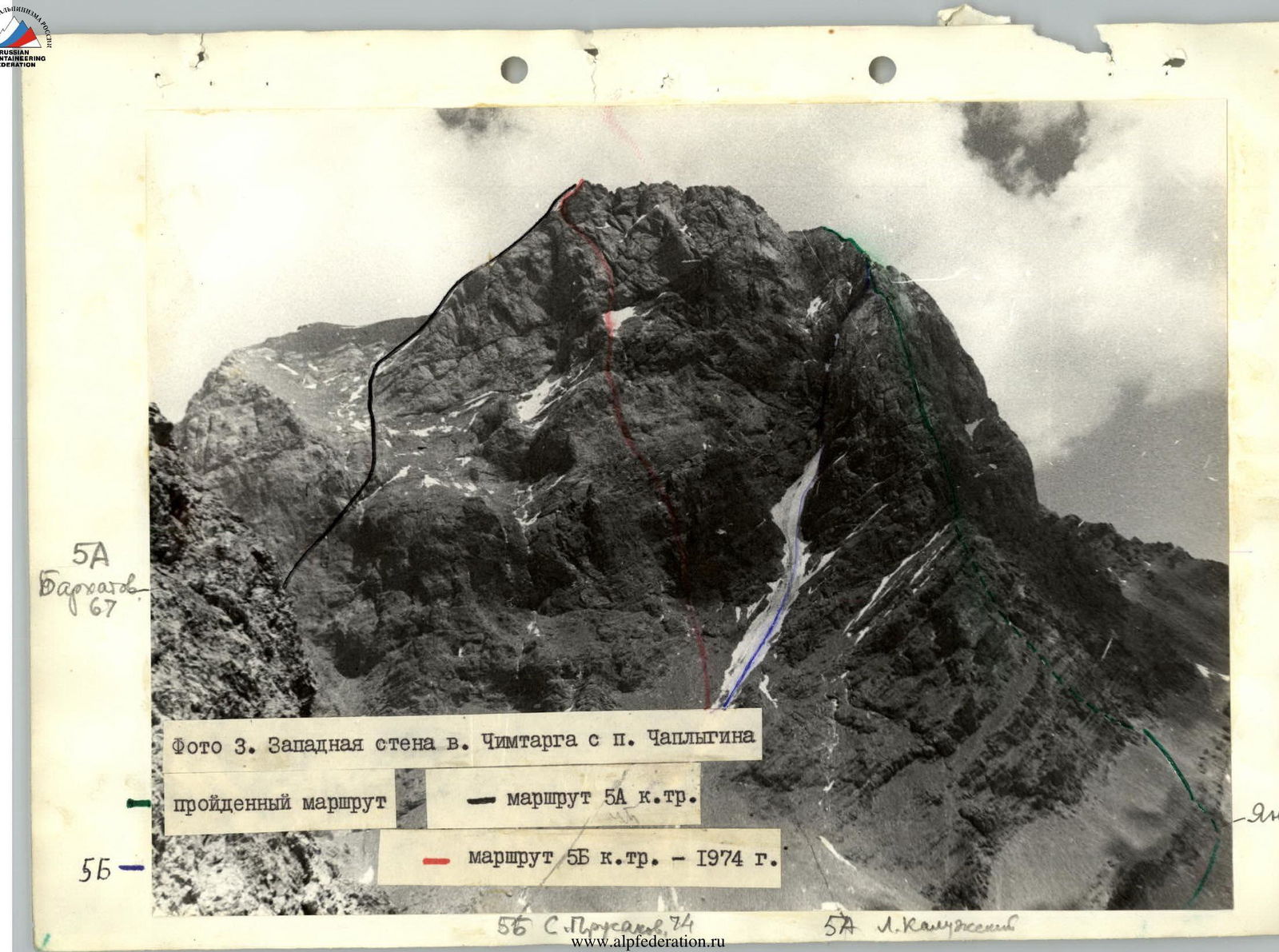
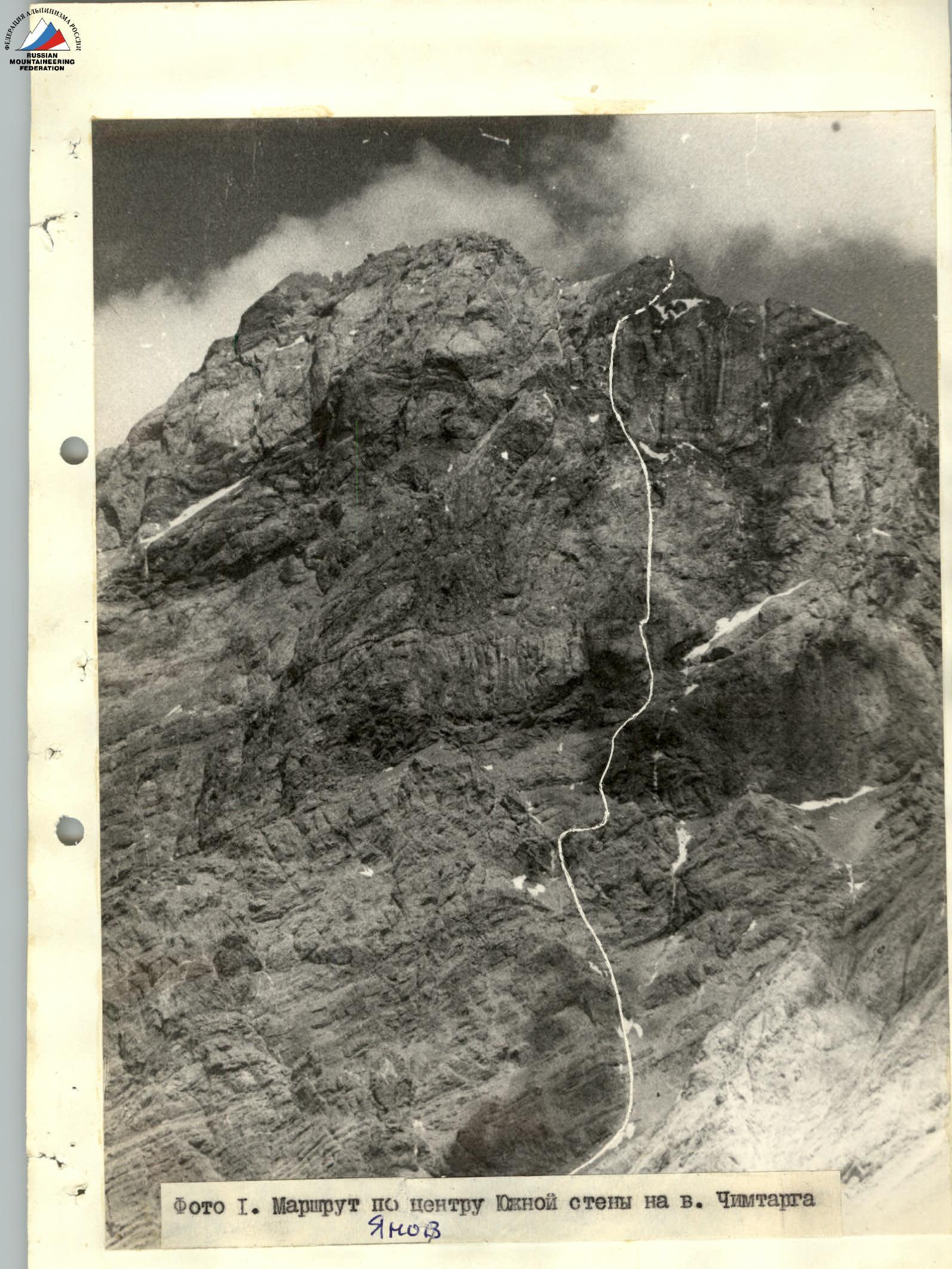
ASCENT REPORT ON CHIMTARGA PEAK — 5494 m VIA THE CENTER OF THE SOUTH FACE
First Ascent
The route was climbed by the team from the Krasnoyarsk Regional Council of the Spartak Sports Society, consisting of:
- YANOV V.F. — Master of Sports of the USSR — team captain
- SOBOLEV V.S. — Candidate for Master of Sports — team member
- BYCHKOV V.M. — Candidate for Master of Sports — team member
- GAVROSHKIN V.V. — Candidate for Master of Sports — team member
- KOTOV E.V. — Candidate for Master of Sports — team member
- GORDEEV I.M. — 1st-class athlete — team member
Team coach — SVETLAKOV V.A. — Master of Sports of the USSR, senior instructor
PAMIR-ALAY
FAN MOUNTAINS
Pravy Zindon Valley
The following tactical plan was devised for the ascent in the Fan Mountains:
August 3 — approach from the base camp to the assault camp. August 4-7 — work on the route. August 8 — descent from the summit and return to the base camp.
3. Route Description
Day 1. August 4, 1976. At 6:00 AM, according to the developed tactical plan, half of the team members, consisting of YANOV V.F., SOBOLEV V.S., and GORDEEV I.M., set out under the start of the route, carrying a variety of rock climbing equipment for the initial processing and passage of the route. The remaining team members packed the bivouac gear and, after a radio communication session with the base camp, followed under the wall.
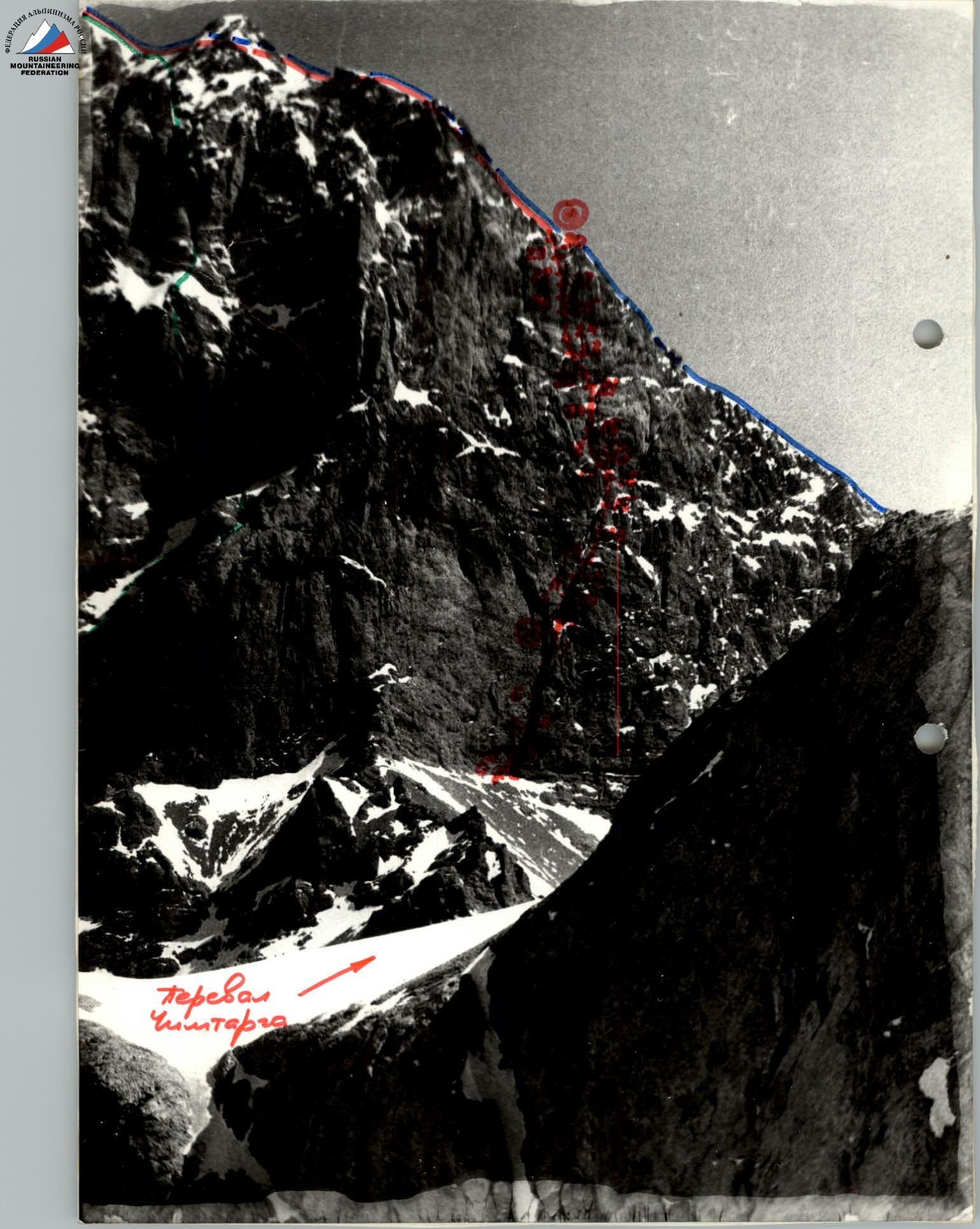
The approach to the route from the assault camp takes about three hours of tiring ascent along the small scree slopes of the Chimtarga pass. The route begins 150 m below the Chimtarga pass — 4600 m; a good landmark is the stream bed flowing from the snowy and icy upper part of the wall.
The initial part of the route (section R0–R1) is an alternation of rock sections of the "baраньи лбы" type of varying steepness and difficulty. When passing this section with heavy backpacks, 3 pitons were hammered in for the organization of belays.
The upper belt of smoothed rocks leads to the base of a 70° steep wall. Section R1–R2 ends in a 15 m long chimney, leading to the base of an overhanging massif. A good rock shelf allows all team members to gather and discuss the further path.
After consultation, it was decided to relieve the first rope team of their backpacks to process the subsequent sections of the route.
A 30-meter wall with an inner corner of 80° steepness leads to the top of the bastion, which is overcome on its left side. Difficult climbing with small holds and narrow cracks, into which it is possible to wedge one's palm. 4 pitons were hammered in on this section. Further along a gentle rock shelf, we reach the top of the bastion (section R3–R4). Time: 14:30. Here, it is possible to receive the second rope team and discuss the further path. Ahead on the wall, a crack is visible, turning into a small inner corner. It was decided to move along it since the sections to the right and left of it are sheer wall sections without cracks or holds. Already while passing the inner corner, it becomes clear that the decision was correct, as the inner corner ends in an inclined shelf to the right, although it is too steep to rest comfortably. However, after consideration, it is concluded that it can be used to receive backpacks, but a more suitable place for an overnight stay needs to be found above.
While the first rope team discusses the situation, the remaining team members below transfer the bivouac to the top of the bastion under a huge overhanging cornice, reliably protecting them from falling rocks and ice fragments. It is not possible to move further until the first rope team completes its work on the nearly sheer wall. Finally, the "processors" report that a spot for pulling up backpacks has been organized, but there is no possibility of arranging an overnight stay for the team members. It is then decided to use the remaining daylight for further route processing, while the rest of the team attends to the "improvement" of the bivouac, as the top of the second bastion is a sloping (about 40°) platform in the form of a small scree slope, with streams running down it. Setting up the bivouac takes about 2 hours of intense "construction work".
Three hours later, in the twilight, the first rope team returns, having processed another section (R12–R13), which is a difficult sheer wall with overhanging sections. At the end of the section, there are two niches, in which three people can barely fit. This is the intended overnight spot.
Day 3. August 6, 1976. A cold, windy morning. Clear skies promise good weather for the day. Ahead lies intense work. A control cairn is left at the top of the second bastion. Ascending via vertical rope ladders on jumar clamps takes quite some time. The first 100-meter pull-up of backpacks is organized. Overhanging wall sections cause a lot of trouble.
Meanwhile, the lead rope team reaches the end of the previously processed section, above three pronounced "ковриг" stuck to the sheer wall. Above, the wall presents another surprise — a cornice with a 2 m overhang. Difficult climbing on ladders. The ascent onto the wall, with a steepness of about 80°, has no distinct rock "foreheads"; it is challenging to find a spot to hammer in a piton, even a leaf-shaped one. A diagonal ascent to the right along the wall leads to an inner corner filled with crystallized limestone. Further to the right and above, a rock "forehead" slightly protrudes, on which it is possible to organize the next backpack pull-up point. The movement goes along a streak, cutting through the entire wall from top to bottom.
To the right, on a diagonal inclined shelf, it is possible to gather all team members and organize a sitting overnight stay.
From the shelf, to the left and upwards (photo 12), using a series of vertical cracks, difficult climbing with pitons and ladders overcomes 15 m to two parallel crevices. The movement occurs in the following order:
- First, the movement goes along the left one
- Then — along the right one
To the right, the wall is completely smooth; to the left, it protrudes with outer corners and reverse holds. Difficult climbing leads to a triangular cornice, overcoming which took a lot of time and effort (endless ladders and pitons).
25 m are passed above the shelf. Further on, there is a 40-meter wall; after processing it, the rope team returns to the diagonal shelf, where, now clearly, an uncomfortable overnight stay awaits. By this time, the entire group has gathered:
- Backpacks are hung on pitons
- A complex system of belays is set up
- We prepare dinner on our knees
- To get water, we have to extract ice pieces from a groove to the right of the shelf
Day 4. August 7, 1976. Departure at 8:00 AM. A control cairn is left at the sitting overnight stay spot, in a small niche.
Difficult climbing at the beginning of the wall of the next section (R17–R18) leads to a series of cornices. Moving straight into the "forehead," the cornices are overcome using artificial aids: wooden wedges, ladders, loops. Above the cornices is a spot for pulling up backpacks. To the right of the path remains a steep, ice-covered shelf (section R18–R19).
Further on, the wall becomes less steep, up to 60°–65°, and is dissected by a 40-meter chimney, leading to a massive rockfall formed by a huge cracked boulder.
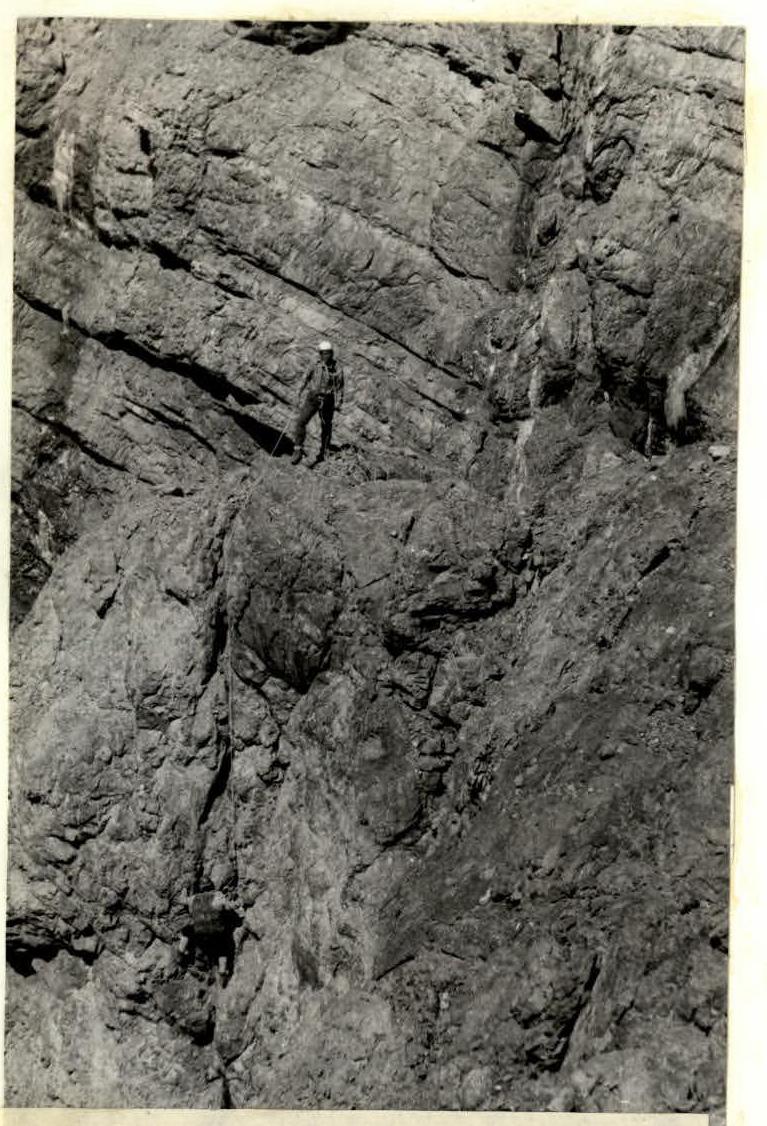
Photo 7. Passage of section R2–R3
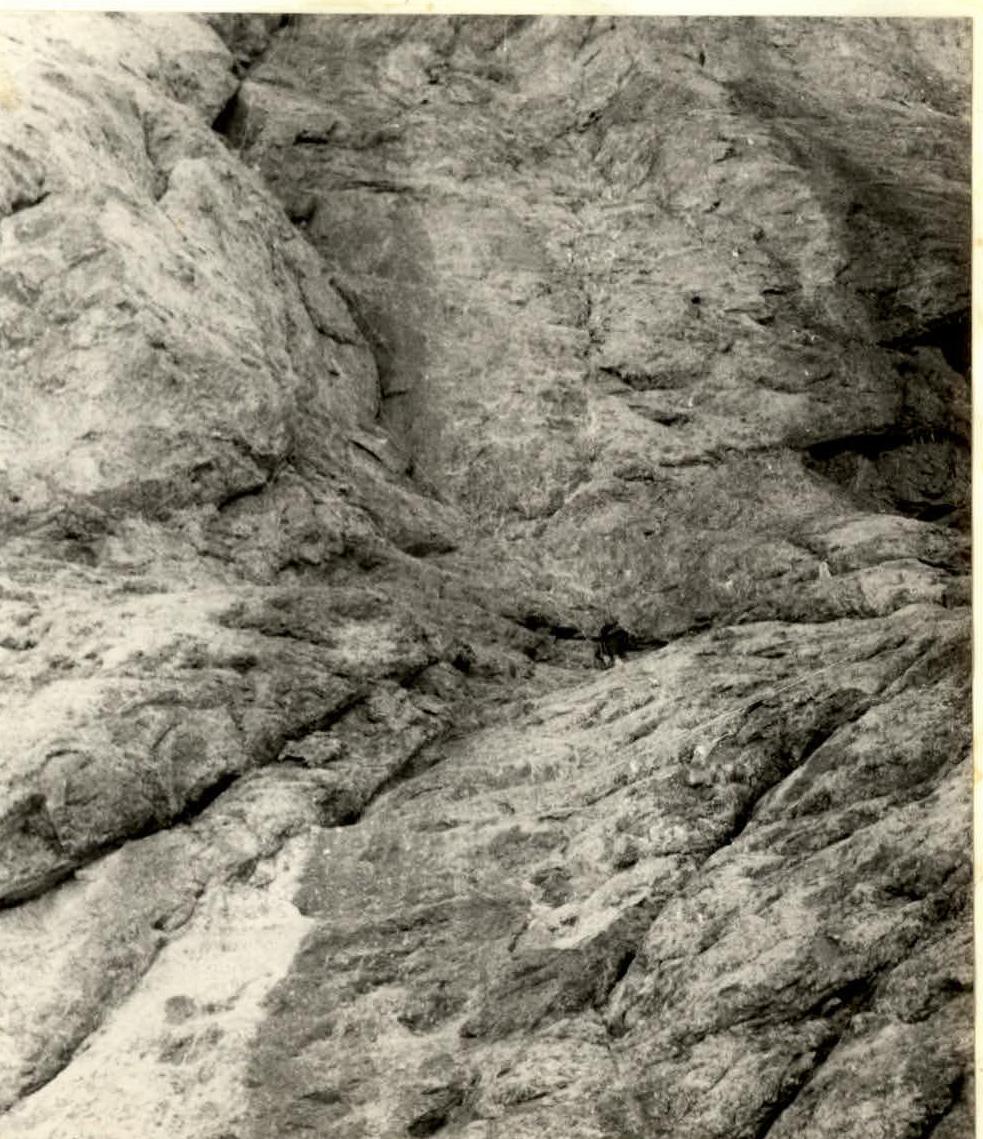
Photo 8. Beginning of the pre-processed part of the route. Section R9–R10

Photo 11. Chimney and cornices on section R10–R11
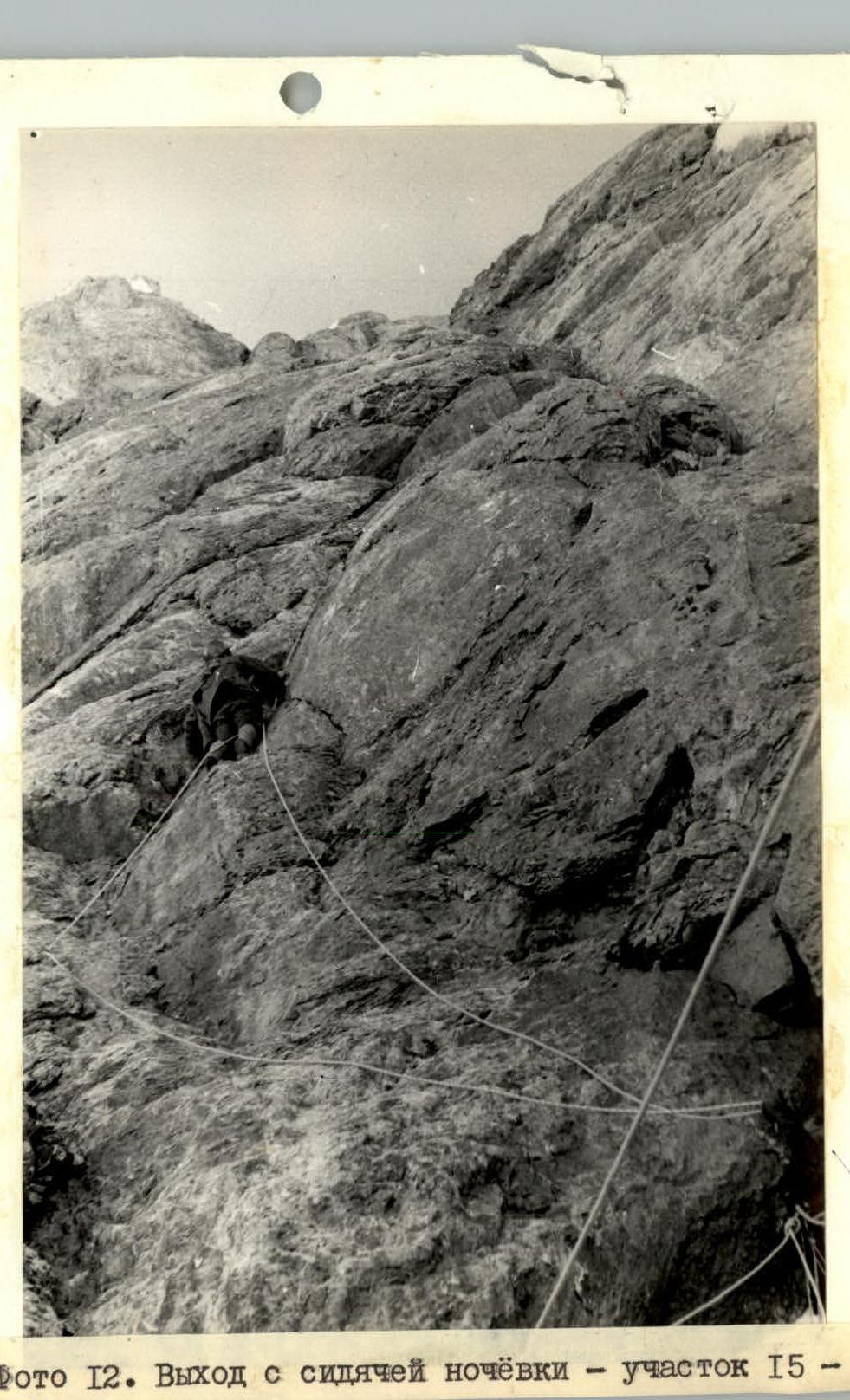
Photo 12. Exit from the sitting overnight stay – section R15–R16
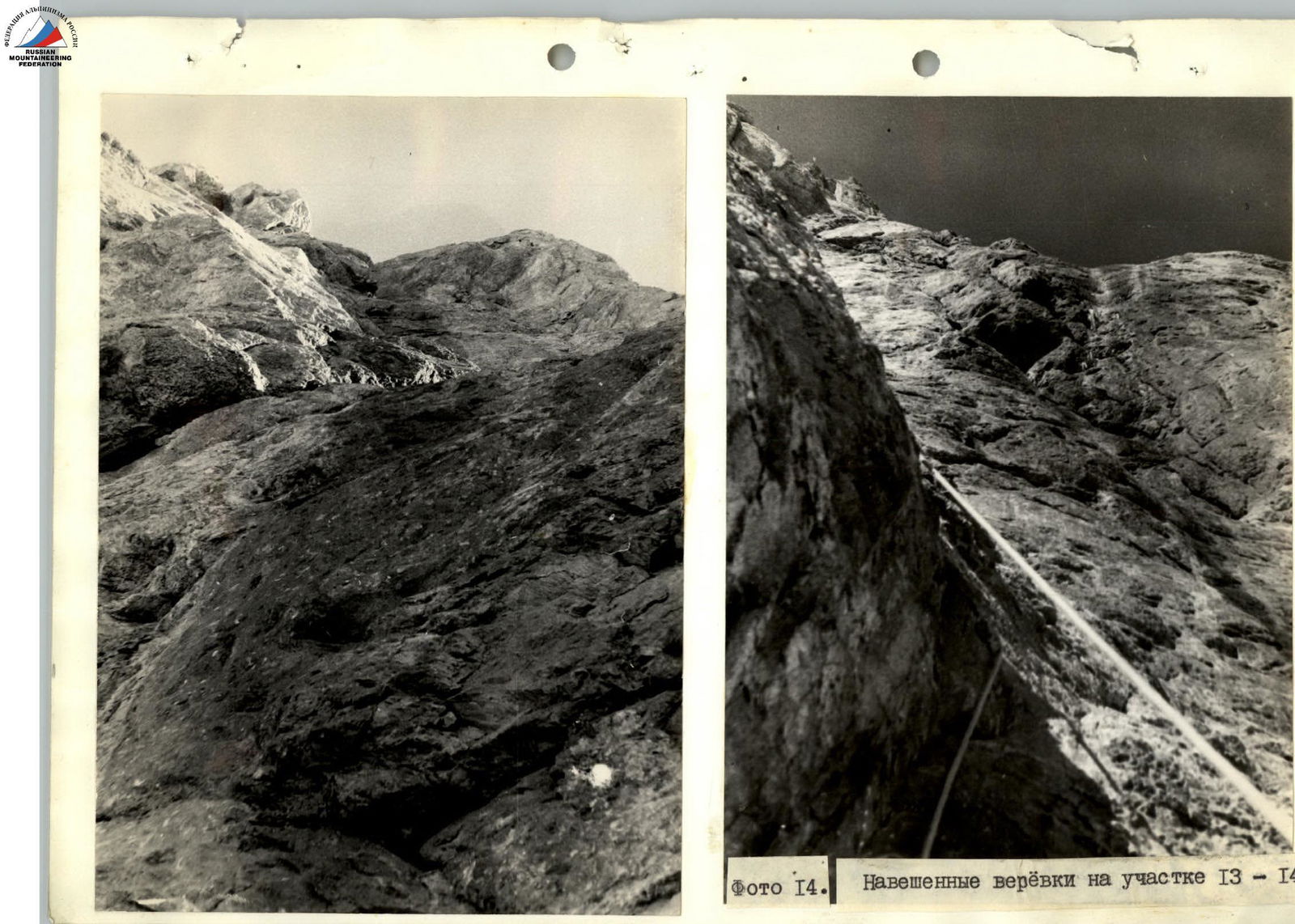

Comments
Sign in to leave a comment