
REPORT
on the first ascent to the summit of Chapdara (5297 m) via the left part of the western wall, approximately 5B category of difficulty.
Team of Sports Club "Polytechnic"
August 20–23, 1971
Team Composition
| 1. Petrov M.V. — team leader | 1st sports category |
|---|---|
| 2. Karkoshko I.V. — participant | 1st sports category |
| 3. Gavrilov G.A. — participant | 1st sports category |
| 4. Bril A.G. — participant | 2nd sports category |
| 5. Burago N.A. — participant | 2nd sports category |
Coach: Staritsky V.G.
Leningrad
1971
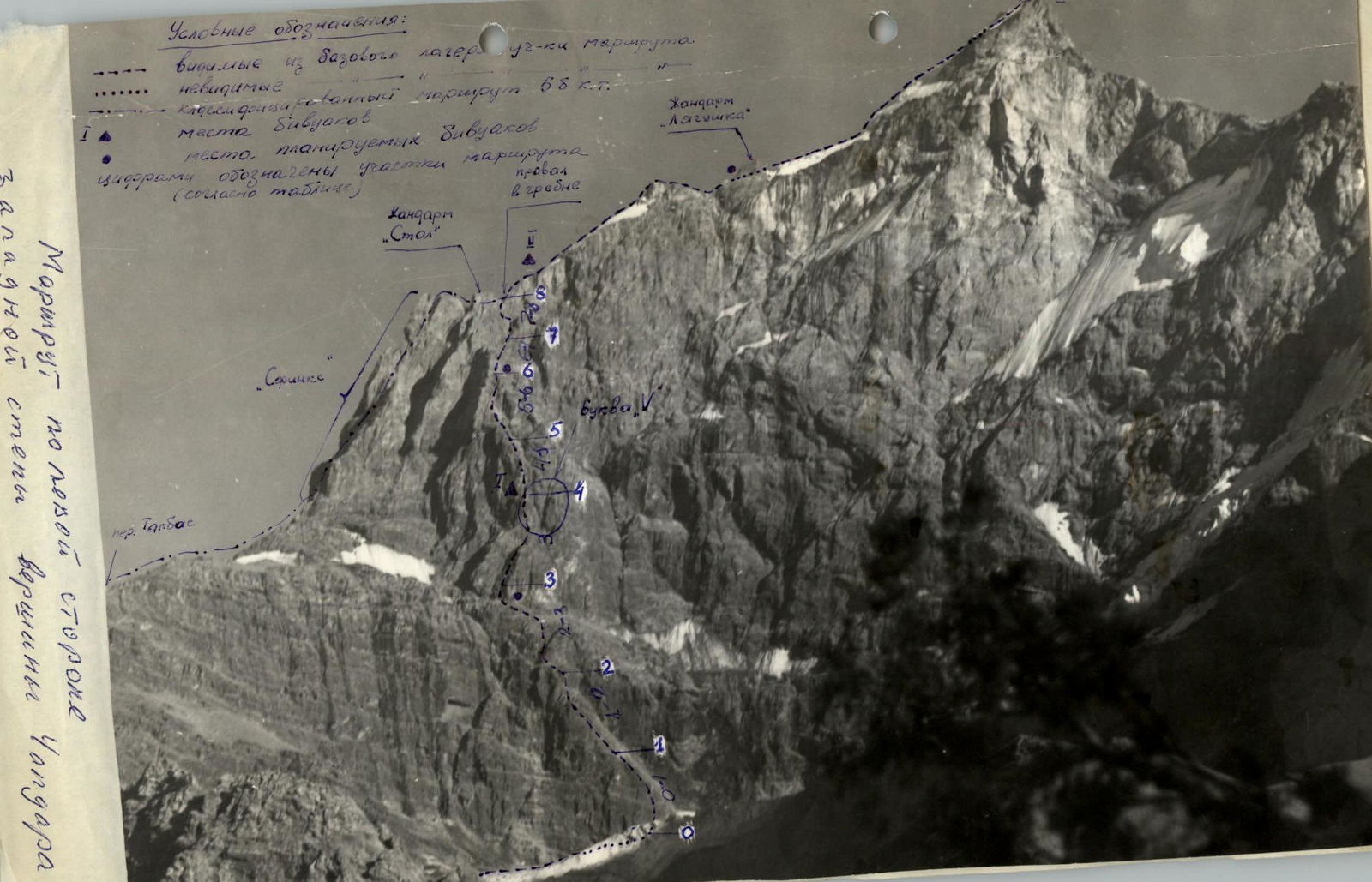
The summit of Chapdara (5297 m) is located in the northern spur of the Eastern Fan range, east of the Big Alaudin lake. To the south, it is directly adjacent to the massif of Bodhona peak. The western and northern slopes of Chapdara are vertical rock walls with a height difference of up to 2 thousand meters.
The area of Alaudin lakes is located at a considerable distance from the nearest road and settlements (25 km), which creates certain difficulties when organizing a base camp. The area is insufficiently studied, there are many unclassified and unclimbed routes, including those of high complexity. The weather in July–August is usually without prolonged precipitation, which contributes to the successful passage of the most difficult wall routes.
In August 1970, a team from the Sports Club "Polytechnic," which included three participants of this ascent, climbed Chapdara via the classified 5B category route from Tolbas pass, during which they studied an alternative ascent to the northern ridge not from the pass, but via the western wall, and outlined a plan for the ascent.
However, the plan was thwarted by an accident involving Moscow "Trud-2" team member Silichov during their ascent of Chapdara via the 5B category route, and the subsequent rescue operations.
The ascent was rescheduled for the summer of 1971. In August 1971, several exits were made to the slope of the western ridge to clarify the route and study the rockfall regime. On August 19, 1971, the eve of the ascent, four participants and coach Staritsky V.G. went under the route to finally choose the optimal and safe ascent option. The path via the glacier and the main landmarks on the wall were examined.
Given the high rock climbing preparation of the participants, it was decided to complete the rock part to the ridge in two and a half days, with two overnight stays, without preliminary throws and processing.
The entire ascent was planned to be completed with four overnight stays and a return to the camp on the fifth day.
The team proposed the following composition for the ascent:
- V.V. Mamelov
- G.A. Gavrilov
- I.V. Karkoshko
- M.V. Petrov
- A.G. Bril
- N.A. Burago
However, three days before the ascent, Mamelov was forced to leave for work, and the final team composition was determined as follows:
| 1. Petrov M.V. — team leader | 1st sports category |
|---|---|
| 2. Gavrilov G.A. — participant | 1st sports category |
| 3. Bril A.G. — participant | 2nd sports category |
| 4. Karkoshko I.V. — participant | 1st sports category |
| 5. Burago N.A. — participant | 2nd sports category |
Due to the reduction in the number of participants and favorable route and weather conditions, the ascent was completed a day ahead of schedule. On August 20, 1971, at 7:00, the team departed from the base camp, located on the Big Alaudin lake, towards Tolbas pass. To the left of the Chapdara glacier moraine, they exited under the rocks leading to the glacier. At 10:00, they roped up.
Ropes: 1st rope — M.V. Petrov — G.A. Gavrilov; 2nd rope — A.G. Bril — N.A. Burago — I.V. Karkoshko.
Movement was on a double rope. The first 80 m (exit to the glacier) were not difficult, with tile-like rocks at an angle of 50–60°. Many loose rocks. Belay on protrusions.
From the rocks — to the right, through the bergschrund — exit to the glacier. The glacier is open, heavily crevassed. Along the passages between crevices — 300 m to the right along the wall to the start of the route.
The landmark is a steep, about 60°, shelf going from right to left upwards. Upon closer inspection, the shelf turns out to be an inclined corner about 200 m long, visible throughout its length with rocks.
To ensure safety, the team decides to go along the rocks to the left of the corner. This section needs to be passed in the morning. Here, on the visible section, the rocks are of the "shelf-wall-overhanging section" type. Petrov crosses the bergschrund via a snow bridge and exits under the wall.
Section R0–R1
The first rope (everywhere hereafter "rope" means 40 m) — simple rocks. Rocks are dry. Put on galoshes. 3 pitons driven. Angle 60–65°. Small overhanging sections alternating with 2–3-meter shelves are overcome without using artificial footholds. Second rope (40 m). 5 pitons, rocks of the same type, direction of movement is left upwards. Further, despite a large number of holds, climbing becomes difficult due to the fact that the shelves turn into inclined slabs at 65°, and vertical sections become 10–15 m long. On the third rope, 7 pitons are driven. Alternating movement with organization of belay points.
Section R1–R2
Fourth rope — upwards, difficult climbing along a not very pronounced crack (rather, a groove), in the last part — 5 m of overhanging rocks. 7 pitons driven.
After a cornice, the fifth rope — traverse left-upwards along a small ledge to a crack, not of the same type as the previous one; upwards along the crack — very difficult climbing, angle 85°. The rope ends on an inclined scree shelf — a belay point, a place for an overnight stay. 6 pitons driven. At 12:35 — a cave 3 m wide.
After the shelf — a vertical wall 40 m, to the right are black streaks. Sixth rope — overcoming the wall head-on, 5 pitons driven. Many holds, cracks — mostly for wedges and thick vertical pitons. Climbing is difficult. At 13:10 — seventh rope. Again it becomes more gentle, about 70°, but simple sections alternate with complex ones, there are small overhanging sections. 8 pitons driven, including one ice piton. To speed up the passage of the section, the seventh rope is secured. Belay point. Interaction between ropes.
Section R2–R3
Exit to a shelf, where the first control cairn is placed, and along it — to the left by one rope — to an ice couloir. 1 piton driven. Exit to the level of Tolbas pass. The ice couloir going upwards to the right is filled with loose rocks. At the top — a jumble of large blocks. A dangerous place. There are no detours, to the right and left — smooth walls. A snowfield is visible at the foot of "Sphinx". For the first time, the entire group assembles. They decide to release the first climber on two ropes. Before the start of the couloir — a 10-meter overhanging wall. At 14:00, Petrov ascends the couloir on a double eight, angle 75–80°. 8 pitons driven. Few cracks. Dangerous, difficult climbing. Sometimes the rope — loose rocks are dislodged. Those below are behind a turn. The couloir leads to a gentle wall at 65° with ledges. Tenth rope — 4 pitons. This 80-meter wall ends on a scree shelf crossing the entire western wall of Chapdara horizontally. To the right and left of us lie old snowfields. Here — the place of the first planned overnight stay. Time 14:50. Rest and food. We are under the letter "V".
Ropes change. First rope: A.G. Bril — N.A. Burago. Second rope: M.V. Petrov — G.A. Gavrilov — I.R. Karkoshko. At 17:00 — eleventh rope, 40 m along the shelf to the left to an internal corner going from left-upwards-right and leading to the main couloir, which is to our right. The internal corner is vertical, 80 m; in places overhanging.
Section R3–R4
Twelfth – thirteenth ropes — difficult climbing using hand and foothold opposition. Few cracks. The left wall in the corner is all cracked, the rock surface consists of blocks the size of a matchbox, holds are unreliable, crumble under load. 14 pitons driven. The corner leads to the left side of the main couloir, angle 75–80°. Difficult climbing. We exit onto a scree shelf. 8 pitons driven. Along the shelf left-upwards — transition to a wide internal corner and exit to a crack with snow and ice. 40 m. 4 pitons driven. Place for a sitting overnight stay. Time 19:00.
Sixteenth rope: along the crack 10 m to the right, then upwards and exit to a shelf. Very inconvenient for an overnight stay. 5 pitons driven. Further climbing is very difficult. Bril goes first. To facilitate passage, he leaves his backpack. Ascends on two ropes upwards — 40 m, 5 pitons driven. Few cracks for pitons. Few holds, and those crumble. Ropes are secured. At 20:00 — pulling up backpacks. The site is sloping. A platform for a tent is made. To the right in the couloir, there is ice. At 22:00, they went to sleep. The route is illuminated by the sun until 20:00.
Section R4–R5
August 21. Rise at 7:15. At 8:15, A.G. Bril and M.V. Petrov start on the route. Along the shelf to the right to the couloir 10 m up its left wall. Overhanging wall 20 m with an internal corner in the left part. No holds. Drilling pitons is not allowed — the wall has a destroyed surface layer. Climbing is very difficult.
- On the first 10 m, 1 piton driven.
- Further, in the internal corner — a piton for ladders, very difficult climbing.
- After 3 m, another piton for ladders.
- Then a sloping ledge 1 × 0.5 m — a belay point. The rope is secured.
All 40 m vertically upwards — 8 pitons. Belay point. Backpacks are pulled up 80 m. Time taken for pulling: 2 h 00 min.
Next, Petrov goes first. Nineteenth rope: vertical chimney 40 m with a plug. 8 pitons driven.
Surrounding terrain:
- To the right — an overhanging wall, behind it — the main couloir.
- To the left — a smooth vertical wall, the upper part of which overhangs.
Section R5–R6
The chimney is climbed using opposition, cracks — for thin pitons. 8 pitons driven in the chimney. Climbing is difficult with a very challenging exit to the right from under the plug. Under the plug — dangerous loose rocks. Exit to the edge of the left side of the couloir. Small rocks from above fall to the right inside the couloir. Pulling up backpacks 60 m. Bril follows with the second rope. Ropes are secured. Reliable belay is organized on a protrusion.
Further, rocks of the "ram's forehead" type are visible:
- 80 m of not difficult climbing.
- On the twenty-first rope, 7 pitons driven.
- "Ram's foreheads" are covered with small rocks from above, which can be dislodged by the rope.
- "Ram's foreheads" end with destroyed rocks, at their base — a belay point.
Twenty-second rope — simple climbing along these rocks to the left of the couloir, 10 pitons driven.
Twenty-fourth rope — after the destroyed rocks, to the right and upwards along an internal corner with ice, into which the couloir has turned in its upper part. 5 pitons driven.
We exited onto a wide scree shelf with large "live" blocks. A possible overnight stay.
- The ridge is visible with a gap after the "Stol" pinnacle.
- Lunch and rest — 2 h.
Section R6–R7
Further, twenty-fifth and twenty-sixth ropes, 80 m upwards along the shelf. Belay on protrusions. In places, there are 5–7 m vertical sections. Along the shelf — exit to an ice couloir, angle 75°, leading to a gap.
Section R7–R8
Twenty-seventh and twenty-eighth ropes — ascent along the couloir. Difficult climbing, in some places — cutting steps in the ice. Cracks — for channel pitons and titanium wedges. Not reaching the exit from the couloir by 5–7 m, traverse left along a vertical section 10 m and further along a vertical crack 20 m upwards — into the gap in the ridge. 8 pitons driven. Climbing is very difficult. Exit to the ridge — on August 21, 1971, at 19:00.
Further, the path follows an unclassified 5B category route. After passing one of the key points of the unclassified route — a vertical section with a minimal number of holds — the group stopped for an overnight stay.
August 22, 1971. Continuation of the ascent along the unclassified 5B category route. Snowy ascents leading to the "Lягушка" pinnacle are bypassed to the right along the rocks. Above "Lягушка", the glacier is extremely crevassed. The group spent 5 h on its passage (from 12:00 to 16:00). In the ice mulde under the pre-summit ascent, the group stopped for an overnight stay.
On August 23, 1971, at 9:15, the group reached the summit. At 10:00, the descent began along the standard variant to the moraine of Bodhona glacier. At 13:00, the group descended to the glacier, and at 15:00 on August 23, 1971, returned to the base camp.
The following equipment was taken for the ascent:
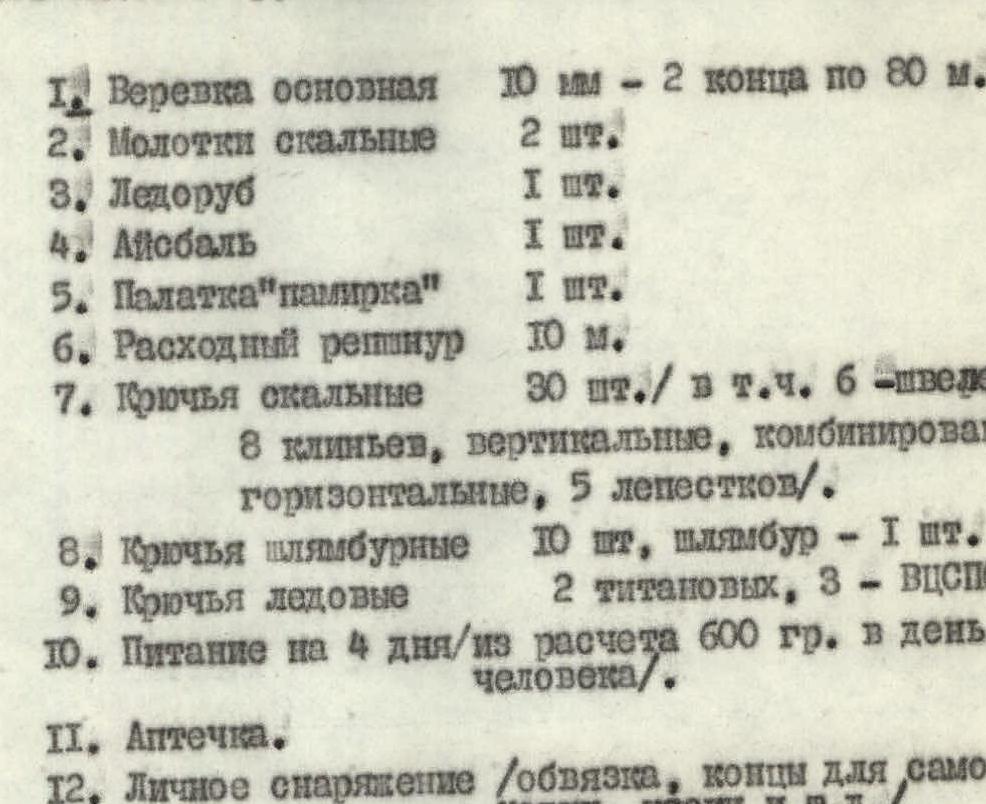
- Main rope 10 mm — 2 ends of 80 m each.
- Rock hammers — 2 pcs.
- Ice axe — 1 pc.
- Ice hammer — 1 pc.
- "Pamirka" tent — 1 pc.
- Spare reepschnur — 10 m.
- Rock pitons — 30 pcs. (including: channel — 6, wedges — 8, vertical, combined, horizontal, petals — 5).
- Drilled pitons — 10 pcs., drilling hammer — 1 pc.
- Ice pitons — titanium — 2, VTsSPS — 3.
- Provisions for 4 days (at 600 g per day per person).
- First-aid kit.
- Personal equipment (harness, self-belay ends, helmets, etc.).
- Titanium carabiners — 20 pcs., iron — 5 pcs.
- Crampons — 2 pairs.
- Flare gun, flares.
- Primus stove.
- Ladders — 8 pcs.
Communication with the base camp — visual. In case of an emergency — flares immediately after the accident and during emergency communication hours.
Conclusions
The team of Sports Club "Polytechnic" ascended the western wall of Chapdara peak (5297 m) via the left part.
- The height difference of the entire route is 2000 m, including the wall — 1100 m.
- The length of the path along the wall is about 1200 m.
Two sections are very difficult climbing:
- Fifth rope — 40 m;
- Section R4–R5 — 160 m.
On section R4–R5, ladders are used. The route partially includes a classified 5B category route, but the rock part of the new route exceeds the classified one in height difference more than twice and is significantly more difficult. The relative degree of its complexity can be judged by the following fact: the same group in 1970 climbed the rock part of the classified route "Sphinx" and "Stol" in 5 h; in 1971, it took the team 20 h to ascend the western wall.
As a training ascent, the team climbed a 5B category route to Bodhona peak. Both classified 5B category routes on Chapdara and Bodhona are significantly less difficult than the ascent via the western wall.
The route was preliminarily studied (1970 and 1971) — a tactical plan for the ascent was developed, which was largely adhered to by the group.
Hot meals were prepared twice a day, in the morning and evening; during the day, the group stopped for a light lunch and rest.
Throughout the ascent, except for the descent, the group was observed from the base camp.
There were no injuries, falls, or loss of equipment in the group. There were no deviations from the planned route. Due to the reduction in the number of participants (5 instead of 6), the excellent rock climbing preparation of the participants, and the use of galoshes, the wall was ascended a day ahead of the planned schedule. During the passage of the wall, 153 pitons were driven (excluding the organization of bivouacs), and 20 h of climbing time were spent. The average angle of the wall is 70°.
The high altitude of the peak and the western orientation of the wall allow work until 20:00 — until this time, the wall is illuminated. All team members were prepared for the passage of the route, acted correctly, and in coordination.
The route is recommended for groups with good rock climbing preparation.
The route deserves classification as a 5B category route.
Table of main characteristics of the route for ascending the left part of the western wall of Chapdara peak
Height difference 2000 m, including the most complex sections — 200 m. Average angle of the route 70°.
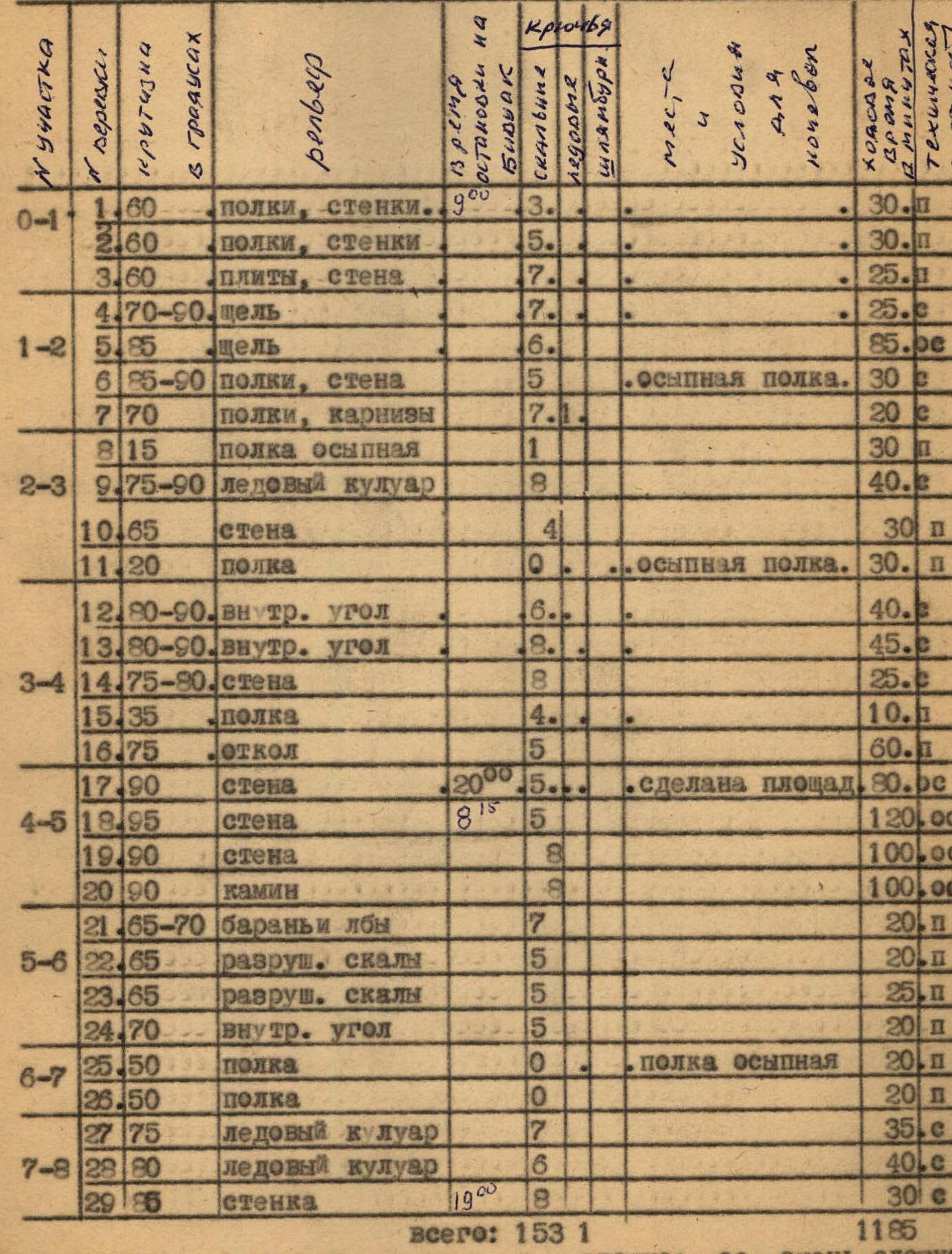

| Section | Rope № | Angle (degrees) | Relief | Pitons (total) | Time of stop at bivouac | Conditions for overnight stay | Time (min) | Technical difficulty |
|---|---|---|---|---|---|---|---|---|
| R0–R1 | 1 | 60° | shelves, walls | 3 | 30 | easy | ||
| 2 | 60° | shelves, walls | 5 | 30 | easy | |||
| 3 | 60° | slabs, wall | 7 | 25 | hard | |||
| R1–R2 | 4 | 70–90° | crack | 7 | 25 | hard | ||
| 5 | 85° | crack | 6 | 85 | very hard | |||
| 6 | 85–90° | shelves, wall | 5 | Scree shelf | 30 | hard | ||
| 7 | 70° | shelves, ledges | 7 | 20 | hard | |||
| 8 | 15° | scree shelf | 1 | 30 | easy | |||
| R2–R3 | 9 | 75–90° | ice couloir | 8 | 40 | hard | ||
| 10 | 65° | wall | 4 | 30 | easy | |||
| 11 | 20° | shelf | 0 | Scree shelf | 30 | easy | ||
| R3–R4 | 12 | 80–90° | internal corner | 6 | 40 | hard | ||
| 13 | 80–90° | internal corner | 8 | 45 | hard | |||
| 14 | 75–80° | wall | 8 | 25 | hard | |||
| 15 | 35° | shelf | 4 | 10 | easy | |||
| 16 | 75° | outcrop | 5 | 60 | easy | |||
| R4–R5 | 17 | 90° | wall | 20 | Platform made | 80 | hard | |
| 18 | 95° | wall | 8 | 120 | very hard | |||
| 19 | 90° | wall | 8 | 100 | very hard | |||
| 20 | 90° | chimney | 8 | 100 | very hard | |||
| R5–R6 | 21 | 65–70° | ram's foreheads | 7 | 20 | easy | ||
| 22 | 65° | destroyed rocks | 5 | 20 | easy | |||
| 23 | 65° | destroyed rocks | 5 | 25 | easy | |||
| 24 | 70° | internal corner | 5 | 20 | easy | |||
| R6–R7 | 25 | 50° | shelf | 0 | Scree shelf | 20 | easy | |
| 26 | 50° | shelf | 0 | 20 | easy | |||
| R7–R8 | 27 | 75° | ice couloir | 7 | 35 | hard | ||
| 28 | 80° | ice couloir | 6 | 40 | hard | |||
| 29 | 85° | wall | 8 | 30 | hard | |||
| Total | 153 | 1185 |
Note: "easy" — simple climbing; "hard" — complex; "very hard" — very complex. Team captain M.V. Petrov. Coach V.G. Staritsky.