
Ascent Log
- Ascent class — technical.
- Ascent area — Fann Mountains.
- Peak Rudaki, 4400 m, via the East wall.
- Difficulty category — 5B.
- Pitons used: rock — 32, bolt — 0, chocks — 31.
- Climbing hours — 15, days — 1.
- Leader — RAIL GALEEV — Candidate Master of Sports. Participants: ALEXANDER MIROSHKIN — 1st sports category, VLADIMIR TELITCYNS — 1st sports category, VLADIMIR RUSINOV — 1st sports category.
- Coach — EVGENY MIROSHKIN.
- Departure to the route — August 7, 1984, return — August 7, 1984.
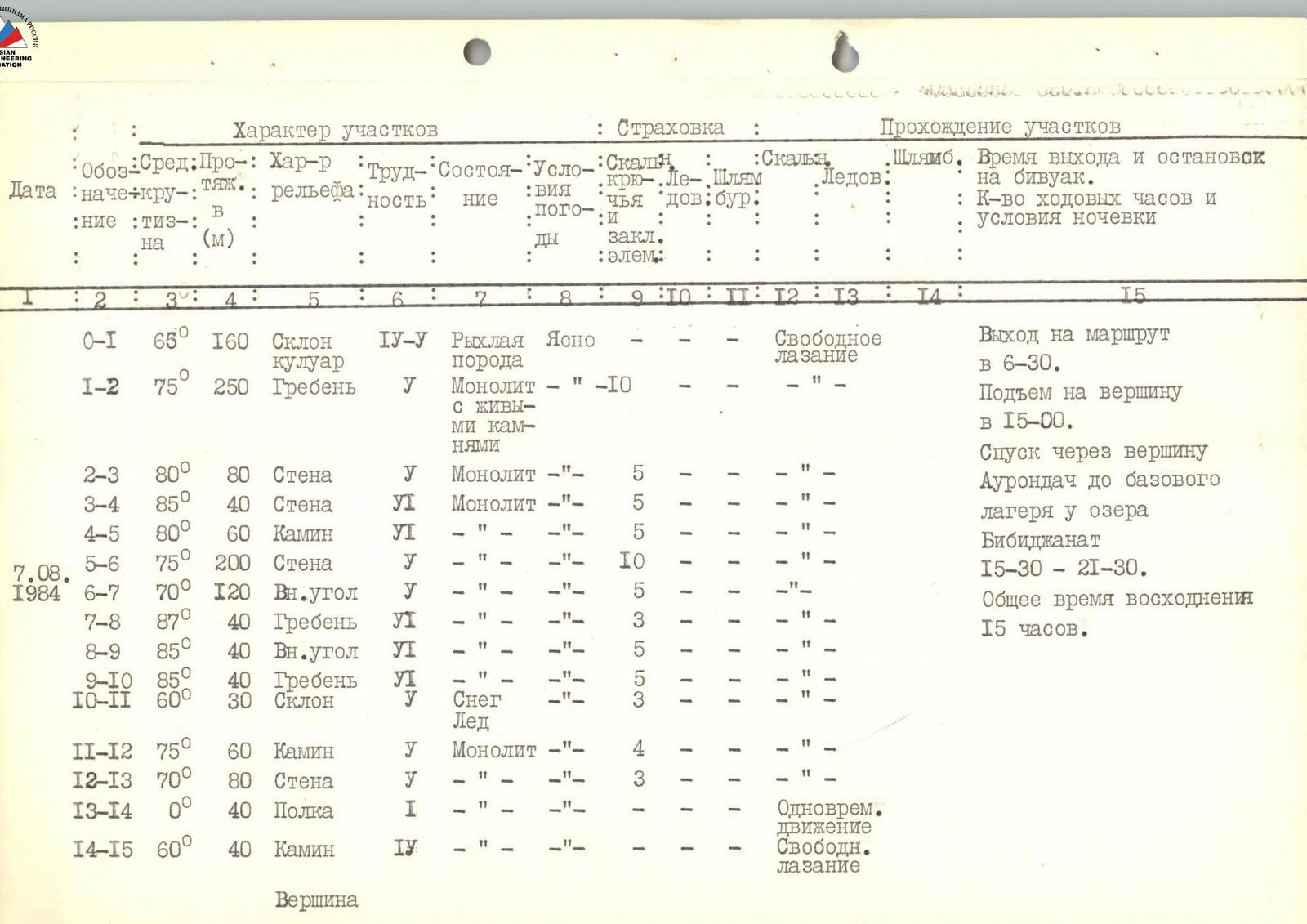
Route profile (scale 1:5000)
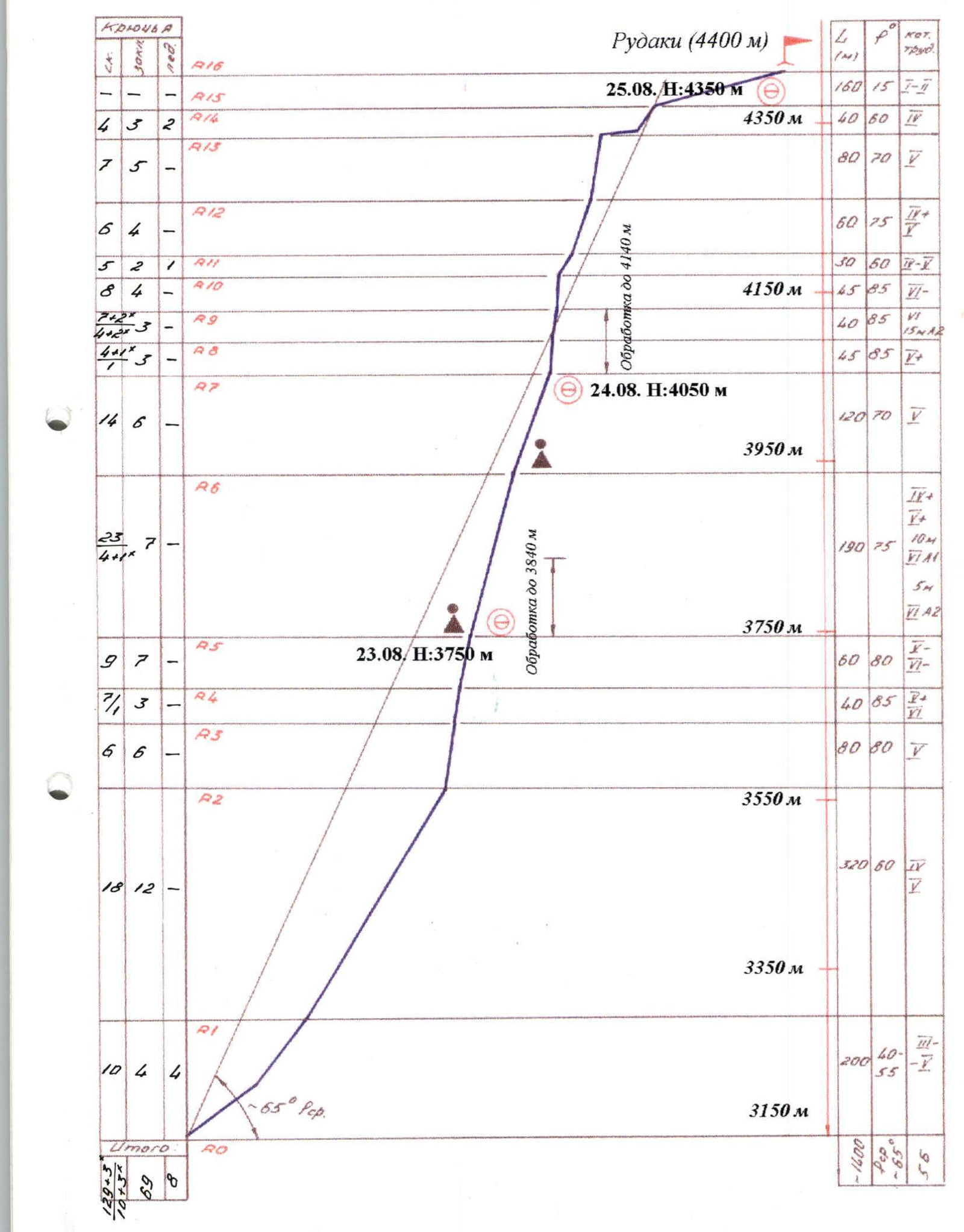
Route diagram in UIAA symbols.
| Section | Rock Pitons | Ice Pitons | Chocks | Bolt Pitons | UIAA Diagram | L, m | Steepness, ° | Difficulty Category |
|---|---|---|---|---|---|---|---|---|
| R5 | 9 | - | - | - | - | 60 | 80 | 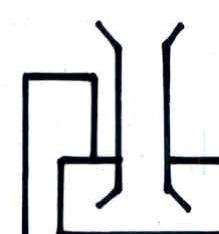 |
| R4 | 4 | - | 3 | - | - | 40 | 85 | 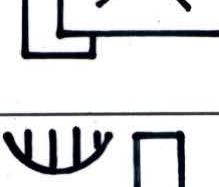 |
| R3 | 6 | - | 6 | - | - | 80 | 80 | 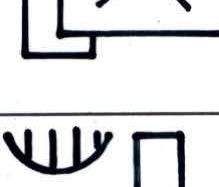 |
| R2 | 12 | - | - | - | - | 320 | 60 | 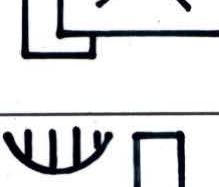 |
| R1 | 10 | 4 | 4 | - | - | 200 | 40–55 |  |
Total: 129 + 3°, 8–69°

Route diagram in UIAA symbols.
| Section | Rock Pitons | Ice Pitons | Chocks | Bolt Pitons | UIAA Diagram | L, m | Steepness, ° | Difficulty Category |
|---|---|---|---|---|---|---|---|---|
| R10 | - | - | 4 | - | - | 45 | 85 | 6 |
| R9 | 4 | - | 3 | - | - | 40 | 85 | 6 |
| R8 | 4 | - | 3 | - | - | 45 | 85 | 6 |
| R7 | 14 | - | 6 | - | - | 120 | 70 | 5 |
| R6 | - | - | 4 | - | - | 190 | 75 | 5 |
Route diagram in UIAA symbols.
| Section | Rock Pitons | Ice Pitons | Chocks | Bolt Pitons | UIAA Diagram | L, m | Steepness, ° | Difficulty Category |
|---|---|---|---|---|---|---|---|---|
| R16 | - | - | - | - | - | 160 | 15 | 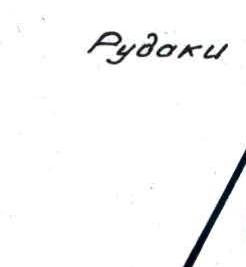 |
| R15 | 4 | 2 | 3 | - | - | 40 | 60 | 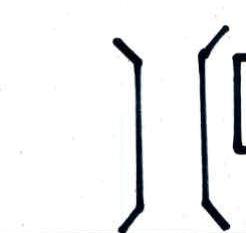 |
| R14 | - | 1 | - | - | - | 40 | 0 | 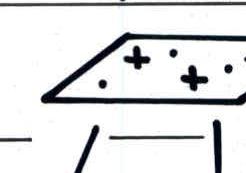 |
| R13 | - | - | 5 | - | - | 80 | 70 | 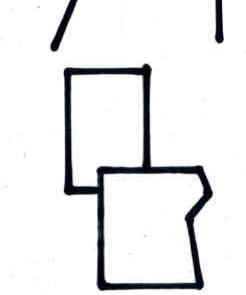 |
| R12 | 6 | - | 4 | - | - | 60 | 75 | 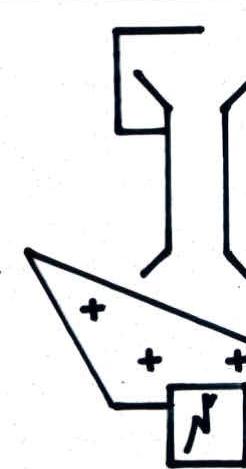 |
| R11 | 5 | 1 | 2 | - | - | 30 | 60 |  |
Peak Rudaki
- 40 m 60° IV
- 40 m 0° I
- 80 m 70° V
- 60 m 75° V
- 30 m 60° V
- 40 m 85° VI
- 40 m 87° VI
- 120 m 70° V
- 200 m 75° V
- 60 m 80° VI
- 40 m 85° VI
- 80 m 80° V
- 280 m 75° V
- 160 m 65° IV–V
Team Tactics
At 6:30, the group approached the base of Peak Rudaki and began the ascent.
At 7:00, the group started moving along the route. R. Galeev worked first, paired with A. Miroshkin. After autonomously completing two pitches of moderate difficulty (sections R0–R1, R1–R2), both teams reached a ledge below the grey wall. On sections R2–R3–R4–R5, the teams worked in coordination.
The team of R. Galeev and A. Miroshkin ascended first; the team of V. Telitsyn and V. Rusinov followed on the fixed ropes. After four pitches of challenging climbing, the first team reached the control cairn at 10:00. Following a brief rest, V. Telitsyn began the ascent with V. Rusinov. Sections 5–6–7–8 were traversed in coordination. The difficult climbing required careful belaying.
By 12:00, the group reached the "red stone." Here, the lead was passed to R. Galeev and A. Miroshkin. Section 8–9 was the most challenging part of the route.
At the start of the ridge (section 9–10), there was no safe spot to establish belays and gather the entire group. Rocks were falling from the snowfield above, so the first climber proceeded with a extended rope, reaching the end of the ridge. The group quickly traversed the rockfall-prone section and gathered at the edge of the snowfield.
From point 11, V. Rusinov and V. Telitsyn led, passing a chimney and establishing fixed ropes. From point 12 to the summit, the teams moved independently with alternating belays.
Sections 12–13–14–15 were traversed with great caution due to numerous loose rocks.
At 15:30, the group reached the summit. By 21:30, they descended to the base camp. The tactical plan was largely executed, facilitated by favorable weather, acclimatization, and the team's physical and technical preparedness. The ascent utilized a well-practiced movement scheme:
- The lead climber used a double rope without a backpack,
- The others used jumar ascenders with top-rope belay, without extracting backpacks. Lead changes were made according to the tactical plan.
The team used relatively new equipment, including "Jumar" ascenders and various chocks.
The ascent was conducted with adherence to safety protocols, with no falls or injuries. Radio communication with the base camp was maintained using a "Kaktus" radio station.
Route Description by Sections
At 6:30 on August 7, 1984, the group began working on the route. Teams: Galeev R. — Miroshkin A., Telitsyn V. — Rusinov V.
Section 0–1: along the left edge of the couloir. Climbing is moderately difficult, with heavily broken rocks; belays are placed on natural features (200 m). Teams traverse this section independently.
Section 1–2 — buttress: rocks of moderate difficulty with internal angles, chimneys, and cracks. The first team, Galeev R. — Miroshkin A., leads this section. Belays are placed using pitons, outcrops, and chocks. The second team follows, using the belay points left by the first team. The buttress ends at a ledge below the grey wall. The route then proceeds leftward and upward toward the junction of the snowy-icy couloir and the eastern wall of Peak Rudaki. The grey wall begins with moderately difficult rocks, increasing in difficulty; the upper part features a chimney with very challenging climbing.
Sections 2–3–4–5. The first team, Galeev R. — Miroshkin A., leads. The chimney is traversed using artificial aids. The second team follows on fixed ropes. At 10:00, the first climber reaches the control cairn.
The control cairn is located on a ledge, at the bend of the couloir (start of the waterfall), 80 m to the right, below a black rock. To the left, toward the pre-summit wall, lies a large couloir with "ram's foreheads." The route continues through the right part of the couloir, under steep, smooth rocks, toward the upper part of the couloir. A red stone serves as a landmark, visible from the moraine at the start of the route.
Section 5–6: from the control cairn, a 40 m rock wall begins. Climbing is challenging, but there are sufficient cracks for pitons. The first ascent is made by Telitsyn, paired with Rusinov. The wall transitions into an internal angle, slightly less steep but still challenging.
Section 6–7: the first team proceeds with careful belaying through pitons and chocks. The second team follows on fixed ropes.
Section 7–8 is a steep, rocky ridge with very challenging climbing. By 12:00, the group reaches the "red stone." The lead is then taken over by Galeev R. and Miroshkin A.
From the stone, the route proceeds leftward and upward along a steep internal angle. Section 8–9. At the end of this section, ascending and traversing a monolithic slab under a rocky cornice is particularly challenging. The left part of the slab leads to the ridge. Climbing is extremely difficult, with wet seepage. The first climber uses artificial aids. The route then continues along the rocky ridge.
Section 9–10. Climbing is very difficult. The ridge is complicated by wet seepage, leading to a snow- and ice-covered slope.
Section 10–11. From point 11, the route proceeds rightward and upward through a chimney. The team of Rusinov V. — Telitsyn V. leads. The first team follows, establishing fixed ropes. The route then continues along a rock wall with moderately difficult climbing.
Sections 12–13. The wall leads to a ledge. Along the ledge, rightward — 40 m. Then, Section 13–14, followed by a chimney — Section 14–15 — to the summit.
At 15:30, the group reaches the summit. The descent from Peak Rudaki is made via Peak Aurondag, following a Category 3B route to the saddle between Aurondag and Zeerat. From the saddle, the group descends via a scree-filled couloir, returning to the base camp by 21:30.
Footnotes
-
Departure to the route at 6:30. Summit reached at 15:00. Descent via peak Aurondag to the base camp near Lake Bibijanats from 15:30 to 21:30. Total ascent time 15 hours. ↩