
IX Climbing Record
- Climbing category — technical
- Climbing area — Fann Mountains range
- Peak, its height, climbing route — p. Maria 4970 m via the left part of the northeast wall
- Proposed difficulty category 5B
- Route characteristics: height difference 1210 m, total 1870 m. Length of sections with 5–6 difficulty category — 945 m Average steepness 78°
- Number of driven pitons: for rock insurance — 252, ice — 12, bolted — 1; for creating and organizing rock — 24, ice — 12, bolted —
- Number of travel hours — 57.5 hours
- Number of bivouacs and their characteristics — three bivouacs on the wall; of these: one semi-reclined, two — sitting
- Surname, name, patronymic of the leader, participants, and their qualification Leader: Varov Viktor Ivanovich, Candidate Master of Sports Participants: Antipin Vitaly Mikhailovich, Candidate Master of Sports Parshin Vladimir Sergeyevich, Candidate Master of Sports Krapivin Valentin Nikolaevich, Candidate Master of Sports
- Team coach Ivashov Vadim Kornilovich, Master of Sports of the USSR
- Dates of departure and return: departure on July 13, 1980, return to the base camp at Bibijonat lake on July 19, 1980
P. MARIA, TEAM'S ROUTE
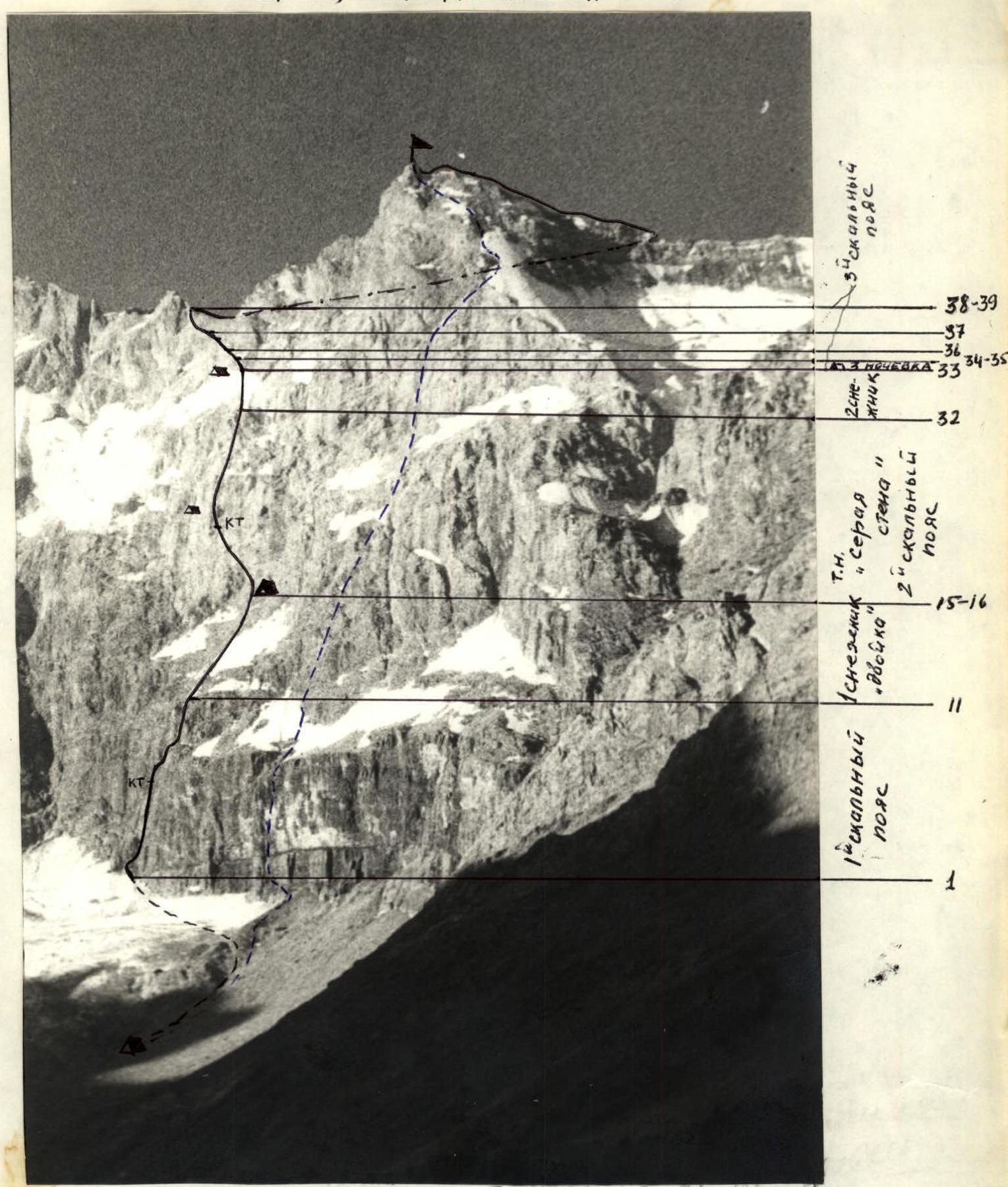
— ROUTE taken by the group (visible part) — ZHITENEV'S ROUTE K.T. — CONTROL TOURS — PLACES OF BIVOUACS — Invisible part of the TEAM's route
III. Brief Geographical Description and Sporting Characteristics of the Climbing Object
The Maria massif is located in the center of the Kulikalon wall and includes three peaks:
- Main (4970 m),
- Uzlovaya (4870 m),
- Western (4700 m).
To the east of the Main peak is the highest point of the Kulikalon wall, p. Mirali (5150 m). To the north of Uzlovaya, a short ridge extends, where two peaks, Tashkents and Flyorit, are located. To the west of p. Maria, the Kulikalon wall continues with the peaks Rudaki and Aurondag.
By the time of our ascent, two routes had already been laid on the northeast wall of p. Maria:
- F. Zhitenyev's route through the center of the NE wall;
- Vakhmenin's route, as a variation of his route.
Both routes are 5B category, certified.
The northeast wall is a three-tier rock formation separated by two horizontal snow and ice shelves (50–100 m). The wall is "bounded" by hanging glaciers on the right and left, which occasionally disrupt the tranquility of the area. The first rock tier, where our team passed through, has the greatest extent. Its height is about 320 m, with an average steepness of 85°. The rock is strong — marble, dense limestone. There are overhanging sections, but the relief is good for climbing.
The second tier, passed by the team through the so-called "gray wall," is composed of dense limestones, similar to those in Crimea. It is very steep throughout its entire length, 85–90°. Depending on the time of day, there is rime ice and water. The length is about 500 m.
The third tier, according to the team's route, is also composed of limestones but is more destroyed. The uppermost part of the third tier (80 m) is red, destroyed limestones. Insurance and climbing are problematic. Throughout its length, the ridge between p. Mirali and p. Maria overhangs towards the Kulikalon cirque.
During the observation and passage of the route, there were no rockfalls. The hanging glacier, which bounds the NE wall on the left, broke off with icefalls to the left of the passed route.
VI. Tactical Climbing Plan
Considering the results of observations, consultations with participants of previous ascents on the northeast wall of p. Maria, and recommendations from the Fann Mountains Sports Committee, the group adopted the following climbing plan:
- First day — processing the first tier by a duo, descending to bivouac under the wall.
- Second day — passing the entire first tier by the group, bivouacking below the first snowfield.
- Third day — passing the lower third of the second tier, processing a bivouac on the wall.
- Fourth day — passing the second tier, bivouacking under the third rock tier.
- Fifth day — passing the third rock tier and reaching the summit.
- Sixth day — descending to the base camp at Bibijonat lake and, as an option, descending to the Pravy Zindon valley to Bolshoe Allo lake in case of bad weather.
This plan was largely followed, with minor deviations. Due to bad weather, the group descended to Bolshoe Allo lake and, after crossing the Mezhozerny and Zierat passes, returned to the base camp at Bibijonat lake.
IV. Climbing Chronicle
July 13. This day was dedicated to processing the lower rock tier. On the evening of July 12, the team thoroughly checked the selected equipment and supplies, documentation, and received approval from the release officer. They once again carefully examined the upcoming route, whose lighting allowed them to identify the macro-relief on the lower rock tier and the "gray wall" in the central part of the route.
This wall appeared to be a key point of the ascent, as became clear in two days. Our assumptions were correct.
So, July 13 morning arrived. It was sunny and quiet, as usual. The weather had been ideal for two weeks, and on this day, it didn't cause any concerns. The "gray wall" was still of great interest. In the morning light (the wall's exposure is northeast), the climbing relief wasn't visible. It remained to figure it out on the spot.
From the base camp at Bibijonat lake, five people set out at 7:30: Varov V., Antipin V., and three observers. The duo Parshin V. – Krapivin V. were to join under the route in the second half of the day. Fortunately, the entire approach from the base camp to the wall of p. Maria takes 1.5 hours.
At 10:00, the duo Varov V. – Antipin V. began processing the lower rock tier.
They had already passed a small bergschrund, 3 m deep, filled with ice, and immediately the wall began without any transitions. The steepness was about 75°, with good holds, and the duo quickly found themselves on a small ledge, 10 m above the ice. They organized an insurance point.
The wall steeply rose upwards, but the path was visible. Boots were hung on a piton, and "Asian" galoshes were put on their feet, and Varov moved up slightly to the left. The work began.
"Five meters of rope," came Vitaly Antipin's cry, and these meters were just enough to reach a ledge where insurance could be organized.
The further path was not very pleasant:
- Rock wetted by water crumbled under their hands in the right part of a huge internal corner.
- There were practically no places for pitons.
The wet Varov reached a steeply inclined ledge and received Vitaly. Both were wringing wet.
The path to the left suggested itself, but it was not possible to go that way because the hanging glacier would be above their heads, so they continued straight up towards the "red rocks" overhanging the route.
Climbing became more difficult, the wall approached the vertical, but good relief helped. Strong, comfortable holds were a joy.
On the fifth rope, they had to use ladders, but only in two places.
The sixth rope ended with a small waterfall and a wide ledge. Processing was complete. It was time to descend as it was getting dark.
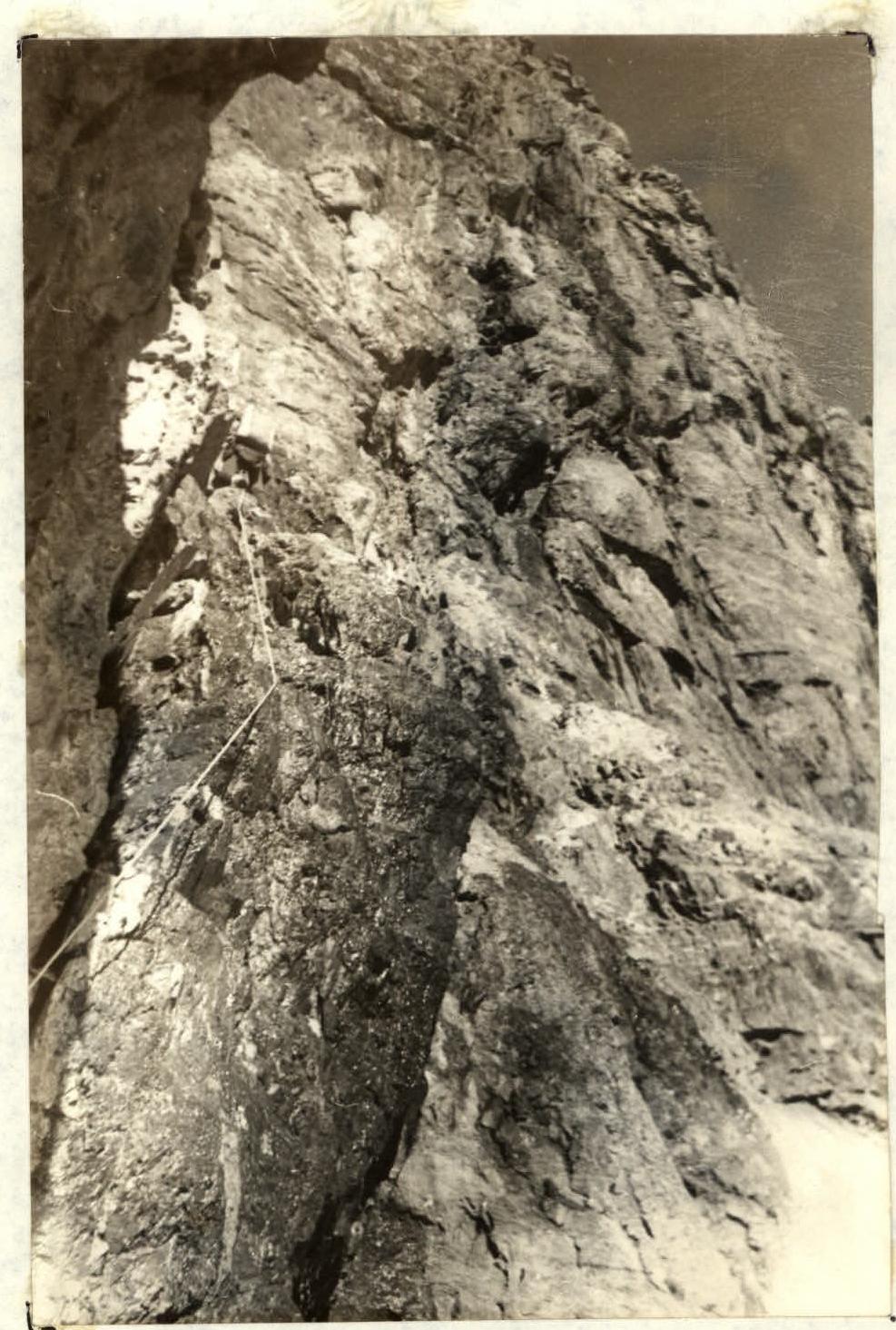
Internal corner (2nd rope of the lower rock tier). At 18:30, the duo Varov – Antipin, having passed six ropes of the lower tier, began descending to bivouac under the route. Parshin and Krapivin also arrived here at 18:00. The exchange of opinions was quite brief: preliminary study of the wall and processing of the lower tier showed that the route was not prone to rockfall, climbing in galoshes was confident, mostly without artificial footholds. The average time to pass a rope was 40–60 minutes.
After discussing the ascent plan for tomorrow and consuming a good portion of the brought supplies, they settled in for rest at the last well-arranged bivouac before the ascent.
July 14. They rose with the first rays of the sun, as planned. The weather was again excellent. It took 40 minutes to reach the route. They calmly and carefully prepared for the exit. Final instructions were given to the observers, who were to collect the ropes dropped from the lower tier, and they set off. They left the bivouac at 7:30.
Despite the early hour, the wall was already alive with its usual activity:
- Stones began to fall in many places under the lower rock tier.
- Their whistling was heard in the area of the start of Zhitenyev's route and to the left of it, where our foursome was heading.
- Traversing the glacier and getting closer to our route, they involuntarily looked and listened — were there any stones along the path of their upcoming ascent?
- But the falling stones remained to the right.
- The trace of the icefall from the hanging glacier between p. Maria and p. Mirali was to the left.
- The snow under their route was clean.
After the last 40–50 meters of a steep climb, they were above the route. A fixed rope went up from the rappel anchor and slightly to the right.
According to the plan for today:
- The first to work was the Parshin – Krapivin duo.
- Krapivin V. started moving.
- Dressed in harnesses, with chest and leg jammers prepared.
At 8:20, they began the ascent.
The fixed ropes facilitated movement, as in some places the rope hung freely. Antipin moved last. Soon, the sound of a hammer was heard from below. Work had begun. The glacier gradually receded; looking up, the upper edge of the rock tier was visible. The steepness of the rocks, close to sheer, obstructed the view of the route.
When passing the third fixed rope, stones started falling from above. However, their trajectories passed to the left and right of their path. As assumed, the "gray wall" in the middle of the route reliably protected them from stones falling from the upper snow shelf and from the pre-summit tier. And further, stones fell to the left and right of their path.
July 15. The weather was again favorable, although some clouds appeared at high altitude in the second half of the day. They attributed their appearance to the gain in height, from which it was possible to see further.
The first to move today were Varov V. and Antipin V. Looking ahead, it is noted that they passed 7 ropes that day, of which 3 were of the 6th category. All work was associated with overcoming rocky relief.
Varov V., prepared for such climbing by years of training on the Crimean rocks, was in a fighting mood and optimistic. Careful selection of equipment and supplies, and relatively light backpacks, allowed them to move without hauling for now. However, even with the use of fixed ropes, movement was difficult because sections of traverses often passed over slippery rocks under waterfalls, of which there were many on the "gray wall."
By mid-day, Varov V. reached a cave, which, according to their calculations, was in the center of the wall. It became clear that they would have to bivouac on the wall. On the passed section, they didn't even find suitable places for a sitting bivouac.
And from the cave, further movement was problematic because the path was blocked not by a cornice but by an extended overhang without pronounced ledges or cracks. Viktor, after several attempts to find a bypass or overcome the overhang with climbing, agreed to drive a bolted piton.
And now, frequent hammer blows indicated further movement of the first climber. Two — Antipin V. and Parshin V. — provided him with work using a pulley system. Slowly, the ropes moved upwards, and after 2 hours from the start of movement, Viktor's cry was heard: "The fixed ropes are ready!"
Wetted and chilled, they began to catch up with Viktor. It was only surprising how he managed to overcome the section before driving the bolted piton. But even after that, the wall did not become more gentle; it simply allowed the driving of rock pitons. It was already 16:00.
Two more ropes of difficult climbing — and Viktor entered an inclined ledge represented by compacted stones and ice. Again, 2 hours of work passed — and there was a semblance of a platform. This time, the platform was narrow and sloping. They arranged themselves across the tent, sitting. Warmed by chicken soup, they regained strength for the third day of work.
July 16. Again, around six in the morning, the sun illuminated them, and the third day on the wall began. The preparations associated with removing pitons from the bivouac, preparing ropes, etc., were behind them, and the Parshin V. – Krapivin V. duo set out onto the sheer wall above the bivouac. Vladimir Parshin was in front. The first, as always, moved lightly. A narrow, inclined crack often appeared, so Vladimir's movement was more like work on a rope than on rock — accurate and focused. But then a good piton rang out, the ropes began to move faster, and the familiar work resumed: securing, handing over.
On this third day, they hoped that they would pass the "gray wall" and, if not reach the ridge, then there would be no more complex technical work on the fourth day. They were mistaken.
Vladimir Parshin's movement around 10:00 was halted by an overhanging internal corner more than 10 m long. Having confidently started its passage, Vladimir soon had to resort to commands: "Hand over the white one, secure the blue one!" — that is, to use a pulley system again. But after an hour, Parshin reported from above that the fixed ropes were ready and further on, it was "a road," meaning there would be no more need for a pulley system or bolted pitons. That's good.
For the three climbing on Parshin's fixed ropes, this section of the route would be remembered more than once because water ran down the wall, or rather, down the internal corner. Varov V.'s joking about Krapivin V.'s trousers getting wet on his "buttocks" quickly stopped. Later, Viktor explained that he had envisioned himself in that section. Yes, they got wet here to the last thread. It was especially hard on Vitaly Antipin — he was climbing last through increasingly arriving water and also had to remove pitons.
Parshin V. was right. The wall suddenly began to slope, and they saw the ridge of p. Maria, going towards p. Mirali. But they still had a long way to go, as Vitalik put it, "as far as the Moon." The section of the route that seemed not particularly difficult from below turned out to be:
- strongly destroyed red limestones, which hung like brickwork over the entire wall of p. Maria;
- stones fell from these rocks, and the traces of their fall were clearly visible on the second snowfield (in the upper third of the wall).
After reaching the snowfield, they decided to reach the ridge of p. Maria between the summit tower and the first powerful boulder.
Although the "gray wall" remained below, they couldn't relax for a moment — constantly hearing falling stones. However, their traces on the snow indicated a safe path. After 4 ropes, which they passed partly on snow, partly on rocks, they found themselves under the protection of a huge boulder, behind which the gap between it and p. Maria was guessed. It was already 16:00.
The duo Varov V. and Parshin V., taking 3 ropes, moved to scout and process further, while the remaining duo occupied themselves with bivouac arrangements. After 2 hours and 30 minutes, the first duo returned with the news that the further path was problematic:
- either they had to move far to the right and reach the summit tower of Maria (and that was another 8–10 ropes of work) on sheer and overhanging rocks of very poor structure;
- or try to reach the boulder from the side of the gap (and that was also 5–6 ropes of steep, crumbling rocks).
There was no path into the gap itself because it was a collector of stones and filled with rime ice. The weather throughout the day had been slowly but surely deteriorating, and towards evening, it started to sleet several times. There was plenty to think about.
Before sleep, after each team member had spoken, Viktor Varov made the decision to abandon the option of reaching the summit tower and to move towards the gap between Maria and Mirali. They fell asleep on this decision, on a semi-sitting bivouac.
July 17. The morning did not bode well for the weather. Cloudiness was everywhere; above its upper boundary, towered clouds rose. A bad omen.
Preparations took a long time because they had to remove 3 more ropes hung the previous evening. But everything was done, the bivouac was packed up, and tasks were clear. Parshin V. moved forward-left to prepare the traverse of the couloir, which was red from constantly falling stones. There was no other path, so they hastened to use the cold morning hours.
With the help of pendulum movements, they quickly crossed the couloir and, 4 hours after leaving the bivouac, found themselves 2 ropes above the second snowfield. Yes, scouting the route for first-timers is always associated with additional expenditure of time and effort.
Ahead were 5 ropes to reach the gap. The path represented a very steep slab with slides, and two fractures were traced in the slab:
- one led to the left side of the gap;
- the other — to the right.
Varov V. preferred the left fracture, which turned out to be filled with "live" stones. Exceptionally concentrated climbing by Viktor and the subsequent team members allowed them not to spoil the impression of the ascent with stones thrown at each other.
There was one last rope to reach the gap. Viktor Varov was in front. There was one hour left until radio contact at 13:45. Snowfall began. The rocks were limestone, which had crumbled finely on the surface but did not form ledges or cracks. Climbing was extremely tense, complicated by snowfall. Thunder rumbled. But then Viktor's cry was heard: "And here's a talus field!" Viktor had climbed into the gap. He tried to climb further but then removed the antenna and radio. Electricity was everywhere. The others climbed up. For the first time in 4 days, they could stand without self-insurance. However, the thunderstorm did not allow them to stay in the gap, and the summit was still ahead. Visibility was very poor because clouds were everywhere.
The further path from the gap to p. Maria was well represented by descriptions and consultations:
- talus fields bypassing the ridge to the left, descending to p. Mirali;
- then ascent from the ridge to the western ridge of p. Maria — the so-called "Kораблика" (little ship);
- along it — to the summit.
The continuing thunderstorm and cloudiness did not allow them to easily use this recommendation, and they had to move, clinging to the ridge on the right side of the path. Occasionally, the clouds parted, and they saw p. Mirali, p. Chim-Targ, and ahead — walls emerging from the fog.
But then, having overcome several wide couloirs, climbed their walls, they approached under the blackening, almost horizontal western ridge. However, the bad weather intensified towards the evening. It was already 20:00 when they reached the summit. They had to think about bivouac.
The decision was made to abandon the planned descent via p. Temir-Tau due to the weather, as finding a descent path in the fog and evening on snow was not a simple task. Therefore, even on the way to the summit, they knew they would descend into the Pravy Zindon valley, which corresponded to the backup plan.
And so they did, and at 20:00, in poor visibility, having descended from the western ridge, they stopped for bivouac.
This day turned out to be very difficult due to the challenges of reaching the gap and the bad weather. However, the confidence in a simple descent to Bolshoe Allo lake reassured them.
July 18. All night, the bad weather continued, leaving no hope for improvement. Snow was everywhere, it was cold. Rare breaks in the clouds revealed the path descending from p. Chim-Targ. This was enough for them to be on the trail in 3 hours. In another 2.5 hours, they were at Bolshoe Allo lake.
The friendly and hospitable Lithuanian gathering group reinforced them very well, and they were ready to head to their camp. The path ahead lay through two passes: Mezhozerny and Zi erat. None of them had traversed these passes, and cloudiness obscured the approach to Mezhozerny pass. So, they took advantage of the gathering group's hospitality and set out towards Mezhozerny pass on the morning of July 19. In 8 hours, they were back at the base camp on Bibijonat lake, from where they had departed on July 13.
The first duo passed six ropes of fixed ropes by 10:30. Here, they had to wait for the second duo, who had a lot of work removing pitons. Viktor Varov appeared, followed by Antipin V. 120 meters of rope were thrown down to the observers, and another sixty meters of rope went with them.
Rest, discussion of the further path, and Parshin V. began to drive pitons. The exit of their route to the first snowfield was three ropes higher than on Zhitenyev's and Vakhmenin's routes. Climbing was difficult, but the speed of passage was good. The excellent preparation of Parshin V., who had completed three 5B category ascents this season before ascending p. Maria, was evident.
By 14:00, the lower rock tier was passed, and the "gray wall" loomed ahead, separated from them by a steep snow ledge. To the left of the "gray wall," 200 m away, was a hanging glacier, and to the right were steep couloirs of red color, where stones continuously fell; they were once again convinced that the route was chosen correctly. Thanks to the consultants:
- Zhitenyev
- Zayonchkovsky
- Mumdzhi
Below, a magnificent view of the lakes, gathering camps, and the "Artuch" tourist center unfolded. After reaching the snowfield, they should be clearly visible from the base camp. However, there was no time to admire the view. The "gray wall" was ahead.
Two ropes on the steep snowfield:
- brought them to the wall;
- it turned out that its scale from below was significantly underestimated against the background of the walls of p. Maria and p. Mirali;
- close up, the "gray wall" rose steeply, and it was impossible to take it in with a glance.
The wall from the first snowfield, having given one rope of fragmented rocks for warm-up, rose sheer. The sun had passed over p. Maria, and they were in the shade. Varov V. reminded them from below that it was time to look for a bivouac spot. However, there was nothing suitable even for a sitting bivouac. Parshin V. persistently sought to reach a potential crack slightly to the right of the center of the wall. And then a cheerful exclamation was heard: "There's a bivouac spot!" Two hours of work laying out stones, and a platform wide enough for three people was ready. The fourth (Varov V.) had to climb onto the platform twice during the night because he rolled off it. The night passed well. The awareness that the plan for two days was fully implemented instilled confidence in the future. Only the lack of a visible path further was worrying. On this day, 17 ropes were passed, including processing.
VIII. Table of Main Climbing Route Characteristics
| Date | Designation | Average Steepness (°) | Length (m) | Relief Character | Difficulty | Condition | Conditions | Rock Pitons | Ice Pitons | Bolted Pitons |
|---|---|---|---|---|---|---|---|---|---|---|
| 1 | 2 | 3 | 4 | 5 | 6 | 7 | 8 | 9 | 10 | |
| July 13, 1980 | R0–R1 | 50° | 35 | ice | 5 | soft | good | – | 3 | – |
| 10:00–18:30 | R1–R2 | 85° | 30 | strong marble | 5–6 | monolithic | good | 8 | – | – |
| R2–R3 | 25° | 12 | osypnaya, wide ledge | 2 | destroyed | good | 2 | – | – | |
| R2–R4 | 90° | 31 | internal corner with a crack | 6 | semi-destroyed, wet | good | 9 | – | – | |
| R4–R5 | 80° | 40 | wall, monolithic | 5 | water runoff | good | 6 | – | – | |
| R5–R6 | 85° | 42 | wall, monolithic | 5–6 | dry, good | good | 10 | – | – | |
| First Control Tour | ||||||||||
| R6–R7 | 80° | 33 | counterfort, monolithic | 5 | water runoff | good | 4 | – | – | |
| R7–R8 | 90° | 9 | chimney with a waterfall | 6 | wet, slippery | good | 4 | – | – | |
| July 14, 1980 | R8–R9 | 85° | 8 | wall | 5–6 | water, live stones | good | 3 | – | – |
| 8:20–18:30 | R9–R10 | 80° | 45 | wall, destroyed | 5 | live stones | good | 8 | – | – |
| R10–R11 | 75° | 60 | wall with water runoff | 5 | live stones | good | 9 | – | – | |
| R11–R12 | 60° | 60 | ram's foreheads, smoothed | 4 | wet, slippery | good | 10 | – | – | |
| R12–R13 | 40° | 110 | dense snow with ice outcrops | 4–5 | thawing | good | – | 4 | – | |
| R13–R14 | 50° | 70 | ram's foreheads with snow | 4–5 | wet, slippery | good | 6 | – | – | |
| R14–R15 | 70° | 60 | destroyed rocks | 5 | live stones | good | 10 | – | – | |
| Total for the day of processing and movement | 610 | – | – | – | 89 | 7 | – | |||
| July 15, 1980 | R15–R16 | 35° | 35 | narrow ledge | 4 | snow, rime | good | 6 | – | – |
| 7:00–20:00 | R16–R17 | 70° | 12 | steep internal corner, filled with ice | 5 | ice, water | good | 3 | – | – |
| R17–R18 | 80° | 29 | narrow crack in the internal corner | 5–6 | monolithic | good | 7 | – | – | |
| R18–R19 | 85° | 43 | wall with overhanging sections | 6 | strong limestone | good | 14 | – | – | |
| R19–R20 | 95° | 5 | cornice | 6 | monolithic | good | 4 | – | – | |
| R20–R21 | 85° | 35 | wall, steep | 5 | slightly destroyed | good | 6 | – | – | |
| R21–R22 | 35° | 3 | ledge | 2 | osypnaya | good | 2 | – | – | |
| R22–R23 | 80° | 42 | wall | 6 | smoothed, few holds | good | 10 | – | – | |
| Second Control Tour | ||||||||||
| R23–R24 | 95° | 12 | wall, traverse left | 6 | monolithic | good | 5 | – | – | |
| R24–R25 | 110° | 15 | cornice with a narrow crack | 6 | wet, water | good | 6 | – | 1 | |
| R25–R26 | 85° | 15 | wall, smoothed | 6 | water | good | 4 | – | – | |
| R26–R27 | 80° | 39 | traverse left, up | 5 | water, rime ice | good | 12 | – | – | |
| Total for the third day of movement | 285 | – | – | – | – | 79 | – | 1 | ||
| July 16, 1980 | R27–R28 | 85° | 24 | smooth wall with small ledges | 6 | rime ice | overcast | 6 | – | – |
| R28–R29 | 95° | 30 | narrow | 6 | water, rime ice | overcast | 14 | – | – | |
| R29–R30 | 70° | 42 | ram's foreheads | 5 | snow, water | overcast | 8 | – | – | |
| R30–R31 | 65° | 40 | ram's foreheads | 5 | rime ice, water | overcast | 8 | – | – | |
| R31–R32 | 75° | 44 | wall with a slab | 5 | water, rime ice | overcast | 10 | – | – | |
| R32–R33 | 45° | 75 | snow with ice outcrops | 4–5 | soggy | overcast | 4 | 4 | – | |
| Total for the fourth day of movement | 296 | – | – | – | – | 56 | 4 | – | ||
| July 17, 1980 | R34–R35 | 75° | 42 | destroyed rocks | 5 | with snow | overcast | 8 | – | – |
| 6:30–20:30 | R35–R36 | 80° | 40 | traverse left along the monolithic wall | 5 | rime ice, smoothed | overcast, snow | 8 | – | – |
| R36–R37 | 85° | 35 | wall with a crack | 5–6 | very destroyed rock | snow | 10 | – | – | |
| R37–R38 | 85° | 43 | wall, monolithic | 5–6 | good | snow | 12 | – | – | |
| R38–R39 | 0° | 8 | narrow ledge | 4 | destroyed rock | snow, fog | 10 | – | – | |
| R40–R41 | 30° | 1200 | talus fields of southern slopes of p. Maria | 1 | osypnye | snow, fog | – | – | – | |
| R41–R42 | 75° | 30 | destroyed rock | 4–5 | smoothed | snow, fog | 2 | – | – | |
| Total for the fifth day of movement | 1428 | – | – | – | – | 52 | – | – | ||
| Total for five days of ascent to the ridge | 1389 | |||||||||
| Total to the summit | 2817 | 276 | 12 | 1 |

Profile of the "Gray wall", snowfield "Dвойка" (Two). Sections of the route.