
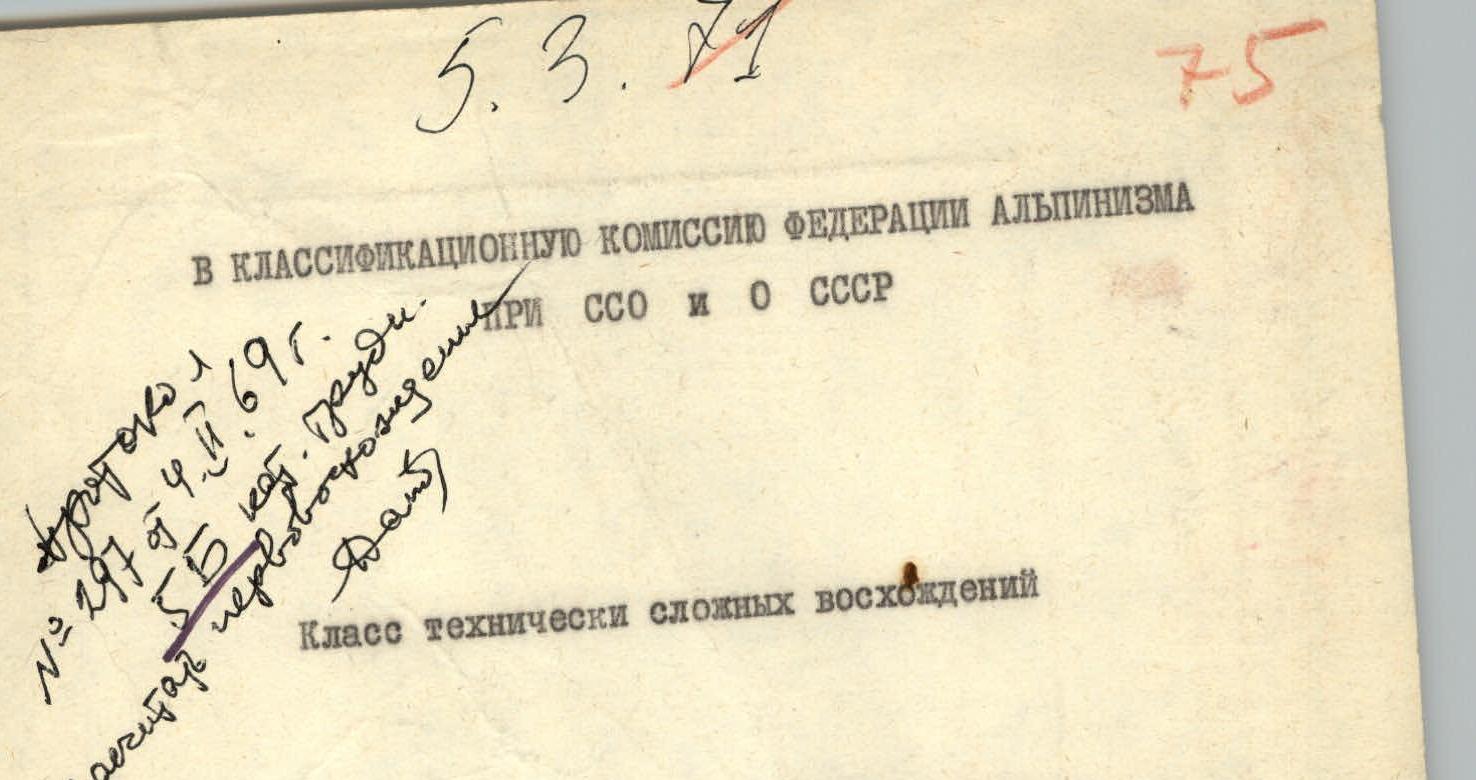
- ASCENT TO MARIA PEAK VIA NORTH-NORTHEAST FACE
First Ascent
Approximately 5B category of difficulty
Route climbed by a combined team of LOS SDSO "Burevestnik" Zhitenev
FAN MOUNTAINS 1968
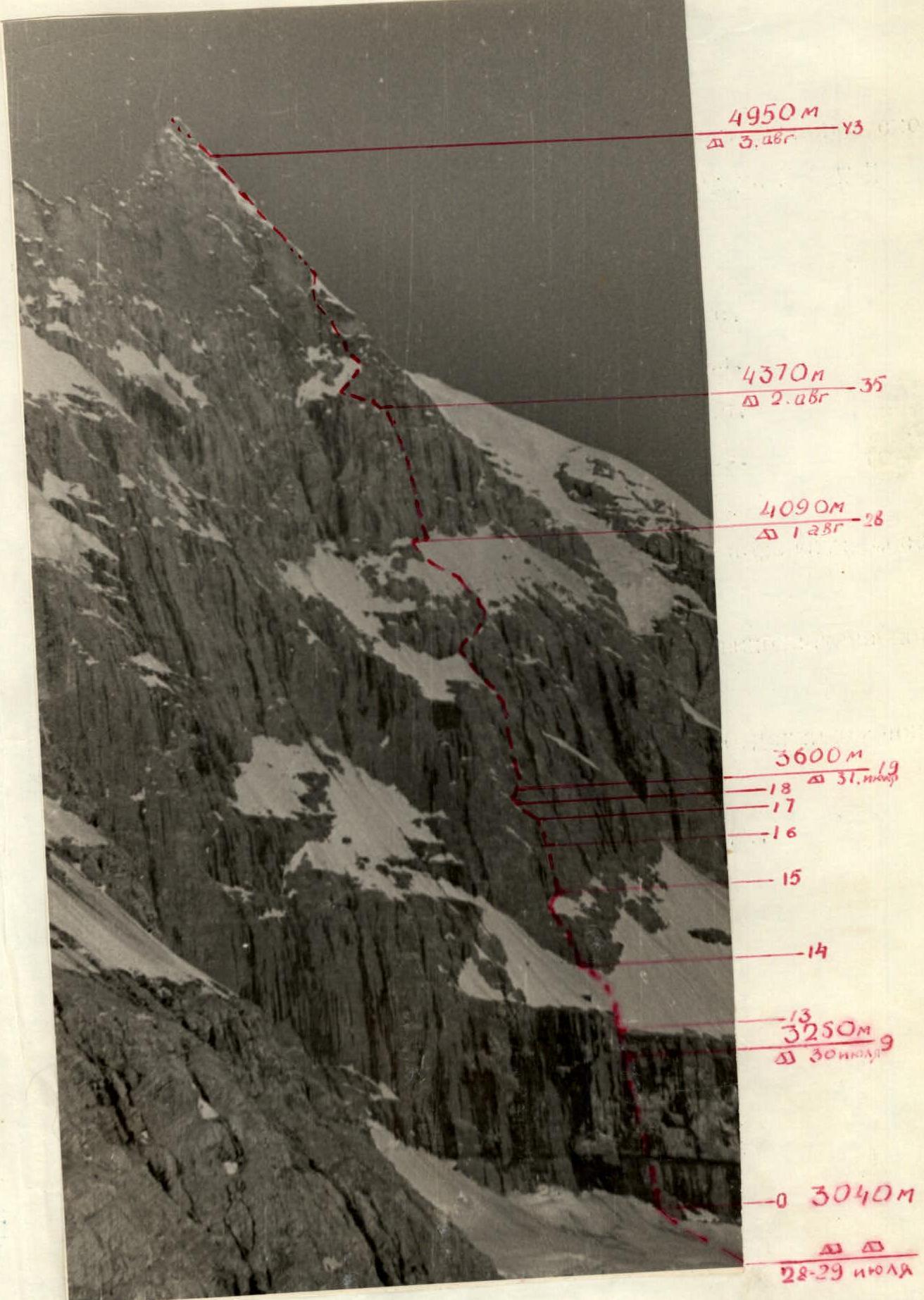
- ASCENT ROUTE TO NORTH-NORTHEAST FACE OF MARIA PEAK
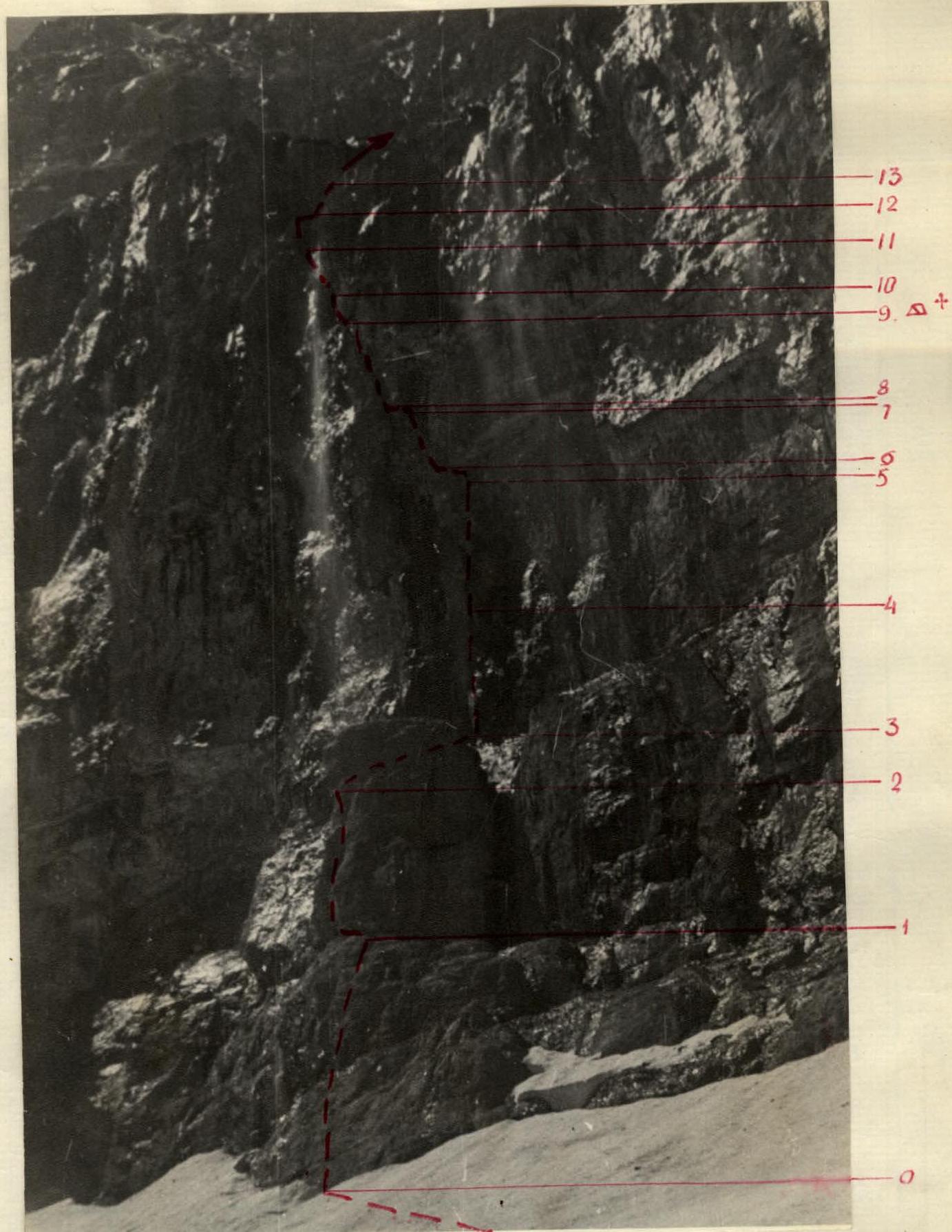
4. First Belt of Maria Peak
The relief is hard to see due to the water curtain constantly hanging in front of the wall, but this gives an idea of the steepness.
III. Information about the route known before the ascent
Maria massif is located in the center of the Kulikalon wall and includes three peaks: Main (~5000 m), Uzlovaya (4870 m), and Western (4700 m). To the east of the Main peak is the highest point of the Kulikalon wall, Mirali peak (5150 m). To the west, the ridge drops significantly, but there are no easy paths to climb it. To the north of Uzlovaya, a short ridge branches off, with two peaks: Tashkentets and Flyorit. To the northwest of Maria lies Kulikalon lake, and to the north-east lies Dushakha lake.
The northern wall on Western Maria is of great sporting interest. It's a pure vertical wall of 80–90° extending about 800–900 m. The Main peak has an elevation of around 5000 m above sea level and faces north-northeast with a triangular wall. According to N.V. Poganuzzi, the height at the base of the wall is 3040 m. To the left and right of the wall are hanging glaciers. The wall consists of three distinct rock belts separated by two horizontal snow-ice ledges (50–100 m).
The first belt is composed of relatively hard rocks (marble). Its height ranges from 200 to 300 m. The entire belt overhangs so that water falling from above almost nowhere touches the rocks. The belt is abundant with cornices, sometimes reaching 15–20 m. We chose the shortest and driest ascent route.
The second belt is a fairly steep wall made of fragile limestone. The average steepness is around 70–75°. It extends about 900 m, with about 250 m being very challenging to climb. The rock is soft.
The third belt is 85–90° steep. Climbing is easier due to the hard rocks. It extends about 500 m. The pre-summit tower is made of red limestone, so soft that it sometimes crumbles in hands. Because of this, the water flowing under it is colored red. To the north, the tower faces a vertical wall about 400–500 m long. Organizing reliable protection in such rock is very challenging, so we bypassed this tower to the right via ice and rock walls. The final 40 m to the summit is not difficult.
During the observation period, no rockfall was noticed on the route.

5. Middle Part of the Wall and Pre-summit Tower of Maria Peak
July 27, 1968
Today we leave the base camp at Dushakha lake. Dushakha translates to "lake of two kings" or more accurately "lake of two shahs" since it lies at the foot of two peaks bearing female names, Mirali and Maria. The peaks face us with two-kilometer walls connected by a necklace of seracs. But it's time to stop with the lyrical descriptions.
Leshya Troshchinenko is leaving with us to observe. In two days, S.B. Tikhvinsky will join him after finishing treating German climbers at a nearby base camp.
We are seen off by several people who have just returned from a traverse. We slowly make our way to the moraine, chatting. Our tent, set up during our observation of the wall, is now in sight. We say our goodbyes, receive final advice and wishes for good weather.
Within an hour, we're at the tent. We unpack our backpacks, take it easy, and rest, as we'll be sleeping here for two nights and need to be well-rested for the next week.
Leshya brought an unplanned product, and we have a "ground-level" dinner. After dinner, a short tech council decides that tomorrow, Sasha Zayonchkovsky and I, Zhitenev, will go for processing. Our task is to reach the source of the waterfall. To do this, we need to pass a bastion and two cornices. We pack our gear, and there's no more discussion; we go to sleep.
July 28, 1968 – Day One
At 5 am, we're woken up, fed, and pushed out of the tent, while the others go back to sleep. We have no choice but to start. We head out, first across the scree, then across a snowfield. The rock bastion appears immediately, without any transition, as a wall. In the pre-dawn twilight, the rocks are slick with a thin layer of ice, but the water hasn't frozen everywhere.
The first 40 m is steep but doesn't pose significant difficulties; there are good handholds. However, our hands are freezing.
A small ledge leads to a narrow vertical chimney (section R1–R2), with water flowing down its walls. Trying to jam myself in, I get wet. It's too narrow; my body only fits halfway. We decide to abandon this approach and hang ladders instead.
The left wall of the chimney gradually turns into an outer corner. The corner ends with a wide ledge 15–20 m long, where the waterfall pours down from above. Huddled together, we dive into it and take shelter under the wall. It's 9 am; processing the bastion took over three hours.
We take a break, look around, and notice an internal corner above us with a wide crack at the junction of the walls (fig. 7). Both walls overhang, although the right one less so. All handholds are "upside down." To save on pitons, Sasha Zayonchkovsky stands on my shoulders and hammers in the first piton for this rope length, followed by the standard procedure: carabiner, rope, ladder, self-belay, and so on, for 25 m.
It gets a bit easier afterward; the corner turns into a vertical wall, making it possible to climb a bit. However, we soon face another complication: we run out of wide pitons. Sasha hammers in a bolt, secures the rope to it, and I climb up on it to drill in more pitons. They say the 13th is an unlucky number, and although I don't believe in it, on the 13th piton, I break my hammer. I descend back with a dozen pieces of hardware to continue the belay for the first climber. On challenging sections, our lead climber always pulls a spare rope attached to their belt. Sasha uses this rope to hammer in more pitons.
Another dozen meters, and the rope ends. We have the "ceiling" of the first cornice above us. It's 2 pm, and the sun is already hidden behind the mountain. It's getting cool.
A small outcropping under the cornice allows us to switch lead climbers. To overcome the cornice, we have to hammer in two bolt pitons.
I exit from under the cornice on ladders onto a small ledge (fig. 8). While hammering in a piton, half of the ledge breaks off and falls down, nowhere touching the rocks. From the ledge, a steep step leads up to the left. Handholds are small, and there are almost no cracks. I slowly make my way along it with side steps, trying to "stick" to the wall. Finally, I manage to jam my knee into a small outcropping and catch my breath. Sasha shouts from below that it's time to head down. Indeed, it's 5 pm. I hammer in a blade piton, test it, and then hammer in a bolt. We need to descend, after all! I look ahead, thinking we'll make it. I secure the rope and start backing down on a Prusik knot.
By 8 pm, we're drinking tea, with our feet in a bag and wearing dry down jackets.
July 29, 1968 – Day Two
Today, Kirill Pavlenko leads the way. His task is to reach the source of the waterfall and, if possible, attempt to pass it; if not, to find a suitable spot for the night.
With Yura Gorenchuk, they depart at 5 am, carrying only their personal gear. Our pair, having slept for a couple more hours, dismantles the bivouac. We leave behind sleeping bags, cups, and the second camera. I'm trying to throw away dry omelette and milk but face resistance.
No matter how light we pack, we still have 45–46 kg to haul up the wall.
At 9 am, we depart. The leader generously allows Leshya to carry his backpack for a bit. On the snowfield, we say our goodbyes. Leshya, with little hope, says, "Guys, take me with you to the mountain!" "Who will observe?" "Well, have an easy rucksack!" "Thanks," we say, shouldering our "abalaki" and starting to breathe heavily as we head towards the wall. Our pair's job today is backbreaking.
Sasha climbs up on the rope and, on command "Ukh!", starts pulling the backpacks. I go below, push, then return for the other.
Meanwhile, the first pair has already passed the ropes we hung yesterday and is continuing further. Kirill climbed up an internal corner another 10 m and took Yura up. Above them is the second large cornice. According to our observations, it needs to be bypassed on the left to reach the outer corner. This 15-meter traverse was the most challenging part of the day (section R7–R8).
After the traverse, we entered an outer corner, slightly overhanging, but with some handholds. The corner ended with a horizontal crack where a stone block lay. We cleared the step, creating a "bench" for three, with the fourth making a seat out of ice axes and foam.
There were no reliable cracks, so we hammered in two bolt pitons for safety. We pulled up the last backpack at 9 pm. We fired a green flare. Above us is the third cornice. Water falling from it passes three meters away, and to get a drink, we toss our helmet on a 40-meter rope far to the right and down.
Peck and Catch:
Four "pecks" and half a pot of food.
The ledge is as crowded as a train from Kuznechny on May 2nd, so we sit down, drink tea for a couple of hours. By midnight, having calmed down and covered ourselves with a tent, we try to doze off. It's interesting to imagine what the row of our eight tricornes looks like from below.
July 30, 1968 – Day Three
The low altitude of our bivouac makes itself felt in the morning. The waterfall hasn't stopped despite the cold night; ice has only formed on the rocks, sprinkled with frozen droplets and water dust. Gorenchuk is the first to get tired of shivering.
At 5 am, Yura volunteers to take a cold shower. There aren't many enthusiasts, and without much competition, he makes his first step towards the waterfall within half an hour, jingling his frozen gear.
The rope from the previous night is frozen stiff, and Yura takes a different one. He opens the carabiners with a hammer, threads the new rope through, and climbs, holding onto the icy rope like a handrail. However, the handrail ends, and he has to make a step from under the cornice into the cold shower. I'm not sure if he counted to three before doing so, but he made the step, first one, then another 30 or 40.
The challenging steps on the vertical wall, sometimes covered in ice, require hammering in pitons while water pours down one's face. Water everywhere – on the head, in boots, pockets, sleeves. Only the top of the head under the helmet stays dry.
Gorenchuk endures this for over an hour. Finally, we hear "I'm out!", and the rope freezes for half an hour. As it turns out later, he was warming his hands.
We pack our backpacks, leave a control cairn, and quickly follow. Fyodor goes last, pulling out pitons. It's a shame to leave them behind – they're titanium. Gorenchuk remarks, "I told you to stretch the cuffs!" Fyodor replies, "I didn't hear you."
On the platform we reach, it's paradise. There's plenty of space – we could even play table tennis. It's dry, and the sun is shining. It's already half past 10. We undress, hang our clothes on the rope, and sit down to breakfast.
At 11 am, Svet arrives under the wall, and we drop a bag of gear that we no longer need. It free-falls for a quarter kilometer before thudding onto the snowfield.
At noon, warmed up and dried off, we continue. Sasha Zayonchkovsky leads. After passing a simple 10-meter wall to the right, we reach the snow. There are rocky outcrops on the snow where we hammer in safety pitons. Then we reach the second belt. We climb up two rope lengths on fragile rocks until we reach a small snowfield. We traverse it to the right for half a rope length and enter a long internal corner ending in a smoothed marble "mirror." To exit the corner, we have to hang several ladders as the last six meters overhang. We drop our backpacks again.
Sasha, like a fly, climbs up the "mirror": first up (15 m), then left (10 m), and up again (10 m) (section R16–R17).
The exit from the "mirror" is via a small cornice. Before catching his breath, Sasha clicks away with his "Smena" camera (photo 9). Fate is unfair to people; the group's constant photographer couldn't provide a photo of himself for the report.
For today, all the hard work is done. We need to traverse the ledge to the left to a wide internal corner and climb up it, slightly to the right. Here, in a wall niche, we spend a long time arranging our bivouac, trying not to ruin the mountain forget-me-nots seen on the cover. The bivouac is great – water, a roof overhead, and we can stretch out fully.
July 31, 1968 – Day Four
We sleep like marmots until 8:30 am. The sun wakes us up. The leader prepares breakfast and plans to go first today. Within an hour, we're on our way.
The exit to the ridge and along it into the internal corner is not difficult (section R20–R21). The corner has short wall sections and some night ice. It ends under an overhanging wall with huge icicles. The sun is getting hotter. Sometimes an icicle falls, breaking into pieces the size of half a brick. It's bad luck for anyone who doesn't quickly pull their head into their shoulders like a turtle.
From under the wall, there's a challenging exit to the right and up through a crack. Then the crack turns into a crevice. Fyodor leaves his backpack and switches to ladders. Seven meters – seven pitons. He peeks around the corner and finds a ledge. Great! Another 10 m of decent climbing up, and he's on a crumbling ridge.
Along the ridge for 50 m, we reach the snow. A snowy ridge (70 m) leads us under the wall to the start of a long ledge going left-up-right. The rock here resembles smoothed "ram's foreheads."
We quickly cross under the foot of a decent waterfall (section R24–R25). Another 15 m almost vertically, and we're on the ledge. We have lunch here.
After lunch, we make a few challenging steps and reach simple rocks that lead us through 100 m to the start of the second snow ledge. From here, we see the summit very close for the first time. We examine the options for climbing the third belt and choose the right one, as stones occasionally fly from the pre-summit to the left.
That day, we still had to climb about 100 m on snow and ice to reach the third belt, which we did in the next hour.
We were quite tired, so we didn't bother to carve out a large ice platform. We slept semi-reclined.
August 1, 1968 – Day Five
We woke up late. We had trouble lighting the stove – it turned out we were out of fuel. We immediately discarded the flask used to refuel the stove. Every gram counts. We had a peculiar breakfast: Instant coffee without sediment – 2.5 g, sugar – 4 pieces, a round of sausage 5 mm thick, a tablespoon of pressed caviar, a tablespoon of PKV mix (honey, walnuts, butter), two liver pâté, two tablespoons of crushed crackers.
Seven courses. Eat as much as you want.
On this bivouac, we left a control cairn. Gorenchuk, suffering from stomach issues, ate everything before the others and is itching to go. Today, he leads without a backpack – it's too steep. While we packed our gear, Yura broke through to the right on a traverse for 30 m and climbed into an outcropping. You could see 20 meters up because the base of the last belt slightly overhangs. It's good we examined the ascent route yesterday; otherwise, we might have climbed into who-knows-what.
We advise Gorenchuk to wear galoshes. He doesn't want to. We waste some time on this. Eventually, he has to wear them – the wall forces him to.
The route on the third belt is very monotonous but extremely challenging. It's a vertical wall of 400–450 m. So, I won't describe it and instead provide the records from the route for that day.
August 1
| Rope No. | Direction | Number of Pitons |
|---|---|---|
| 30 | 9:00 – Traverse right | 3 |
| 31 | Up, first without backpack | 11 |
| 32 | Left, up, cornice, ledge, lunch | 8 |
| 33 | Right up | 5 |
| 34 | Straight | 7 |
| 35 | Straight onto ledge. No ledge found | 8 + 1 ice |
| 36 | Left up into internal corner. Bivouac at 21:30 | 7 |
That day, I gave a flare signal while still on the ladders. Within half an hour, we set up a tent on a good platform under the wall. We warmed up some soup. We don't boil tea to save fuel.
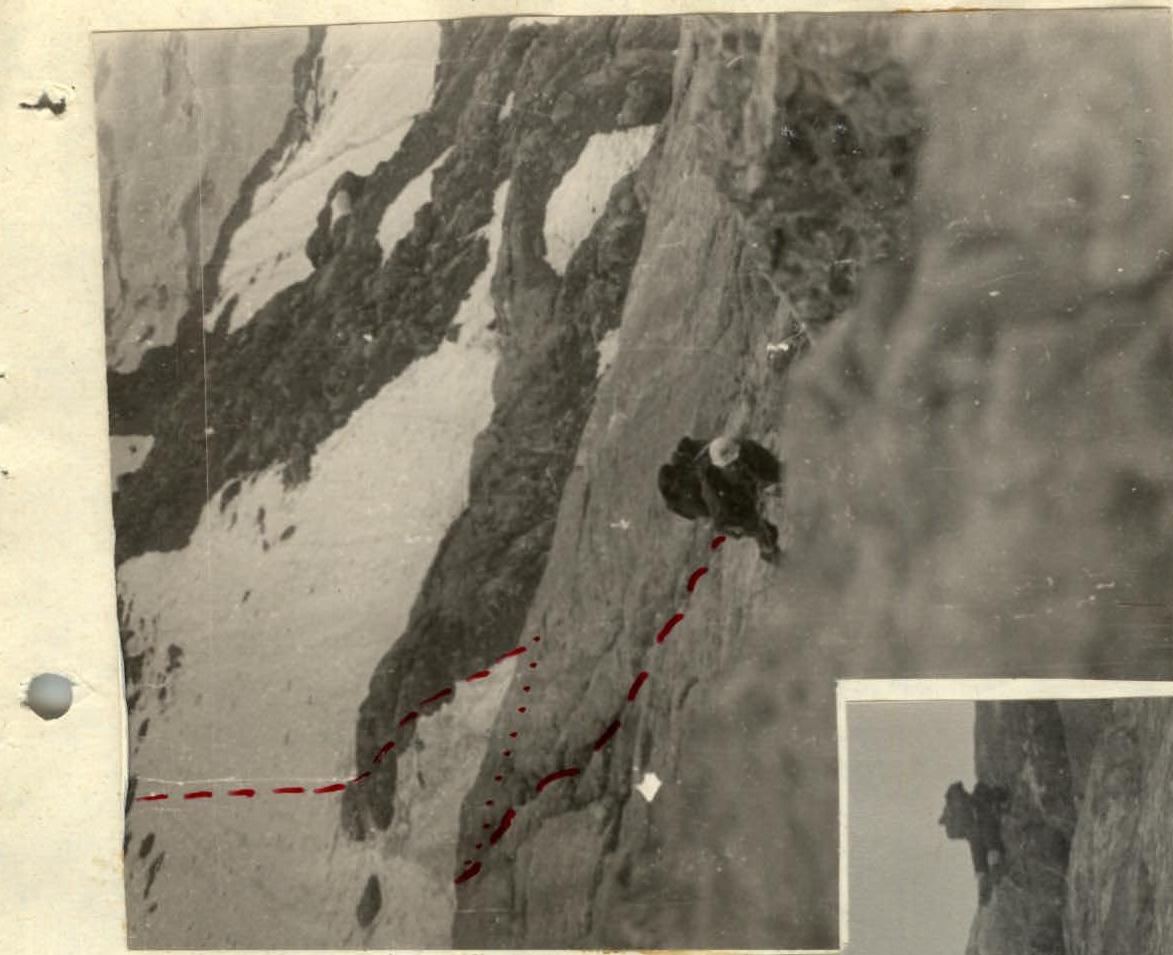
Kirill Pavlenko hammering pitons under a cornice on the second rope of the third belt.
Characteristic steepness of the third belt.
August 2, 1968 – Day Six
We woke up early today. The anticipation of the nearing summit drove us upward. Zayonchkovsky chooses the route today. There's supposed to be a ridge on the third belt somewhere to the left. Sasha traverses a rope to the left and up, switching between "ram's foreheads" and reaching the ridge. Now we need to move right along it to avoid being hit by stones from the pre-summit tower. We quickly pass two ropes on crumbling rocks and approach a concave "mirror" of red-brown color. The rocks here are of a different character – cracked "tiles" that can be easily pulled out by hand. It's very hard to find a reliable spot for protection. After discussing, we decide to bypass the pre-summit to the right along the ridge.
The exit to the ridge was challenging and complex. It took three hours to climb the "mirror" due to three overhanging steps. At 1 pm, we took a break under a large stone cornice. After passing under it on a steep ledge with ice, we entered a chimney that resembled a groove with ice on the walls.
The climbing was extremely difficult. It was tight, and there was no room to swing an ice axe. There were no places to hammer in a rock piton – everything was covered in ice. Tricornes were slipping. Those climbing on the rope used ladders and jumar ascenders as if on a pure vertical.
After the chimney, we turn right to bypass the green "boulder" and, after passing two 3-meter ice walls, exit onto a snowy ridge onto a slope.
There's no ridge!! Instead, there's a very steep (65°) and long ice slope with small rocky outcrops. Sasha chose a path through these outcrops. Ice flying from under his ice axe hits our helmets. When we climbed on the rocky islands, we had to hammer in one bolt piton for safety as there were no suitable cracks, and the rope wasn't long enough to reach the ice. We suggest Sasha switch; he refuses. He continues to cut steps. He climbed 250 m, hammering in 21 ice pitons. We're almost at the summit. But we won't make it today... We're still a couple of ropes away from the unpleasant "shingle."
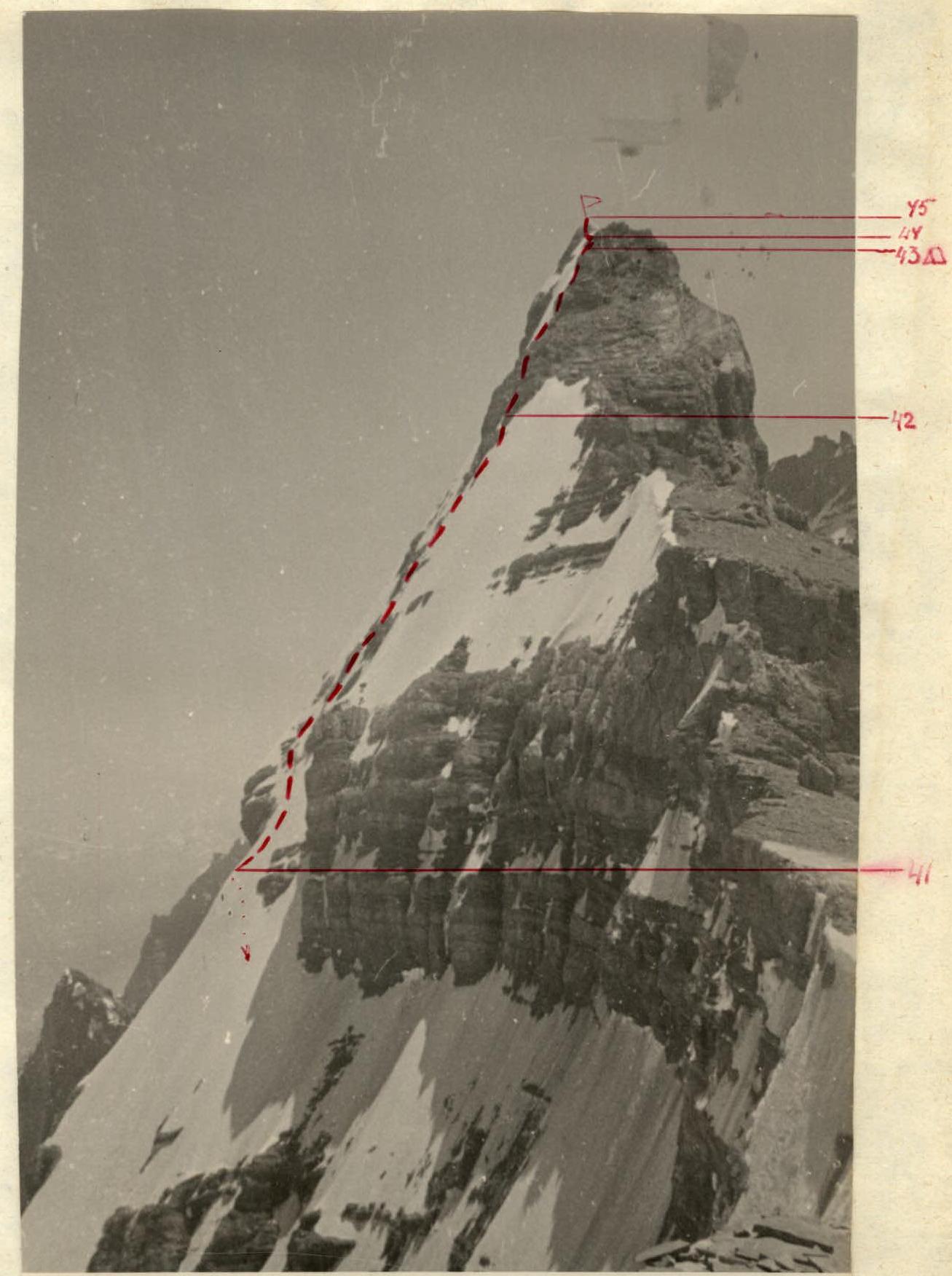
- Bypassing the Summit Tower. Exiting onto the ridge and then the summit.
After further climbing on the "shingle," where one careless move could trigger a rockfall, we're on the ridge. It's done!
We set up the tent in a depression to minimize wind exposure. Our last flare goes up just above the summit.
August 3, 1968 – Day Seven
The night was cold and windy. The altitude was starting to make itself felt. We got up early and headed to the summit without breakfast. The sun was invitingly warm there. After climbing along the ridge to the summit tower, we began our ascent. The summit tower, due to its crumbling state, was passed without much difficulty. At 9:30 am, the entire group gathered at the summit cairn.
From an aluminum capsule, we retrieved a note from a group of German climbers who ascended Maria peak via the northern rib, led by a doctor.
The ascent is accomplished! The goal we've been preparing for a year is reached! We leave a note in the cairn and a dedication to Viktor Egorov, on the anniversary of his tragic death, for which this ascent was undertaken. This dedication is not just from us but also from all participants of the Leningrad "Burevestnik" gathering.
At 10 am, we start descending via the western peak. There's a small surprise waiting for us in the cairn there – two chocolate bars and a can of meat. The descent follows the northern ridge to the Temir-Tau pass and takes eleven hours. The descent required four sports descents on ice and nine times we had to pull the rope on rocks.
We arrive at the base camp in the dark. We're greeted ceremoniously, like novices – with bonfires on the trail and torches. Despite the camp running out of food, we're fed to our heart's content. They even managed to find cigarettes! We were deeply touched.
The last day of the ascent has ended.
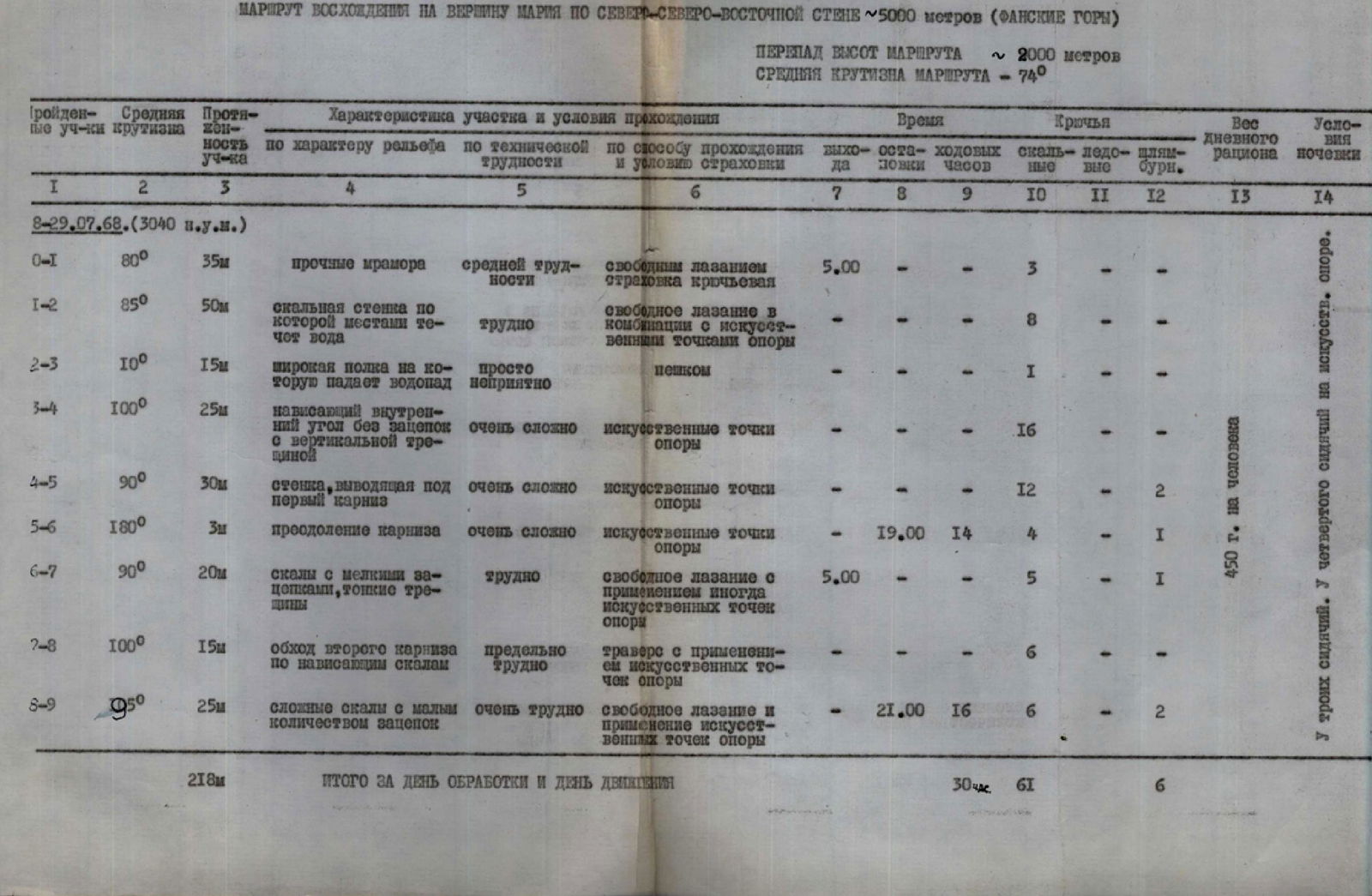
TABLE OF MAIN CHARACTERISTICS OF THE ROUTE BY SECTIONS
ASCENT ROUTE TO MARIA PEAK VIA NORTH-NORTHEAST FACE ~5000 m (FAN MOUNTAINS)
ELEVATION GAIN ~2000 m AVERAGE STEEPNESS OF THE ROUTE ~74°
| Sections | Average Steepness | Section Length | Section Characteristics and Passage Conditions by Relief Character | Technical Difficulty | Passage Method and Belay Conditions | Departure Time | Stop Time | Working Hours | Rock Pitons | Ice Pitons | Bolt Pitons | Daily Ration Weight | Bivouac Conditions |
|---|---|---|---|---|---|---|---|---|---|---|---|---|---|
| July 28-29, 1968 (3040 m a.s.l.) | |||||||||||||
| R0–R1 | 80° | 35 m | Solid marbles | Medium difficulty | Free climbing, piton belay | 5:00 | – | 3 | – | – | – | 450 g per person | Three sitting, one on artificial support. |
| R1–R2 | 85° | 50 m | Rock wall with water flowing | Difficult | Free climbing combined with artificial holds | – | – | 8 | – | – | – | ||
| R2–R3 | 10° | 15 m | Wide ledge where the waterfall pours | Easy | Walking | – | – | 1 | – | – | – | ||
| R3–R4 | 100° | 25 m | Overhanging internal corner without handholds, with a vertical crack | Very difficult | Artificial holds | – | – | 16 | – | – | – | ||
| R4–R5 | 90° | 30 m | Wall leading under the first cornice | Very difficult | Artificial holds | – | – | 12 | – | – | 2 | ||
| R5–R6 | 180° | 3 m | Overcoming the cornice | Very difficult | Artificial holds | 19:00 | 14 | 4 | – | – | 1 | ||
| R6–R7 | 90° | 20 m | Rocks with small handholds, thin cracks | Difficult | Free climbing with occasional artificial holds | 5:00 | – | 5 | – | – | 1 | ||
| R7–R8 | 100° | 15 m | Bypassing the second cornice on overhanging rocks | Extremely difficult | Traverse with artificial holds | – | – | 6 | – | – | – | ||
| R8–R9 | 95° | 25 m | Challenging rocks with few handholds | Very difficult | Free climbing and artificial holds | – | 21:00 | 16 | 6 | – | 2 | ||
| 218 m | TOTAL FOR THE DAY OF PROCESSING AND MOVEMENT | 30 | 61 | – | 6 |
| Sections | Average Steepness | Section Length | Section Characteristics and Passage Conditions by Relief Character | Technical Difficulty | Passage Method and Belay Conditions | Departure Time | Stop Time | Working Hours | Rock Pitons | Ice Pitons | Bolt Pitons | Daily Ration Weight | Bivouac Conditions |
|---|---|---|---|---|---|---|---|---|---|---|---|---|---|
| July 30, 1968 (3245 m a.s.l.) | |||||||||||||
| R9–R10 | 95° | 10 m | Rock wall with a small cornice | Very difficult | Free climbing, 2 ladders hung | 5:30 | – | 4 | – | – | – | ||
| R10–R11 | 90° | 20 m | Waterfall on the wall | Extremely difficult | Free climbing | – | – | 4 | – | – | – | ||
| R11–R12 | 80° | 15 m | Rock wall | Difficult | Free climbing | – | 10:30 | 2 | – | 1 | – | ||
| Backpacks of all participants were pulled up to this point. From here, about 30 kg of gear was dropped to observers. | |||||||||||||
| R12–R13 | 70° | 10 m | Broken rocks | Easy | Free climbing | 12:00 | – | 1 | – | – | – | ||
| R13–R14 | 40° | 60 m | Snow | Easy | Alternating, through ice axe | – | – | 3 | – | – | – | ||
| R14–R15 | 70° | 80 m | Fragile rocks | Medium difficulty | Free climbing, piton belay | – | – | 6 | – | – | – | ||
| R15–R16 | 85° | 70 m | Internal corner with loose rocks | Difficult | Free climbing, occasional artificial holds | – | – | 16 | – | – | – | ||
| R16–R17 | 90° | 35 m | Smoothed "mirror" with overhanging sections | Very difficult | Artificial holds, pulling up backpacks | – | – | 15 | – | – | – | ||
| R17–R18 | 75° | 45 m | Traverse onto a ledge to the left | Medium difficulty | Free climbing | – | – | 3 | – | – | – | ||
| R18–R19 | 60° | 40 m | Internal corner ending in a niche | Medium difficulty | Free climbing | – | 20:30 | 15 | 2 | – | – | 400 g per person | Ledge, good bivouac. |
| 385 m | TOTAL FOR THE THIRD DAY | 15 | 56 | 1 | – |
| Sections | Average Steepness | Section Length | Section Characteristics and Passage Conditions by Relief Character | Technical Difficulty | Passage Method and Belay Conditions | Departure Time | Stop Time | Working Hours | Rock Pitons | Ice Pitons | Bolt Pitons | Daily Ration Weight | Bivouac Conditions |
|---|---|---|---|---|---|---|---|---|---|---|---|---|---|
| July 31, 1968 (3605 m a.s.l.) | |||||||||||||
| R19–R20 | 70° | 45 m | Climbing onto the ridge | Medium difficulty | Free climbing | 8:30 | – | 2 | – | – | – | ||
| R20–R21 | 80° | 80 m | Internal corner with ice | Above medium difficulty | Free climbing | – | – | 6 | – | – | – | ||
| R21–R22 | 90° | 35 m | Traverse right on a horizontal crack on a smooth wall | Very difficult | Free climbing, artificial holds, first without backpack | – | – | 11 | – | – | – | ||
| R22–R23 | 70° | 50 m | Crushed rock ridge | Medium difficulty | Free climbing | – | – | 2 | – | – | – | ||
| R23–R24 | 40° | 70 m | Snow | Easy | Alternating, through ice axe | – | – | – | – | – | – | ||
| R24–R25 | 80° | 80 m | Walls with smoothed "ram's foreheads," traverse of a waterfall | Difficult | Free climbing, piton belay | – | – | 11 | – | – | – | ||
| R25–R26 | 65° | 100 m | Crushed rock ridge with slabs | Medium difficulty | Free climbing | – | – | 5 | – | – | – | ||
| R26–R27 | 45° | 50 m | Snow and ice | Medium difficulty | Cutting steps, through ice axe and pitons | – | – | 1 | 2 | – | – | ||
| R27–R28 | 50° | 45 m | Ice and rock walls, approach to the third belt | Above medium difficulty | Free climbing, cutting steps | – | 20:00 | 11 h 30 min | 4 | 1 | – | 400 g per person | Bivouac on carved ice platform, semi-reclined under an overhanging wall. |
| 555 m | TOTAL FOR THE FOURTH DAY | 11 h 30 min | 42 |