

ASCENT DOCUMENT
- Rock climbing category
- Pamir-Alay, Hissar Range, Tagrich valley
- Peak "4200", via the Southeast wall
- Proposed category 5B, first ascent
- Route elevation gain: 650 m, wall section: 540 m Route length: 775 m, wall section: 565 m. Length of 5–6 category sections: 485 m (6 category – 215 m). Average steepness of the wall section: 83°
- Pitons driven:
| Rock pitons | Bolt pitons | Nuts |
|---|---|---|
| 14 | 2/1 | 102/1 |
- Climbing hours: 23, days: 3
- Overnight on a ledge, semi-reclining, separate, without a tent
- Leader: Bogdanov Boris Borisovich, Candidate for Master of Sports
Team members:
- Antonov Sergey Vasilievich, Candidate for Master of Sports
- Zabolotnykh Andrey Vladimirovich, Candidate for Master of Sports
- Men'shenin Sergey Leonidovich, Candidate for Master of Sports
- Coach: Arefieva Rufina Grigorievna, Master of Sports
- Approach to the route: August 6, 1988 Summit: August 8, 1988 Return: August 8, 1988
- Organization: Alpine club named after R.V. Khokhlov
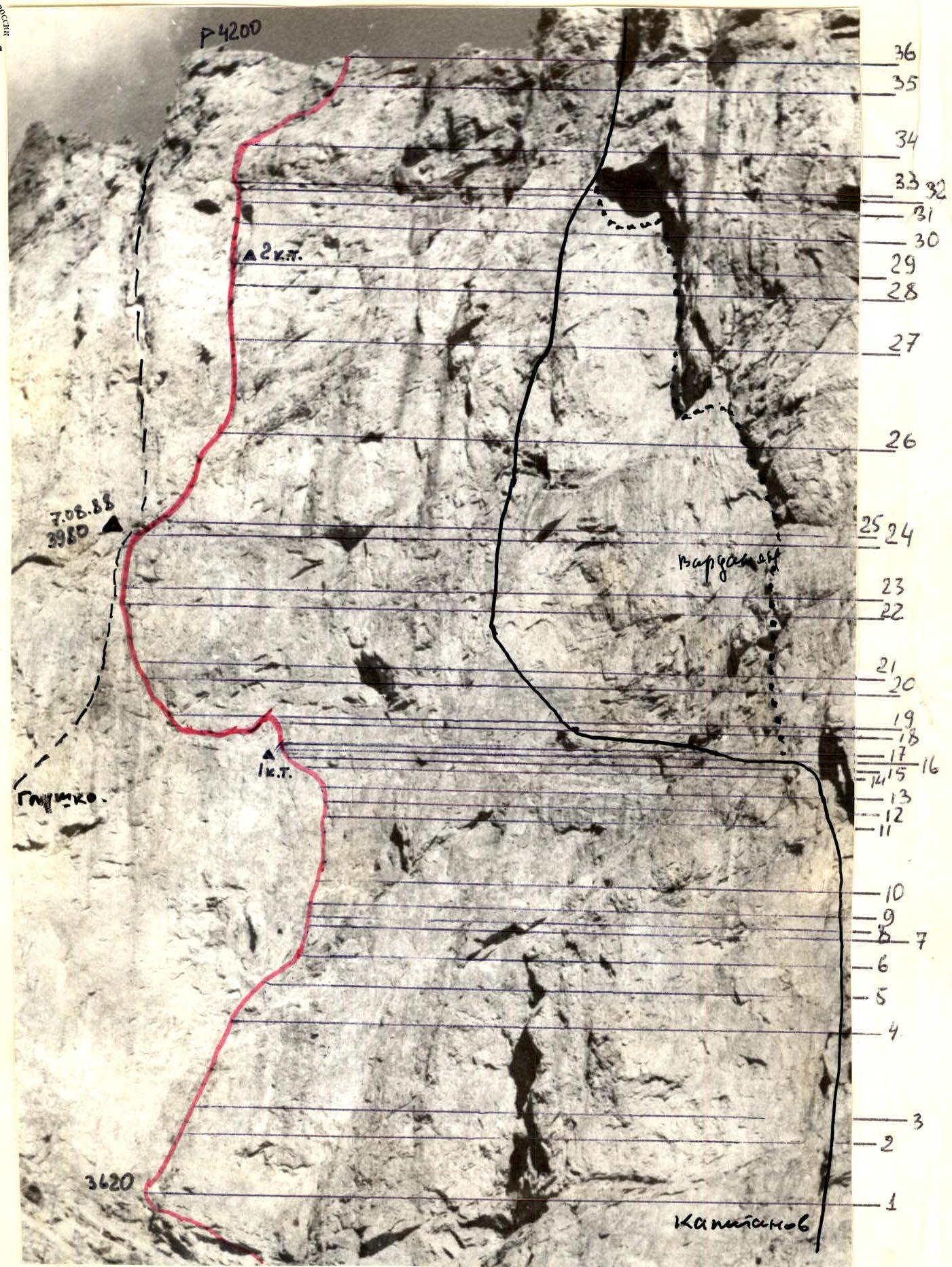
Taken on August 3, 1988, at 11:00, shooting point F1, Helios-44-2 lens, f=58 mm. Distance 1 km, height 3430 m.
- team member
- team member Glushko
- team member Kapitanova
- team member Vardanyan
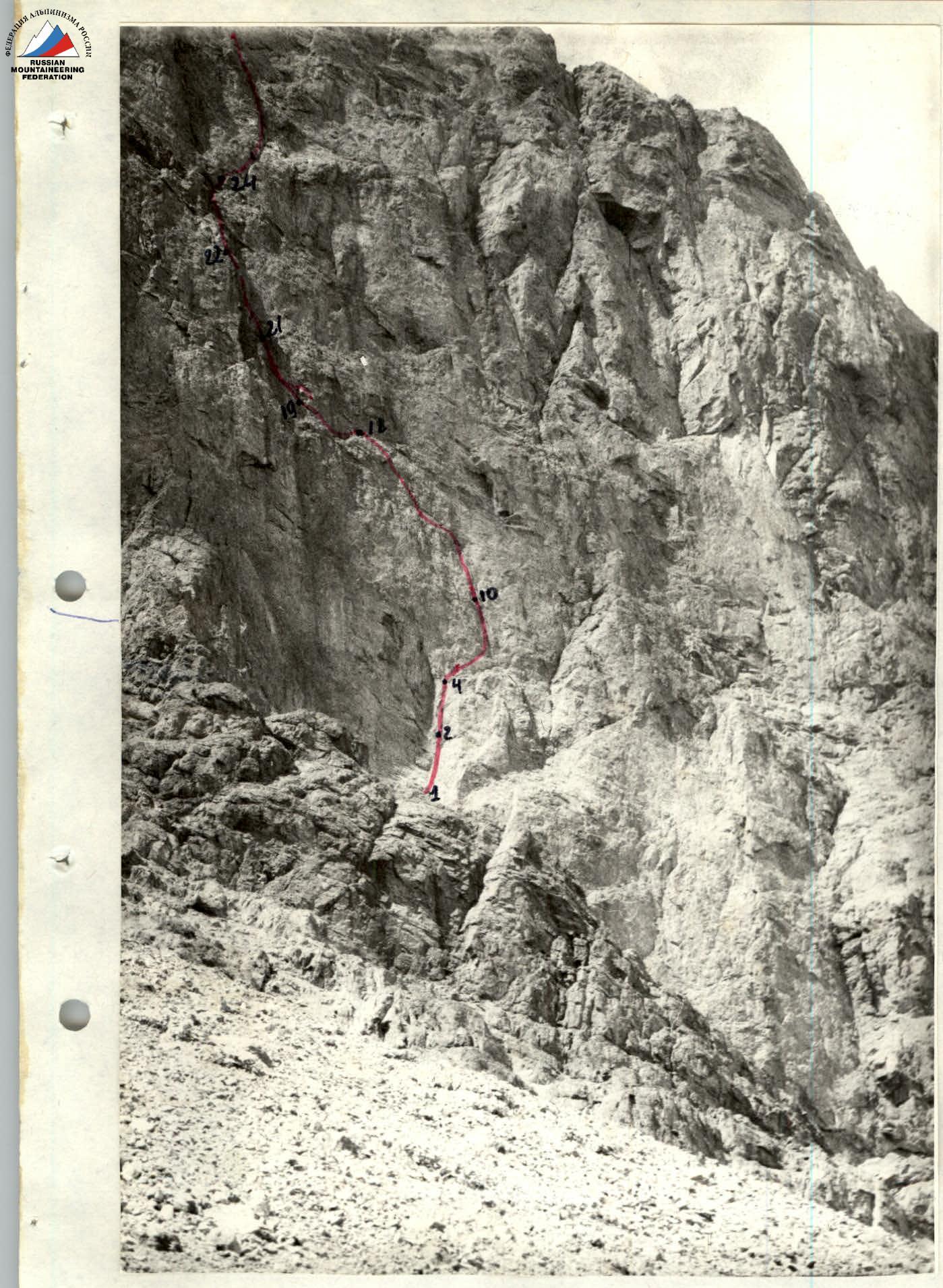
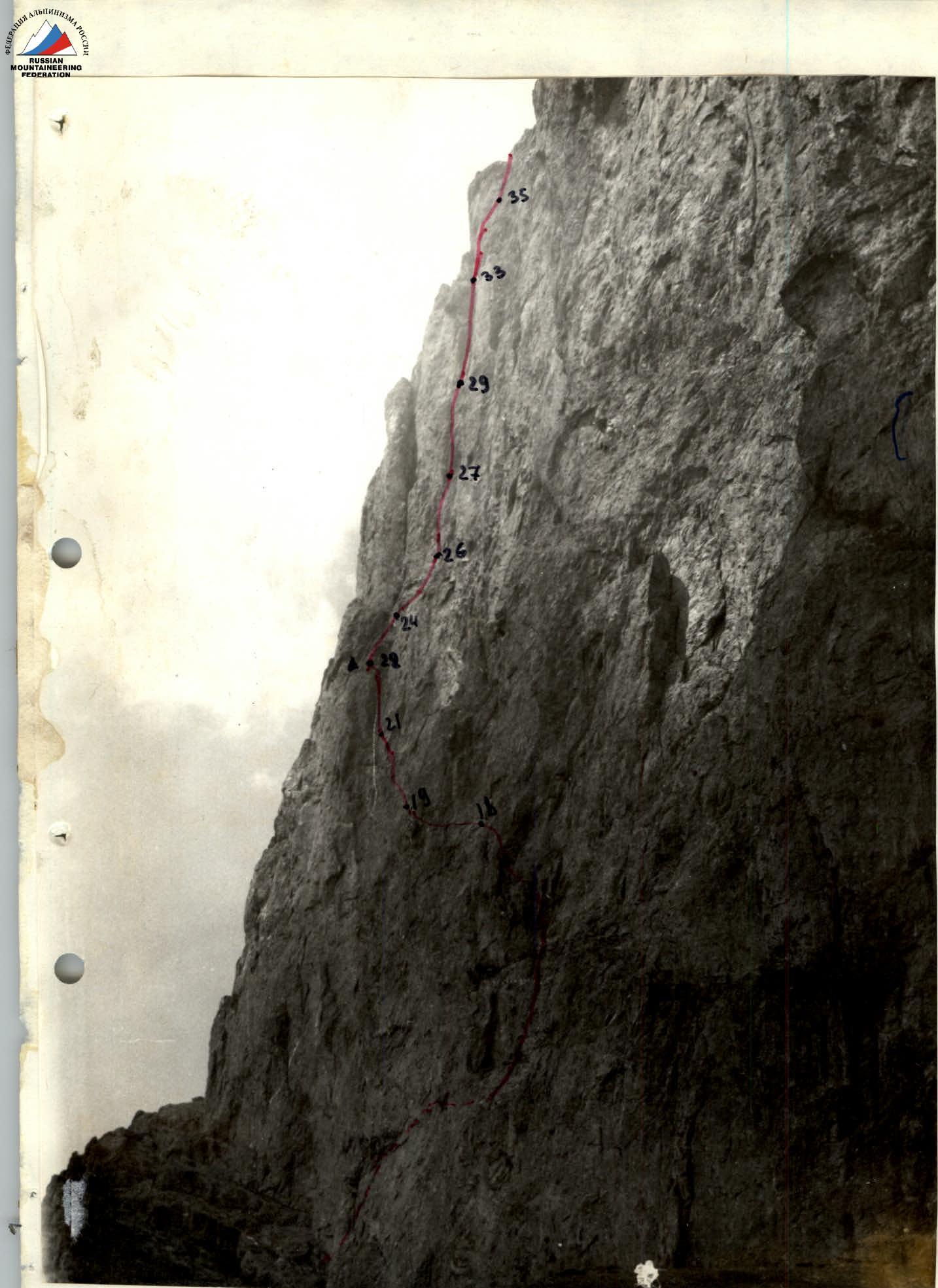
Photo 2. Wall profile from the right. Taken on August 3, 1988, at 15:00, shooting point F2, Helios-44-2 lens, f=58 mm. Distance 0.5 km, height 3500 m.
Photo 3. Wall profile from the left. Taken on August 3, 1988, at 15:30, shooting point F3, Helios-44-2 lens, f=58 mm. Distance 0.5 km, height 3500 m.
TACTICAL ACTIONS OF THE TEAM
The route was completed by the team without deviations from the tactical plan, despite bad weather at the end of the first climbing day. The movement was organized as follows:
- August 6 — the Menshenin—Zabolotnykh team processed sections R2–R10. Climbing was difficult due to the poor microrelief. The pair descended to the rescuers' camp for the night.
- August 7 — they left the camp under the wall at 6 am. At 7:00, they began moving along the route. After passing the processed section, Bogdanov went ahead. The team moved in the following order: Bogdanov—Antonov—Menshenin—Zabolotnykh. This part of the route is a steep, poorly articulated wall with poor microrelief. The rock crumbles, and holds are unreliable. Climbing is very difficult both physically and psychologically, especially sections R10–R11 and R15–R18. After section R17–R18, Bogdanov was replaced by Antonov. Further, the route consists of a series of internal corners and chimneys. The microrelief is still poor, the cracks are filled with earth and grass. Climbing is tense, with no place to relax. Additional difficulties were introduced by bad weather (rain, snow grains). The rocks became wet, making climbing extremely complicated. They also had to wait out snow charges. Under such conditions, they passed the end of section R21–R22 and sections R22–R24 (up to the overnight stop). It made no sense to stop and wait out the bad weather since it was unclear when it would end, and there was only one rope length left to the overnight stop. They reached the overnight stop by 20:00.
The overnight stop was organized on a system of narrow, inclined ledges. Above is an overhanging rock, so the overnight stop is safe from rockfall. There was no place to set up a tent, so everyone arranged themselves as they could. The overnight stop was inconvenient, semi-reclining, with participants hanging on their self-belay devices. In case of nighttime bad weather, each had a plastic bag.
August 8 — overnight, the rocks dried, and climbing conditions returned to normal.
Movement order: Zabolotnykh—Menshenin—Bogdanov—Antonov.
The terrain's character did not change: again internal corners, chimneys, poor microrelief. It was very steep throughout. It was anticipated that problems would be encountered on sections R26–R27 and R29–R33. This proved to be the case. Section R26–R27 is a narrow, vertical chimney with a plug. Climbing is almost entirely in a stem position. The plug was passed with free climbing. "Friends" were used for intermediate belay points. Section R29–R33 is a wide internal corner overlapped in the middle part by cornices. Only a hanging crack remains. Further, there is another internal corner with an overhang at the top. The rock is brittle, holds break off. The crack is passed with free climbing in a counter-pressure position. Throughout the internal corner, nuts and "friends" worked well. There were no further significant issues, and they reached the summit at 14:30. They began their descent at 14:30 and were back at the camp under the wall by 19:30.
On the entire wall section (sections R2–R36), the first climber worked on a double rope with a shock absorber, without a backpack. The rest moved along the rope on jumar with top-rope belay.
It should be noted that:
- the team's pace was determined solely by the first climber's speed,
- the other participants caught up very quickly,
- there were no delays in supplying the leader with equipment.
Belay points were organized on blocked nuts and pitons. The points were mostly inconvenient, standing or semi-hanging.
Characteristic of this ascent is that the route was completed almost exclusively with free climbing, with mainly nuts (nuts, "friends") used for protection, although the team had a wide range of pitons, including bolt pitons and artificial climbing aids. The route was completed at a good pace, without delays or hiccups. Each participant worked as the first climber, and this did not reduce the speed of the team's progress. All this indicates significant physical and technical reserves of the team.
During the ascent, the rescue team was under the wall, observing the entire process of the team's movement along the route. At any moment, they could have intervened to assist. Communication was organized so that the team could receive or transmit necessary information almost without delay. The rescue team consisted of Candidate Masters of Sports who had undertaken 5B–6 category ascents that season. Stable communication was maintained with the overnight stops under Zamin-Karor, where the AUSB "Varzob" team was located at the time, and through them, with the KSP TajSSR.
Communication schedule: main — 9:00, 13:00, 17:00, 21:00; additional — every half hour from 7:00 to 22:00 for 5 minutes.
The route was completed cleanly; 2 bolt pitons were left on belay points (smooth slabs without cracks), which do not affect the passage of the route.
Overall, the route turned out to be logical, even, and tense. In terms of steepness and complexity of the main sections, it is not inferior to the routes of Kapitanov (1982, USSR Championship, 1st place), Vardanyan, Glushko (1982, Central Asia Championship, 1st place) to this peak.
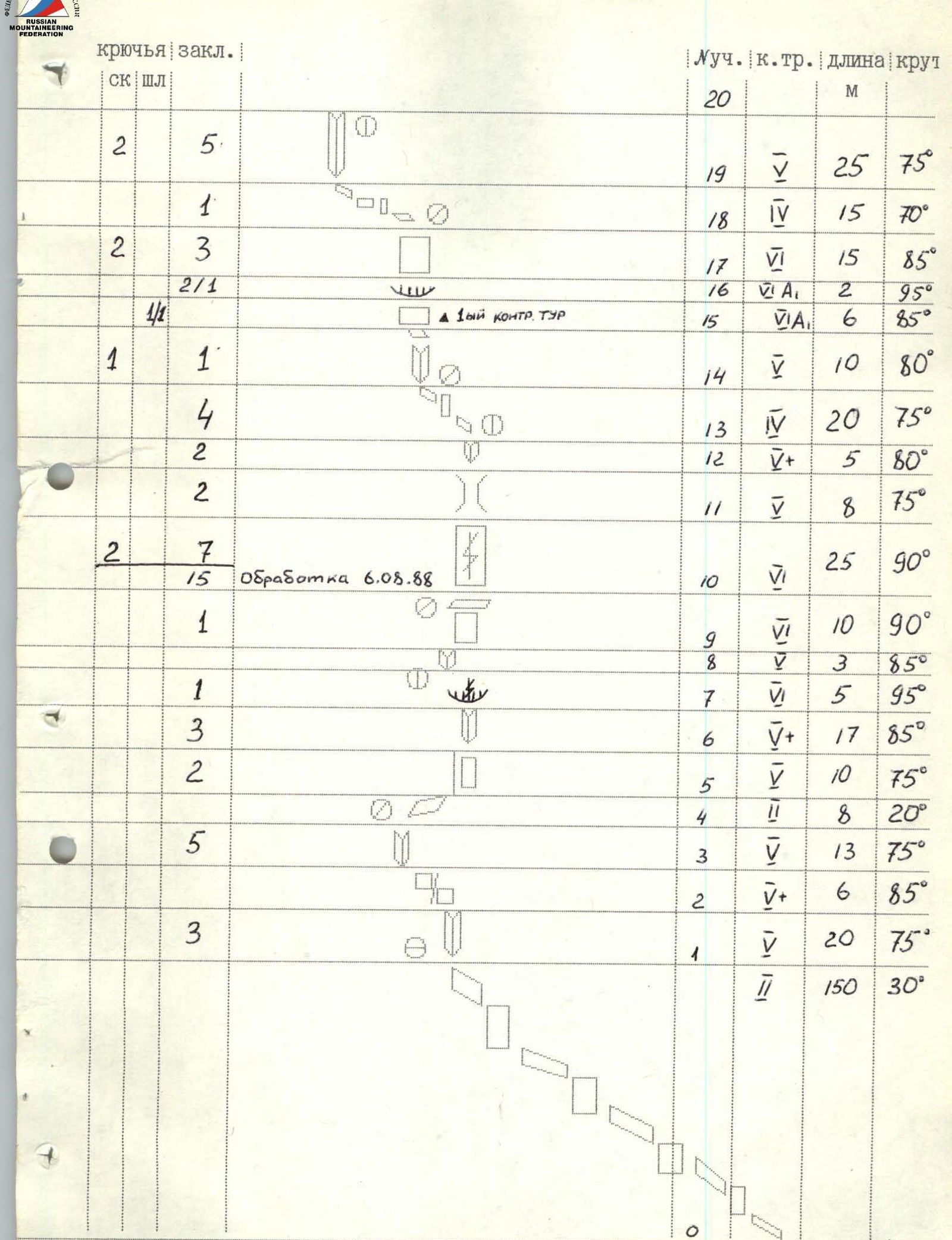
| Pitons (RP) | Pitons (Bolt) | Nuts | Section # | Cat. diff. | Length, m | Steepness, ° |
|---|---|---|---|---|---|---|
| 20 | ||||||
| 2 | 5 | 19 | 5 | 25 | 75 | |
| 1 | 18 | 4 | 15 | 70 | ||
| 2 | 3 | 17 | 6 | 15 | 85 | |
| 2/1 | 16 | 5 | 2 | 95 | ||
| 1/2 | 1st control point | |||||
| 15 | 6 | 6 | 85 | |||
| 1 | 1 | 14 | 4 | 10 | 80 | |
| 4 | 13 | 4 | 20 | 75 | ||
| 2 | 12 | 5 | 5 | 80 | ||
| 2 | 11 | 5 | 8 | 75 | ||
| 2 | 7 | 10 | 6 | 25 | 90 | |
| 15 | Processing on August 6, 1988 | |||||
| 1 | 9 | 6 | 10 | 90 | ||
| 8 | 5 | 3 | 85 | |||
| 1 | 7 | 6 | 5 | 95 | ||
| 3 | 6 | 5 | 17 | 85 | ||
| 2 | 5 | 5 | 10 | 75 | ||
| 0 | 4 | 2 | 8 | 20 | ||
| 5 | 3 | 5 | 13 | 75 | ||
| 2 | 2 | 5 | 6 | 85 | ||
| 3 | 1 | 5 | 20 | 75 | ||
| 0 | 2 | 150 | 30 |
| Pitons (RP) | Pitons (Bolt) | Nuts | Section # | Cat. diff. | Length, m | Steepness, ° |
|---|---|---|---|---|---|---|
| 37 | ||||||
| 36 | 4 | 60 | 40 | |||
| 1 | 4 | 35 | 6 | 25 | 90 | |
| 1 | 3 | 34 | 4 | 40 | 70 | |
| 1 | 3 | 33 | 5 | 15 | 80 | |
| 1 | 32 | 6 | 4 | 95 | ||
| 2 | 31 | 6 | 8 | 90 | ||
| 3 | 30 | 6 | 8 | 95 | ||
| 5 | 29 | 6 | 20 | 90 | ||
| 2nd control point | ||||||
| 1 | 2 | 28 | 6 | 10 | 95 | |
| 1 | 4 | 27 | 5 | 30 | 80 | |
| 1 | 10 | 26 | 6 | 40 | 90 | |
| 1 | 9 | 25 | 5 | 45 | 70–80 | |
| 7 | 2 | 41/1 | 24 | 4 | 5 | 75 |
| 6 | 23 | 5 | 25 | 80 | ||
| 1 | 22 | 5 | 5 | 75 | ||
| 6 | 21 | 6 | 35 | 85 | ||
| 20 | 6 | 5 | 90 |
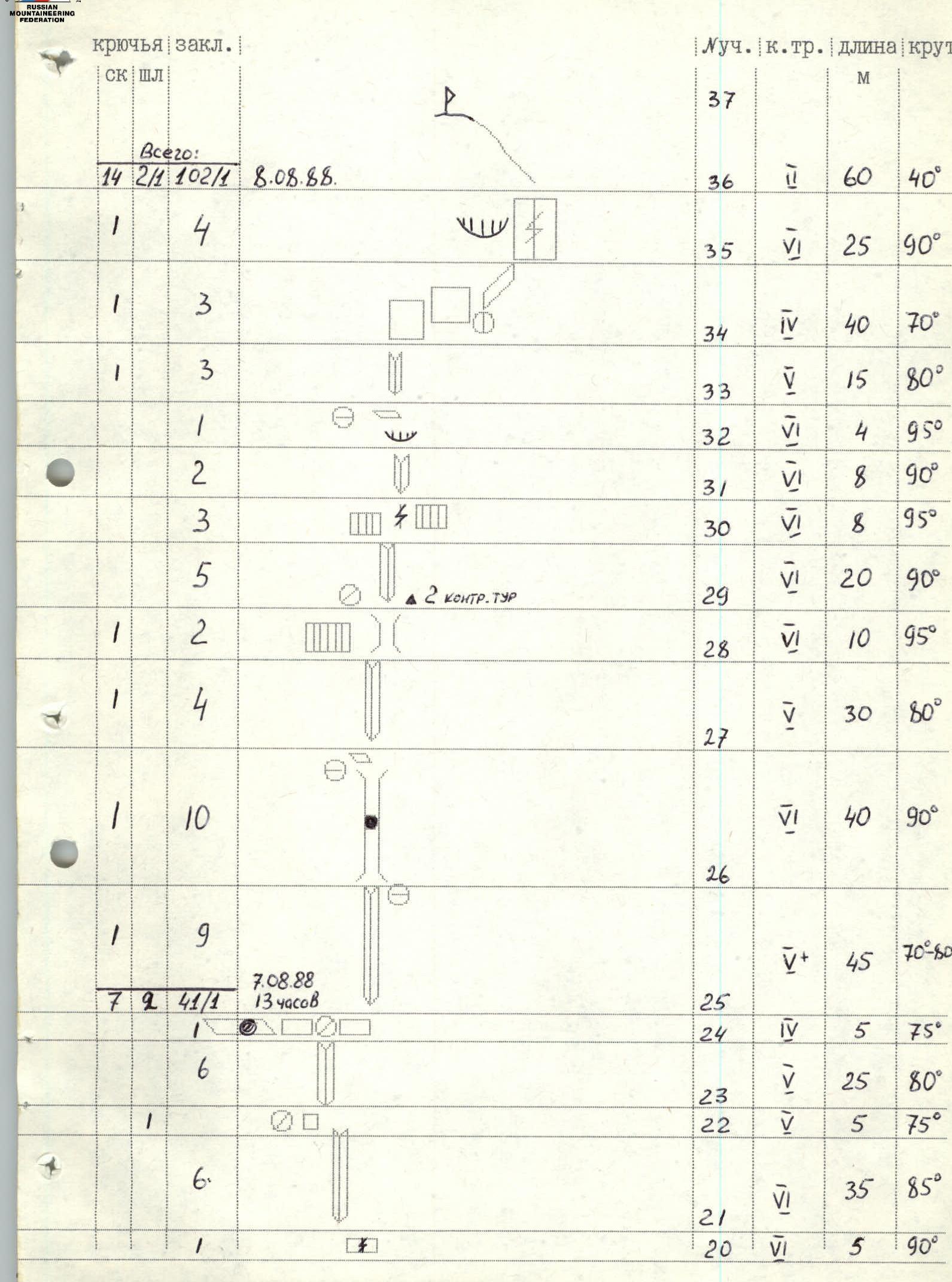
ROUTE DESCRIPTION BY SECTIONS
R0–R1 The route begins on the right side of the wall's "pedestal". Via a system of simple rock ledges, internal corners, and walls from right to left upwards to the start of the route.
R1–R4
- Internal corner, then along a monolithic wall with few small holds to the left into the next internal corner.
- Climbing is complicated, rocks are smooth, protection on nuts.
R4–R9
- Ledge, wall, ledge. Internal corner, in the middle part a plug. It is passed with free climbing. Climbing is very tense.
- Further, again along the internal corner to a small ledge.
R9–R11
- Two consecutive walls, steep, almost without cracks, with poorly defined relief. Very difficult climbing.
- Difficult to find places for intermediate belay points.
R11–R13
- Steep chimney with a crack overgrown with grass, then along the internal corner to a break.
R13–R15
- From the break along a steep, interrupted ledge to an internal corner.
- Along the internal corner left-upwards to a narrow ledge.
R15–R17
- Left-upwards along the ledge to a wall (1st control point).
- Upwards along crumbling rock under an overhang.
- The overhang is passed head-on via uncomfortable, unreliable holds.
- In one place, AIDs were used (a cable on a protrusion).
R17–R18
- Steep, smooth slabs with rare deep cracks.
- Along them, exit to a ledge under cornices.
- On the right part of the ledge, a sitting bivouac is possible.
R18–R20
- Left along the ledge to an internal corner.
- Internal corner with few holds, cracks filled with earth.
R20–R22
- From the upper part of the internal corner, exit right along margin 4 via a vertical slab with a crack to a small ledge (rock crumbles, holds are uncomfortable).
- From the left part of the ledge, a steep internal corner, cracks filled with earth, climbing is tense.
- In the upper part, exit from under the plug to the left onto a small ledge.
R22–R24
- Along a slab with few holds into an internal corner.
- Cracks filled with earth.
- The internal corner leads under an overhanging rock.
- To the left is a ledge, suitable for overnight stay.
- Overnight stop is semi-reclining; there's no place to set up a tent.
R24–R26
- From the overhanging rock, traverse right into an internal corner.
- Along it, to the base of a chimney with a plug.
R26–R27
- Chimney with a plug in the middle part, partly overhanging.
- The plug is passed with free climbing, climbing is tense.
R27–R29
- Steep internal corner with a crack leads under a chimney.
- The left side of the chimney overhangs.
- Climbing is very complicated, rock crumbles, many loose stones.
- Second control point.
R29–R30
- Along a vertical internal corner under a hanging crack between two cornices.
R30–R32
- The hanging crack is passed with free climbing at the limit of one's capabilities.
- Further, an internal corner with a crack, leads under a cornice.
R32–R33
- Bypass of the cornice to the right along the crack.
- The section is overhanging, climbing is difficult, in a counter-pressure position.
R33–R35
- Along an internal corner to the base of a destroyed wall.
- Along the wall right-upwards, bypassing the overhanging wall.
- Holds are brittle, no cracks.
R35–R36
- Along a steep, partly overhanging crack, exit to the ridge.
- Climbing is complicated, rock crumbles.
R36–R37
- Along rocks of medium difficulty, exit to the summit.