
§ 4 Assault Group Composition
After the coaches' council, the following groups were formed:
Assault Group
- Rusanov Viktor Nikolayevich — leader of the ascent, Master of Sports of the USSR in alpinism, Candidate Master of Sports in rock climbing
- Sivtsov Boris Grigoryevich — participant of the ascent, Master of Sports of the USSR in alpinism, 1st sports category in rock climbing
- Sapoga Yevgeny Alexandrovich — participant of the ascent, Candidate Master of Sports in alpinism, Master of Sports of the USSR in rock climbing
- Shatilov Vadim Mikhailovich — participant of the ascent, Master of Sports in alpinism, 1st sports category in rock climbing
Observation and Communication Group
- Zhelobotkin Pyotr Ivanovich
- Alekseenko Alexey Andreyevich
- Chernikov Oleg Nikolayevich
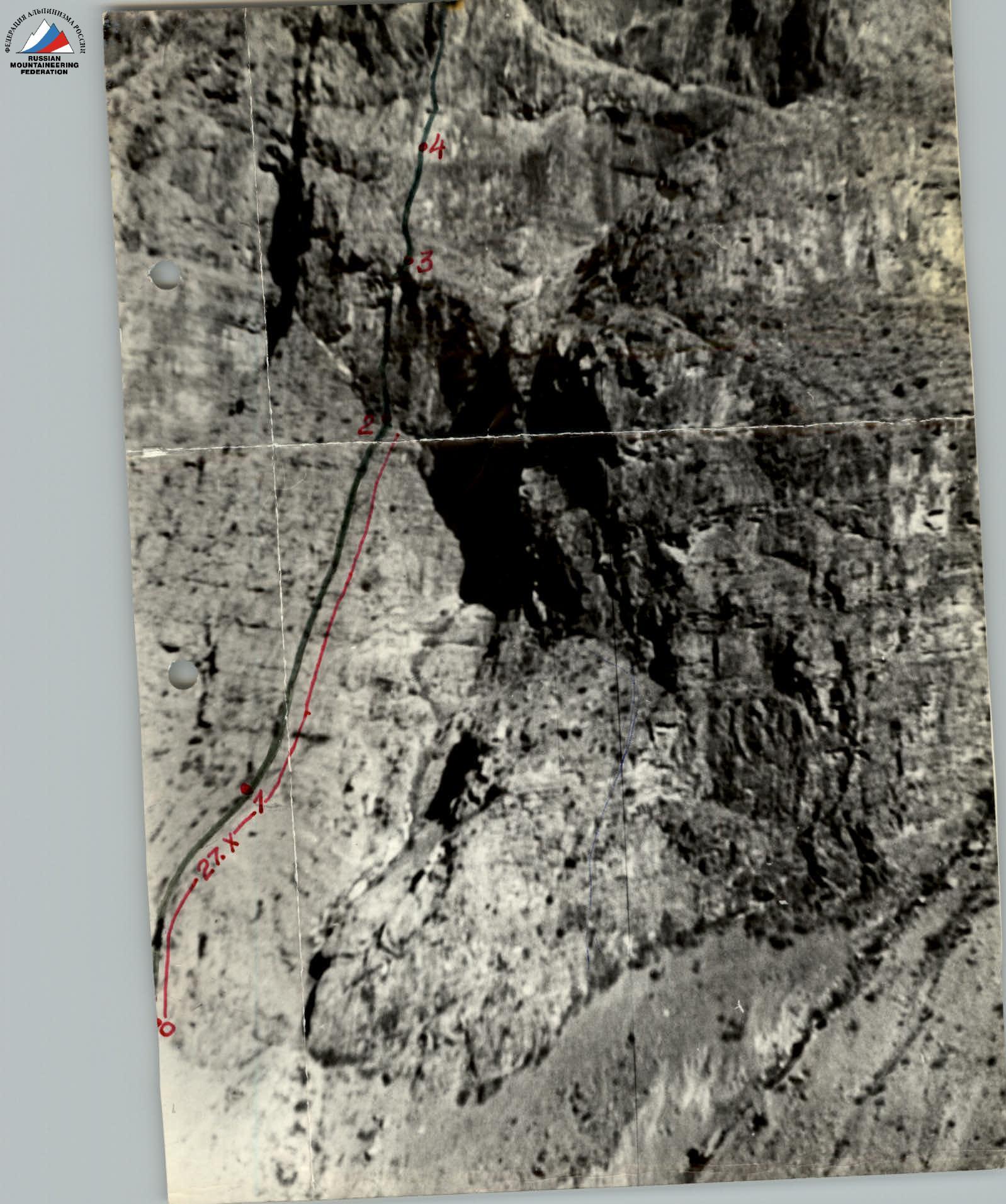

Route Progression Order
On October 27, the team set out from the base camp lightly equipped with only climbing gear at 8:00. It was cold, -3 °C.
They ascended via grassy slopes to the base of the left, not clearly defined rib of the western wall. The left part of the rib was less steep but smoothed out. The right part was more rugged.
The start of the route was about 50 meters to the left of the black traces of a watercourse.
40 meters of relatively gentle, slabby, and fragile rocks, followed by about two rope lengths of steep rocks with cracks (sections 1–2), led to a sheer wall composed of steep blocks. They descended down using ropes fixed to ice screws.
On October 28, the entire group departed with a full load at 8:00. The ascent via the fixed ropes took about an hour. A 30-meter sheer wall (section 3) was overcome without backpacks. In several places, ladders were used to bypass overhanging rocks. The next two rope lengths (sections 4–5) in the direction of a green bush along a monolithic wall, and pulling up the backpacks, took the rest of the day and required a great deal of effort. They set up a tent on a wide ledge under the wall in the evening.
October 29:
- A rope length of relatively gentle rocks led to a ridge where it met the wall and ended.
- 40 meters of difficult climbing with the pulling of backpacks up a nearly sheer inner corner ended on a steep ledge (section 8).
- Here was a control cairn.
The next sheer ascent of rocks was marked by two inner corners with an overhanging left edge. Passing the left 70-meter corner (section 10) required virtuosic technique from Master of Sports in rock climbing Y. Sapoga and necessitated the use of ladders again. Organizing the pulling and receiving of backpacks in the middle of the wall using ladders was particularly challenging.
The inner corner ended on a narrow ledge. Further, the wall became slightly gentler. 40 meters of climbing up a groove with crumbling holds made of shale led under a small overhang, which was traversed to the right, and then along a narrow ledge to the left, 8 meters to an overhang under the base of the next steep groove made of the same shale. 20 meters of climbing led under a 0.6-meter overhang, which was overcome using ladders. On the next 20 meters, the groove became less defined (the rocks were very solid) and led into the throat of a cirque in the middle part of the wall (section 12). 40 meters of climbing up the left side of the throat (section 13) led to the bottom of a watercourse (dry at the time) made of monolithic "ram's foreheads." Along the cirque's bottom, 60 meters led under a sheer ascent of a monolithic wall. They set up a tent in the dark and had dinner.
October 30. It was very cold, so their departure was somewhat delayed. Along the base of the wall via scree and then "ram's foreheads" — they exited left to a small ledge. From here, the sheer monolithic wall could be overcome via a steep crack — a chimney filled with snow and ice and with an overhanging rock. Two attempts — first by Sapoga, then by Rusanov — to overcome the chimney were unsuccessful. The chimney was overcome on the third attempt (section 16). Half a rope length of a crack turning into an inner corner led to an intermittent ledge going to the right, bypassing the edge of the wall. 20 meters to the right and up via cracks in a not very steep, icy wall led to a scree shoulder on the right edge of the cirque. Second control point.
The shoulder met a sheer face with many shadowy overhangs. A probable path was visible — a corner similar to the passed section R0, but less complex; however, they still needed to reach it. 50 meters up a nearly sheer crack-corner led up to a 1-square-meter tower; from here, the corner continued up with an overhang, and to the left, towards the chosen corner from the shoulder, led a difficult 20-meter ledge.
Fearing the same difficulties with pulling backpacks using ladders as on section R0, they continued moving upwards. On the tower, it was convenient to pull and receive backpacks, and above — to the right of the overhanging part — a small ledge was discernible.
Section 21:
- straight up the crack, 12 meters using ladders
- another 40 meters gradually becoming gentler
Led under a large overhang with a cave (section 22). Here again, they settled in for the night, or rather, sat down for a bivouac, each separately on small ledges.
October 31. A warm night and a cloudy morning promised bad weather. By noon, it was snowing heavily.
From the cave, a rope length of relatively easy rocks led to a wide crack with an overhanging wall, and then 50 meters of easy rocks and scree — to the next sheer face. 40 meters of difficult rocks in an inner corner of a large-block structure led under a sloping overhang with a wide crack (section 25).
Along a smooth monolithic wall on the right edge of the corner, to the right and up under the overhang along the crack, 30 meters to a small ledge. It was very difficult; they had to remove their galoshes as the rocks were covered in snow. On the tiny ledge, pulling and receiving backpacks was challenging.
Further:
- Another 40 meters of steep, nearly sheer rocks of blocky sandstone
- A wide scree ledge
Visibility was almost zero; only a sheer wall was faintly visible ahead. They stopped for the night.
On November 1, it was snowing lightly. Visibility improved. The ledge stretched far to the left, rising gently.
Along the ledge, next to the wall:
- they exited onto "ram's foreheads"
- and from there back onto the ledge
From here, a narrow corridor was visible. To the right, along the corridor, after overcoming 5 meters near an overhanging wall, they exited onto a wide, scree-covered western ridge of the summit. The wall was traversed. The summit was vaguely visible through the haze of snowfall.
About another half kilometer along scree and slabby ridge — and they reached the cairn. They wrote a note and quickly descended.
§ 7 Overall Assessment of the Group's Actions
All participants of the ascent acted in an organized and coordinated manner, demonstrating great organization, respect for each other, and a striving for victory.
There were no remarks against the participants. Some members of the group, participating in the 1972 USSR championship, completed ascents of the highest category of difficulty.
The observation and communication group continuously observed the ascent and maintained communication punctually.
§ 8 Route Assessment
The route to the Western summit of Yaghnob via the western wall is a first ascent. In terms of technical difficulty, length, and steepness, the route significantly surpasses classic routes of category 5B.
Ascent Leader: V. Rusanov
Team Coach: B. Sivtsov

Comments
Sign in to leave a comment