
Ascent Passport
- Ascent class — technical.
- Ascent area — Gissar Ridge.
- Peak, its height, ascent route.
I-st Western peak of Zamyk-Karor (Yaghnob wall) — 4303 m via the shortest path C-3 of the wall.
- Proposed difficulty category — 6th cat. of difficulty.
- Route characteristics:
- height difference — 1350 m
- average steepness — 87°30'
- length of sections 5–6 cat. of difficulty — 1000 m.
- Pitons hammered for belaying and for creating I.T.O.:
- rock — 212 pcs, ice — 40 pcs
- ice — none
- bolt — 16 pcs
- Number of walking hours — 51 hours.
- Number of overnight stays and their characteristics — 4 overnight stays on the route, all bivouac.
- Surname, name, patronymic of the leader, participants and their qualification:
-
- KAPITANOV OLEG VIKTOROVICH
- Master of Sports — participant
-
- YANOVICH YURIY SERGEEVICH
- Candidate Master of Sports — participant
-
- Team coach:
- SOTRIN SERGEY NIKOLAEVICH — Master of Sports of the USSR.
- Date of departure and return:
- DEPARTURE — July 11, 1976.
- RETURN — July 14, 1976.
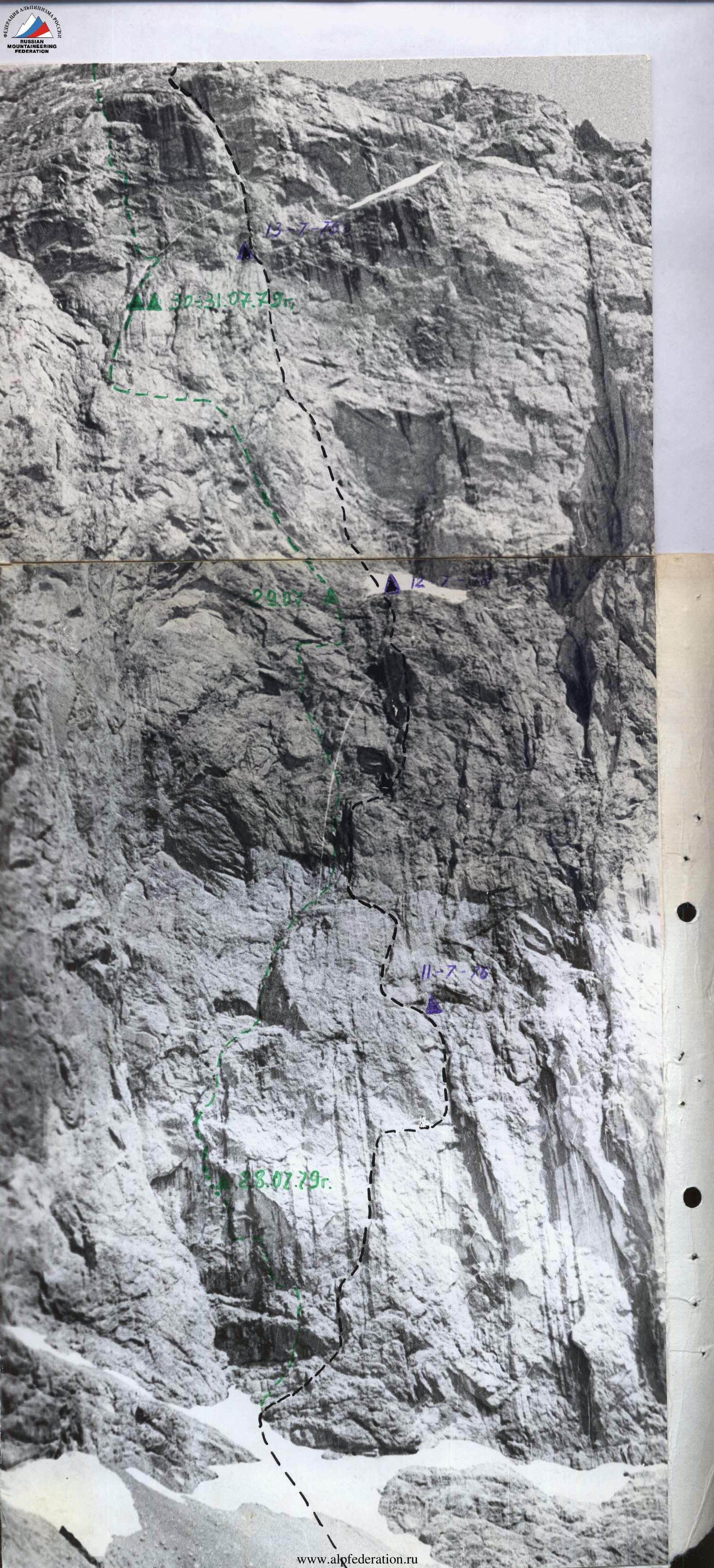
More accurate measurements require special instruments, as the feature of the wall is its concavity, which does not allow for profile shots and measurements during the ascent. The steepness of individual sections of the route was checked by indirect methods. Thus, above the snowpatch, all backpacks were pulled up without touching the wall, and a stone dropped from section R29 touched the outer edge of the snowpatch.
The significant convexity "overhang" in the upper part of the route above the snowpatch is noteworthy. However, the relief on sections R21–R32 is represented by a system of crevices, chimneys, and internal corners, which allows a significant part of the overhanging sections to be traversed by free climbing in the deepening chimneys or due to the different orientation of the planes of the chimneys and corners, using more gentle faces for passage with subsequent exit to the vertex of another strongly overhanging plane. This section, despite some technical simplicity, has a strong psychological barrier.
Ascent Chronicle
July 11, 1976.
At 6:00 we left the base camp and were under the wall in an hour. Following our tactics, today we need to ascend about 90 meters above the first bivouac of the first ascenders. The first ascenders' start of the route is quite simple (section R1–R3), 50 meters along firm rocks of medium difficulty in an internal corner. The corner's steepness is 90°, but there are many holds. From the ledge above the corner, we traverse to the second internal corner along rocks of medium difficulty and, passing it diagonally, emerge under the base of a 20-meter chimney with a plug. The chimney is damp and widens downwards. The weather is excellent — the route matches the description. Ahead is a 40-meter overhanging section, and a smooth gray wall 50–60 meters high. The corner is damp — wooden wedges, pitons, and ladders are used at the entrance. We ascend quite slowly, with the help of ITO, using a pendulum, and emerge onto a ledge. We pull up the backpacks.

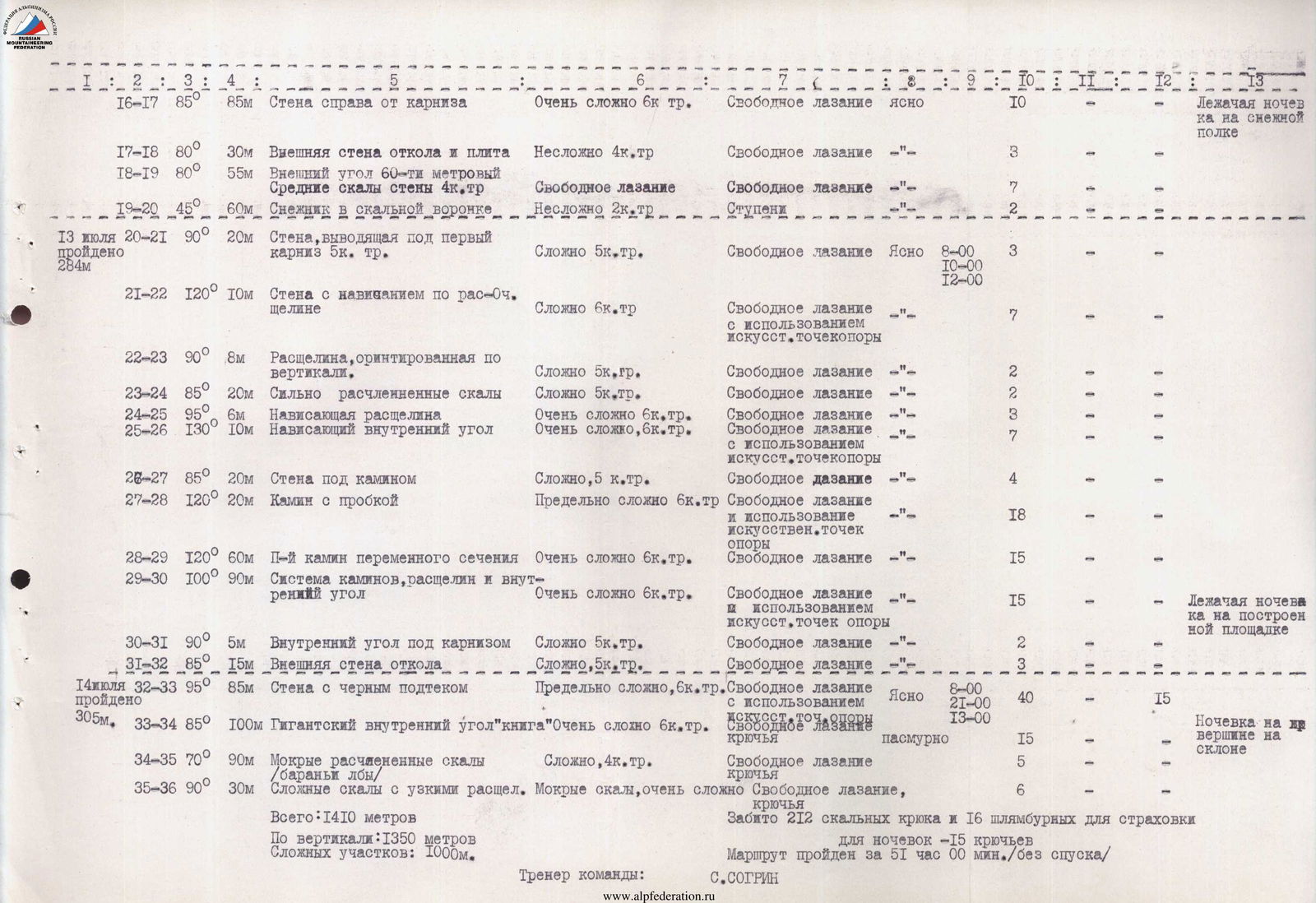
| Date | Section | Steepness | Length | Terrain character | Cat. of difficulty | Method of overcoming and belaying | Weather | Time of departure/stop | Pitons (rock) | Pitons (bolt) | Overnight stay conditions |
|---|---|---|---|---|---|---|---|---|---|---|---|
| July 11 covered 390 m | R0–R1 | 65° | 50 m | Medium rocks like "sheep's foreheads" | 3 | Free climbing, pitons | Clear | 7:00–20:00 13 h 00 min | 4 | – | – |
| R1–R2 | 90° | 15 m | Internal corner with good holds | 5 | Free climbing, pitons | –"– | – | 3 | – | – | |
| R2–R3 | 80° | 25 m | Along easy rocks under a crevice | 3 | Free climbing, pitons | –"– | – | 2 | – | – | |
| R3–R4 | 80° | 20 m | Crevice turning into an internal corner | 5 | Free climbing, pitons | –"– | – | 3 | – | – | |
| R4–R5 | 85° | 30 m | Diagonal traverse under the base of a chimney | 3 | Free climbing, pitons | –"– | – | 3 | – | – | |
| R5–R6 | 90° | 20 m | Chimney with a plug | 6 | Free climbing with use of artificial holds | –"– | – | 4 | – | – | |
| R6–R7 | 95° | 40 m | Overhanging internal corner under a gray wall | 6 | Free climbing with use of artificial holds | –"– | – | 12 | – | – | |
| R7–R8 | 85° | 60 m | Smooth gray wall | 6 | Climbing with use of artificial holds, platforms, ladders | –"– | – | 15 | 11 | – | |
| R8–R9 | 90° | 10 m | Ledge, slope, traverse | Easy | Walking | –"– | – | 1 | – | – | |
| R9–R10 | 95° | 90 m | Overhanging "petal", water flow | 6 | Free climbing with use of artificial holds | –"– | – | 18 | – | – | |
| R10–R11 | 85° | 30 m | Diagonal traverse along an inclined ledge | 3 | Free climbing | –"– | – | 3 | – | – | |
| July 12 covered 430 m | R11–R12 | 80° | 60 m | Internal corner leading to a gray wall | 5 | Free climbing | Clear | 8:00–21:00 13 h 00 min | 8 | – | – |
| R12–R13 | 90° | 30 m | Gray monolithic wall | 6 | Free climbing | –"– | – | 8 | – | – | |
| R13–R14 | 80° | 20 m | Unstable rocks leading under an internal corner | 5 | Free climbing | –"– | – | 2 | – | – | |
| R14–R15 | 90° | 60 m | Internal corner leading to an upper ledge | 6 | Free climbing | –"– | – | 8 | – | – | |
| R15–R16 | 70° | 30 m | Diagonal traverse to the bivouac | 3 | Free climbing | –"– | – | 2 | – | – | |
| R16–R17 | 85° | 85 m | Wall to the right of a cornice | 6 | Free climbing | Clear | – | 10 | – | Bivouac on a snow ledge | |
| R17–R18 | 80° | 30 m | Outer wall of a chip and a slab | 4 | Free climbing | –"– | – | 3 | – | – | |
| R18–R19 | 80° | 55 m | Outer corner 60 meters high. Medium rocks of the wall | 4 | Free climbing | –"– | – | 7 | – | – | |
| R19–R20 | 45° | 60 m | Snowpatch in a rocky funnel | 2 | Steps | –"– | – | 2 | – | – | |
| July 13 covered 284 m | R20–R21 | 90° | 20 m | Wall leading under the first cornice | 5 | Free climbing | Clear | 8:00–10:00 12:00 | 3 | – | – |
| R21–R22 | 120° | 10 m | Wall with an overhang along a crevice | 6 | Free climbing with use of artificial holds | –"– | – | 7 | – | – | |
| R22–R23 | 90° | 8 m | Crevice oriented vertically | 5 | Free climbing | –"– | – | 2 | – | – | |
| R23–R24 | 85° | 20 m | Highly dissected rocks | 5 | Free climbing | –"– | – | 2 | – | – | |
| R24–R25 | 95° | 6 m | Overhanging crevice | 6 | Free climbing | –"– | – | 3 | – | – | |
| R25–R26 | 130° | 10 m | Overhanging internal corner | 6 | Free climbing with use of artificial holds | –"– | – | 7 | – | – | |
| R26–R27 | 85° | 20 m | Wall under a chimney | 5 | Free climbing | –"– | – | 4 | – | – | |
| R27–R28 | 120° | 20 m | Chimney with a plug | 6 | Free climbing and use of artificial holds | –"– | – | 18 | – | – | |
| R28–R29 | 120° | 60 m | U-shaped chimney of variable cross-section | 6 | Free climbing | –"– | – | 15 | – | – | |
| R29–R30 | 100° | 90 m | System of chimneys, crevices, and internal corner | 6 | Free climbing with use of artificial holds | –"– | – | 15 | – | Bivouac on a constructed platform | |
| R30–R31 | 90° | 5 m | Internal corner under a cornice | 5 | Free climbing | –"– | – | 2 | – | – | |
| R31–R32 | 85° | 15 m | Outer wall of a chip | 5 | Free climbing | –"– | – | 3 | – | – | |
| July 14 covered 305 m | R32–R33 | 95° | 85 m | Wall with a black streak | 6 | Free climbing with use of artificial holds | Clear | 8:00–21:00 40 h 00 min | – | 15 | – |
| R33–R34 | 85° | 100 m | Giant internal corner "book" | 6 | Free climbing with use of pitons | Cloudy | – | 15 | – | Bivouac on the summit slope | |
| R34–R35 | 70° | 90 m | Wet, dissected rocks ("sheep's foreheads") | 4 | Free climbing, pitons | – | – | 5 | – | – | |
| R35–R36 | 90° | 30 m | Complex rocks with narrow crevices. Wet rocks, very complex | Free climbing, pitons | – | – | 6 | – | – |
Total: 1410 m. Vertical: 1350 m. Complex sections: 1000 m. 212 rock pitons and 16 bolt pitons were hammered for belaying, 15 pitons for bivouacs. The route was covered in 51 h 00 min. (without descent).
The traversed gray wall is a test of technical skill for any sports group. Here, everything we have in terms of equipment and climbing technique is put to use. Here is the first bivouac of the first ascenders and the control tour. We alternate with our partner every 90 meters. At the same time, the condition is constantly observed: Kapitanov only leads the ropes that Yaroslavtsev led first. This is quite fair, as Oleg repeats the route. Ahead is a wet and unpleasant internal corner, which starts with a 6-meter cornice under a huge "flake". The average steepness is 95°. Climbing is extremely complex.
Section R10. Having passed the "flake", we lay out a small platform at its top — here is our first bivouac.
July 12, 1976.
Along a diagonal ledge processed yesterday at sunset, we traverse from left to right under a 60-meter internal corner (R12). Along the corner to the gray and smooth wall with a steepness of 90°. The wall is traversed along an arc curved to the left in the direction of ascent — very complex. We pull up the backpack. Further, there is again a giant "flake", representing exceptional technical and emotional difficulties. Before exiting under the "flake" — 20-meter destroyed rocks — perhaps the only place on the entire route — everything else is monolithic. After the "flake", as a reward, there is a small section of easy rocks, at the top of which is the 2nd control tour and the second bivouac of the first ascenders. We exchange notes. A small traverse to the right. The next stage is an 80-meter wall that abuts a huge red chip with a chimney in the middle. The steepness of the wall is 85° (R17). We bypass the red chip to the right and ascend along its central wall. We follow the description exactly (R18).
20 meters of easy rocks, then a 60-meter wall that is traversed to the right along a rope. Here, at the base of a giant rocky funnel, we organize our 2nd bivouac, having processed 50–60 meters of snow the next day. We exchange notes in the control tour.
July 13, 1976.
A beautiful, warm night turned into a bright sunny morning. We start the route immediately after breakfast. The beginning is of medium difficulty — a 10-meter wall, a traverse to the left along an inclined ledge to a cornice, which is approached head-on. Complex and emotional. The 10-meter cornice led to a narrow ledge (R22), from which the further path goes along a sheer wall with a crevice. Then there are 30 meters of medium rocks with a steepness of 80° — under the base of a rocky ledge. The exit to the ledge is to the left along an overhanging wall with a crevice.
Section R25. Again, a "treat" — an overhanging internal corner with a steepness of 95°. 20 meters of desperate and emotional climbing. The overhang is bypassed to the right along the wall, but this is not a gift either! A 25-meter wall leads to the base of an 8-meter expanding chimney. The chimney really has a presence. Climbing is interesting, complex, and virtuosic. Here, no detail of the available equipment goes unnoticed. The average steepness is close to 115°.
Section R29. Further, following the general direction — upwards along a system of crevices and chimneys, after heavy technical work, having overcome 90 meters of wall with an average steepness of 100°, we emerge onto a small ledge where we gather together. Above the ledge is a 20-meter chimney, which is bypassed to the left. First, traverse to the left upwards, then 5 meters along the wall to the base of an internal corner with a steepness of 90°. We pass the corner and a chip with a steepness of 85°. Another 20 meters upwards, and before us is a "balcony" — the 5th bivouac of the first ascenders and our third. There is still time, even after a satisfying snack. Ahead is an impressive picture — above us is a huge overhanging, monolithic red-gray wall with dark streaks. It is clearly visible from below and, it must be said, evokes a sense of cold and uneven, uncertain state. We are experiencing something similar now. About 7 meters to the left upwards and 10 meters along the wall with holds. Further, there is a smooth red 12-meter internal corner, and before you is the main wall. Its average steepness is 95°. We descend down to the bivouac.
July 14, 1976.
We traverse the wall, alternating every 30 meters. Progress is slow, much time is spent on hammering in bolt pitons, working only on ladders and platforms. This wall, until we exit into the internal corner — "book" — is one of the key places on the entire route. Extremely complex. 90 meters. The "book" is also clearly visible from below — it is a giant internal corner with damp walls. The steepness is 85°. Climbing is complex, with an abundance of various wedges used. Above the "book" are 30 meters of "sheep's foreheads" leading under the pre-summit wall — 50–60 meters of black and cold struggle and the ridge. Along the ridge, 40 meters — and you are on the summit!
Recommendations for pairs
Since the route is exceptionally complex in all respects, a pair must be well-prepared both technically and physically. The pair must be well-coordinated and have modern equipment, practical clothing, high-calorie and compact food, and a strong desire to succeed. If these requirements are met, the ascent can be completed without pulling up backpacks, possibly with less time spent. It is necessary to have a water container. A pair can do without hot food.
The description by the first ascenders is clear. The route is logical and safe. To facilitate the overall — light signaling to observers.
Observation group
The observation group is located in the base camp, a kilometer from the wall. Observation was conducted using a 30x telescope. The observation group consisted of qualified climbers from the Chelyabinsk gathering (Leader — Master of Sports Levin M.).