
The ascent category is technically complex. The ascent area is the Gissar Ridge. The summit is Zamin Karor I West along the center of the NW wall. The difficulty category is 6B. Height difference — 1200 m. The length of sections with 5–6 difficulty category — 1175 m. Average steepness — 87.5°. Pitons used: for belay: rock 180, ice —, bolted 17; for creating belay stations: rock 15. Total climbing hours — 56 hours. Number of bivouacs on the route — 4:
- sitting — 2;
- lying — 2.
Team members:
- Baychenko Yuri Petrovich — Candidate for Master of Sports, team leader;
- Lapshin Leonid Petrovich — Master of Sports;
- Krasnoukhov Yuri Vasilyevich — Master of Sports;
- Shadskaya Ludmila Ilyinichna — Candidate for Master of Sports.
Team coach — Master of Sports Sogrina E.G.
Departure to the route — August 22, 1977. Return — August 27, 1977.
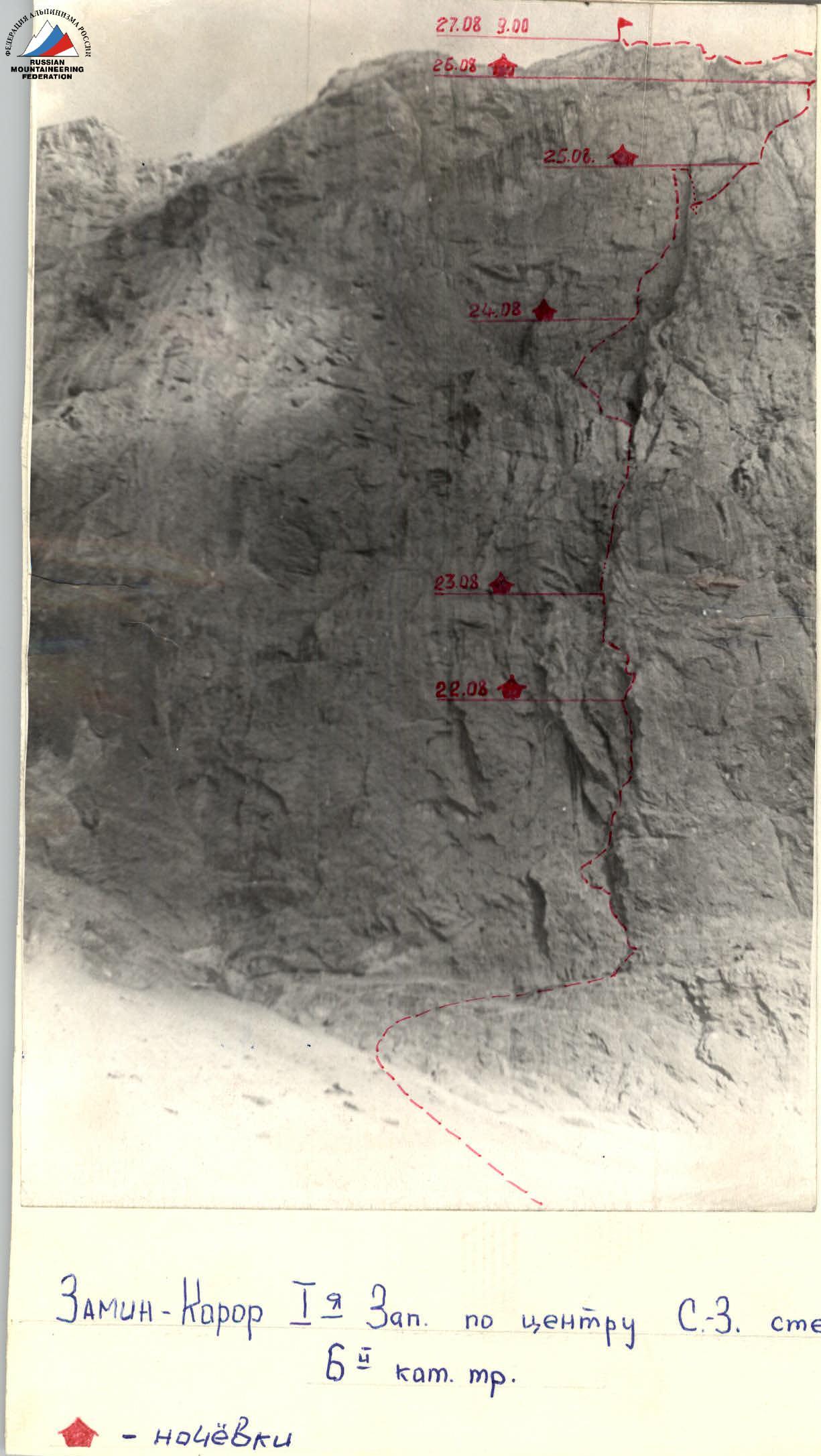
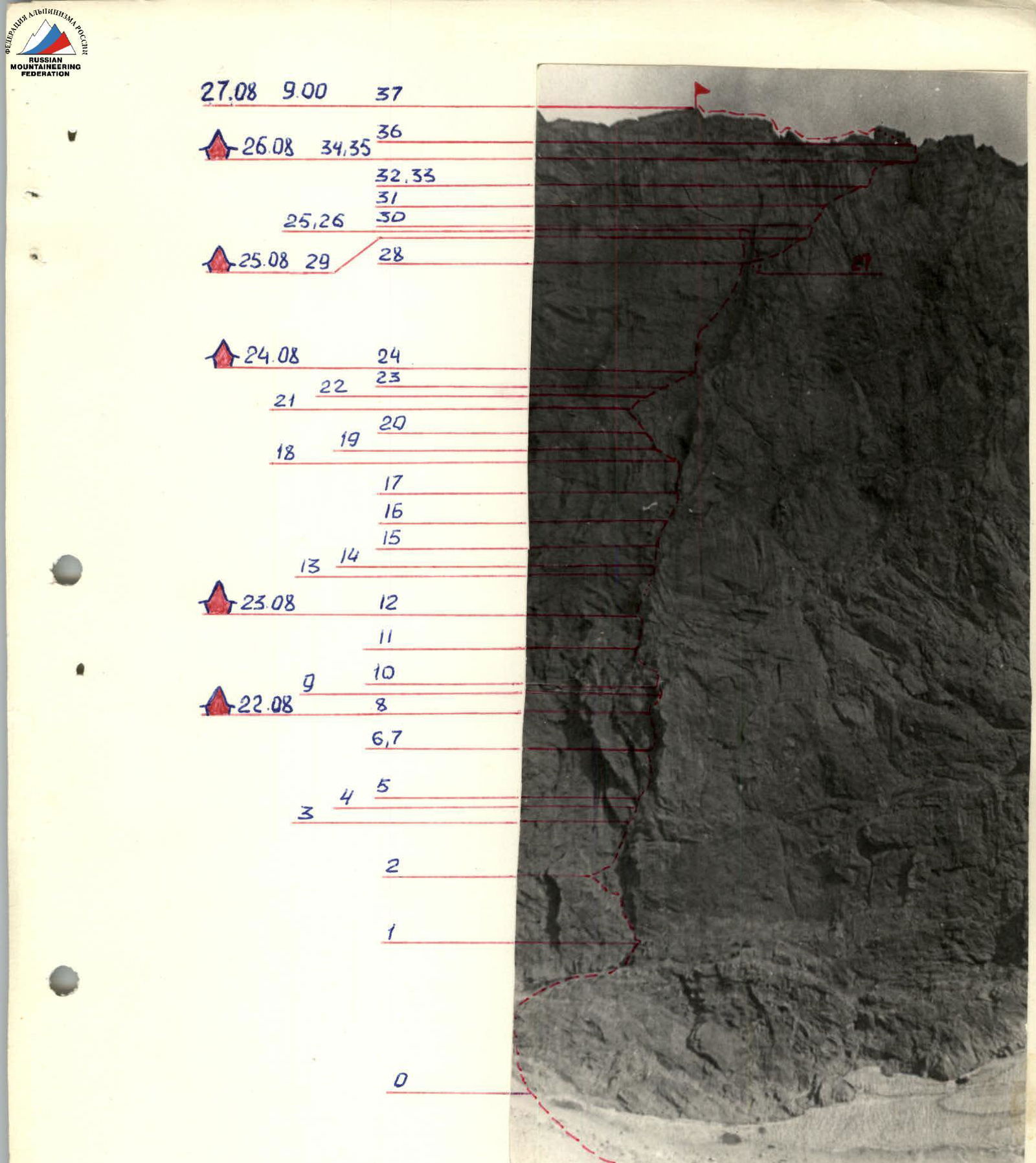 Zamin-Karor, 1A West, via center of NW wall 6B category. Δ — New Climbing Route Information
Route Description
Day 1, August 22 Around 9:30, all four of us reach the "ram's foreheads". We rest. The wall is calm.
Section R0–R1. We pass simultaneously and quickly. Section R1–R2. Lapshin leads through this section reliably using free climbing. The rest of the team follows with backpacks. There are three backpacks for the group. Climbing aids are used here and onwards.
Section R2–R3. A very smooth section. Lapshin leads. One ladder and two bolted pitons are used. Backpacks are still carried on the back.
Section R3–R4. Two pitons are hammered on the overhang. At the base of the chimney, there is a belay station.
Section R4–R5. Very difficult, wet, and overhanging. Lapshin hangs a ladder on the cornice and uses a bolted piton at the exit for belay. The exit leads to a small ledge for one person.
Section R5–R6. The section is extremely smooth;
- 4 bolted pitons are used;
- 2 ladders are used. We still see the ledge on the "ram's foreheads" below us — the beginning of the difficult sections. A sheer drop.
Sections R6–R7, R7–R8. Lapshin leads. He exits wet, as do all subsequent climbers. Two ladders are used. The difficulty is maximum. A narrow crack does not allow climbing with backpacks; for the first time, we pull them up on the R7–R8 section.
We gather together — overnight stay. We fetch water by descending into a couloir for ice. We manage to settle in a sitting position in "zdaraks".
Day 2, August 23 Sections R8–R9, R9–R10. We exit to a slab under the "ram's foreheads". Lapshin leads. It's somewhat easier than the previous sections. We carry backpacks on our backs, starting to get used to it.
Section R10–R11. Very difficult and smooth. Bolted pitons are hammered, and ladders are used. Backpacks are also pulled up. Lapshin exits into the base of a gully. The first 300-meter overhanging part of the route is completed!
Section R11–R12. The section is easier but perhaps the most stonefall-prone on the route. It's dry. We need water for the night. Lapshin exits onto an inclined shelf without much difficulty. There's little water, but it's there. We decide to bivouac. Again, in a sitting position in "zdaraks".
Table of Main Characteristics of the Ascent Route
Ascent route of the "Barfob" team to Zamin-Karor I West via the center of the NW wall, 6B category.
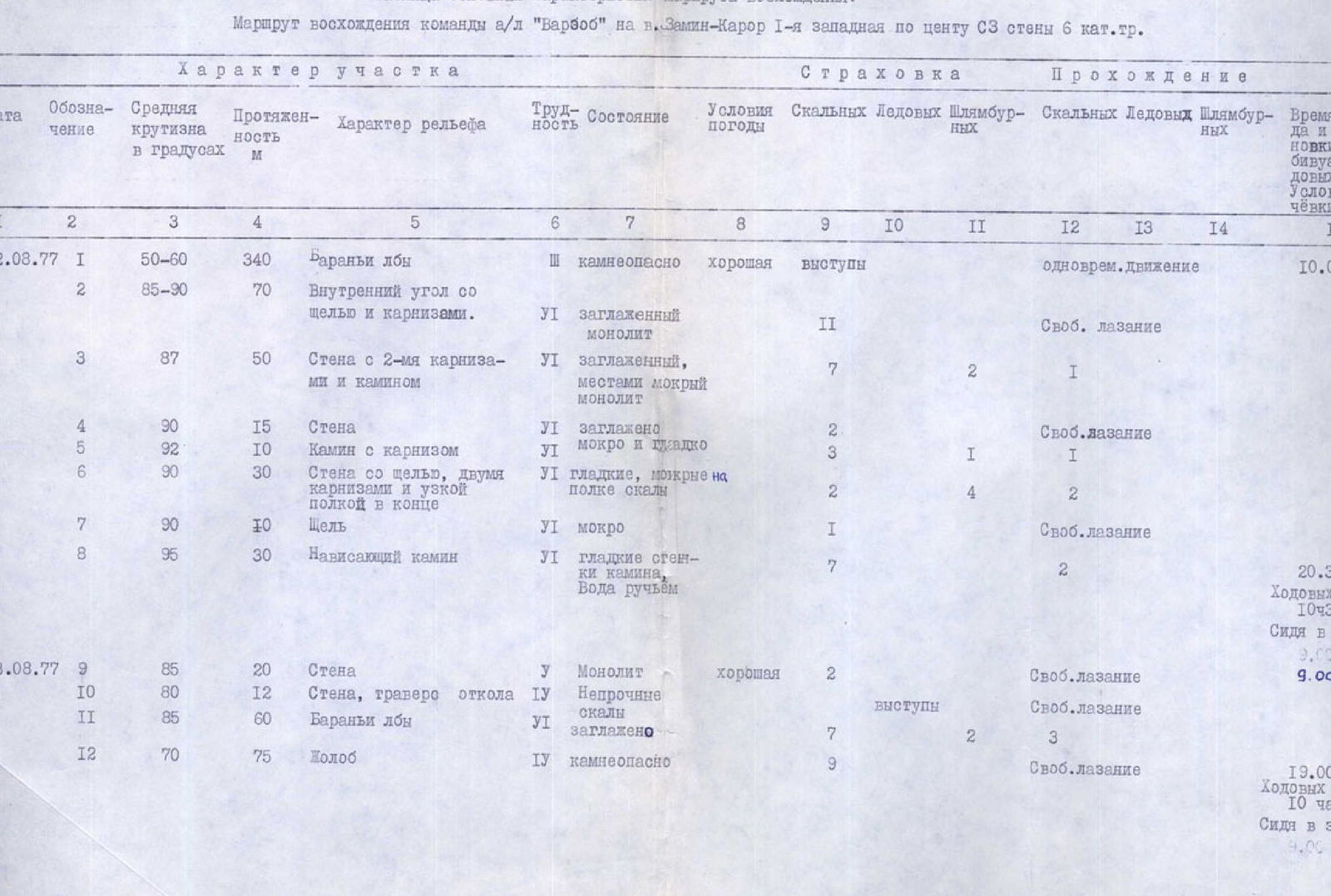
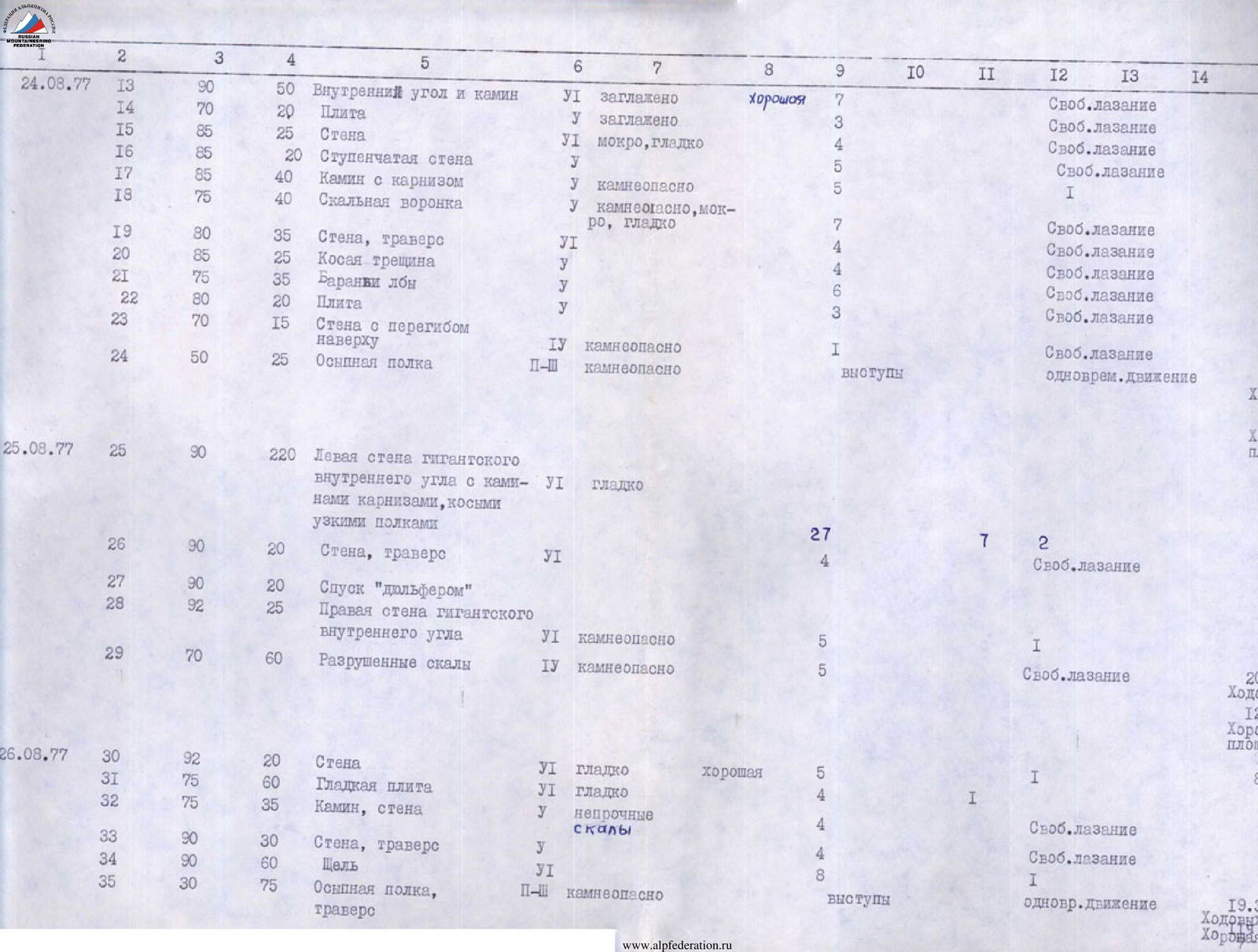
| Date | Designation | Average steepness in degrees | Length, m | Terrain characteristics | Difficulty | Condition | Weather conditions | Rock (belay) | Ice (belay) | Bolted (belay) | Rock (passage) | Ice (passage) | Bolted (passage) | Time of departure and stop for bivouac. Climbing hours. Bivouac conditions. |
|---|---|---|---|---|---|---|---|---|---|---|---|---|---|---|
| 22.08.1977 | R1 | 50–60 | 340 | Ram's foreheads | 5 | stonefall-prone | good | natural features | simultaneous movement | 10:00 | ||||
| R2 | 85–90 | 70 | Inner corner with a crack and cornices | 6 | smooth monolith | 2 | Free climbing | |||||||
| R3 | 87 | 50 | Wall with 2 cornices and a chimney | 6 | smooth, partially wet monolith | 7 | 2 | 1 | 1 | |||||
| R4 | 90 | 15 | Wall | 6 | smooth | 2 | Free climbing | |||||||
| R5 | 92 | 10 | Chimney with a cornice | 6 | wet and smooth | 3 | 1 | 1 | ||||||
| R6 | 90 | 30 | Wall with a crack, two cornices, and a narrow ledge | 6 | smooth, wet rocks on the ledge | 2 | 4 | 2 | ||||||
| R7 | 90 | 10 | Crack | 6 | wet | 1 | Free climbing | |||||||
| R8 | 95 | 30 | Overhanging chimney | 6 | smooth walls of the chimney, water flow | 7 | 2 | 20:30. Climbing hours 10 h 30 min. Sitting in zdaraks. | ||||||
| 23.08.1977 | R9 | 85 | 20 | Wall | 5 | Monolith | good | 2 | Free climbing | 9:00 | ||||
| R10 | 80 | 12 | Wall, traverse of a slab | 4 | Unstable rocks | natural features | Free climbing | |||||||
| R11 | 85 | 60 | Ram's foreheads | 6 | smooth | 7 | 2 | 3 | ||||||
| R12 | 70 | 75 | Gully | 4 | stonefall-prone | 9 | Free climbing | 19:00. Climbing hours 10 h. Sitting in zdaraks. 9:00 | ||||||
| 24.08.1977 | R13 | 90 | 50 | Inner corner and chimney | 6 | smooth | good | 7 | Free climbing | 9:00 | ||||
| R14 | 70 | 20 | Slab | 5 | smooth | 3 | Free climbing | |||||||
| R15 | 85 | 25 | Wall | 6 | wet, smooth | 4 | Free climbing | |||||||
| R16 | 85 | 20 | Stepped wall | 5 | 5 | Free climbing | ||||||||
| R17 | 85 | 40 | Chimney with a cornice | 5 | stonefall-prone | 5 | 1 | |||||||
| R18 | 75 | 40 | Rock funnel | 5 | stonefall-prone, wet, smooth | 7 | Free climbing | |||||||
| R19 | 80 | 35 | Wall, traverse | 6 | 4 | Free climbing | ||||||||
| R20 | 85 | 25 | Diagonal crack | 5 | 4 | Free climbing | ||||||||
| R21 | 75 | 35 | Ram's foreheads | 5 | 6 | Free climbing | ||||||||
| R22 | 80 | 20 | Slab | 5 | 3 | Free climbing | ||||||||
| R23 | 70 | 15 | Wall with a bend at the top | 4 | stonefall-prone | 1 | Free climbing | |||||||
| R24 | 50 | 25 | Scree ledge | 2–3 | stonefall-prone | natural features | simultaneous movement | 18:30. Climbing hours 9 h 30 min. Good ledge. | ||||||
| 25.08.1977 | R25 | 90 | 220 | Left wall of a giant inner corner with chimneys, cornices, and diagonal narrow ledges | 6 | smooth | 27 | 7 | 2 | 8:00 | ||||
| R26 | 90 | 20 | Wall, traverse | 6 | 4 | Free climbing | ||||||||
| R27 | 90 | 20 | "Dolpher" descent | |||||||||||
| R28 | 92 | 25 | Right wall of a giant inner corner | 6 | stonefall-prone | 5 | 1 | |||||||
| R29 | 70 | 60 | Broken rocks | 4 | stonefall-prone | 5 | Free climbing | 20:30. Climbing hours 12 h 30 min. Good ledge. 8:00 | ||||||
| 26.08.1977 | R30 | 92 | 20 | Wall | 6 | smooth | good | 5 | 1 | |||||
| R31 | 75 | 60 | Smooth slab | 6 | smooth | 4 | 1 | |||||||
| R32 | 75 | 35 | Chimney, wall | 5 | unstable rocks | 4 | Free climbing | |||||||
| R33 | 90 | 30 | Wall, traverse | 5 | 4 | Free climbing | ||||||||
| R34 | 90 | 60 | Crack | 6 | 8 | 1 | ||||||||
| R35 | 30 | 75 | Scree ledge, traverse | 2–3 | stonefall-prone | natural features | simultaneous movement | 19:30. | ||||||
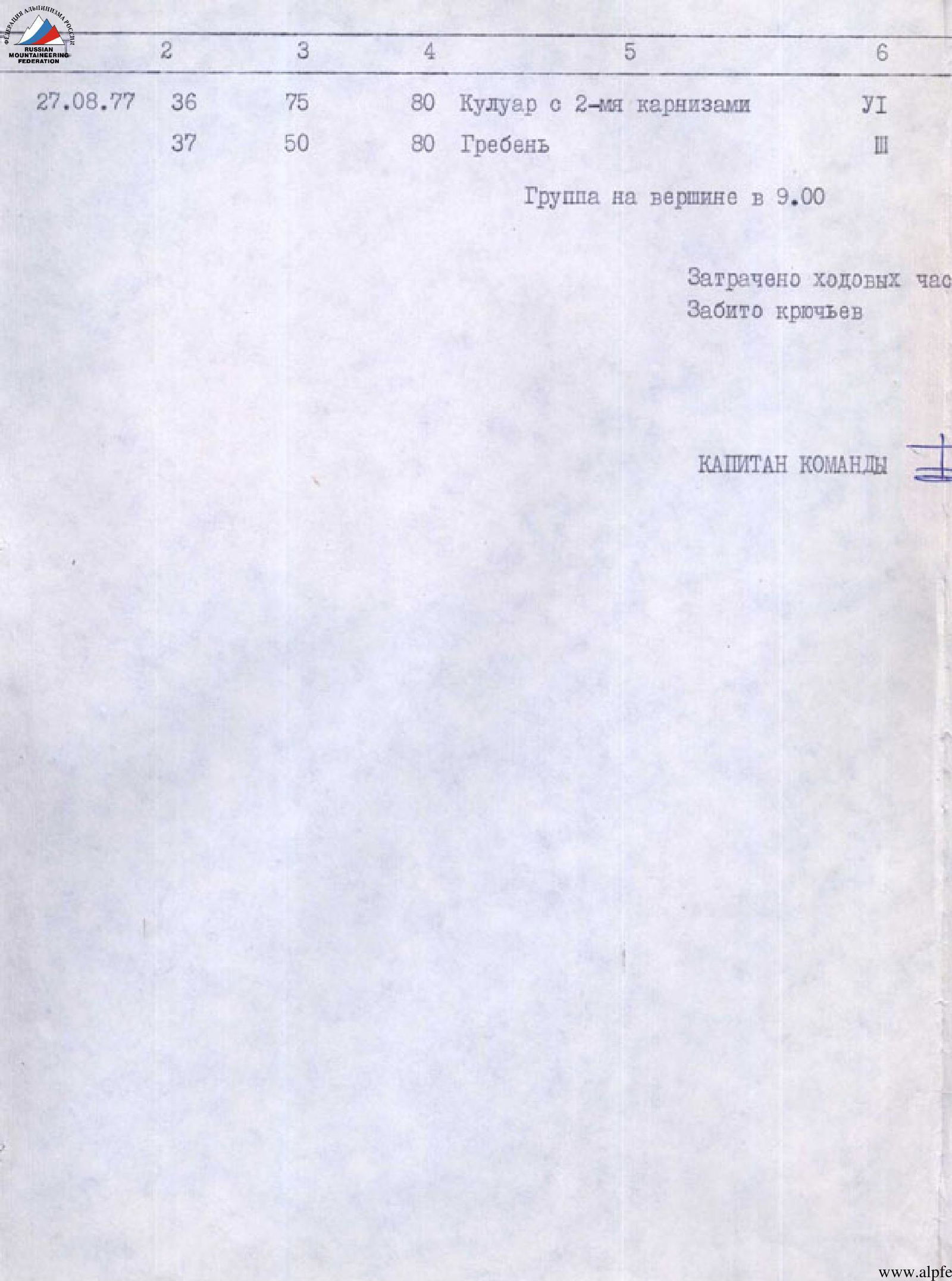
| 27.08.1977 | R36 | 75 | 80 | Gully with 2 cornices | 6 | 14 | Free climbing | 7:00 | ||||||
| R37 | 50 | 80 | Ridge | 3 | natural features | simultaneous movement |
Day 3, August 24 Section R12–R13. Lapshin leads through the corner and chimney using free climbing to a wet ledge. Everything is smooth. To avoid getting stuck in the chimney with backpacks, we pull them up directly.
Sections R13–R16. Lapshin leads through free climbing as well. Water hinders progress, especially on the vertical wall. It's very difficult even in gaiters. We pull backpacks up to the stepped wall, then carry them on our backs.
Sections R16–R17. The chimney is stonefall-prone with a cornice at the bottom. A ladder is used on it. Afterwards, free climbing ensues. It's steep but climbs well, even with backpacks. We reach an excellent ledge, but our goal is higher — on a snow ledge. Here, the ledge is littered with "fresh" stones.
Section R17–R18. Lapshin leads through the chimney-funnel. Many pitons are hammered (7). It's smooth and wet. Stonefall-prone. We pass this section with backpacks.
Section R18–R19. Lapshin traverses along the wall with a slight ascent. Still very smooth and difficult. Practically no relief. 7 pitons are hammered.
Section R19–R20. Steep but climbs reliably. Like the previous section, we carry backpacks on our backs. Lapshin leads with 4 pitons.
Sections R20–R24. Difficult walls alternate with good ledges. Steep but enjoyable climbing. The upper part — simple rocks — leads to a scree ledge with snow, to an excellent safe bivouac under the cornices of the third belt.
Day 4, August 25 Section R24–R25. 220 m of smooth walls. The terrain is organic, with few cracks, and dry. Very difficult. We use our entire arsenal of pitons, including bolted ones, wedges, and ladders. We follow the path of the first ascensionists. We pull backpacks up twice. Lapshin leads throughout.
Section R25–R26. Traverse to the corner, 20 m, practically on the overhang. With backpacks.
Section R26–R27. "Dolpher" descent. Last to descend is Krasnoukhov.
Day 5, August 26 Section R27–R28. Exit to the shoulder of the right wall of the corner. Lapshin uses a ladder. The wall is like a mirror, obviously due to water, and overhangs. Still very difficult.
Section R28–R29. Passed without significant difficulties with backpacks. Overnight stay under the wall, in a sitting position. No water — only dirty ice.
Section R29–R30. The first to lead with a ladder, using it at the top, on a bend. Pitons go in well.
Section R30–R31. Monolithic slabs transitioning into a gully. There's no place to hammer pitons. One bolted piton is used. Most of the section is on friction. Dry and smooth, difficult. We carry backpacks on our backs.
Section R31–R32. Passed in good tempo. There are cracks and relief for climbing with backpacks.
Section R32–R33. Traverse along a narrow ledge (15 cm wide) along the wall, on the overhang. Movement is hindered by backpacks. 4 pitons are hammered.
Section R33–R34. A 20 cm wide crack on a smooth wall is passed by Lapshin using climbing (15 m), very difficult. A wedge is hammered, and a ladder is used. A total of 8 pitons are hammered on this section. Overhang — the base of the wall is visible. We exit with backpacks onto a wide scree ledge with snow and decide to bivouac (there's water!), preparing the exit to the ridge.
Section R34–R35. We traverse simultaneously to the bivouac site.
Section R35–R36:
- Lapshin and partially Baychenko overcome the gully with smooth walls using free climbing, hammering 14 pitons.
- The rest exit to the ridge with backpacks.
Section R36–R37:
- The ridge is passed simultaneously, with belay through natural features in places.
At 9:00, we gather at the summit.
 (BAYCHENKO)