
II. Climbing Passport.
I. Climb category — TECHNICAL.
-
Northern spur of the Gissar ridge.
-
Summit — ZAMIN KAROR I West, height 4303 m, via the right part of the NW wall.
-
Estimated difficulty category — 6B.
-
Route characteristics: height difference — 1300 m. length of sections with 5th difficulty category — 460 m. length of sections with 6th difficulty category — 690 m. average steepness — 80°
-
Pitons hammered: for belaying, rock and chock pitons — 214 pcs. drill pitons — 8 pcs. for creating artificial footholds, rock pitons hammered — 26 pcs.
-
Total climbing hours — 78 h.
-
Number of overnight stays — five, sitting and semi-reclining.
-
Participants: Vinokurov Anatoly Filippovich — Master of Sports, team leader Zhurzdin Vladimir Iosifovich — Master of Sports, deputy captain Merlis Viktor Petrovich — Master of Sports Dzaparidze Yuri Otarovich — Candidate for Master of Sports Vorobyov Lev Fedorovich — Candidate for Master of Sports Monaenkov Evgeny Ivanovich — Candidate for Master of Sports
-
Team coach: Dauter Boris Vladimirovich — Master of Sports. II. Date of departure and return to the camp: July 28 to August 3, 1979.
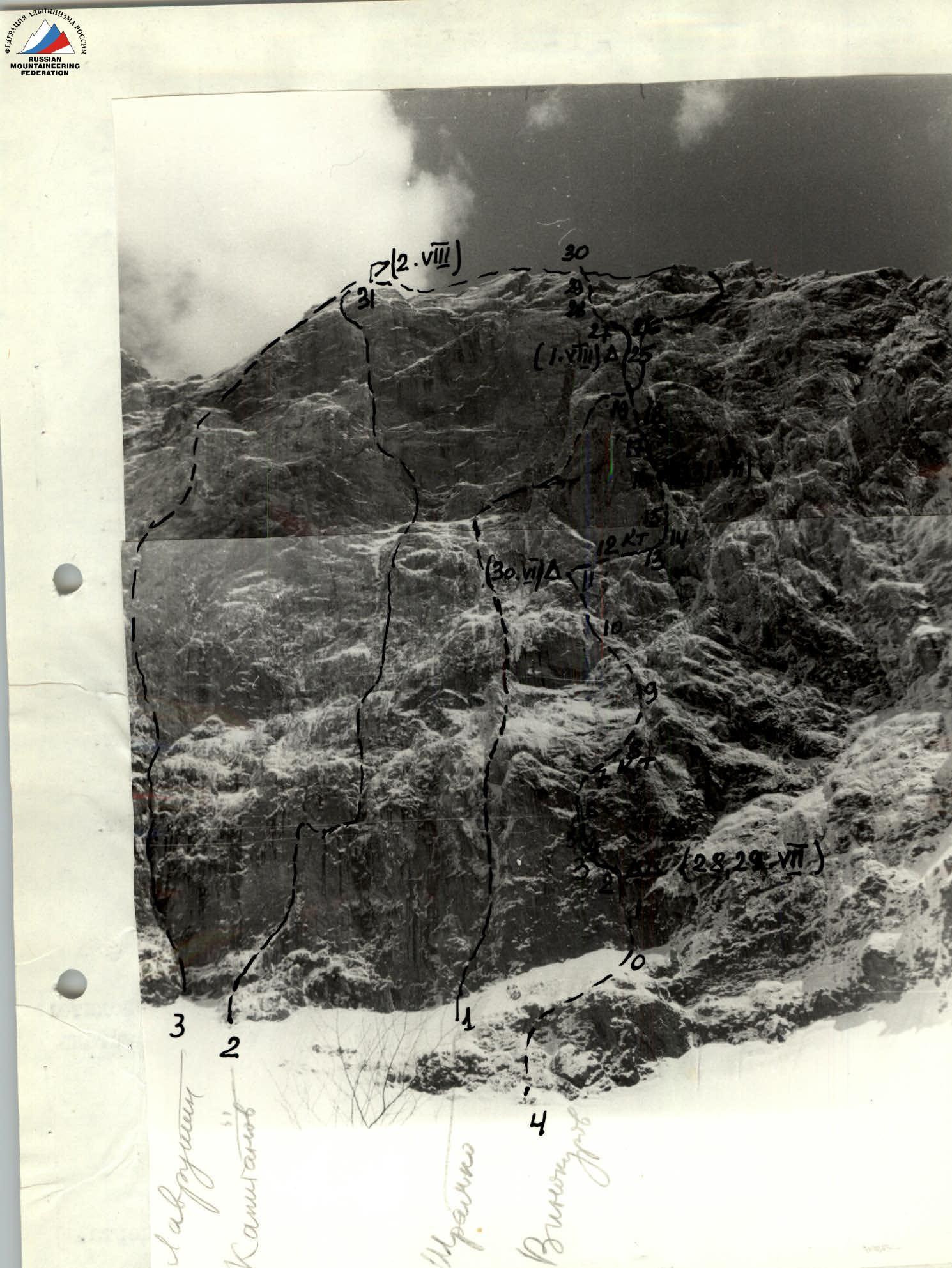
3. Table
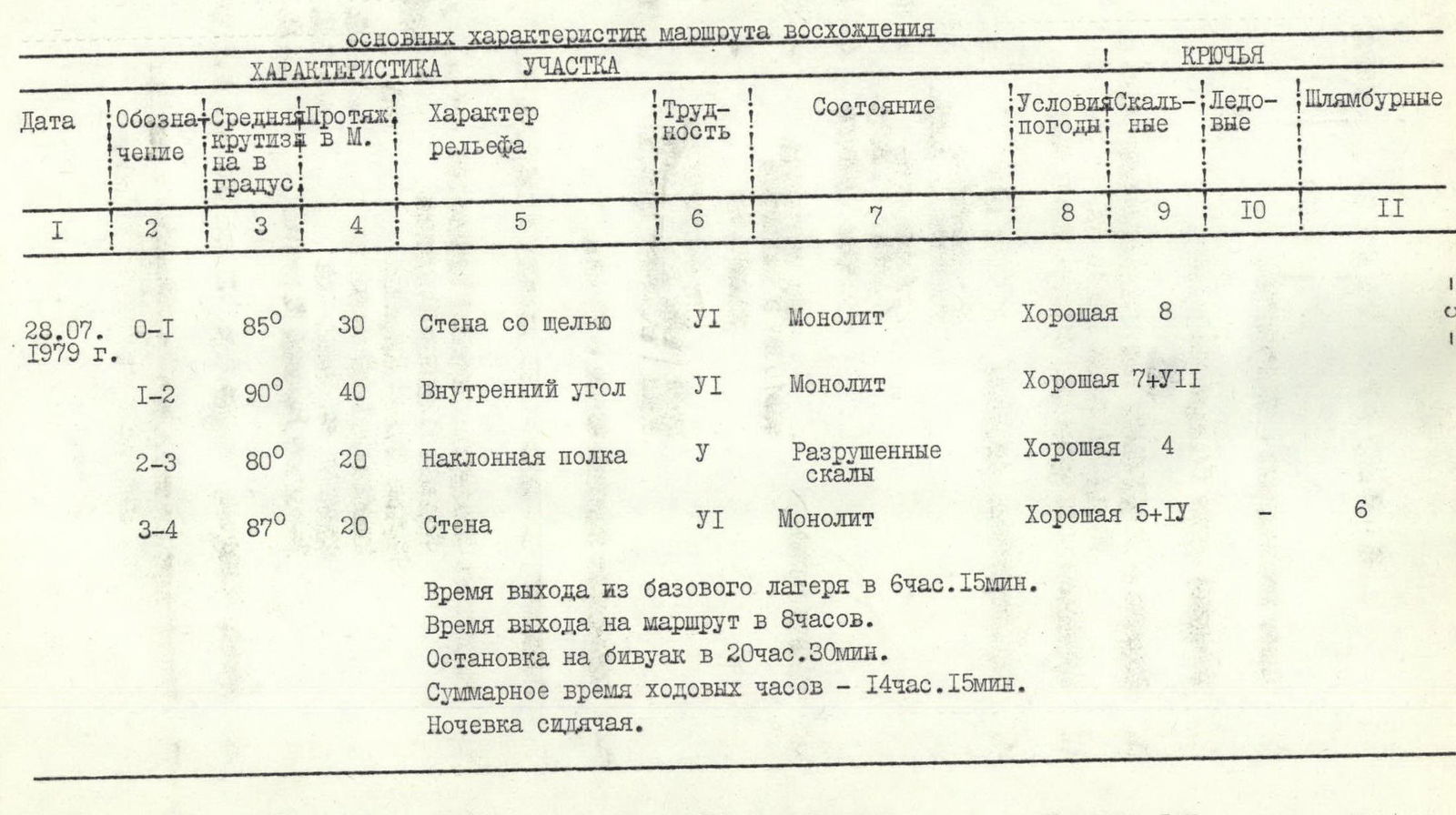
| I | 2 | 3 | 4 | 5 | 6 | 7 | 8 | 9 | 10 | II |
|---|---|---|---|---|---|---|---|---|---|---|
| 29.07. | R4–R5 | 95° | 20 | Overhang. | 6 | Monolith. | Good. | 5+3 | 2 |
Return to bivouac at 18:30. Total time for the rope team — 10 h. Overnight stay sitting.
| I | 2 | 3 | 4 | 5 | 6 | 7 | 8 | 9 | 10 | II |
|---|---|---|---|---|---|---|---|---|---|---|
| 30.07. | R5–R6 | 90° | 20 | Wall-overhang. | 6 | Monolith. | Good. | 5+3 | ||
| R6–R7 | 85° | 40 | Chimney. | 5 | Monolith. | Good. | 7 | |||
| R7–R8 | 20° | 40 | Sloping ledge. | 2 | Loose rocks. | Good. | 4 | |||
| R8–R9 | 75° | 120 | Chimney. | 5–6 | Monolith. | Good. | 18 | |||
| R9–R10 | 80° | 120 | Wall with cracks and inner corner. | 5–6 | Monolith. | Good. | 22 | |||
| R10–R11 | 70° | 80 | Chimney. | 4 | Loose rocks. | Good. | Rock outcrops. |
Departure from bivouac at 6:30. Stop at bivouac at 20:30. Total climbing time — 14 h. Overnight stay semi-reclining.
| I | 2 | 3 | 4 | 5 | 6 | 7 | 8 | 9 | 10 | II |
|---|---|---|---|---|---|---|---|---|---|---|
| 31.07. | R11–R12 | 70° | 80 | Chimney, inner corner. | 5 | Loose rocks. | Good. | 10 | ||
| R12–R13 | 0° | 60 | Ledge. | 2 | Monolith. | Good. | 4 | |||
| R13–R14 | 90° | 20 | Wall. | 6 | Loose rocks. | Good. | 4 | |||
| R14–R15 | 87° | 20 | Inner corner. | 5 | Monolith. | Good. | 5 | |||
| R15–R16 | 85° | 80 | Wall with inner corner. | 5–6 | Monolith. | Good. | 12 | |||
| R16–R17 | 90° | 40 | Inner corner. | 6 | Monolith. | Good. | 7 | |||
| R17–R18 | 95° | 10 | Overhang. | 6 | Monolith. | Good. | 3+2 | |||
| R18–R19 | 85° | 30 | Wall. | 6 | Roof-like rocks. | Good. | 5 |
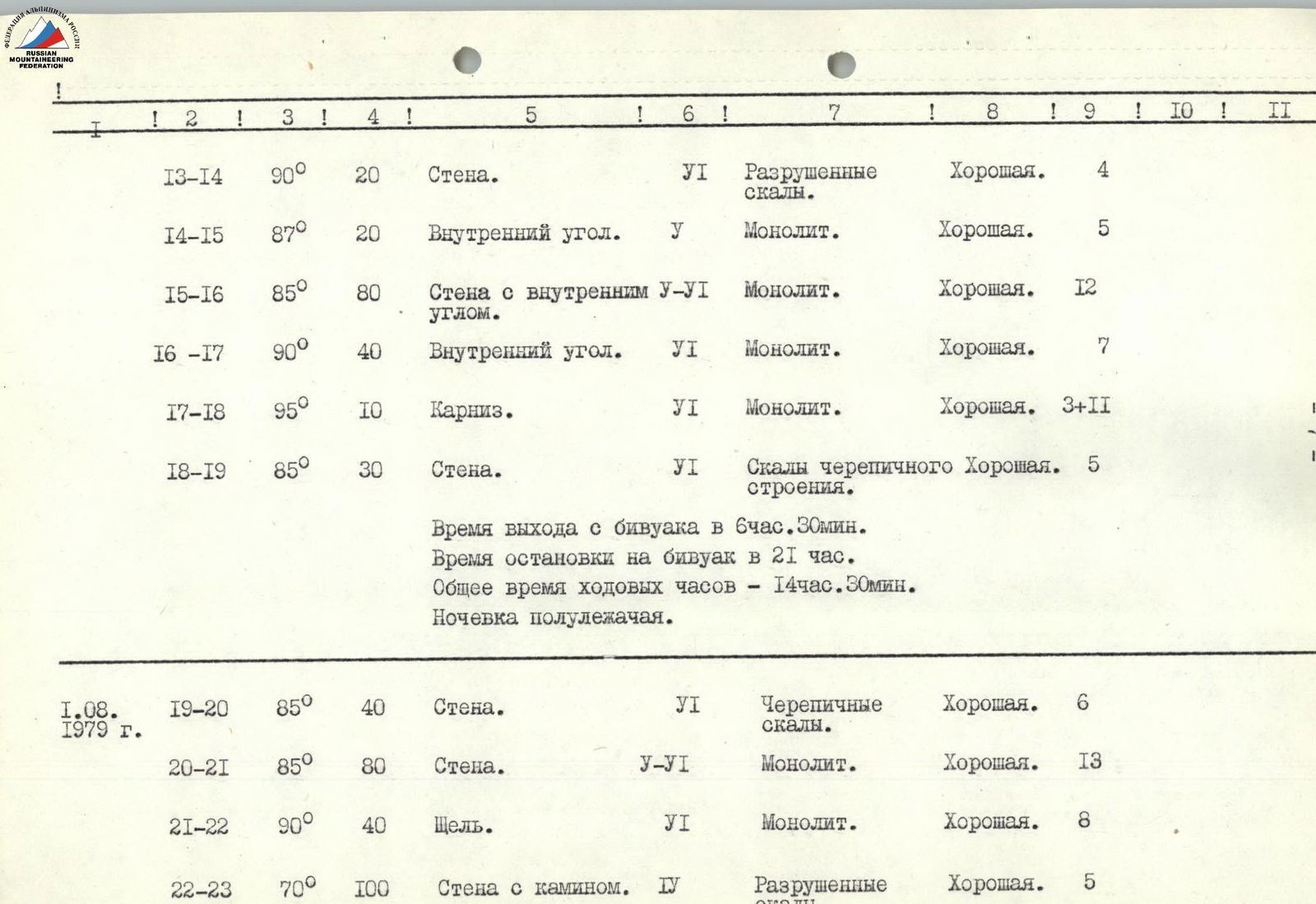
Departure from bivouac at 6:30. Stop at bivouac at 21:00. Total climbing time — 14 h 30 min. Overnight stay semi-reclining.
| I | 2 | 3 | 4 | 5 | 6 | 7 | 8 | 9 | 10 | II |
|---|---|---|---|---|---|---|---|---|---|---|
| 1.08.1979 г. | R19–R20 | 85° | 40 | Wall. | 6 | Roof-like rocks. | Good. | 6 | ||
| R20–R21 | 85° | 80 | Wall. | 5–6 | Monolith. | Good. | 13 | |||
| R21–R22 | 90° | 40 | Crack. | 6 | Monolith. | Good. | 8 | |||
| R22–R23 | 70° | 100 | Wall with chimney. | 4 | Loose rocks. | Good. | 5 | |||
| R23–R24 | 10° | 30 | Narrow ledge. | 3 | Smooth rocks. | Good. | 3 | |||
| R24–R25 | 85° | 60 | Wet couloir. | 6 | Smooth rocks. | Good. | 10 |
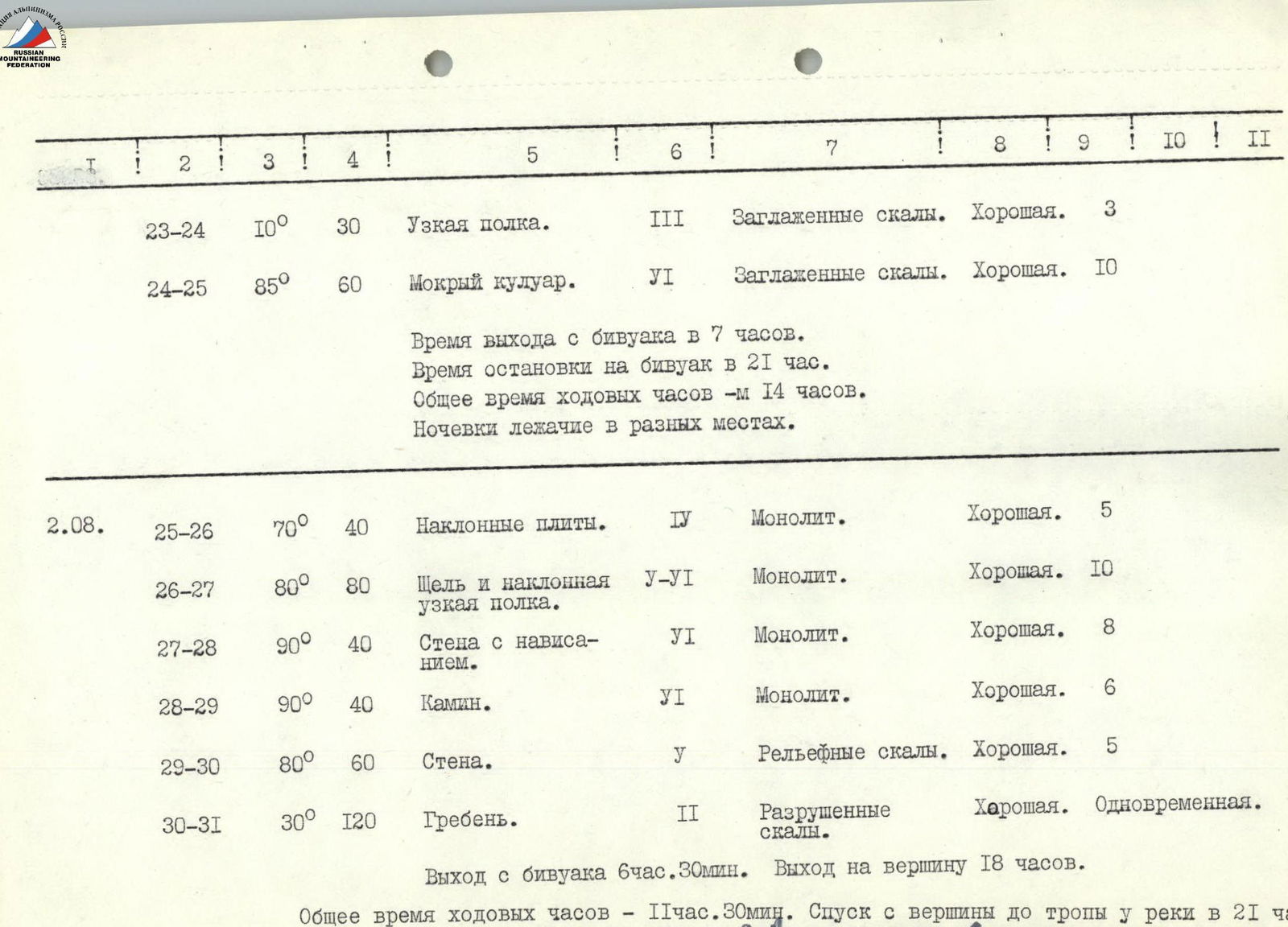
Departure from bivouac at 7:00. Stop at bivouac at 21:00. Total climbing time — 14 h. Overnight stays lying in different places.
| 2.08. | R25–R26 | 70° | 40 | Sloping slabs. | 4 | Monolith. | Good. | 5 | ||
|---|---|---|---|---|---|---|---|---|---|---|
| R26–R27 | 80° | 80 | Crack and narrow sloping ledge. | 5–6 | Monolith. | Good. | 10 | |||
| R27–R28 | 90° | 40 | Wall with overhang. | 6 | Monolith. | Good. | 8 | |||
| R28–R29 | 90° | 40 | Chimney. | 6 | Monolith. | Good. | 6 | |||
| R29–R30 | 80° | 60 | Wall. | 5 | Relief rocks. | Good. | 5 | |||
| R30–R31 | 30° | 120 | Ridge. | 2 | Loose rocks. | Good. | Simultaneous. |
Departure from bivouac at 6:30. Reach the summit at 18:00. Total climbing time — 11 h 30 min. Descent from the summit to the trail by the river at 21:00.
4. Brief explanation of the table.
The route's nature and steepness can be divided into three parts.
The first part (sections from R0 to R7) features monolithic, smooth, dark gray rocks with very few holds, sometimes wet, with an average steepness of around 85°. This part has two overhangs (sections R1–R2 and R4–R5). These sections have few holds and cracks, making them very challenging to pass.
The second part consists of rocks with a smaller angle of inclination, around 75–77°, making this section less difficult to climb. However, the rock relief on this section is even poorer than on the previous section — a smooth slab with almost no cracks or holds, which can only be passed on the left side, along a shallow and smooth inner corner (sections R7–R14).
The third part (sections R13–R31) features steep rocks, on average around 85°, with overhanging sections and overhangs with poor relief and few holds.
5. Tactical plan for the ascent.
The tactical plan for the ascent provided for optimal organization of the group's movement based on observations, study of reports on wall routes, and consultations with participants who had previously climbed the NW wall. The tactical plan submitted to the judging panel included dividing the route into daily segments with approximate locations for overnight stays and tactical measures for safe progress along the route:
- organization of overnight stays
- movement under cover
- double-rope climbing
- use of harnesses and jammers.
It should be noted that during the ascent, the assessment of most of the route proved correct, and the large number of overhangs and overhanging sections contributed to the tactical plan for safe passage. For the same reasons, it was deemed appropriate to slightly adjust the planned locations for the III–IV overnight stays.
The most significant tactical miscalculation was the assessment of the upper part of the route on the first day. The lack of experience climbing this wall was a factor. This section lacked the usual microrelief typical of such rocks, which is not visible through optical instruments, and the group spent a full working day searching for a path through the first overhang without deviating from the planned corridor.
The participants' movement style on the route adhered to the tactical plan — all moved on double rope with the use of jammers, harness-ladder on overhanging sections and overhangs without relief, or with rope hauling on simpler relief.
7. Conclusion.
The route climbed by the team via the right part of the Northwest wall is technically more challenging than all classified routes of the highest category in the Fann Mountains (all of which were climbed by team members in previous seasons) and is only surpassed by the route to the summit of Chapdara via the center of the "well" climbed by the team this season.
Given that the Northwest wall is divided in the center by a giant inner corner-couloir, the team considers the route via the right part of the Northwest wall to be a standalone route, climbed for the first time.
Team captain: — (Vinokurov A.F.) Participants: — (Zhurzdin V.I.) — (Merlis V.P.) — (Dzaparidze Yu.O.) — (Vorobyov L.F.) — (Monaenkov E.I.) Team coach: — (Dauter B.V.)