
Passport
- Rock climbing category
- Pamir-Alay, Alay Ridge, Ajaljhilga gorge
- Peak OSh 4180, via the center of the 3rd wall.
- Proposed 5B category of complexity, first ascent
- Height difference: 498 m, length 603 m — (section R0–R15). 365 m — (section R0–R15). 393 m
Length of sections 5–6: 285 m. Average steepness of main sections 80°.
- Pitons driven:
| Rock | Bolt | Nuts | Ice |
|---|---|---|---|
| 114 | 10 | 22 | – |
| 59 | 8 | 20 | – |
- Team's total climbing hours 40.5, and days 5.
- Overnights: 1st and 2nd in the I-st grotto, 3rd on a ledge, 4th in the II-nd grotto.
- Leader: BLAŽAITIS ZIGMAS KOZO, Master of Sports. Participants: Baėras Eugenijus Alfonso, Candidate for Master of Sports; Pundzius Edvardas Vincento, Candidate for Master of Sports; Virbalis Kletutis Adomo, Candidate for Master of Sports.
- Coach: Makauskas Lainis Antano, Master of Sports.
- Route approach:
Summit OSh — June 19, 1982. Return — June 23, 1982.
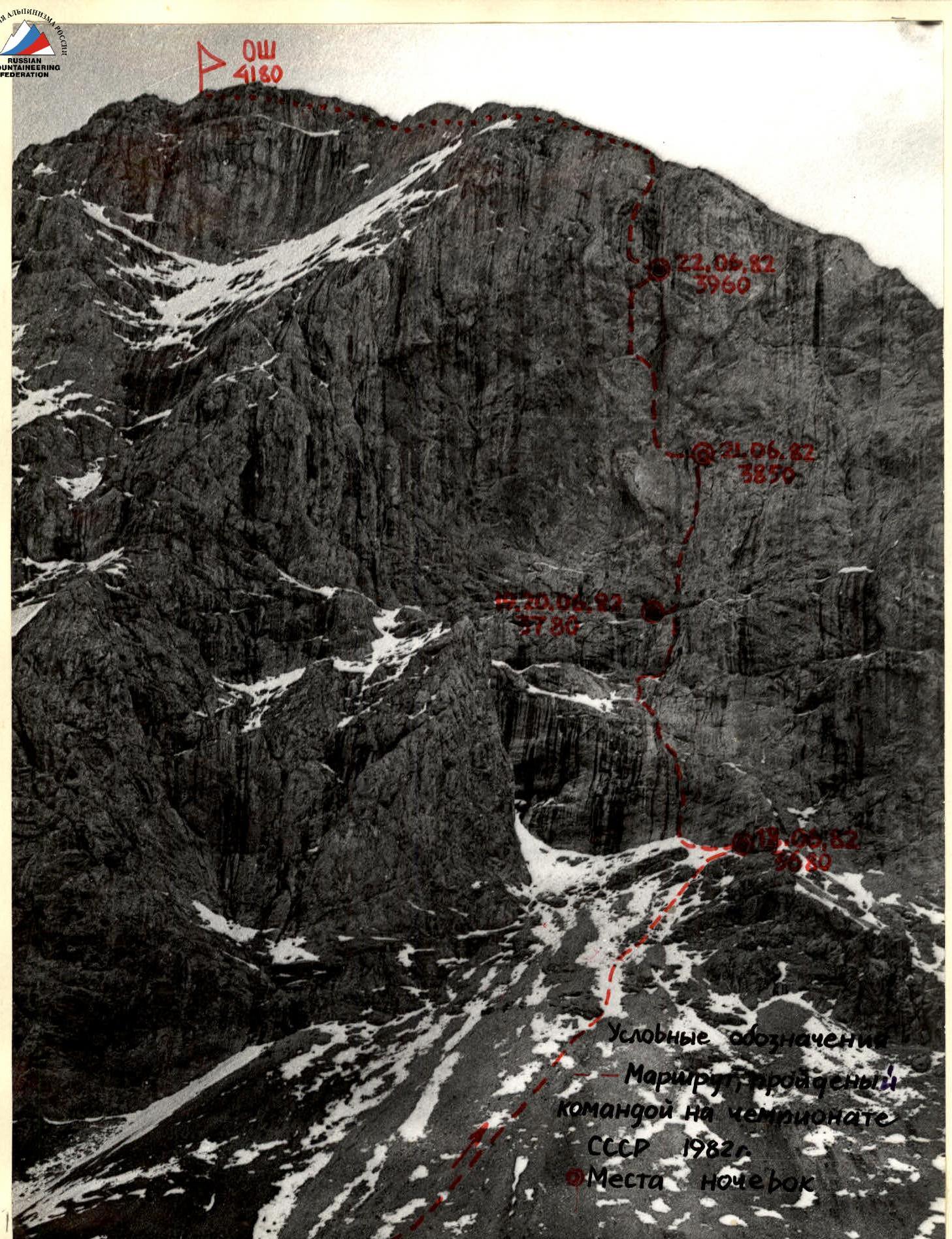
General photo of the summit

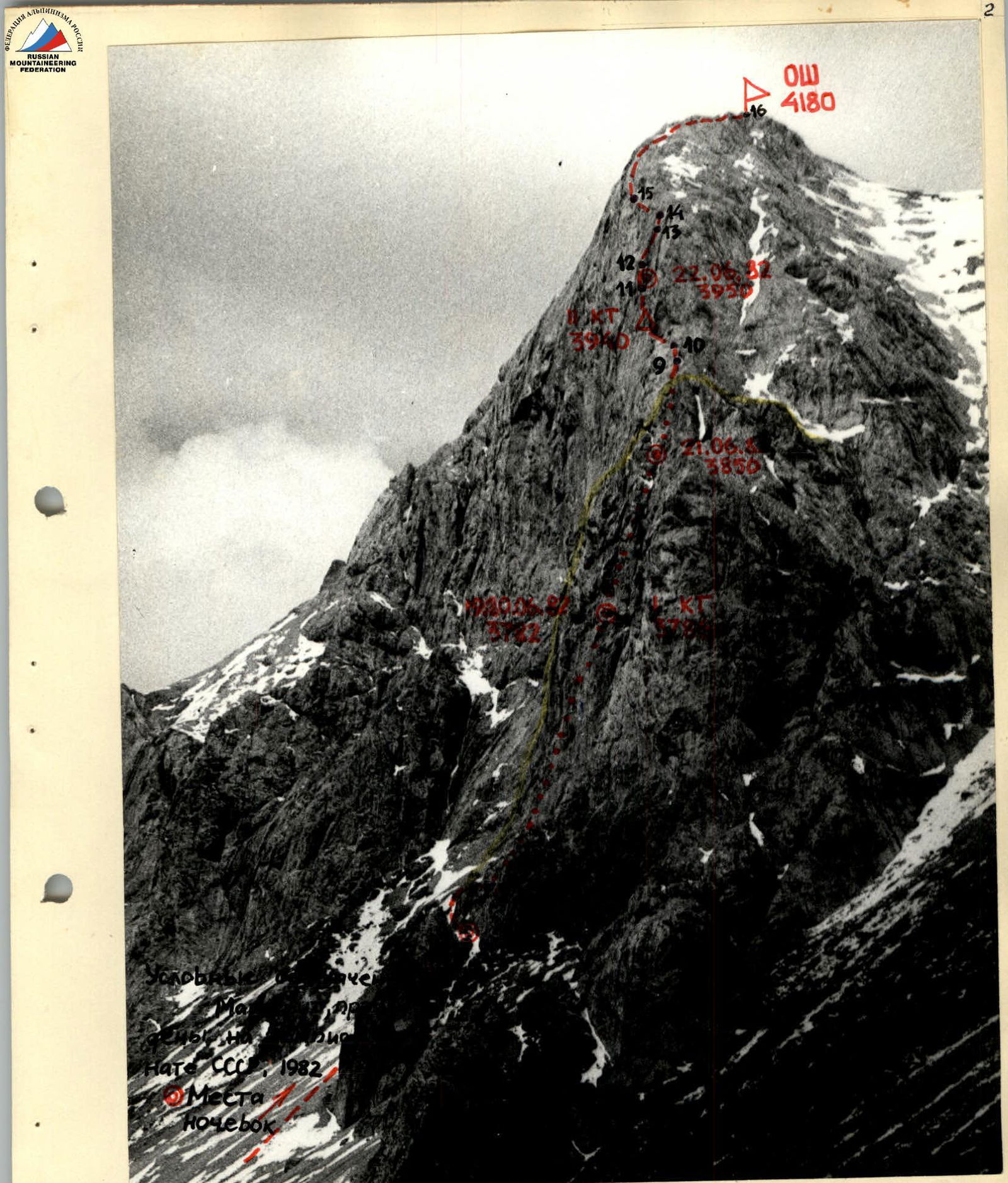
Half-profile of the wall on the right
Tactical actions of the team
Team members' daily tasks were planned considering: – the wall's great steepness; – the nature of the rock relief; – safety and convenience of overnight stays.
Niches (grottos) at points R3 and R11 were discovered during observations using binoculars. When drawing up the tactical plan, it was decided to have the first overnight stay after the second day, as frequent precipitation in the second half of the day made staying in hammocks tiring.
Team duties were distributed as follows: – Blažaitis and Pundzius took turns processing the route. The rotation of leaders was based on their individual qualities for handling complex sections. – Baėras and Virbalis pulled up backpacks where necessary, organized bivouacs, maintained radio communication, sketched the route, and occasionally belayed the lead climber.
On the first day, Pundzius processed the route. Blažaitis belayed. The first rope team started ascending after processing section R0–R2. The logical path of the route goes 10 m to the right of the I-st grotto, where the overnight stay was planned. After processing 20 m of section R3–R4, securing the rope at point R4, it was convenient to swing into the grotto, also laying horizontal handrails from the route to the grotto. The tent was tightly set up here, secured with two bolt pitons. There were no crevices.
Analysis of weather observations in this area showed that in the second half of the day, there is almost systematic rain or wet snowfall.
By 15:00 on the first day of ascent, due to snowfall, the rock relief became very slippery, and free climbing was excluded. Pundzius descended from point R4 into the grotto.
Throughout the ascent, the previous day's ropes were found to be icy in the morning, which must be taken into account when selecting clamps.
II day. Section R4–R8 was processed by Blažaitis with Baėras belaying. As planned, the bivouac in the grotto was not dismantled. The rest of the team could only ascend after fully laying out the R3–R5 section's ropes. Otherwise, the whole team would be on the same vertical line, without shelter from random rockfall in the icy inner corner. While the pair processed section R6–R8: – Pundzius freed section R3–R5 from intermediate pitons. – Hung a parallel 90 m rope from the bivouac in the grotto to point R5.
From 17:00, snowfall began. The team continued working until 19:00.
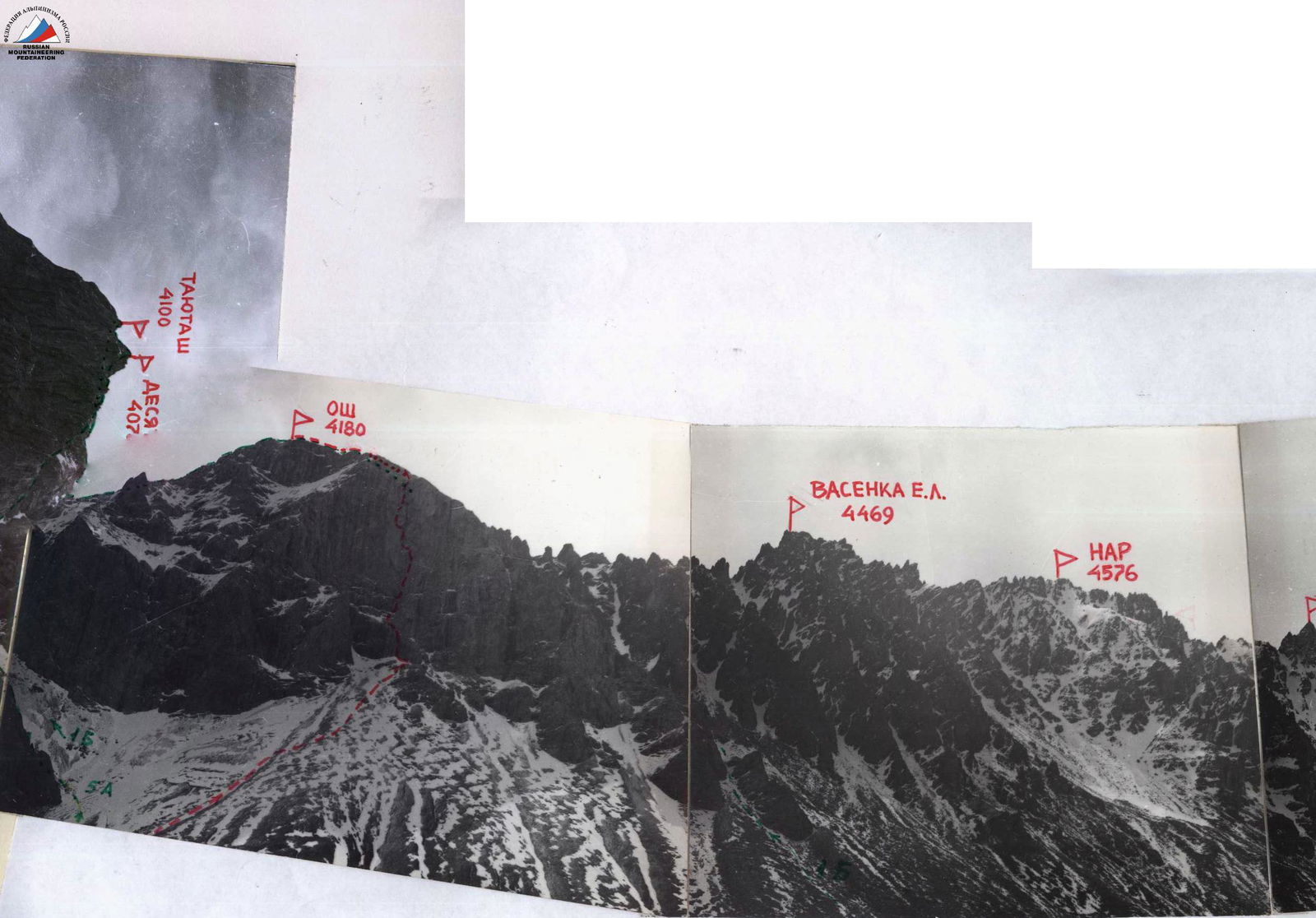
Vasenka E.A.
Section R7–R8 was climbed using a platform. After hanging a free rope, they descended down to the I grotto. At point R5, they found a platform where the next overnight stay could be arranged.
III day. The Pundzius—Blažaitis pair ascended via the ropes for further wall processing. Virbalis followed them to organize the extraction of backpacks to point R5. Baėras, securing the backpacks and staying in the grotto, was in complete safety. Pundzius processed the route up to point R10. Here, they waited out bad weather for 3 hours, which did not allow them to reach the next II grotto. Therefore, they decided to set up an overnight stay at point R5. By evening, the weather improved, and they managed to process another 20 m of wet rock. They used a platform. After securing the rope and removing intermediate pitons, they descended to point R5, where the second pair struggled to set up a tent.
IV day. Blažaitis went out to process the wall. Pundzius belayed. Baėras ascended to the R10 ledge to pull up backpacks. Blažaitis laid out ropes up to the II grotto, where there was an absolutely safe place for a bivouac. At 12:00, bad weather began, halting their ascent until 18:00. For the remaining daylight, Blažaitis, with Pundzius belaying, went above the R14 balcony. By this time, the second pair had pulled up the backpacks and set up a bivouac in the II grotto (point R12). After securing the ropes, Blažaitis descended to the tent.
V day. Baėras went first. Blažaitis belayed. Ropes were needed up to the pre-summit ridge (point R15). The rest of the way to the summit was a simultaneous movement of the rope teams.
Throughout the route, the first rope team secured the main rope to their harness via shock absorbers.
Section R3–R14 was climbed on a double rope, except for the traverse R5–R6. Thanks to the successful location of overnight stays, during route processing, the second rope team, and when pulling up backpacks, the lower climber, was completely safe from accidentally dislodged stones. In all overnight stays, the belay rope was taut on both the outside and inside of the tent. There were no falls or injuries.
Due to frequent bad weather in the second half of the day, route processing was slowed down. They used 1 reserve day provided for in the tactical plan. At all stages of the ascent, there was: – direct visibility with observers; – regular and reliable radio communication.
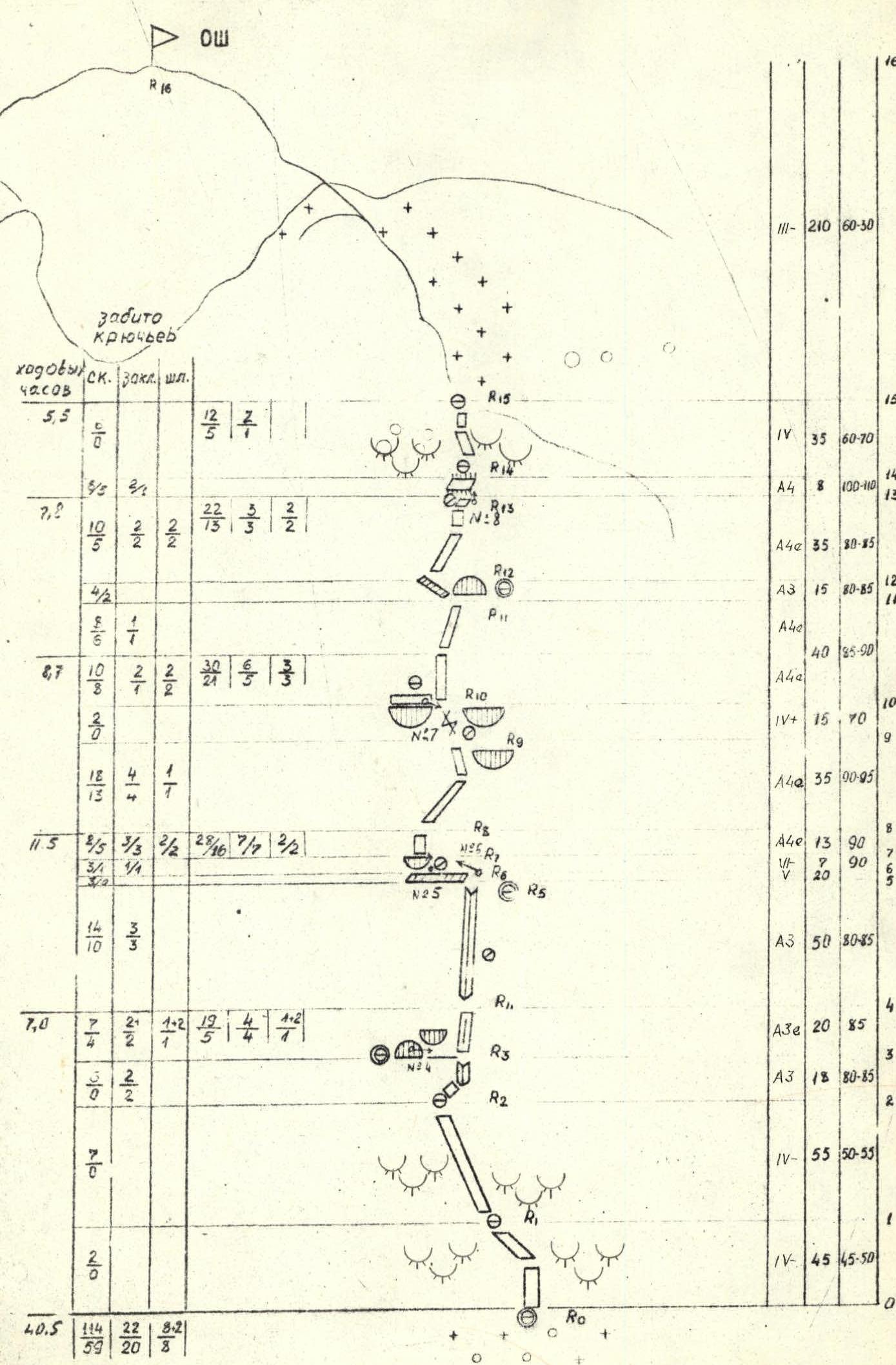
Route scheme. Scale 1:2000
| Category | Length, m | Steepness, ° |
|---|---|---|
| IV | 210 | 60–30 |
| IV | 35 | 60–70 |
| А4 | 8 | 100–110 |
| А4 | 35 | 80–85 |
| А3 | 15 | 80–85 |
| А4 | 40 | 85–90 |
| IV+ | 15 | 70 |
| А4 | 35 | 90–95 |
| А4 | 13 | 90 |
| V | 20 | 65 |
| А3 | 50 | 80–85 |
| А3е | 20 | 85 |
| А3 | 18 | 80–85 |
| IV– | 55 | 50–55 |
| V– | 45 | 45–50 |
Description of the route by sections
Day I. June 19, 1982. Departure at 8:00 from the initial bivouac, conveniently and safely set up between a large stone and the wall 100 m away. We ascend via wet "ram's foreheads" (R0–R2) to a small broken ledge half a rope length below the grotto. It's a convenient place for the rest of the team to gather. On the right side, there's a not very deep, icy inner corner (R2–R3) in a monolithic wall. Above the grotto's level, when driving in a piton, the rock flakes off (R3–R4). For reliable belay, we drove in one piton. By 15:00, dense clouds gave way to bad weather. The leader's work became unsafe. The team gathered in the grotto. Here, as well as during the 10 m traverse to it, there were no crevices. There was enough snow nearby for water. The monolith above the grotto overhangs.
Day II. June 20, 1982. The whole day was planned to process the wall without dismantling the bivouac. At 7:30, the first climber ascended via the centimeter-thick ice covering the ropes. The 50-meter inner corner (R4–R5) forms the right side of a large triangular delamination of the wall. The sides are monolithic. In many places, they are icy, which forced the use of artificial aids 13 times. On this and subsequent sections where ladders were used, a piton was used, fixed below the knee, for stability when working from the top rung of the ladder. The inner corner ends with a negative step under a massive overhanging wall. The upper part of the delamination is a narrow horizontal ledge (R5–R6). 20 m to the left on this ledge, sharp "feathers" (R6–R7) that almost don't touch the wall look impressive — photo 6. It's the most optimal place to start the assault on the wall. At the beginning, the wall is monolithic (R7–R8). It's necessary to use a platform (photo 5). Higher up to the left, there's a thin delamination, receding 5–10 cm from the wall. It's the only crack, but it doesn't inspire great confidence. For the time being, while overcoming the wall, the belayer (R7–R9) has a relatively convenient and safe place on a ledge 2–3 m short of the "feathers". We worked for 2 hours in snowfall. By 19:00, the weather finally deteriorated. The Blažaitis—Baėras pair descended via the ropes to the I grotto for an overnight stay.
Day III. June 21, 1982. We departed at 7:15. Pundzius processed the wall (R8–R9) in the direction of the waterfall, on the path of which the II large grotto is located. For the first time, we crossed the waterfall by traversing a ledge (R5–R6), but it didn't concern us, remaining behind our backs. Now, the rock relief suggests climbing directly into the water streams. In many places, the first climber used artificial aids. Under the waterfall, there's a safe but very unpleasant place for the belayer. An inclined slab (R9–R10) (photo 7) leads to the base of the next 40-meter wall onto a good ledge 20–30 cm wide. Here, we waited out bad weather for 3 hours. At the beginning, the wall (R10–R11) is wet and monolithic. We drove in 2 bolt pitons. By evening, we processed half a rope length.
Day IV. June 22, 1982. At 7:15, we set out to further process the wall. The Blažaitis—Pundzius pair led. Baėras organized the extraction of backpacks onto the R10 ledge. In several places, the first climber used a platform. In the upper part of the wall, in the monolith, clean, not deep cracks appear. On relief protrusions, there's snow or formed ice. When approaching the II grotto, the cracks are filled with ice. The entire lower side of the II grotto is covered with formed ice. Today, bad weather started earlier than on previous days, by 12:00. Using the ropes in bad weather conditions, the second team member ascended to the II grotto. It's partially icy, with water flowing down the wall. It's a convenient place for a bivouac after intense wall work. By 18:00, the bad weather passed. We continued processing the route in the direction of the balcony. To the left, a narrow inclined ledge (R11–R12) departs, forming the only very shallow crack at the junction with the wall (R12–R13). All protrusions are covered with wet snow. In the upper part, the cracks form small delaminations, monolithic from the wall. Under the yellow balcony (R13–R14) — a smooth, steep slab. We exited from under the balcony using a platform. Photo 8.
Day V. June 23, 1982. Baėras worked first: from the balcony to the pre-summit ridge, there are constantly flattening "ram's foreheads" (R14–R15). The pre-summit ridge — snowy rocks 2–3. We were at the summit cairn at 13:00. Descent on R13 via a snowy-moraine slope.