

Ascent Logbook
- Ascent class — technical
- Ascent area, Pamir range, Kichik-Alay
- Peak, its height, ascent route — Pik Bratyev Kadomtsyevyx, 4670 m, via the right part of the northwest face
- Expected difficulty category 5B
- Route characteristics: height difference of the wall section 540 m, total 770 m.
Length of sections with 5–6 cat. diff. 603 m. Average steepness 71°
- Pitons used: for belaying on rock — 166 ice — 6 bolted — for creating anchor points on rock — 16 ice — bolted —
- Total climbing time 31.5 hours
- Number of bivouacs and their characteristics — two bivouacs on the wall, including: one semi-reclined, one seated
- Surname, name, patronymic of the leader, participants, and their qualification Leader: Varov Viktor Ivanovich, Candidate Master of Sports
Participants:
- Antipin Vitaliy Mikhaylovich, Candidate Master of Sports
- Martirosyan Albert Aleksandrovich, Candidate Master of Sports
- Semyonov Vyacheslav Ivanovich, 1st sports category
- Gatanov Sergey Borisovich, 1st sports category
- IO, 1st sports category
Team coach: Troshchinenko Leonid Andreyevich, 2nd sports category.
Date of departure and return:
- Departure on the route: February 8, 1982
- Return to the base camp at "Leskhoz": February 13, 1982
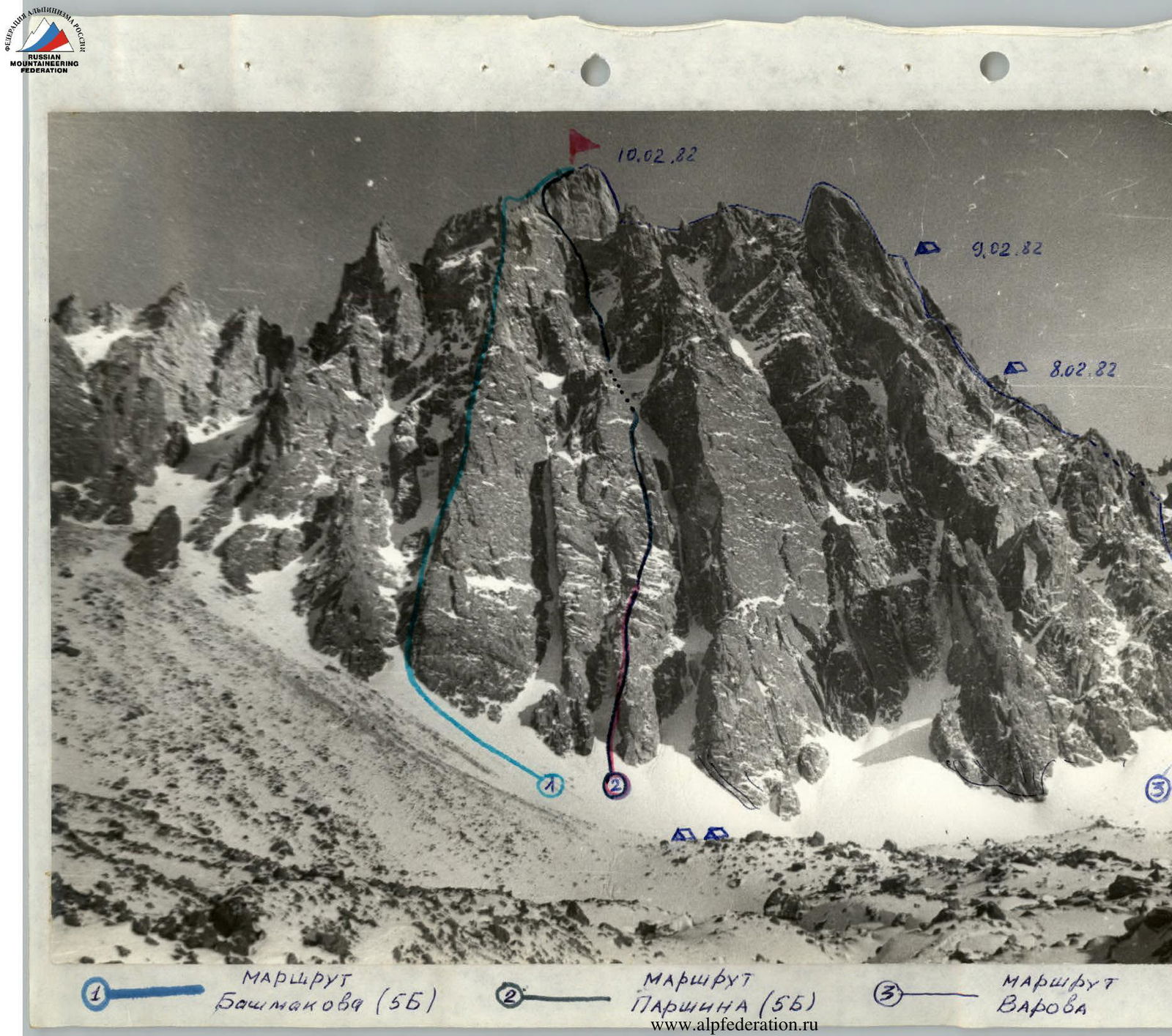
Route Diagram in UIAA Symbols
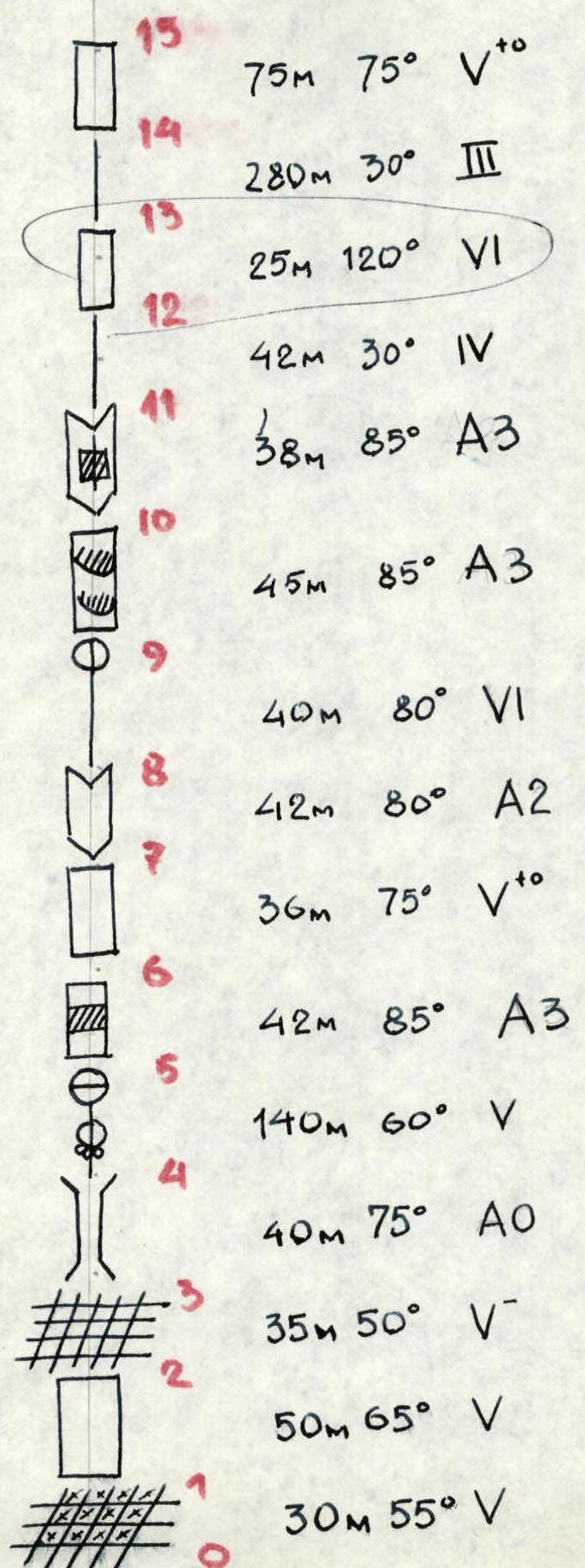
TABLE OF MAIN CHARACTERISTICS OF THE ASCENT ROUTE
| Date | Section designation | Average steepness | Length (m) | Terrain characteristics | Difficulty | Condition | Weather conditions | Rock/ice pitons | Bolts |
|---|---|---|---|---|---|---|---|---|---|
| I | 2 | 3 | 4 | 5 | 6 | 7 | 8 | 9 | II |
| 8.02.1982 | R0–R1 | 55° | 30 | snow-covered rocks | 5 | semi-destroyed | good | 4 | - |
| 8:00–18:30 | R1–R2 | 65° | 50 | wall | 5 | smoothed | good | 10 | - |
| R2–R3 | 50° | 35 | "ram's foreheads" | 4–5 | monolithic | good | 4 | - | |
| R3–R4 | 75° | 40 | chimney | 5–6 | verglaced | good | 12/1 | 1 | |
| R4–R5 | 60° | 140 | buttress, blocks | 5 | semi-destroyed | good | 28 | - | |
| Total for the 1st climbing day: 295 m | |||||||||
| 9.02.1982 | R5–R6 | 85° | 42 | wall, cornices | 6 | hard limestone | overcast, wind | 14 | - |
| 9:00–19:00 | R6–R7 | 75° | 36 | wall | 5–6 | monolithic, verglaced | overcast, wind | 7/2 | - |
| R7–R8 | 80° | 42 | internal angle | 6 | monolithic, verglaced | overcast, wind | 14 | - | |
| R8–R9 | 80° | 40 | buttress | 5–6 | monolithic | snow, wind | 12 | - | |
| R9–R10 | 60° | 45 | wall | 5–6 | monolithic | overcast, wind | 14 | - |
Brief Explanation of the Main Characteristics Table
Section R0–R1: Represents destroyed snow-covered rocks. Many loose rocks. Passed with free climbing. Piton belay.
Section R1–R2: Steep snow-covered wall. Free climbing. Thin belay pitons.
Section R2–R3: "Ram's foreheads", quite steep. Rock is monolithic. Piton placement limited.
Section R3–R4: Large chimney. Climbed on the left part. Piton belay, chocks. Upper part with artificial holds.
Section R4–R5: Buttress composed of large blocks, partially destroyed. Piton belay. Free climbing. Small ledge at the end. Bivouac.
Section R5–R6: Monolithic wall, "overhangs" with two cornices in the middle. Free climbing. Cornices passed with artificial holds. Piton belay, chocks.
Section R6–R7: Continuation of the wall and exit to a small ledge to the left. Control cairn. Free climbing. Caution! Verglaced.
Section R7–R8: Huge internal angle. Monolithic rock with verglaciation. Chocks work well. Middle and upper parts with artificial holds.
Section R8–R9: On this section, the internal angle forms a small buttress on its right part. Free climbing, difficult. Small ledge at the end. Seated bivouac.
Section R9–R10: Steep wall. Climbing with artificial holds. Piton belay, chocks. Monolithic rocks, partially overhanging.
Section R10–R11: Internal angle with a cleft. Artificial holds. Verglaced. Very difficult.
Section R11–R12: Sharp ridge from the peak gendarme. Caution! Loose blocks. Limited piton placement.
Section R12–R13: Rappelling wall. Loop at the top.
Section R13–R14: Destroyed ridge. Belay through a protrusion, pitons.
Section R14–R15: Pre-summit wall. Monolith. Difficult climbing.