

Klabo — a technical route in the Pamir-Alay mountain system, the northern spurs of the Alay Ridge, the Gumush gorge, the West Gumush peak, height — 5200 m above sea level, along the center of the north face (S. Efimov's route). Classified as 5B category of difficulty (official), proposed — 6 category of difficulty.
Main characteristics of the route:
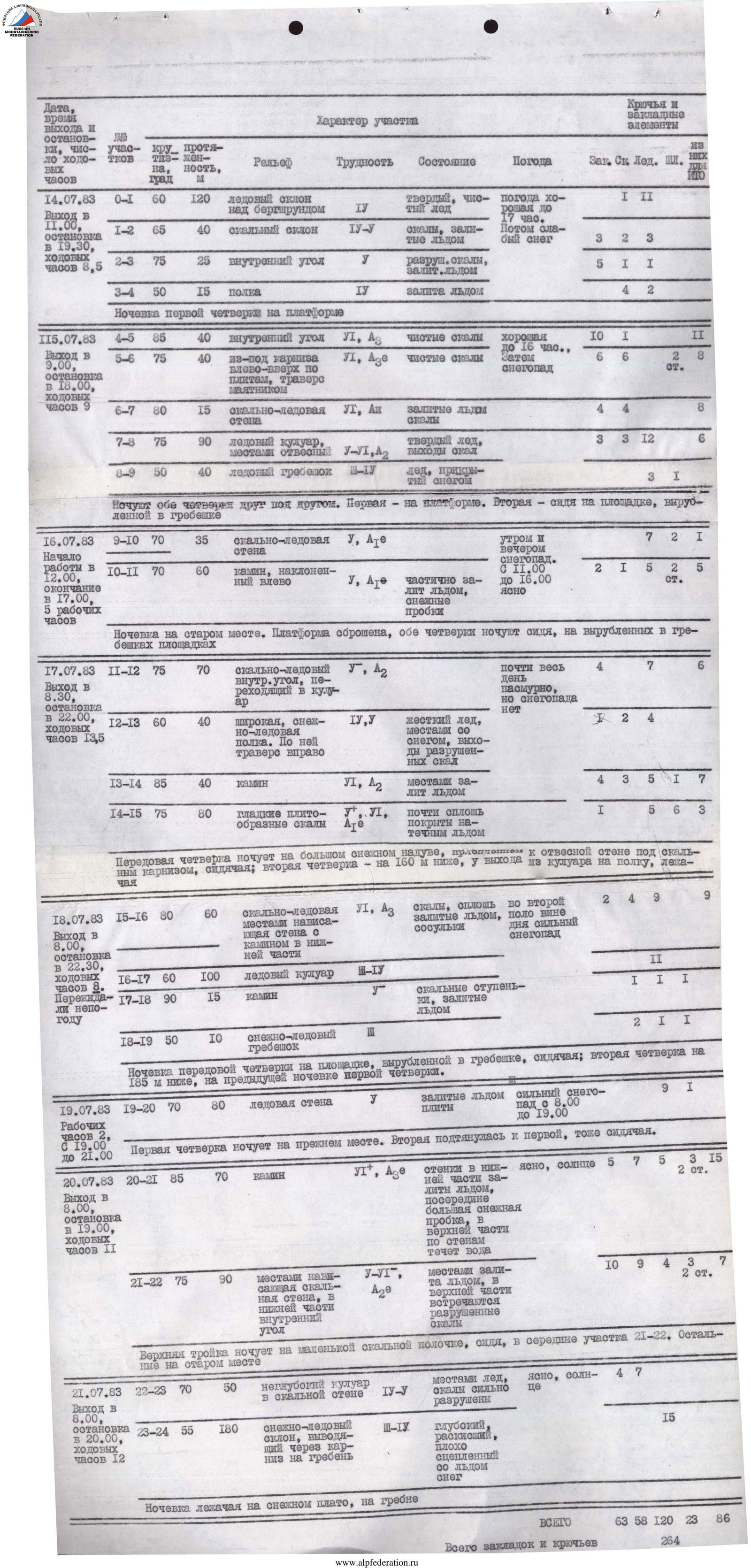
- Length — 1400 m
- Height difference — 1100–1200 m
- Average steepness — 70°–75°
- Length of sections with 5–6 category of difficulty — 875 m
Number of pitons hammered and placement elements used:
-
Placement elements — 63
-
Rock pitons — 58
-
Ice pitons — 120
-
Bolt pitons — 23 (8 of them are old)
-
Total — 264, 86 of them are IT
-
Number of climbing days — 8
-
Climbing hours — 69
-
7 bivouacs on the route, all sitting
Team of LOS DSO "Burevestnik"
Team composition:
- Captain: KALMYKOV Sergey Georgievich — Master of Sports of the USSR
- Deputy captain: MOSHNikov Anatoly Ivanovich — Master of Sports of the USSR
- Participants:
- BADANIN Nikolay Alekseevich — 1st sports category
- BOTOV Dmitry Alexandrovich — 1st sports category
- IVANOV Andrey Konstantinovich — 1st sports category
- KRITsUK Alexey Georgievich — 1st sports category
- SORKIN Alexander Davidovich — Candidate for Master of Sports
- TOTMYANIN Nikolay Alekseevich — 1st sports category
- Coach: A.I. MOSHNikov
Ascent completed on July 21, 1983.
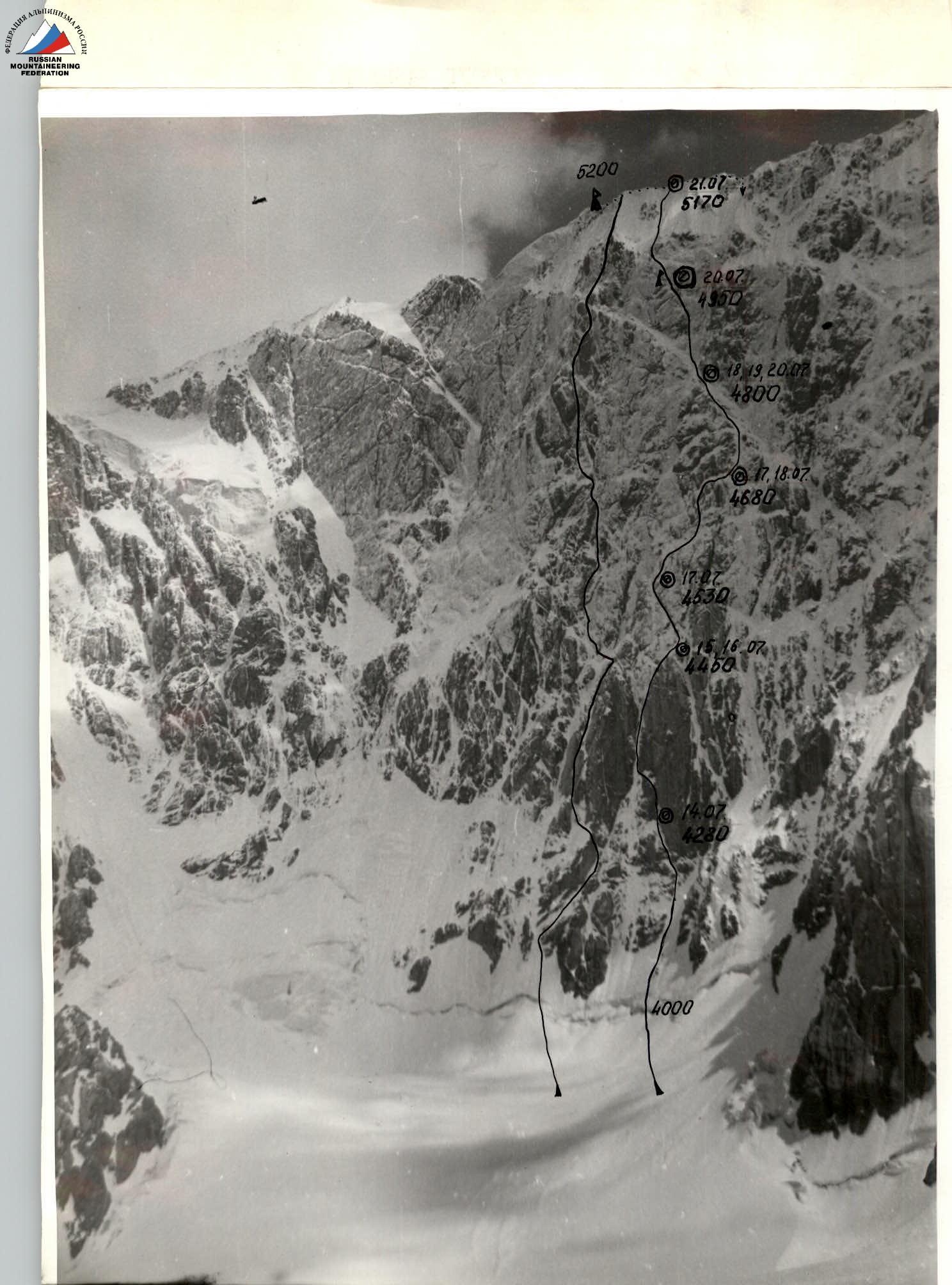
Photo of the general view of the route. To the left is Yu. Gorenchuk's route.
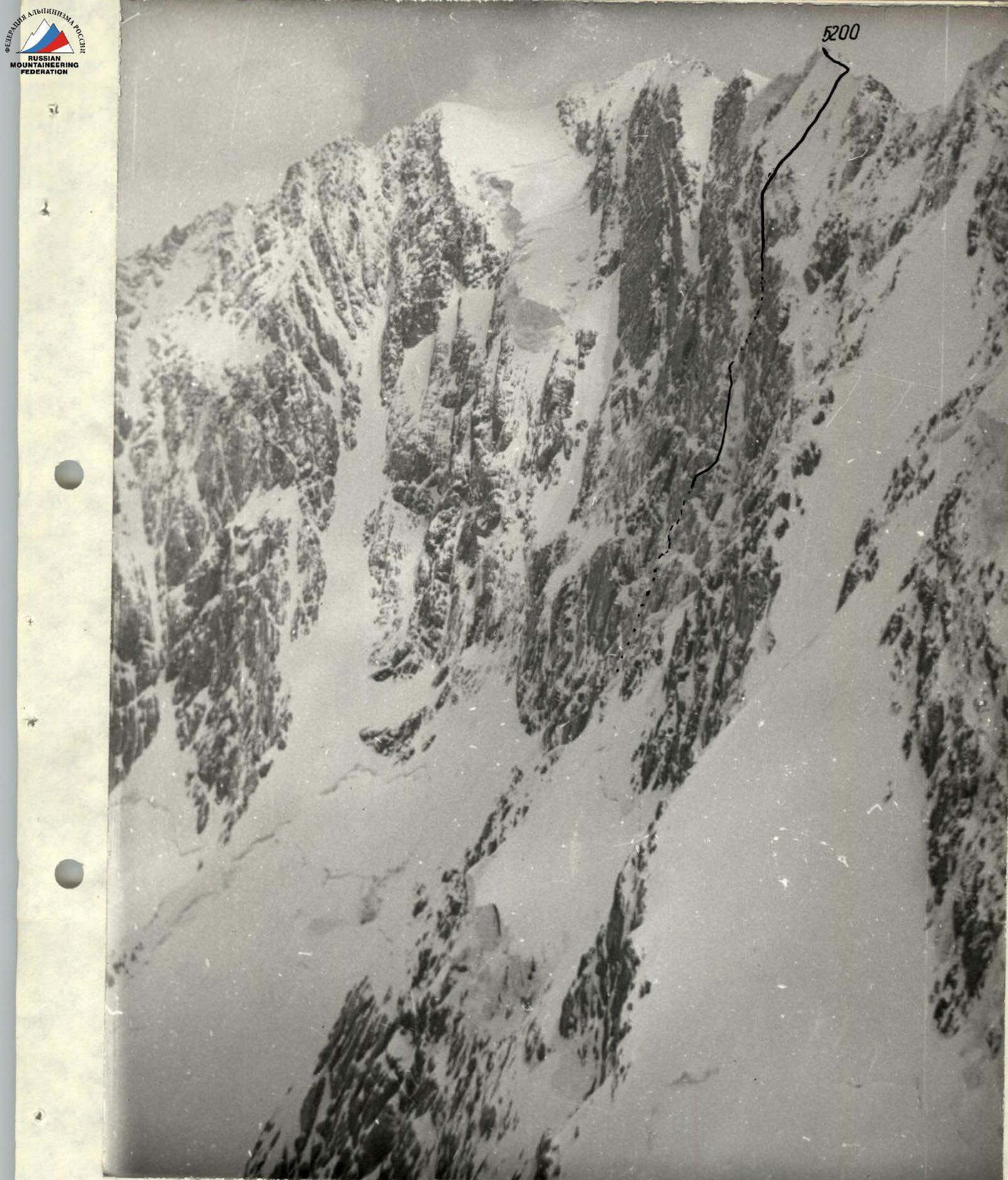
Profile of the route. Shot from p. Karaganda, Lebedikhin's route.
Explanations for the table of main characteristics
On July 14, 1983, at 6:00, the first four participants, consisting of MOSHNikov, BOTOV, KRITsUK, and TOTMYANIN, leave the base camp for the ascent. At 8:30, they are already in the assault camp on the moraine in the circus under the wall. After replenishing their load from the dump in this camp, the group begins to approach the wall. Two hours later, TOTMYANIN, going first, squeezes through the sheer wall of the bergschrund and approaches the base of the lower bastion of the wall — the "iron". The lower rocks are not steep, but now they are all covered with ice, so it's already difficult here. MOSHNikov goes forward. Having passed one rope length, he approaches the base of a huge internal corner. 20 meters above, there is a wide inclined step covered with ice. Above the step, the steepness of the corner increases sharply, and nowhere ahead is a suitable place for an overnight stay visible, so they will have to spend the night here. The ledge is quite sloping and not very suitable for an overnight stay, but the suspended platform should help. While TOTMYANIN and KRITsUK climb onto the ledge, hang the platform, and set up a tent on it, MOSHNikov and BOTOV continue to work up the corner. They manage to process another rope length above the overnight stay. Climbing is very difficult, and they often have to use IT. It's good that the rocks here are relatively clean and dry.
The second half of the group arrives at the new camp (PBase) by evening. In the evening, it's lightly snowing.
On July 15, 1983, from the upper end of yesterday's processing, they manage to climb a few meters higher, but further on, a huge cornice blocks the path along the corner. Some relief under the cornice is visible to the left and upwards, but it disappears after 15 meters. MOSHNikov, going first on TOTMYANIN's belay, decides to traverse left and down to the left edge of the "iron" with a pendulum.
It's very difficult to enter the steep ice couloir bordering the "iron" on the left.
From this point on, they can forget about clean rocks. Ice will dominate the rest of the route. Tоля puts on crampons and starts using ice axes. In the couloir, the lower four catch up with the upper four, and everyone patiently hangs under the rain of small crushed ice. The weather starts to deteriorate, but the exit to the top of the "iron" is already visible: the steepness of the right side of the couloir decreases — the group emerges onto a snow-ice ridge.
While the lower four are cutting out a platform in the ice, and MOSHNikov and TOTMYANIN are hanging the platform, KRITsUK starts working further — traversing left along the ice wall to the base of a tilted chimney. However, the snowfall gradually intensifies, and they can't make any progress.

On July 16, 1983, the morning bad weather prevents them from starting work early. By mid-day, KRITsUK approaches the beginning of the chimney and gets stuck there for a long time. This place turns out to be very difficult:
- the right wall of the chimney overhangs throughout its entire length;
- the left wall breaks off with a large cornice.
They are saved by an old bolt piton dug out from under the ice flow — it's hammered in the most needed place.
Before the evening snowfall starts, they manage to pass through the chimney and enter the next vertical internal corner filled with ice.
In the morning of this day, they dropped a platform to the observers. Its frame couldn't withstand the load and broke tonight. However, it managed to fulfill its task — providing the first four with a night's stay on the "iron" wall on the first night.
On July 17, 1983, the first to work is the team of BADANIN — SORKIN. Having passed about 2 rope lengths along the corner, they exit onto the so-called "shelf". This is a rather steep ice slope that allows them to move about 40 m to the right. Further, the shelf rests against the failure of a giant internal corner descending from above.
At this point, the double team MOSHNikov — KALMYKOV replaces the ones ahead. The relief above is bleak. MOSHNikov chooses a steep, overhanging chimney in its lower half for the ascent. However, there isn't too much ice in it, and they even manage to pass the upper part of it with free climbing. Further above their heads are grandiose cornices, and to the right and upwards are spacious fields of ice-covered smooth slabs. Tоля moves along the slabs. This section of the route is extremely unpleasant: there are no cracks in the slabs, the ice layer is thin and unreliable. MOSHNikov moves on crampons from one belay point to another, covering huge distances of 10–15 m, but the steepness is 75°, and belaying is still necessary. Therefore, he has to hammer in bolt pitons, which takes a lot of time and effort, especially when drilling a hole with a piton, standing on the front teeth of crampons at the upper edge of the ice flow. It's getting dark, and there's still no small ledge on the wall. The lower four shout to the upper team and receive permission to spend the night at the very beginning of the shelf, on a small snow ridge. Already in complete darkness, Tоля climbs onto a huge snow drift stuck to the sheer wall under a large rock cornice. Two bolt pitons are hammered in, a tent is hung, and the four settle in for the night at 12 o'clock.
On July 18, 1983, at 8:00, MOSHNikov descends from the snow drift and, moving to the right, goes around the edge of the outer corner — the right edge of the wall along which the group was climbing yesterday. Here, he enters a chaos of ice flows, icicles, completely covering the sheer wall, the top of which is hidden in the fog. Having worked 40 m and making sure that it leads to the long-awaited couloir — the right lower leg of the snow-ice "X" clearly visible from below on the wall, Tоля descends to the snow drift to coordinate the actions of the lower four, whose voices are now clearly audible. The team of IVANOV — BADANIN — KALMYKOV goes up. Having passed the slightly overhanging upper 15 m of the rock-ice wall, they enter a wide ice couloir. This, as it turns out later, is the only easy place on the wall — calm ice with a steepness of 55°–65°. However, as soon as the three reach the middle of the couloir, around 12:00, a heavy snowfall starts. Two hours of futile attempts to move further — and the leading team freezes, standing knee-deep in the snow stream rushing along the bottom of the couloir. MOSHNikov is caught by the bad weather on the wall when approaching the couloir, and, half-choked by the snow stream, he is forced to return under the cornice. Only around 18:00 does the snowfall subside, and the group gets a chance to work further. In the twilight, the leading four (MOSHNikov still manages to break into the couloir) reach the top of the couloir and set up a tent at the intersection of the "X". Already in the dark, the last pitons are hammered in today. The lower four occupy the previous bivouac. It snows at night. The upper tent turns out to be standing (though on a ridge) on the path of the snow stream flowing from the upper part of the wall, and its inhabitants have to fend off the snow covering them all night.
On July 19, 1983, at 8:00, taking advantage of a brief clearing in the weather, the lower four catch up and, in the starting snowfall, set up their tent three meters below the first one. Again, snow, and they sit almost the whole day. By evening, the snowfall subsides, and the sun even comes out. From 19:00 to 21:00, the team of BOTOV — TOTMYANIN passes two rope lengths to the left and upwards along the ice wall to the base of the upper bastion.
On July 20, 1983, they finally wait for good weather! The university team TOTMYANIN — KRITsUK quickly moves upwards; Kolya starts working on the upper bastion first. The only path here is a large (about 80 m high) vertical chimney. In its lower part, it's filled with ice, in the middle — a snow-ice plug. Hours pass slowly. Those remaining at the tents watch the work of the first ones with tension. After 4 hours, MOSHNikov climbs up, replaces the tired TOTMYANIN; another 2 hours, another 30 m — and the chimney is passed. Undoubtedly, this is the most difficult part of the route. SORKIN and KALMYKOV move up from the overnight stay — it seems like just a little more, and the wall will be overcome.
Above the chimney, as if its continuation, is an internal corner that soon fades away and disappears. It's here that they find a control point of the first ascenders in a tin can hanging on a piton. Here they are — the second ascenders.
Further, the wall is rocky, clean, dry, but still steep, with sheer sections. On one of them, MOSHNikov falls. The fall is arrested by TOTMYANIN, and Tоля tries to continue working, but no — pain in the bruised ankles doesn't allow him to do so, and he descends to a small platform to the control cairn. KALMYKOV and SORKIN are already here.
The three, after consulting, decide to spend the night here, leaving the rest at the previous site. After finishing the rope, KRITsUK and TOTMYANIN descend, carrying fresh instructions down.
On July 21, 1983, having made sure that Tоля's legs are more or less okay, KALMYKOV and SORKIN start working — they have about 2 rope lengths left to the top of the wall.
The last obstacle:
- a 10-meter sheer drop with a bolt piton stuck in it by EFIMOV;
- 60 m of broken rocks;
- a steep rocky ridge covered with ice.
The wall is finished. Ahead is a snow-ice slope with cornices hanging under it. However, it's already 15:00. Deep snow, poorly attached to the ice substrate, has become wet. Only at 21:00 does the last participant climb over the cornice.
They remove the last ropes, set up bivouac tents. In the red rays of the sunset, under the first stars, they head to the summit cairn. Tomorrow, they will descend into the beautiful and warm Dzhailisu valley.
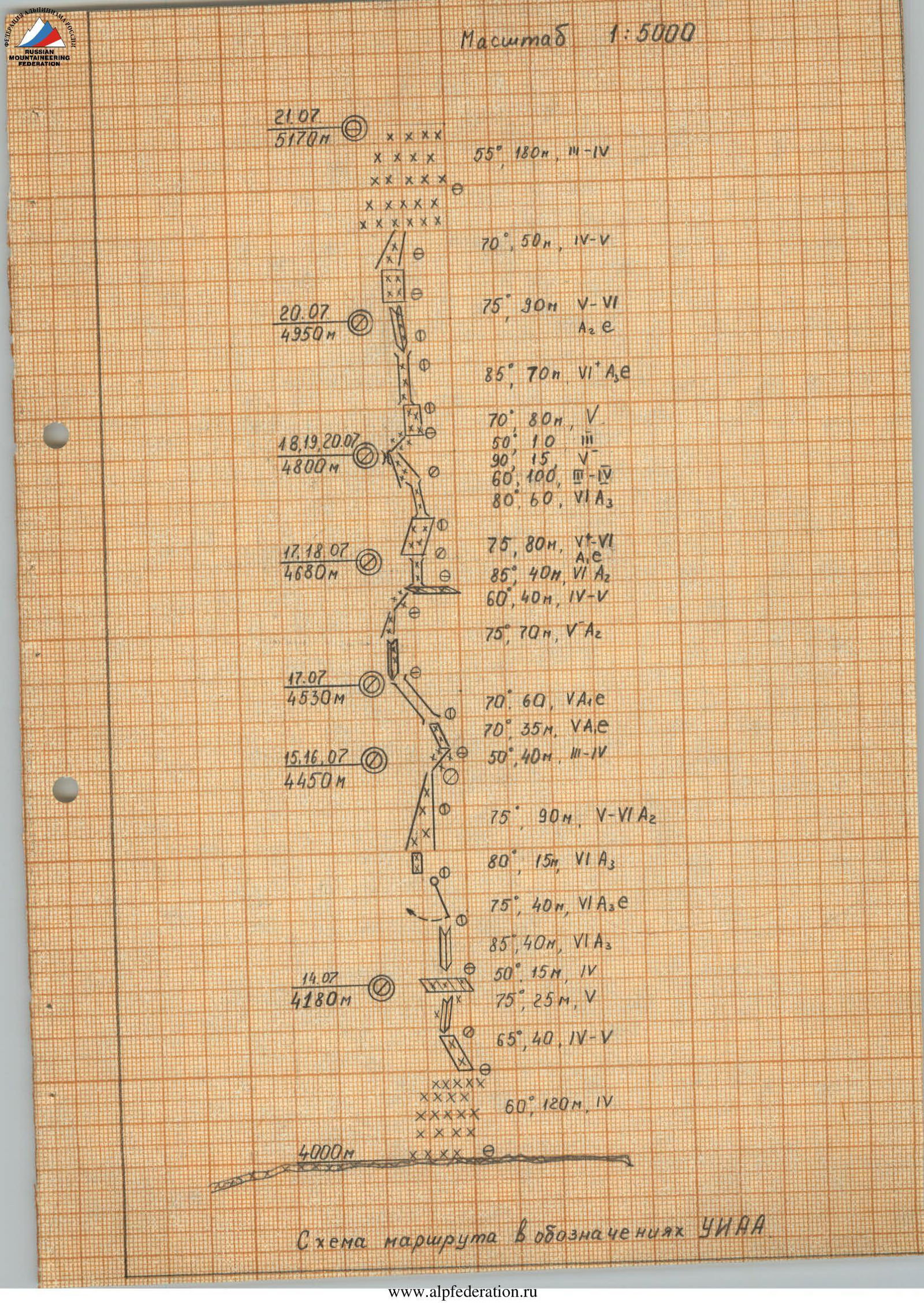
Scale 1:5000
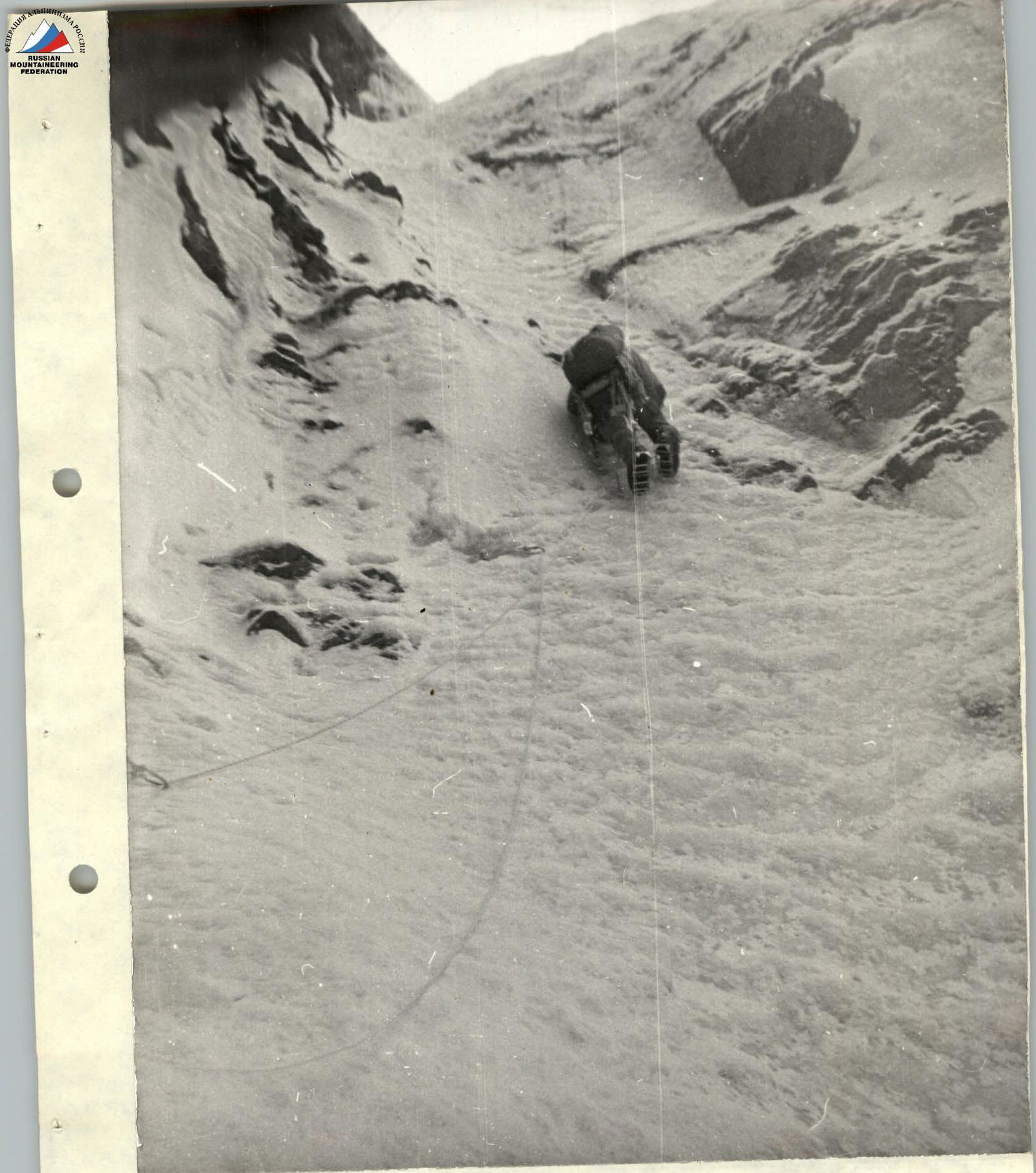
Section R7–R8. Exit from the ice couloir to the top of the "iron".
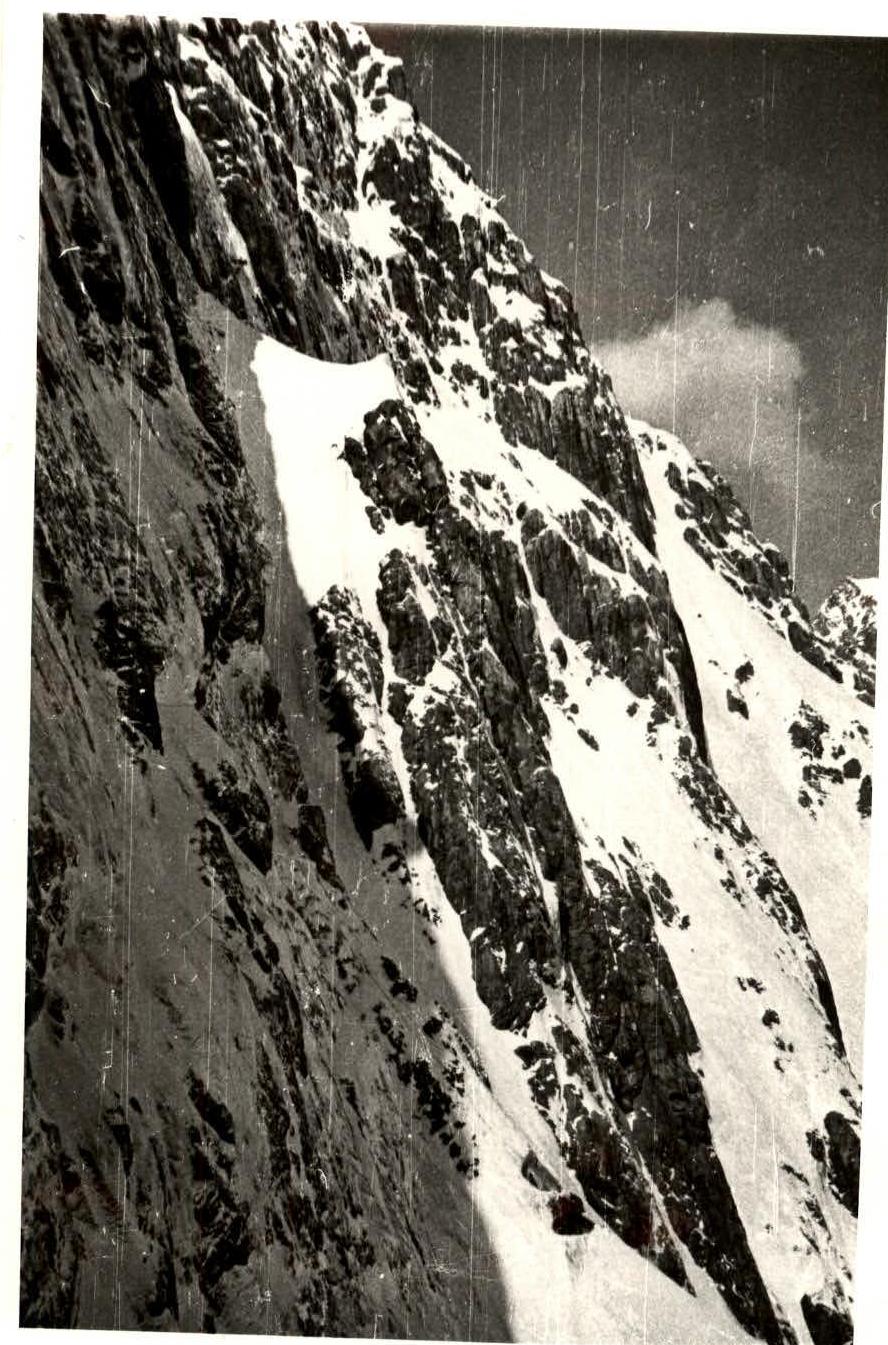
Section R8–R9.
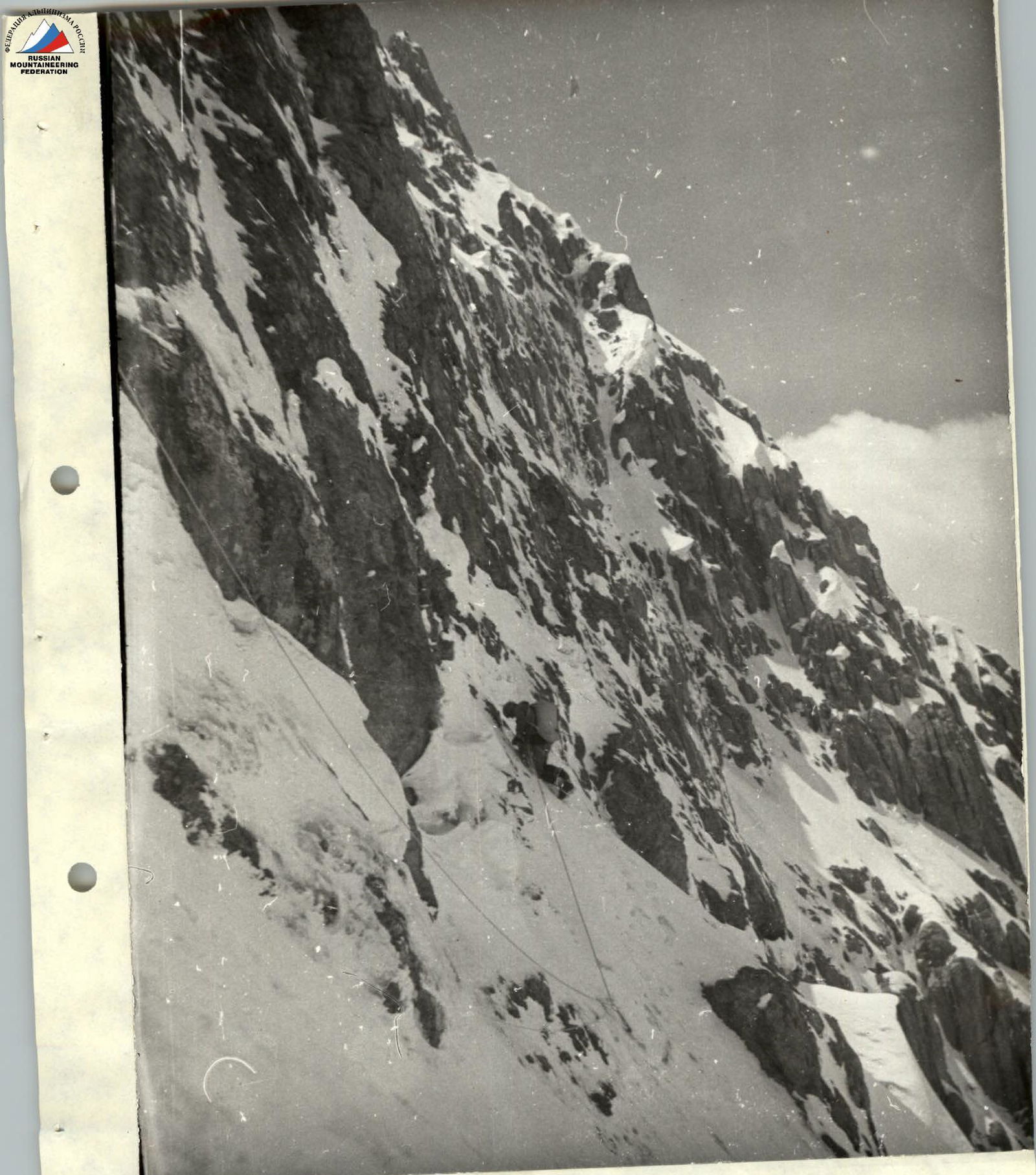
On section R12–R13. Traverse of the snow-ice shelf.
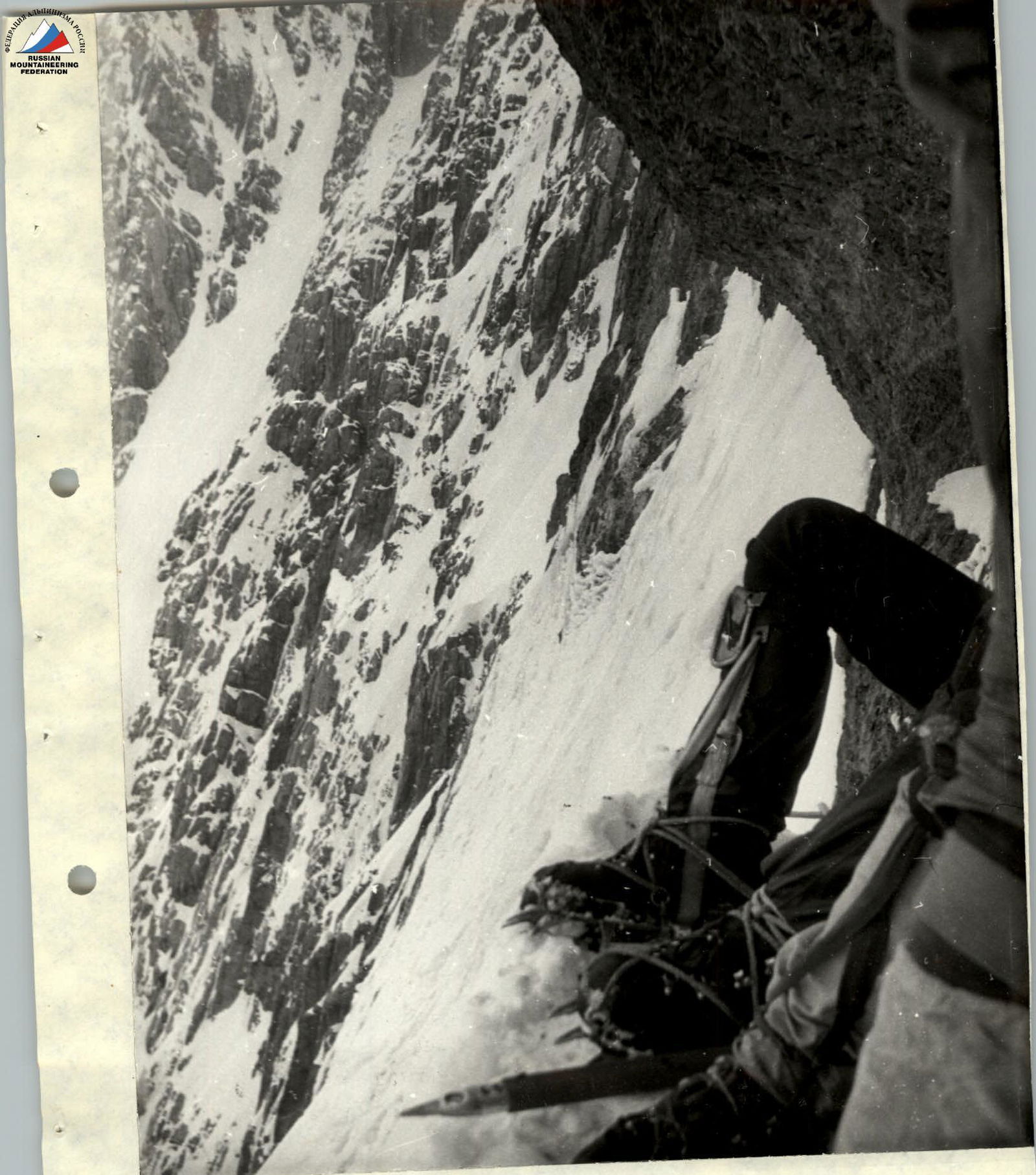
Section R14–R15. Overnight stay on a snow drift.