
Passport
I. Class: TECHNICAL
-
Region: PAMIR-ALAI, ALAISKY ridge
-
Peak: SHAIT (4916 m), via the Northeast face
-
Route complexity category: 6A
-
Route characteristics:
Elevation gain: 938 m, Average slope: 65°. Section lengths:
- 4th category complexity — 35 m
- 5th category complexity — 910 m
- 6th category complexity — 90 m
- Pitons hammered in: rock — 142 bolt — 159 chocks — 5 ice screws — 5
- Climbing hours: 25 h, days: 2
- Overnight stays: 1
- Team captain: Papin V.G. — Candidate for Master of Sports Team members: Artemyev V. — Candidate for Master of Sports Kormin O.Yu. — Candidate for Master of Sports Kogtev E.A. — Candidate for Master of Sports Lavruha S.V. — 1st sports category Volodin V. — 1st sports category
- Coach: Kurgin S.N. — Master of Sports
- Start of the route: July 11, 1989 Summit: July 12, 1989 Return: July 13, 1989
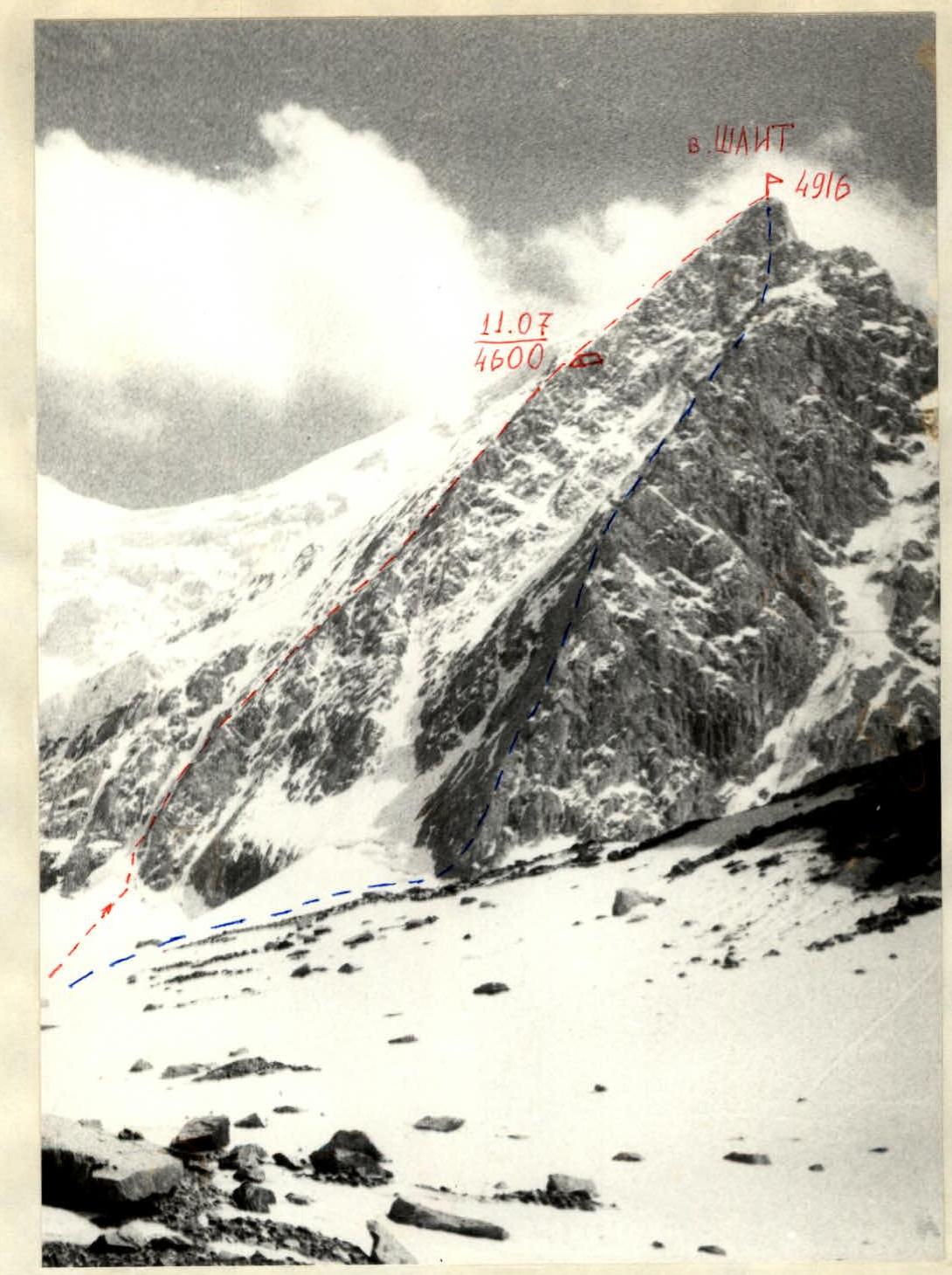
General photo of the summit
- — team route
- — route via the NNE wall
- Δ — overnight stay.
The photo was taken with a "Minitar" lens, focal length 1.5 cm, on July 9, 1989, at 12:30, distance to the object about 2 km. Shooting point No. 1 (3800 m).

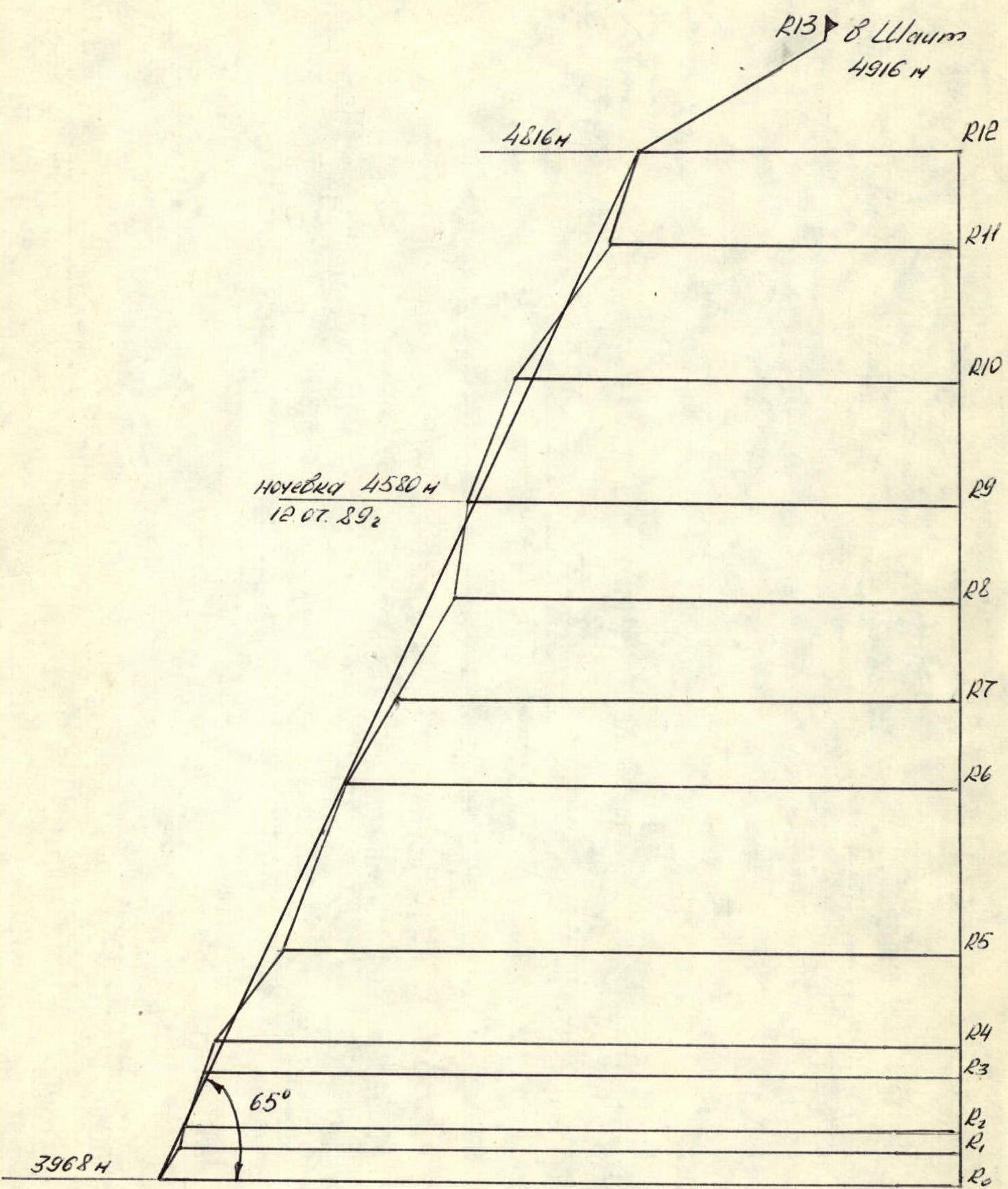
Profile of the wall from the right
R0, R9 — route sections Δ — overnight stay — team route
The photo was taken with a "Minitar" lens, focal length 1.5 cm, on July 9, 1989, at 15:00, distance to the object 2 km (3800 m).
T#2
M 1:5000

Photopanorama of the area
— routes
The photo was taken with a "Minitar" lens, focal length 1.5 cm, on July 9, 1989, at 12:00, point No. 3 (3800 m).
Tactical actions of the team
The team's tactical actions during the ascent generally corresponded to the planned tactical plan. The tactics employed were tested on previous ascents (e.g., Dvuzubka peak) and aimed to ensure the lead climber's progress without delays.
All equipment and personal gear were distributed among five backpacks.
The lead climber ascended without a backpack, carrying all necessary gear on their harness. Throughout the route, they climbed on a double rope with a shock-absorbing knot.
Tasks of the other team members:
- Second climber — straightening the fixed ropes, removing carabiner hangers and chocks.
- Last climber — removing pitons and dismantling belay stations.
Movement on fixed ropes was done with top-rope protection. The technique for climbing on fixed ropes was well-practiced during training, and everyone confidently navigated the most challenging sections using two jumar ascenders with a backpack or with the backpack secured between their legs.
The tactical plan included changing the lead climber. Climbing pairs rotated throughout the day according to the tactical plan.
Safety measures
During the route, great attention was paid to safety. Safety was ensured by the following measures:
- Consultations and careful observation of the wall for 1 hour along the route.
- Crossing snow and ice slopes early in the day.
- The team's speed on the route was increased due to correctly chosen tactical actions (teamwork among climbing pairs) and a significant amount of rock sections climbed using free climbing with chocks and friends.
- Using redundant pitons when setting up belay stations.
- The lead climber's use of a double rope with a shock-absorbing knot, and movement on fixed ropes with top-rope protection.
- Choosing a suitable location for the overnight stay.
- Having a team of observers and reliable communication means.
- To ensure clear navigation on the route, the team had a working photo and could consult with observers via a "ROMASHKA" radio station at any moment, as the observers continuously monitored the route through a 60x telescope.
- Having a backup group.
- Possibility of long-distance communication via AUSB "Dugova".
- Prior agreement with AUSB "Dugova" on the possibility of using a GAZ vehicle.
Implementation of the tactical plan
The team's movement along the route followed the tactical plan. The number of working days, the location of the overnight stay, and the rotation of lead climbers and climbing pairs during the ascent exactly matched the tactical plan.
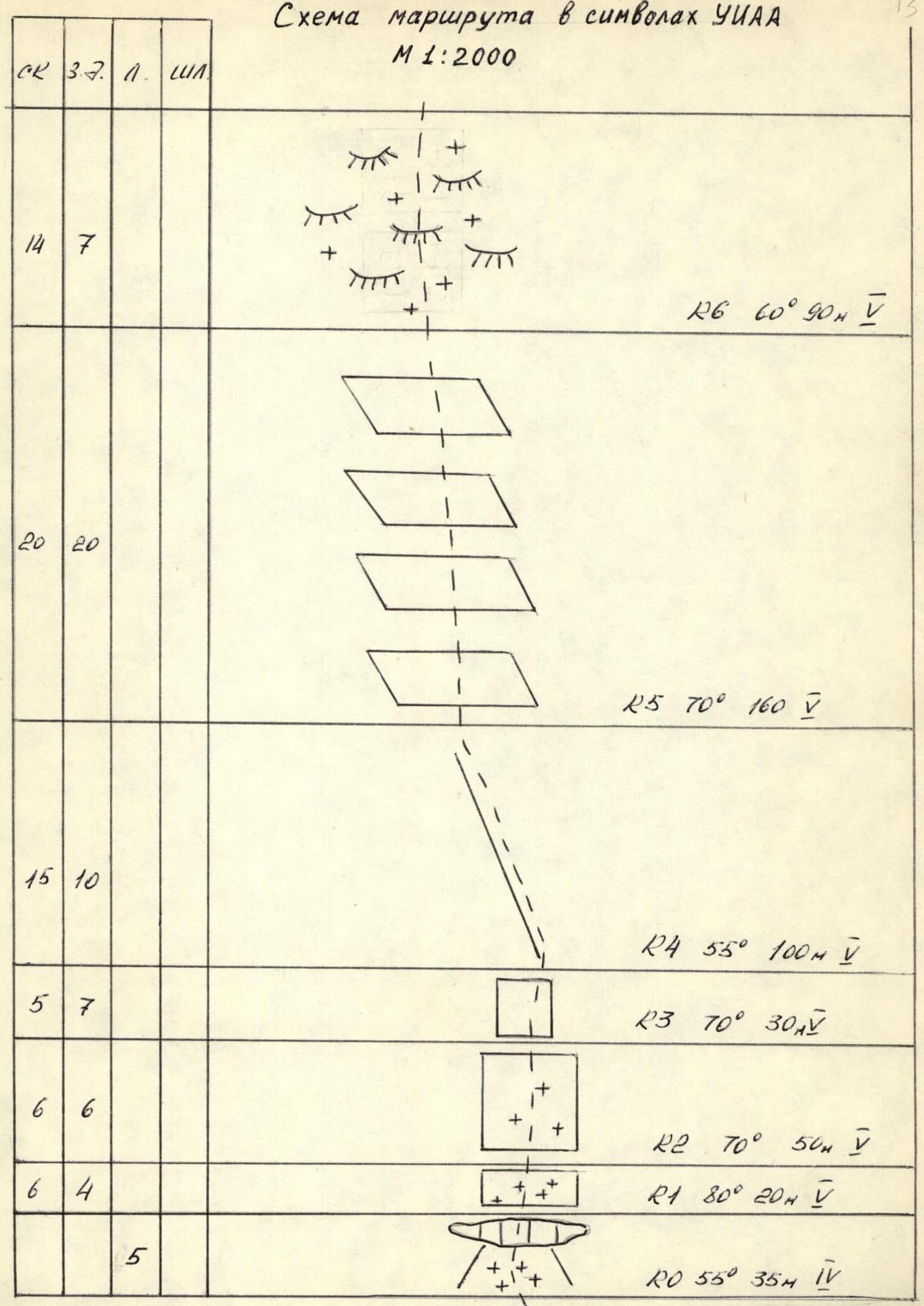
Route diagram in UIAA symbols M 1:2000
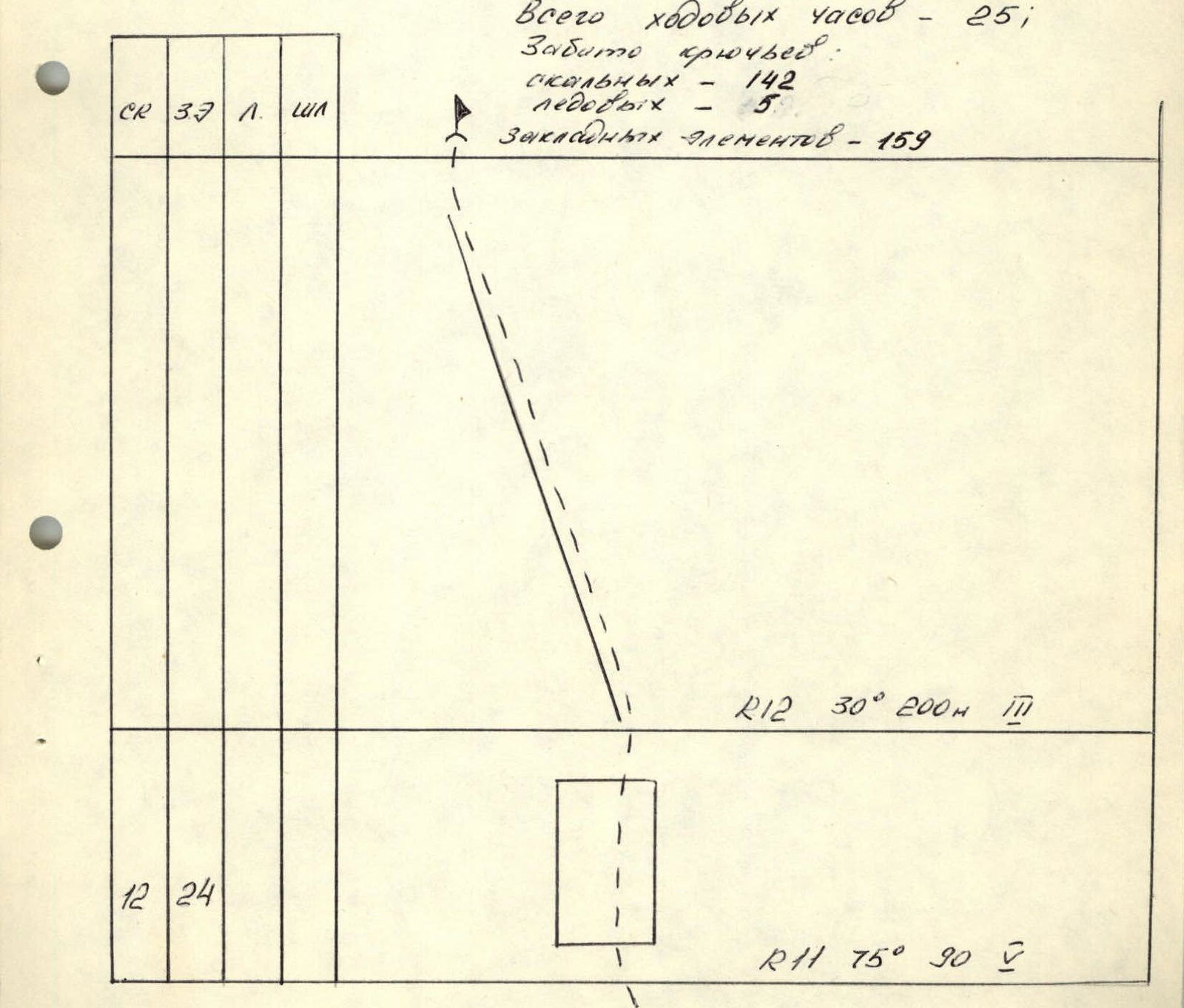
Route description by sections
R0–R1. Ascend in crampons on firm snow to a snow shelf below the bergschrund. Simultaneous movement. The bergschrund is crossed on the right side, near rocks protruding from under the ice. The first climber uses "fifas" and sets up ice screw protection.
R1–R2. Ascend an ice gully leading to broken rocks. The ice is firm, with some snow. Protection via ice screws.
R2–R3. Icy, broken rocks. Movement in crampons. Mainly using thin titanium pitons for protection.
R3–R4. Monolithic wall with many small cracks and ledges, covered in ice. Very difficult climbing.
R4–R5. Exit and ascend to an edge. Protection through medium-sized chocks.
R5–R6. Move along inclined slabs with large horizontal cracks. Protection through large and medium-sized chocks.
R6–R7. "Sheep's foreheads" are wet, smooth rocks with almost no cracks. Some areas are icy. Very slippery; difficult to set up protection: psychologically challenging climbing.
R7–R8. Move rightwards to dry, smooth rocks similar to "sheep's foreheads" leading to a wide chimney. The section is climbed on friction in gym shoes. Protection mainly through small chocks.
R8–R9. Wide, long chimney. Climbed using free climbing with friends and large chocks. The chimney gradually turns into an inclined, smooth wall, leading to a narrow horizontal ridge where we set up an overnight stay. The bivouac is in a seated position.
R9–R10. Dry, smooth rocks. Climbed on friction in gym shoes. Protection through small chocks and titanium wedges.
R10–R11. Wide, fairly slippery, inclined slabs. Protection mainly through pitons.
R11–R12. Broken rocks with large cracks, leading to the snow-covered pre-summit ridge. Protection through large chocks. Many loose rocks. Very rockfall-prone area. Recommended to proceed with maximum caution.