
Ascent Passport
- Ascent class: technical
- Ascent area: Alayskiy ridge (northern spur)
- Peak: Sauk Jaylyau Western 1st tower via the northern edge (first ascent)
- Estimated difficulty category: 3A
- Route characteristics:
elevation gain 710 m, average steepness 53°, route length details see appendix
- Pitons used for belays to create I.T.O.
rock pitons 31 — ice screws 1 — bolt pitons —
- Total climbing hours 12
- Number of bivouacs and their characteristics:
main bivouac — right orographic moraine of the Sauk Jaylyau glacier. Comfortable bivouacs for 3 tents; alternative bivouacs — saddle between the gendarme and the summit;
- at the foot of the 40-meter wall, a wide ledge.
- Surname, name, patronymic of the leader and participants, their sports characteristics:
Okhrimenko V.N. 1st sports category, hands-on.
List:
- Khariyniak I.V. 1st sports category, trainee
- Bondarev V.M. 1st sports category, trainee
- Volkov A.N. 1st sports category, trainee
- Team coach — Kovtun Vasily Grigorievich.
- Departure to the route July 21, 1978; return July 23, 1978
Brief description of the approach to the route
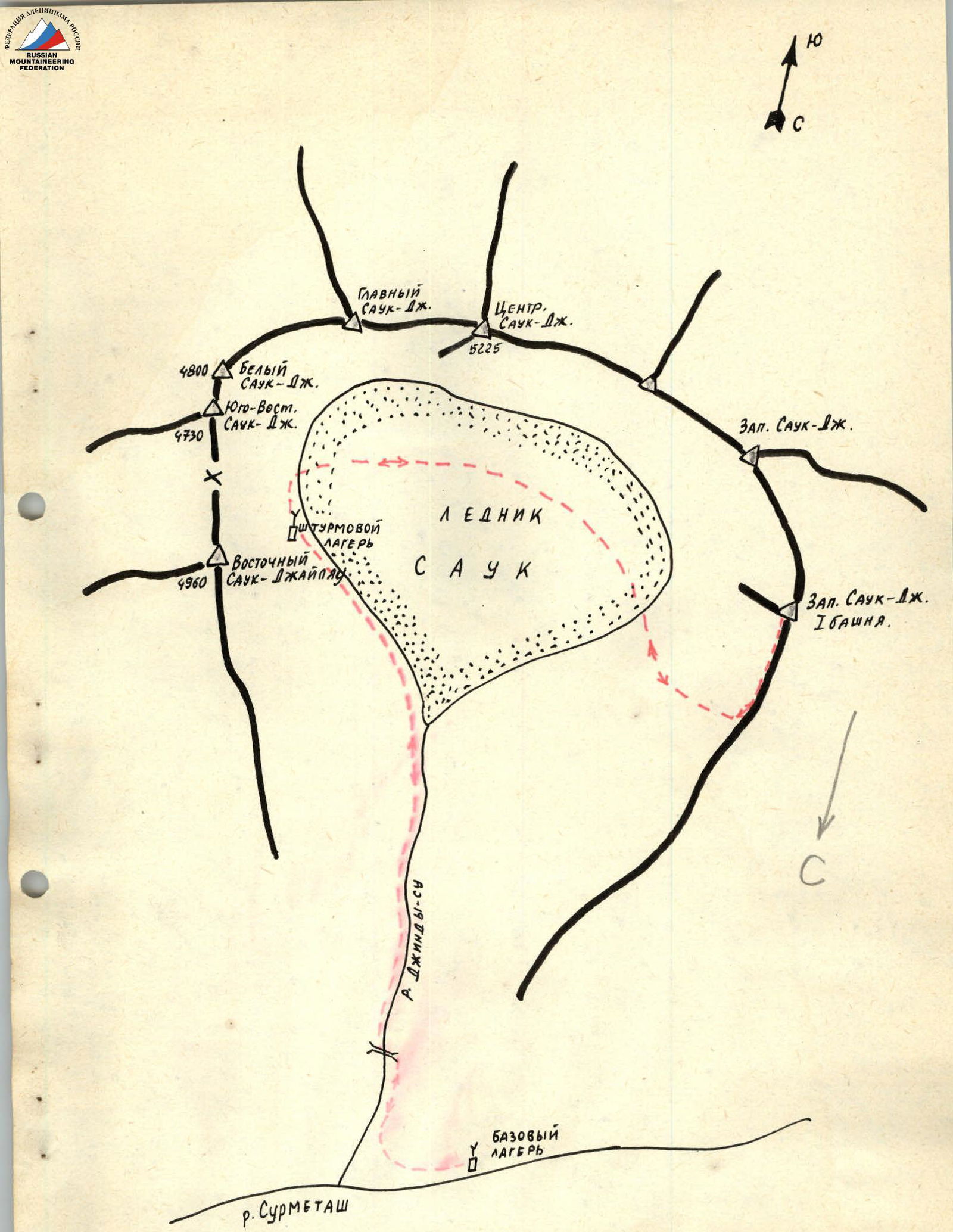
The Sauk Jaylyau massif (cirque) is located in the northern spur of the Alayskiy ridge. The cirque is horseshoe-shaped, open to the north. Inside the cirque, there is a large glaciation — a glacier approximately 1 x 3 km and snow-ice slopes with northern and eastern exposure.
The Dzhindy-Su river flows out of the glacier and descends into the Surmetash valley through a deep canyon, merging with the river of the same name. The glacier tongue ends in an icefall, from which blocks of ice periodically break off and slide down the canyon. The Dzhindy-Su river is quite full-flowing and is difficult to cross in the second half of the day.
From the base camp, located at the confluence of the Surmetash and Dzhindy-Su rivers, we ascend along the latter on the right (in the direction of travel) side of the river to the "ram's foreheads." 200 m before reaching them, we descend directly to the river at its narrowest point. We cross to the left (in the direction of travel) bank of the Dzhindy-Su river. Then, along a steep grassy slope, we reach the lateral moraine of the glacier and move along it. Proceeding along the northern spurs of the peak Vostochny Sauk Jaylyau and reaching its foot, we stop for a well-organized bivouac on the lateral moraine of the glacier.
From the base camp to the bivouac — 7–8 hours ascent.

| Date | Section designation | Average steepness in degrees | Length in meters | Terrain characteristics | Difficulty | Condition | Weather conditions | Rock pitons | Ice screws | Bolt pitons |
|---|---|---|---|---|---|---|---|---|---|---|
| July 21, 1978 | R1 | 40° | 350 m | ridge | 5 | crumbling slabs | excellent | - | - | - |
| R2 | 80° | 40 m | wall | 4 | monolith | 10 | - | - | ||
| R3 | 40° | 200 m | ridge | 3 | crumbling | 1 | - | - | ||
| R4 | 75° | 30 m | gendarme 1 | 3 | monolith | 7 | - | - | ||
| R5 | 45° | 240 m | ridge | 5 | crumbling | - | - | - | ||
| R6 | 85° | 40 m | gendarme 2 | 4 | crumbling | 13 | 1 | - | ||
| R7 | 20° | 120 m | ridge | 5 | crumbling | - | - | - |
Route description
From the bivouac under the peak Vostochny Sauk Jaylyau, we move in the direction of the peak Tsentralny Sauk Jaylyau and descend from the scree onto the glacier. By-passing the broken crevasses on the left (in the direction of travel) and crossing the glacier, descending under the southern slopes of the peak Zapadny Sauk Jaylyau (1st tower), we step off the glacier onto a grassy slope.
Along a steep grassy slope, we ascend to a depression before a clearly defined gendarme on the northern ridge, avoiding on the left (in the direction of travel) a large rockfall-prone couloir.
Further, the path goes along the ridge. The ridge is represented by smoothed slabs. Moving (in the direction of travel) along the right side of the ridge, after 350 m, we reach a 40-meter wall, along which a wide crack runs (fits a boot rand). After 40 m of ascent through the crack, we emerge onto the ridge. Further along the ridge rocks of medium difficulty, we reach the 1st gendarme, which is bypassed on the left along a very narrow ledge under the overhanging wall of the gendarme. Then along the ridge — exit to the 2nd gendarme. The 2nd gendarme is passed directly head-on. Descent to the saddle before the summit is better done using a fixed rope, leaving it there and using it later for ascent. The ascent from the saddle to the summit goes along rocks of medium difficulty, represented by large-block stones.
From the bivouac, the ascent to the summit takes 7 hours. Descent via the ascent route takes 5 hours. In case of bad weather, possible bivouac locations are:
- on the saddle
- at the foot of the 40-meter wall with a crack.

Comments
Sign in to leave a comment