
Ascent Passport
- Climbing area — Pamir-Altai, ridge — Altai.
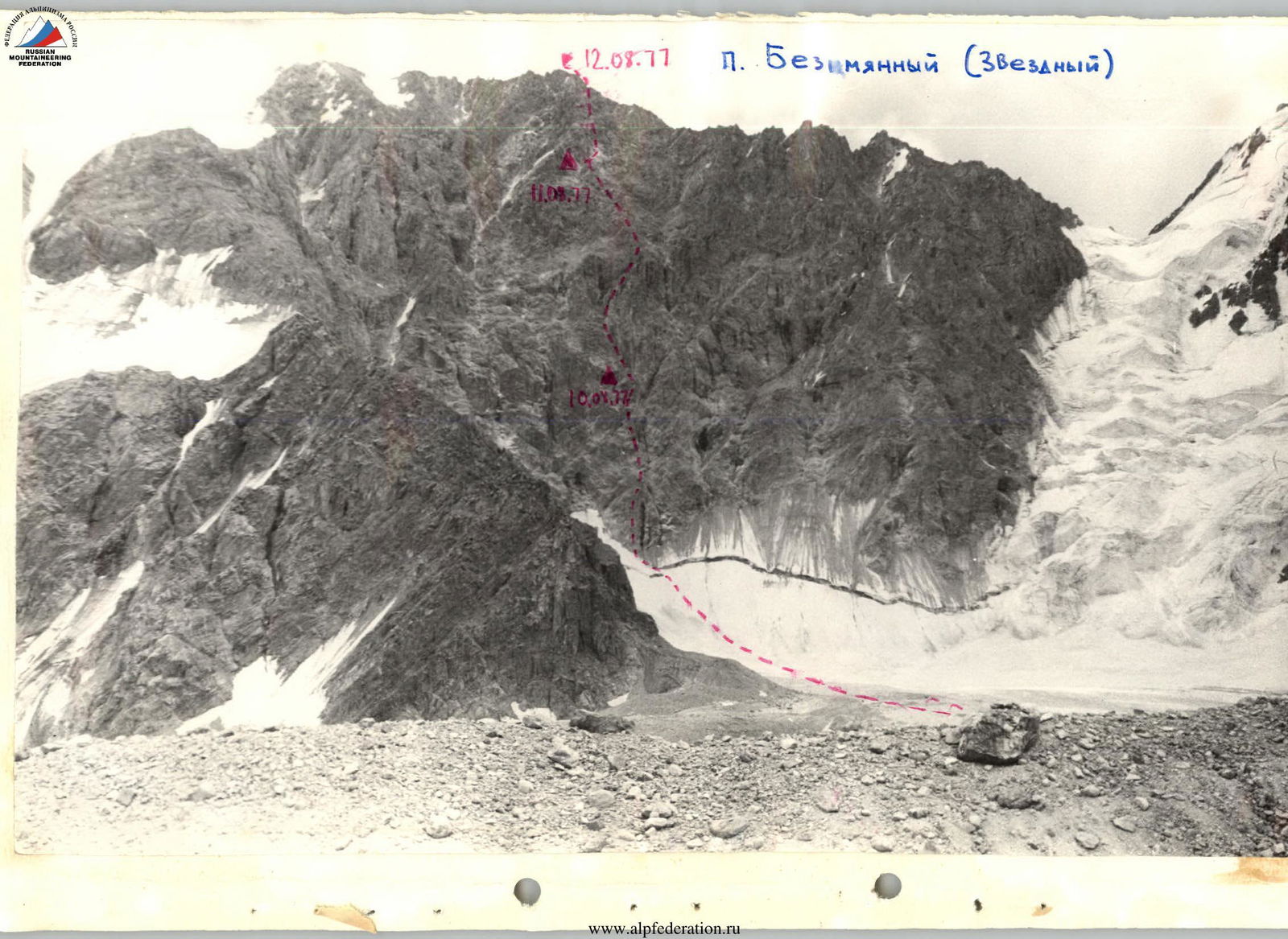
- Peak Bezymannaya, height 4780, via the Central Bastion of the NW wall.
- Proposed difficulty category — 5B.
- Route characteristics:
- height difference — 780 m,
- length of sections:
- II difficulty category — 90 m
- III — 270 m
- IV — 340 m
- V — 340 m
- VI — 20 m
- Total: 930 m
- average steepness — 58°.
- Number of pitons driven:
| Type of pitons | For belaying | For creating A.T.O. |
|---|---|---|
| Rock | 190 | 18 |
| Ice | 23 | — |
| Bolt | 1 | 1 |
| Total | 115 | 16 |
- Number of climbing hours — 30.
- Number of nights — 2.
- 1st night — in a chimney under the red rocks. There's no place to set up a tent. 2 people spent the night sitting on ledges, and 2 — lying down in sleeping bags.
- 2nd night — under a white marble slab. Spent the night lying down on an inclined scree ledge, covered with a tent.
- Kachur Ivan Ivanovich — leader, 1st sports category, alpinism.
- Moroz Sergey Andreevich — participant, 1st sports category, alpinism.
- Merkovich Valery Borisovich — participant, 1st sports category, alpinism.
- Kovalenko Alexander Vladimirovich — participant, 1st sports category, alpinism.
- Coach: Saprykin Vasily Danilovich, Master of Sports of the USSR, senior instructor.
- Departure date: August 10, 1977. Return date: August 12, 1977.
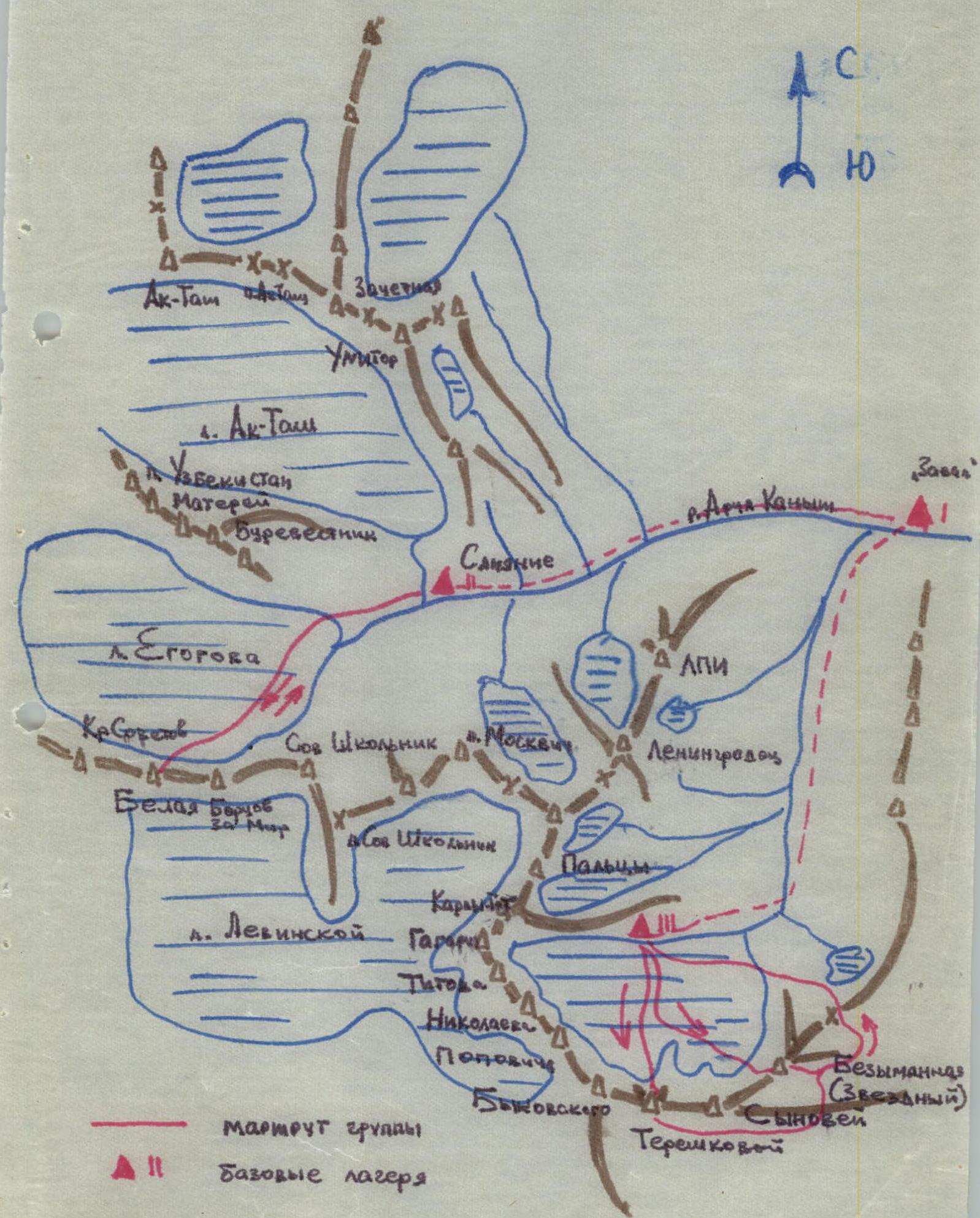
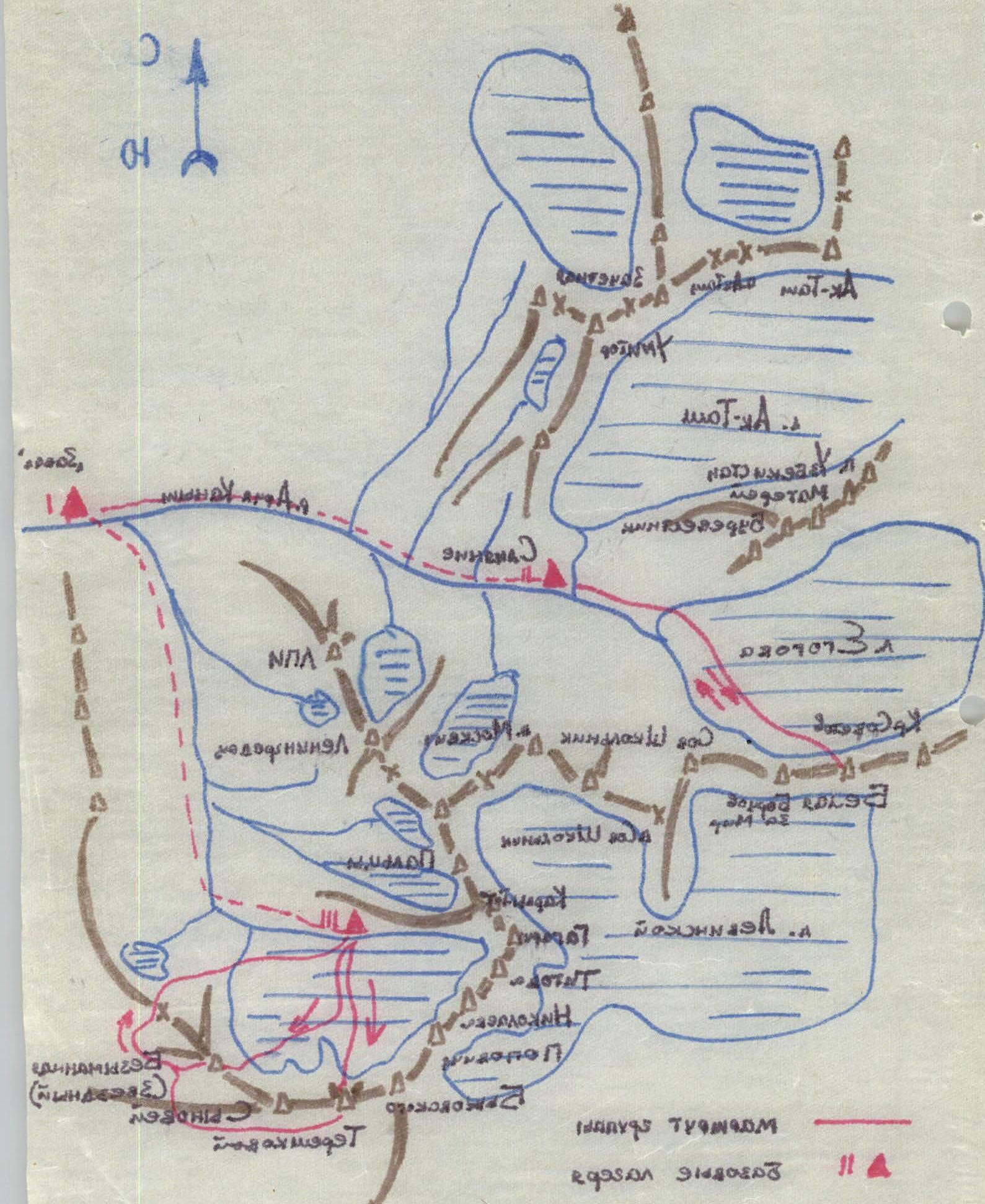
Area map of the ascent

Brief explanation of the table
Section R0–R1. Length 100 m, steepness up to 35°, difficulty category 2–3. Approach via a snow-ice slope, initially gentle, but steeper (up to 35°) at the top, to the bridge over the bergschrund.
Section R1–R2. 45–50 m, 40–50°, difficulty category 3. Cross the bergschrund and ascend the ice-snow slope to the lower protruding part of the rock promontory. Belay with pitons.
Section R2–R3. 40 m, 70–75°, difficulty category 5. Ascend the rock wall of the promontory (limited holds) vertically upwards for 25 m to an overhanging internal corner 4 m long. Then move right-upwards along inclined ledges with a "tile" structure to an inclined platform. Climbing is very difficult, belay with pitons, the internal corner is passed using artificial holds (A.T.O.).
Section R3–R4. 40 m, 60–70°, some sections up to 95°, difficulty category 5. From the inclined ledge, move vertically upwards for 7–10 m, then left, avoiding grey and red "lobs", approach under an overhanging 2–2.5 m wall. Overcome the wall head-on using A.T.O. Then, moving right, approach under the red overhanging rocks. Climbing is very difficult, belay with pitons. Rocks are like "ram's foreheads", limited number of cracks.
Section R4–R5. 40 m, 50°, some sections 80–90°, 20 m — difficulty category 4, 20 m — difficulty category 5. Moving right, avoiding red overhanging rocks, ascend vertically upwards onto grey "beaten" ledges. Climbing is very difficult, belay with pitons.
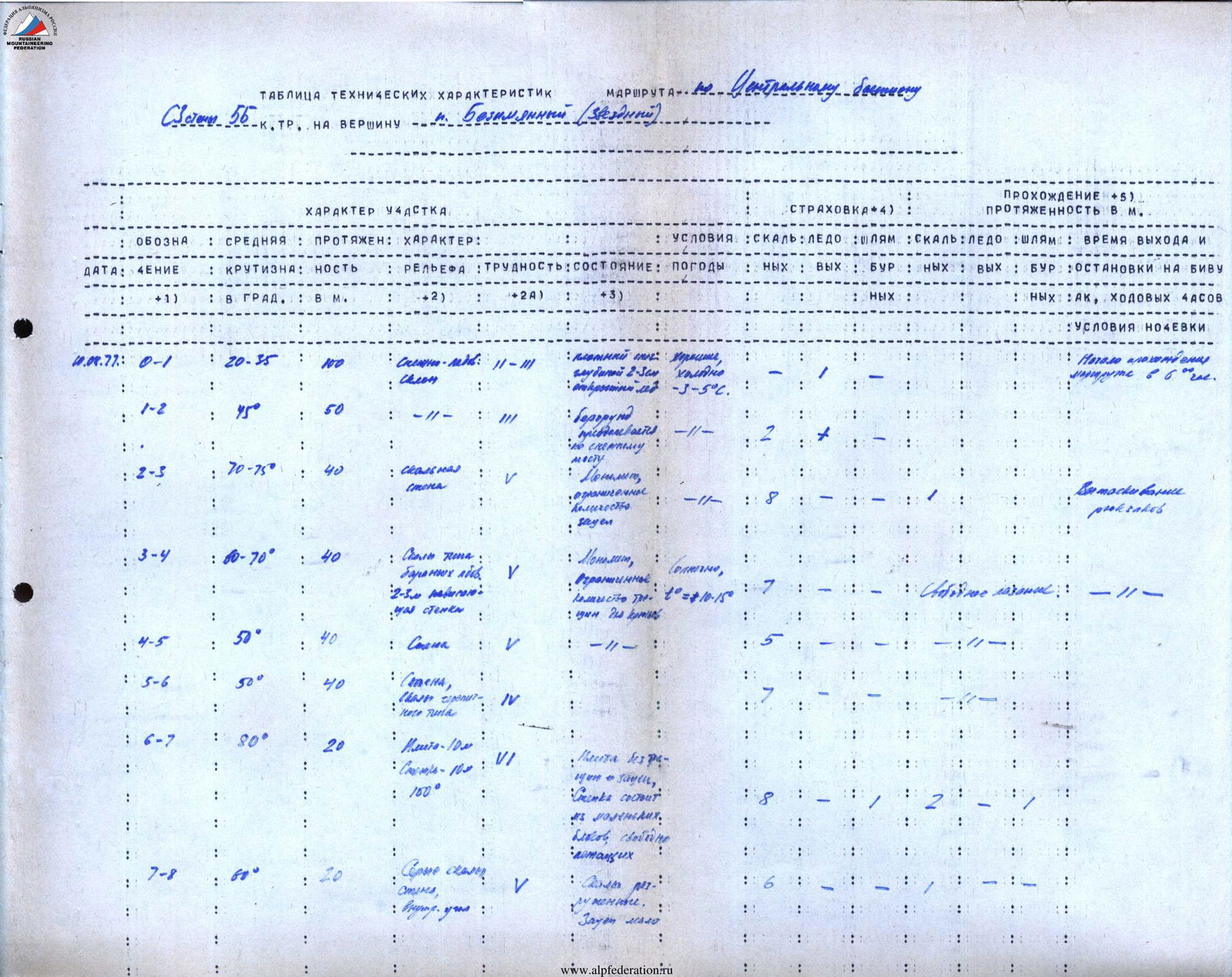
Table of technical characteristics of the route
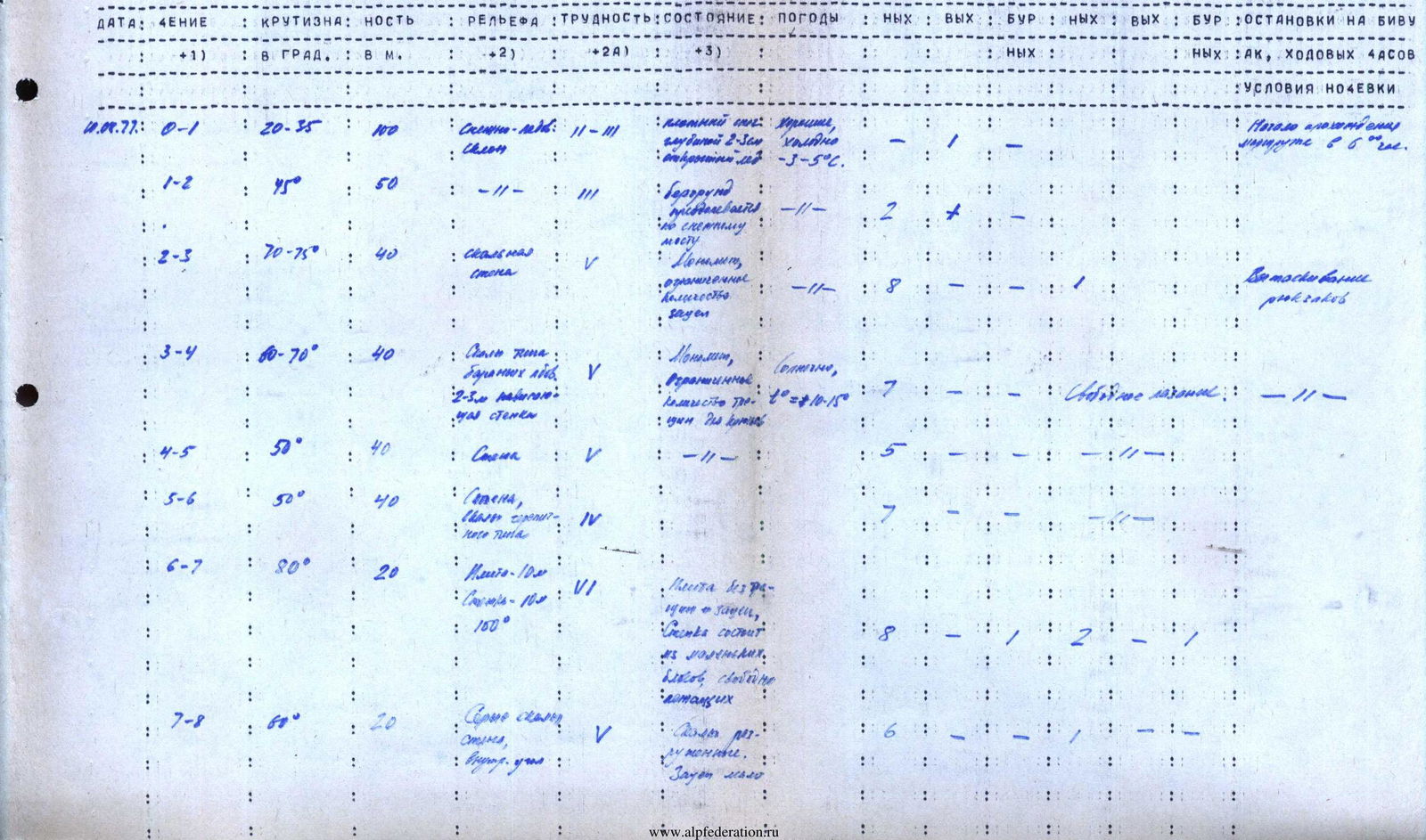
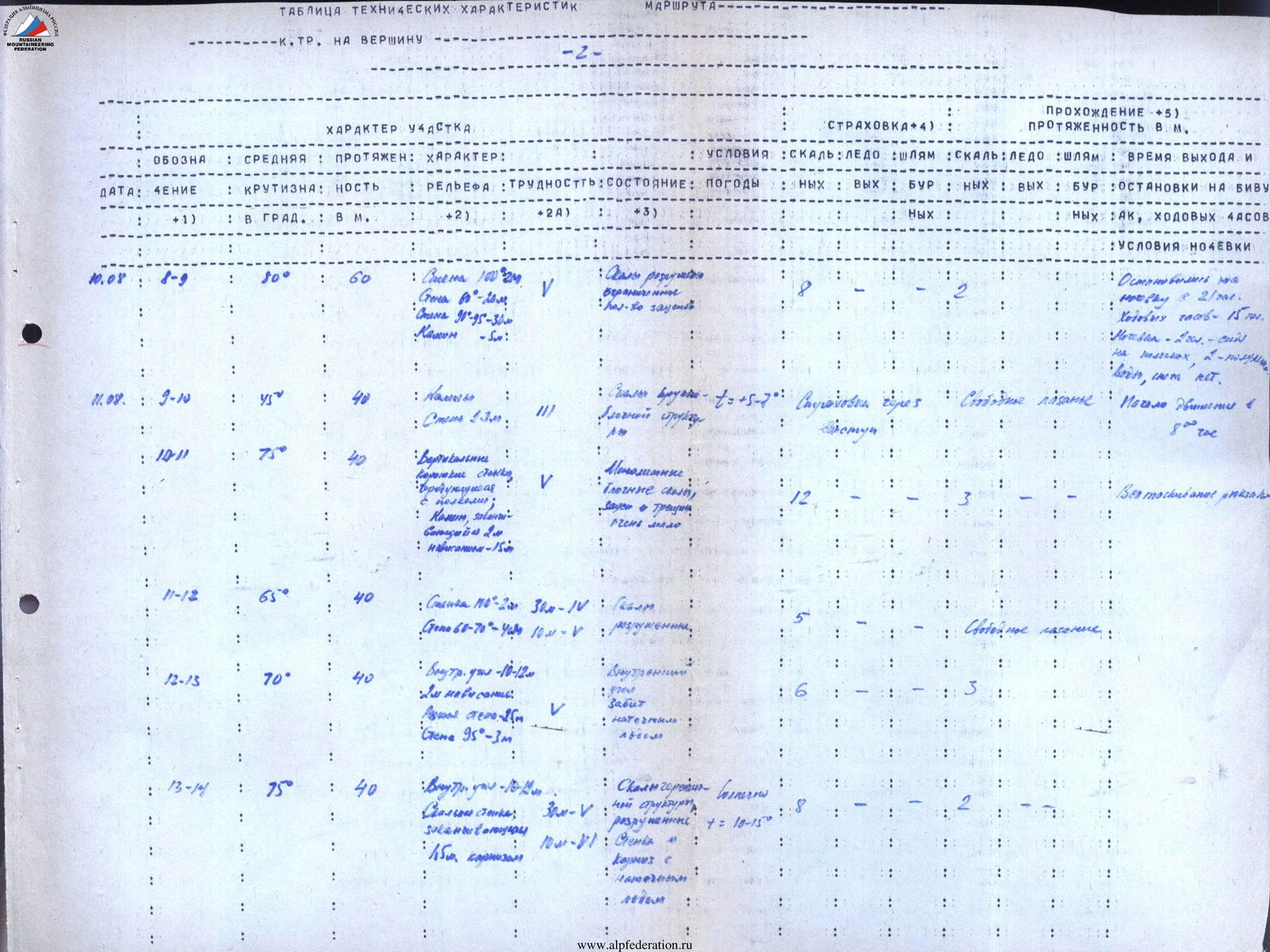
| Departure Date | Section | Steepness | Length | Terrain Characteristics | Difficulty Category | Belay (piton) | A.T.O. (piton) | Climbing Hours / Overnight Conditions |
|---|---|---|---|---|---|---|---|---|
| 10.08.1977 | R0–R1 | 20–35° | 100 m | Rock-ice slope | 2–3 | — | — | Before passing the route for 6 hours |
| R1–R2 | 45° | 50 m | Bergschrund, ice-snow slope | 3 | — | 2 | — | |
| R2–R3 | 70–75° | 40 m | Rock wall, limited holds | 5 | 8 | — | Pulling out wedges | |
| R3–R4 | 60–70° | 40 m | Rocks like "ram's foreheads", overhanging wall | 5 | 7 | — | Free climbing — 11 hours | |
| R4–R5 | 50° | 40 m | Rock wall | 5 | 5 | — | — | |
| R5–R6 | 50° | 40 m | Wall of "tile" type | 4 | — | — | — | |
| R6–R7 | 80° | 20 m | Slab 10 m, corner 100° | 6 | 8 | — | — | |
| R7–R8 | 60° | 20 m | Grey destroyed rocks, wall | 5 | 6 | — | — | |
| 11.08.1977 | R8–R9 | 80° | 60 m | Wall (100°, 60–80°, 90–95°) | 5 | 8 | 2 | Overnight at 20:00, climbing 15–18 hours, semi-reclining on ledges |
| R9–R10 | 45° | 40 m | Chimney, wall 2–3 m | 3 | Pitons driven | — | Overnight at 5:00 | |
| R10–R11 | 75° | 40 m | Vertical rocks, internal corner | 5 | 12 | 3 | Waterless site | |
| R11–R12 | 65° | 40 m | Wall (10 m, 60–70°) | 5 | 5 | — | Free climbing | |
| R12–R13 | 70° | 40 m | Internal corner (10–12 m), overhang 2 m | 5 | 6 | — | — | |
| R13–R14 | 75° | 40 m | Rocks of "tile" structure, wall 3–4 m, cornice 1.5 m | 5 | 8 | 2 | — | |
| 12.08.1977 | R14–R15 | 50° | 120 m | Not clearly defined buttress | 3–4 | 10 | — | Overnight at 20:00, climbing 26–28 hours, sitting on ledges |
| R15–R16 | 50° | 40 m | Gentle slope, wall 8–10 m | 4–5 | 7 | — | Overnight lying on ledges | |
| R16–R17 | 65° | 40 m | Wall 60–80°, rocks, corner 20 m | 4–5 | 6 | — | Ascent to the route at 7:00 | |
| R17–R18 | 50° | 80 m | Inclined, smooth marble slabs | 3–4 | — | — | — | |
| R18–R19 | 10–15° | 40 m | Destroyed ridge | 2 | — | — | Reach the summit at 14:00. Climbing 30–33 hours |
Section R5–R6. 40 m, 50 R4–R5. 40 m, 50°, some sections 80–90°, 20 m — difficulty category 4, 20 m — difficulty category 5. Straight up, then right along rocks of "tile" type, heading towards the tower with a black chimney. Approach under a smooth grey slab, above which red overhanging rocks are visible. Climbing is difficult, rocks are smooth with limited cracks.
Section R6–R8. 40 m, 60°, some sections 90–100°, 30 m — difficulty category 5, 10 m — difficulty category 6. Along a crack that goes right, approach under the overhanging red walls — 5 m. Under the overhang, move left-upwards 7–9 m along a smooth grey slab without cracks, and then along a vertical, overhanging in the upper part, white destroyed wall — 4 m. Then, right, towards the chimney, into a heavily destroyed internal corner. Climbing is extremely difficult, pass the grey slab and white wall using bolt pitons and A.T.O.
Section R8–R9. 60 m, 60–80°, last 30 m — 80–100%, difficulty category 5. From the internal corner, exit right onto an overhanging 2 m wall and then move upwards 20 m along an inclined (60°) wall, and then along the left overhanging wall, which ends with a 5 m negative chimney. The chimney leads to a small ledge. Climbing is extremely difficult using A.T.O. Belay with pitons.
Section R9–R10. 40 m, 40–50°, difficulty category 3. Move left-upwards along the chimney, the right side of which is formed by overhanging red walls with black streaks, to a ledge. Belay through ledges, climbing is average. On the ledge, a possible site for a sitting overnight stay. Climbing time from Camp Cosmonauts 18–20 hours.
Section R10–R11. 40 m, 70–80°, 15 m — 100°, difficulty category 5. Continue moving upwards along the overhanging red rocks. Overcoming a 4–5 m vertical wall, approach under an overhanging internal corner 10–12 m long. The corner is passed using A.T.O.
Section R11–R12. 40 m, 60–70°, 30 m — difficulty category 4, 10 m — difficulty category 5. From the ledge, overcoming a 2 m wall, move right-upwards towards the internal corner. Climbing is difficult, belay with pitons.
Section R12–R13. 40 m, 70–80°, some sections — 90–95°, difficulty category 5. Along the internal corner with rimed ice, which ends with a 2–3 m overhang, exit onto red rocks. Then, along the red rocks, through a 3 m negative wall, exit onto a small scree ledge with a ledge. Climbing is very difficult, on negative sections A.T.O. is required.
Section R13–R14. 40 m, 70–80°, 30 m — difficulty category 5, 10 m — VI difficulty category. Traverse right 2–3 m along overhanging rocks, enter the internal corner. Along rocks of "tile" structure (70–80°), approach a 3–4 m vertical wall, ending with a 1.5 m cornice. The wall and cornice have rimed ice. Overcome the cornice, exit onto a narrow 1.5 m inclined ledge. Climbing is extremely difficult using A.T.O.
Passing sections from R2–R3 to R12–R13 (except R8–R9) requires high mountaineering and rock climbing skills. The first climber must pass the route without a backpack in rubber boots.
Section R14–R15. 120 m, 50°, 80 m — difficulty category 3, 40 m — difficulty category 4. Move straight up along a not clearly defined buttress of average difficulty, leaving the rockfall-prone couloir to the right, to a white inclined slab bounded on the left and right by overhanging red rocks.
Under the marble slab, a possible site for a sitting overnight stay. Climbing time from Camp Cosmonauts 26–28 hours.
Section R15–R16. 40 m, 50–60°, 30 m — difficulty category 4, 10 m — difficulty category 5. Moving right-upwards along the lower edge of the marble slab, avoid the overhanging tower on the right. Then, through a vertical wall 6–8 m, exit onto an inclined ledge. Climbing is difficult, belay with pitons.
Section R16–R17. 40 m, 60–70°, in the upper part 90–100%, 20 m — difficulty category 4, 20 m — difficulty category 5. Move straight up along smoothed rocks under an overhanging red wall 30 m. The wall is passed in the left part through an overhanging internal corner (6–8 m, 90–100°).
Climbing is difficult, in the upper part of the section — extreme.
Section R17–R18. 80 m, 40–50°, 50 m — difficulty category 3, 30 m — difficulty category 4. Along smooth, destroyed marble slabs, move straight up and exit onto the pre-summit shoulder.
Climbing is average, sometimes difficult, with many "live" stones.
Section R18–R19. 40 m, 10–15°, difficulty category 2. Along a heavily destroyed ridge — exit to the summit. From Camp Cosmonauts to the summit 30–33 climbing hours.
Recommendations for climbers:
- The group must be provided with a supply of food and water for 2–3 nights (the route is completely waterless).
- Pass sections R0–R1 and R1–R2 before 8:00 due to rockfall. The bergschrund area is especially hazardous.
- Having bivouac equipment is mandatory.
- The first climber must move on a double rope in rubber boots.
- Crampons are necessary for overcoming sections R0–R1 and R1–R2.
- Have the following equipment: for a group of 4 people:
Route Profile
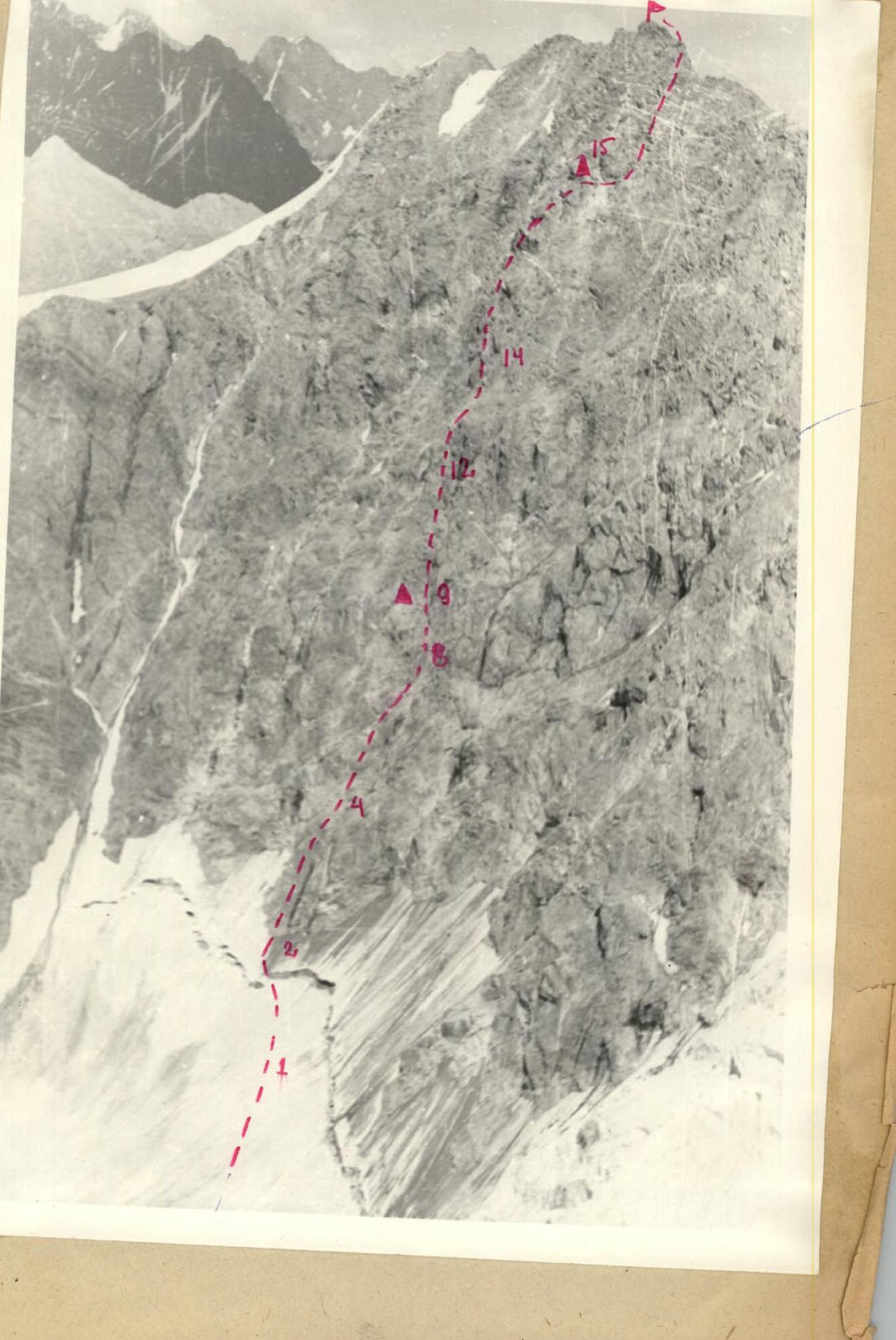
Brief description of the ascent
When observing the route, a plan, tactics, and ascent features were determined. Since the route is completely waterless, the group had to take a water supply for two nights. Each participant had a flask with a capacity of 1–1.5 liters, filled with strong tea with dissolved black currant and honey.
The group was supplied with food for 4 days. The diet included high-calorie foods such as dried sausage, cod liver, goose liver pate, canned chicken, sprats, honey, chocolate, and cookies. The total weight of food was — 6.5 kg, water — 5 kg.
1st day — August 10, 1977. Wake-up at 4:00. The first team, Kachur — Moroz, departed at 5:00, taking only climbing equipment (ropes, crampons, ice axes, personal gear). At 6:00, the team was at the start of the route and began processing the snow-ice slope. The second team, Merkovich — Kovalenko, ascended a bit later, gathered the bivouac, and approached the route by 8:00. By this time, the first team had hung ladders on the steep ice section and was finishing the passage of the first rope on the rocks. Merkovich — Kovalenko quickly passed the ladders of the 2nd rope, and the group continued the ascent in full force. When the ladders were removed, to lighten the load, they dropped the ice axes and crampons onto the glacier, where they were picked up by the observation group.
The lower part of the route turned out to be much more complicated than expected. Despite the relatively small steepness, passing this part of the route was very difficult. Non-steep sections alternated with vertical and negative walls, which were passed using A.T.O. The micro-relief consisted of smooth rocks without holds or with small, smoothed holds. There are very few cracks for pitons. Often there are "belts" of destroyed rocks, typically on vertical walls. This made it difficult to use artificial holds. The group passed the route in galoshes. The tactics were as follows: the first climber went on a double rope; having taken the partner in the team, who pulled out the third rope and fixed it for ladders, the second team followed. At any given time, the teams were not connected, which ensured greater safety for the group.
By 12:00, the group had passed only 3 ropes on the rocks and reached a small ledge, where they managed to fit for breakfast and a short rest. There were about 100 m left to the planned overnight stay. Quickly passing a rope on a simple section, they approached the key section of the first day (below and to the left of the chimney with rimed ice), which was an absolutely smooth grey slab bounded on three sides by overhanging red rocks. When passing the slab, a bolt piton was driven to hang a ladder and organize belaying. 8 m of extremely difficult climbing — and the slab was passed.
But ahead was a 5 m marble destroyed wall with a steepness of 90–95°, consisting of separate blocks. An attempt to drive a piton and hang a ladder was unsuccessful — the pitons came out of the cracks under load. It was necessary to carefully, without breathing, with a minimal number of pitons, pass this wall. The section is VI difficulty category.
Then move along a vertical, heavily destroyed internal corner. From the corner, first along an inclined wall, then along vertical red rocks, move under the last overhang of the bastion towards the overnight stay. The site, which seemed from the tube to be a convenient ledge behind a protruding "tooth" at the level of 2/3 of the chimney, turned out to be unsuitable for overnight stay due to the large inclination and small "useful area". It was already getting dark, and there was still no suitable site for overnight stay. Finally, the first climber, Valery Merkovich, shouted that there was a convenient site, which turned out to be a pile of blocks at the base of the red overhanging walls. They settled in for the night:
- Moroz and Kachur — sitting, pressed against the rocks on small ledges, like steps;
- Kovalenko and Merkovich — were even able to lie down.
2nd day — August 11, 1977
Due to the lack of comfort on the route, they woke up early — at 6 am. While they were gathering, tea was being heated. They set out on the route at 7:00.
A 6 m section of simple climbing along the chimney under the red wall. Then the chimney turns into an internal corner with rimed ice, becomes steeper, and in its upper part, they had to climb on ladders with extreme tension. Complex rocks with overhanging walls, internal corners, and chimneys followed. They had to use "Zalzrug", ladders. They moved very slowly due to the route's difficulties and cold.
By 15:00, they reached a buttress leading to the summit tower. Having passed three ropes, they approached under the route's white slab, where they stopped for a bivouac around 20:00. There's no place for a tent. They spent the second night lying on separate small ledges.
3rd day — August 12, 1977
Departure at 9:00. They pass two ropes of complex rocks and, overcoming an overhang, exit onto a heavily destroyed wall consisting of small marble blocks. From here, the teams begin to move independently of each other and, after 80 m, exit onto the ridge. 40 m along the ridge, and at 14:00, the group reached the summit of Peak Bezymannaya.

Comments
Sign in to leave a comment