
Report
Ural Military District team's ascent to Peak 4300 m via the center of the Eastern wall (3rd ascent of the route by the team from alpinist camp “Elbrus” — 2nd place in the 1980 USSR Championship)
Team composition:
- Kharitonov A.P. — CMS — team leader
- Zadvoryev Yu.V. — CMS
- Povolotsky V.Yu. — CMS
- Tarkhov E.V. — 1st sports category
Team coach — Master of Sports Mikhailov A.A.
Pamir-Alay
1980

Photo 1. General view of the Ural Military District team's route on Peak 4300 m via the center of the Eastern wall (following V. Grishchenko's path — 3rd ascent)
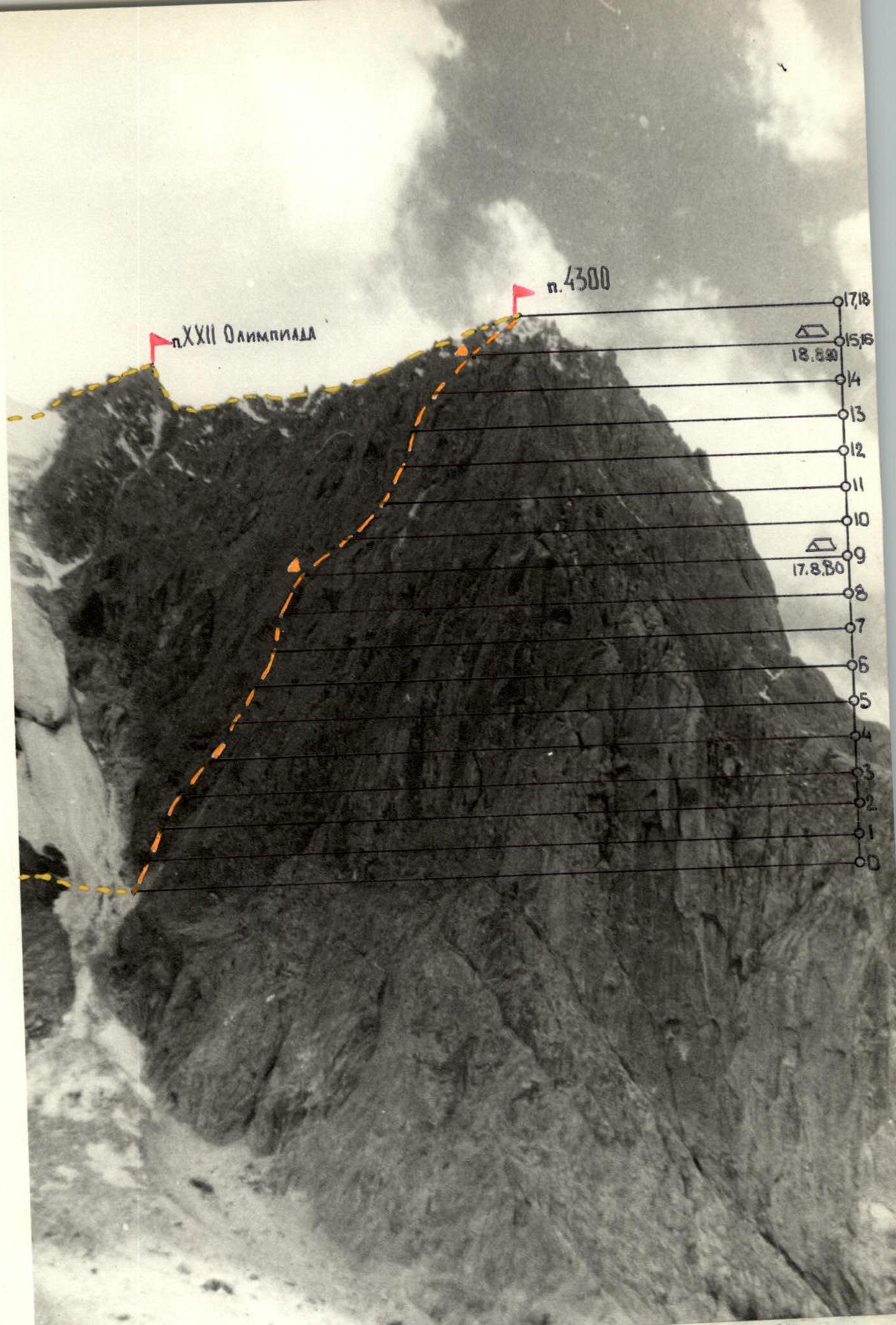
Photo 2. Profile of the Ural Military District team's route on Peak 4300 m via the center of the Eastern wall (3rd ascent)

UIAA-style croquis and profile diagram of the route's wall section
Table of main characteristics of the route to Peak 4300 m via the center of the Eastern wall
Height difference — 780 m, including complex sections (wall section height difference) — 520 m. Average steepness of the route — 80 °. Number of pitons driven — 99.
| Date | Section description | Difficulty | Pitons | |||||||
|---|---|---|---|---|---|---|---|---|---|---|
 |  |  |  |  |  |  | rock | chocks | ||
| I | 2 | 3 | 4 | 5 | 6 | 7 | 8 | 9 | 10 | II |
| August 17, 1980 | R0–R1 | 70 | 40 | Slabs | 4 | monolith | good | 7 | - | - |
| R1–R2 | 60 | 40 | Cleft | 5 | -"- | -"- | 2 | - | - | |
| R2–R3 | 75 | 40 | Wall with cornice | 5 | -"- | -"- | 3 | 2 | - | |
| R3–R4 | 75 | 40 | Wall, crack | 5 | -"- | -"- | 3 | 1 | - | |
| R4–R5 | 80 | 40 | Wall, crack to the right then to the left, cornice | 5 | monolith | good | 3 | 2 | - | |
| R5–R6 | 80 | 40 | Wall, inner corner | 5 | -"- | snow, rain | 2 | 1 | - | |
| I | 2 | 3 | 4 | 5 | 6 | 7 | 8 | 9 | 10 | II |
| August 17, 1980 | R6–R7 | 85 | 40 | Wall, crack, overhang | 6 | monolith | snow | 3 | 5 | - |
| R7–R8 | 85 | 40 | Inner corner, cornice | 6 | -"- | damp | 7 | 1 | - | |
| R8–R9 | 85 | 40 | Cleft with overhang, exit to the “plug” | 5 | -"- | good | 4 | - | - |
Time of departure onto the route — 9:00. Time of stopping for bivouac — 19:00. Number of climbing hours — 10 hours. Sitting bivouac: 3 together + 1 separate. Control cairn at the bivouac site.
| I | 2 | 3 | 4 | 5 | 6 | 7 | 8 | 9 | 10 | II |
|---|---|---|---|---|---|---|---|---|---|---|
| August 18, 1980 | R9–R10 | 80 | 40 | Cleft | 5 | monolith | good | 5 | - | - |
| R10–R11 | 80 | 40 | Inner corner with overhang | 6 | -"- | -"- | 9 | 1 | - | |
| R11–R12 | 80 | 40 | Chimney, crack | 5 | -"- | -"- | 1 | 2 | ||
| R12–R13 | 85 | 40 | Wall, crack | 6 | -"- | -"- | 7 | 3 | ||
| R13–R14 | 95 | 40 | Inner corner with overhang | 6 | -"- | snow, fog | 5, 1 | 5, 1 | ||
| R14–R15 | 80 | 40 | Inner corner, cleft leading to the top of the wall — “stockade” | 5 | -"- | fog | 3 | 2 |
Time of departure from the “plug” bivouac — 8:00. Time of stopping for bivouac — 18:00. Number of climbing hours — 10 hours. Lying bivouac in a ridge depression, in a tent.
| I | 2 | 3 | 4 | 5 | 6 | 7 | 8 | 9 | 10 | II |
|---|---|---|---|---|---|---|---|---|---|---|
| August 19, 1980 | R15–R16 | 60 | 40 | Couloir with ice | 5 | monolith, ice | good | 5 | - | - |
| R16–R17 | 45–60 | 260 | Pre-summit ridge | 4 | Loose rocks | -"- | 2 | - | - | |
| R17–R18 | 50 | 60 | Summit ridge | 4 | monolith | -"- | - | - | - |
Time of departure from the ridge depression bivouac — 7:30. Time of reaching the summit of Peak 4300 m — 10:30. Number of climbing hours — 3 hours.
Team captain (Kharitonov)
Team coach (Mikhailov)

Description of the route ascent
(Explanation of the table of main route characteristics)
The team's ascent followed the planned route in strict accordance with the tactical plan.
Day 1, August 17. At 5:30, we departed from the camp at the “talus”. By 8:00, we reached the platform below the route, where the main equipment had been transported the previous day, August 16. From here, we traversed the ice slope and approached the start of the route. We began the ascent at 9:00 in two rope teams: Kharitonov–Povolotsky and Tarkhov–Zadvoryev, heading towards the “plug” — a convex rock massif in the middle of the wall, the main landmark of the route (sections R0–R9).
Sections R0–R4 are more fragmented, allowing for good belay opportunities.
Sections R4–R9 have a steeper slope, and movement is only possible along vertical cracks at the junction of convex, heavily glaciated vertical blocks, similar to the Krasnoyarsk “spindles”.
For belaying, the following worked well:
- large chocks (“hexes”)
- elongated pitons
By mid-day, the weather deteriorated significantly. Snow began to fall, and streams ran down the wall, complicating the ascent. At 19:00, we reached the bivouac site on the “plug”. Here, we found a control cairn with a note from the “Dugoba” team (led by Pershin) dated August 1, 1980. The platform on the “plug” is the safest bivouac location, but the bivouac is uncomfortable. Three of us sat together, while one person sat separately.
On the first day of the ascent, we covered 360 m of the wall in 10 climbing hours, drove 34 rock pitons, and used 12 chocks.
Day 2, August 18.
- Departure at 8:00
- Directly from the control cairn, 2–3 ropes upwards
- Reached the ridge to the right of the Large Cornice
The character of the rocks remains the same: cracks formed by huge blocks resembling “ogurtsi”.
The most challenging section of the second half of the day was the inner corner with an overhang (section R13–R14).
At 18:00, the team completed the wall ascent and stopped for a bivouac in a comfortable location within a depression of the “stockade” below a large pinnacle.
The bivouac was comfortable. We set up a tent. There was ice and snow available.
In the evening, we processed one rope length up the ice couloir to the rocky ridge leading to the summit.
Day 3, August 19. We departed from the bivouac at 7:30. We ascended the processed section and continued along the ridge to the summit. Simultaneous movement was possible. Belaying was done using rock outcrops. At 10:30, we reached the summit of Peak 4300. We found a note from the Leningrad Military District team (led by Sharonov) dated August 18, 1980.
We began descending along the ridge towards Peak “XXII Olympiad”. We traversed the pinnacle before the summit directly. At 12:30, we found another note from the Leningrad Military District team (led by Sharonov) on Peak “XXII Olympiad”, also dated August 18, 1980, and continued our descent to the southeast into the cirque of Peak Leningradets.
By 16:00, the team had returned to the camp at the “talus” in full.

Comments
Sign in to leave a comment