Ascent Logbook
I. Ascent category: Rock climbing
2. Ascent area, ridge: Western Tian Shan, Ugam Ridge.
3. Peak, its height, ascent route: Peak "Sairam" 4238 m, via the center of the north face.
4. Proposed difficulty category: sixth, 5B
5. Route characteristics:
height difference — 830 m
length of sections with 5B–6 difficulty — 485 m
average steepness — 76°
6. Number of pitons: for belaying, for creating artificial anchors
rock pitons 163, 14
ice screws 13
bolt pitons 3
7. Number of climbing hours: 66
8. Number of bivouacs and their characteristics: five (four sitting, one lying) on artificially created surfaces.
9. Surname, name, patronymic of the team leader, participants, and their qualifications:
Sedelnikov Viktor Nikolaevich, Master of Sports
Akchurin Marat Khasanovich, Master of Sports
Kuramshin Rashid Midhatovich, Master of Sports
Khrebtov Nikolai Petrovich, Master of Sports
Balyukin Vitaly Alekseyevich, Candidate Master of Sports
10. Team coach: Ilyinsky Ervand Tikhonovich — Honored Coach of the Kazakh SSR, Master of Sports
II. Date of departure and return:
July 2, 1977 (not counting processing)
July 7, 1977 (for the first section of the wall)

© № 3 389044577
6. Route Description
July 1
At 6:00, the team of N. Khrebtov — V. Balyukin left the observers' camp to process the first section of the wall. Their task was to pass the first rock bastion and choose a suitable place for a bivouac. The rest of the team observes the "regime" of the wall and studies the planned route.
The team crosses the glacier and ascends a snow-ice slope (section R0–R1) towards the rock bastion. Then, wearing crampons, they ascend an ice slope with a steepness of 55° upwards for the length of a rope, belaying through ice screws. They approach the rocks. Before them is a five-meter negative wall (section R2–R3, photo 3), which they overcome with a "boost". Further, a monolithic wall with sections of broken rocks and a steepness of 75° is visible, along which they move left-upwards for 15 m (section R3–R4, photo 4).
Before them are sheer smooth rocks without cracks. They decide to traverse left above these rocks on ice. Along the boundary of ice and sheer rock, they pass 10 m with difficult climbing and enter an internal corner with a steepness of 85° (section R5–R6, photo 5), the entrance to which is blocked by a 2-meter negative wall. With very difficult climbing, they pass 10 m of the corner and reach an almost vertical monolithic 35-meter wall (section R6–R7, photo 6). There are no places for organizing belay points, so they have to belay sitting in a harness. After overcoming the wall with difficult climbing, they reach an inclined slab under a cornice. After working here, they can set up a sitting area. Water has to be fetched from a neighboring couloir, which is shot with stones during the day. At 16:00, the processing is finished. After securing the "forge" under the cornice, the team begins their descent, preparing the rope for the next day's passage.
In the afternoon, a team from their training, ascending Peak Sairam via route 2A, visited them. They had an aviation altimeter, and they asked them to take readings at the peak to determine the height difference of the north wall. According to their readings, the difference was approximately 820 m. July 2, 1953.
Departure at 7:00. On this day, they need to pass the processed section and prepare a bivouac.
On sections:
- R2–R3
- R5–R6
they have to pull up their backpacks.
By 14:00, they reach the inclined slab. Setting up a site takes a lot of time. "Pamirka" and "Zdarka" were hung on pitons.
They laid a path to water, hanging 20 m of rope. At times, stones fly down the neighboring couloir with great speed. Sometimes they even fly "to visit" their bastion — they have to be on the lookout and watch "the air".
In parallel with the work on setting up the bivouac, the team of N. Khrebtov — V. Sedelnikov processed one and a half ropes of the monolithic wall above the bivouac. July 3. Departure at 8:00. The team of M. Akchurin — R. Kuramshin went up the hung rope. They will lay the path today.
Above them is a monolithic wall (14 m, 90°), composed of limestones, almost without grips (section R7–R8, photo 8). The first climber passed it with difficult climbing in galoshes. Further left-upwards, bypassing the overhanging bastion, is a 25-meter almost sheer wall (section R8–R9) with extremely unreliable grips. All this is "live", and a wrong move can cause it to collapse down to their bivouac under the cornice. On this section, to avoid rockfall, they had to pass the rope without backpacks.
The wall leads to an internal corner (section R9–R10, photo 9) with a small number of grips. Sometimes stones "shoot" down the corner. The corner ends with an overhanging section (100°, 4 m, section R10–R11), which is passed with the help of a platform.
To the right-upwards, a 10% steep wall (section R11–R12) with sections of broken rocks departs upwards. Climbing here is moderately difficult, and one can rest.
Further straight up, a series of rock walls with steepness from 80° to 90° (sections R12–R13, R13–R14, R14–R15, R15–R16) of various lengths (from 10 to 40 m) follows, interspersed with narrow ledges.
The walls are overcome using artificial anchors. Backpacks are pulled up on these sections. At the end of the last wall, a narrow horizontal, seemingly safe ledge is found, on which they decide to set up a bivouac. They stop for the night at 17:00.
July 4. Departure at 7:30. The team of V. Balyukin — N. Khrebtov goes first. Immediately from the bivouac, a 55-meter almost sheer wall (section R16–R17, photo 13) in the form of a counterfort begins, some sections of which are overcome with the help of ladders.
The wall leads to a sharp ice "knife" (15 m, 50°, section R17–R18), which is overcome on the front teeth of crampons.
Further, they move 10 m left-upwards along a wall with a destroyed relief (section R18–R19, photo 14) and come up against a 10-meter internal corner (section R19–R20) with monolithic smooth walls, climbing of moderate difficulty.
On their way, there is again a wall 30 m long, 85°, composed of very unreliable rocks. Many live stones and whole blocks. They need to be very attentive! The problem is to find a stable support.
The section of unreliable rocks turns into a monolithic wall (30 m, 85°, section R21–R22, photo 16). Difficult climbing with the use of ladders begins. A section is found where a bivouac can be organized.
The time is 17:00. They decide to spend the night here, especially since they are faced with a key section of the route.
July 5. Departure at 7:30. The team of V. Sedelnikov — M. Akchurin works ahead. The working day begins with very difficult climbing on a 35-meter vertical wall with two overhangs (section R22–R23, photo 18). To the right-upwards, huge blocks depart, breaking off on them with cornices with a large overhang. They decide to bypass them along an internal corner-chimney (section R23–R24).
After passing 35 m with difficult climbing, they come up against a monolithic sheer wall — "mirror" (section R24–R25, photo 19–20). Passing the "mirror" took a lot of effort and time.
As a result, they reached a section of monolithic slabs with a steepness of 65° (section R25–R26) and a length of 15 m. The relief is almost without cracks; in one place, they had to drive a bolt piton for belaying.
At the end of the 35-meter monolithic wall (section R26–R27, photo 21), following the slabs, a good platform was found. If it is "reconstructed", it can be comfortably settled here. But they cannot reach it with backpacks before nightfall, so they decide to spend the night on the previous uncomfortable bivouac.
They descend down; the key section of the route is passed! They finished processing at 17:30.
July 6. Departure at 7:00. Despite the hung rope, they passed the processed section only by 16:00. Although it's still early, they decide to set up a bivouac — they won't make it to the pre-summit ridge today. It's time to get a good rest; moreover, this time they have a lying bivouac.
Tomorrow, they need to:
- Reach the summit
- Try to descend
While the bivouac was being set up, the team of V. Sedelnikov — M. Akchurin processed a rather difficult 60-meter section of slabs (section R27–R28), leading to the pre-summit counterfort.
July 7. At 6:30 in the morning, they are already on the route. They quickly pass the section processed the day before, which is sometimes "shot" by falling stones from somewhere above. The slabs lead to a vertical monolithic wall, 15 m (section R28–R29). After the slabs, they reach an icy rock counterfort with many live stones (section R29–R30). The weather starts to deteriorate, and the rocks are covered in fog. After passing the ice wall (60°, 30 m, section R30–R31), they reach the continuation of the counterfort (section R31–R32). Climbing is moderately difficult. After the counterfort, they reach slabs with a destroyed relief (50°, 15 m), then left-upwards, bypassing the destroyed wall along ledges and an internal corner with many live stones and whole blocks (this is where stones fall onto the route!).
They reach the pre-summit NE ridge. And here they meet the judge for their area, Master of Sports V.S. Tokmakov, who is ascending with one of their observers along the NE ridge to inspect the north face of Peak Sairam and their route. After several dozen meters along the snowy pre-summit ridge (simultaneous movement), they reach the summit at 14:30.
They found a note from the team of V. Tokmakov — S. Lukyanov, who made the ascent along the NE ridge, category 3B (approximately).
The descent from the summit was along the route of category 2A. At 19:30, they were back in the observers' camp.
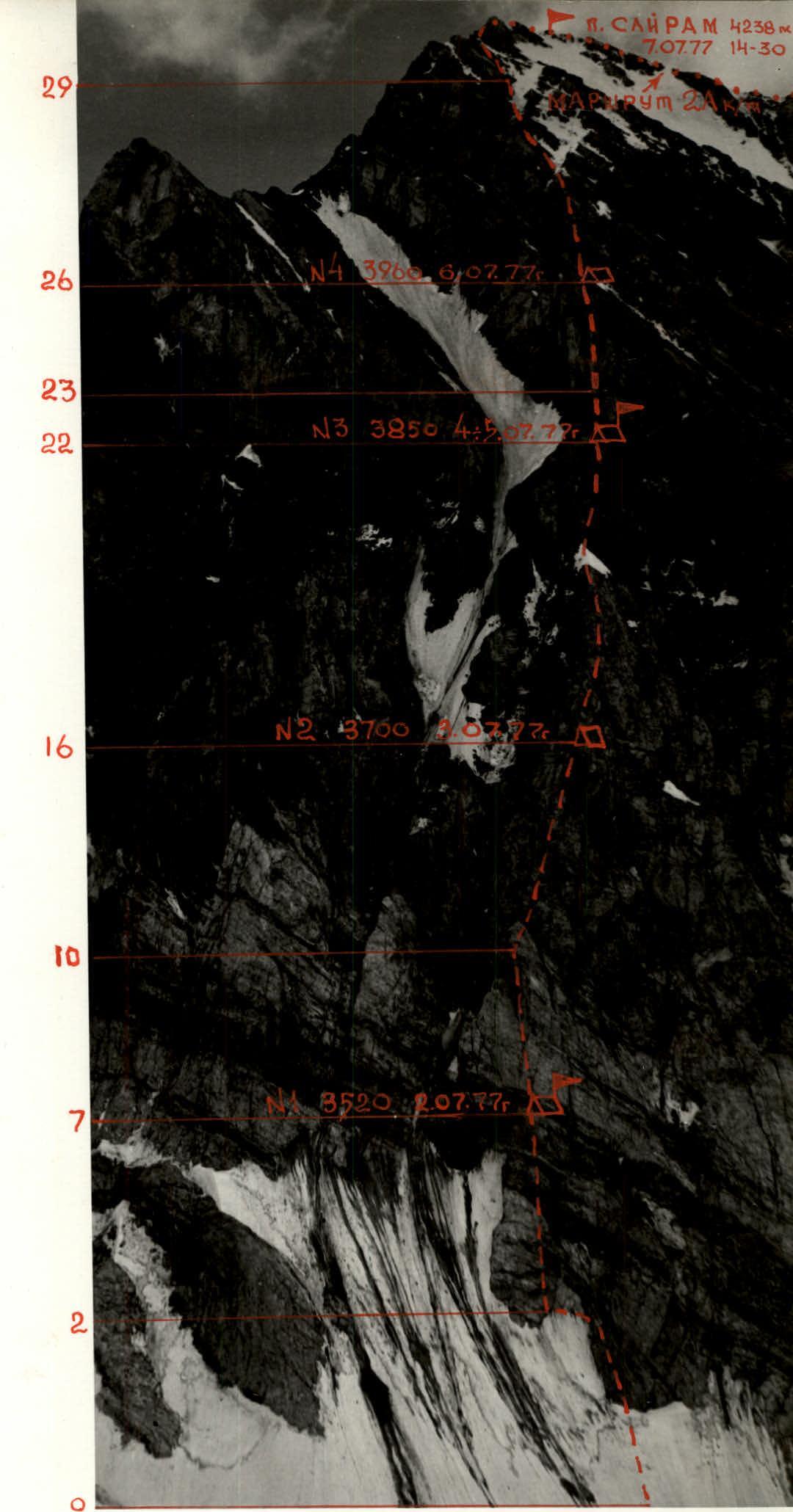
Photo 1. General view.
TABLE OF MAIN CHARACTERISTICS OF THE ASCENT ROUTE
Ascent route:
- Via the center of the north face of Peak Sairam (4238 m)
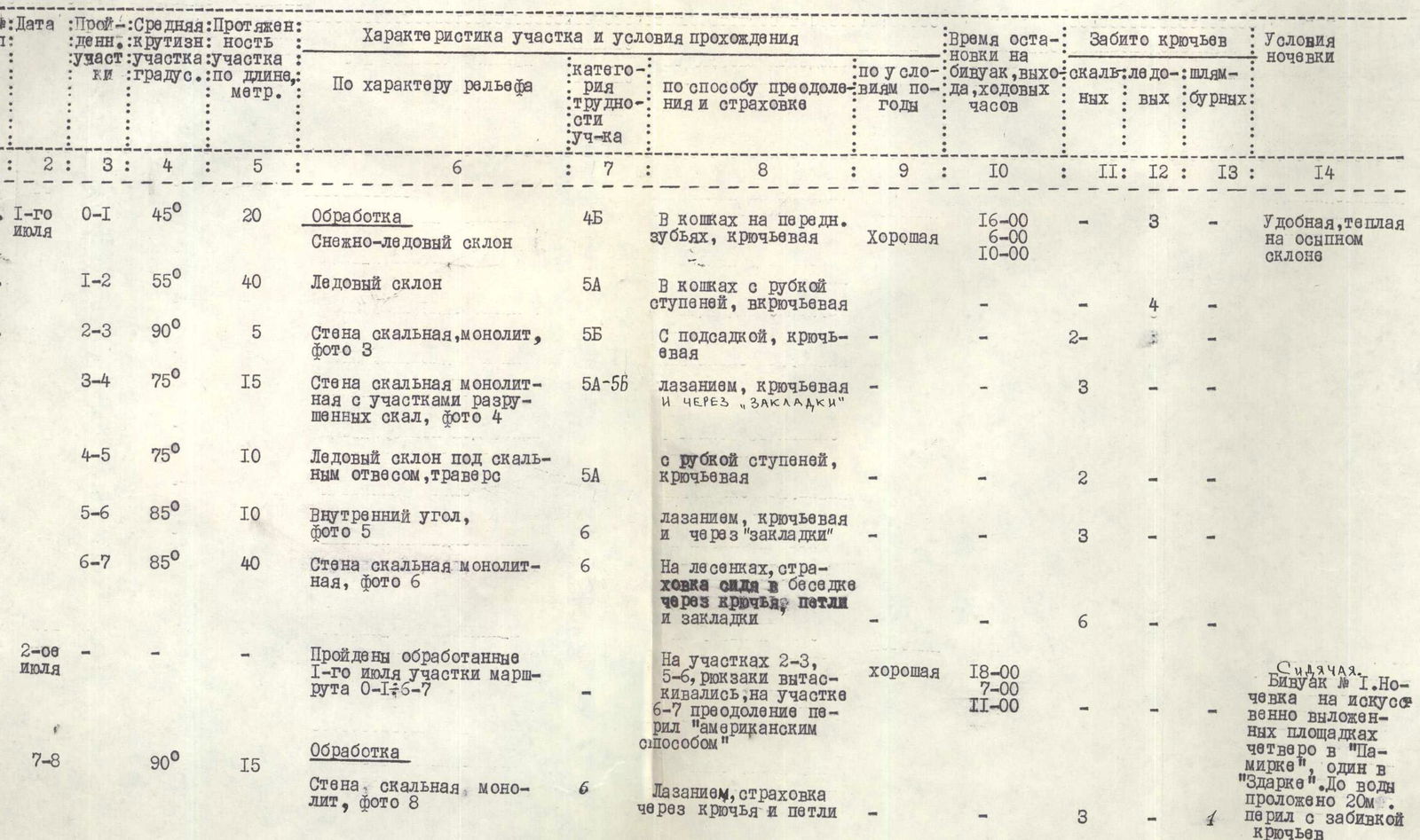
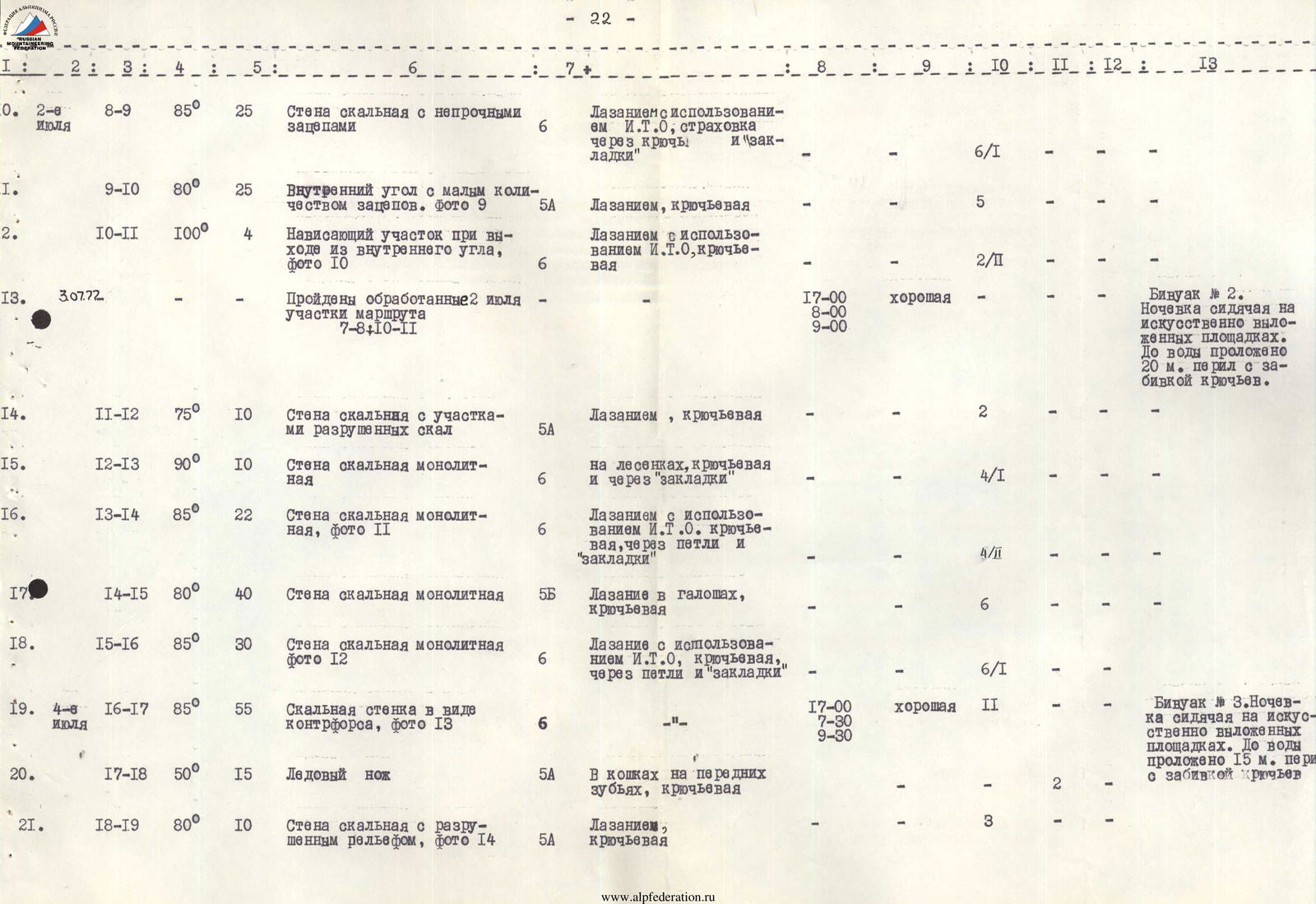

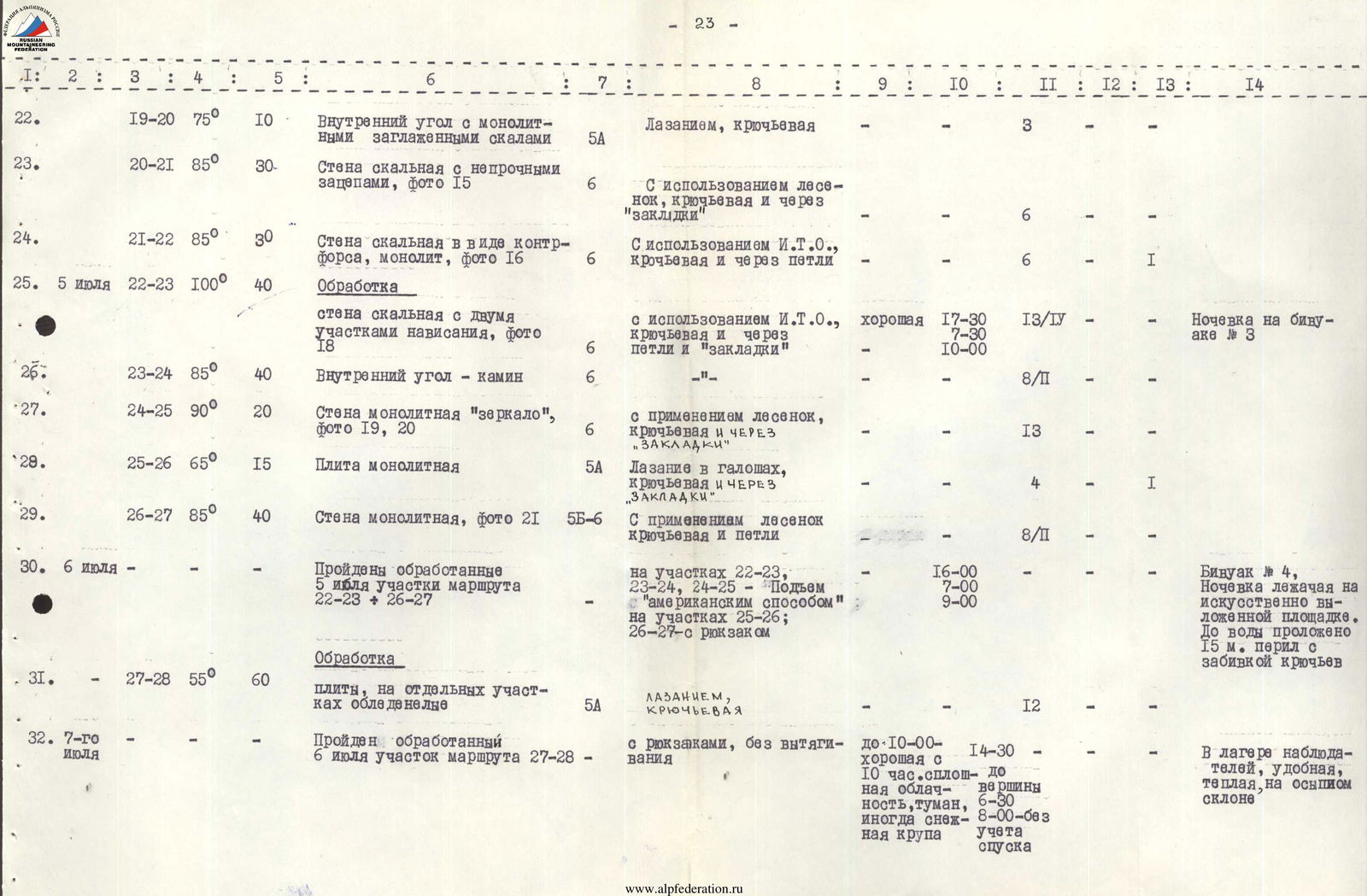
| № | Date | Section | Steepness of section (degrees) | Length of section (m) | Characteristics of section and passage conditions | Difficulty category | Time of bivouac, departure, climbing hours | Rock pitons | Ice screws | Bolt pitons | Bivouac conditions |
|---|---|---|---|---|---|---|---|---|---|---|---|
| 1. | July 1 | R0–R1 | 45° | 20 | Processing. Snow-ice slope | 4Б | Crampons on front teeth, hook belay. Good. 16:00, 6:00, 10:00 | — | 3 | — | Comfortable, warm on talus slope |
| 2. | R1–R2 | 55° | 40 | Ice slope | 5А | Crampons with step cutting, hook belay | — | 4 | — | ||
| 3. | R2–R3 | 90° | 5 | Rock wall, monolithic, photo 3 | 5Б | With a "boost", hook belay | — | 2 | — | ||
| 4. | R3–R4 | 75° | 15 | Rock wall monolithic with sections of broken rocks, photo 4 | 5А–5Б | Climbing, hook belay and through " закладки" | — | 3 | — | ||
| 5. | R4–R5 | 75° | 10 | Ice slope under rock overhang, traverse | 5А | With step cutting, hook belay | — | 2 | — | ||
| 6. | R5–R6 | 85° | 10 | Internal corner, photo 5 | 6 | Climbing, hook belay and through "закладки" | — | 3 | — | ||
| 7. | R6–R7 | 85° | 40 | Rock wall monolithic, photo 6 | 6 | On ladders, belay sitting in harness through pitons, loops, and "закладки" | — | 6 | — | ||
| 8. | July 2 | Passed processed sections R0–R7 on July 1 | On sections R2–R3, R5–R6, backpacks were pulled up; on section R6–R7, overcoming rope "American style". Good. 18:00, 7:00, 11:00 | — | — | — | Sitting. Bivouac № 1. Night on artificially created platforms, four in "Pamirka", one in "Zdarka". 20 m of rope laid to water with piton installation. | ||||
| 9. | R7–R8 | 90° | 15 | Rock wall, monolithic, photo 8 | 6 | Climbing, belay through pitons and loops | — | 3 | 4 | ||
| 10. | R8–R9 | 85° | 25 | Rock wall with unreliable grips | 6 | Climbing using I.T.O., belay through pitons and "закладки" | 6 | 1 | — | ||
| 11. | R9–R10 | 80° | 25 | Internal corner with few grips, photo 9 | 5А | Climbing, hook belay | — | 5 | — | ||
| 12. | R10–R11 | 100° | 4 | Overhanging section at exit from internal corner, photo 10 | 6 | Climbing using I.T.O., hook belay | 2 | 11 | — | ||
| 13. | July 3 | Passed processed sections R7–R11 on July 2 | Good. 17:00, 8:00, 9:00 | — | — | — | Bivouac № 2. Sitting night on artificially created platforms. 20 m of rope laid to water with piton installation. | ||||
| 14. | R11–R12 | 75° | 10 | Rock wall with sections of broken rocks | 5А | Climbing, hook belay | — | 2 | — | ||
| 15. | R12–R13 | 90° | 10 | Rock wall monolithic | 6 | On ladders, hook belay through "закладки" | 4 | 1 | — | ||
| 16. | R13–R14 | 85° | 22 | Rock wall monolithic, photo 11 | 6 | Climbing using I.T.O., hook belay through loops and "закладки" | 4 | 1 | — | ||
| 17. | R14–R15 | 80° | 40 | Rock wall monolithic | 5Б | Climbing in galoshes, hook belay | — | 6 | — | ||
| 18. | R15–R16 | 85° | 30 | Rock wall monolithic, photo 12 | 6 | Climbing using I.T.O., hook belay through loops and "закладки" | 6 | 1 | — | ||
| 19. | July 4 | R16–R17 | 85° | 55 | Rock wall in the form of a counterfort, photo 13 | 6 | —. Good. 17:00, 7:30, 9:30 | 11 | — | — | Bivouac № 3. Sitting night on artificially created platforms. 15 m of rope laid to water with piton installation. |
| 20. | R17–R18 | 50° | 15 | Ice "knife" | 5А | Crampons on front teeth, hook belay | — | 2 | — | ||
| 21. | R18–R19 | 80° | 10 | Rock wall with destroyed relief, photo 14 | 5А | Climbing, hook belay | — | 3 | — | ||
| 22. | R19–R20 | 75° | 10 | Internal corner with monolithic smooth rocks | 5А | Climbing, hook belay | — | 3 | — | ||
| 23. | R20–R21 | 85° | 30 | Rock wall with unreliable grips, photo 15 | 6 | Using ladders, hook belay and through "заклидки" | — | 6 | — | ||
| 24. | R21–R22 | 85° | 30 | Rock wall in the form of a counterfort, monolithic, photo 16 | 6 | Using I.T.O., hook belay and through loops | — | 6 | 1 | ||
| 25. | July 5 | R22–R23 | 100° | 40 | Processing. Rock wall with two overhanging sections, photo 18 | 6 | Using I.T.O., hook belay and through loops and "закладки". Good. 17:30, 7:30, 10:00 | 13 | 4 | — | Night on bivouac № 3 |
| 26. | R23–R24 | 85° | 40 | Internal corner — chimney | 6 | — | 8 | 11 | — | ||
| 27. | R24–R25 | 90° | 20 | Monolithic wall "mirror", photo 19, 20 | 6 | Using ladders, hook belay and through "закладки" | — | 13 | — | ||
| 28. | R25–R26 | 65° | 15 | Monolithic slab | 5А | Climbing in galoshes, hook belay and through "закладки" | — | 4 | 1 | ||
| 29. | R26–R27 | 85° | 40 | Monolithic wall, photo 21 | 5Б–6 | Using ladders, hook belay and loops | — | 8 | 11 | ||
| 30. | July 6 | Passed processed sections R22–R27 on July 5 | On sections R22–R23, R23–R24, R24–R25 — ascent "American style"; on sections R25–R26; R26–R27 — with backpacks. 16:00, 7:00, 9:00 | — | — | — | Bivouac № 4. Lying night on artificially created platform. 15 m of rope laid to water with piton installation. | ||||
| 31. | R27–R28 | 55° | 60 | Slabs, partly icy | 5А | Climbing, hook belay | — | 12 | — | ||
| 32. | July 7 | Passed processed section R27–R28 on July 6 | With backpacks, without pulling up. Good. Until 10:00 — 14:30. Overcast, fog, sometimes snow flurries. Until summit 6:30–8:00 (not counting descent) | — | — | — | In observers' camp, comfortable, warm, on talus slope. | ||||
| 33. | R28–R29 | 90° | 15 | Monolithic wall, photo 22 | 5Б | Climbing, hook belay, through "закладки" and ledges | — | 3 | — | ||
| 34. | R29–R30 | 60° | 50 | Rock counterfort with sections of rime ice on rocks | 5А | Climbing, hook belay and through ledges | — | 6 | — | ||
| 35. | R30–R31 | 55° | 30 | Ice slope, snow-covered | 5А | Crampons on front teeth, hook belay and through ledges | — | 4 | — | ||
| 36. | R31–R32 | 55° | 30 | Rock counterfort with sections of icy rocks | 5А | Climbing with grip cleaning, hook belay and through ledges | — | 6 | — | ||
| 37. | R32–R33 | 50° | 15 | Slab with sections of broken rocks | 4Б | Climbing, hook belay and through ledges | — | 2 | — | ||
| 38. | R33–R34 | 65° | 60 | Rock counterfort with destroyed relief | 5А | Climbing, hook belay and through "закладки" | — | 5 | — | ||
| Total: | 66,5 | 163 | 13 | 3 |
Team Captain V. Sedelnikov
Team Coach E. Ilyinsky