
I. Rock class. 2. Western Tian-Shan, Ugam ridge, "Sairam" gorge. 3. "4200" peak, via the North-Eastern wall. 4. Proposed - 6B cat. of difficulty, first ascent. 5. Height difference - 870 m, length - 1080 m.
The length of sections with 5B-6B cat. of difficulty - 750 m, of which 5B-6B cat. of difficulty - 680 m. The average steepness of the main sections - 80°, of which 6B cat. of difficulty - 312 m (3230–3365), (3560–3610), (3650–3730).
- Pitons driven:
| rock | bolt | chocks | ice |
|---|---|---|---|
| 97/1 | 14/3 | 66/5 | 0/0 |
- Team's working hours - 37 and days - 3.
- Overnights: 1st and 2nd - artificially laid platform, one in a hammock.
- Leader: Timofeev Alexander Veniaminovich - MS
Team members: Aigistov Gleb Akhmetovich - MS, Vekhter Vladimir Viktorovich - CMS, Povetin Anatoly Alekseevich - CMS, Morev Nikolai Borisovich - CMS, Kovalenko Pyotr Konstantinovich - CMS. 10. Coach: - Timofeev Alexander Veniaminovich
Senior Coach: - Shedelnikov Viktor Nikolaevich, Honored Coach of KazSSR.
- Departure to the route: - July 6, 1982.
Summit - July 8, 1982.
Return - July 9, 1982.
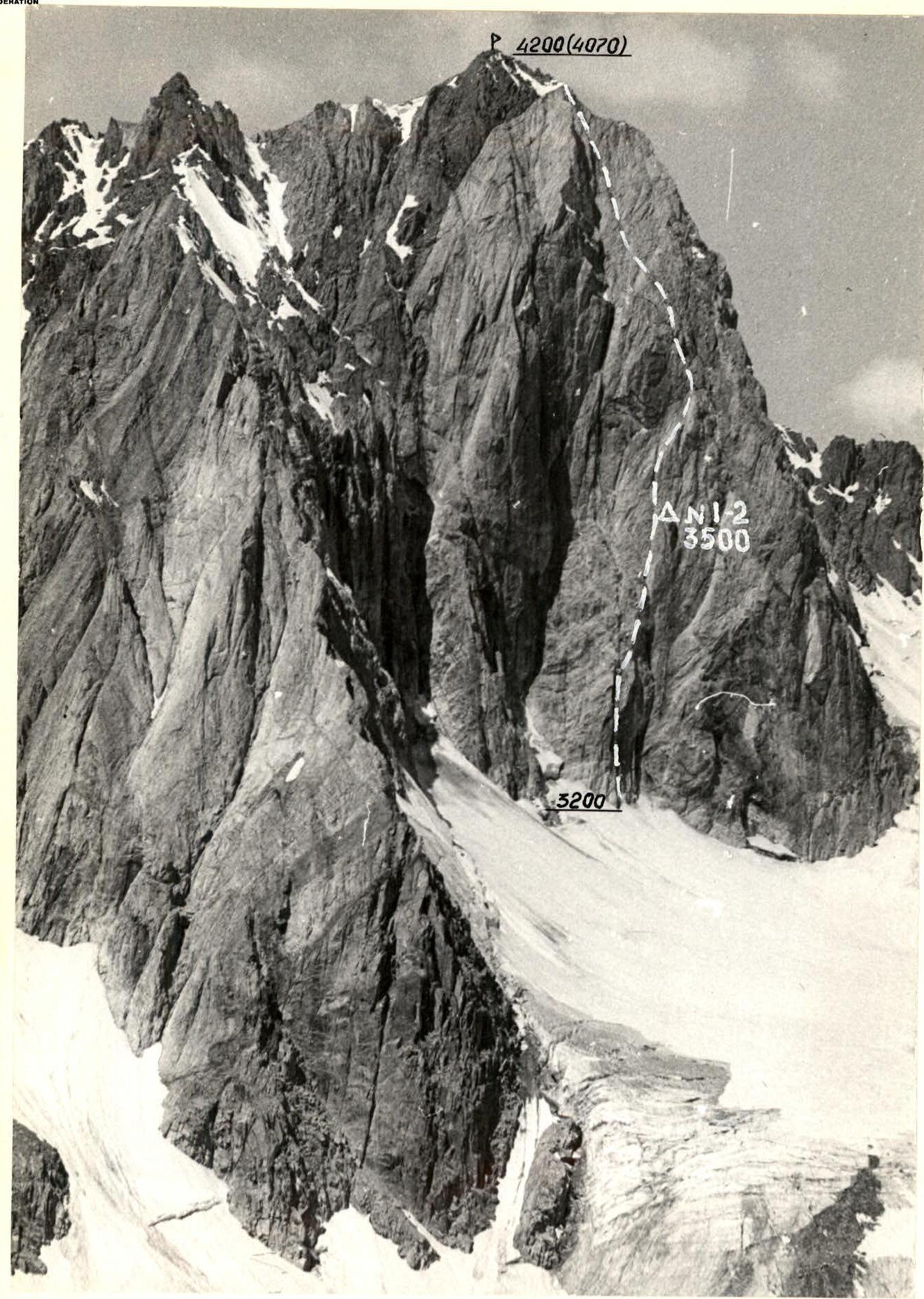
General photo of the summit
TEAM'S ROUTE July 5, 1982 15:00 Lens I-61 F-52
Point 1. H-3500. Distance - 2000 m
HEIGHT 4200 DETERMINED BY MAP, THE REST BY ALTIMETER
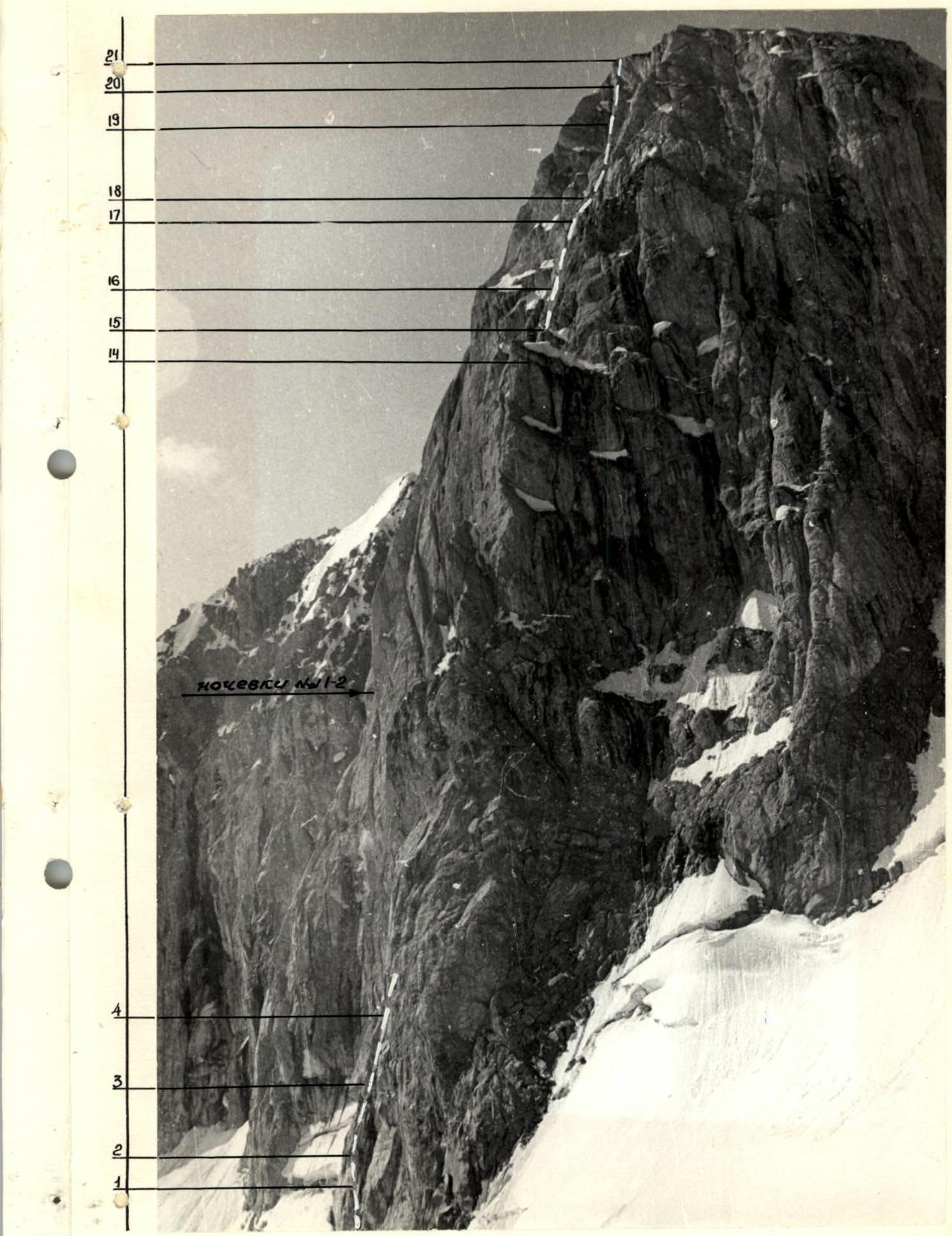
PHOTO OF THE WALL PROFILE FROM THE RIGHT July 6, 1982 12:00. Lens - Mir-1. F-35.
Point 3. H-3400. Distance - 700 m.
Tactical actions of the team
The tactical actions of the team during the ascent were determined by the tactical plan, taking into account changes in the situation during the climb.
All sections of the route were overcome by free climbing, except for a few places with overhangs, where artificial holds were used. The movement of the "first" on the route was carried out in galoshes without a backpack, using a double rope.
Given the steepness and nature of the wall relief on almost the entire route (sections R0-R21), perils were used, along which team members climbed with backpacks using jammers to speed up movement, given their high individual physical and technical training. The lack of water (snow, ice), places convenient and safe for organizing bivouacs (route problem), necessitated:
- maximum use of daylight, physical and technical capabilities of team members on the first day to reach the planned overnight stay - an inclined shelf, protected by an overhanging section of the wall, on which there was a small strip of ice;
- preliminary processing of the key section of the route above the bivouac (200 m, sections R9-R14) on the second day in order to overcome sections of the wall unfavorable for organizing a second bivouac in one day.
Unfavorable weather conditions during the training camp and preparation for the ascent required their consideration when developing a tactical plan, which included an overnight stay in the upper part of the wall. However, excellent weather conditions during the ascent made it possible to maximize the use of daylight. The well-coordinated and clear work of the team ensured that the route was overcome in 3 days, without organizing a third overnight stay on the route.
The following rope teams were formed for work on the route:
- Timofeev A.V. - Povetin A.A.
- Aigistov G.A. - Morev N.B.
- Vekhter V.V. - Kovalenko P.K.
The rope teams were organized taking into account the physical, technical, and moral-volitional qualities of the participants, as well as their compatibility. Most participants had high rock climbing training. Vekhter V.V. is the champion of KazSSR in rock climbing - a candidate for master of sports. Timofeev A.V., Aigistov G.A., Kovalenko P.K. have 1st sports category. Morev N.B., Povetin A.A. - 2nd sports category. The organized rope teams were independent structural units of the team and remained unchanged until the end of the ascent. During the day, participants had individual pocket food.
During the ascent, all participants were leading in the rope teams, and the teams changed evenly. Movement on the route was organized continuously during the working day. Rest and nutrition of participants were carried out during the change of leading rope teams. Clear interaction between the rope teams made it possible to pass the route without any delays.
Two overnight stays were organized on an inclined shelf (on an artificially laid platform), on which a tent was set up. A hammock was hung on the wall nearby for a participant who could not fit on the shelf.
There were no falls or injuries during the passage of the route. To improve the safety of the route, chock stones were used as attachment points for ropes whenever possible. The bivouac was organized in a safe place.
Titanium alloy rock pitons, chocks, and quickdraws were widely used on the route.
Communication with the observation group under the wall in the assault camp was carried out without interruption using VHF radios. Daily main communication sessions: 7:45, 13:45, 19:45; emergency - 12:00, 18:00. The use of rockets was supposed to be used as a backup communication means.
The observation group constantly monitored the team's work on the route using binoculars. Observers communicated with the base camp using the "Nedra-3" radio station. A car was on duty in the base camp.
Route scheme in UIAA symbols

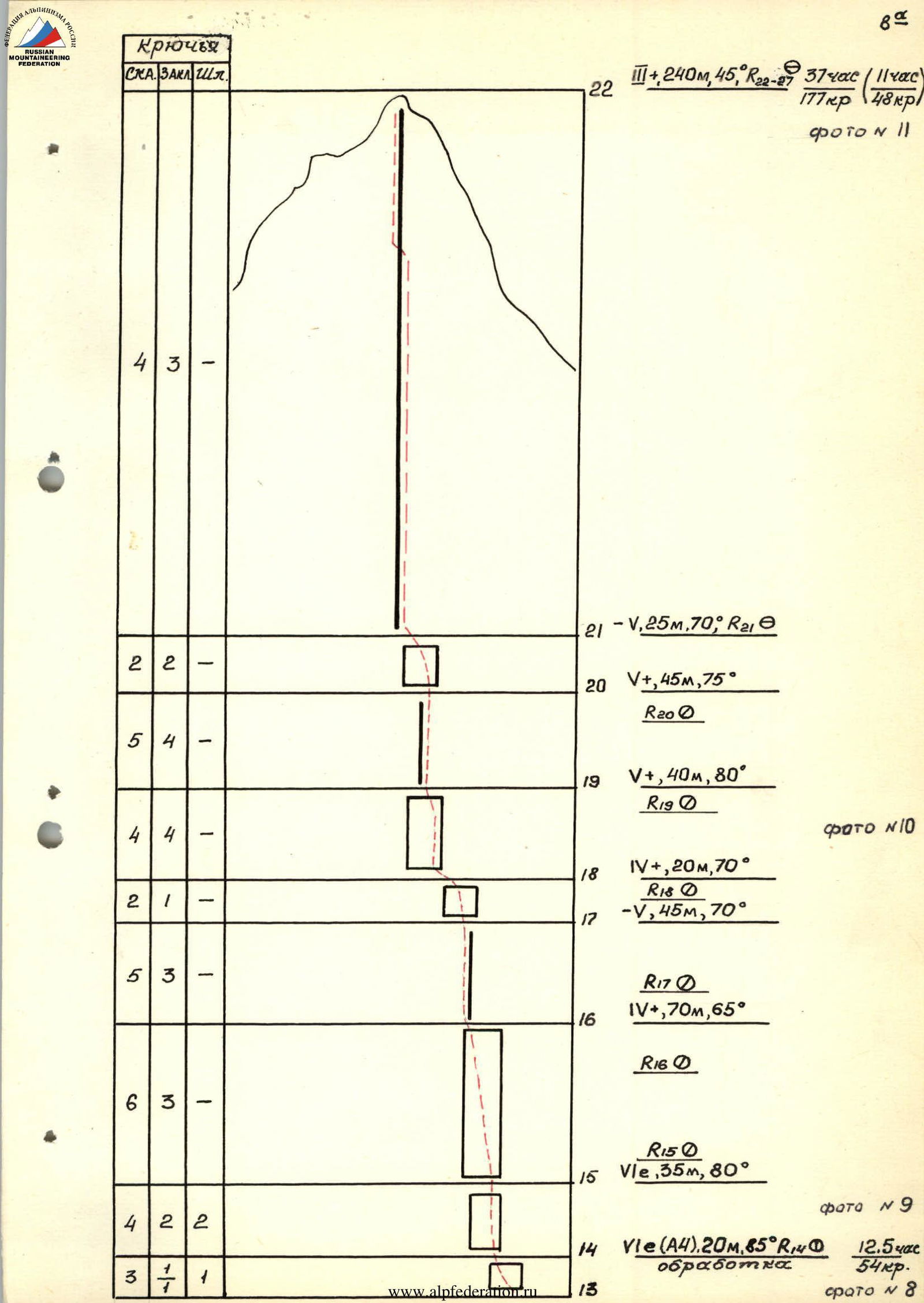
Data on sections from the scheme: For sections R22-R27: III+, 240 m, 45°. Total pitons - 177. (Photo #11)
- R0: V+, 30 m, 80° (Photo #1)
- R1: VI (A3), 22 m, 85°
- R2: VI (A3), 22 m, 85° (Photo #2,3)
- R3: VIe (A4), 60 m, 90°
- R4: VI (A4), 55 m, 85° (Photo #4)
- R5: V+, 42 m, 80°
- R6: V+, 40 m, 75°
- R7: Ve+, 75 m, 80°
- R8: V+, 25 m, 75°, 75 pitons
- R9: V+, 10 m, 75°, 13 h 30 min
- R10: V+, 10 m, 85° (Photo #5)
- R11: VIe (A3), 55 m, 90°
- R12: Ve+, 50 m, 85° (Photo #6)
- R13: VIe+, (A4), 65 m, 90° (Photo #7)
- R14: VIe (A4), 20 m, 85°, processing, 12 h 30 min, 54 pitons (Photo #8)
- R15: VIe, 35 m, 80° (Photo #9)
- R16: IV+, 70 m, 65°
- R17: -V, 45 m, 70°
- R18: IV+, 20 m, 70° (Photo #10)
- R19: V+, 40 m, 80°
- R20: V+, 45 m, 75°
- R21: V, 25 m, 70°
Description of the route by sections
Section R0-R1. Move straight up along the inner corner, rocks are monolithic, in the middle part the corner juts out. It is necessary to belay while standing on the edge of a randkluft due to the danger of rockfall. Aigistov goes first, Morev belays him. For safety, the other team members were on a snowy slope 30 meters below.
Section R1-R2. Smooth wall, practically without holds and convenient places for driving pitons. In the first meters, a ladder was used.
Section R2-R3. Sheer wall, in the upper part - a cornice (1 m overhang), movement is straight up. When passing the cornice, the Morev-Aigistov rope team used chock stones like "stoppers". Belay - sitting in a harness, movement along the perils using étriers.
Section R3-R4. One of the key places. Exit to the inner corner with a minimal number of holds. Movement along the corner by free climbing is extremely difficult, in the upper part exit from the corner to the right onto the wall (a ladder was used). When moving along the corner, large "segments" were used for belaying. Belay - sitting in a harness.
Section R4-R5. Move right-up along the wall. Vekhter goes first. Practically no cracks. For belaying, very small cams and rock pitons "nails" are used. The movement of the "first" is mainly on friction. At the belay point, one can stand on a short self-belay loop.
Section R5-R6. Somewhat easier. For belaying, medium-sized rock pitons and small chocks are used. Belay - sitting in a harness. Rocks are monolithic but heavily eroded.
Section R6-R7. Two people can stand at the belay point. Exit to the wall with a boost, it is passed by Timofeev-Povetin. Very inconvenient places for driving pitons. Almost no holds. Movement is mainly on friction, very difficult.
Section R7-R8. Move up along the wall, long rock pitons are used. Belay - sitting in a harness, subsequent rope teams move along the hung perils. Passing sections R4-R8 by free climbing in case of bad weather (rain, snow) may be problematic.
Section R8-R9. "Ram's foreheads" are passed on friction. Exit to the platform for overnight stay. The platform is an osypnaya inclined shelf. 2 hours were spent preparing the overnight stay site. Only one "Pamirka" tent can be set up.
Section R9-R10. From the overnight stay straight up along the wall - exit to the base of a characteristic chimney with a plug. Few places for driving pitons, thin pitons are used.
Section R10-R11. One of the key places on the route:
- The chimney is very steep, few holds, all holds are mostly reverse.
- There is no possibility to jam inside the chimney.
- The plug is bypassed on the right with an exit to the top of the plug.
- The section was passed along the perils with the help of a ladder.
- The Kovalenko-Vekhter rope team was the first to pass.
- The group spent 2.5 hours on this section.
Section R11-R12. Very steep wall, rocks are heavily eroded, no convenient places for driving pitons. Belay of the first on the section - sitting in a harness. Long rails are used for belaying. Aigistov goes first, movement is right-up, then left-up. When passing sections R9-R12, falling rocks on the overnight stay platform is possible. For safety, when processing the sections, the tent was removed, and the Timofeev-Povetin rope team was on a narrow shelf to the left of the overnight stay platform.
Section R12-R13. Key section of the route:
- Sheer wall with an unstable structure, in the upper part - a cornice (1.5 m overhang).
- The cornice is passed straight on étriers with pulling up.
- When exiting from under the cornice, small chocks were used.
- When passing along the perils, étriers were used.
- Rockfall hazard!
- The most safe place for a belay point is on the left under the cornice.
Section R13-R14. Smooth wall. It is passed in the direction from right to left. In the upper part, it juts out. The Vekhter-Kovalenko rope team works first.
Section R14-R15. The wall is in the form of a slab, few cracks for driving pitons, in the upper part - "live" stones. Bolt pitons were used to organize belaying. Rockfall hazard!
Section R15-R16. Very wide gray wall, rough, there are small holds and places for driving pitons. Pleasant climbing. Movement is from right to left in the direction of a characteristic counterfort. The Povetkin-Timofeev rope team chooses the route.
Section R16-R17. Move along the ridge of the counterfort. Quite steep. Rockfall hazard to the right. Piton belaying, rocks are relatively strong.
Section R17-R18. Along the destroyed wall - traverse left-up. Many "live stones". Rockfall hazard! Morev and Aigistov are in front, subsequent rope teams carefully pass along the perils one by one.
Section R18-R19. Steep wall in the form of a counterfort. Four people can stand under the wall. Move straight up, in the upper part - a few to the right. Rocks are monolithic, piton belaying.
Section R19-R20. Steep ridge, in the upper part - destroyed. Very few holds. Inconvenient belay point. Povetin works very carefully in front.
Section R20-R21. The wall has a block structure with wide cracks. At the top of the wall is an excellent platform where the whole group can gather. The wall part of the route is passed.
Section R21-R22. Ridge representing a jumble of granite monolithic blocks. In some areas, movement is on friction. Rope teams move, interacting on driven pitons.
Notes:
- The movement of the first on the entire route was carried out on a double rope.
- Belay points when passing the entire route were organized on blocked pitons using specially designed loops.
- The absence in the description of data on the nature of the used pitons and chocks means that a standard set can be used.
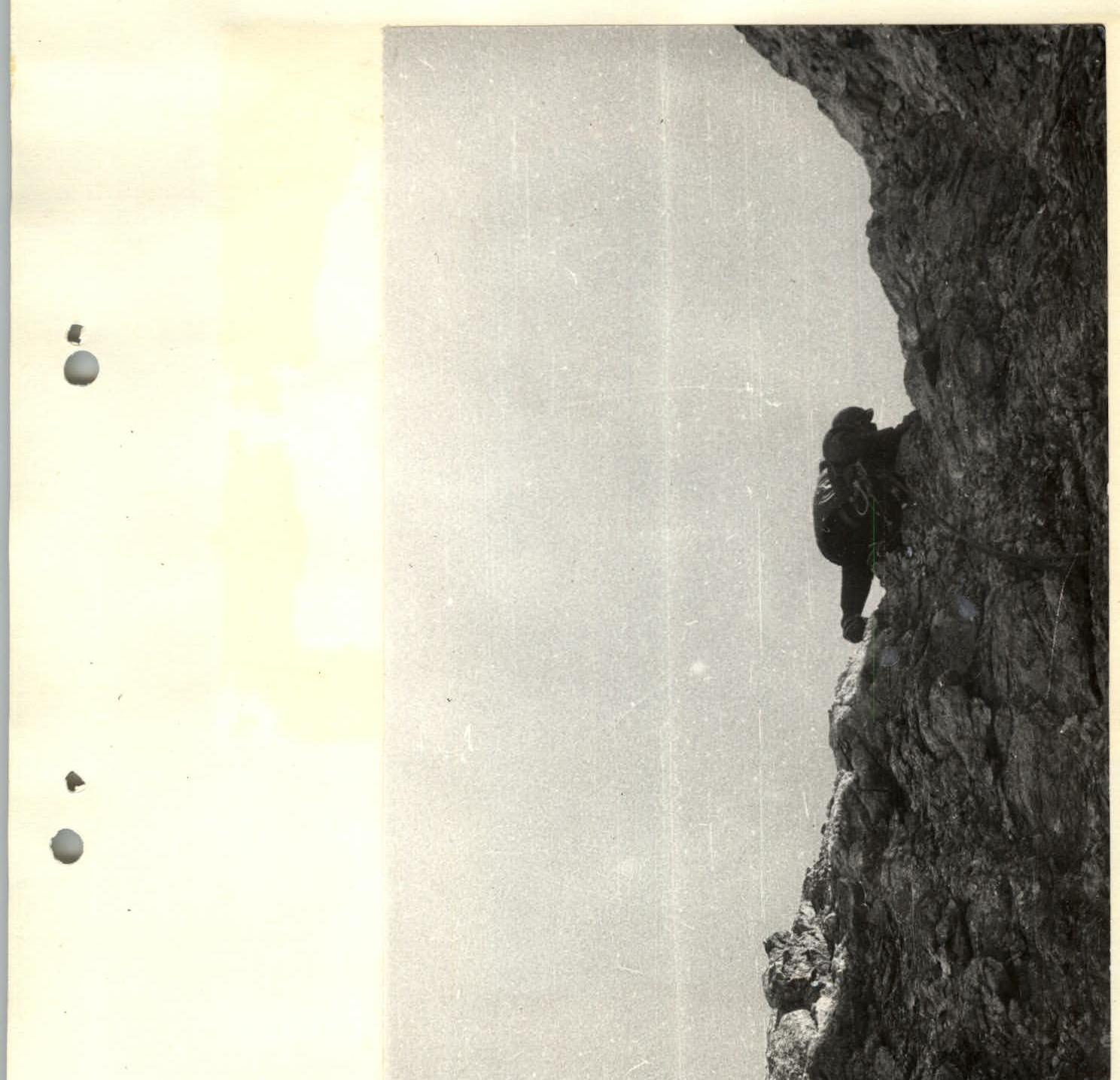
Photo #10
SECTION R18-R19. Point 9. July 8, 1982 14:00. Lens T43, F-40.
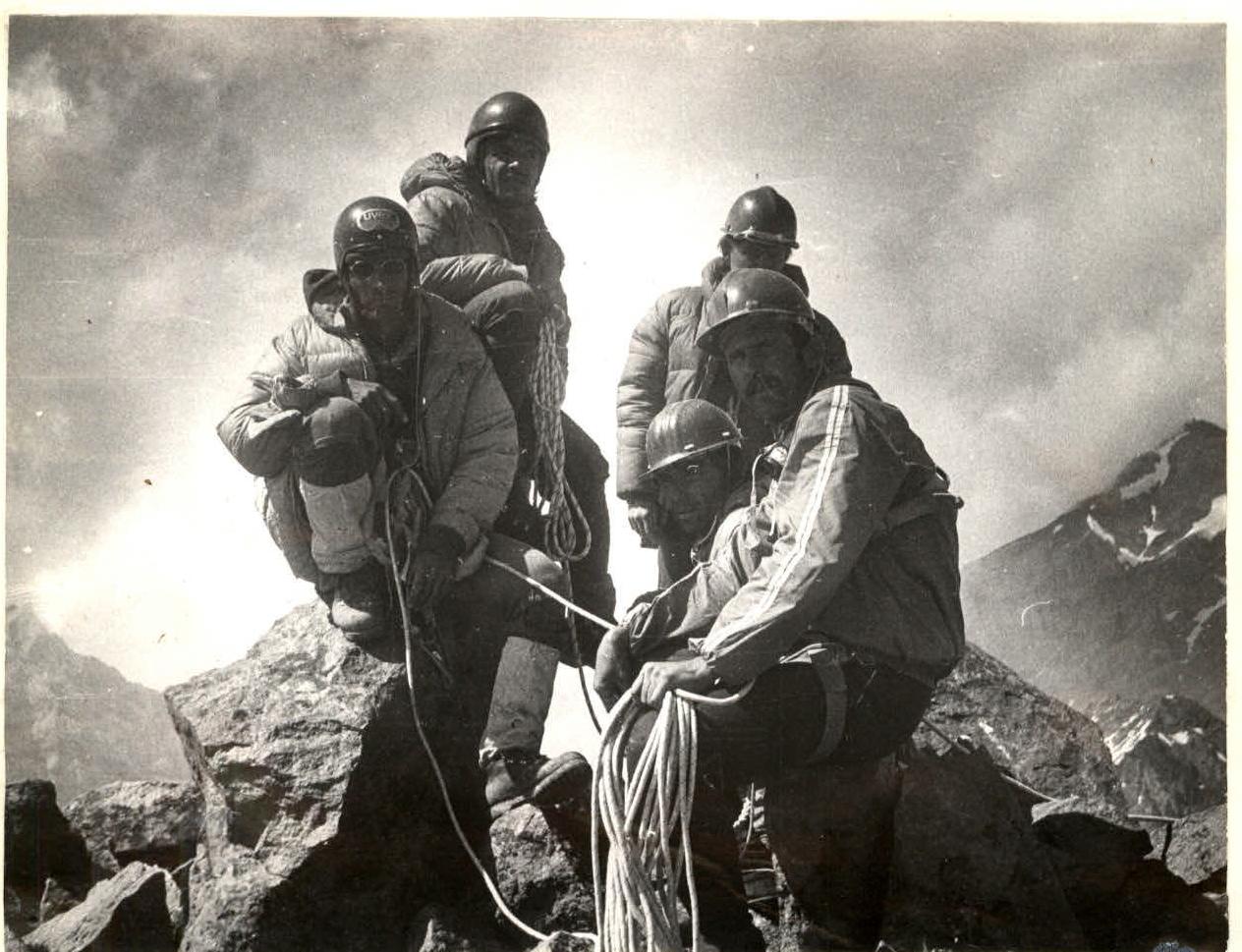
Photo #N
AT THE SUMMIT.
Team leader and coach A. Timofeev.