
- Climbing type — technical.
- Climbing area — Tian Shan, Terskey Ala-Too.
- Peak, its height, ascent route — p. Dzhigit, 5170 m, via the center of the N wall (V. Vakurin's route, 83).
- Difficulty category — 6B.
- Route characteristics — height difference 1120 m, length — 2050 m, length of 6B difficulty sections — 140 m.
- Protection:
- rock anchors: 97
- ice screws: 66
- placed nuts: 20.
- Total climbing hours — 39.
- Number and characteristics of bivouacs: 3 bivouacs (two — lying, one — sitting).
- Surname, name, patronymic of the leader, participants, and their qualification:
- Krasnoukhov Yuri Vasilyevich, Master of Sports — leader
- Emelyanov Evgeny Georgievich, Candidate Master of Sports — participant
- Pashin Andrey Viktorovich, Candidate Master of Sports — participant
- Reznik Valery Alexandrovich, Candidate Master of Sports — participant
- Shamalo Valery Pavlovich, Candidate Master of Sports — participant.
- Team coach: Master of Sports Stepanov Igor Vasilyevich.
- Date of departure on the route — July 23, 1992 (July 23–24 route reconnaissance), summit — July 27, return to base camp — July 28, 1992
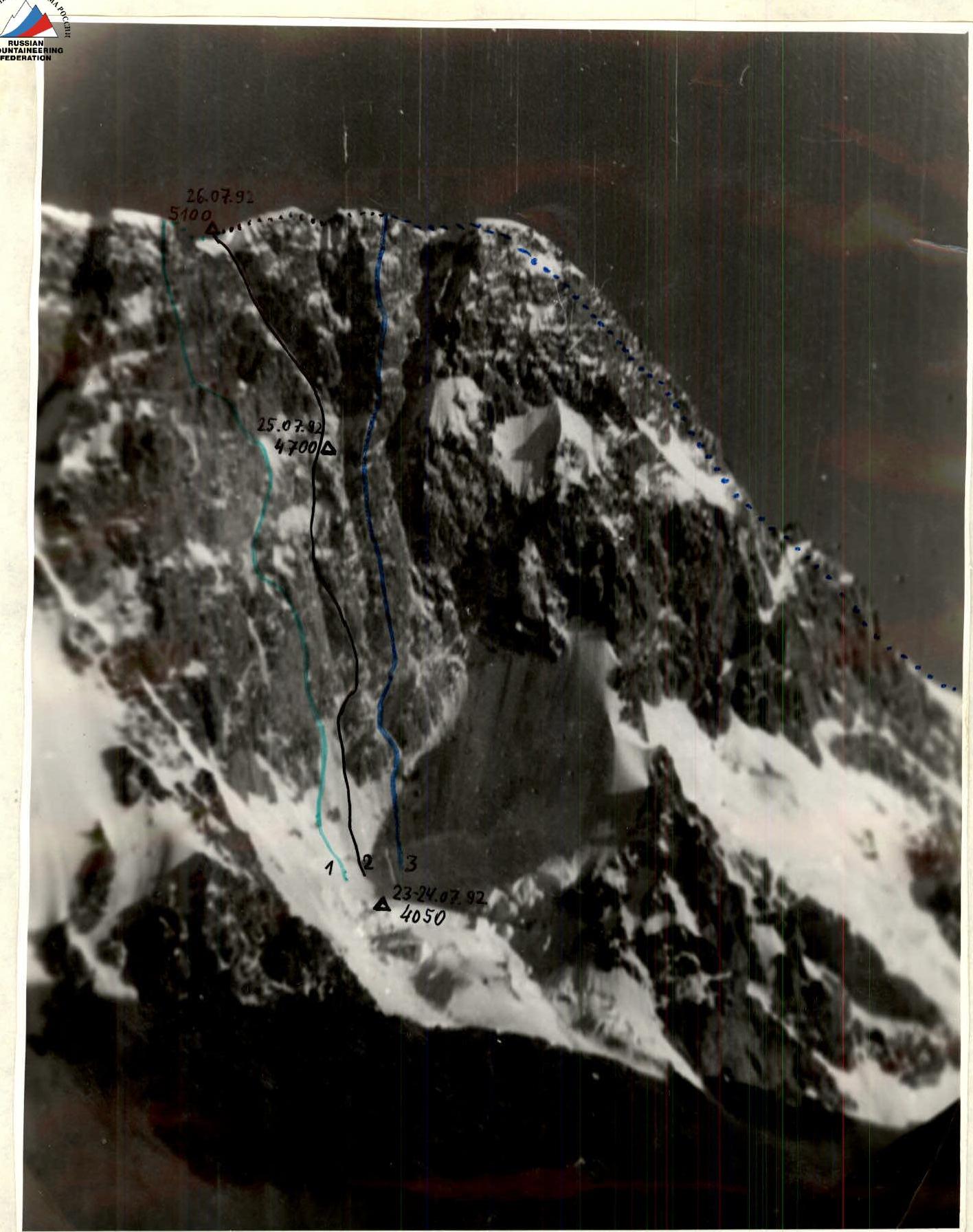
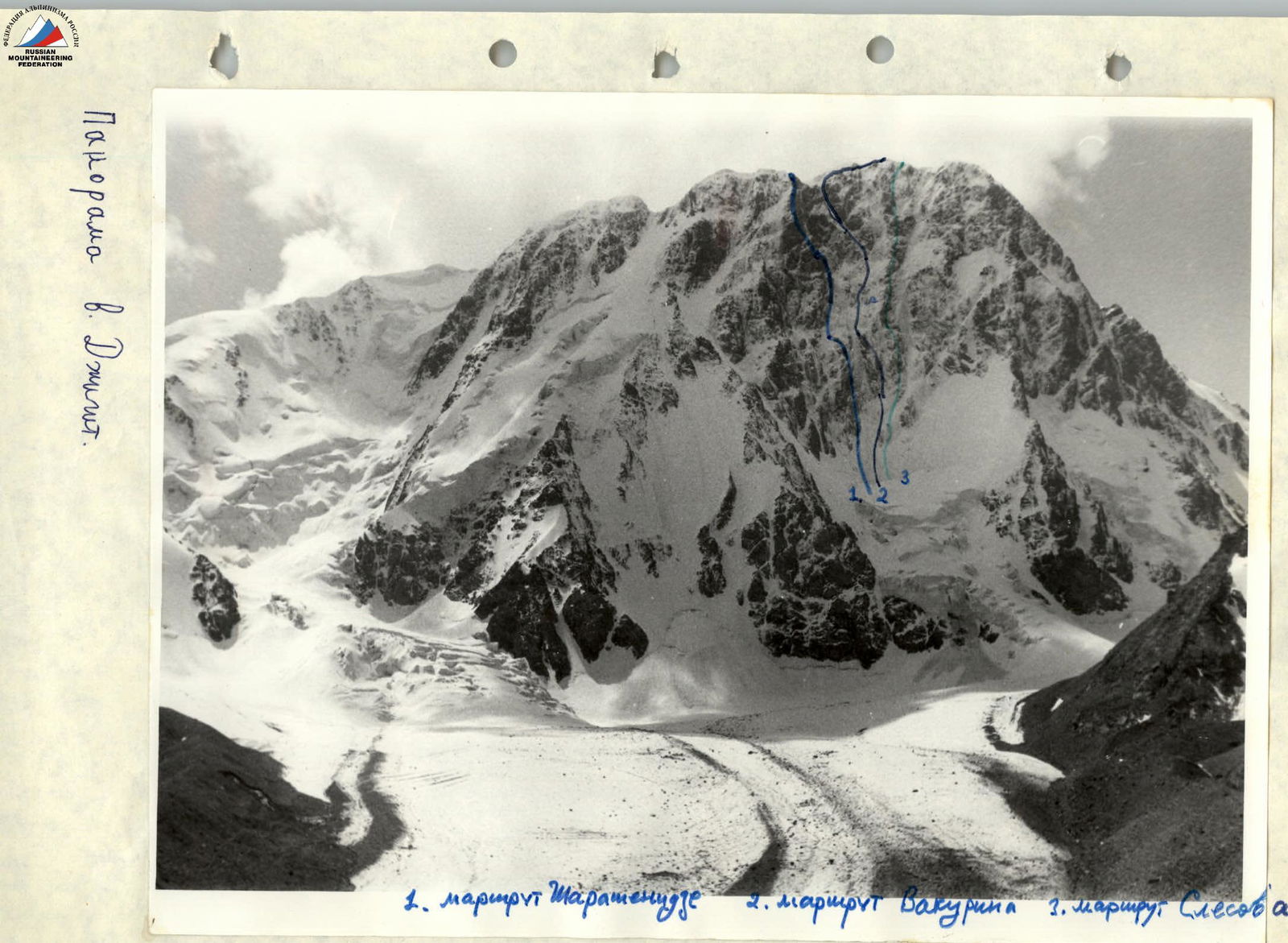
Routes:
- Sharashanidze, 6A difficulty category.
- Vakurin's, 6B difficulty category.
- Slesov's, 6A difficulty category
 www.alpfederation.ru↗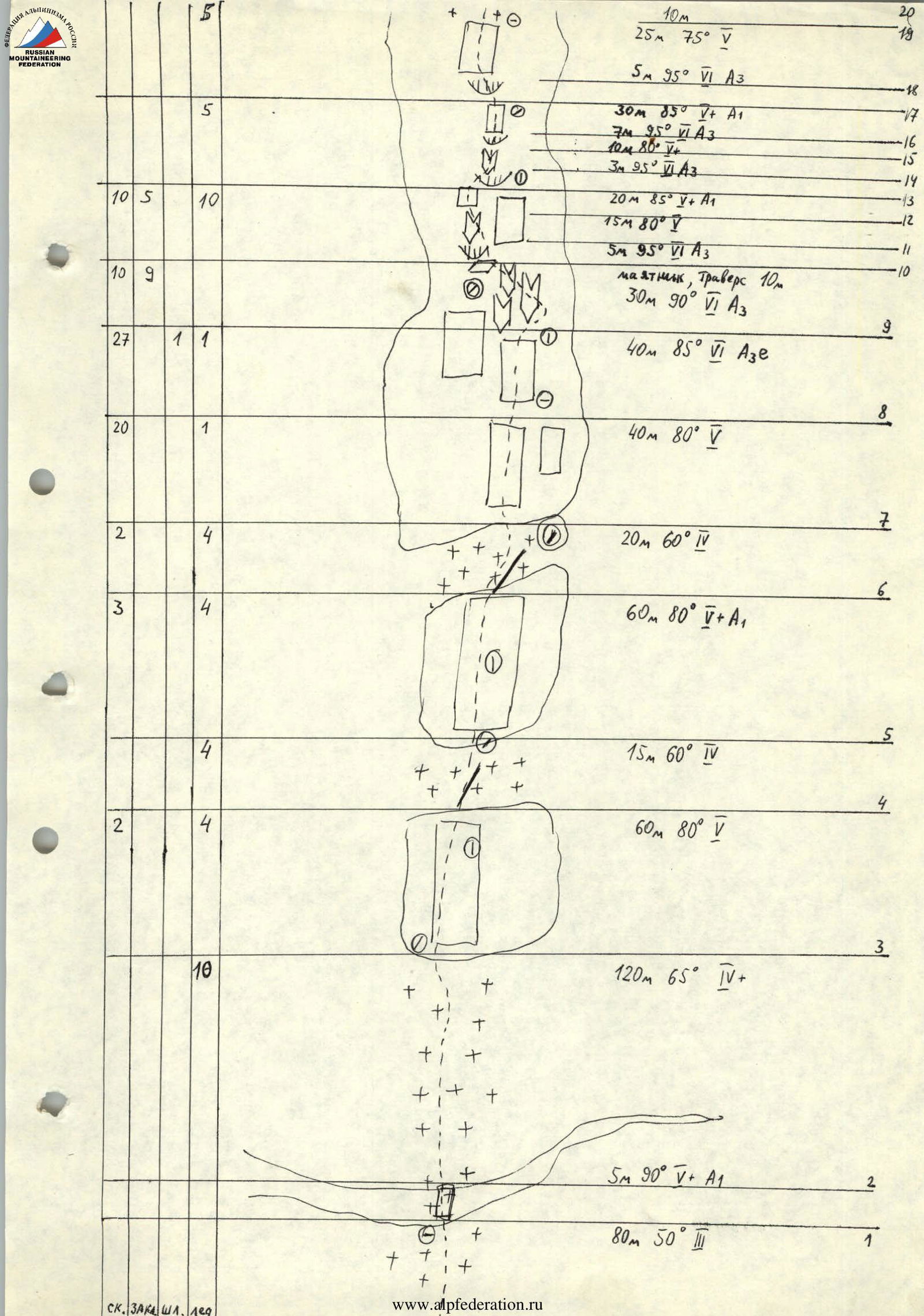

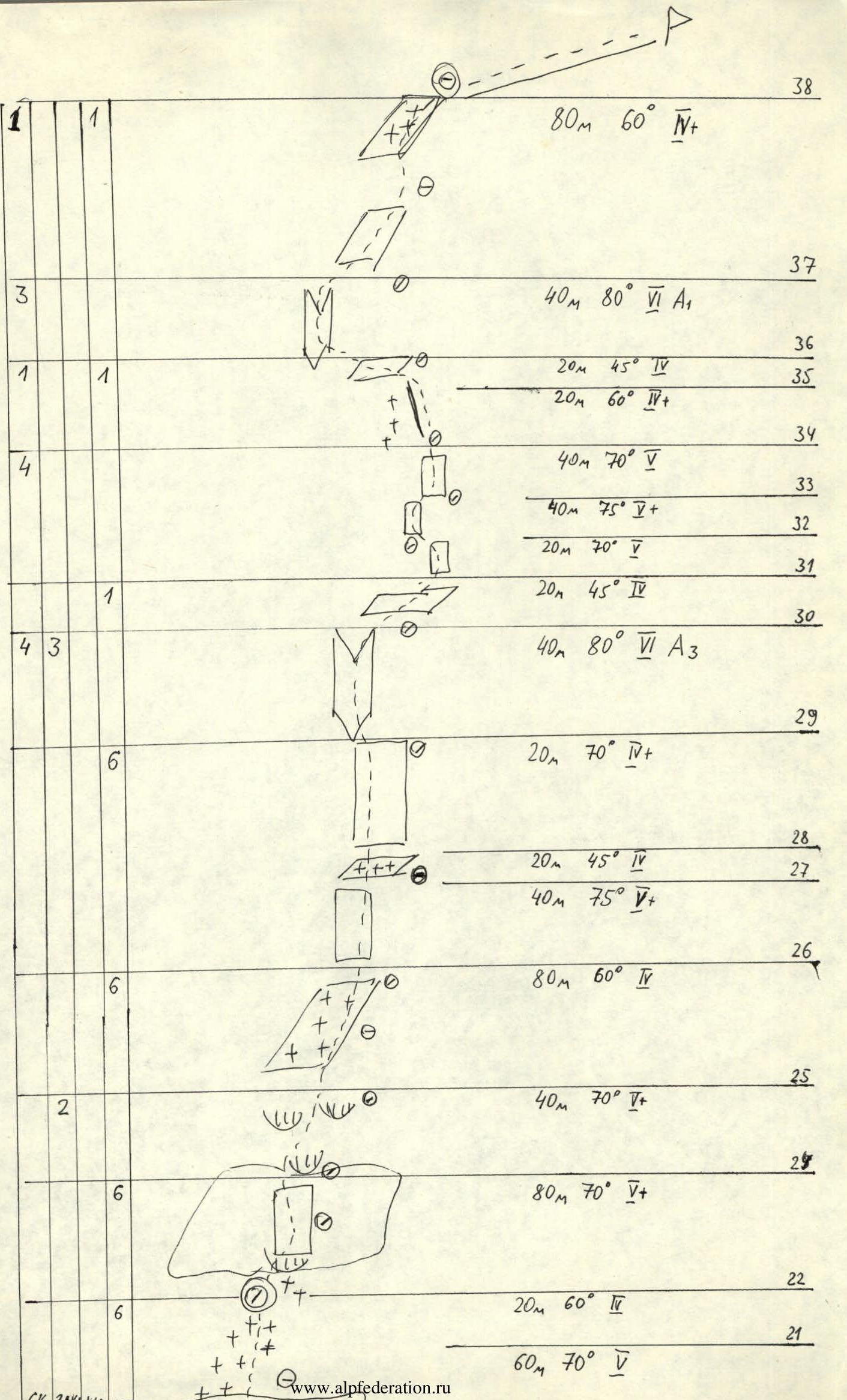
Route description by sections
Sect. R0–R1. Snow-ice ascent from the snow pad of the bergschrund. Sect. R1–R2. Bergschrund 2–3 meters wide. The upper boundary has a overhang, complicating passage. Passed with the aid of ice axes and ice pick. Sect. R2–R3. Ice of medium steepness. Sect. R3–R4 and R4–R5. Two rock spires. These are two steep rock walls, iced and powdered with snow. All loose rocks, cracks — iced with no convenient protection points. Sect. R4–R5. Icy ridge with embedded rocks. Sect. R6–R19. Lower bastion. General characteristic — very steep monolithic wall, steepness varies from 80° to 95°, completely iced and powdered with snow. Passage requires chipping away ice to find cracks and holds; bastion length – 50 m. Passing the entire bastion is a problem, complicated by daily snowfalls in the second half of the day. Convenient ledges for bivouac organization, protection points, or rest on the bastion are absent. Sect. R8–R9. Monolithic rock wall with very few cracks. Has an overhang in the upper part. Very tense climbing using ladders. Sect. R9–R10. Rock wall. First climber required 3.5 hours to pass. The problem is as follows:
- Climbing straight up is impossible (monolithic overhanging wall).
- To the right — a couloir separating from Slesov's route, to the left — a monolithic corner.
- Passage possible only using a pendulum, complicated by few cracks.
- For the rest of the team, a suspended traverse was organized.
- Climbing was complicated by snow in the form of graupel, flowing down the wall during bad weather.
- From below, the overhanging walls appear as two black rock "islands" not lightening even after snowfalls. On sect. R10, organization of a hanging bivouac in a hammock is possible. This is the top of the inner corner, ending in a 40–50 m ledge. Sect. R10–R11. Overhanging wall. Passage possible only using ladders.
Sect. R11–R13. Inner corner; ice crust 10–10 cm thick. Cracks practically absent. Organization of intermediate protection using ice screws. In the upper part — overhanging wall. Protection point — under a rock overhang. To the right and left of the inner corner, from below, two snow patches can be seen — resembling ledges. In reality, these are two steep (50–60°) rock walls, covered in snow. Sect. R13–R16. Series of overhanging cornices. First climber required 2.5–3 hours to pass 20 m. Sect. R16–R19. Rock wall, iced, ending in a cornice. Nuts. Sect. R19–R21. Lower bastion's bend. In the upper part, a convenient spot for protection. Sect. R21–R22. Ice-snow slope, abutting an overhanging wall. The only spot on the route where a sitting bivouac is possible. Sect. R22–R25. Third rock "island". Walls resembling "ram's foreheads" with few cracks and holds, iced. Sect. R25–R26. Snow-ice slope. Sect. R26–R29. Rock wall, ending in a steep ledge, iced and powdered with snow. From below, the ledge appears as a snowy couloir. In the upper part, the ledge ends in cornices. Sect. R29–R38. Upper bastion. General characteristic: wall having a large-block structure. In the lower and middle parts — very steep, and flattening in the upper part. Rocks here are less iced, but no ledges for bivouac. Sect. R29–R30. Inner corner, iced. Very tense climbing using artificial aids. Sect. R30–R31. Rock ledge, composed of light granite rocks. From below appears as a clearly visible light strip. Sect. R31–R34. Rock walls, powdered with snow. Section passed with free climbing. Exit to a cornice — feather-like. Sect. R34–R36. Snow ridge and exit to a rock ledge. Traverse left. Sect. R36–R38. Inner corner with very tense climbing. Rocks dry. During passage, for the first time on the route, crampons were removed. Sect. R37–R38. Rocks of medium difficulty and exit to the snow-ice ascent of the main ridge.
Ascent chronicle
July 23 The pair Pashin — Emelyanov reconnoitered the lower part of the route. On the section from the bergschrund (4050 m) to the lower bastion, representing a snow-ice slope of 65° steepness, they fixed: 1 rope 90 m and 4 ropes 40 m long. Used 22 ice screws and 5 rock anchors. Reconnaissance took 5 hours.
July 24 The entire team ascended to the cirque under the bergschrund. The pair Shamalo — Reznik reconnoitered 3 ropes on the lower bastion's rocks. Rocks iced, average steepness around 80°. Hammered in 49 rock anchors and 6 ice screws. Due to the lack of a suitable ledge for a bivouac, the pair descended to the cirque under the bergschrund. Reconnaissance took 6 hours.
July 25 The team passed all the fixed ropes, after which the 90 m rope and 3 ropes 40 m long were dropped to observers. Ahead worked the rope team Pashin — Krasnoukhov. On this day, the team reached the top of the lower bastion and organized a sitting bivouac on an ice slope at an altitude of 4700 m. They passed 1 rope upwards (rocks 80°, 10 rock anchors and 9 nuts hammered in), then — a pendulum left 10 m, traverse left 2 ropes (10 ice screws, 10 rock anchors, 5 nuts), then — upwards on 85° ice 2 ropes (10 ice screws). Total 11 hours.
July 26 On this day, the team reached the ridge. First, Reznik worked ahead (2 ropes on ice, steepness 65° to the upper bastion, 6 ice screws). Then — left-upwards on an icy couloir under a snowy cornice, 5 ropes steepness 60–80° — first passed by Shamalo. Used 15 ice screws, 13 rock anchors, and 5 nuts. Total climbing hours – 12.
July 27 Moving simultaneously along the ridge with protection via ice axe, at 12:00 they reached the summit. Descent was via route 4A difficulty category.