
To the Main Judging Panel of the 2005 Russian Federation Alpine Championship High-Altitude Class
Report
On the ascent to the summit of Khan-Tengri 6995 m via the center of the North face. Route combination: Studenin-74, Myslovsky-74, Zakharov-88
From August 20 to 30, 2005, the FASKO team consisting of Tukhvatullin I.Kh. and Shabalin P.E.
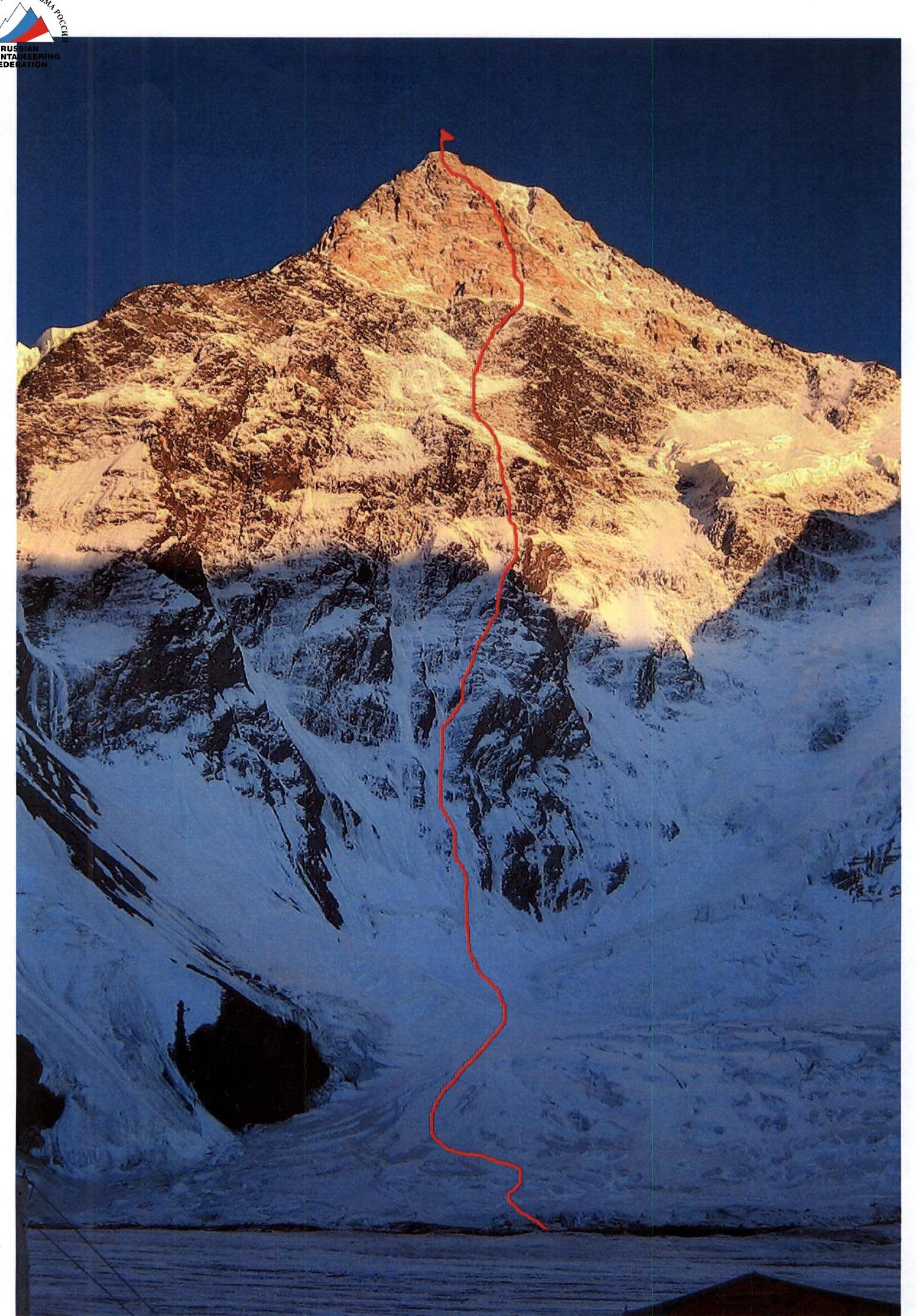
Ascent Passport
- Central Tian Shan, Tengri-Tag ridge, S.Inylchek glacier, section 7.9
- Khan-Tengri peak 6995 m, from S.Inylchek glacier via the center of the N face
- Proposed — 6B category of difficulty, combination of Studenin-74, Myslovsky-74, Zakharov-88 routes.
- Route type — combined
- Route height difference — 2760 m.
Route length — 3960 m. Length of sections with category U-U1 difficulty — 860 m. Average steepness of the main route part — 59°
- Pitons left on the route: total 10; including screw pitons 0. Used screw pitons on the route: 0. Total ITO used: approximately 40.
- Team's travel days — 10
- Team leader: Shabalin Pavel Eduardovich, Master of Sports of International Class
Team member: Tukhvatullin Ilyas Khamidovich, Master of Sports
- Coach: Shabalin Pavel Eduardovich, Master of Sports of International Class
- Route entry: 6:00 August 20, 2005
Summit ascent: 12:00 August 29, 2005. Return to Base Camp: 24:00 August 30, 2005
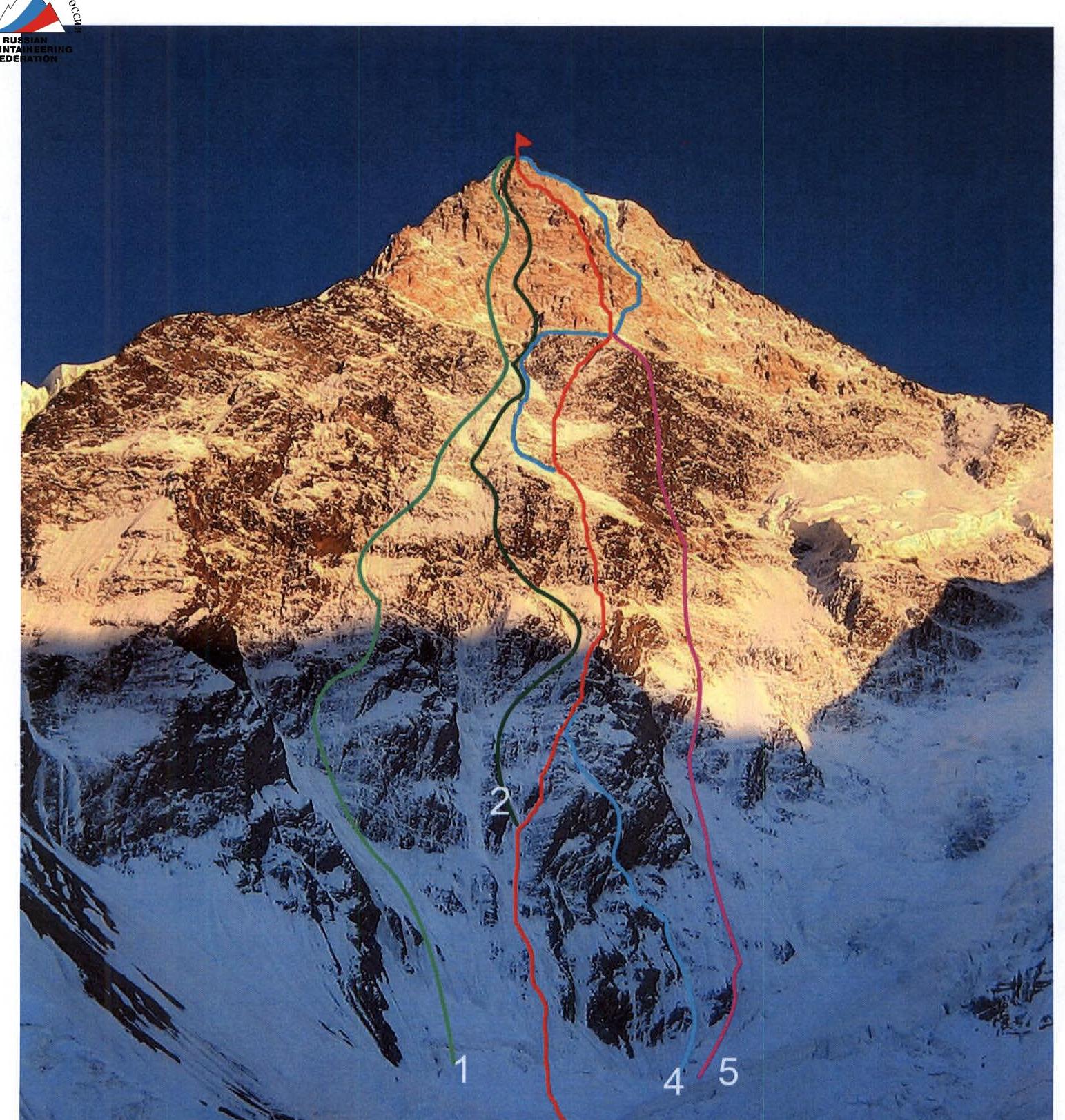
General photo of the summit
1 — Gorbenko route 1987, 2 — Studenin route 1974, 3 — 2005 team route, 4 — Myslovsky route 1974, 5 — Zakharov route 1988

UPPER PART OF THE ROUTE PROFILE PHOTO FROM THE RIGHT
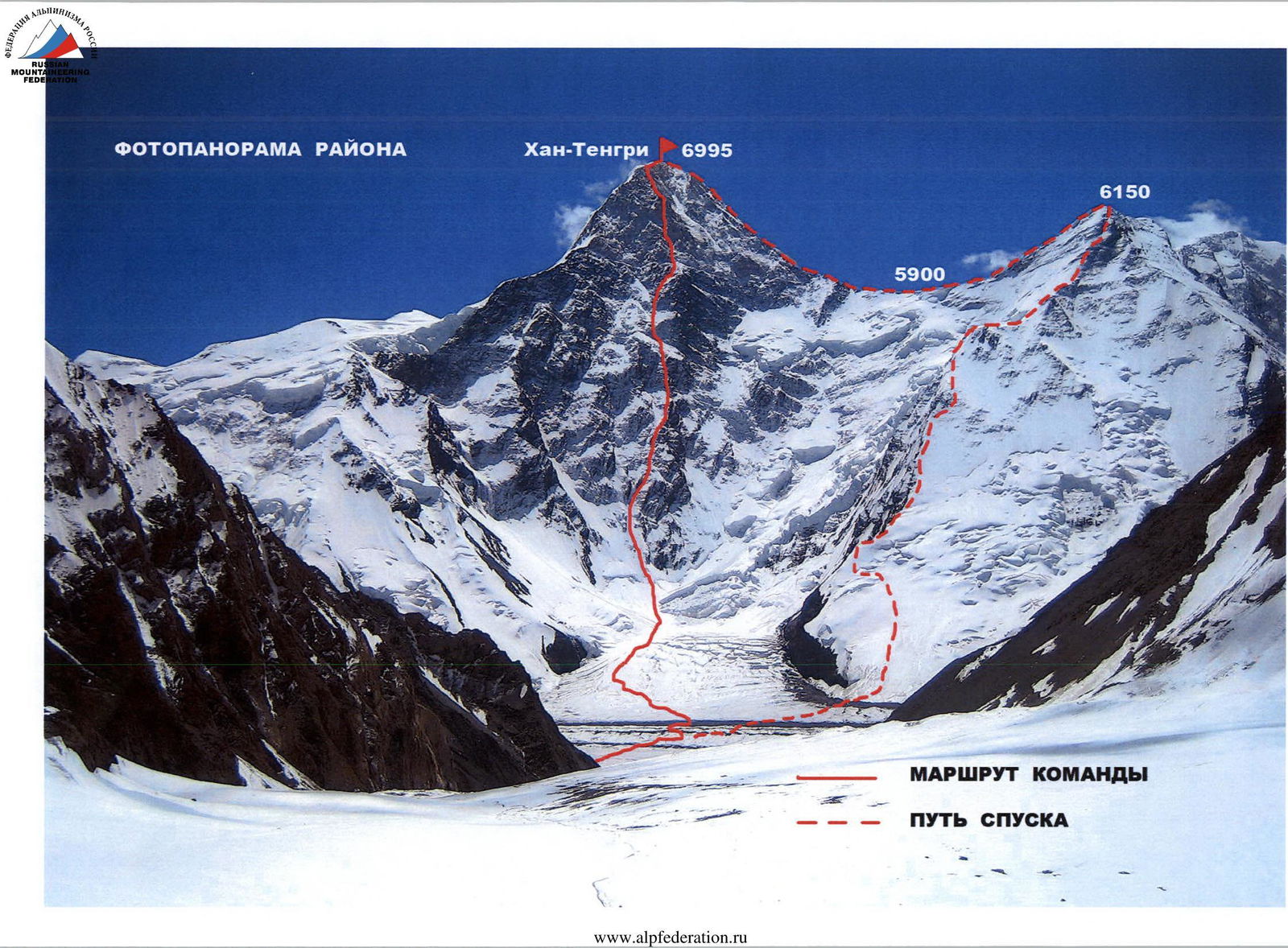
AREA PHOTOPANORAMA
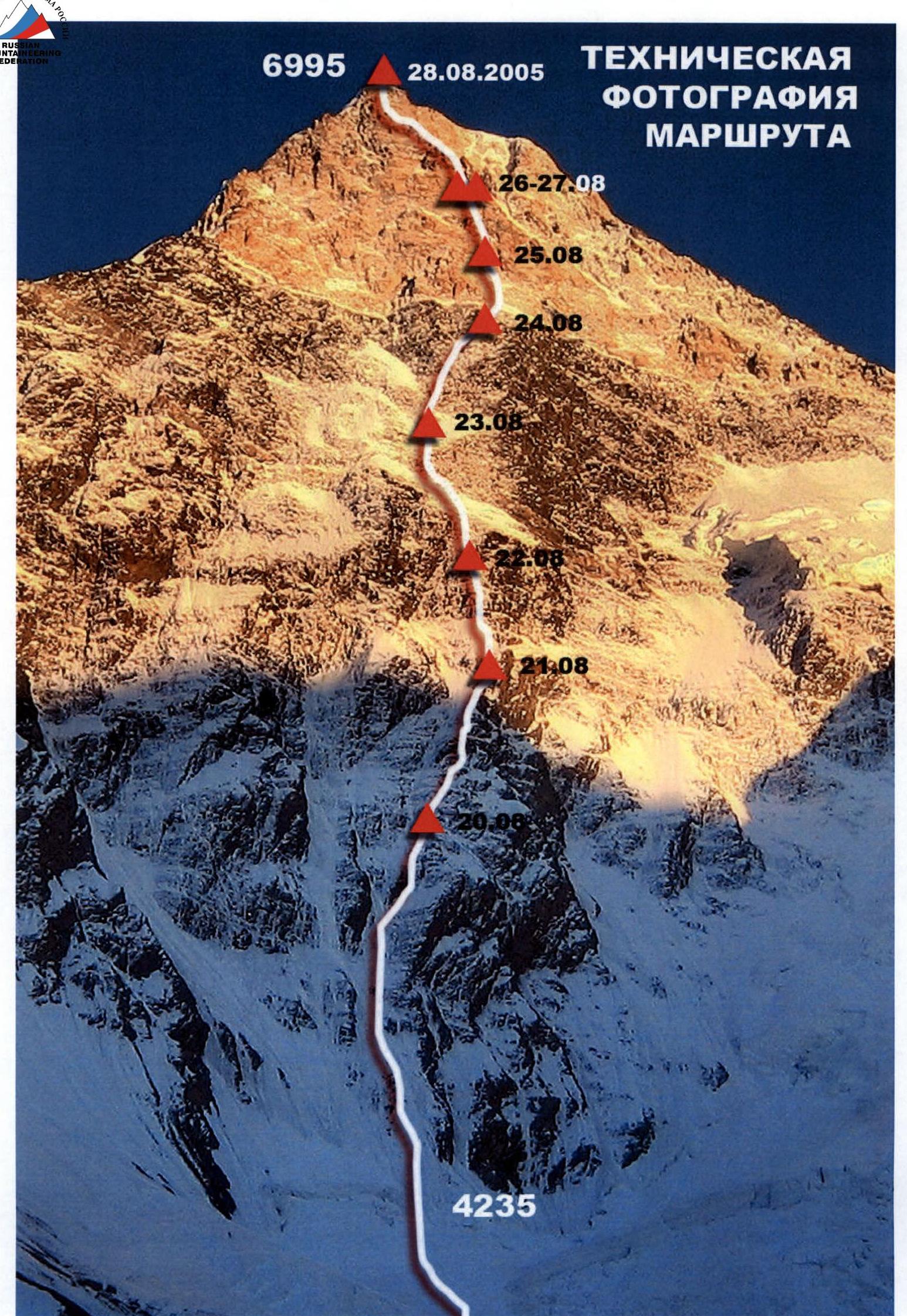
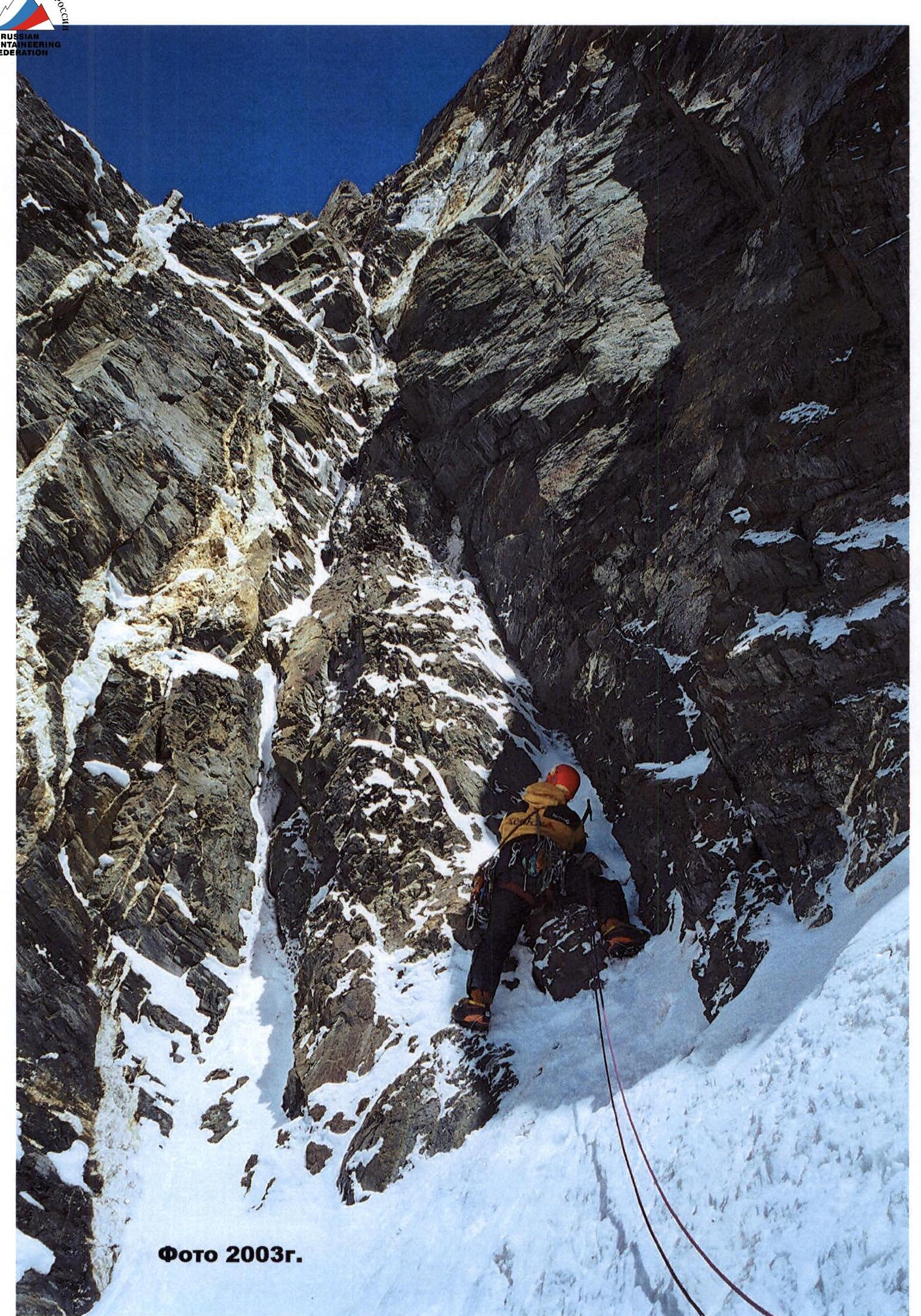
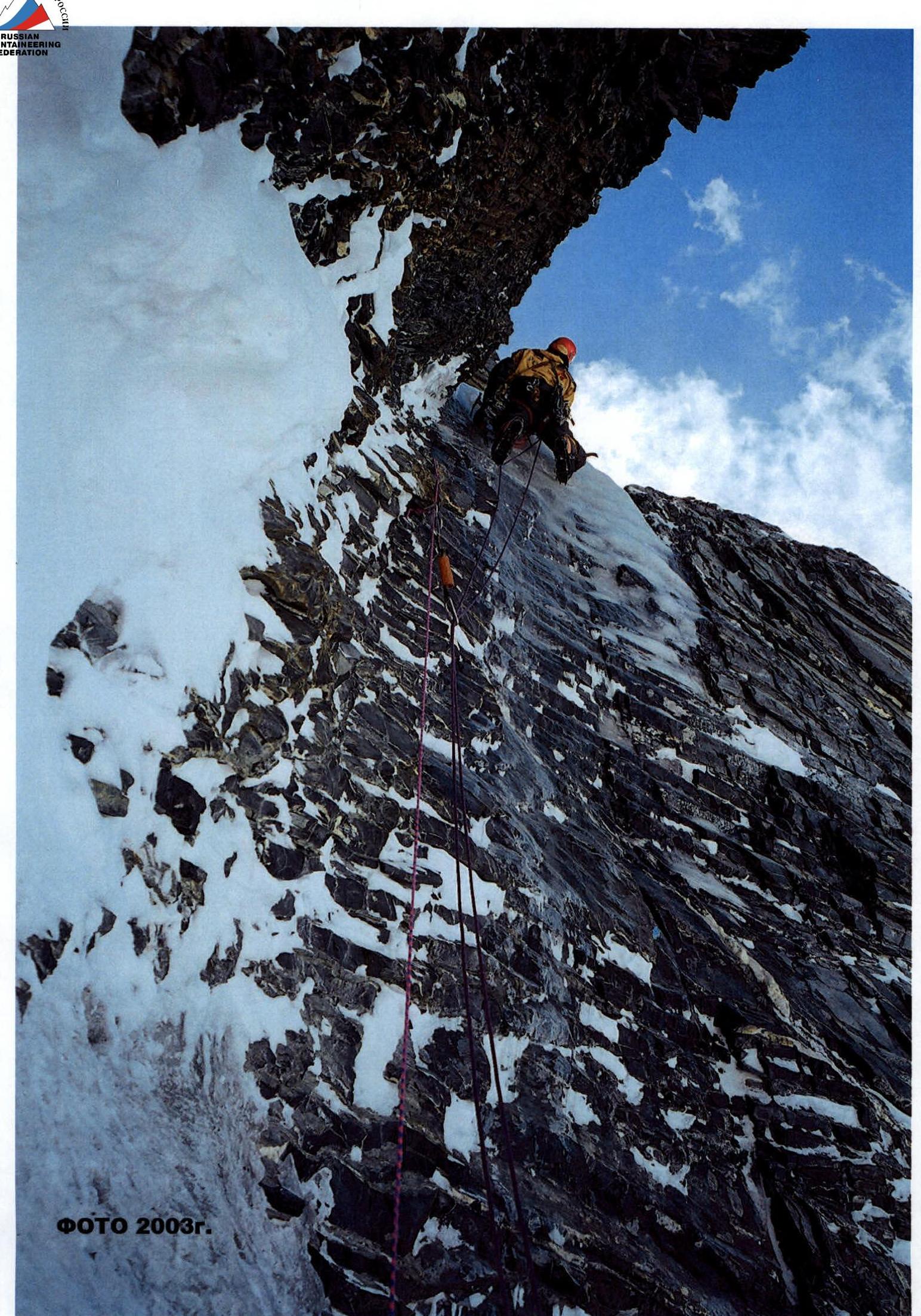
TECHNICAL PHOTOGRAPHY OF THE ROUTE
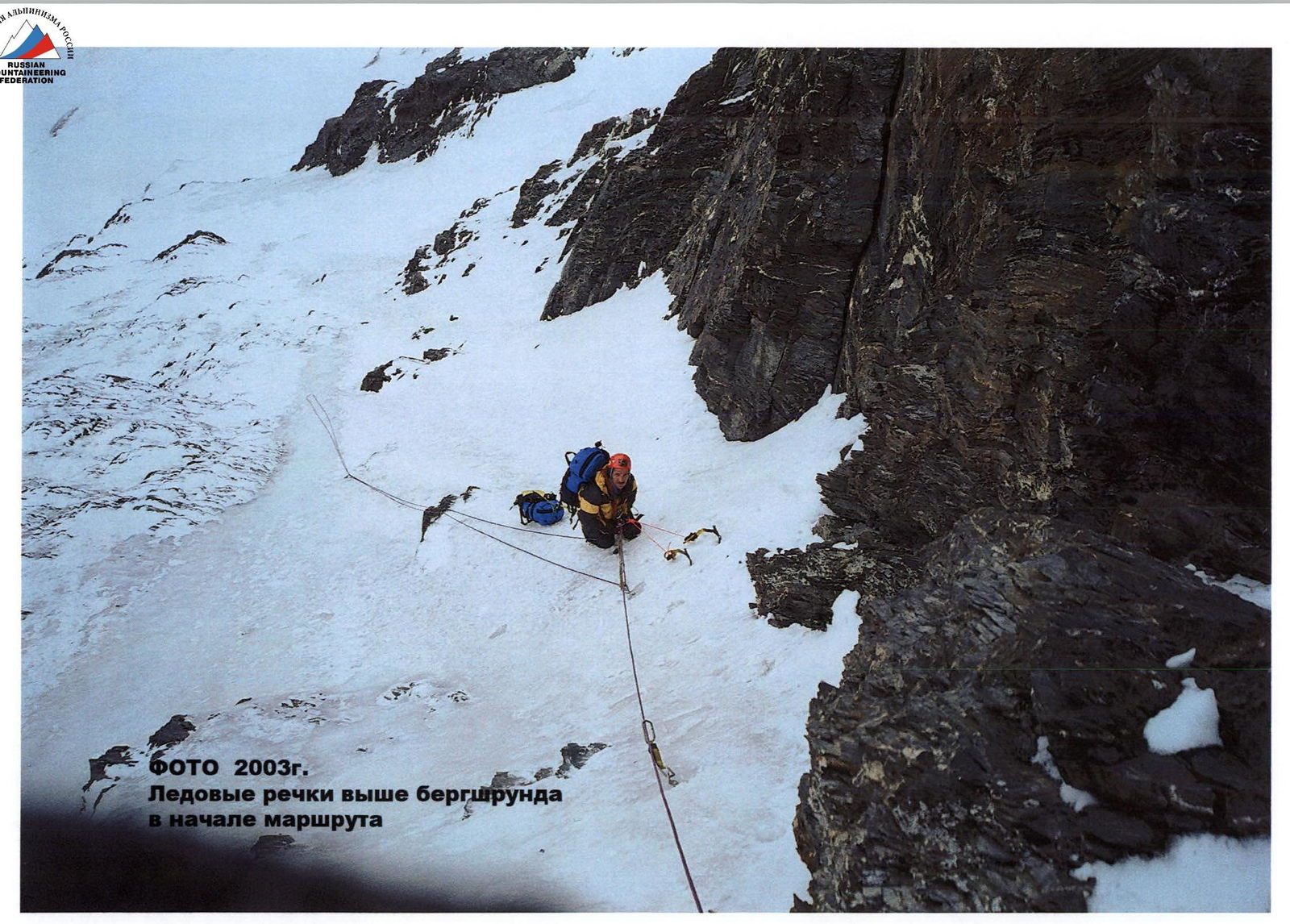
2003 PHOTO. Ice rivers above the bergschrund at the beginning of the route
2003 PHOTO. Ice gorge before turning onto the Myslovsky route from the Studenin route
Notes
1. Ascent Passport
Clause 5
The route height difference is taken from the report of the "Yenisei" sports club team led by N.N. Zakharov in 1988. No altimeter was used.
Route length and lengths of sections with 5-6 category difficulty were not measured during the ascent and are taken as the average of reports by:
- Zakharov,
- Pogorelov,
- Urubko,
- Koroteev.
The average route steepness is taken from the report of the "Yenisei" sports club team led by N.N. Zakharov in 1988. No inclinometer was used.
2. Hand-drawn route profile
Not provided in the report due to the impossibility of conducting measurements by a two-person team during the ascent.
3. Ascent schedule
Not provided in the report since watches and altimeters were not taken on the ascent. It is not possible to specify the exact time spent on the route and the heights of bivouacs. The team assesses the weather conditions as challenging. After the first three days of sunny weather, there were daily precipitations with strong winds in the second half of the day.
4. UIAA symbol route diagram
Not provided in the report since, in challenging weather conditions with half of the bivouacs being seated, it was impossible to accurately record the technical parameters of such an extensive route.
5. Report photo illustration
No photos from the route or summit are attached since the camera broke during the ascent. Photos from the 2003 ascent are attached. General wall photos, panorama, and profile were taken during acclimatization exits.
Pavel Shabalin, Ilyas Tukhvatullin. First ascent by a two-person team in alpine style via the center of Khan-Tengri North face
P.Sh.: In the eighties, we were among the first to participate in the technical class not as a team, but as a two-person team. Two years ago, the idea emerged to do the same in the high-altitude class. Many routes are "abandoned":
- North face of Khan-Tengri,
- South face of Peak Communism,
- Pobeda...
There have been repeats, but always by teams. It's time to climb in two-person teams and in alpine style. Just like Pavlenko and Koshelenko wrote about. Why go to Nuptse, spend thousands of dollars — our routes are standing there. Climb on our championships and our routes, and everything will be great.
Yura Moiseev lamented that people are attempting Khan-Tengri, but not our guys. Poles, Bulgarians, Zoltan Demyan... At best, they reach the ledge and turn left. Last year, a two-person Polish team attempted it and gave up on the second day. One descended, the other perished. There were about six attempts by two-person teams in total.
Two years ago, Ilyas and I decided to try. But we didn't know the equipment, clothing, the nature of the wall, climate... We spent a week climbing. We found an interesting route — a combination of Odessa and Studenin (starting like Studenin with an exit to Odessa), and finishing with a variation of Pogorelov's route. Due to bad weather, we couldn't complete it.
We climbed two ropes up via Pogorelov's route, started getting hit by avalanches, couldn't wait, and the helicopter was evacuating the camp below, so we descended traversing along the ledge.
But every cloud has a silver lining. We figured out the tactics, strategy, what gear we needed, and everything else:
- tactics
- strategy
- what gear we needed
- everything else
We ordered the necessary gear from Camp and Red Fox.
We took experimental Red Fox and Camp gear, calculating for K2, so this was a test run for all the gear that would be used on K2.
MR: Frostbite
P.Sh.: I thought: new gear, plus this new superstyle, we'll climb, climb, climb... Urubko and K. also minimize their gear on ascents, almost wearing spikes.
I decided to try this style, saying: "Ilyas, you'll be standing on belay, so climb in regular boots, and I'll be like in pointe shoes, in thin crampons, actually climbing in sneakers." This was the first miscalculation, taking small boots. Even if they're "super".
Second: Ilyas and I always climb like this: he last, me first. When this mess started, bad weather, lack of bivouac sites, one seated bivouac after another, then equipment failures — the burner failed, spent half a day repairing it. As the travel days started to slip away, one after another... Gas runs out, food runs out, energy too (alcohol ran out already on the saddle, only a liter was taken, but we weren't focused on that).
And we didn't start on August 15 as planned, but on the 20th. And Ilyin says that after August 15, winter starts there. One thing led to another.
Hands are always stretched up, no matter what you wear — they freeze. Do you have thumb loops? — they constrict. And I'm always first. More or less, you're climbing. The second can sit, go through a rope in 15-20 minutes, and huddle on belay.
No, everything works, everything's fine. Just the strategy I chose failed in real conditions.
When we made it to the top, to the "roof", everything was still okay. But when we went from the "roof" to the summit, I felt my hands weren't bending right. This was already on the dome.
In the morning, we emerged at 6850 m. We sat for another night, again somehow, practically without gas, without water, already not removing our boots. For the last two nights, we didn't even change boots. So that's how it happened: general body weakening plus heavy work, tight boots, bad weather... Resulted in frostbite.
We actually planned to go in a team of three with Mariev. And planned a speed ascent... If there were three of us, we could have:
- gone via the center, to Zakharov's tower,
- finished via Myslovsky,
- turned the corner and run.
When people can take turns, when there's someone to work with, even on snows, you can "hammer" in non-stop mode. With two, it's different.
MR: Gear, clothing, personal. What did you take to the mountain?
P.Sh.: I had a backpack, two sleeping mats, and a sleeping bag. Everything else was carried by Ilyas.
There was complete minimization. I clearly remember that there were 4.3 kg of food. A liter of 70-degree hawthorn tincture. A first-aid kit with repair kit, film, glasses, everything — 1 kg. Personal items — half a kilo (warm gloves, 1 pair of spare socks, 1 pair of spare gloves, mask). Ilyas had roughly the same. One sleeping bag for both, weighing 1 kg (a very thin Red Fox tinsulate blanket 2×2, enough to tuck in from all sides). It was absolutely comfortable. Thin blue down jackets, weighing 600 grams. On us:
- "Powerstretch" thermobase
- Black "Windpro" suit
- Gortex suit on top
- Cap
- Helmet
- Gloves and Gortex gloves
Red Fox. Everything worked perfectly.
MR: Rope
P.Sh.: The Lanex rope, half, 9.1. We cut an "eighty-meter" rope to make a "sixty-meter" one. The thing is, it's hard to make a 40–50 m lead, but 25–30 m is normal. This is what we learned from previous ascents. You have enough strength for these 25–30 m, for a sprint. To run quickly. Tactically, it's better than making a 50 m lead with intermediate anchors. You climb slower with intermediates, then even slower — you're getting tired. And it's easier for the second with a heavy backpack to run a 25–30 m section.
I actually climbed the whole rope, from station to station (maybe there were five ropes with intermediate anchors). Never releasing the devices from my hands, not removing crampons, from bottom to top. The team on the wall is like a caterpillar: stretched from station to station — pulled the "tail". And so on. This is more effective than the standard way of hanging ropes on the wall.
MR: Ironware
P.Sh.: Camp fully equipped us with ironware. "Avaks" — amazing tools, and "Vector" crampons. Surprisingly, nothing got bent during the whole ascent, all ice tools worked perfectly. Friends, nuts, drills, pitons — all Camp. And we took some anchor pitons from Krasnoyarsk to test. Also an amazing thing. We used a lot of anchor pitons. They held well, but were also easy to place. They're very hard to knock out, but you can place them anywhere. Anchor pitons helped a lot.
Khan-Tengri (6995 m). Information on ascents via the center of the North face
Update to the information in "Steep World" magazine №V, p. 121 (prepared by G.A. Starikov)
| year | dates | days | team | in championships: |
|---|---|---|---|---|
| 1972 | 22.7–6.8 11–13.8 | - | route processing (V. Putrin — MS participated) up to 5500 m; E. Myslovsky — MSМК, I. Grebenshchikov — КМС, V. Ivanov — MSМК, V. Maksimov — MS, V. Masyukov — MS (returned due to lack of time) | - |
| 1973 | 9–13.8 | - | processing 12 ropes left of Myslovsky's route to ...? V. Vstavsky — КМС, V. Gavryushkin — КМС, V. Kokarev — КМС, V. Osin — КМС, A. Sakash — КМС (g. Krasnoyarsk). Expedition leader — V.V. Bezzubkin — MS (returned due to an accident with V. Borisenko — 1st category, August 23) | - |
| 1974 | 20.7–1.8 22.7–3.8 | 13 13 | B. Studenin — MSМК, V. Gapich — КМС, A. Kurchakov — КМС, Yu. Marchenko — КМС, V. Medvedev — КМС E. Myslovsky — MSМК, V. Glukhov — MSМК, V. Ivanov — MSМК, I. Grebenshchikov — КМС, A. Golovin — КМС, V. Loktionov — КМС, E. Pelekhov — КМС, V. Puchkov — КМС | 1st place — USSR, 1st place — USSR |
| 1986 | 14–21.8 | 8 | V. Koroteev — КМС, V. Yelagin — MS, V. Kolomyttsev — MS, V. Moskalyov — КМС, O. Nikolaev — КМС, V. Obikhod — КМС, N. Petrov — КМС, V. Yanochkin — КМС | (bypassing KSP) |
| 1987 | 10–17.8 | 8 | M. Gorbenko — MS, V. Alperin — MS, N. Bazelevsky — КМС, O. Erohin — КМС, P. Serenkov — MS, M. Sitnik — MS, V. Todorov — КМС | 1st place — USSR |
| 1988 | 4–11.8 | 8 | N. Opoitsev — КМС, A. Artamonov — КМС, V. Kalyuzhny — КМС, G. Guryyev — КМС, F. Akhmatov — КМС, S. Shuvalov — КМС (in the upper part of the route — turned right) | 1st place — Russia |
| 10–17.8 | 8 | Yu. Moiseev — MS, P. Kovalenko — КМС, A. Studenin — КМС, Kh. Tashmambetov — КМС, V. Tugalev — КМС, A. Tselishchev — КМС | 2nd place — USSR | |
| 14–21.8 | 8 | N. Zakharov — MSМК, S. Antipin — MS, E. Bakaleinikov — MS, V. Bogdanov — КМС, A. Karlov — КМС, V. Lebedev — MS, V. Sereda — MS | 1st place — USSR | |
| 1993 | 9–15.8 | 7 | A. Pogorelov — MSМК, Yu. Koshelenko — КМС, A. Moiseev — КМС, V. Nikitenko — КМС (didn't pass the summit wall, turned left to K. Kuzmin's route, 64) | 1st place — Russia |
| 1994 | 31.7–9.8 | 10 | N. Zhilin — MS, A. Bolotov — КМС, Yu. Yermachek — MS, V. Suvorov — КМС, S. Khabibullin — MS (from 2/3 of the route, traversed right to 5A) | 2nd place — Russia |
| 22–30.8 | 9 | D. Grekov — MS, Sh. Gataullin — КМС, M. Mikhailov — КМС, A. Molotov — КМС, V. Suviga — MSМК, V. Frolov — КМС | 2nd place — EAAC | |
| 2000 | 1–9.8 | 9 | D. Urubko — КМС, D. Molgachev — КМС, V. Pivtsov — КМС, A. Rudakov — КМС, S. Samoilov — КМС | 1st place — EAAC |
| 2–13.8 | 12 | V. Popovich — КМС, Yu. Yermachek — MS, A. Korobkov — КМС | 3rd place — Russia |
Note the sports ranks and titles of the participants in these ascents!
Note: This list does not include two very challenging ascents since they were made left of the center of the wall and exit onto K. Kuzmin's route, 64:
- Right variant of the N face O. Khudyakov, 70
- Right variant of the N face N. Zhilin, 98
and also does not include the route — a variant on the right edge of the center N face D. Grekov, 93
PART II
MR: Ascent Schedule
P.Sh.: We wanted to leave on the 15th. We waited in the cafeteria until midnight. Left. And couldn't find our tent. Fog settled completely, bad weather. We sat, tried to leave every day, and only managed to leave on the 20th. The first three days were normal in the morning, then it started: normal in the morning, terrible by evening. The main thing is that during the whole ascent, we used only two platforms made by those before us. Others we found were either not in the right place, or in a dangerous location, or not at the right time. So out of eight nights, four were seated bivouacs. You climb until you're done, then sit, without removing boots, then sit, having put up the tent.
The tent (Red Fox "Solo") showed itself to be excellent:
- Weighs only two kilograms.
- Didn't tear in these extreme conditions, survived, despite the winds and us sitting — kicking with crampons.
MR: Route Condition
P.Sh.: There's a lot of snow. The snow is loose. We had to clear it all nine days, all nine days, without releasing the ice axes from our hands: clear in front of your nose and climb. Quite steep. When you step onto snow, you try to jump back onto the rock because the snow is waist-deep, you're digging, but it's not compacted... Very hard.
On August 20, 2005, at 4:00, we left, and on August 28, 2005, we set up a tent on the dome. On August 29, 2005, early in the morning, we left and passed the tripod in 1.5–2 hours. We still had a cache from two years ago, made from the "classic" route.
MR: Found?
No, that's the thing. There was a big gas cylinder, food, carbohydrates. Nothing was found.
So we quickly passed by and went down via the "classic" route. We were the last to descend, there was no one else. We found a sea of different food. Empty gas cylinders — and not a single one even half full. Ilyas melted water on a candle, then, like in a shaker, you shake this snow, sprinkle some nonsense like sugar. And so for two days. Without water, without gas, without anything.
And descending to the saddle during the day, we set up a tent, sat. And how we went to the saddle... It's flat, but you take twenty steps — and fall. The next twenty steps — and fall again.
We got into the tent, the wind is howling, I say: "Let's not undress, wait until it subsides, then at night — so be it, we start moving towards Chapayev and descending."
We sat until night, not removing boots, in harnesses, closer to night we pulled out the sleeping bag, covered ourselves. In the morning, we wake up and sit again, still dressed. For three days, we didn't remove our boots, constantly ready to go. And all the time — bad weather.
MR: Frostbite...
P.Sh.: I saw my hands on the dome. Until the dome, everything was fine. On the dome, I feel — what's going on? The body was just exhausted. Constantly cold. Always doing something — waving hands, but suddenly — they're all black. It was still okay in the morning, after an hour and a half of climbing in a strong wind — everything.
You're always first, hands always up. It's one thing for the second to pass — fifteen minutes on a rope, then sit and belay, another thing for the first — half an hour, two, two and a half. Who knows how long one rope will take. You're just hanging on your hands. It just layered on top of each other: weather, cold, time of year...
MR: Communication
P.Sh.: We specifically didn't take communication or watches with us... That's just how we climb.
Thank God that Lenka Kalashnikova ("Ak-Sai — Travel") waited for us down there. Thanks to them for waiting, not evacuating the camp.
When we descended, they called a helicopter via radio, and we were picked up from there. Otherwise, we would have had to return on foot. Huge thanks to them.
MR: Gear
P.Sh.: The backpack weighed around 16–17 kg at the start. Contents:
- Ironware
- Rope
- Two sleeping mats
- Sleeping bag
- Down jacket
MR: Ironware
P.Sh.: Gear:
- Six drills (four long, two short)
- Twelve classic pitons (from blade to bong, with carbide tips and soft-alloy, Camp)
- 12 anchor pitons (brought down half)
- Two sets of nuts
- Set of friends
- Seven quickdraws (two of them extendable)
- Loops
- Carabiners (a few)
- Complete minimization.
Short rope, intentionally, so as not to carry 10–12 quickdraws and a bunch of other junk.
MR: Nutrition
P.Sh.:
- Two cans of red caviar
- Puree
- "Hot cups"
- "Bystrov" porridge
- "Klinsky" croutons
- A couple of dry-cured sausage sticks
MR: First-aid kit
P.Sh.: There was nothing for frostbite. We didn't count on it... Minimum: adrenaline, mesaton, prednisolone, green pencil. Ilyas, the scoundrel, when injecting prednisolone, would sign on my butt :)
Ascent sponsors:
- Red Fox
- Camp

Comments
Sign in to leave a comment