
Championship of the Kazakh SSR
High-altitude class
II. Peak Khan-Tengri (6995 m) via the north-eastern ridge of the shoulder of Peak Chapayev from the North Inylchek Glacier (first ascent)
Team 12 SCA SAVO Coach: Yuriy Mikhaylovich Moiseev Team captain: Valeriy Nikolayevich Khrshchatyy
- 12 Sports Club of the Army, Almaty
- Almaty, Kurmangazy St., 15, apt. 8, Khrshchatyy V. N., ph. 61-27-25
Participants: V. Khrshchatyy, Z. Aubekerov, G. Mikhaylov, A. Vasil'yev, Ye. Sedel'nikov (SCA-12)
August 17-20, 1988
Ridge profile from the right
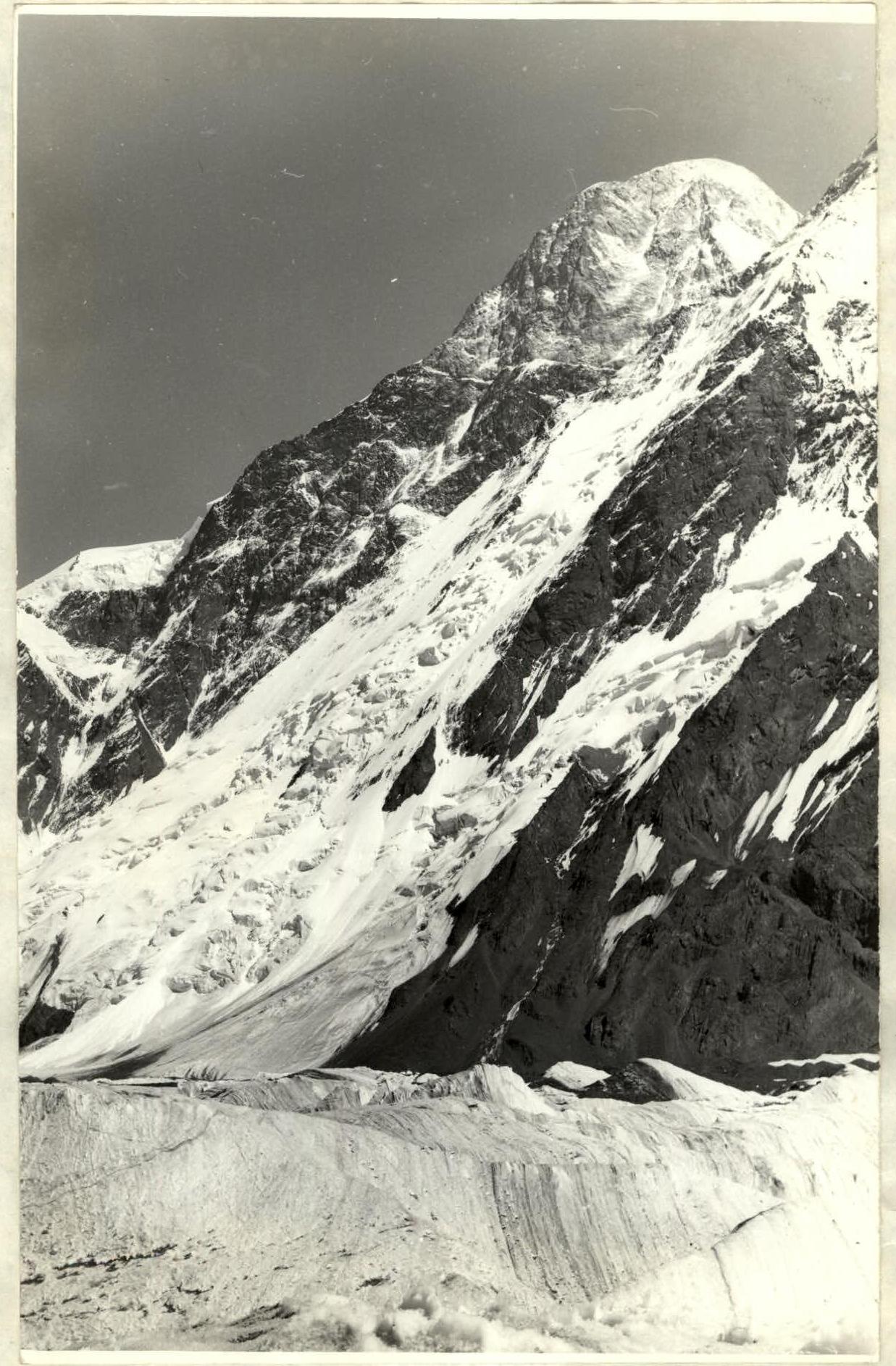
Tactical Actions of the Team
The team's tactical actions had to be adjusted due to the complex snow situation. Heavy snowfall on the night of August 18-19 caused increased avalanche danger in the area. After an unsuccessful attempt to descend from the saddle (6050 m) to the base camp on the North Inylchek Glacier, the team was forced to move to the South Inylchek Glacier, taking with them the representative of the USSR State Committee for Sports, V. Krovich. The next day (August 21), the team was airlifted by helicopter to the North Inylchek Glacier and then immediately to Karakara.
Food and fuel table:
- Canned beef – 2.2 kg
- Vermicelli – 0.5 kg
- Buckwheat porridge – 0.5 kg
- Semolina porridge – 0.4 kg
- Rice porridge – 0.3 kg
- Sugar – 1.0 kg
- Salmon in tin cans – 1.5 kg
- Carbonate – 0.3 kg
- Small sausages – 0.3 kg
- Minced pork with egg – 0.3 kg
- Zander in Polish style – 0.3 kg
- Sturgeon in tin cans – 0.3 kg
- Tomato sauce in tubes – 0.2 kg
- Sausage – 1.0 kg
- Tea – 0.2 kg Total: 9.3 kg
- Gasoline – 3.5 kg TOTAL: 12.8 kg
The starting weight of the backpacks was 13.2 kg.
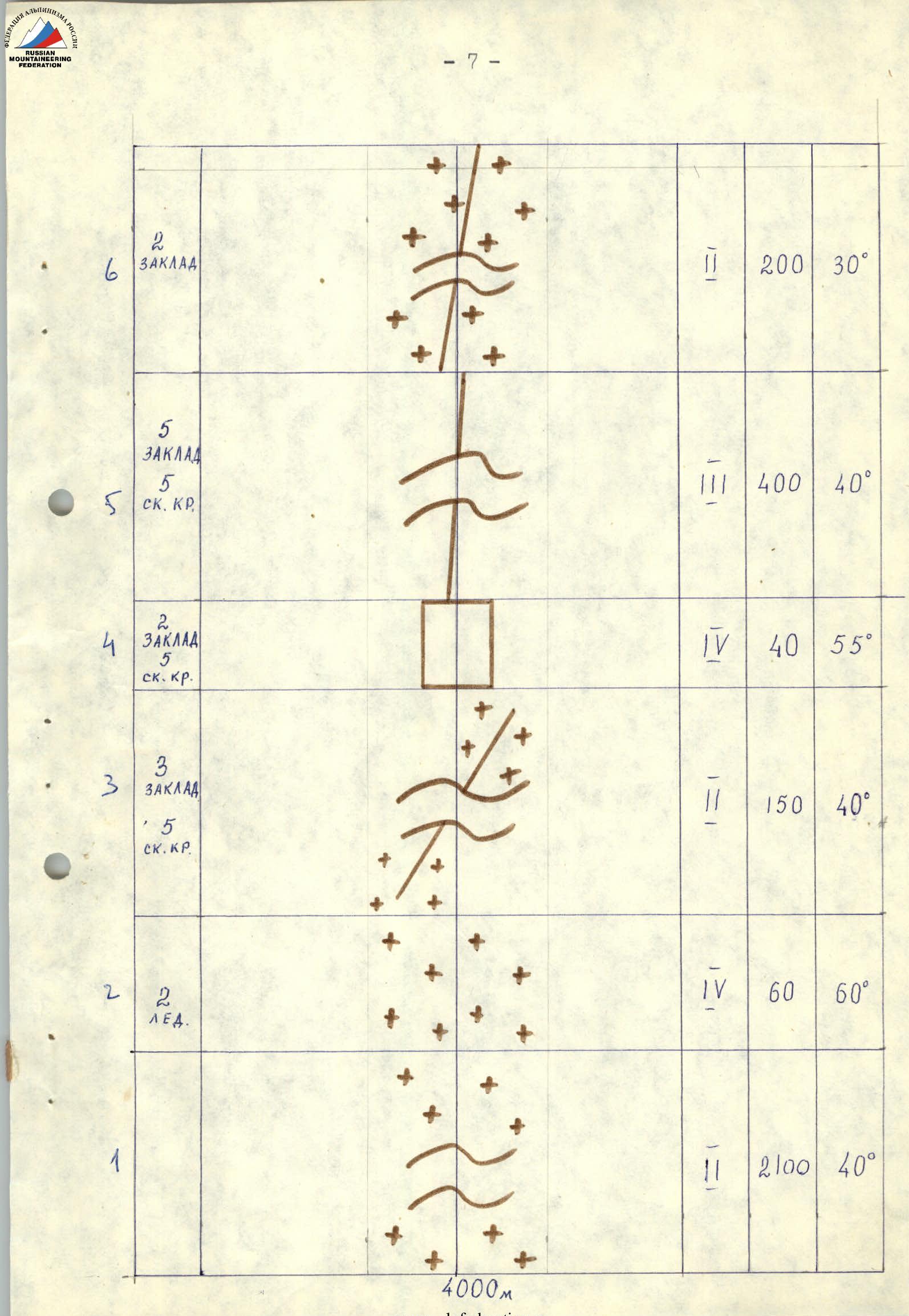
| Section | Cat. diff. | Length (m) | Angle (°) |
|---|---|---|---|
| R1 | 2 | 2100 | 40 |
| R2 | 4 | 60 | 60 |
| R3 | 2 | 150 | 40 |
| R4 | 4 | 40 | 55 |
| R5 | 3 | 400 | 40 |
| R6 | 2 | 200 | 30 |
| R7 | 2 | 1640 | 20 |
| R8 | 2 | 1050 | 40 |
| R9 | 5 | 180 | 50 |
| R10 | 3 | 660 | 25 |

Route description by sections R0–R1. Section of about 2100 m. Snow-ice slopes. Simultaneous movement. Only on some steep short sections is insurance used through an ice axe. R1–R2. Steep ice forehead. Insurance through pitons. R2–R3. Snow-ice slope with some rock outcrops. Insurance through ice axe and pitons. закладные элементы are used. R3–R4. Rocky block wall. Climbing is not very difficult, but the rocks are covered with ice and snow. Pitons insurance. R4–R5. Rocky ridge. Rocks are slightly covered with ice. Pitons insurance. 2–3 pitons per rope. R5–R6. Snow-ice ridge. Quite wide. With some rock outcrops. In the upper part, the steepness increases to 50°. R6–R7. Very long traverse of a snow-ice slope with a small gain in height. In the second third, the steepness increases. Twice there are ice ledges 15–20 m long, with a steepness of up to 50–55°. The traverse ends on the left side of the saddle (6050 m). R7–R8. Rocky ridge with loose stones. Pitons insurance and rock features. Simultaneous movement. About 1 piton per rope. Often there are handrails. R8–R9. Huge rocky couloir. Rocks are partially covered with snow and ice. Pitons insurance. Handrail work. R9–R10. Snow slope leading to a snow-ice ridge going to the summit. Some rock outcrops.
Protocol for the analysis of the ascent
to Peak Khan-Tengri (6995 m) via the north-eastern ridge of the shoulder of Peak Chapayev, 5B cat. diff. (approximately), made by the SCA SAVO team as part of the 1988 Kazakh SSR Alpine Championship (high-altitude class).
The analysis was conducted with the participation of:
- Khrshchatyy V. — team captain
- Aubekerov Z. — participant
- Mikhaylov G. — participant
- Sedel'nikov Ye. — participant
- Vasil'yev A. — participant
The analysis was led by the team's coach, Z. Sh. Khalitov. Present: Honored Coach of the Kazakh SSR, International Master of Sports V. N. Sedel'nikov, Master of Sports Yu. M. Moiseev.
Khalitov: "Tell us briefly how the ascent went? What goals did the team pursue during the route?"
Khrshchatyy: "When I arrived at the North Inylchek Glacier after the Himalayan selection, the team had already decided on the route — ascent via the NE ridge of the shoulder of Peak Chapayev, with an exit to the saddle (6050 m) in the upper part and then following the classic path to the summit of Peak Khan-Tengri. This route was familiar to me since 1974, when the SCA SAVO team started its ascent as part of the USSR Championship in the traverse class. The route was interesting and, although it had been climbed by other teams before, it was not documented. Therefore, it is submitted to the Kazakh SSR Championship and the classification commission as a first ascent. In the future, this will be a very popular route from the North Inylchek Glacier side.
On August 7 at 6:00, the team started moving from the base camp to the North Inylchek Glacier. After 1 hour of movement, they approached the route. The excellent condition of the route (firm firn) allowed the participants to quickly gain height. Only on some sections did they need to use pitons and organize insurance. At 17:00, the team reached the saddle (6050 m), where they planned to camp. Excluding 3 hours of rest during the ridge traverse, the participants spent 7 hours of climbing from the start of the route to the saddle.
On August 18, the team left the saddle at 8:00 and, moving at an average pace, reached the summit in 7 hours, and spent another 3 hours descending to the saddle. On the way down, they met Bukreyev's group at around 6500 m. On August 19, they were supposed to ascend to the summit and then descend following us.
On the night of August 18-19, bad weather started in the area, and a lot of snow fell. This forced the team to spend another day on the saddle, providing insurance for Bukreyev's team. On the evening of August 19, Bukreyev and his team safely descended to the saddle after ascending to the summit of Peak Khan-Tengri.
On August 20, we attempted to break through to the North Inylchek Glacier in two groups but were forced to retreat due to high avalanche danger. On the same day, we descended to the base camp of the Kazakh Club expedition on the South Inylchek Glacier under Peak M. Gor'kiy. On the morning of August 21, both groups were airlifted to Karakara by helicopter."
Moiseev: "How was the tactical plan for the route developed? What factors influenced the team's tactics?"
Khrshchatyy: "The style of the route corresponds to the tactics developed by the team during their stay under Peak Khan-Tengri. The choice of tactics was influenced by:
- fairly stable weather in the area;
- good physical and technical preparation of all team members without exception;
- light backpacks (about 13 kg).
The tactics were designed to ensure a high-quality passage of the route due to high demands on the participants."
Khalitov: "I ask the team members to comment."
Mikhaylov: "The preparation for the ascent was thought out in detail. The decision to have a light backpack was tactically correct, in my opinion. This allowed the team to maintain a high pace on the route."
Sedel'nikov V.: "Was there a desire to change the route? Were there other logical options?"
Aubekerov: "Given the snow and ice conditions at the time, the route chosen by the team was the most logical and safe. Although in snowier years, with some avalanche danger, it is possible to start the route 400 m to the left of where the team began — via a scree slope leading to the middle part of the ridge."
Vasil'yev: "All team members train year-round. Before the ascent, everyone had completed several high-altitude climbs. Khrshchatyy climbed Peak Lenin in winter, and in July, he climbed Peak Lenin again, then ascended Peak Vostochnyaya Pobeda (7049 m) as part of the USSR national team, and in August, traversed Peaks Pobeda — Voennykh Topografov. Mikhaylov and Sedel'nikov climbed Peaks Lenin, Kommunizma, and Korzhenevskoy in June-July."
Aubekerov: "At the same time, I climbed Peaks Lenin and Korzhenevskoy. In August, all team members (except Khrshchatyy) ascended the NE ridge of Peak Chapayev to the saddle (6050 m). This allowed the team to reach the summit of Peak Khan-Tengri in 14 hours of climbing from the North Inylchek Glacier."
Sedel'nikov Ye.: "Comparing this route to the route to Peak Kommunizma via Peak Khokhlov with an ascent along Borodkin's rib (5B cat. diff.), I can note that the path to Peak Khan-Tengri via the NE ridge of Peak Chapayev is more difficult."
Khalitov: "The ascent was made in good style, with no injuries or frostbite among the team members. I propose to submit the report to the judging panel of the Kazakh SSR Championship and ask the panel to consider it."
Coach: Z. Sh. Khalitov Protocol recorded by: V. N. Khrshchatyy


Comments
Sign in to leave a comment