
Ascent Passport
-
Ascent category — high-altitude
-
Ascent area — Central Tian Shan, Kokshaal-Too ridge
-
Ascent route — Pobeda Western peak (6918 m) via 3rd category route (Medzmariashvili route, 1961)
-
Technical difficulty category — 5B, combined
-
Route characteristics:
height difference — 2720 m; wall section height difference — 980 m; total route length — 4580 m; wall section length — 1450 m; including 5th category difficulty — 1060 m; including 6th category difficulty — 70 m.
-
Pitons used: rock — 6, ice — 6, chocks — none, snow stakes — none
-
Total climbing time — 26.5 hours, days — 5
-
Number of bivouacs and their phase:
total 4 bivouacs:
- 1st in a tent (4200 m)
- 2nd and 3rd in a cave (5850 m)
- 4th in a tent (6500 m)
-
Group leader: Odokhovsky Vyacheslav Veniaminovich, 1st sports category
Group members: Lavrov Sergey Serafimovich, Candidate Master of Sports
Group observers:
- Egorov Dmitry Anatolyevich, Candidate Master of Sports
- Shcherbakov Viktor Gennadyevich, Candidate Master of Sports
-
Group coach: Khokhlov Yuri Vladimirovich, Master of Sports
-
Approach to the route — August 4, 1995
Summit — August 8, 1995 Return — August 8, 1995
-
Organization — Federation of Alpine and Sports Climbing (FAiS) of Moscow
Technical Photograph
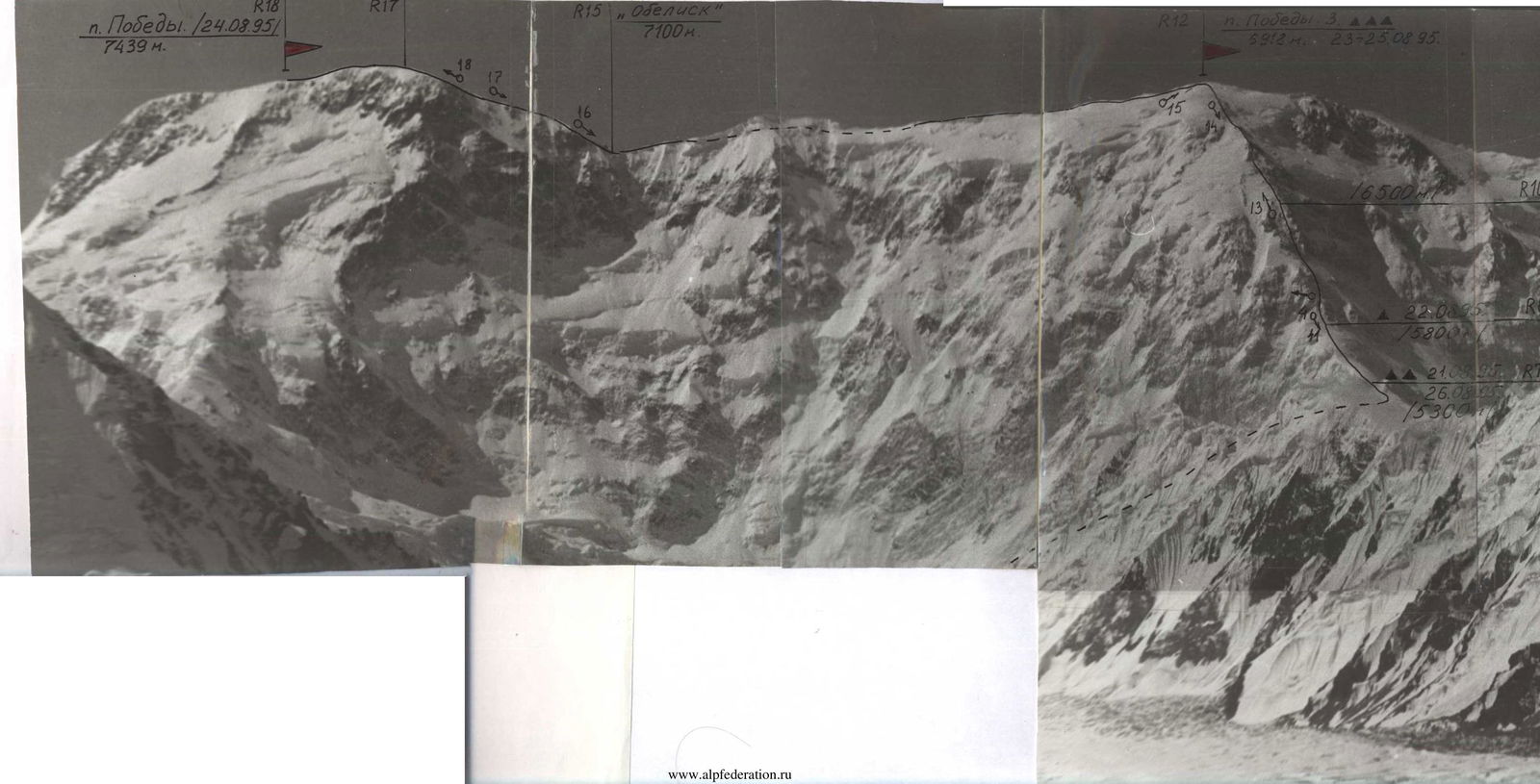
| № | Item | Quantity | Note |
|---|---|---|---|
| 14. | Cooking pot on bivouacs | 2 | on bivouacs |
| 15. | Sleeping bag on bivouacs | 2 | on bivouacs |
| 16. | Insulation mat on bivouacs | 2 | on bivouacs |
| 17. | First aid kit | 1 |
Tactical Ascent Plan
The group's actions on the route were determined by the tactical ascent plan. When compiling it, we considered the poor weather conditions in the area, the state of the route in the current season and bivouac locations, the condition of the icefall above the 4200 m bivouacs, the physical condition and acclimatization of the climbers, as well as the limited time left before the end of the expedition and the flight back to Karakara village.
Overall, the tactical plan consisted of the following:
- 1st day: approach to the 4200 m bivouac on Zvezdochka Glacier;
- 2nd day: traversing the icefall, ascending to Diky Pass (5200 m), then ascending to ~5850 m bivouac (under the start of the rock section of the Western ridge);
- 3rd day: ascending to ~6500 m (bivouac in a tent);
- 4th day: ascending to Pobeda Western peak (6918 m) and descending to the 4200 m bivouac (or to the base camp if in good condition);
- 5th day: reserve day in case of bad weather or poor group condition. A photo of Pobeda Western peak with the ascent route and intermediate camp (bivouac) locations is shown in Fig. 2.
According to the tactical plan, the most physically demanding day was the 2nd day of the ascent (required traversing a height difference of ~1650 m and ~1900 m in length). The group was guided by the following considerations:
- Good acclimatization (three nights at ~6000 m) and physical condition of the climbers;
- Good knowledge of this part of the route, its condition in this season, preliminary processing of the icefall;
- Normal (non-avalanche) condition of the route section from 5200 m to ~5850 m bivouac (snow section of the Western ridge from Diky Pass);
- Presence of caves at ~5850 m bivouac (according to information from other groups that made acclimatization ascents to this height).
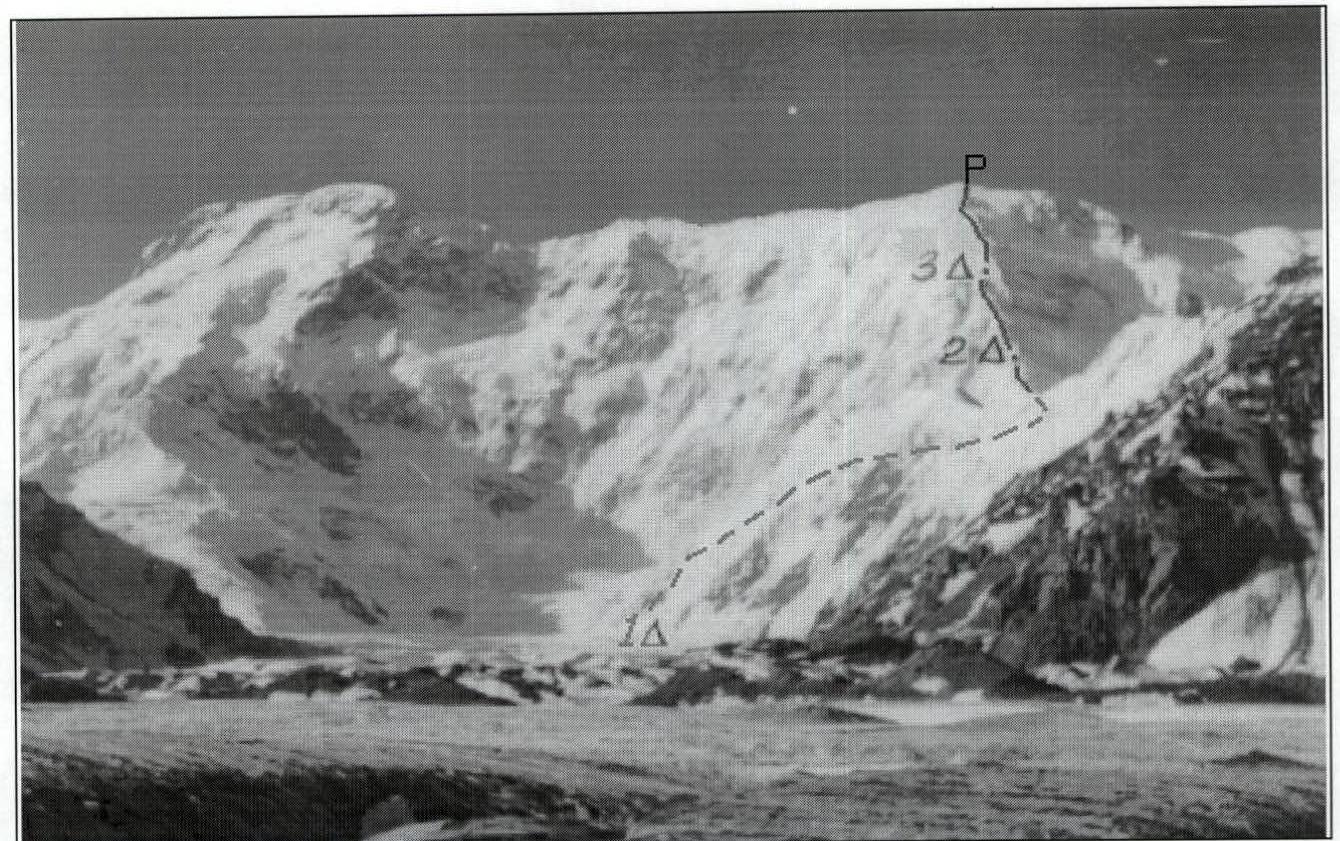
Fig. 2. Photo of the summit showing the ascent route and bivouac locations. The 3rd day according to the tactical plan was supposed to be crucial, as it was planned to establish the last assault camp (tent) on this day. It was decided to choose a site at ~6500 m for this. In case of good condition, an ascent to ~6700 m was possible, and in case of poor condition or bad weather — to ~6300 m (traditional bivouac location on this route).
On the 4th day of the ascent, it was planned to reach the summit of Pobeda Western peak and then descend according to the group's condition and weather.
According to information from participants in the spring ascent to Pobeda peak, the entire Western ridge, including the summit dome, was thoroughly marked. In addition, a large part of the Western ridge was "littered" with old ropes from previous climbers (a kind of markers). All this together allowed us to conclude that descending along the Western ridge was possible even in poor weather conditions. Taking into account all the above, it was planned to descend:
- (in the best case) to the base camp
- or to the bivouac in caves (5200 m) on Diky Pass (in the worst case).
Ascent Description
I day. August 4, 1995
The departure from the base camp was scheduled for 14:00. Initially, the group moved along the right (orographically) moraine part of Zvezdochka Glacier until the trail merged with one of the glacier's tongues. Then the movement continued along the glacier, initially along its central part, and then gradually shifted to its left part under the slopes of Diky peak ridge.
The condition of Zvezdochka Glacier was good (almost completely open), nevertheless, the group moved in a rope team due to the numerous crevasses. In the upper part, Zvezdochka Glacier was heavily crevassed, and the path was potentially hazardous.
At 17:00, the group arrived at the 4200 m bivouac and set up camp.
Along the way, we met a descending group of Spanish climbers who:
- managed to ascend only to ~6400 m;
- due to a torn tent, were unable to continue the ascent at night;
- reported that no one had ascended higher in this season;
- warned that a serac had fallen in the icefall above the 4200 m bivouac, and several ropes were buried under the ice.
For us, this meant that we needed to re-process the icefall and hang new ropes.
During the evening radio communication, we informed the base camp about this information and the possibility of having to change the tactical plan.
II day. August 5, 1995
We started on the route immediately after the 9:00 morning radio communication. The R0–R1 section from the bivouac to the start of the icefall was traversed in a rope team using simultaneous movement. After about 20 minutes, we reached the beginning of the icefall.
Besides our group, two other groups were ascending: MAL instructor group led by Khaibulina and Latvian climbers. It was decided to combine efforts to process the lower part of the icefall (which was covered by the fallen serac). As a result, within 2 hours, two new ropes were fixed. The upper part of the icefall remained untouched by the serac. After another hour, the rope team fully traversed the icefall.
The R1–R2 section (icefall) was traversed using alternate movement with the use of ropes and protection via ice screws.
Then, a gradual ascent-traverse along the slopes of Diky peak ridge began, leading to a sort of "plateau" before Diky Pass. This place somewhat resembles the "skillet" on Lenin Peak. The R2–R3 section was traversed in a rope team using simultaneous movement.
The ascent to Diky Pass was not particularly challenging and did not pose an avalanche risk. Therefore, the group's movement on the R3–R4 section was fully autonomous. It took the group about an hour to ascend to the pass and reach the caves at 5200 m. Here, we rested for 30–40 minutes, communicated with the base camp, made a warm drink on a gas stove, and had a snack.
During the rest:
- the weather began to deteriorate,
- the wind picked up,
- clouds appeared.
The condition of the rope team was excellent, so it was decided to continue ascending to the ~5850 m bivouac (caves).
During the ascent to the caves (R4–R5 section), the weather worsened rapidly, the wind strengthened with each minute, and snow began to fall. The last 200 m were traversed in zero visibility. Due to the strong wind, the entire Western ridge was shrouded in clouds. Consultations with MAL and good knowledge of the route (especially by Lavrov S.S.) proved helpful. The ascent on this section proceeded along the snow, sometimes dense firn, and occasionally crevasses. Movement was in a rope team, simultaneous, with protection via ice axe. By 18:00, we reached the caves. This was the most labor-intensive day of the ascent. Despite issues with the icefall, we managed to adhere to the tactical ascent plan.
Meanwhile, the weather continued to deteriorate, snow intensified, the wind approached storm strength, and it became significantly colder. No one wanted to leave the cave. The cave entrance began to be quickly covered with snow. If this continued, the next day's departure would have to be postponed due to bad weather.
III day. August 6, 1995
The morning confirmed our concerns about the weather. After digging out the exit, we emerged from the cave and almost immediately decided to postpone the departure and wait out the bad weather. There was no snow, the cloud cover was low, but a very strong wind was blowing, almost a storm. The risk of frostbite was too high.
During the morning radio communication, we reported that we would not be ascending due to the very strong wind. After 14:00, the wind gradually began to subside, and other climber groups started to ascend from below. However, we decided to stick to the tactical plan and make the next camp (assault) at ~6500 m. If the weather was the same tomorrow, our plans would not come to fruition — we would be descending. We had no time reserve left. We could only hope and wait for the morning.
IV day. August 7, 1995
Fortune smiled upon us on this day. Although the wind was blowing, it was not as strong as yesterday. Generally, on the Western ridge, the wind blows constantly along the entire Pobeda massif from Neru peak to Eastern Pobeda peak. During the 9:00 morning radio communication, we reported that we would be ascending. A day of rest likely did not add much strength after the labor-intensive 2nd day, but the condition of the rope team was good. We exited the cave at 10:00; the wind continued to blow. Up to the start of the rock section of the Western ridge, the ascent proceeded along hard firn, gradually turning into ice. The rope team moved in a связке, first simultaneously, then alternately, using protection via ice screws. The ridge was heavily serrated, with numerous ledges and remnants of old ropes from previous climbers. Protection was provided through numerous ledges on the ridge. Gradually, the rocky ridge turned into a snowy one, leading to a large snow shelf (height ~6300 m) — an excellent bivouac location.
The R5–R6 section was traversed by the rope team in 2 hours (a decent pace). After a short rest, we decided to continue.
Next followed a relatively technically simple section, R6–R7, transitioning from the snow shelf back to the rocky ridge. Movement here was simultaneous.
The R7–R8 section resembled the rocky part traversed two hours earlier. There were also many ledges used for protection. Movement was mostly simultaneous, with some alternate movement in hazardous (rockfall) areas. Old ropes (path markers) were still hanging.
After a narrow part of the ridge:
- the ridge widened,
- it became more snow-covered (due to winds).
We reached the site where the Spanish climbers had camped. The location was very poor: it was strongly windswept and generally inconvenient for a bivouac. We decided to move further and try to find a better site for the tent.
After about 100 m:
- we came across a large boulder,
- next to which was an excellent site, protected from the wind on one side.
According to our estimates:
- this was ~6500 m,
- we had been walking for another 2 hours from the snow shelf at 6300 m.
We prepared the site, set up the tent, and settled in for the night. After about an hour, we were in a warm tent, starting to prepare a meal. Meanwhile, the wind showed no signs of subsiding; in fact, it even strengthened.
After dinner, we discussed plans for tomorrow:
- If the wind was moderate in the morning, we decided to ascend lightly to the summit of Pobeda Western peak, having previously dismantled the camp.
- If the wind was very strong, the only path would be down.
The condition of the rope team was good, with no signs of illness.
V day. August 8, 1995
The night passed calmly. It even seemed that the wind had subsided. However, around 5:00 AM, the wind picked up again, and we felt it as the tent fabric started hitting our faces. The "summitoma" tent proved to be a good choice for two people at high altitude. Sleep was instantly gone, and thoughts started racing. We decided to wait for the radio communication and then make a final decision. There was not much choice — either to the summit or down. By 8:30 AM, the wind had started to subside a bit, and this was decisive in choosing the direction of movement. We quickly dismantled the camp and, during the 9:00 radio communication, reported that we would attempt to reach the summit if everything went smoothly.
The R8–R9 section from the bivouac to the start of the rocky triangle at 6700 m (a key point on the route) was traversed in a rope team simultaneously in 1 hour. Protection was provided through ledges on the ridge. The wind gradually weakened, giving us confidence that we would be able to reach the summit. Moreover, the thought that we were the first to ascend Pobeda Western peak this summer season acted like adrenaline in our blood.
The R9–R10 section (rocky triangle) was traversed by the rope team alternately using piton protection. This was the steepest and most challenging section of the route on the ridge. Further on, the ridge began to flatten.
The R10–R11 section was traversed simultaneously by the rope team, but when approaching the bivouac site at ~6800 m, Lavrov S.S.'s crampon broke — the front strap failed. For a few minutes, we didn't know what to do. Descending was disappointing when the summit was within reach. Ascending with one crampon was impossible due to the upcoming snow-ice dome of the summit.
After a brief discussion, it was decided that:
- Odokhovsky V.V. would ascend to the summit alone,
- Lavrov S.S. would remain at this site and wait for the return of the first climber for a joint descent.
The R11–R12 section was traversed by Odokhovsky V.V. alone; he reached the summit of Pobeda Western peak at around 12:00. This was the first ascent to the peak in the summer season.
Route features:
- The lower part of the dome (start of the ascent) was icy,
- местами характер зимнего «бутылочного» льда,
- Crampons were essential here.
No note was found; there were only remnants of tents and stands from previous climbers. Odokhovsky V.V. left a note about the ascent to Pobeda Western peak (Vazha Pshavela) on August 8, 1995, at 12:00 (Moscow Sports Committee team).
Then, a challenging descent followed. Lavrov S.S. always descended first with top-rope protection. When traversing key sections of the route and icy areas, movement was alternate; on the rocky part of the ridge and from 5850 m to Diky Pass — simultaneous.
By 13:00, we had descended to the last bivouac site and reported via radio that Lavrov S.S.'s crampon was broken. We were advised not to rush and be particularly cautious during the descent along the ridge. The condition of the rope team was good; the weather had improved, the wind had almost subsided, and the ascent goal was achieved. All this gave us confidence that the descent would proceed normally.
Another 1 hour and 30 minutes later, we descended to the cave at ~5850 m, and by 17:00, we were at the 4200 m bivouac. Our legs were eager to continue to the base camp, and we decided not to bivouac here, continuing the descent together with the observers. The daylight allowed us to traverse Zvezdochka Glacier in daylight; our observers, Kovalyov A.V. and Stetsenko V.D., had "unloaded" us significantly. At 20:00, the group was back at the base camp in full.
The next day at 12:00, we flew out by helicopter to Karakara village.
The following data are provided in the appendix:
- table of ascent route characteristics;
- UIAA route diagram;
- ascent route profile (Fig. 3);
- ascent graph and weather conditions (Fig. 4);
- ascent route sheet;
- ascent debriefing protocol.
Table of Main Characteristics of the Ascent Route to Pobeda Western Peak via the Western Ridge
Height difference 2720 m, average slope ~35°
| Date | Section | Avg. slope | Section length | Terrain | Protection | Difficulty | Climbing time | Pitons used | Note | |||
|---|---|---|---|---|---|---|---|---|---|---|---|---|
| rock | ice | chocks | snow | |||||||||
| 1 | 2 | 3 | 4 | 5 | 6 | 7 | 8 | 9 | 10 | 11 | 12 | 13 |
| August 4, 1995 | Base camp — R0 | 20° | 7.5 km | moraine, glacier | simultaneous | 2 | 3 h | Zvezdochka Glacier heavily crevassed. | ||||
| August 5, 1995 | R0–R1 | 20° | 320 m | firn, ice | simultaneous | 2 | 20 min | |||||
| R1–R2 | 45° | 560 m | ice | piton | 5 | 3 h | 4 | |||||
| R2–R3 | 20° | 530 m | snow, firn | simultaneous | 2 | 1.5 h | ||||||
| R3–R4 | 45° | 420 m | snow, firn | simultaneous | 3 | 1 h | 30 min rest | |||||
| R4–R5 | 40° | 1050 m | snow ridge | simultaneous | 4 | 3 h | Bivouac in a cave. | |||||
| August 6, 1995 | — | Day of rest in a cave at ~5850 m due to bad weather (very strong wind) | ||||||||||
| August 7, 1995 | R5–R6 | 50° | 550 m | rocky ridge | piton, ledge | 5 | 2 h | 3 | ||||
| R6–R7 | 20° | 160 m | snow shelf | simultaneous | 2 | 20 min | 10 min rest | |||||
| R7–R8 | 50° | 230 m | snow ridge | piton, ledge | 5 | 2 h | 1 | Bivouac at 6500 m | ||||
| August 8, 1995 | R8–R9 | 50° | 280 m | rocky ridge | simultaneous | 5 | 1 h | |||||
| R9–R10 | 70° | 70 m | rocky wall | piton, ledge | 6 | 40 min | 2 | 2 | key section of the route. | |||
| R10–R11 | 20° | 160 m | rocky-snow ridge | simultaneous | 4 | 40 min | ||||||
| R11–R12 | 20° | 250 m | snow-ice dome | solo | 4 | 40 min | summit. | |||||
| Total: | Ascent to the summit (from base camp) | 19.5 h | 6 | 6 | ||||||||
| Descent from the summit via the ascent route | 7 h | |||||||||||
| Total: | Entire route | 26.5 h | 6 | 6 |
UIAA Route Diagram

Ascent Debriefing Protocol
for Pobeda Western Peak via the Western Ridge, 5B category difficulty
| Attendees: | ||
|---|---|---|
| group leader | Odokhovsky V.V. | |
| climber | Lavrov S.S. | |
| group observers: | Egorov D.A. | |
| Shcherbakov V.G. | ||
| senior coach | Khokhlov Yu.V. | |
| head of rescue team | Khlyustikov I.N. | |
| 10 participants of the gathering. |
Heard:
Group Leader Odokhovsky V.V.:
The group, consisting of Odokhovsky V.V. and Lavrov S.S., along with two observers, Egorov D.A. and Shcherbakov V.G., departed from the base camp on August 4, 1995, at 14:00, according to the tactical plan, to the first intermediate camp at 4200 m (bivouac on Zvezdochka Glacier under the icefall). The condition of Zvezdochka Glacier was good (almost completely open); nevertheless, they moved in a rope team. Along the way, they met a group of Spanish climbers who reported that a serac had fallen in the icefall, burying several ropes. By around 17:00, the group arrived at the bivouac.
On August 5, 1995, the rope team of Odokhovsky V.V. and Lavrov S.S. started on the route after the 9:00 morning radio communication. The observers remained at the 1st camp. During the processing of the lower part of the icefall, the rope team combined their efforts and equipment with the MAL instructor group led by Khaibulina and Latvian climbers. Two new ropes were fixed. By 14:00, the rope team ascended to Diky Pass and approached the caves at 5200 m.
The condition of the participants was good, and after a 30-minute rest, they continued ascending to the caves at ~5850 m under the start of the rock section of the Western ridge (according to the tactical plan). During the ascent, the weather deteriorated rapidly, the wind strengthened, and snow began to fall. The last 200 m to the caves were traversed in zero visibility. By around 18:00, they ascended to the caves and settled in for the night.
August 6, 1995
Due to very strong winds (almost stormy), it was decided not to ascend — the risk of frostbite was too high. In the afternoon, the weather began to improve, and the wind gradually subsided.
August 7, 1995
They departed from the cave at 10:00. The condition of the group was good. Although a strong wind was still blowing, it was not as strong as the day before. After 2 hours of ascending along the rocky Western ridge, they reached a large snow shelf at ~6300 m — an excellent bivouac location. The condition of the ridge was good, with many old ropes from previous ascents (path markers). After a short rest on the snow shelf, they continued higher. The rocky ridge resumed, somewhat resembling the previously traversed section in structure and the presence of old ropes. After another 2 hours of ascent, they reached a large boulder, next to which was a suitable site for a tent. According to their estimates, this was ~6500 m. If the wind was moderate, they planned to ascend lightly to the summit the next day.
August 8, 1995
Early in the morning (around 5:00 AM), a strong wind picked up again, subsiding somewhat by 8:30 AM. During the 9:00 morning radio communication, they dismantled the camp and, immediately after, departed for the summit. After about 1 hour of ascent, they reached a large rocky triangle on the ridge — a key point on the route. They traversed the triangle along its left part, alternately, using piton protection. Further, the ridge began to flatten and gradually transition into the summit dome. When approaching the bivouac site at ~6800 m, Lavrov S.S.'s crampon broke (the front strap failed). It was decided that Odokhovsky V.V. would ascend to the summit alone, while Lavrov S.S. waited for his return at the site for a joint descent. At around 12:00, Odokhovsky V.V. reached the summit of Pobeda Western peak. This was the first ascent to the peak in the summer season.
During the descent, Lavrov S.S. always went first with top-rope protection. Key sections of the route and icy areas were traversed alternately. By 13:00, the rope team descended to the last bivouac site at ~6500 m. They reported via radio about the broken crampon, gathered their gear, and continued descending to the 4200 m bivouac on Zvezdochka Glacier. By around 17:00, they reached the observers' tent. They decided to continue descending to the base camp. The observers "unloaded" them, and after a short rest and a hot meal, they all continued descending together along Zvezdochka Glacier.
By 20:00, the group returned to the base camp in full.
Climber Lavrov S.S.:
Satisfied with the ascent. It was done at a good pace (thanks to excellent acclimatization and knowledge of the route). Regrets not reaching the summit due to the broken crampon. Nevertheless, the goal was achieved, although some dissatisfaction remained.
Head of Rescue Team Khlyustikov I.N.:
How was safety ensured during Odokhovsky V.V.'s solo ascent to Pobeda Western peak?
Odokhovsky V.V.:
During ascent and descent from the summit dome, protection was provided via ice axe. On steep icy sections of the dome, he moved in three steps on the front teeth of his crampons.
Khokhlov Yu.V.:
What was most memorable about this ascent, and what was the most challenging?
Odokhovsky V.V.:
The size of the cave at ~5850 m, dug out in the spring of that year, was impressive. He had never seen anything like it before. It was like a multi-room apartment.
The most challenging was deciding to ascend to the summit alone rather than descending.
Lavrov S.S.:
The route to Pobeda peak is familiar from previous years. Considers that they were somewhat lucky with the weather (only one day of rest). Otherwise, Pobeda is Pobeda. The conditions of the ascent here are much harsher than in the Pamir.
Khokhlov Yu.V.:
The ascent by Odokhovsky V.V. is confirmed.
Senior coach of the gathering, Khokhlov Yu.V.
Protocol recorded by Stetsenko V.D.

Comments
Sign in to leave a comment