
Passport
- Ice and snow ascents class
- Central Tien Shan, South Inylchek Glacier
- Peak Auezov, 5967 m, via the center of the North-East face
- Proposed - 6A category of complexity, first ascent
- Wall height difference: 1200 m, route - 1367 m; wall length - 1370 m; route length - 1640 m. Length of sections with 5-6 category of complexity - 790 m. Average steepness of the main part of the route 58° (4600-5800), including 6 category of complexity sections: 80° (4750-4800); 70° (4848-4860); 70° (4888-4901); 80° (4920-4931); 70° (5364-5680); 70° (5680-5742); 70° (5758-5800)
- Use of previously driven pitons - no
- Team's working hours: 22.5 (20 hours on the wall) and days - 2
- Overnight stays: 1st in a natural ice-snow cave - 6 people.
- Team leader: Viktor Vasilyevich Zhuravlev, Master of Sports of the USSR
Team members:
- Sergey Konstantinovich Penzov, Master of Sports of the USSR
- Valery Nikolaevich Kuznetsov, Candidate Master of Sports
- Alexander Veniaminovich Fedkov, Candidate Master of Sports
- Igor Vladimirovich Benkin, Candidate Master of Sports
- Ilya Vladimirovich Sabelnikov, Candidate Master of Sports
- Coach: Sergey Petrovich Galkin, Master of Sports of the USSR.
- Route entry: August 3, 1989.
Summit - August 4, 1989. Return - August 4, 1989. 12. Organization - State Committee for Sports of the RSFSR.
Movement on sections R4-R8 was alternating, the first climber moved without a backpack, having pocket food.
Further work on the summit ridge - section R9 - summit - was continued by the first rope team, Fedkov-Benkin, and by 17:30 the group had gathered at the summit.
The sharp ridge with cornices and overhangs required great mental effort.
At 22:00 on the same day, the team descended via a partially familiar path to the observers' camp.
Good physical and technical fitness allowed the team to quickly complete the route without injuries or accidents, and with the use of headlamps, they descended to camp on August 4. During the ascent, a nutrition regime was maintained:
- in the morning - sandwiches with tea;
- during work - pocket food: raisins, nuts, dried fruits, tea with honey from flasks;
- at the bivouac - abundant drinking, buckwheat with meat, chocolate.
The emergency food supply was brought down to the observers' camp.
Considering the possibility of reaching the ridge via rocky outcrops and walls, the team had a set of rock climbing equipment, including drill pitons. Throughout the entire route, the team maintained good radio communication via "Lastochka". Observers conducted daily radio communications and observations. The entire team and rescue team returned to the base camp, leaving the bivouac site under the ascent object clean.
MF photos, which reflect the described moments:
- Photo 6. Bivouac on the route.
- Photo 7. Observers' and rescue team's bivouac.
- Photo 8, 9. Work on the route.
- Photo 10. Special equipment used on the route.
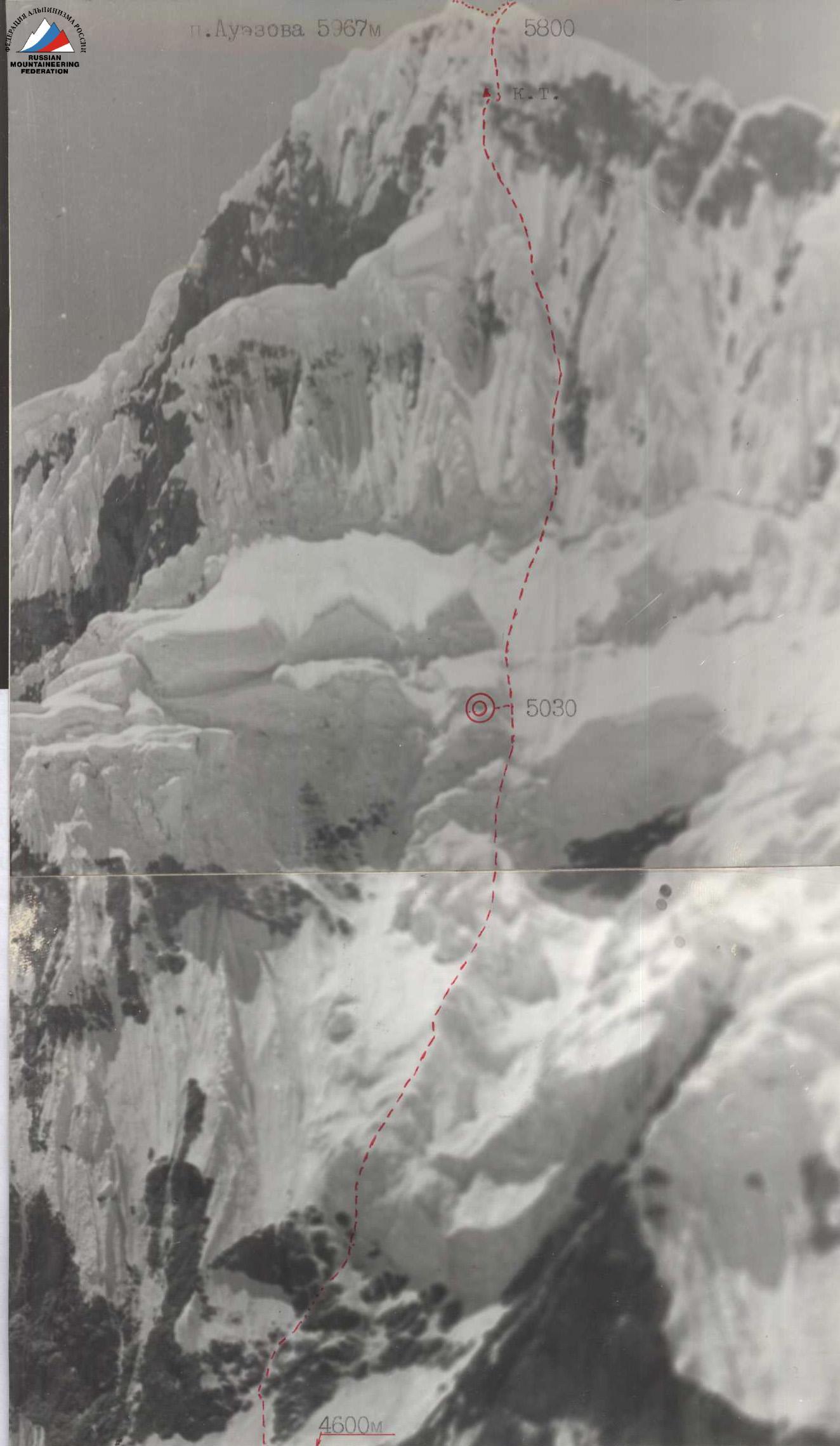
Photo 1. General photo of the route.
- Route of the RSFSR team in the USSR Championship in the ice and snow class 1989.
- Photo taken on August 3, 1989 at 13:00
- Lens "Jupiter II-A", F=135 mm
- Distance to the object 3 km
- Height of the shooting point 4450 m
- Shooting point #5
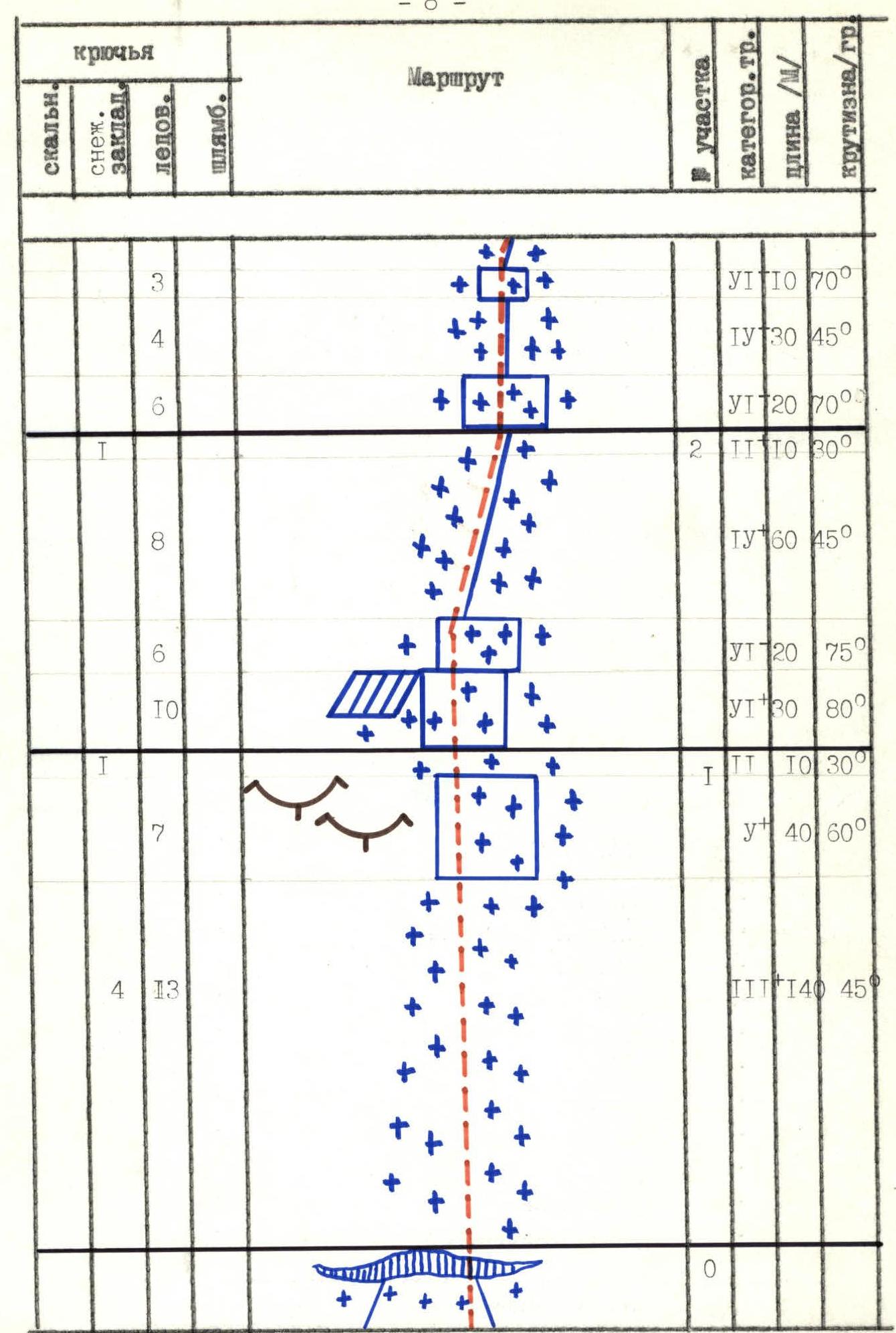
Route scheme in UIAA symbols. Scale 1:2000.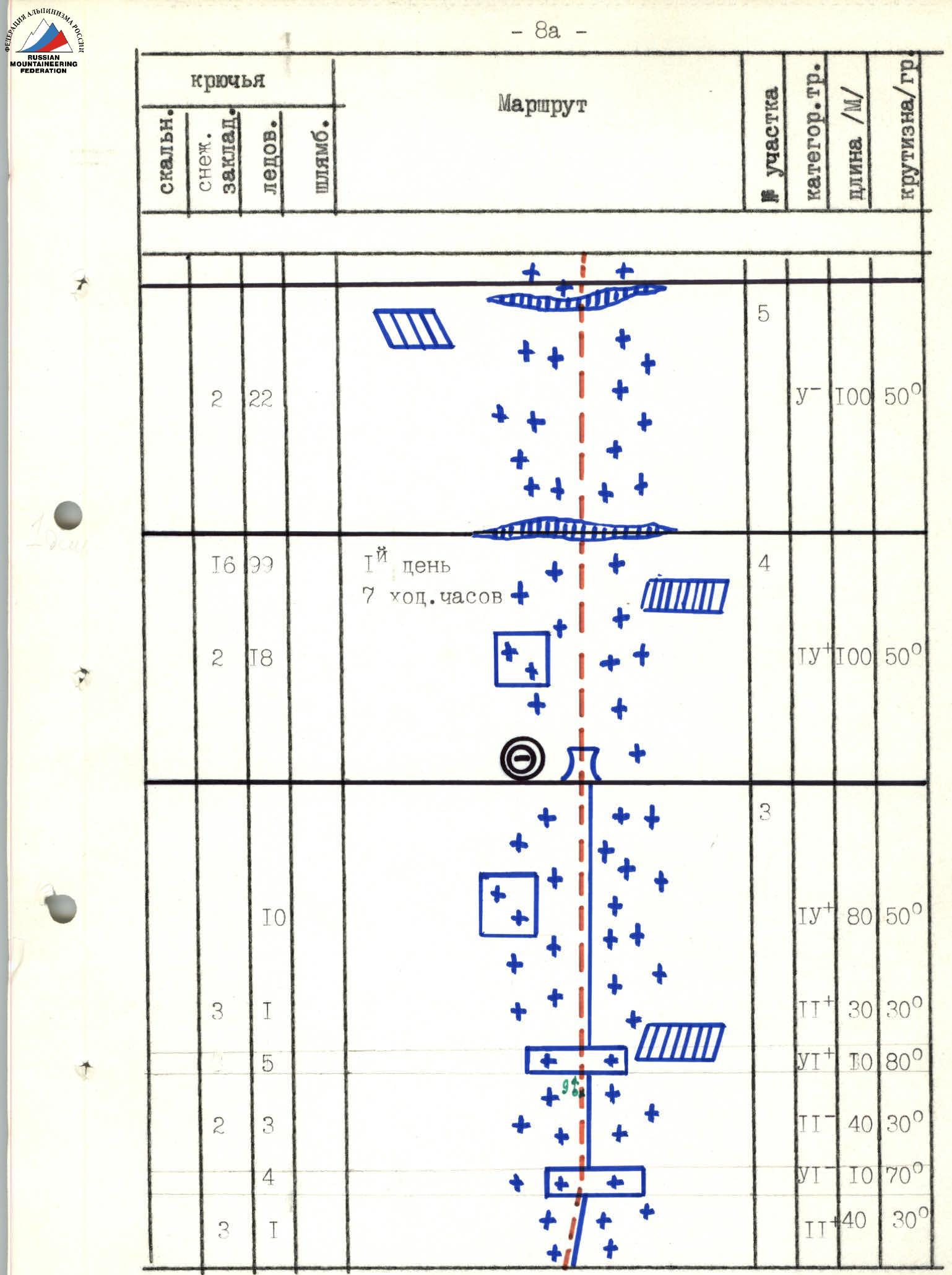
Route scheme in UIAA symbols. Scale 1:2000.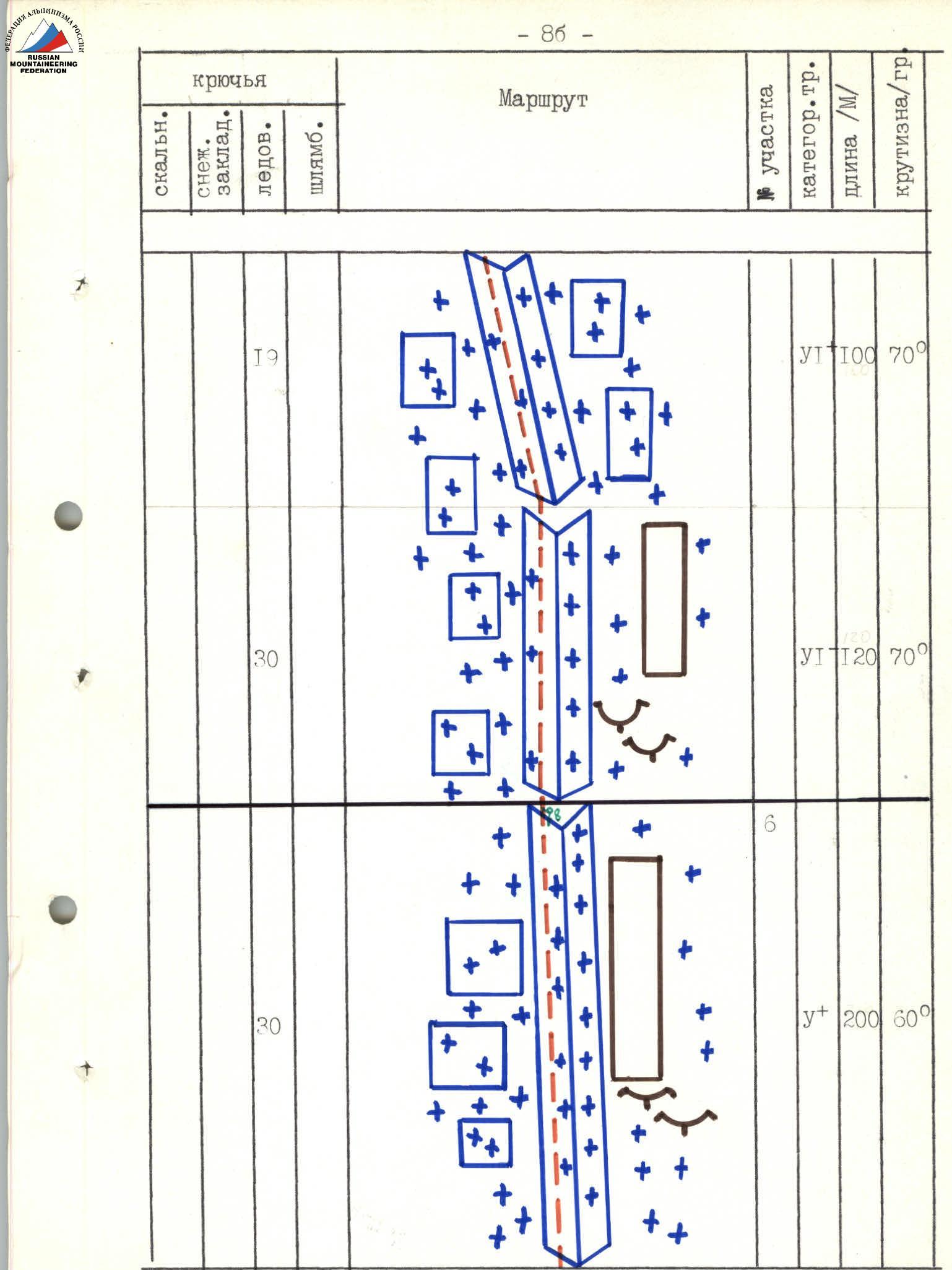
Route scheme in UIAA symbols. Scale 1:2000.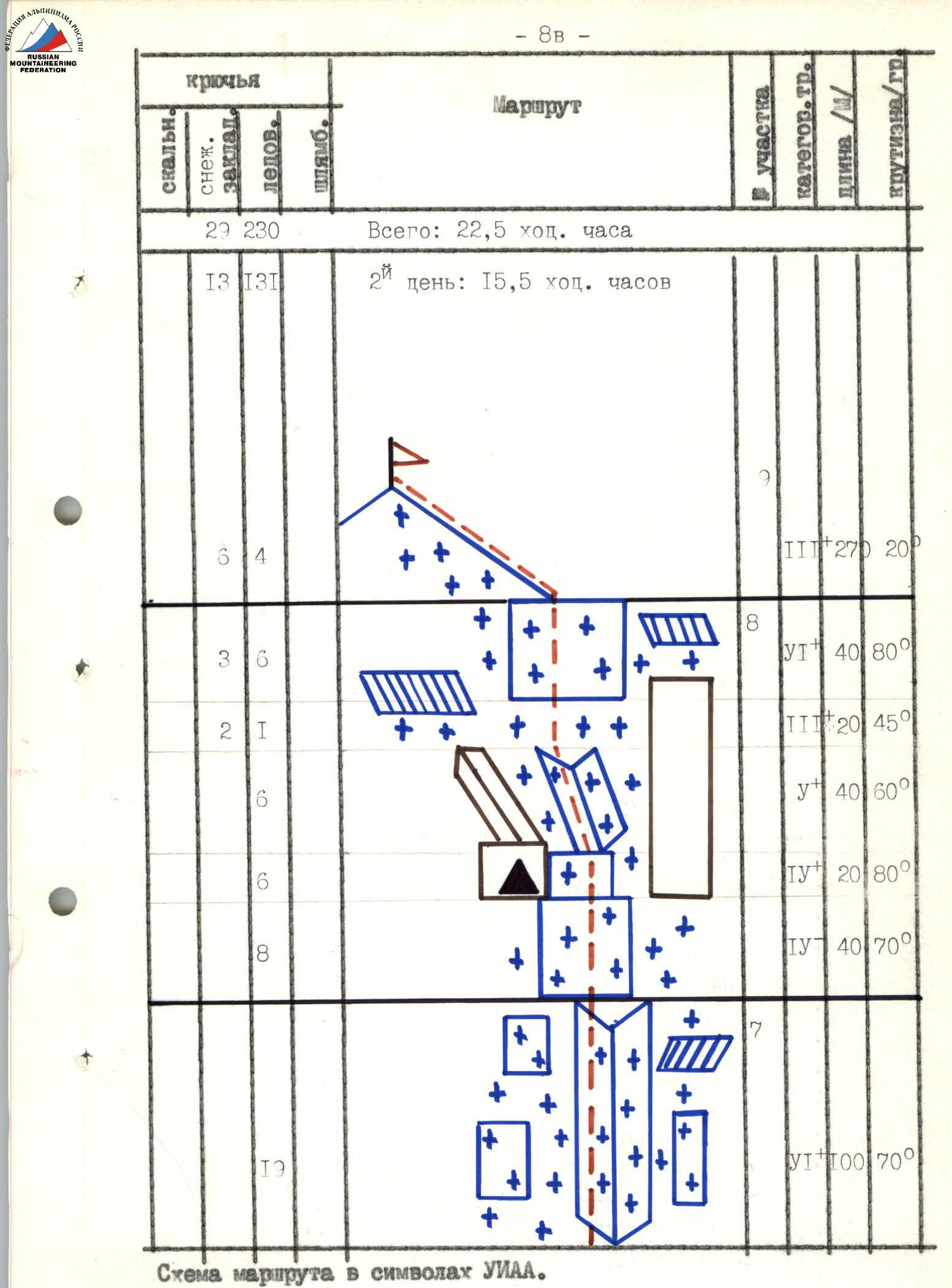
Route scheme in UIAA symbols.
Route description by sections
1st day - August 3, 1989. Section R0-R1. Overcoming the bergschrund and alternating movement with the help of an ice axe and ice screws on the ice slope with snow sections.
Rope teams:
- Kuznetsov - Sabelnikov
- Zhuravlev - Penzov
- Fedkov - Benkin
In the upper part of the section - passage through the ice wall among rocky outcrops. Section R1-R2. Alternating movement left - up, bypassing overhanging ice walls on very steep and hard ice (special ice screws were difficult to place and they froze in such a way that they had to be chopped out). Further - movement on a steep ice slope to a safe ice-snow ridge. All, except the first participant, used ropes.
Section R2-R3. Alternating movement on a long ice-snow ridge, interspersed with steep ice walls, with an exit to an ice-snow grotto, where a day's rest was organized. Further movement on the sunlit route caused great concern.
Section R3-R4. When the sun went down and it got sharply colder, the rope team Zhuravlev-Penzov-Fedkov processed the steep ice-snow slope to the bergschrund, which was largely filled with snow. Further movement was not safe, and the team decided to stop work for the day.
2nd day - August 4, 1989. Section R4-R5. The first to work was the rope team Zhuravlev-Penzov. The first climber worked with ice screws and a special ice hammer. Alternating movement on the ice-firn slope to the uppermost bergschrund.
Section R5-R6. Alternating movement on the left side of a steep ice gully. Very difficult movement - constantly turning right, and "mushrooms" hang overhead. The ice is very hard, and ice screws have to be chopped out.
Section R6-R7. Alternating movement on the left side of a very steep gully. Very physically and psychologically difficult due to the "mushrooms" on the ridge above, very hard ice, and oblique movement with a turn complicates the passage of the section. All participants, except the first, constantly use jammers.
Section R7-R8. Alternating movement with an exit to the ridge under the base of a rocky wall. Here, on a platform, a control point was organized and further - right up, bypassing rocky outcrops on a steep gully under a very steep ice-firn wall, the passage of which took a lot of strength and time. All! The wall part of the route is behind.
Section R8-R9. The first to work was the rope team Fedkov-Benkin. Simultaneous and alternating movement on a treacherous snow ridge with cornices and overhangs with an exit to the summit! The descent to the observers' camp took 4 hours, in the lower part - in the dark with headlamps.
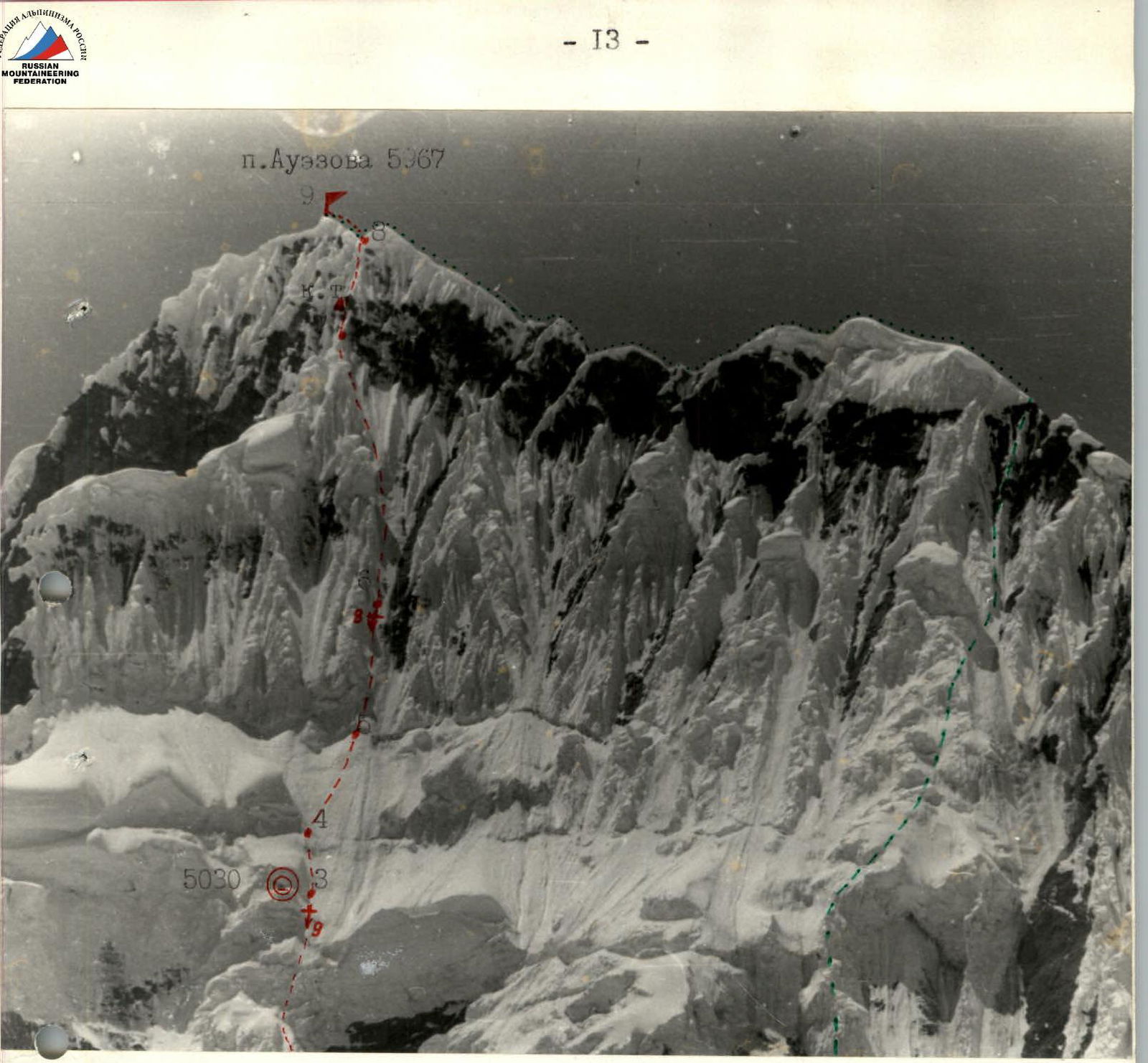
Photo 5. Tactical photo. Route of the RSFSR team in the ice and snow ascents class 1989. Photo taken on August 3, 1989 at 13:30. Lens "Jupiter II-A", F=135 mm. Distance to the object 3 km. Height of the shooting point 4450 m. Shooting point #5