
Svobodnaya Koreya via North Face
S. Semiletkin, 1988, cat. 6B Tian Shan — Kyrgyzsky Ridge 7.4.144.
Passport
- Class: winter
- Tian Shan, Kyrgyzsky Ridge, Ak-Sai gorge
- Peak Svobodnaya Koreya, via North face, 4740 m. 4th ascent
- Route cat. 6B (S. Semiletkin, 1988, 3rd passage)
- Height difference: 890 m, length — 1160 m.
- Length of sections with cat. 6 difficulty — 290 m.
- Average slope of the route 62° (bergschrund — ridge)
- Average slope of the central part 87° (3960–4290 m)
- Pitons driven:
| Rock | Bolts | Nuts | Ice screws | Sky-hooks |
|---|---|---|---|---|
| 131+7X | 4+10X | 122 | 44 | 6 |
| 123+5x | 3+6x | 109 | 0 | 6 |
-
Team's travel hours — 49, days — 7 (until the summit)
-
Overnights:
- 1st–2nd–3rd–4th–5th — semi-reclining on a rock shelf
- 6th — lying on the ridge
-
Team leader: Babanov Valery Pavlovich — CMS
Participants:
- Grekov Dmitry Mikhailovich — MS
- Ruchkin Alexander Alexandrovich — MS
- Shabalin Pavel Eduardovich — CMS
- Karpov Evgeny Anatolyevich — CMS
-
Coach: Ilyinsky Ervand Tikhonovich — Honored Coach of the USSR
-
Start of the route: February 2, 1992
Summit: February 9, 1992 Return: February 9, 1992
-
Organization: branch of CSKA, Alma-Ata

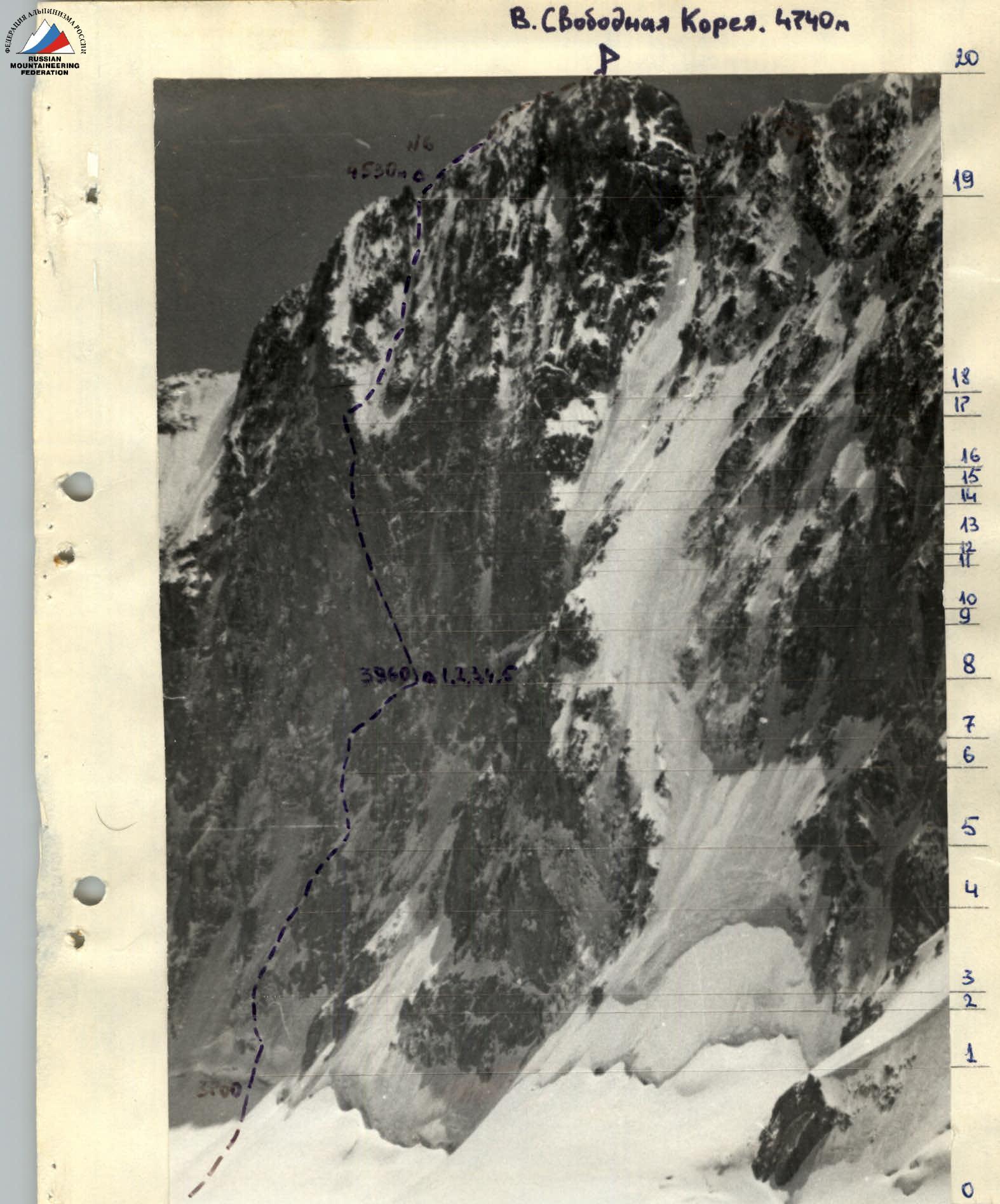
General photo of the summit, 1988, summer.
Lens "Yupiter" 37A, F = 135 mm.
Distance to the wall 3.0 km.
Shooting point # 2, H ± 3800 m.
Profile of the wall on the right, 1988, summer. Lens "Yupiter 37A", F = 135 mm. Distance to the wall 2.5 km. Shooting point # 3, H = 3700 m.
Tactical actions of the team
When drawing up the tactical plan, it was envisaged to complete the route in 7 days, including a day for preliminary processing. 1 day was allocated for descent. In case of unfavorable weather, it was planned to extend the time schedule by 2 days. When working on the route, the short winter day, low temperatures, and the northern exposure of the wall were taken into account.
For winter conditions, the tactic of working from "intermediate camps" was chosen: processing the route up to the "TV" — 8 ropes, setting up a "storm" camp tent, and subsequent processing of the "key" section of the wall — 8 ropes of extremely difficult climbing, and only then dismantling the camp and advancing to the "roof." Moving the camp higher was deemed impractical. The team worked strictly according to the tactical plan. The only deviation was starting work not at 9:00, but at 10:00 due to severe cold. The processing team always managed to descend before dark, and by 18:00, the team was at the bivouac in full.
Since the route was familiar from the ascent in September 1991, this allowed the team to work even on days when the weather worsened and visibility was limited.
According to the tactical plan, on February 2, 1992, the Grekov – Ruchkin – Karpov team started processing the lower part of the route. Wind with snow. For the day:
- 6 ropes of fixed lines were installed
- part of the cargo was transported (sections R0–R6)
On the second day, the remaining 2 ropes were passed (sections R6–R8), and the group in full reached the site of the assault camp by 16:00 (section R8), where a tent was set up (photo 1).
On February 4, they began processing the main part of the wall. On this day, the Babanov – Shabalin team worked. A steep section of vertical exfoliating slabs was passed (photo 2), and by 17:00, having hung 60 m of rope, the team approached a large cornice (sections R8–R9).
On February 5, in strong winds with snow, the Grekov – Ruchkin team continued processing the wall. For the day, 80 m were processed (sections R9–R13) (photo 4), including one of the most difficult sections: an overhang turning into a 3-meter cornice (photo 3). It is impossible to bypass it; it is overcome directly head-on.
On February 6, the Shabalin – Babanov team worked on the wall. Strong wind in the morning. The wall does not allow relaxation. A 15-meter section is passed on sky-hooks. After lunch, the weather worsened: wind with snow. 80 m of the wall were covered (sections R13–R16) (photos 5, 6, 7).
On February 7, the Grekov – Ruchkin team, having processed and hung 60 m of the wall (sections R16–R18), descended for the night.
On February 8, at 9:00 in the morning, having dismantled the tent and passed along the fixed lines, the wall reached the "roof" by 14:00. 6 ropes of the ice couloir with a steep wall in the middle part (sections R18–R19) lead to the ridge. By 17:00, the last participant reached the ridge, and the team settled in for the night. The Karpov – Grekov – Ruchkin team worked at the front.
On February 9, having moved in simultaneous and partly alternating motion along a relatively easy ridge (sections R19–R20), the team reached the summit of Svobodnaya Koreya by 12:00. Descent from the summit down the ridge, then along the Lowe ice couloir — cat. 5A.
The main section of the route — the wall — is passed using artificial climbing techniques (ACT), so the speed of advancement is not high — 1.5–2 ropes per day. On particularly cold days (2 days), there was a change of belayers during lunch.
The teams worked on alternate days, so the participants had the opportunity to warm up, eat well, and rest psychologically.
Throughout the route, the first climber moved on a double rope, one of which was marked UIAA. The second rope was used to secure the fixed lines. A diverse set of technical means was widely used: ice screws, friends, chocks, pitons, sky-hooks.
During the ascent, there were no participant falls.
Every day, the team in the assault camp received three hot meals to restore their strength, and the working team received two hot meals a day. For speed and to save fuel, all hot meals were prepared in an autoclave.
At the site of the assault camp, on the "TV," a platform was built under a high-altitude tent.
All overnight stays:
- Semi-reclining
- On the ridge — lying down
Throughout the ascent and descent, stable radio communication was maintained with observers. A rescue team consisting of participants from the Kyrgyz team was constantly present in the base camp at the "Ratsek" parking lot.
It should be noted that some sections on the route, which during the autumn ascent could be passed by free climbing, were now passed using ACT due to their icy condition and low temperature.
The ascent, complex in all respects, was completed with sufficient reliability and a margin of safety.
| № | Column 2 | Column 3 | Column 4 | Column 5 | Column 6 | Section № | Cat. difficulty of section | Length, m | Steepness, ° |
|---|---|---|---|---|---|---|---|---|---|
| 7 | 26 | R16 | VI (A3) | 40 | 80 | ||||
| 4 | 2 | 2 | February 6, 1992 | R15 | VI | 15 | 75 | ||
| 2 | 2 | 7 travel hours | 6 times | R15 | |||||
| 9 | 5 | 38 rock pitons | R14 | ||||||
| 9 | 4 | 26 nuts, 11 bolt pitons | |||||||
| 9 | 15/15 | 32 | R13 | VI/A4 | 40 | 90 | |||
| 2 | February 5, 1992 | R12 | У | 10 | 55 | ||||
| 3 | 7 travel hours | 60 m | R11 | VI/A3 | |||||
| 29 | 18/18 | 21 | R10 | VI/A3 | |||||
| 6 | R9 | VI/A4 | 5 | 140 | |||||
| 2 | |||||||||
| 21/19 | 1 | R8 | VI/A3 | ||||||
| 2 | 3 | 1 | R7 | У | |||||
| 2 | 3 | 1 | R7 | У | |||||
| 4 | 6 | R6 | VI/A2 | ||||||
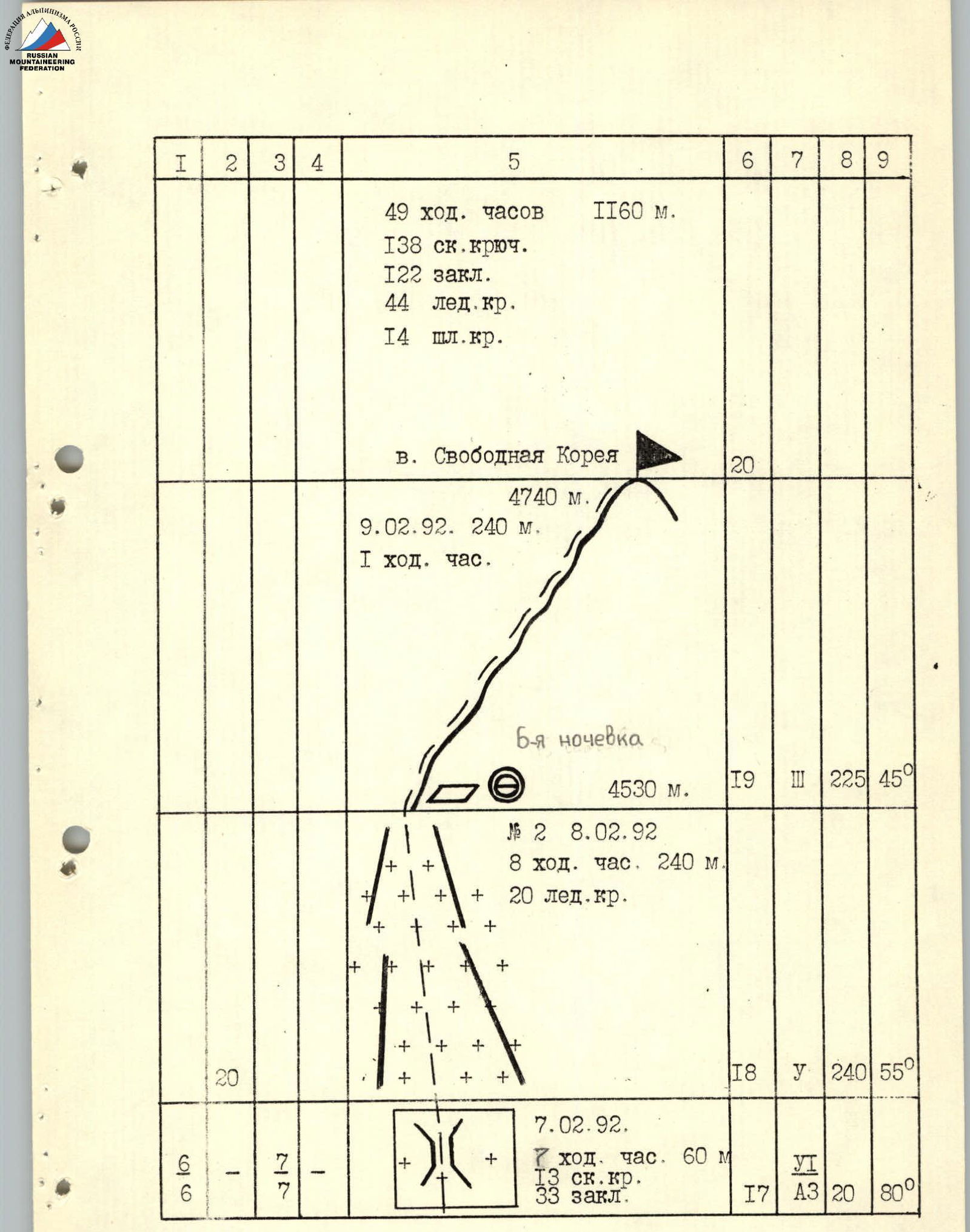
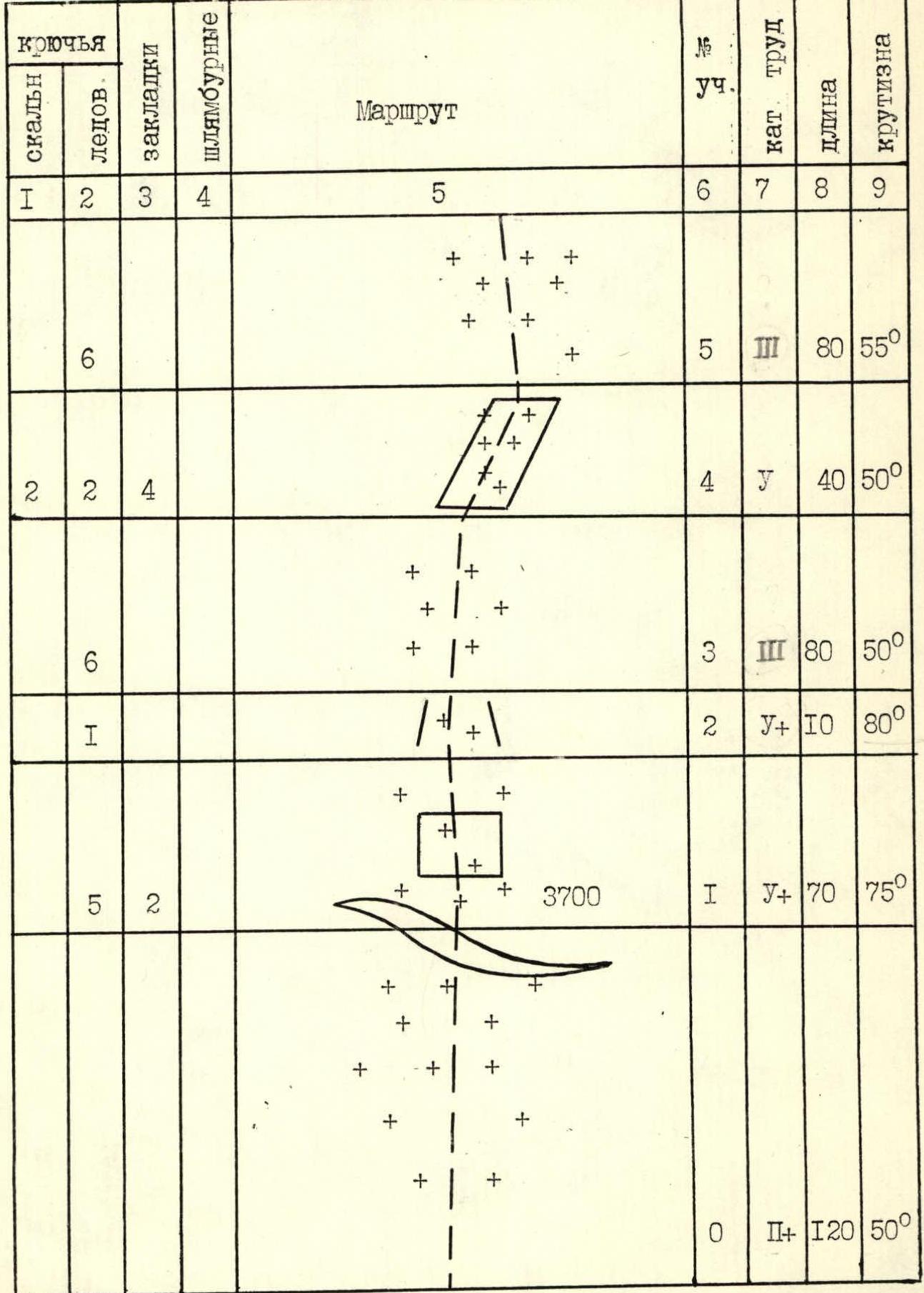
Description of the route by sections
A distinctive feature of the route is that the entire wall section of the route goes diagonally: from right to left, which presents some difficulty for the movement of the last participant in the group.
The entire route was passed with the organization of the first fixed lines and passage by the remaining participants with backpacks using jammers. The first climber worked without a backpack on a double rope.
Section R0–R1. Simultaneous movement along a steep snowy slope of increasing steepness (40–50°), leading to a bergschrund.
Section R1–R2. Steep ice slope, turning into a steep ice gully with rock outcrops in the lower part. The upper part is a rocky wall, iced and snow-covered.1. Protection is carried out: * through ice screws * through chocks
Section R2–R3. Steep ice gully. Protection through ice screws.
Section R3–R4. Alternate movement along a steep ice slope. Protection through ice screws.
Section R4–R5. A rocky ledge, iced and snow-covered, running from left to right, leading to a steep ice slope. There are very few crevices for intermediate protection. Rocks are like "rams' foreheads."
Section R5–R6. Steep ice slope, resting on the beginning of the rock wall at the top. Moving along iced rocks, it approaches the start of a steep crack. Protection through ice screws. Possibly using rock pitons.
Section R6–R7. Steep crack, iced, entering an inclined shelf. Climbing is complex. ACT is used for passage. For protection: * chocks * rock pitons
Section R7–R8. Steep inclined shelf, iced and snow-covered. Protection through chocks. At the end of the shelf — a good place to organize a bivouac (photo 1).
Section R8–R9. Plumb rock wall, consisting of numerous live blocks. Climbing is complex, extremely attentive, and careful in the direction of a large cornice. Fully passed using ACT. Rock pitons like "Korobov" and "Shveller" go well for protection. (Photo 2).
Section R9–R10. Overhang turning into a "Cornice" with a large outreach. Extremely complex climbing on ACT. For passage and protection, chocks and channel pitons are used. Under the cornice, a hanging 1st control turret. (Photo 3).
Section R10–R11. Steep rock wall with smoothed relief forms, like "rams' foreheads." There are few places for intermediate protection and ACT, and they are very unreliable. Cracks are filled with ice and covered with snow on top. Climbing is extremely complex. Rock pitons and chocks were used. For safety, 2 bolt pitons were driven. (Photo 4).
Section R11–R12. Plumb crack, filled with ice and snow. Passed on ACT. For passage and intermediate protection, pitons and chocks are used. (Photo 4).
Section R12–R13. Steep shelf, iced. Leads to a rock wall, at the base of which a bolt piton is driven for protection. Protection through ice screws.
Section R13–R14. Movement is constantly from right to left upwards. There is a constant alternation of plumb walls with protruding "live" slabs and "cornices" with internal corners. Climbing is extremely complex on ACT. In two places, bolt pitons are driven for protection. For passage, both nuts and pitons are used. (Photos 5, 6).
Section R14–R15. Steep, partly overhanging wall with cracks mainly suitable for pitons. In the middle part, the 2nd control turret on two bolt pitons. Climbing on ACT is very complex, constantly being thrown out of the overhanging corner. (Photos 6, 7).
Section R15–R16. Steep wall like "rams' foreheads," iced and snow-covered. Almost no cracks for protection. The section was passed using "sky-hooks" for ACT.
Section R16–R17. Steep internal corner. The right wall of the corner is overhanging, so it pushes out of the corner. Passed on ACT. Climbing is complex. For passage and protection: * friends * large-sized chocks
Section R17–R18. Plumb wall in the upper part with a small chimney. Passed on ACT. For passage and protection: * pitons * chocks
Section R18–R19. System of steep ice couloirs and gullies. In the middle part — a rocky wall, iced. Protection through ice screws. "Ice fifis" are used for passage.
Section R19–R20. Steep ridge, cat. 2B. Partly snow-covered and iced. Protection through ledges. Movement is alternate and simultaneous. Descent from the summit along the ridge and further along the Lowe ice couloir — cat. 5A.
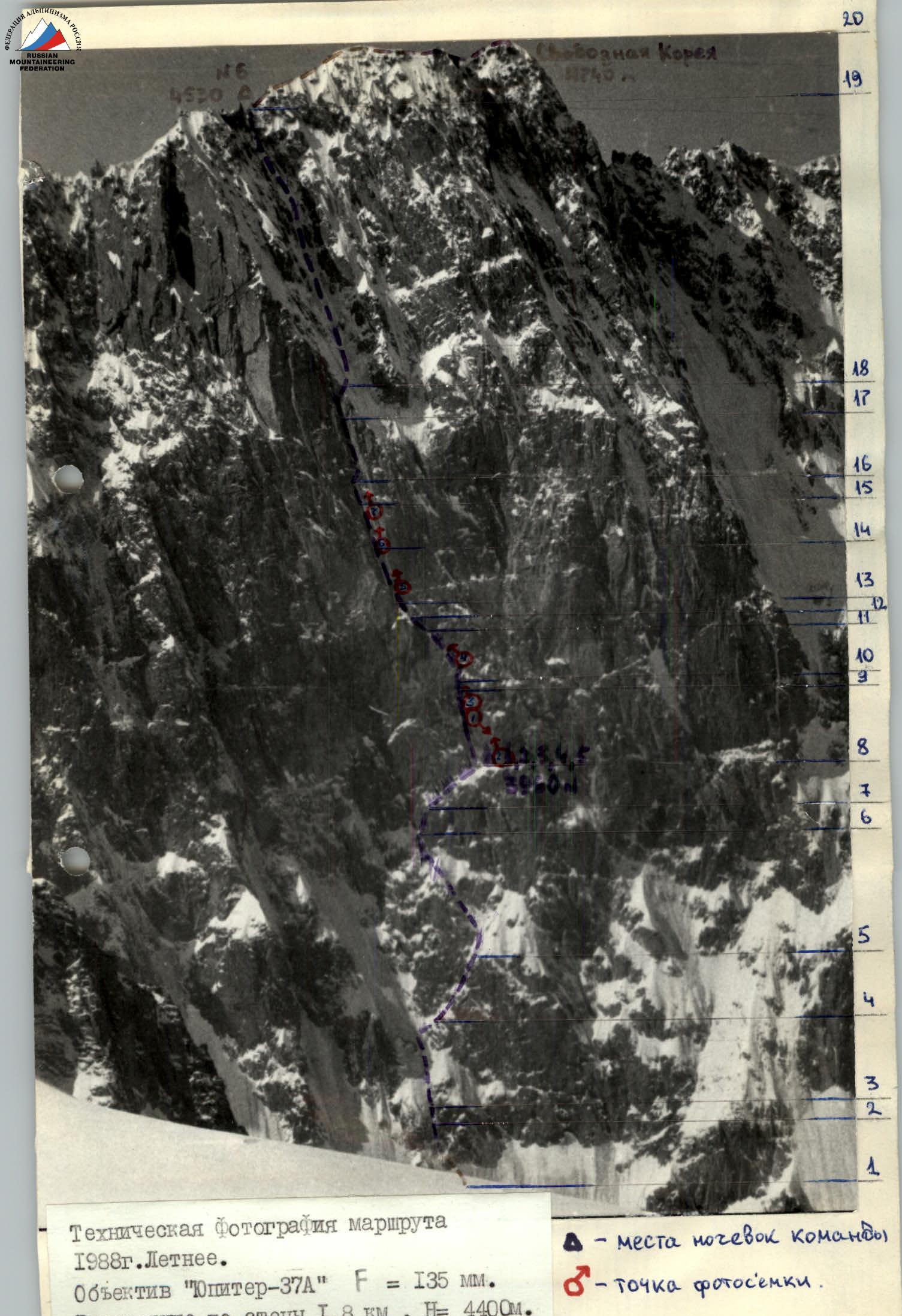
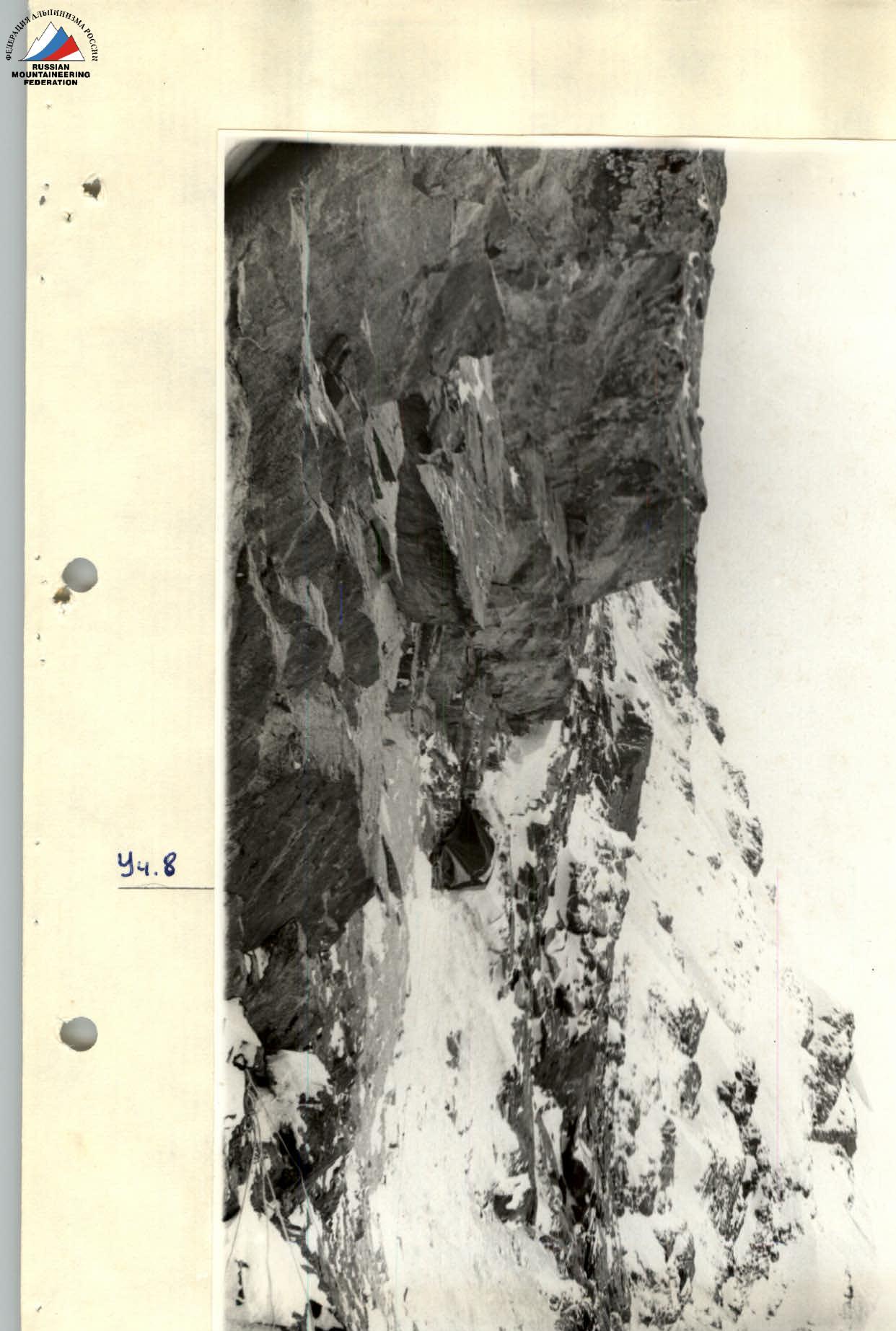
Photo 1. Assault camp of the team. Section R7–R8.
| Rock pitons | Bolt pitons | Nuts | Friends | Ice screws | Section № | Cat. difficulty ACT | Cat. difficulty of section | Length, m | Steepness, ° |
|---|---|---|---|---|---|---|---|---|---|
| R25 | III | 240 | 40 | ||||||
| R24 | V+ | 200 | 60 | ||||||
| 2 | R23 | V+ | 10 | 90 | |||||
| 4 | 1 | R22 | V+ | 20 | 90 | ||||
| 2 | 1 | 8 | R21 | VI | 4 | 10 | 90 | ||
| 3 | 2 | 6 | R20 | VI | 2 | 20 | 80 | ||
| 3 | R19 | VI | 4 | 0.5 | 95 | ||||
| 4 | 1 | R18 | V | 30 | 80 | ||||
| 5 | 15 | R17 | VI | 4Е | 25 | 85 | |||
| 7 | 5 | R16 | VI | 4 | 2.5 | 90 | |||
| 651 | 3 | R15 | VI | 4Е | 1.5 | 180 | |||
| 4 | 341 | R14 | V | 3Е | 20 | 60 | |||
| 4 | 5 | R13 | V | 3 | 20 | 60 | |||
| 3 | 8 | R12 | VI | 4 | 30 | 75 | |||
| 1 | 5 | R11 | VI | 4Е | 15 | 70 | |||
| 3 | 4 | R10 | VI | 4 | 2 | 180 | |||
| 6 | 14 | R9 | VI | 4 | 15 | 85 | |||
| 6 | 5 | R8 | VI | 3 | 30 | 80 | |||
| 1 | R7 | V | 1Е | 40 | 60 | ||||
| 2 | 8 | 1 | R6 | V+ | 40 | 80 | |||
| 4 | R5 | V+ | 40 | 60 | |||||
| 2 | 8 | R4 | IV+ | 80 | 50 | ||||
| 3 | 2 | R3 | V | 40 | 70 | ||||
| 2 | 4 | R2 | IV | 20 | 45 | ||||
| 5 | R1 | IV+ | 40 | 45 | |||||
| 2 | 2 | 8 | R0 | V- | 80 | 60 |

Comments
Sign in to leave a comment