
Ascent Log
-
Ascent class: technical
-
Ascent area: Tian Shan, Kyrgyz Ala-Too
-
Ascent route: Svobodnaya Koreya peak, 4740 meters, via the Central North Face route by V. Bezzubkin
-
Difficulty category: sixth
-
Route characteristics: height difference 1100 meters, sections of 5th-6th difficulty category, 1150 meters, average steepness 70°
-
Pitons used:
- for belaying:
- ice screws: 51
- rock pitons: 76
- chocks: 49
- bolt pitons (used old ones): 14
- for creating artificial holds:
- ice screws: 1
- rock pitons: 16
- chocks: 1
- bolt pitons: 1
- for belaying:
-
Total climbing time: 18 hours
-
Number of bivouacs and their characteristics: one sitting bivouac
-
Group composition:
- leader — Alexander Bogachev — Candidate Master of Sports of the USSR
- participants:
- Yuri Sapozhnikov — Master of Sports of the USSR
- Valery Balezin — Master of Sports of the USSR
- Vladimir Egunov — Candidate Master of Sports of the USSR
- team coach — Yuri Sapozhnikov — Master of Sports of the USSR
-
Departure date 23 July 1981 — return date 24 July 1981
North Face of Svobodnaya Koreya Peak
V. Bezzubkin's Route through the Center of the North Face
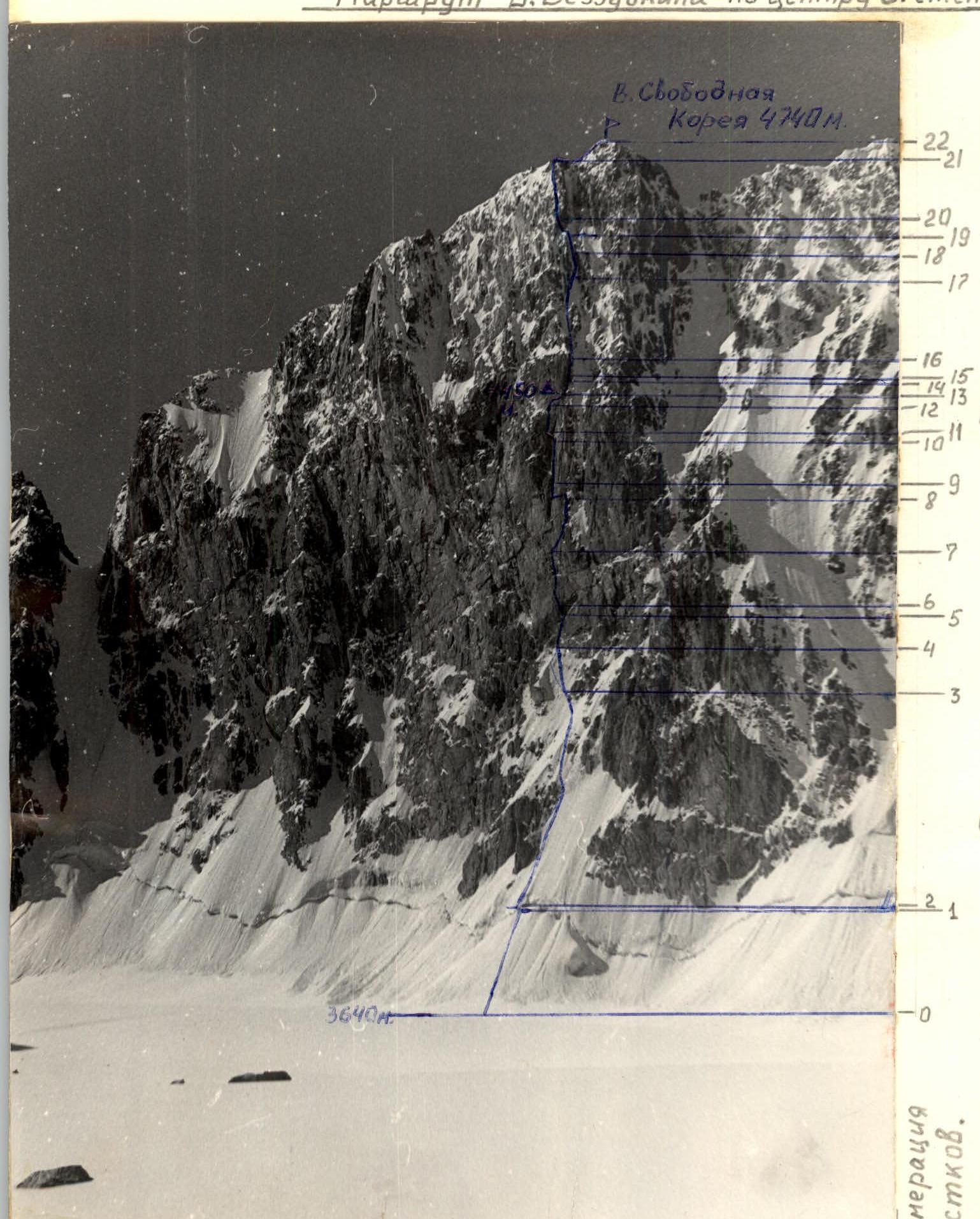 TABLE OF MAIN CHARACTERISTICS OF THE ASCENT ROUTE.

Brief Explanations to the Table.
R0–R1: Steep snow slope. Weak, loose snow above knee-deep.
R1–R2: Bergschrund, ice edge is loose, icicles. The first person uses a bent ice axe and an ice hammer to cross.
R2–R3: Ice slope, ice is clear, hard, slope is rockfall-prone.
R3–R4: Steep ice under rocks.
R4–R5: Steep, heavily broken wall. Rockfall hazard, organization of belays is severely hampered by the broken nature of the rocks.
R5–R6: Cornice, traversed on the left part with a move to the right and then left.
R6–R7: Heavily smoothed wet rocks, "shower" from upper cornices.
R7–R8: Monolithic wall with few cracks but good microrelief. Many bolt pitons.
R8–R9: Traverse left along small rock shelves, exit to a wide internal corner.
R9–R10: Movement up the corner under the cornice. All rocks are ice-covered, water flows from the cornice in the upper part of the corner. Rocks are broken. Weather deteriorated — rain and wet snow.
R10–R11: Exit from under the cornice through its left part, from right to left.
R11–R12: Steep monolithic wall with large cracks, bolt pitons encountered. Movement upwards to a large monolithic slab. Very slippery, all rocks are covered in snow "porridge," knots do not hold on the ropes.
R12–R13: Traverse steeply to the right onto a ridge, climbing is very difficult.
R13–R14: At the beginning of the section on the ridge — a flat horizontal ledge under the protection of a wall. Dropping two huge rocks from it, we create a platform where all four of us can gather. We hang the tent on its edge, thread a rope through it for belaying. Meanwhile, the section upwards and to the right from the tent is processed — a heavily snowed, icy wall on the right side of the ridge. Frequent use of artificial holds. The wall leads to an overhang.
We finish processing, barely make it into the tent, there's barely enough room to sit. Time — 17:00.
It snows until late at night, it gets noticeably colder. We depart at 10:00 in the morning. All rocks are covered in a crust of ice and snow. The rope hung yesterday and the slings are almost inflexible. We pass the rope belay, approach the next section.
R14–R15: Overhanging wall with a cornice. Movement and belaying are severely hampered by snow cover and the broken nature of the rocks.
R15–R16: Steep wall of the right ridge. Movement upwards and to the right, towards the wall. Exit into an ice gully.
R16–R17: Movement in crampons along rocks, bypassing the first bastion and then the second bastion. Steep ice, местами тонкий слой натечного льда на скалах. Rocks of the second bastion provide protection from potential rockfall.
R17–R18: Narrow ice gully, thin layer of hard ice on rock. Belaying is only possible on rocks. About 15–20 meters of "throat" — objectively rockfall-prone. Careful belaying and quick passage through the hazardous section are necessary.
R18–R19: Left and upwards under the protection of the third bastion. Higher up, the ice chimney becomes vertical and is further blocked by a cornice of the icefall. We move left onto a counterfort.
R19–R20: Exit onto the third bastion "head-on" via an internal corner ending in a short chimney with an ice tongue. All rocks are in ice, loose fresh snow. Continue movement in crampons.
R20–R21: Movement along the left part of the third bastion on a steep ice-rock wall. Exit onto the eastern ridge of Svobodnaya Koreya.
R21–R22: Movement along a simple snow-covered ridge. Cornices to the north.
Ascent to the summit of Svobodnaya Koreya.

Comments
Sign in to leave a comment