
Passport
- Climbing category — winter
- Region — Tian-Shan, Kyrgyzsky Ridge, Ala-Archa gorge
- Peak Korona (5th), 4860 m, via the center of the southern side
- Category — 6A
- Height difference: 400 m Length: 1010 m Length of sections with 5–6 difficulty category: 480 m Average steepness: 59°
- Pitons driven: rock pitons 51/17, chocks 100/13, ice screws 8
- Climbing hours: 40, days 4
- Overnight stops: 1st and 2nd in a hut, on Koronsky glacier, 3rd on a rock ledge
- Leader: Sergeev Viktor Platonovich — Master of Sports Participants: Vinnikov Evgeny Anatolyevich — 1st sports category, Tumulis Vladimir Vitalius — Master of Sports, Plotnikov Valery Grigoryevich — Master of Sports, Rusakov Yuri — 1st sports category, Kirikov Alexander — 1st sports category
- Coaches: Sadykov Vladislav Zakiyevich — 1st category coach
- Departure to the route: February 11, 1999 Summit: February 14, 1999 Return: February 14, 1999
- Organization: Rubtsovsk Sports Committee
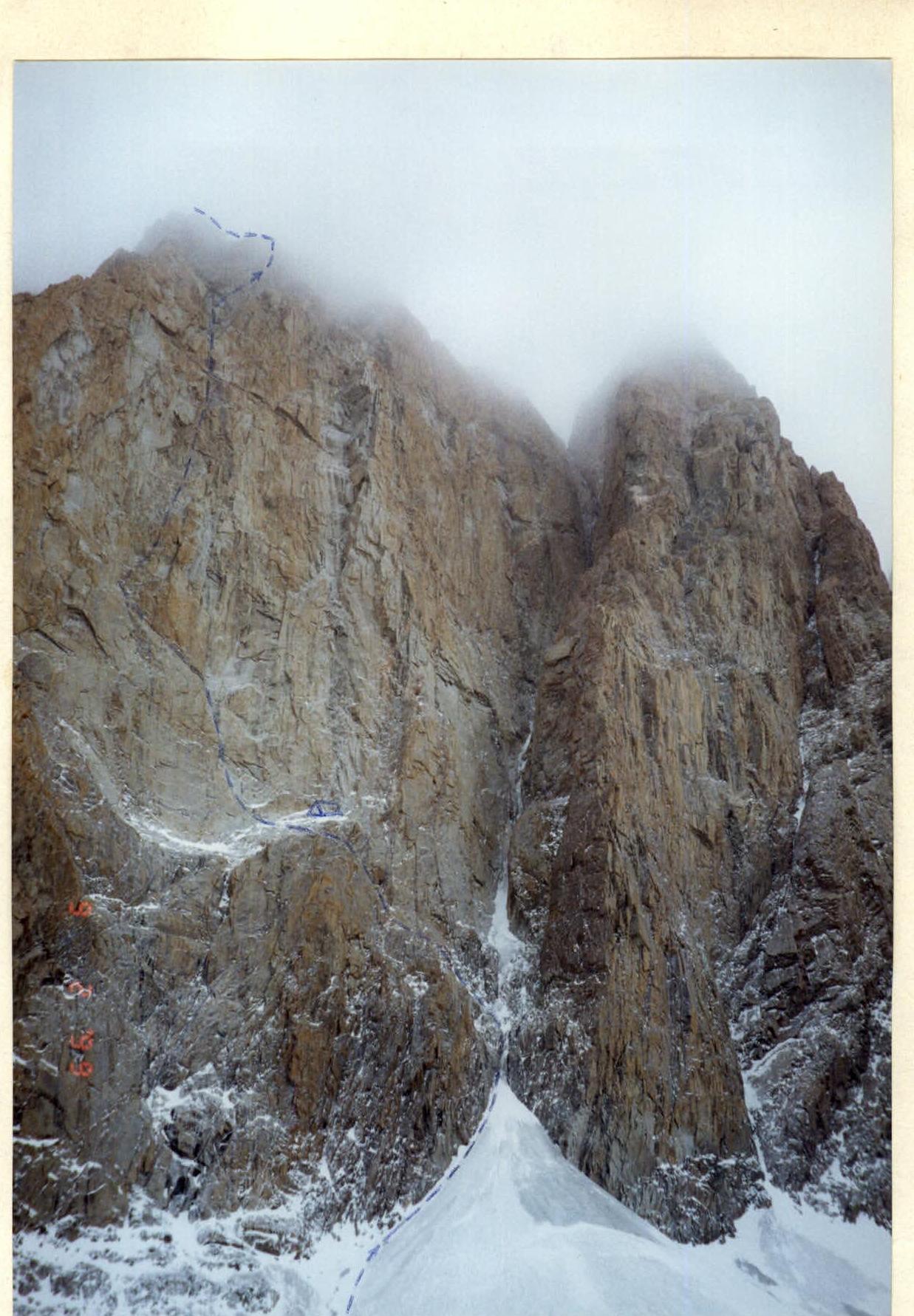
Photo 1. General photo of the summit.
Team's route.
Overnight stop.
Taken with "Amena 8N" camera, Lomo T-43 lens. 4/40.
NI shooting mode.
DRAWN ROUTE PROFILE M 1:5000
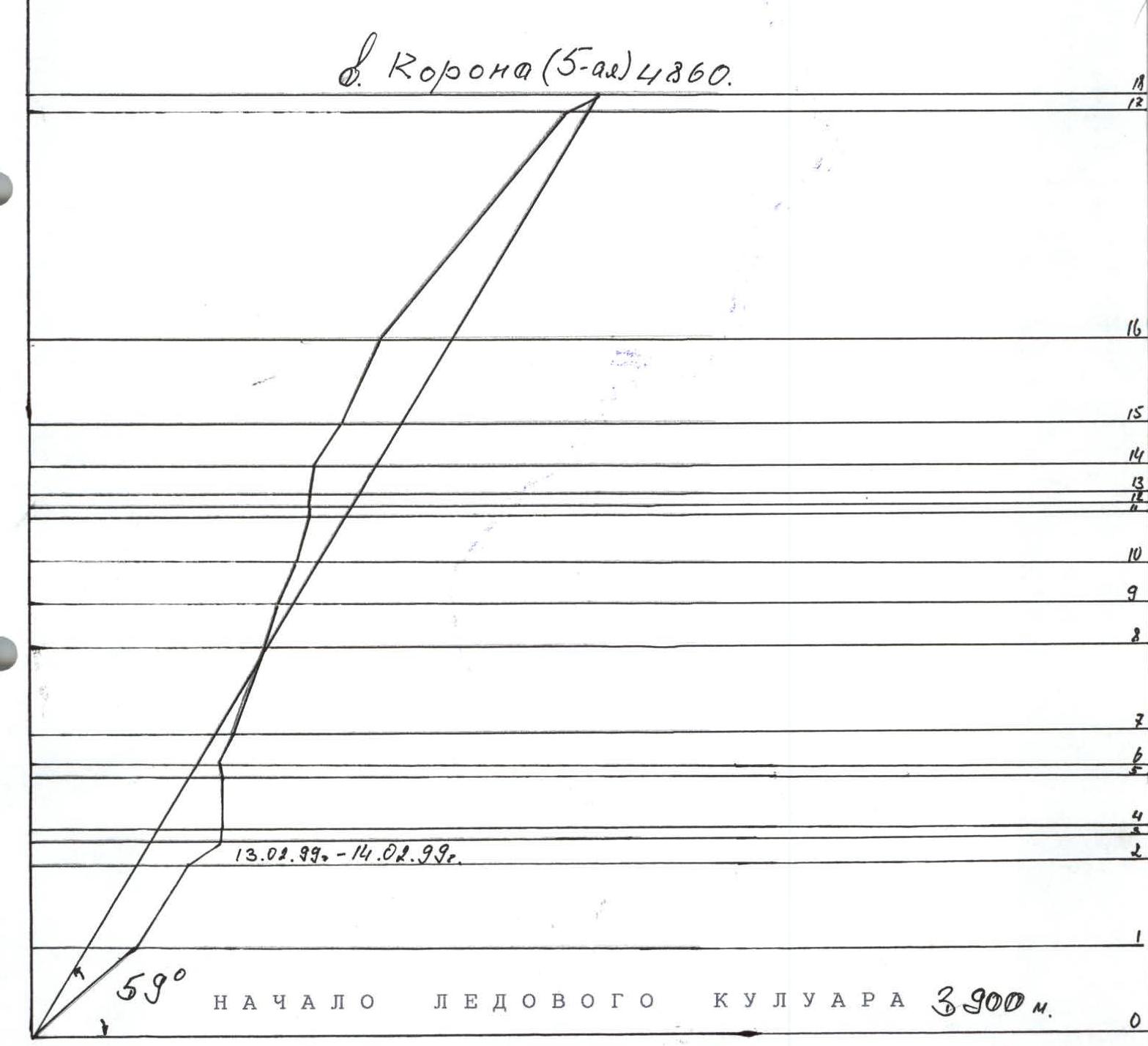
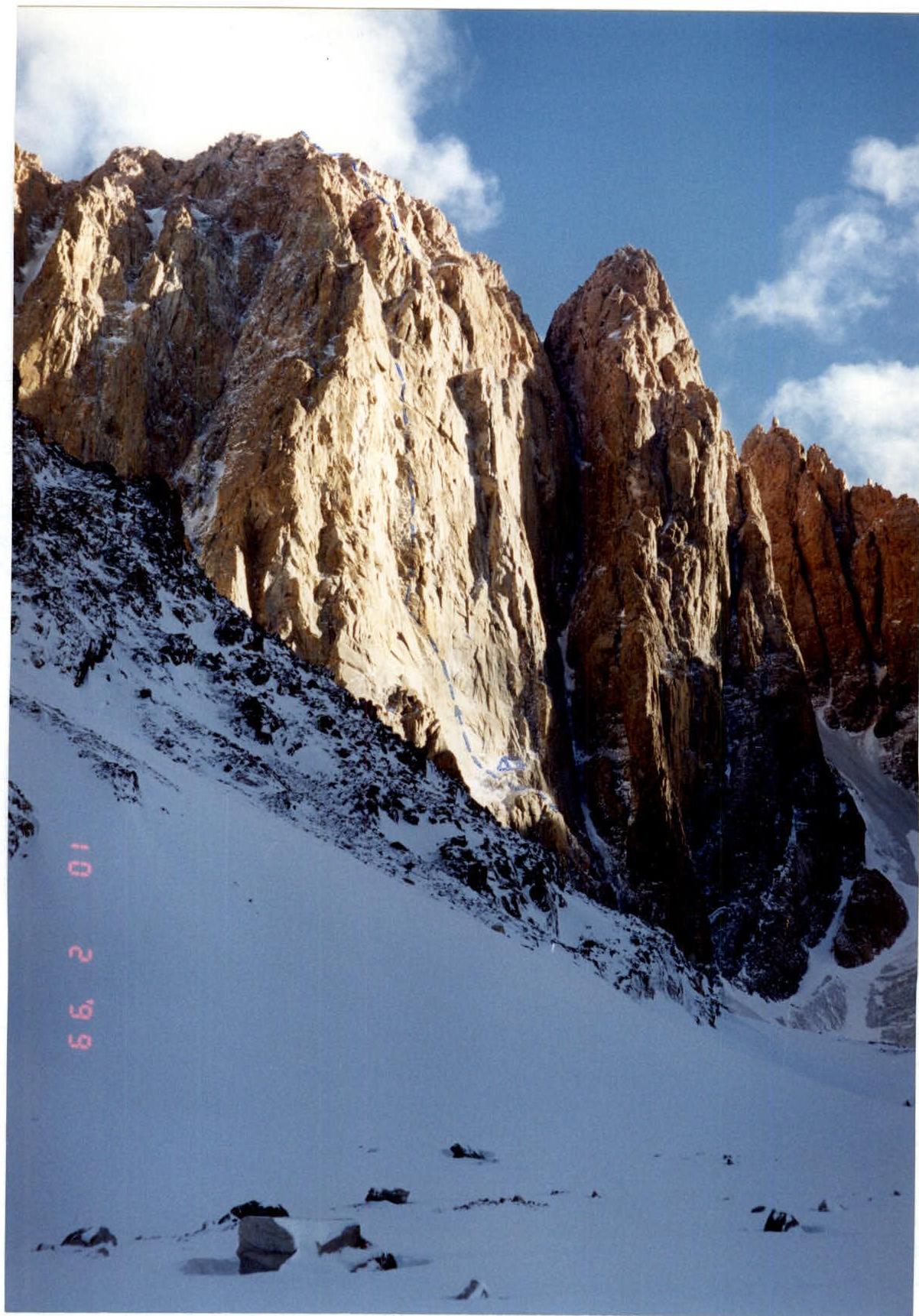
Tactical Actions of the Team
The ascent to Korona (5th) peak was carried out by the team within the framework of the tactical plan, taking into account bad weather. 40 hours were spent on the route, of which 19 hours were in bad weather (strong wind, snow, icy and snowy rocks, poor visibility).
The organization of rope team movement and their interaction was in accordance with the tactical plan.
On the first day, the team of V. Plotnikov — V. Sergeev worked. On the second day — the team of V. Tumulis — A. Kirikov. On the third day, the team of V. Plotnikov — Yu. Rusakov worked first. On the fourth day, the team of E. Vinnikov — V. Sergeev worked first.
For belaying the first, they used a UIAA rope and "8" descenders. All participants moved along the fixed ropes with belay.
The most difficult sections to pass were the first two ropes after the large ledge and the last leading rope from the wall to the rocky cirque.
Difficult sections: complex rock faces, overhangs and internal corners, very difficult climbing, use of artificial climbing aids.
Bad weather complicated the passage through steep rocks.
Radio communication session — according to the route sheet.
There were no falls or injuries among the team.
Table of Food and Fuel
- Rusks — 3.5 kg
- Cereals, vermicelli, noodles — 3.5 kg
- Lard, sausage — 4.5 kg
- Cheese — 3 kg
- Sugar, candies, honey — 3.5 kg
- Nuts, prunes, raisins — 1.5 kg
- Tea, coffee, drinks — 1.2 kg
- Canned fish — 2.5 kg
Total weight of products in packaging — 22 kg, gasoline — 4 l
TOTAL: 25.5 kg
ROUTE SCHEME WITH SYMBOLS 1:2000
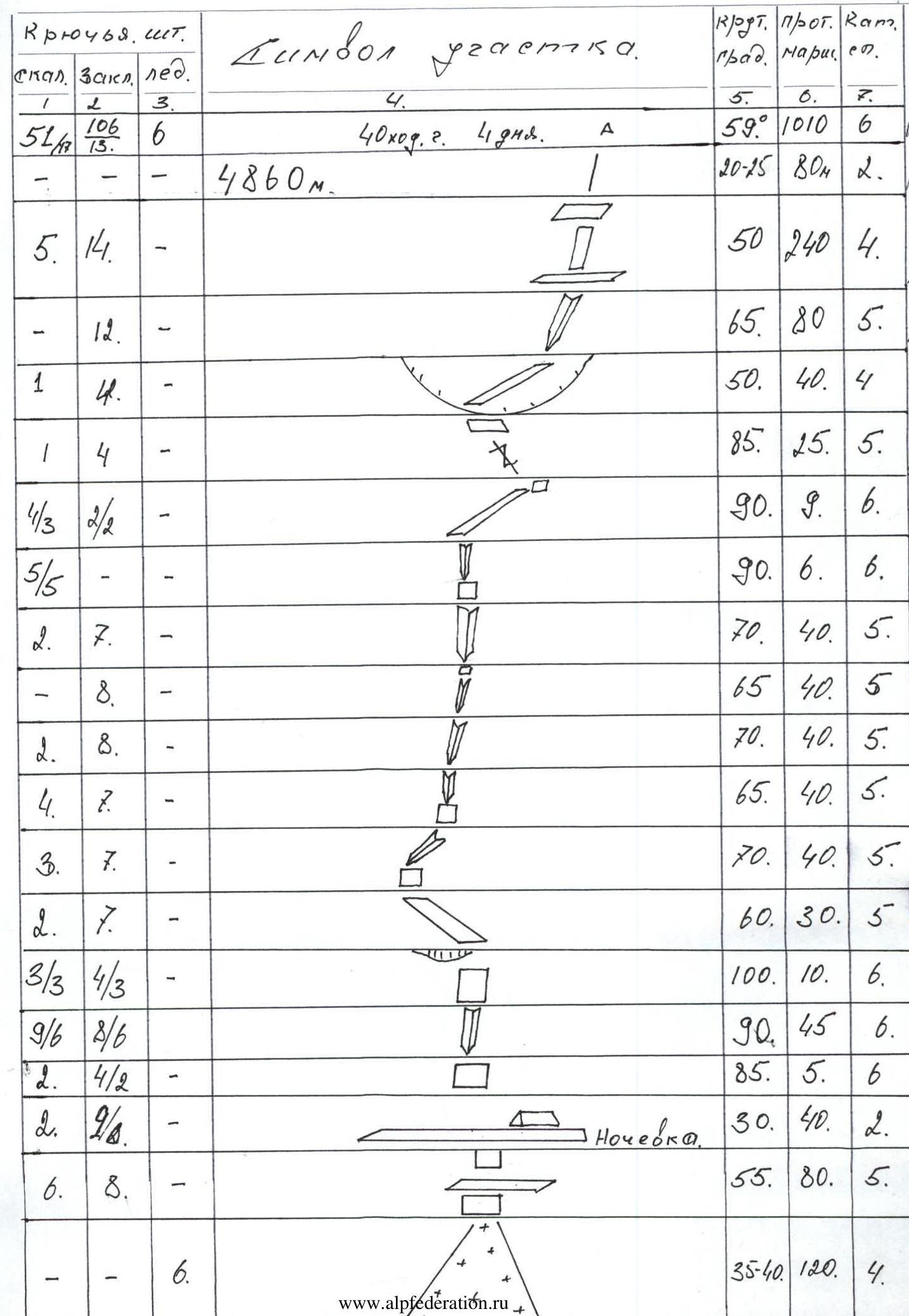
Description of the Route by Sections
Sect. 0–3. Beginning of the route — ice couloir. Then a series of rock faces and internal corners. Rocks are crumbling, snowy, ice-covered. Pitons used for belay. Fixed ropes organized. Exit to a ledge. Convenient spot for overnight stop.
Sect. 3–5. Initially, a very steep rock face and an ice-filled internal corner. Pitons used for belay. Use of artificial climbing aids. Climbing is very difficult. Organization of fixed ropes.
Sect. 5–7. Beginning is very complex. Inclined internal corner, rock face, overhang. Exit to an inclined ledge using artificial climbing aids. Pitons used for belay. Organization of fixed ropes.
Sect. 7–12. This section features a series of complex rock faces, internal corners, which are overcome with thorough belaying, free climbing. Organization of fixed ropes.
Sect. 12–15. This is the most difficult section (key to the route). Here, the choice of cracks is limited and holds are very small. A significant part of this section is climbed using artificial climbing aids.
Organization of fixed ropes. Exit to a rocky cirque, to the beginning of the waterfall. End of the wall part of the route.
Sect. 15–18. Extended section, alternating between simple and complex internal corners. In bad weather, climbing becomes more complicated. There are places for belaying through rock outcrops and bends. Organization of fixed ropes. Exit to the summit ridge.
Sect. 18–19. Uncomplicated rocky ridge. Work by autonomous teams. Exit to the summit.

Comments
Sign in to leave a comment