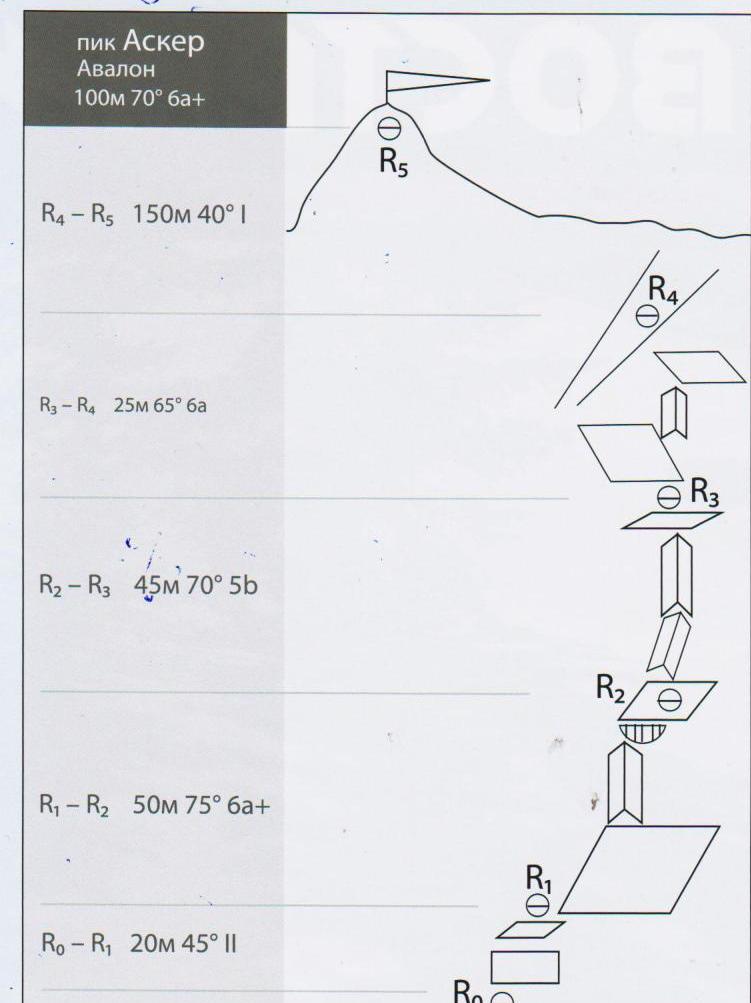
Peak Asker, "Avalon" (100 m, 70′, 6a+), K. Belotserkovsky, 2010
R0–R1. Twenty meters up easy rocks to a large rock spall. Station on a juniper bush.
R1–R2. Up and right to a large slab with two parallel cracks. Climb the first one. The crack gets narrower in the upper part, but the slope is gentle, so in dry weather it won't be a problem. Then, using the internal dihedral and belaying on its left wall, get over a small ledge (the crux of the route). Station on three pitons, two of which are half-driven, three meters higher.
R2–R4. Up and right along the edge. The first two protection points are juniper bushes. Then up along the edge to a ledge. A logical option was to go slightly left to a ledge that leads to the top a bit lower. R3–R4. From the ledge, left and up to a slab. Along it, near a vertical wall, climb up to an internal dihedral with a good crack for pitons and climb it (fr 6a) for several meters up to an inclined ledge. From it, left and up, exit to the top. Station on a protrusion. R4–R5. Across talus, then up easy rocks to the summit. Descent via route 16 to Chertovo gorge.
The best time to visit the area is from August to October.
In June-July, rain traditionally starts in the second half of the day and continues until evening.
The second half of October and November is off-season; the weather is relatively stable, but it's already quite cold.
The coldest period begins in early January.
In spring, activity in the area depends on the avalanche danger of the slopes.