Ascent Passport
-
Region — Western Sayan, Ergaki Ridge.
-
Peak — Zуб Дракона (Dragon's Tooth) via the center of the southwest wall of the Western Tower.
-
Assumed — 6A category of difficulty. First ascent.
-
Route type — rock climbing.
-
Route characteristics:
- elevation gain — 480 m;
- route length — 560 m;
- section lengths:
- 6B category of difficulty — 200 m;
- 5B category of difficulty — 200 m;
- average steepness — 75°.
-
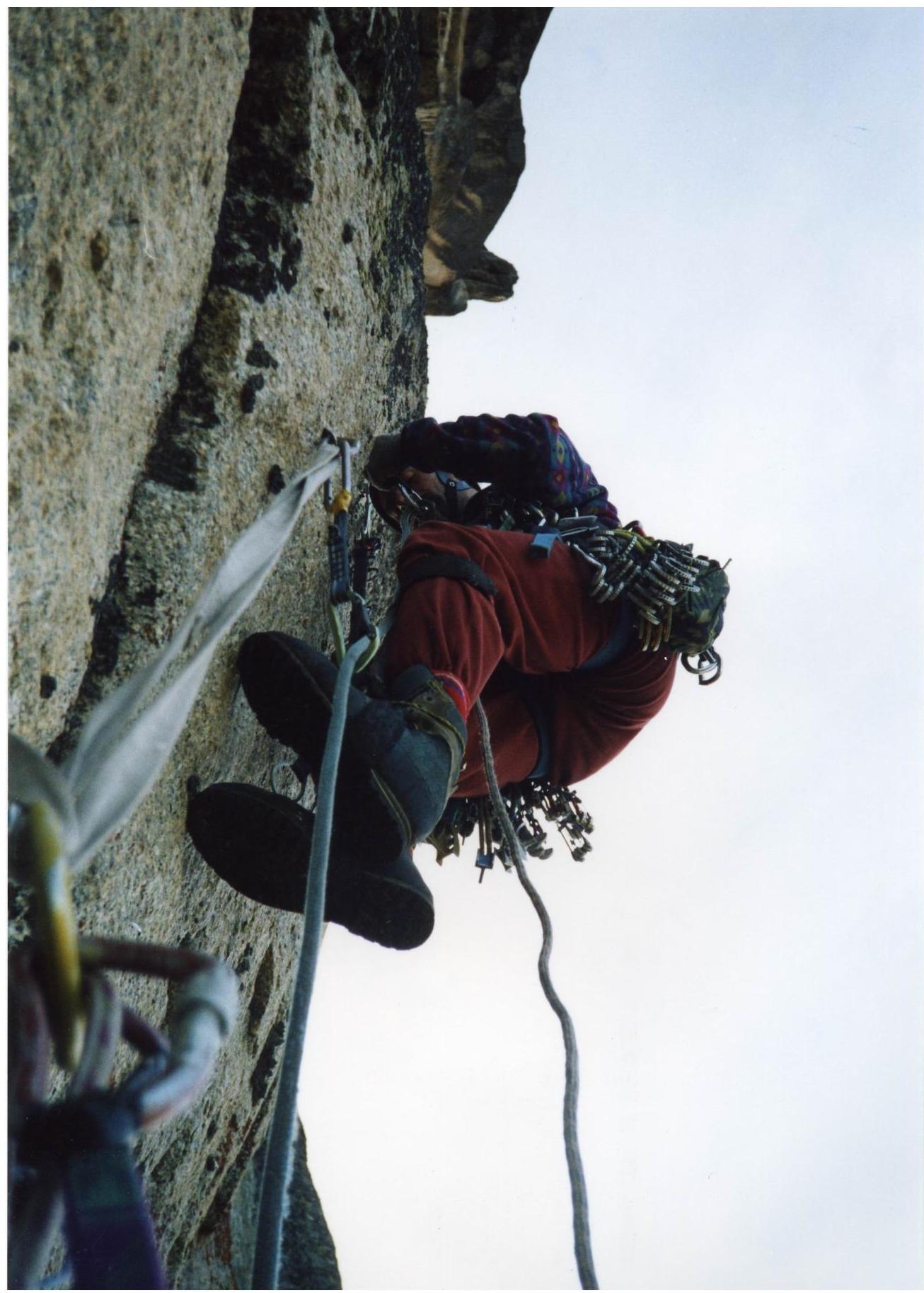
Equipment left on the route: 8 pitons, including 5 bolt pitons, and 3 chocks. Pitons used on the route: 5 stationary bolt pitons (3 used as artificial support points), 22 removable bolt pitons (all used as artificial support points). Total artificial support points used — 156, including 32 skyhooks and Fifi hooks.
-
Total climbing hours — 48 hours, days — 3, including processing sections of the route.
-
Team leader: Yuriy Borisovich Ran'ko, CMS.
Team members:
- Vladimir Aleksandrovich Aleksandrov, MS;
- Andrey Evgen'evich Zakrepa, MS;
- Yuriy Vladimirovich Stepanov, MS.
-
Team coaches:
- Valeriy Viktorovich Balezin, CMSM;
- Nikolay Nikolaevich Zakharov, CMSM, 3TR.
-
Departure dates:
- onto the route — June 6, 2001, at 17:00;
- to the summit — June 9, 2001, at 14:00;
- return — June 9, 2001, at 16:00.
-
Organization: Krasnoyarsk Krai Sport Committee.
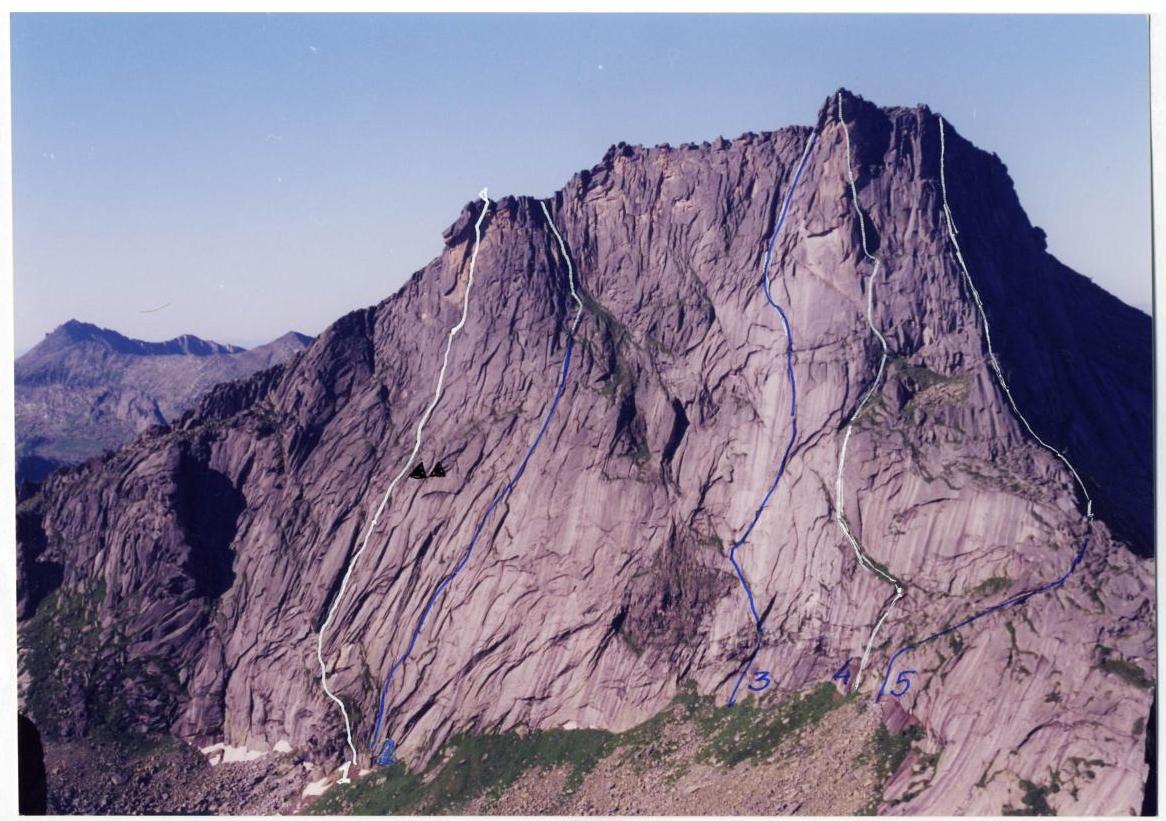
General photo of Zуб Дракона (Dragon's Tooth) peak, 2170 m.
1 — route taken by the team via the center of the SW wall, 3B (Pushkarev); 2 — via the S wall, 5B (Pushkarev); 3 — via the SW wall of the main tower, 6A (Karyukin); 4 — via the center of the S wall of the main tower, 6A (Balezin); 5 — via the canted S wall, 5A.
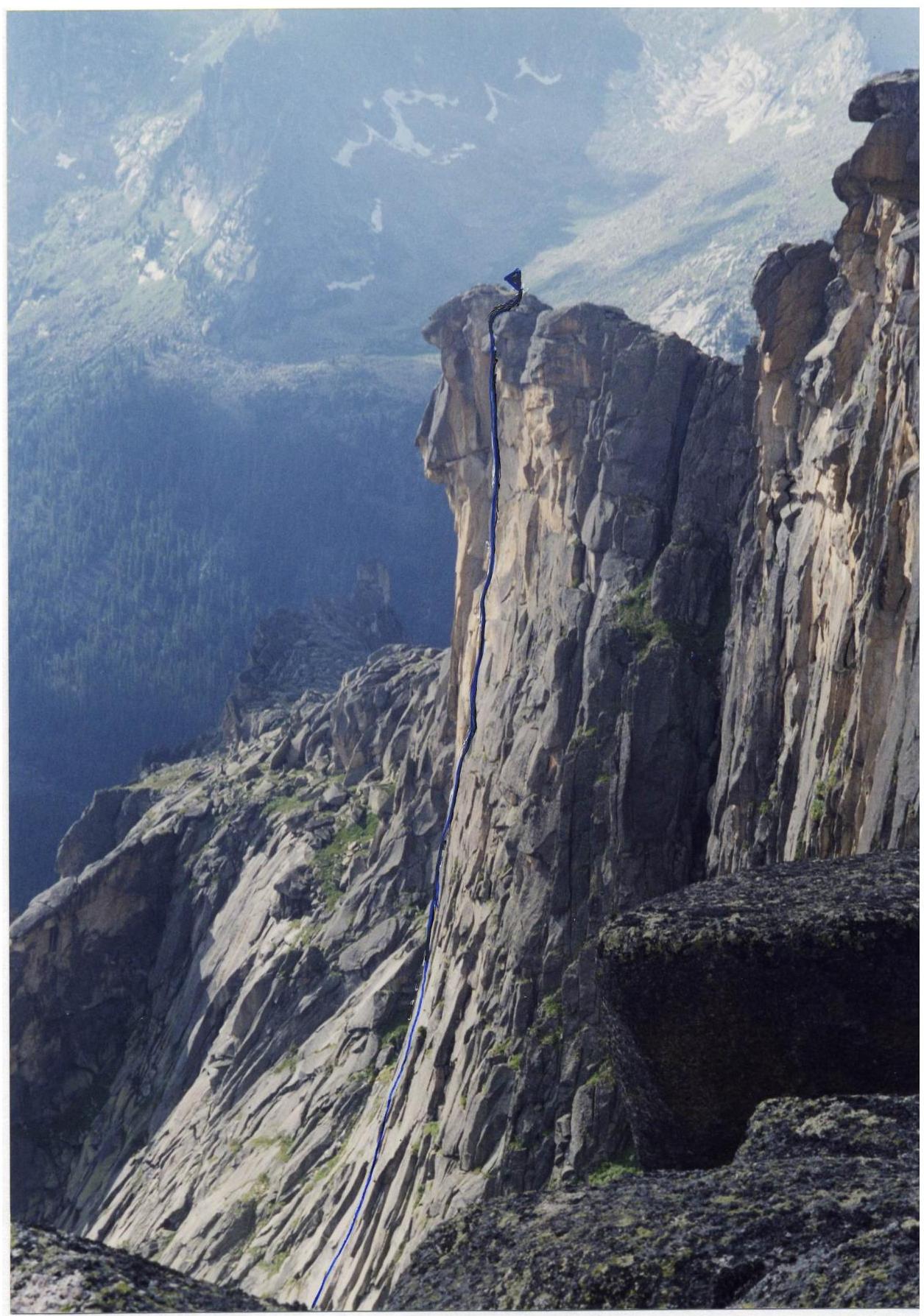
Route profile on the right.
| 15 | |||||||||||||||||||||||||||
|---|---|---|---|---|---|---|---|---|---|---|---|---|---|---|---|---|---|---|---|---|---|---|---|---|---|---|---|
| 14 | |||||||||||||||||||||||||||
| ... (table continues as in the original text) |
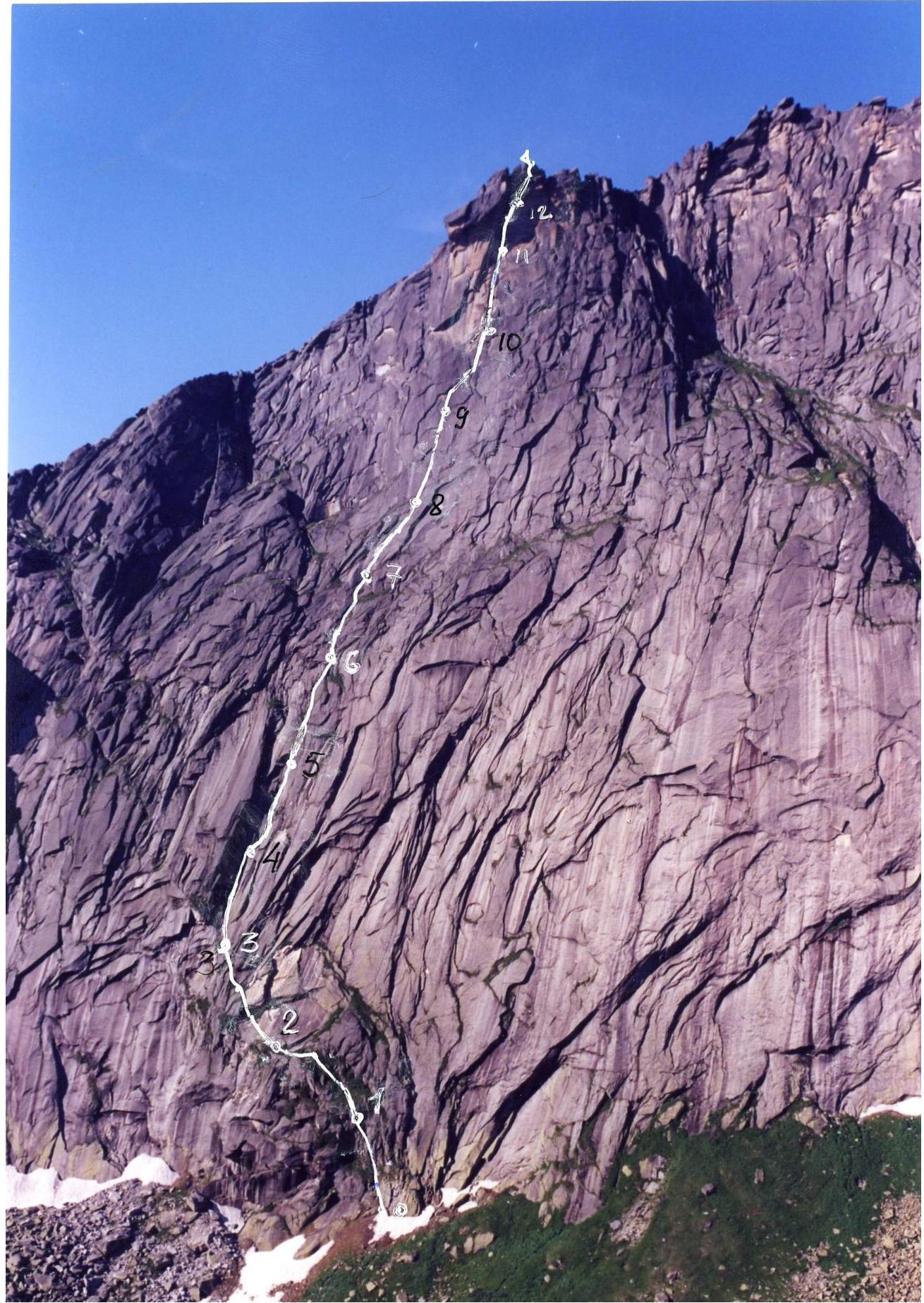
Section-by-Section Description.
Section 0 — 1 — 2. Inclined wet slabs, lots of grass.
Section R2–R3. Internal corner, lots of grass. Climbing with Fifi hooks.
Section R3–R4. Inclined slabs, internal corner. Bypassing the cornice on the left using artificial support points.
Section R4–R5. Wet internal corner, lots of grass. Climbing with the use of Fifi hooks.
Section R5–R6. Steep slabs, then an internal corner. Climbing partially on artificial support points. Reaching a ledge, control point, overnight stay.
Section R6–R7. Internal corner, then right along a crack on a slab, artificial support points.
Section 7–8. Internal corner, cracks filled with earth, many unreliable protection points. Then a cornice bypassed on the left, followed by a vertical crack. Almost all climbing on artificial support points.
Section 8–9. Traverse left along a slightly overhanging wall, then up an internal corner, rocks covered with a fragile crust. Many unreliable protection points. Bolt pitons were used for reliable protection. Almost all on artificial support points.
Section 9–10. Internal corner with two cornices, rock covered with a fragile crust. Artificial support points.
Section R10–R11. Vertical wall, blunt, often interrupted cracks. Protection points unreliable. Removable bolt pitons and skyhooks were used for passage. Belay point — hanging on a loop.
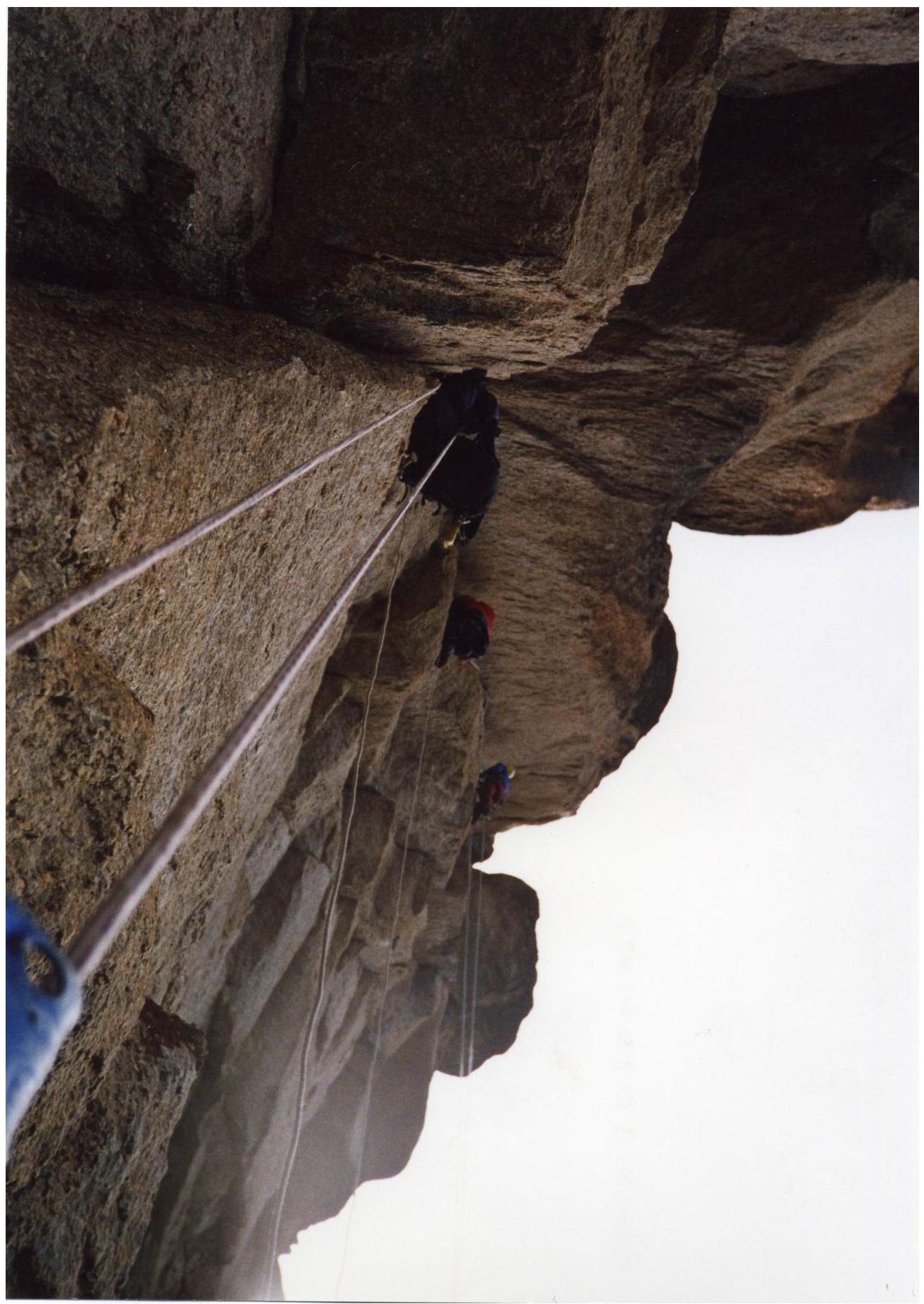
Section R11–R12. Diagonal ascent up and to the right under a large overhanging fragment, artificial support points on removable bolts. The crack under the fragment is blind, sometimes allowing placement of not very reliable chocks. Passage entirely on artificial support points.
Section R12–R13. Cornice bypassed on the left via a crack, with a bolt at the exit. Then via "ram's foreheads" — exit to the summit of the Western Tower.
Water is absent on the route.