
Ascent Record
- Climbing area — Western Sayan, Ergaki ridge.
- Peak — Zub Drakona, 2170 m. Direttissima of the main tower, South wall.
- Claimed 6A category of difficulty, 1st ascent.
- Climbing class — rock.
- Height difference — 520 m.
Total length 615 m. Length of sections with 6th category of difficulty 415 m, 5th category of difficulty 180 m.
Average steepness of the route 80°. Main part 93°.
- Total of 13 pitons left on the route, including 13 Petzl bolts. Pitons used on the route: 13/9 fixed bolts, 220/180 chocks, 43/43 removable bolts, 44/44 skyhooks, 45/37 rock pitons.
Total of 313 artificial support points used.
- Team's climbing hours: 52 hours, 4 days.
- Leader: Fyodorov Sergey Rostislavovich, Master of Sports.
Team members: Kokhanov Valery Petrovich, International Master of Sports; Cherezov Sergey Vladimirovich, Master of Sports; Starov Vladimir Arnoldovich, Master of Sports.
- Coach: Zakharov N. N., International Master of Sports.
Balezin V. V., International Master of Sports; Kolesov A. P., Master of Sports.
- Route entry: July 5, 2001, 18:00.
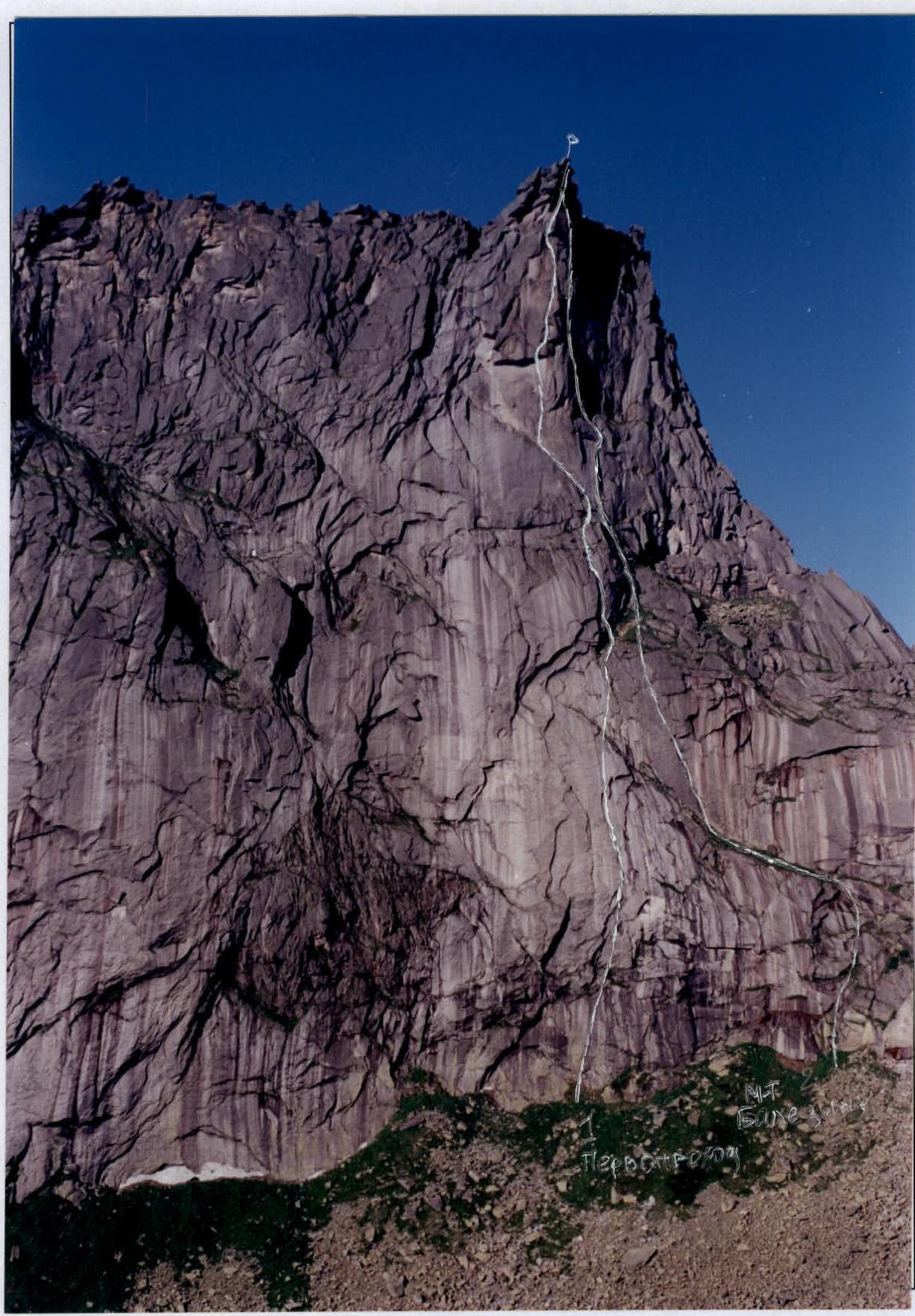
General view of the Zub Drakona peak 2170 m.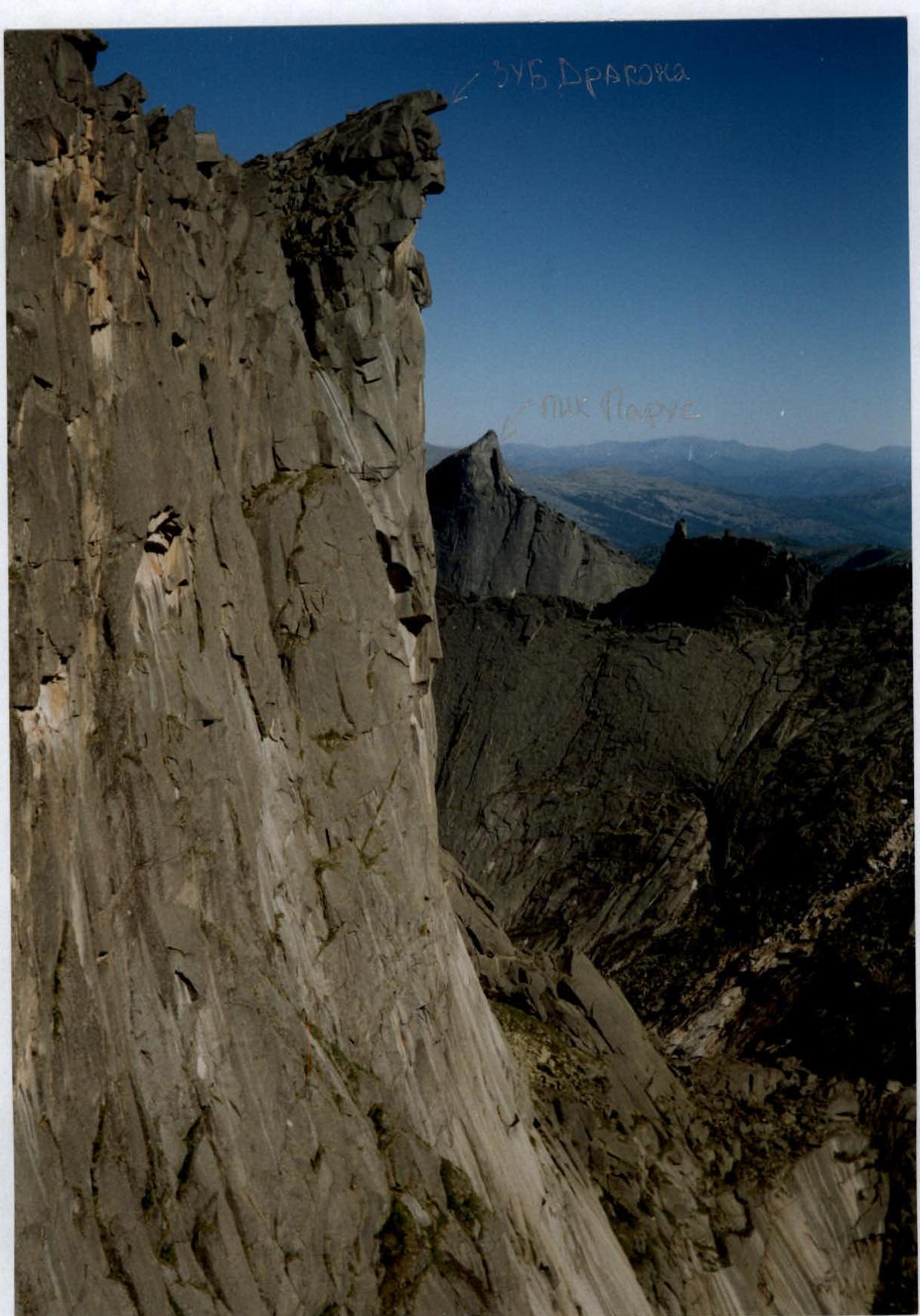
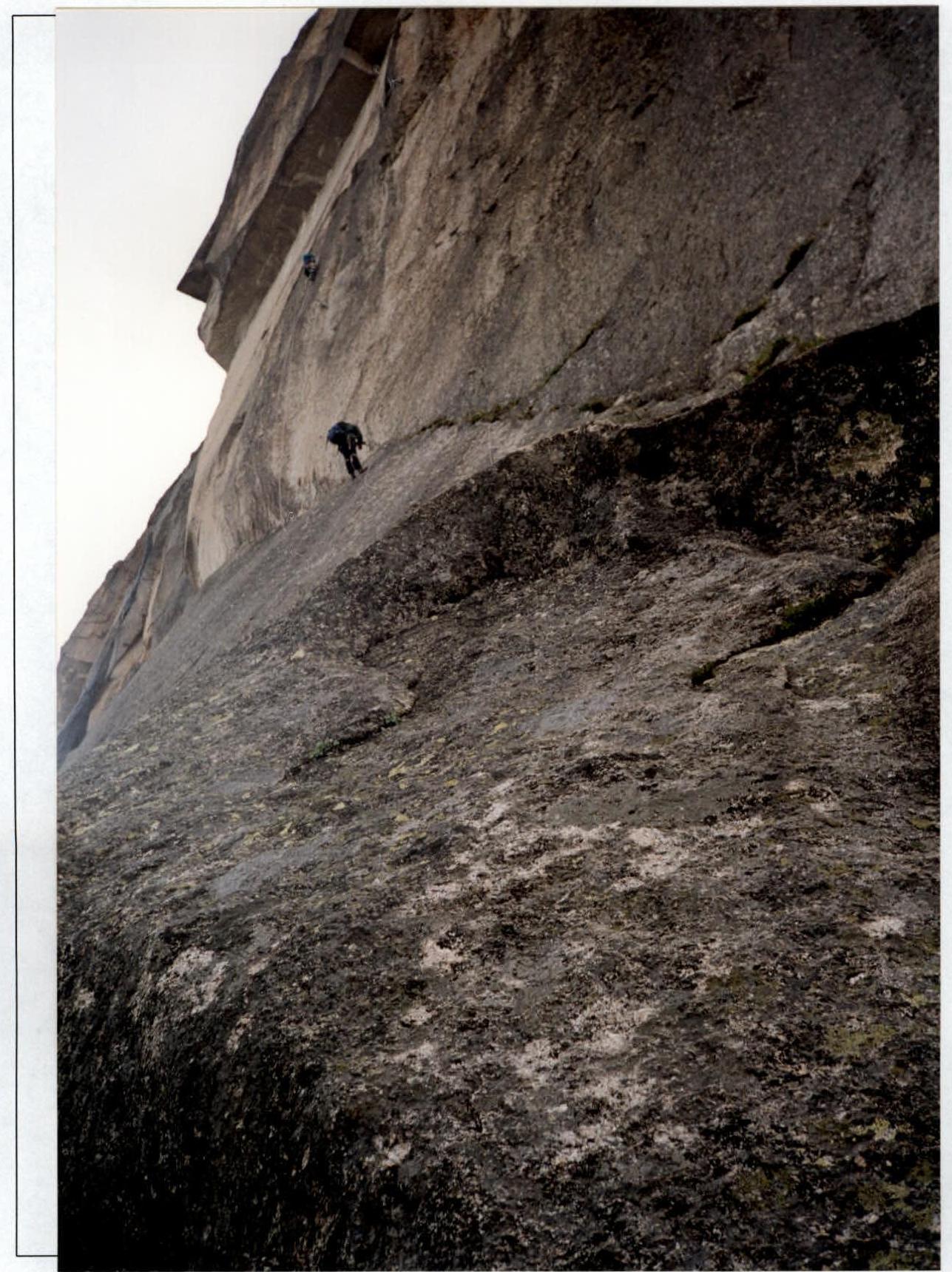
Profile of the wall from the left. The route line is not visible, it is located beyond the bend and passes through an even steeper, concave part of the wall and exits exactly at the summit.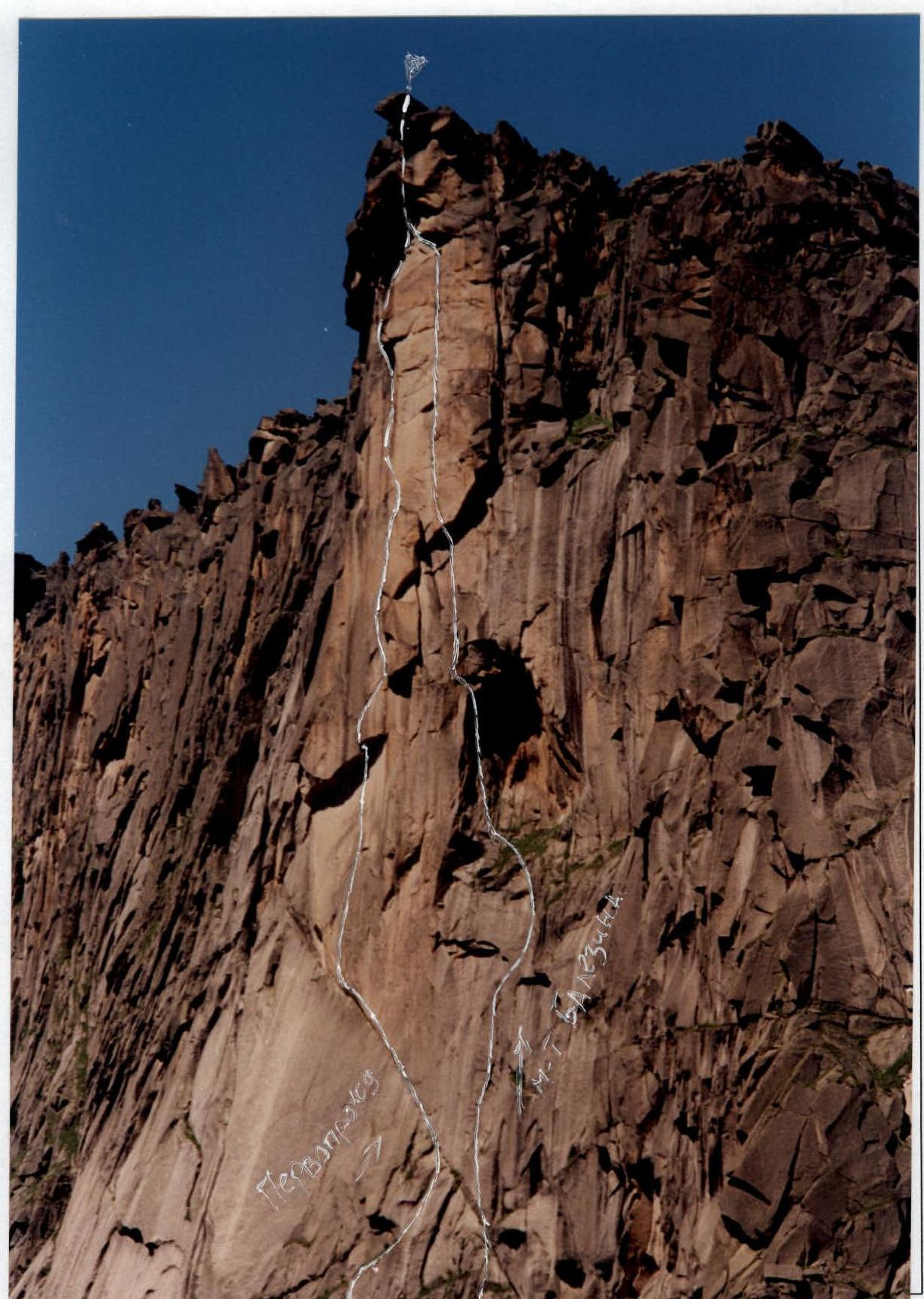
Profile of the wall from the right. The main part of the route is visible.
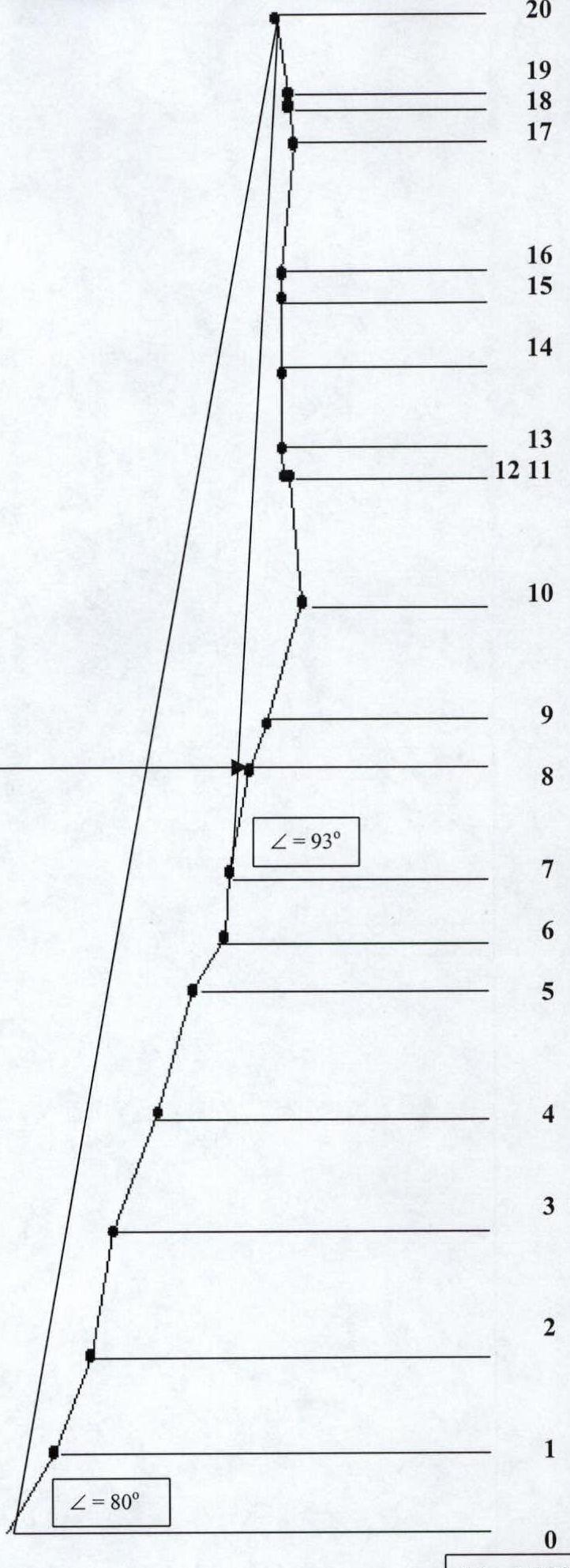
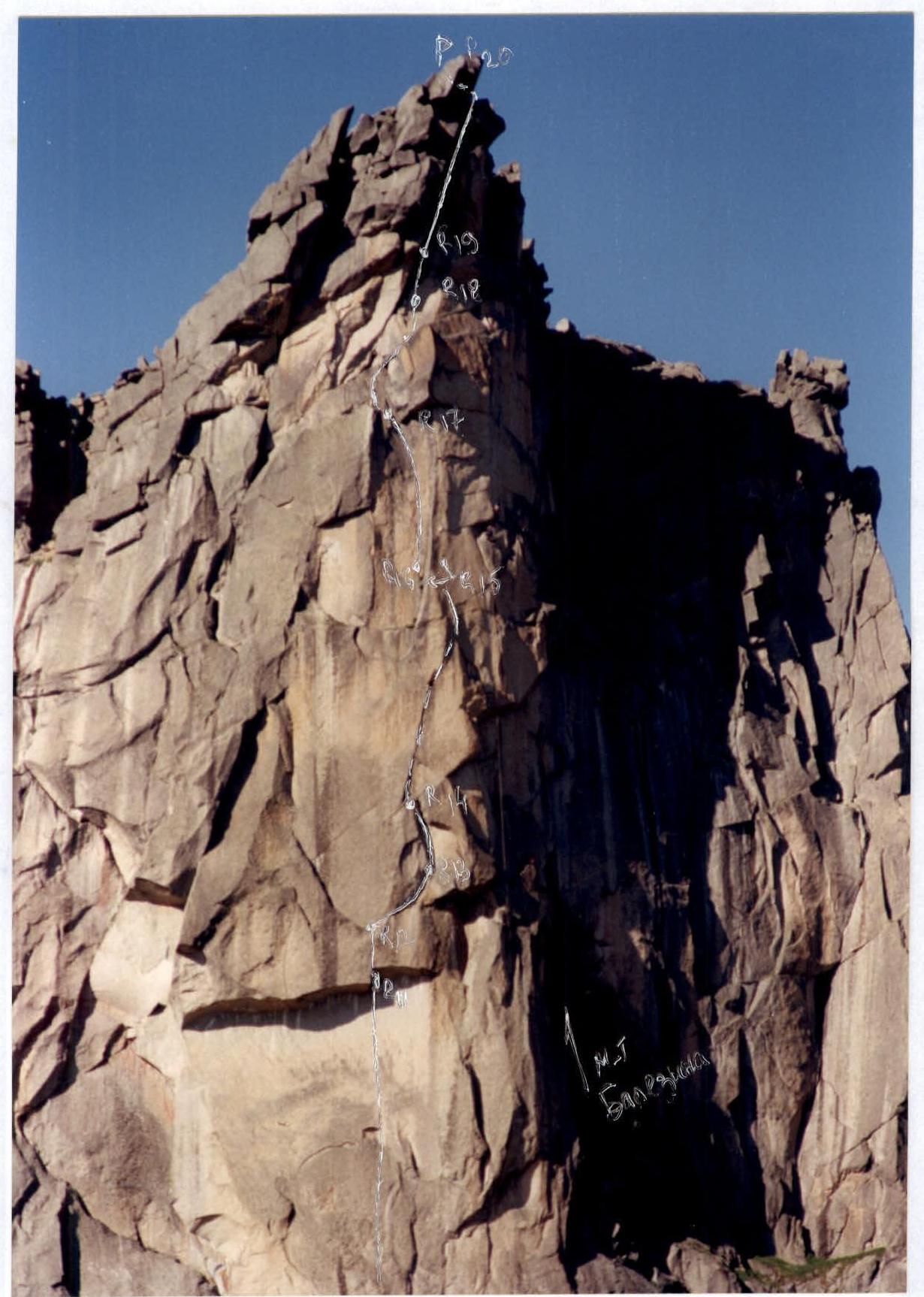
Hand-drawn Route Profile
Zub Drakona — 2170.
July 9, 2001.
Area Map
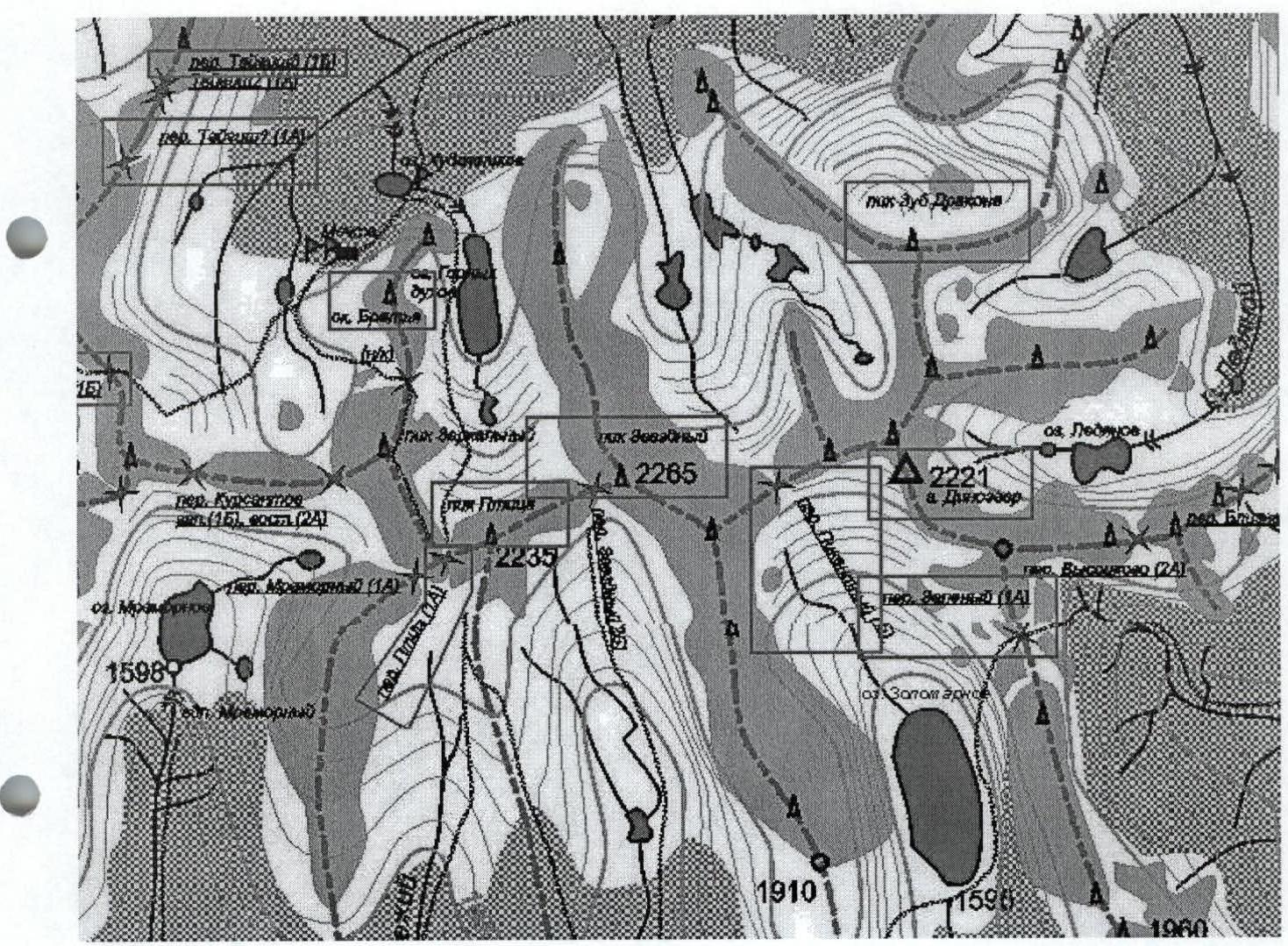
Tactical Actions
The Zub Drakona massif is named so due to its sharp, tooth-like summit tower with an overhanging southern wall. The wall's relief is varied: from numerous internal corners and crevices in the lower part to monolithic bastions, wide overhanging chimneys, and cornices. The steepness of the cornices on the main tower varies from 60° to 100°.
The team chose the Direttissima route of Zub Drakona as part of the Russian championship in the rock climbing class. There is only one ledge for an overnight bivouac on the route. It is possible to descend from the middle of the route using 1-2 rappels. There is no water on the route.
The team, having approached the route on July 2, 2001, spent 2.5 days choosing the route and waiting for the weather to improve (continuous rain).
- On July 5, 2001, at 18:00, the duo Fyodorov — Kokhanov started processing the route. Kokhanov led ahead. They processed 4 ropes up to the ledge that intersects the route and the Balezin route, and at 22:00, the duo returned to the base camp.
- On July 6, 2001, they started the route at 9:00 in the rain. They climbed the processed ropes and left a control cairn on the ledge. The duo Fyodorov — Kokhanov fixed a rope up to the ledge under an internal corner. At 14:00, they changed leaders. The duo Starov — Cherezov, with Starov leading, fixed a rope up to the overnight bivouac and processed the route through a crevice, leading alternately.
- On July 7, 2001, at 9:00, the duo Kokhanov — Starov, with Starov leading, processed the crevice and reached the "belly". Throughout the day, Starov — Fyodorov, alternating leads, fixed ropes up to the cornice.
- On July 8, 2001, at 9:00, the duo Cherezov — Fyodorov, with Fyodorov leading, started processing, overcame the cornice, made a traverse to the right, after which Kokhanov led ahead, processed an overhanging chimney, and at the start of the second chimney, he was replaced by Starov, who climbed onto a flake and continued making a path towards a pendulum. After that, due to a lack of information about the further relief, they decided to spend another night on the ledge.
- On July 9, 2001, at 10:00, the duo Fyodorov — Cherezov set out for processing and summit assault. At 11:00, the duo Kokhanov — Starov, having packed up the base camp, moved up the fixed ropes, and the team's work began. Before the "Drakon's beak" chimney, there was a change of lead. Cherezov led the chimney. At 18:00, the entire group gathered at the summit, and an hour later, they descended to the base camp via the 2A category route.
The team used a wide range of mountaineering equipment due to the diverse relief on the route. Petzl bolts were used to reinforce anchor stations.
Typically, the first climber worked on a double rope, while the second climber managed the platform and bivouac. When ascending via fixed ropes, upper belays were used, and mid-rope blocking was done. There were no injuries during the ascent. Water was in short supply.
Route diagram.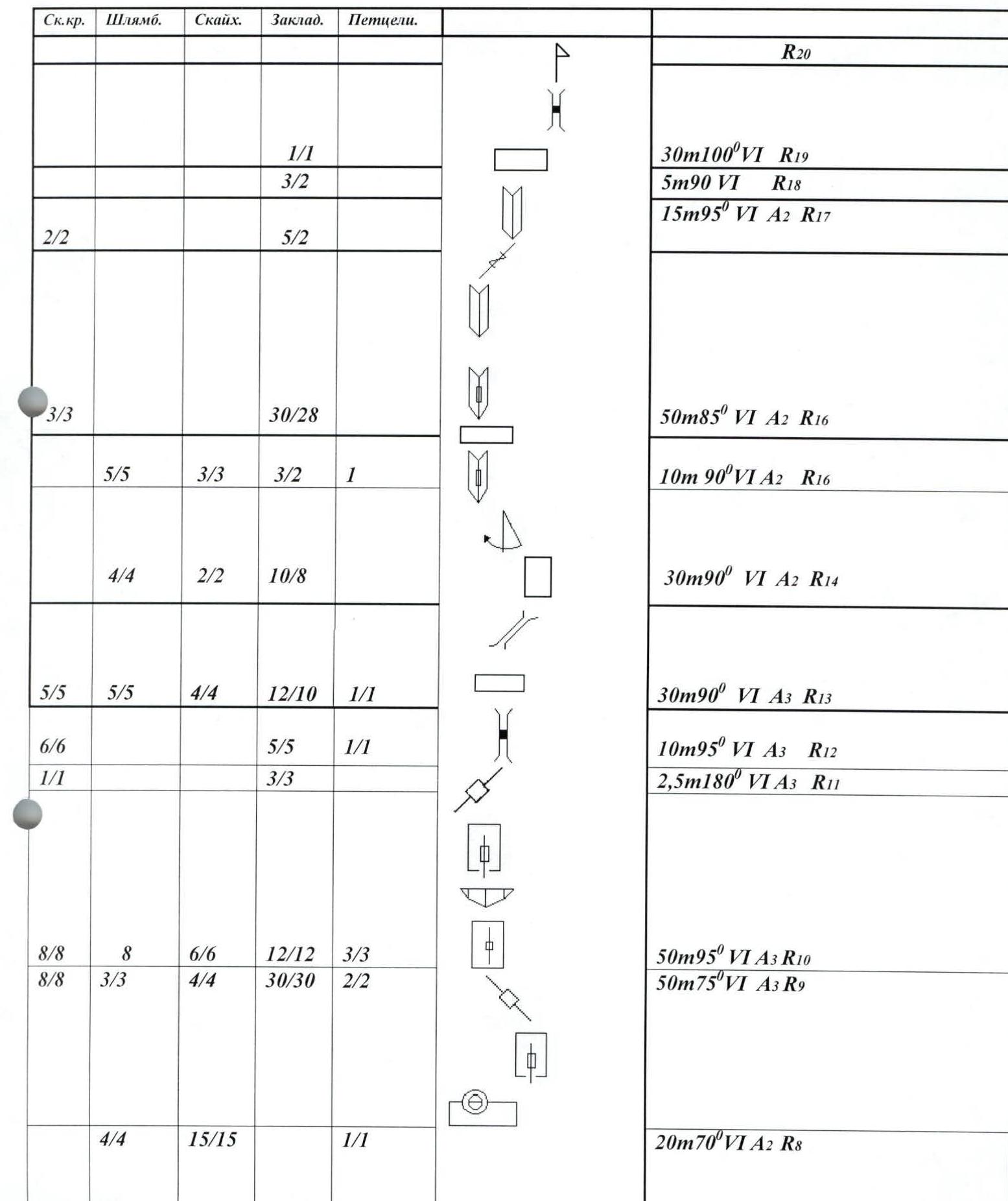
Section-by-Section Description
Section R0–R1. Monolithic slab with poor relief. Problematic climbing in wet conditions, little relief for protection. At the end of the slab, a small ledge.
Section R1–R2. Series of steep internal corners with vegetation and loose rocks. Difficult climbing, hanging belay station.
Section R2–R3. Good internal corner leading under a cornice. The cornice is passed via a crevice using artificial aids. Station in the corner under the cornice.
Section R3–R4. Above the cornice, a slab with a crevice leads to an inclined ledge connecting it to the Balezin route. Control cairn on the ledge.
Section R4–R5. Climbing an overhanging flake with a pendulum move to the right, into a series of internal corners. Difficult climbing, partly using artificial aids. Leads to a steep, grassy slope.
Section R5–R6. Easy climbing with alternating belays.
Section R6–R7. Difficult climbing on skyhooks and artificial aids, on a monolithic slab into an internal corner with a wide crevice.
Section R7–R8. Climbed using artificial aids, in the upper part free climbing. Leads to an overnight bivouac. Two bolts fixed for the platform.
Section R8–R9. To the right of the bivouac, on an inclined slab using skyhooks with belays on bolts, exit under an inclined crevice going under the "belly". Bolt fixed.
Section R9–R10. Traverse left-upwards through a crevice under an overhang. Difficult climbing using artificial aids, utilizing the full range of equipment. Bolts fixed in the middle and at the end of the traverse, when transitioning to the overhang.
Section R10–R11. Most of the slab is climbed using removable bolts and skyhooks. Bolts fixed at the stations. In the upper part, a difficult, "blind" crevice is encountered, climbed using pitons and stoppers. Exit under a cornice.
Section R11–R12. The cornice is passed via a poor crevice, with small stoppers used. Exit from the cornice onto an overhanging slab.
Section R12–R13. Overhanging slab with a "blind" crevice. Artificial aids used. Before traversing the crevice to the right, a bolt is fixed for protection.
Section R13–R14. Traverse to the right using artificial aids under an overhanging, wide chimney, climbed using skyhooks and bolts. Exit onto a small ledge before the next chimney. Bolt fixed for protection.
Section R14–R15. Climbing using artificial aids through a wide chimney up to a crack leading into an internal corner, or climbing inside a flake. Equipment is removed beforehand. Very narrow, and we climb out at the top of the flake.
Section R15–R16. From the top of the flake, straight up the slab using bolts. After 8 meters, a bolt is fixed for a pendulum move to the left, into an internal corner.
Section R16–R17. Through the internal corner under a cornice using artificial aids via a crevice.
Section R17–R18. The overhang is circumvented via crevices to the left, then onto a small cornice and a traverse to the right along large blocks under an internal corner. Climbing or artificial aids used.
Section R18–R19. Through the internal corner, we climb under the summit "tooth-chimney", a good ledge, possible overnight bivouac.
Section R19–R20. Through an overhanging chimney passing through the summit "beak-cornice" with a 10-meter exposure, difficult climbing, circumventing a "plug" from the outside, we climb to the summit.
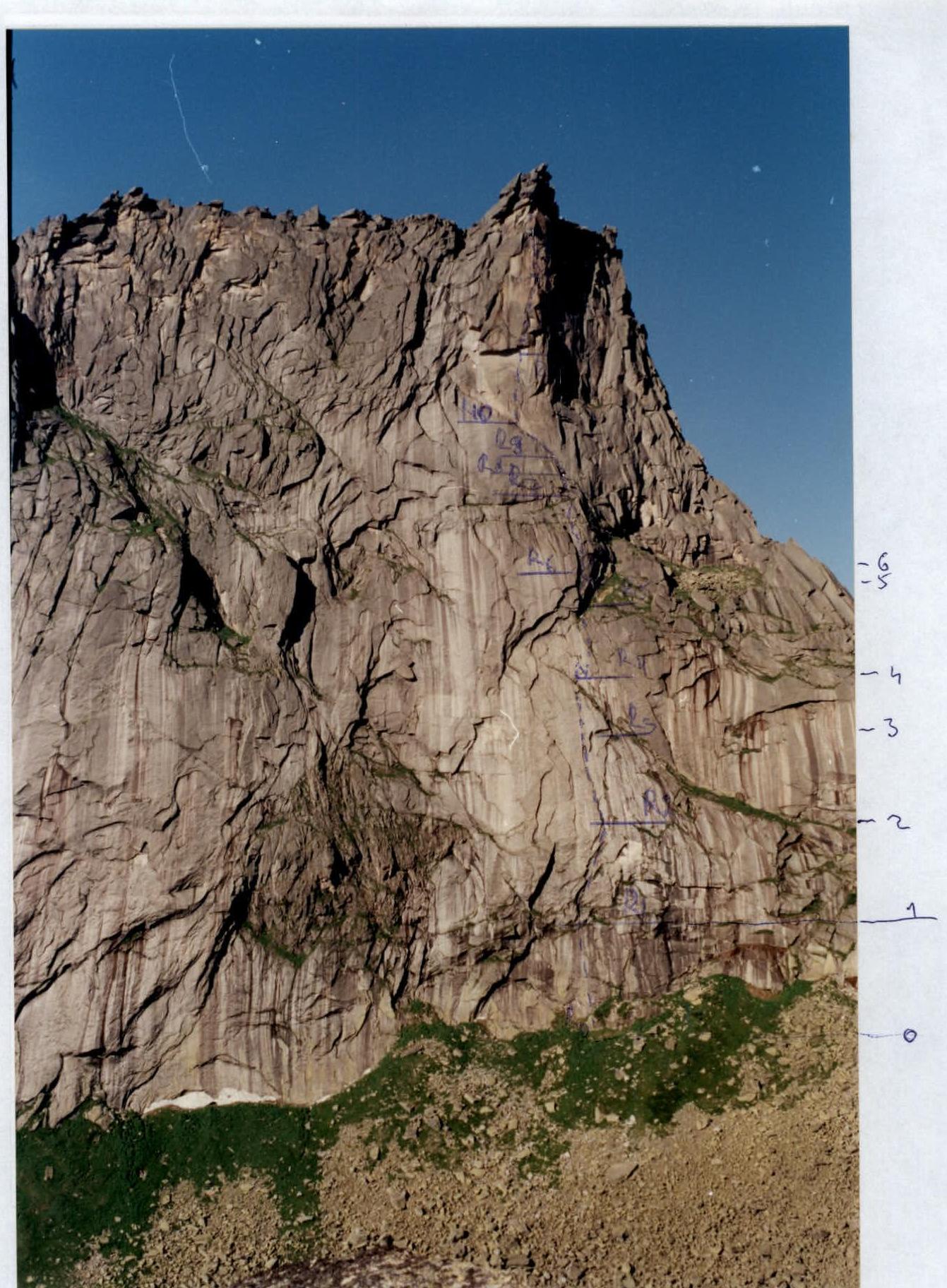
View of the South wall of the main summit from the pass (main part of the route). To the right, a group working on the Balezin route is visible.
Work of the duo Fyodorov — Cherezov on section R10–R11. Fyodorov leading.
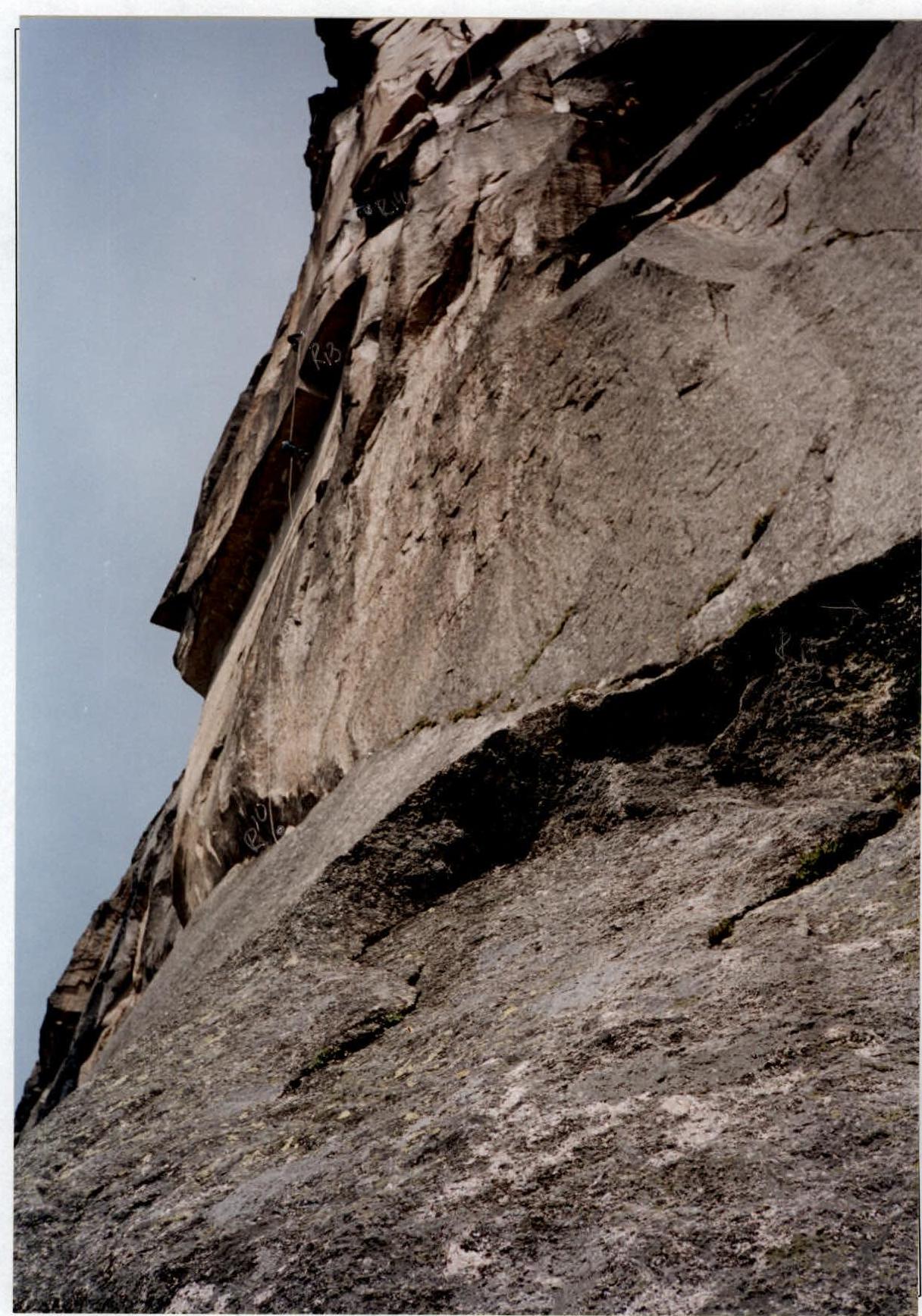
Work of the duo Fyodorov — Cherezov on the traverse section R13–R14. Kokhanov rappelling. The traverse of section R9–R10 is visible.
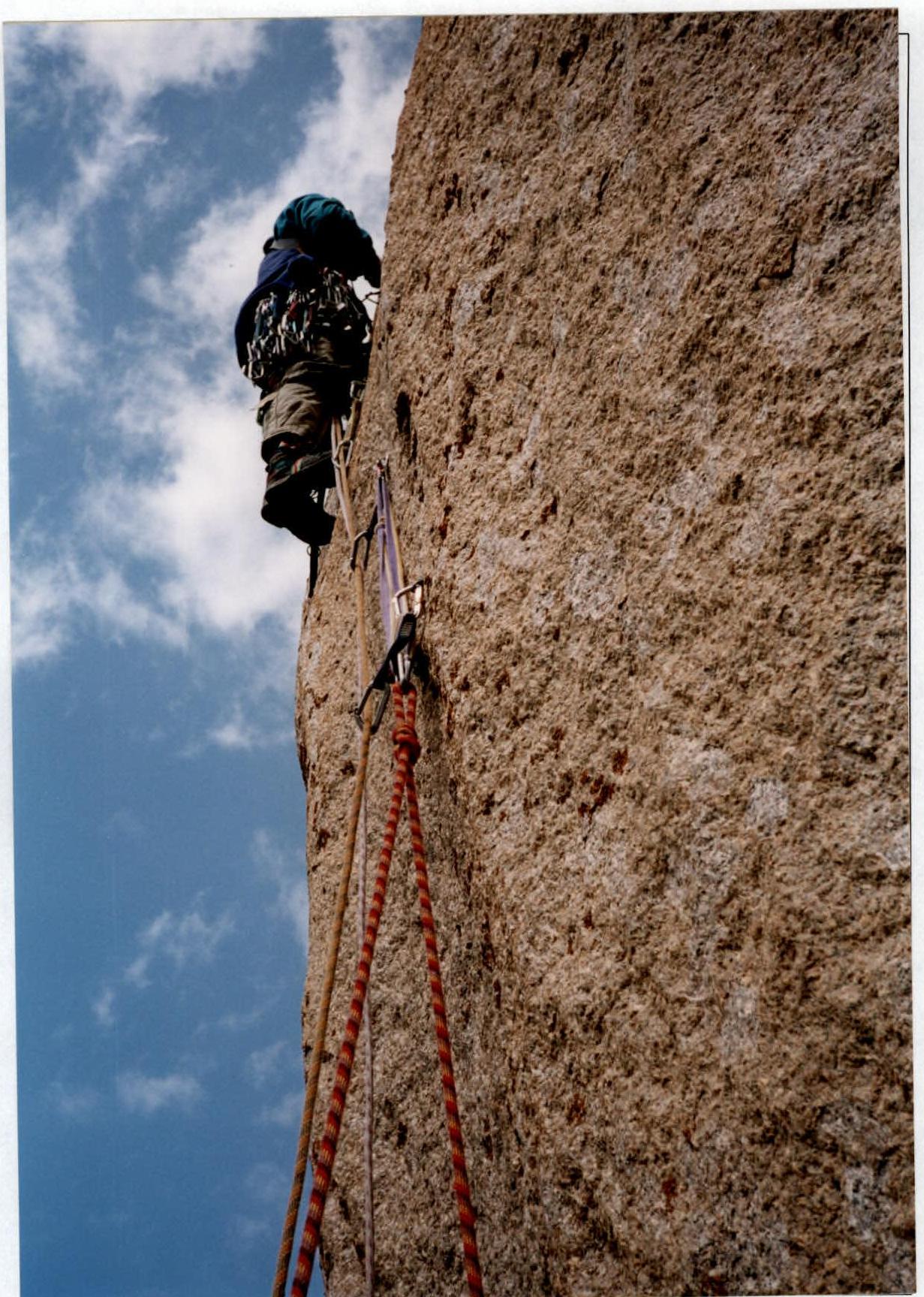
Preparation for a pendulum on section R15–R16. Duo Fyodorov — Cherezov. Fyodorov leading.