Ascent Passport.
- Climbing area — Western Sayan, section according to the 1999 classification table No. 6.2
- Name of the peak — Dinosaur, name of the route — via NW wall.
- Proposed 6A cat. diff. 2nd ascent. 6A
- Nature of the route — rock climbing.
- Height difference of the route: 450 m (by altimeter)
Length of sections:
- 5 cat. diff. — 60 m,
- 6 cat. diff. — 280 m.
Average steepness:
- main part of the route — 85°,
- entire route — 70°.
Pitons left on the route — 0.
Pitons used on the route:
- bolted stationary — 56, including aid climbing — 43.
Total artificial protection used — 320.
- Team's climbing hours: 41 h, days: 3.
- Leader:
Aleksey S. Korochkov — Candidate Master of Sports. Team members:
- Egor A. Timme
- Pavel B. Abramov
- Mikhail R. Kolesnikov.
- Coach: Viktor G. Volodin — Master of Sports.
- Departure to the route: July 5, 2002 at 11:00.
Reached the summit: July 7, 2002 at 21:00. Returned to base camp: July 8, 2002 at 8:00.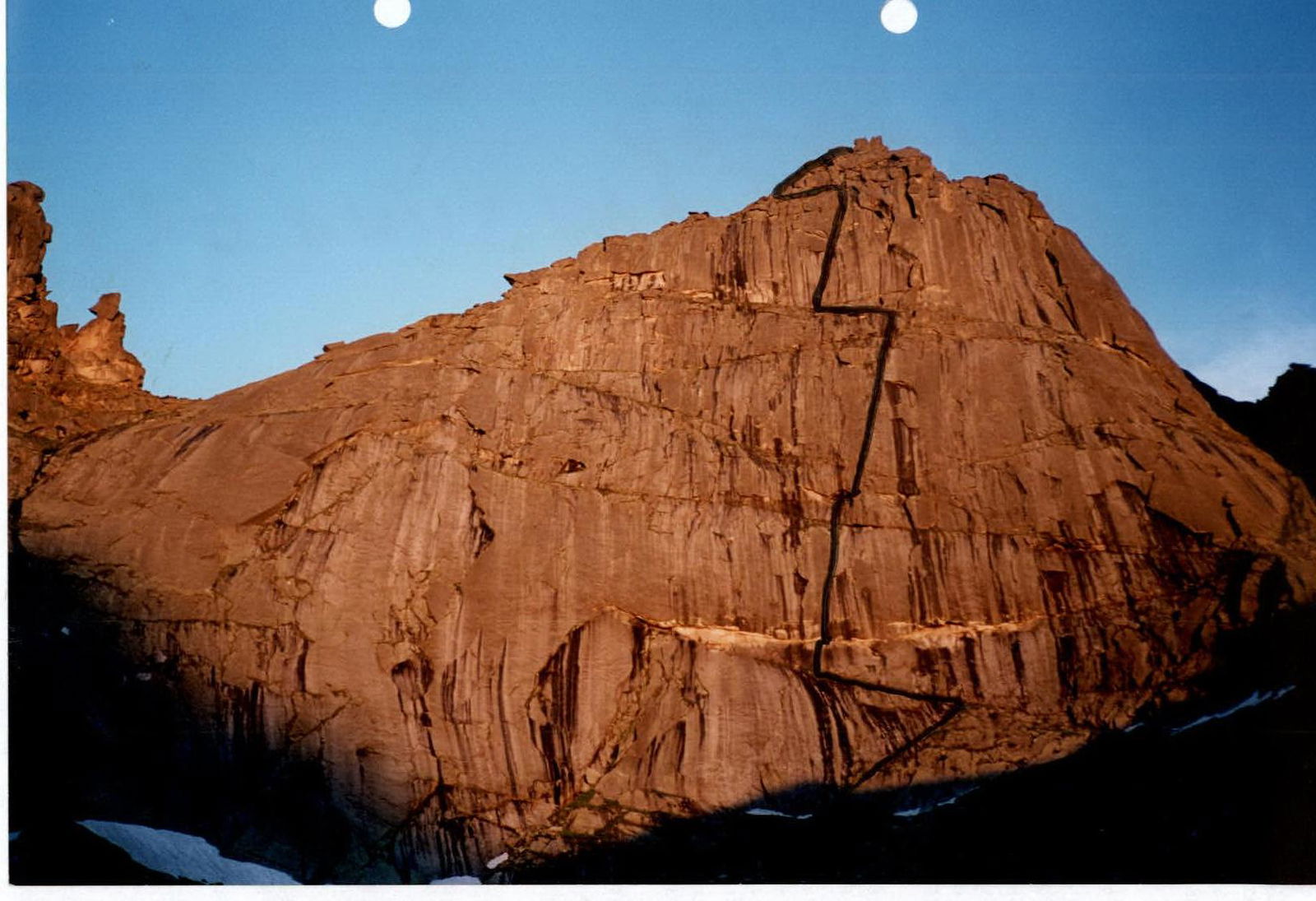 Route diagram in UIAA symbols
Report
On the ascent of Dinosaur peak via V. Balezin's route, 6A cat. diff. — second ascent.
The ascent was made on July 5-7, 2001 as part of the Russian alpine championship in the rock climbing category. Team coach — Viktor G. Volodin.
Team members:
- Pavel B. Abramov — 1st sports category
- Mikhail R. Kolesnikov — 1st sports category
- Egor A. Timme — Master of Sports
- Aleksey S. Korochkov — Candidate Master of Sports, team leader.
Height gain 450 m.
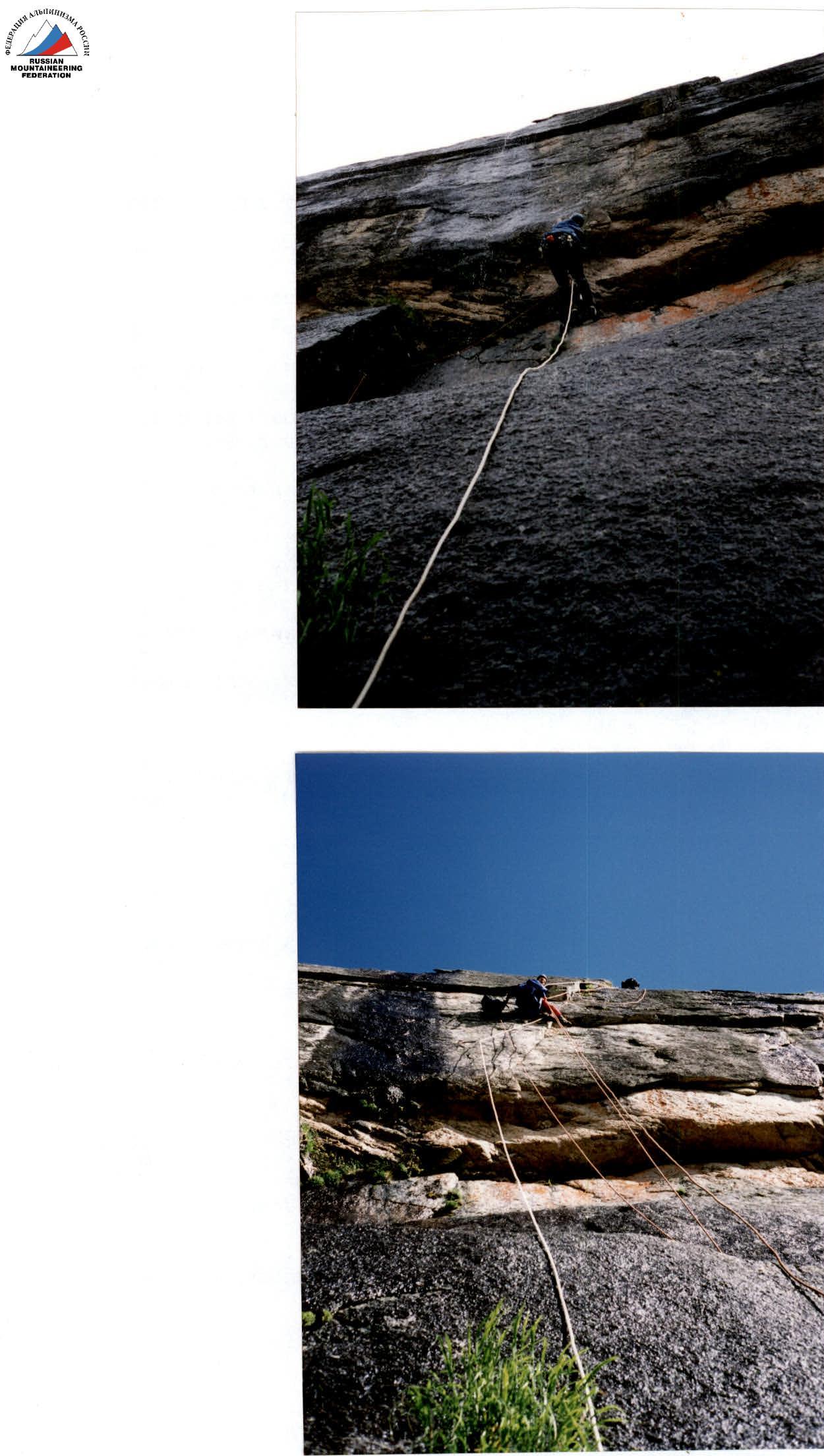
R0–R1 40 m – 3 cat. diff., 45°. Inclined inner corner with chocks and grass-filled cracks. 2 stoppers and one medium-sized friend used. R1–R2 45 m. Wide horizontal ledge, can be traversed without hand-holding onto the rock. R2–R3 45 m. From the ledge, 7 m of free climbing on loose rock, protection on a flake leaning against the rock; further, medium-sized pitons used. The route continues through a slight overhang with no natural features for progression. To overcome this 20 m section, pre-drilled Petzl bolt hangers with 6 mm internal thread, 10 mm spacer holes, and homemade pitons hammered into the bolt hanger holes were used. Distance between artificial protection points is about 1 m 20 cm. Further, the route follows a crack that gradually shifts right. Pitons are hammered into the crack, but in places, the crack is only 2-1.5 cm deep, and stopper-type chocks about 4 mm wide are used. Occasionally, Petzl bolt hangers are found in crucial locations. Finding them is challenging, as they are usually visible only when within arm's reach. 20 m above the overhang, there's a 5 m section that was free-climbed. Further, along the crack — aid climbing, stoppers, friends, pitons. Belay stance is awkward but has a reliable point — a Petzl bolt hanger. R3–R4 35 m. Along the crack, which was filled with earth and had grass growing in it, upwards and slightly right, using aid climbing with chocks and small friends until it flattens out.
R4–R5. Further, 15 m of free climbing along a system of small ledges to the base of an inner corner. The inner corner is overcome partially by climbing, partially using ladders: 8 m up the left side of the inner corner, then 7 m up and right, and 10 m traversing right — to approach the start of an overhang. There's a small ledge for a belay stance. R5–R6. 30 m. Aid climbing through the overhang, then up and right along a crack — medium and small pitons, friends, medium and small stoppers. Petzl bolt hangers are present. Had to clear the crack of earth, grass, and bird nests. The next belay stance is very awkward, hanging. R6–R7 40 m of aid climbing. Terrain is absolutely similar to the previous 30 m section. R7–R8 20 m along the crack using aid climbing. Further, the route flattens out, and 10 m can be free-climbed. On a large grassy ledge — a very comfortable spot for an overnight bivouac. R8–R9 40 m. Traverse left along a grassy, wide ledge to the base of an inner corner. R9–R10 35 m, 6 cat. diff. Along the inner corner, initially climbing, then using aid climbing to transfer to a crack and continue upwards on aid climbing along the crack. Belay stance is hanging, awkward. R11–R12 30 m, 6 cat. diff. Along the crack, 35 m of aid climbing to an inner corner. Belay stance is somewhat more comfortable than the previous one but still leaves much to be desired. R12–R13. 35 m. Along the inner corner, 20 m — partially aid climbing, partially free climbing, to approach the start of a chimney with a large stone plug in its middle part (very carefully, it's advisable not to touch the plug). Under the plug, squeeze through into the chimney and 15 m of free climbing up the inner part of the chimney to a large grassy ledge — a spot for a belay stance. Protection using pitons. It's advisable to pull the rope aside and hang it away from the chimney to prevent live rock from being dislodged onto the team members. R13–R14 150 m. Further, traverse left and 3 cat. diff. rock climbing — exit to the summit. Descent via a 1 cat. diff. route.
Day 1. Route reconnaissance. R0–R4, descent to camp. Day 2. Departure to the ledge for an overnight bivouac. R4–R7. Day 3. Summit push. Descent from the bivouac.
On the route:
- Pitons hammered: 84
- Chocks used: 198 times
- Friends used: 100 times.
Also, earth was removed from cracks, which could be used in winter for ice climbing with ice tools.