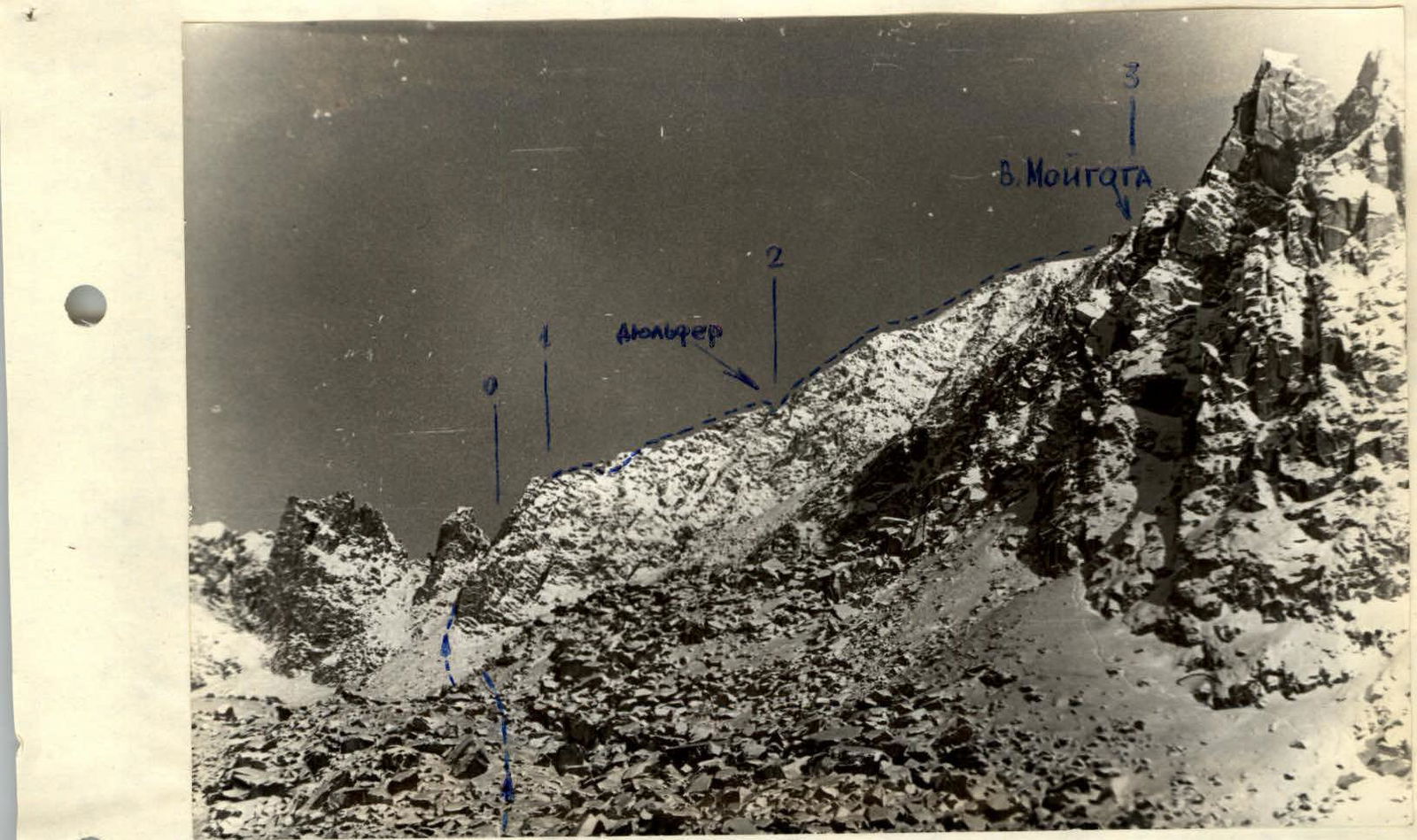
Geographical location, sporting characteristics of the Moygota gorge
The Moygota gorge is located in the middle part of the main watershed of the Tunkin Goltsy in the Eastern Sayan.
The Moygota peak closes the Moygota gorge and is located in the main watershed ridge.
The heights of the peaks in the Moygota gorge do not exceed 3000 m. The alpine relief of the area with jagged rocky ridges makes it possible to classify a number of interesting sporting routes in this gorge.
There are already classified routes to:
- Moygota peak via the southern ridge – 3A;
- Flibustier peak – 3B and 1B;
- Per'ya peak – 2B.
The passage of these routes is often complicated by a significant snow cover, which falls early in autumn and mostly melts only by the end of May or June.
Approaching with a load to the base camp – on the edge of the forest, from the Tunkinskaya valley, from the road leading from the village of Tagarhay – takes just under two walking days.
Map-scheme of the Moygota gorge

Route description
From the base camp, on the edge of the forest, up to the cirque, to the lake before the beginning of the southern ridge of v. Moygota.
From the lake:
- up to the left,
- skirting the large taluses of the southern ridge of v. Moygota.
In the western ridge of the peak, a W-shaped gap is clearly visible. The beginning of the route is in the far right opening of the gap; the path there goes along the medium and small talus, turning into a narrow couloir at the top (photo 1, 2); photo 2.
The approach to the route, to the saddle, takes 3–3.5 hours. On the saddle, there is a control cairn, where it is necessary to connect.
Section R0–R1. A small descent from the saddle to the northern side (3 m) followed by an ascent with climbing with alternate belay through ledges, on a rope (40 m). The exit to the ridge is carried out along monolithic rocks (overall slope 50°) with fissures – 40 m traverse-slab and 40 m – ascent to the ridge. Ledges suitable for belay are absent. Belay is through pitons.
Section R1–R2. The further route goes mainly along the ridge, using counter-slopes (Photo 5), piton belay and ledges. After 4 ropes from the beginning of the ridge route, an绕行 of a difficult section begins: to the right along the ledges with a small loss of height (10–15 m) – 1 rope and exit to the ridge along monolithic rocks of medium difficulty – 1 rope. Piton belay (Photo 8, 9). Here, cairn No. 2 is complex.
Further, there is movement along the jagged ridge, where belay is mostly alternate. After 3–4 ropes, the ridge breaks off with a gap, where a rappel (15 m) is organized – photo 11.
Section R2–R3. Further, there are 3–4 ropes of несложного ridge climbing, followed by an exit to a narrow ridge through a narrow chimney (gap) – 3–4 m. Photo 13.
4–5 ropes – movement along the jagged ridge with alternate belay through ledges, where:
- individual sections are passed using the "horseback riding" technique;
- small gaps are overcome by descending on a rope thrown over a ledge.
The last 2 ropes before the peak – a sharp ascent, which is a large talus, passed simultaneously.
Descent from the peak along the eastern ridge and down from the pass to the left cirque of the Moygota gorge.
Route assessment
This route requires the participants of the ascent to have rock climbing technique and clear organization of belay.
After exiting onto the ridge and up to section R2–R3, it is possible to leave the route only by using a rappel down the wall couloirs.
Travel time on the route: in winter – depending on weather conditions, snow cover and group composition – from 5 to 8 hours.
Recommended group size – no more than 8 people. According to the general opinion of the group – the route passed in these conditions corresponds to 3A category of difficulty.
Group composition:
- STANEVICH A.M. – 1st sports category – leader,
- PLOTNIKOV N.K. – 1st sports category – participant,
- FILIPPOVA T.N. – 1st sports category – participant.
Observers:
- RUSINOV A.K. – badge holder,
- MARKOV S.M. – badge holder.
Leader A.M. Stanevich (1973)
Table of main characteristics of the route passed by sections
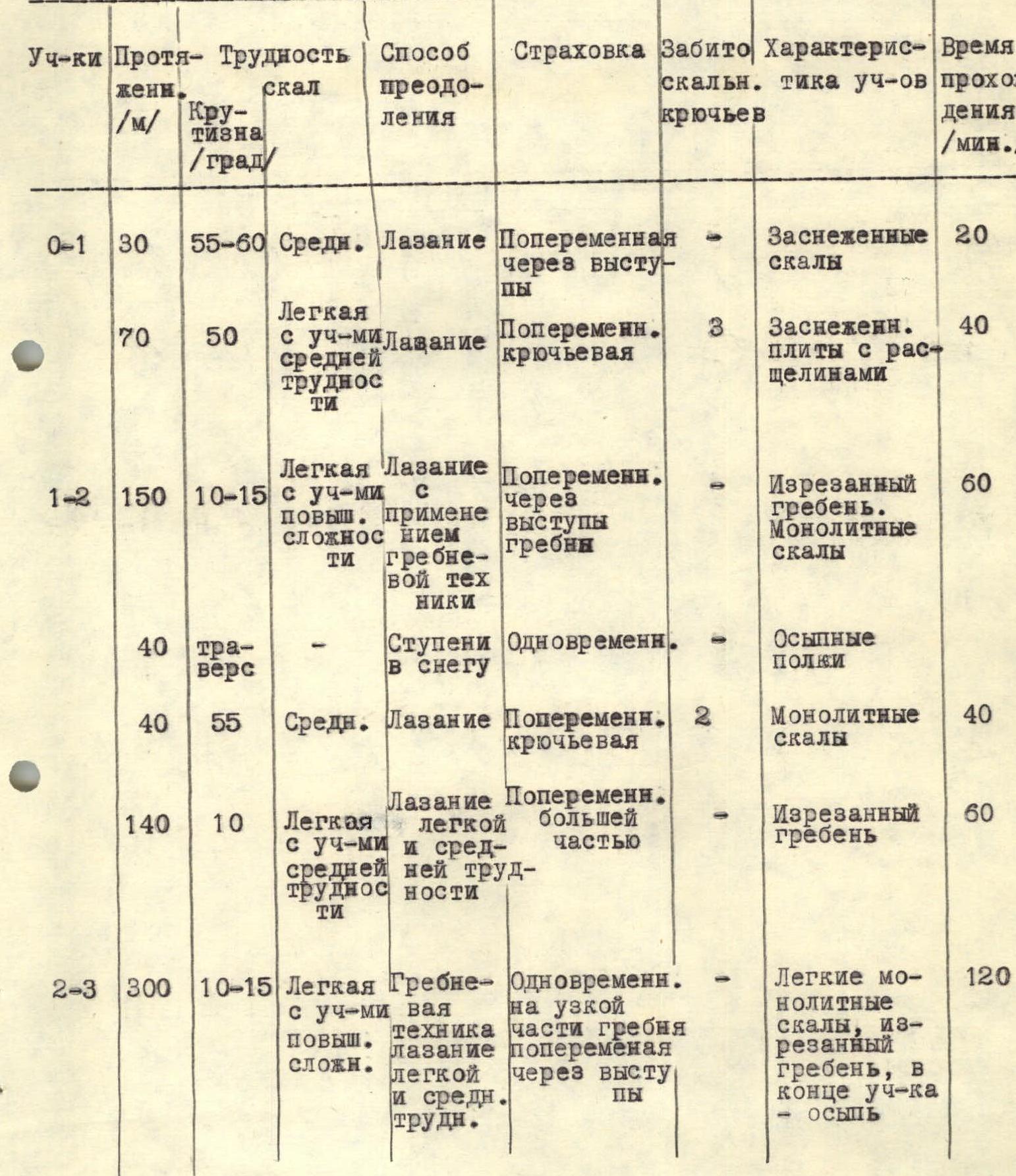

Photo 1
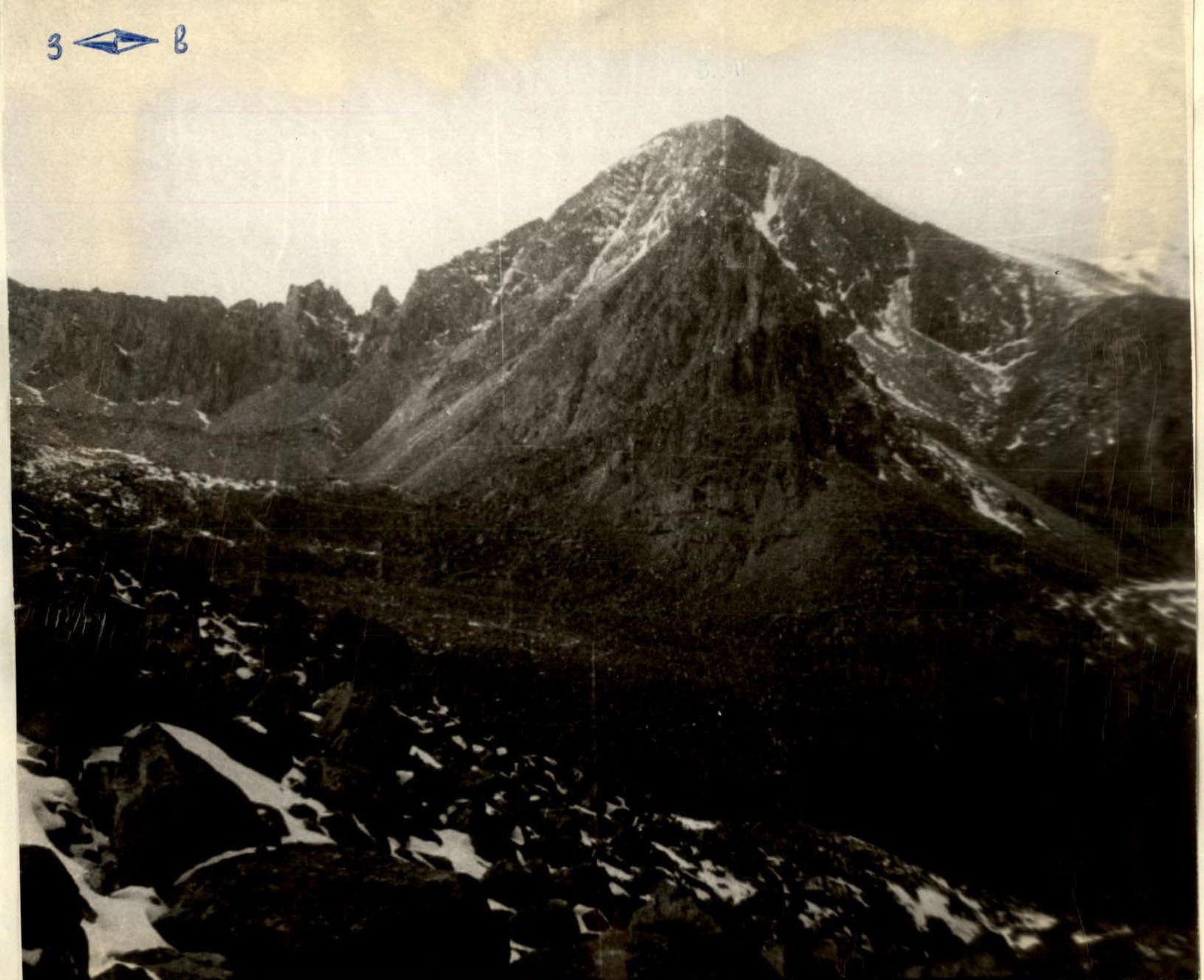
Photo 2