
Geographic location, sporting characteristics, and history of the Zuun-Khandagai valley exploration
The Zuun-Khandagai valley is located in the middle part of the Tunka Alps in the Eastern Sayan. The peak Igly Khandagaya is situated on the watershed ridge of the Tunka Alps and closes the Zuun-Khandagai valley. Although the height of the peaks in the area does not exceed 3000 m, its development is significantly hindered by complex climatic conditions and alpine landforms.
In 1969, the valley was explored by an expedition of the USSR Climbing Federation led by V. Abalakov.
In the same summer, a group of climbers from Irkutsk led by V. Belousov made the first ascent of the southern wall of the peak SOAN, and the route was classified as 4B category in summer conditions. A route along the southeastern ridge to the same peak was also classified as 2B category.
It is worth noting that winter conditions in the Eastern Sayan often last until the end of May, when prolonged snowstorms and frosts unexpectedly deter climbers. By the end of summer, the snow cover almost completely disappears.
The area has more than ten peaks of interest to climbers, and only one peak, SOAN, currently has classified routes.
The traverse of Igly Khandagaya is the second attempt to classify the peaks in this interesting and promising area.
Description of the traverse
April 27. Sections R0–R1, R1–R2.
The route begins from a snow-ice couloir leading to a ridge that leads to the 1st needle. We ascend simultaneously, tied together. In the upper part, the couloir's steepness reaches 50° and ends with a narrow isthmus. Almost the entire R0–R1 section is a narrow, winding ridge, which drops off on the left by a rock wall and on the right by a steep snowy slope. Of the three gendarmes on the ridge, the third is the most complex. We bypass the gendarme on the right along frozen slabs with piton protection (Photo 1). The slabs abut a нависающую стену (4 m). We pass it by climbing. The entire ridge has many cornices. The first rope literally digs a trench (Photo 2). Sometimes there are smooth slabs (Photo 3). We reach the summit. On the summit of the 1st needle, we build a cairn and leave a note. We move along the R1–R2 section. This is a destroyed and snow-covered ridge. The northern side drops off with an almost sheer kilometer wall. A sudden strong wind forces us to look for a place to spend the night. We are all quite wet. We descend in a sporting manner onto a snowy mound and trample a spot for the tent (Photo 4). We spent 8 hours on the move.
One rope descends under the wall of the fourth gendarme, processes it, and returns to the "spot".
April 28 and 29.
A strong wind blows continuously. Fog with snow. By the end of the second day, the tent is almost buried in a snowdrift. But the snowfall and fog disappear.
April 30. Section R2–R3.
The wind is blowing. It's cold. We leave at 8:00.
We pass the wall of the fourth gendarme "head-on" along an internal corner (Photo 5):
- The wall overhangs in the upper part, climbing is difficult, there are few handholds.
- We pull up the backpacks.
- The wall is 25 m.
We descend from the gendarme with a rappel under the 10-meter wall of the 5th gendarme.
We pass a short internal corner with an overhanging top using a ladder (Photo 6):
- We pull up the backpacks.
Descent from the gendarme - 25 m rappel under the 2nd needle.
Section R3–R4
The second needle is smooth slabs with small handholds (Photo 7). To the right, there are steep shelves with ice. It is preferable to move along the slabs "head-on". Protection is piton and ledge. We pull up the backpacks.
From the summit of the needle:
- We descend in a sporting manner along steep, smooth slabs for 20 m to a small spot on the ridge (Photo 8).
- Further movement along the ridge is impossible due to a нависающей скалой (narrow, steep, and smooth ridge behind it).
- We descend in a sporting manner 40 m to the right onto a ledge.
Before us is a 25 m wall with a small internal corner. Climbing is extremely difficult (Photo 9). To the left of the "perch", we find a convenient spot to which we pull up the backpacks.
From the spot, we organize a 40 m rappel along a strongly overhanging wall. We lower the backpacks on a rope (Photo 10).
The weather worsens again. The wind sweeps snow. We lay out a spot from stones under the wall of the 3rd needle. The overnight stay is semi-reclining (Photo 11). We spent 13 hours on the move.
May 1. Section R4–R5 (Photo 12)
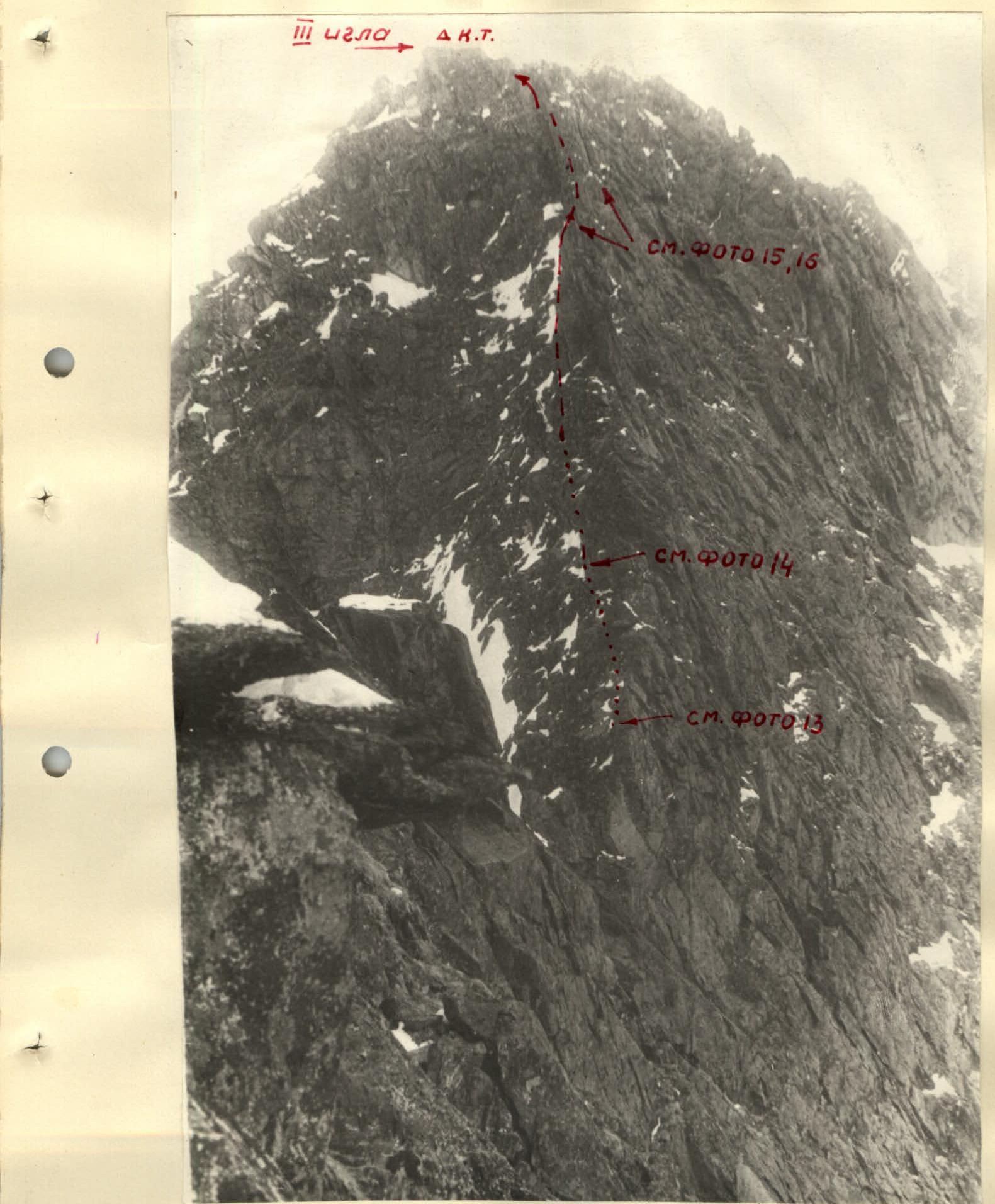
We leave at 10:00. The wind sweeps snow. We bypass the wall of the needle on the left. We move under the wall along steep, snowy shelves 60° (Photos 13–14). The section is dangerous. There are live rocks under the snow. The snow is dry, steps do not hold. To the left is a vertical couloir. After three "sorokovki", we exit to the right onto the wall of the needle along an overhanging corner with a crack (Photo 15). The rocks here are completely dry. By the way, the sun came out. We pass the remaining 80 m of the wall in 3 hours (Photo 16). We pull up the backpacks. On the summit, we build a control cairn. We descend to the left - down along a destroyed, snowy slope (many live rocks). 80 m in a sporting manner. We leave the last rope loop and descend with a rappel along a vertical wall 35 m to the Udachny pass (Photo 17). On the pass, there is a control cairn. The descent from the pass along a snow-ice couloir took 2.5 hours. We spent 8 hours on the move.
Leader: A. Cheremnykh.
Assessment of the route and actions of participants
The entire route requires good mastery of snow and rock technique. There are many wall sections with difficult climbing on small handholds. Throughout the route, there are many descents in a sporting manner and rappels; the group must have special equipment to organize them.
It is necessary to have:
- 20 m of expendable cordelette
- one pair of galoshes
- a ladder
- one or two pairs of crampons (for descending the couloir from the Udachny pass)
In addition to the usual equipment, for passing certain complex sections of the route, one pair of galoshes and a ladder are essential.
In the second half of the day, in warm weather, the couloir from the Udachny pass becomes avalanche-prone and is also shot through with rocks from the right (orographic) wall.
The group is a cohesive team with routes of the fourth and fifth categories in their record.
According to the group's consensus, the route taken corresponds to the 5A category in the given conditions.
Group composition:
- Cheremnykh A.F. - 1st category, 5B - leader.
- Nikonov V.P. - 2nd category, 4A, 4A, 4B, 5A.
- Sazanov V.V. - 2nd category, 4A, 4A, 4B, 4B, 5A.
- Nikolaeva I.M. - 2nd category, 4A, 4A, 4B, 4B.
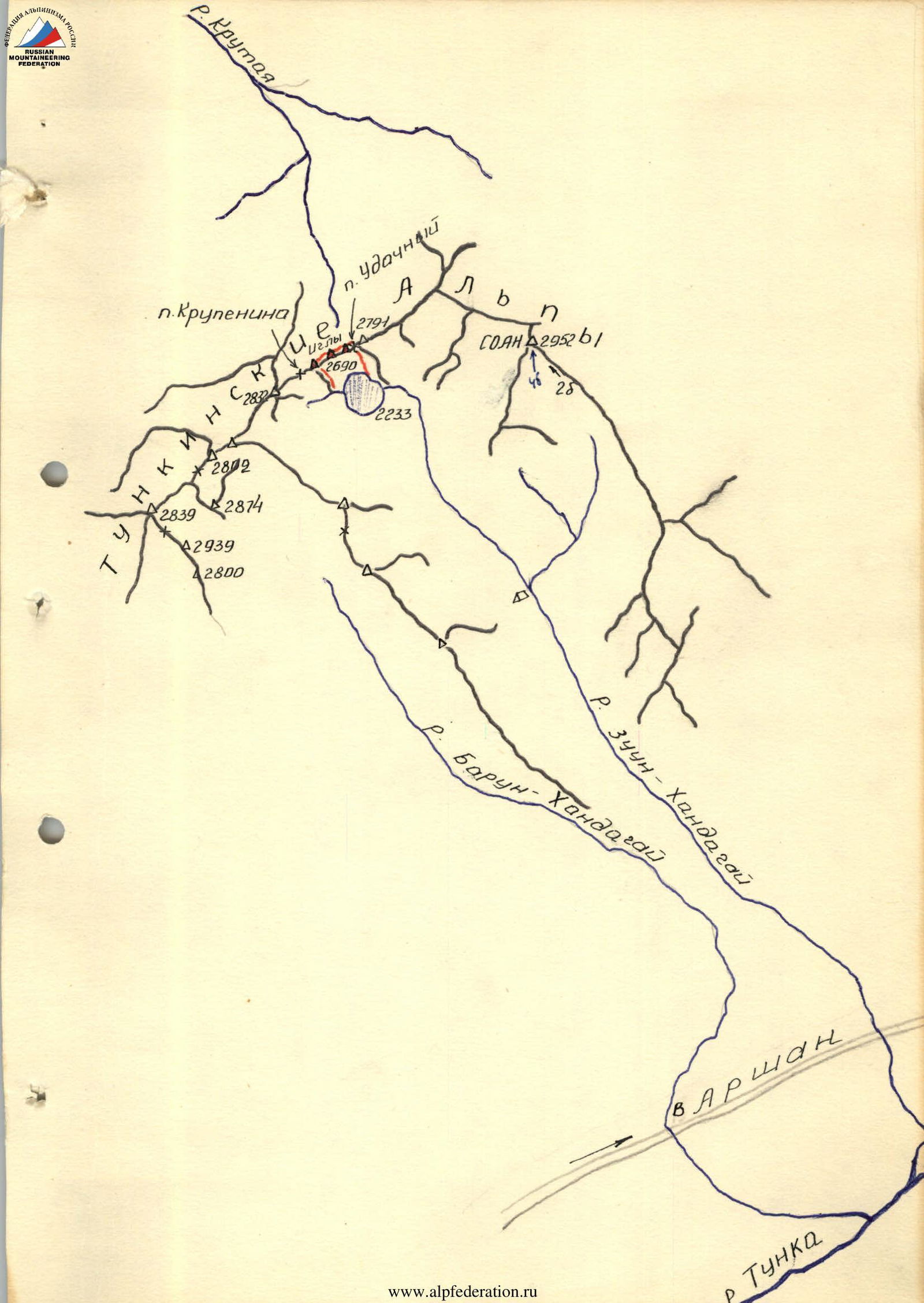
Table of main characteristics of the traverse of the peak Igly Khandagaya
Diagram of the traverse route of the peak Igly Khandagaya
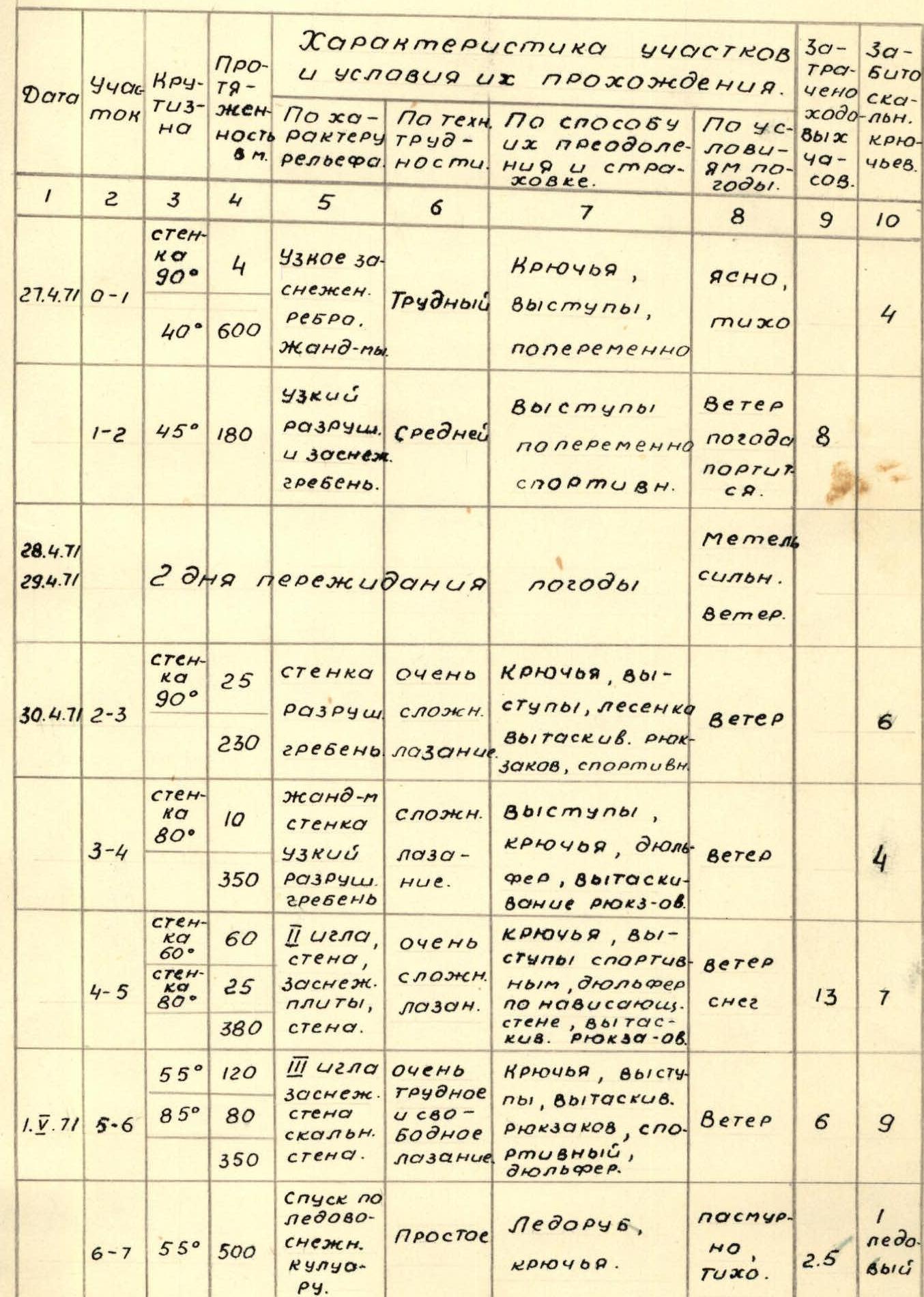
Photo 20.
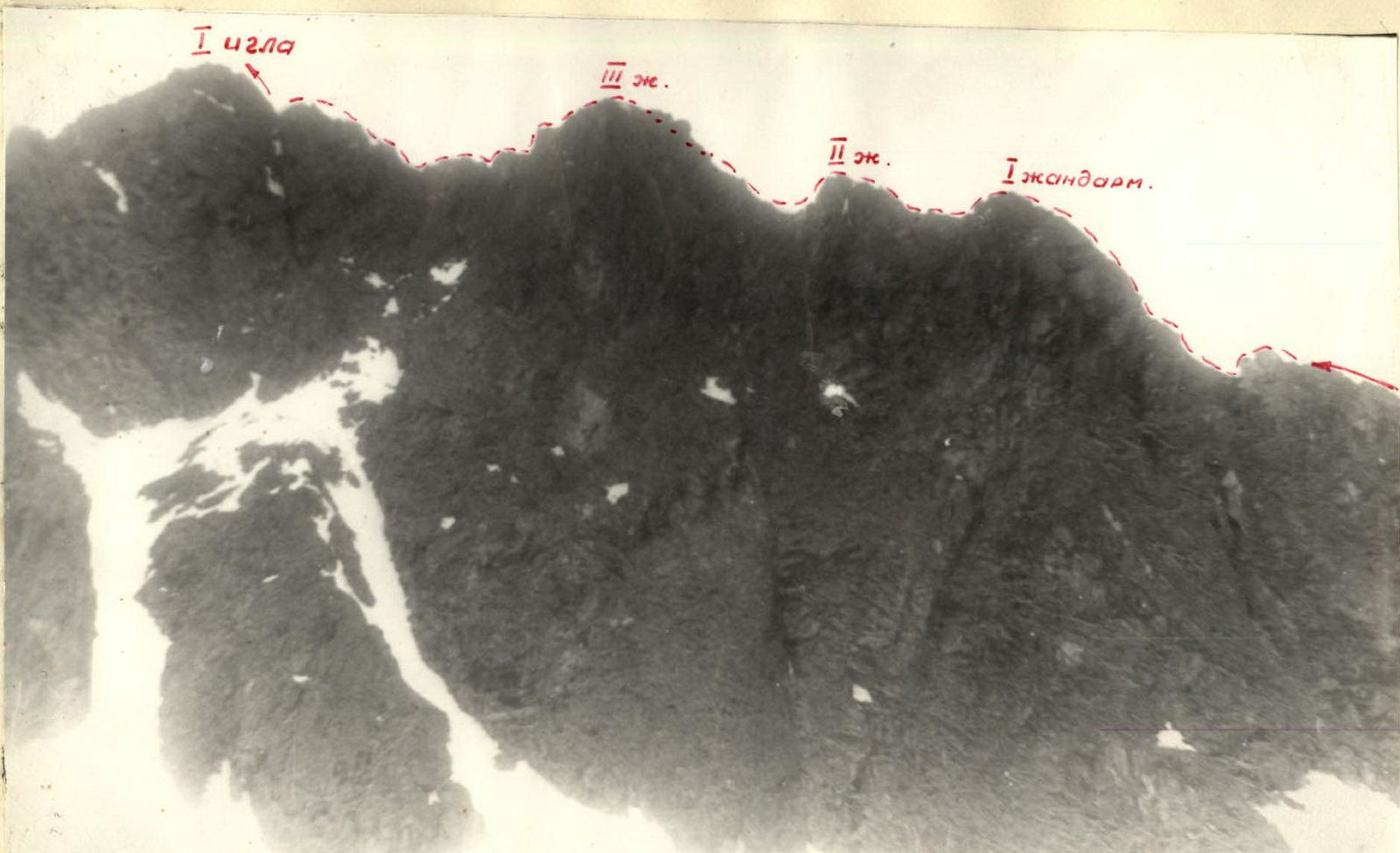
Photo 12.
| Date | Section | Steepness | Length in m | Characteristics of relief | By technical difficulty | Method of overcoming and protection | By weather conditions | Time spent on the move | Pitons |
|---|---|---|---|---|---|---|---|---|---|
| 27.04.71 | R0–R1 | 40° | 600 | Narrow snow-covered ridge. Gendarmes. | Difficult | Pitons, ledges, alternating | Clear, calm | 4 | |
| 27.04.71 | R1–R2 | 45° | 180 | Narrow, destroyed, and snow-covered ridge. | Medium | Ledges, alternating, sporting | Wind, weather worsens | 8 | |
| 28.04.71–29.04.71 | 2 days of waiting | Snowstorm, strong wind | |||||||
| 30.04.71 | R2–R3 | 90° | 25, 230 | Wall, very destroyed, complex. Ridge. | Complex | Pitons, ledges, ladder. Pulling up backpacks, sporting | Wind | 6 | |
| 30.04.71 | R3–R4 | 80° | 10, 350 | Gendarme, wall. Narrow, destroyed ridge. | Complex climbing | Ledges, pitons, rappel, pulling up backpacks | Wind | 4 | |
| 01.05.71 | R4–R5 | 60°, 80° | 60, 25, 380 | Needle, wall. Snow-covered slabs, wall. | Very complex climbing | Pitons, ledges, sporting, rappel along overhanging wall, pulling up backpacks | Wind, snow | 13 | 7 |
| 01.07.71 | R5–R6 | 55°, 85° | 120, 80, 350 | III needle, very snow-covered wall, rock wall. | Difficult climbing | Pitons, ledges, pulling up backpacks, sporting, rappel | Wind | 6 | 9 |
| 01.07.71 | R6–R7 | 55° | 500 | Descent along ice-snow couloir. | Simple | Ice axe, pitons | Overcast, calm | 2.5 | 1 (ice) |
| Total: | 2915 | 29, 52, 30 rock |