
PASSPORT
- High-altitude technical class
- Pamir, Yazgulyam Range
- Peak Kholodnaya стена via the center of the North wall 5970 m (Verba route)
- 6th category of difficulty, second ascent, 4th overall
- Elevation gain: 1500 m, length — 1800 m. Length of sections with 5–6 category difficulty — 1600 m. Average steepness of the main part of the route 75° (4470 – 5850), including 6th category difficulty — 580 m
- Pitons hammered:
| Rock | Bolt | Nuts | Ice |
|---|---|---|---|
| 169+5x | — | 86 | 65 |
| 6 | 3 | 2 |
X — reuse of previously hammered pitons.
- Team's walking hours: 60.5 hours and days — 6.
- Overnights: 1st — on a snowy ridge; 2nd — on a snow shelf, lying; 3rd — on a shelf, lying; 4th — on an ice gryphon, lying; 5th — on an ice ridge, lying. Tents were set up only on the 4th and 5th nights.
- Team leader: Khoroshikh Alexander Nikolayevich — Candidate Master of Sports
Team members: Zakharov N.N. — Master of Sports, Lebedev V.A. — Candidate Master of Sports, Dyukov V.B. — Candidate Master of Sports, Loginov Yu.A. — Candidate Master of Sports, Bogdanov V.A. — Candidate Master of Sports, Mozharov N.P. — Candidate Master of Sports
- Coach: Yanov Vitaly Fedorovich — Master of Sports
- Departure to the route: August 4, 1985
Summit: August 9, 1985. Return: August 9, 1985
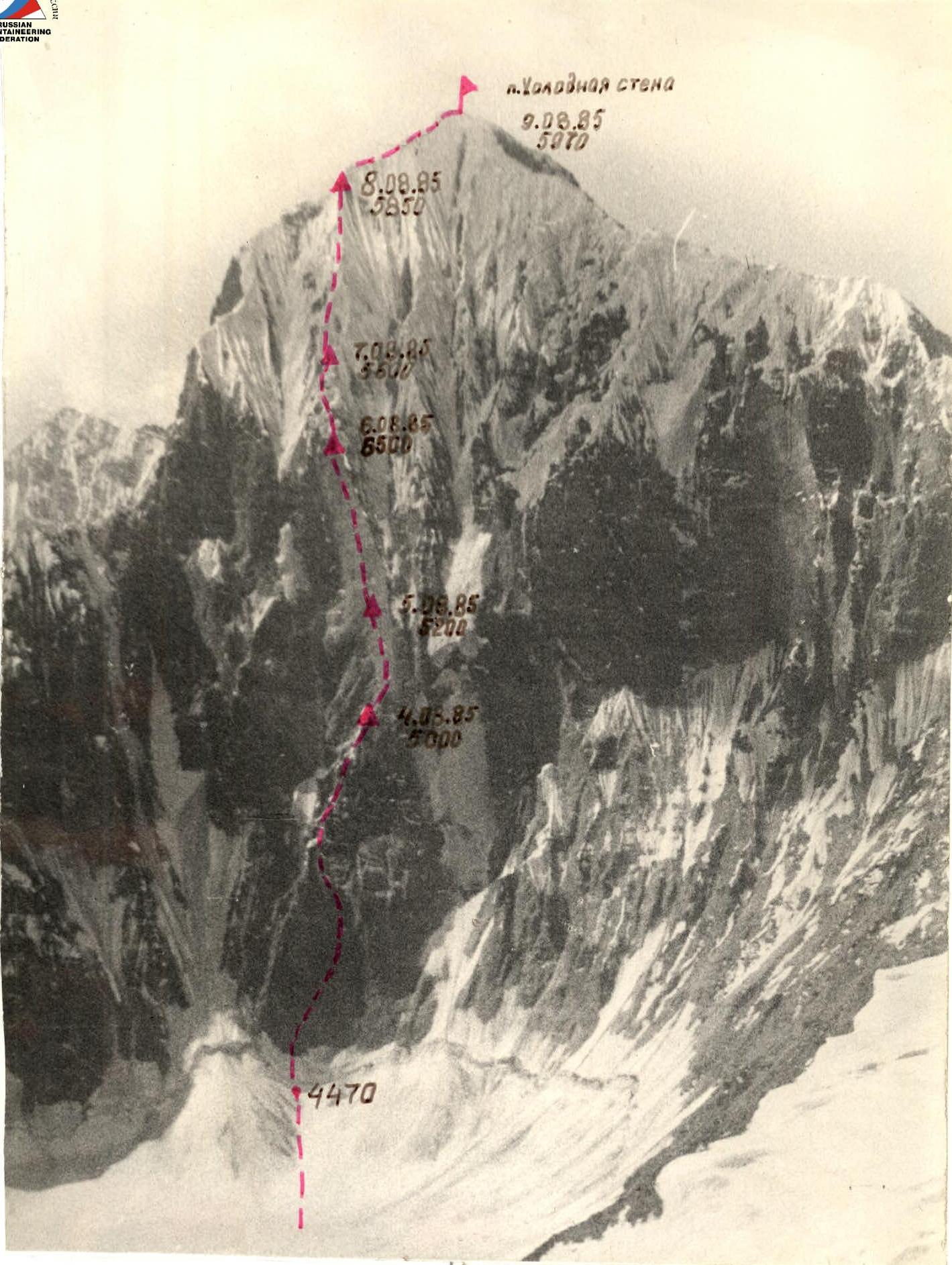
General photo of the summit. Taken on August 6, 1985 at 12:00 from the slope of Ledovaya стена. "Industar" lens, F – 50 mm. Distance 3 km, height 5000 m.
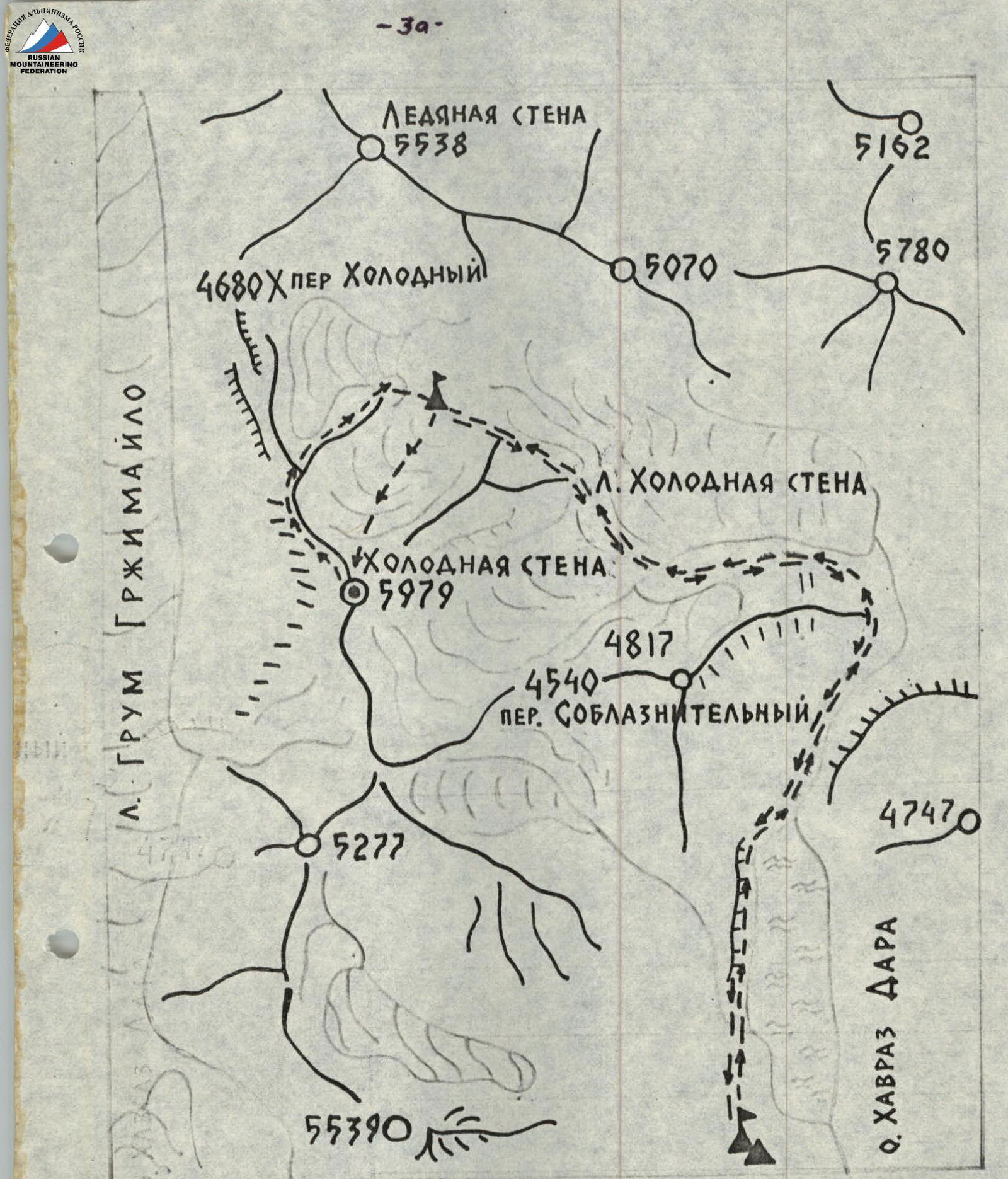
BASE CAMP OBSERVERS' CAMP TEAM'S ROUTE M 1:50000
TACTICAL ACTIONS OF THE TEAM
The first three days went exactly according to the Tactical plan. The distribution of roles was the same as stated in the Tactical plan.
Day 1: August 4
We started the route at 7:00. The first rope team, Lebedev-Zakharov, led. Lebedev went first. Mozharov brought up the rear. We spent the night at section 15–16 in two tents with 3 and 4 people.
Day 2: August 5
On the second day, the first rope team, Dyukov-Bogdanov, started moving at 9:00. Dyukov went first. Double-rope technique was used. Mozharov worked last. We spent the night at section 26 on a sloping shelf with a snow patch. We processed 3 ropes above the bivouac.
Day 3: August 6
On the 3rd day at 9:00, the first rope team, Lebedev-Zakharov, started moving along the fixed ropes and, having passed them, continued moving on rock. Lebedev worked first. Double-rope technique was used. In the upper part of the second rock triangle, on the most steep and complex part of the route, belay points were organized every 15–20 m. This facilitated the work of the first climber. The whole team was stretched out no more than two ropes, which increased safety and improved interaction between participants. We spent the night on a shelf near the summit of the second rock triangle.
Day 4: August 7
On the 4th day at 9:00, the Mozharov-Khoroshikh rope team went ahead. Bogdanov worked last. Mozharov went first on the snow-ice ridge using a single 2mm rope that met UIAA requirements. When bypassing the ice gryphon on a rock section, Bogdanov, who was last, went "pendulum" style and got injured — this happened at 14:00. We descended to the injured climber and provided first aid. We reported the injury via radio communication. Due to Bogdanov's injury, we had to change our tactical actions compared to the previously planned ones to ensure the safety of the injured climber. The Lebedev-Zakharov rope team worked first. Lebedev went first. Loginov worked last in the group. The injured climber climbed along the fixed ropes with top rope belay under constant supervision. Mozharov was constantly near him, and additional fixed ropes were set up for Mozharov. We stopped for the night at 19:00 on the summit of the first gryphon on a large platform. The bivouac was comfortable: two tents were set up in tandem.
Day 5: August 8
The Lebedev-Zakharov rope team departed at 9:00. Lebedev went first, Loginov worked last in the group. The movement of the injured climber was organized as on the previous day. Radio communication was carried out every two hours, through which information about the condition of the injured climber and the group's movement was transmitted. We stopped for the night on the summit ridge. The bivouac was comfortable: in two tents set up in tandem.
Day 6: August 9
At 9:00, we began moving along the ridge. The weather was bad: graupel, fog, visibility 10–15 m. Belay points were organized as often as possible, in any convenient places, on average every 15–20 m. We reached the summit at 13:00. At 14:00, we began descending via the West ridge.
Due to the need for additional belay for the injured climber, organization of more comfortable overnight stays, and a decrease in the pace of movement to ensure the safety of the injured climber, there was a temporary deviation from the original Tactical plan by one day.
DESCRIPTION OF THE ROUTE BY SECTIONS
The first section of the route — ice with a steepness of 75°, 40 m. Then movement on rock to the right and up. The rock on sections 2–11 goes with free climbing, but is heavily destroyed. On average, 5–6 intermediate belay points were made on one rope length, and 3 to 5 local anchor points were made to organize a belay station, which were blocked with slings to evenly distribute the load. Mainly rock pitons were used, often thin ones from among the placement elements — small stoppers.
Sections 11–16 represent a ridge with alternating shelves and rock walls, more monolithic than on sections 2–11, making it easier to organize belay stations. On average, 4–5 intermediate belay points were made on one rope length. Overnight stays are possible:
- on a snowy shelf
- on an ice gryphon
The rock on sections 17–27 (the beginning of the second rock triangle) is characterized by a tiled structure, but is less destroyed than the rock of the first triangle. Here, the following were used:
- rock pitons,
- small and medium-sized cams.
On average, 7 intermediate belay points were organized on one rope length. Belay stations were organized with at least three anchor points. Starting from section 28, the rock becomes increasingly overhanging. The structure of the relief is "reverse tiles". Movement is complicated by the presence of "live" blocks. Pitons, small stoppers, and small cams were used.
On sections 28–29, on average, up to 15 intermediate belay points were made on one rope length.
On section 29–30, it is possible to divert to the right onto a ridge along a small rock shelf. Starting from section 30, the rock becomes more monolithic, but even steeper, with small cornices. Here, nuts, stoppers, and medium and large cams were used more frequently.
Due to the presence of cornices and corners, there were many bends in the rope, and belay stations had to be organized approximately every 20 m. On average, 6–7 intermediate belay points were made on 20 m. On two cornices, artificial aid (ladders) was used.
Overnight stay on section 32–33 on a snow-ice shelf, which turns into a cornice on the left.
The ice ridge, with the use of modern ice climbing equipment — ice screws, ice axes, and ice hammers — was traversed without much tension.
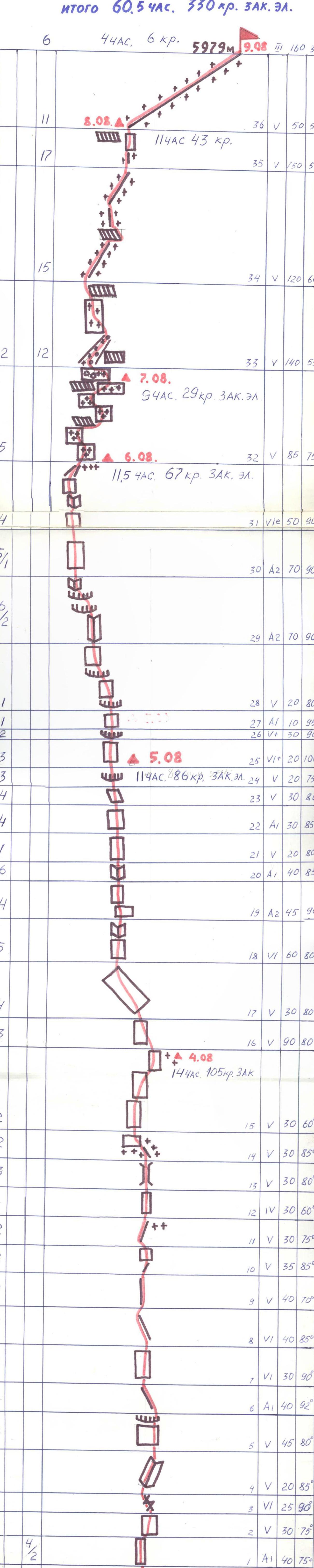 Movement was complicated by poor visibility due to bad weather on the last two days.
It is necessary to pay attention to the safety of movement along the summit ridge, where cornices hang on both sides. Here, belay through an ice axe was often used, as well as through snow and ice overhangs.
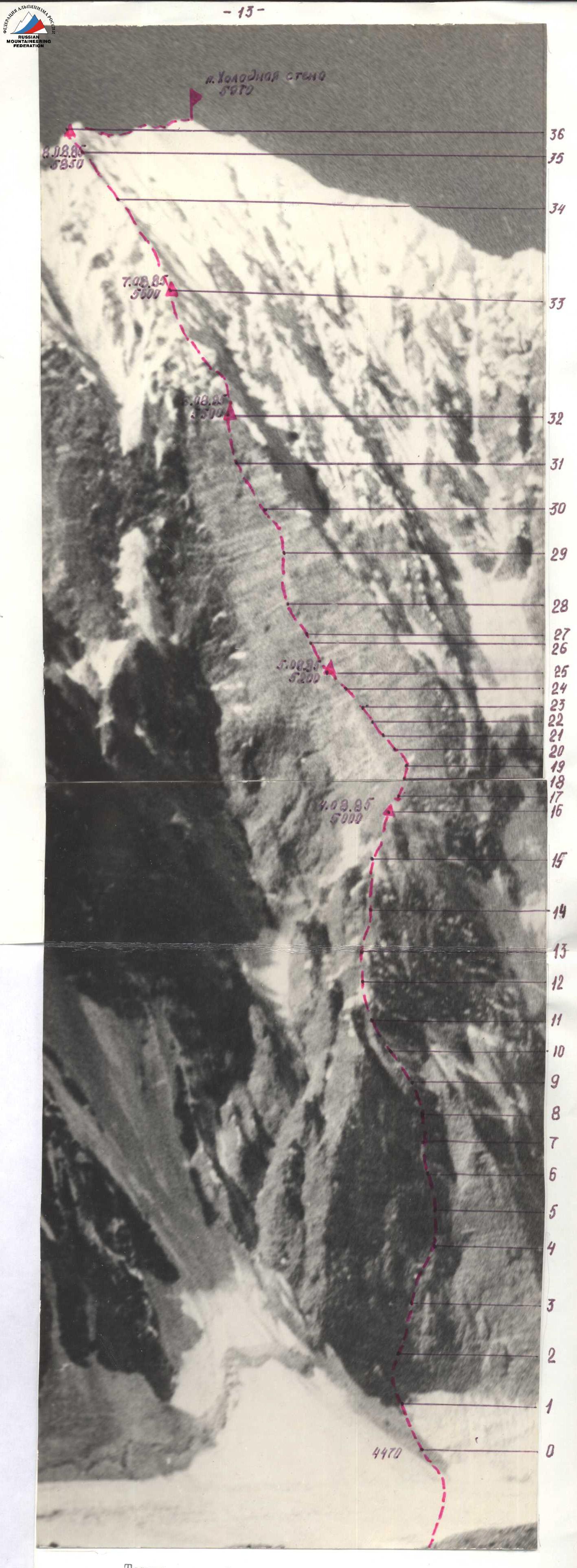
Technical photograph of the route. Taken on August 3, 1985 at 9:30 from the moraine of Kholodnaya стена glacier. "Industar" lens, 50 mm, distance 1.5 km, height 4300 m.

Comments
Sign in to leave a comment