

4.12.38
Armed Forces of the USSR
Report
On the ascent of Peak Oktyabrskoy Revolyutsii 6974 m via the northwestern wall from the Fedchenko Glacier, 6th cat. cl., by the combined team of the Armed Forces of the USSR.
Military-technical ascent.
The ascent is dedicated to the 50th anniversary of the October Revolution.
1967
 Peak Oktyabrskoy Revolyutsii is one of the highest peaks in our homeland.
The height of the peak is 6974 m and is the outer point of the Yazgulemsky latitudinal ridge. Peak Revolyutsii and the surrounding peaks are located at the very top of the world's largest Fedchenko Glacier.
This area was first explored in 1928, and the peak was named by N.V. Krylenko, one of the leaders of the expedition.
Peak Oktyabrskoy Revolyutsii is a huge massif with several peaks, three of which form a convex horseshoe to the east, which breaks off to the south, east, and north with steep walls. The peak drops most impressively and inaccessibly to the northwest onto the Fedchenko Glacier. Here, the wall height reaches 1700 m. The left side of the wall is the steepest part, with rocks free of snow. The route taken by the sports team of the CS "Burevestnik" led by MS USSR L. Myshlyaev in August 1962 follows this part of the wall. The route of ascent via the northwestern wall was recognized as the best ascent of the 1962 season and classified as 6B cat. cl.
The first ascenders noted the high complexity of the route, the large extent of the wall section, the steepness, which in some areas reaches 90°, the extreme destructiveness of the rocks, and the exceptionally laborious approach to the assault camp.
In the 1967 season, the combined team of climbers from the Armed Forces set as their objective to ascend the peak named after the October Revolution, dedicating this ascent to the 50th anniversary of the Soviet state.
The ascent route was planned via the northwestern wall. Qualified consultation and kindly provided photographs by one of the first ascenders (deputy team leader in 1962) MS V. Bozhukov greatly assisted us in organizing the ascent.
Expedition leadership:
- Leader: ZMS USSR V. Ratsek
- Senior coach: MS USSR V. Nekrasov
The expedition included athletes who had repeatedly made ascents in the Pamir and promising young climbers.
The plan for the expedition was thoroughly developed in Moscow and was largely followed.
On July 15, the participants arrived in Osh. Over the next 4 days, work was successfully carried out to prepare for the departure to the ascent area. Participants underwent medical examination, passed control standards, and worked productively on preparing equipment and food supplies. Special sublimated products prepared by the Ministry of Defense's nutrition laboratory were brought in for the assault.
To support the expedition, the following were provided:
- two Mi-4 helicopters
- a radio station
- two vehicles.
On July 19, they arrived in Daraut-Kurgan. From July 20 to 22, preparations were made for the transportation of goods to the upper reaches of the Fedchenko Glacier. A training exit was made to the slopes of the Alay ridge.
Metal barrels were used to transport products, a very useful experiment for future expeditions. During these days, assistance was also provided in transporting the Sverdlovsk expedition by helicopters.
On July 23, participants were airlifted to the Fedchenko Glacier to the Pyльный camp at an altitude of 3200 m.
On the same day, the team proceeded to the bend of the glacier and set up a bivouac at 19:00.
On July 24, they moved towards the observatory. They were warmly welcomed by the friendly young collective of winterers. The cleanliness in the observatory premises, discipline, and high work capacity of the people living in these harsh conditions were striking. Radio communication was established with Daraut-Kurgan. From July 25 to 29, the team made several training exits to the area of Peak Kommunisticheskoy Akademii. They practiced:
- movement techniques on snow, ice, and rocks,
- belay techniques,
- movement in rope teams.
The doctor conducted a thorough medical check. The health of the participants was entirely satisfactory.
On July 30, they moved upwards to the Tanymas snout glacier. They spent the night in the glaciologists' hut. Movement proceeded mainly along the left side of the glacier.
On July 31, they ascended to the plateau at the Abdukagor pass, at an altitude of 5000 m, via the central part of the glacier. They clarified the location for cargo drop via radio communication.
On August 1, helicopters made two flights, dropping about a ton of cargo and skis onto the plateau. They prepared 3 pairs of sleds and resorted the cargo. The products dropped in barrels were 100% intact. August 2 and 3 were tiring, heavy days transporting cargo to the assault camp at an altitude of 5300 m.
Opposite the ridge of Peak 26 Baku Commissars, at the bend of the glacier, an intermediate camp was set up. The assault camp was located at the same site as the 1962 expedition. The location was good. Nearby, across the glacier, the massive Peak Revolyutsii rose with a kilometer-high wall. The route was visible as if on a palm. The first impression of the route was that it was impassable: too steep, with little snow on the rocks. The weather was magnificent. They decided to start processing the route the next day.
August 4. The pair Logvinov–Staroseltsev went to process the lower part of the route. The lower part of the wall consists of 2 rock triangles, composed of rust-colored rocks:
- R1 triangle consists of osypny rocks;
- R2 triangle is composed of light granites and limestones. The rock is destroyed.
The average part of the route is a steep, dissected ridge, beyond which the R3 triangle looms like a black wall, transitioning into a steep ridge at the top, with a wide, steep couloir to the right.
Northwestern wall of Peak Oktyabrskoy Revolyutsii
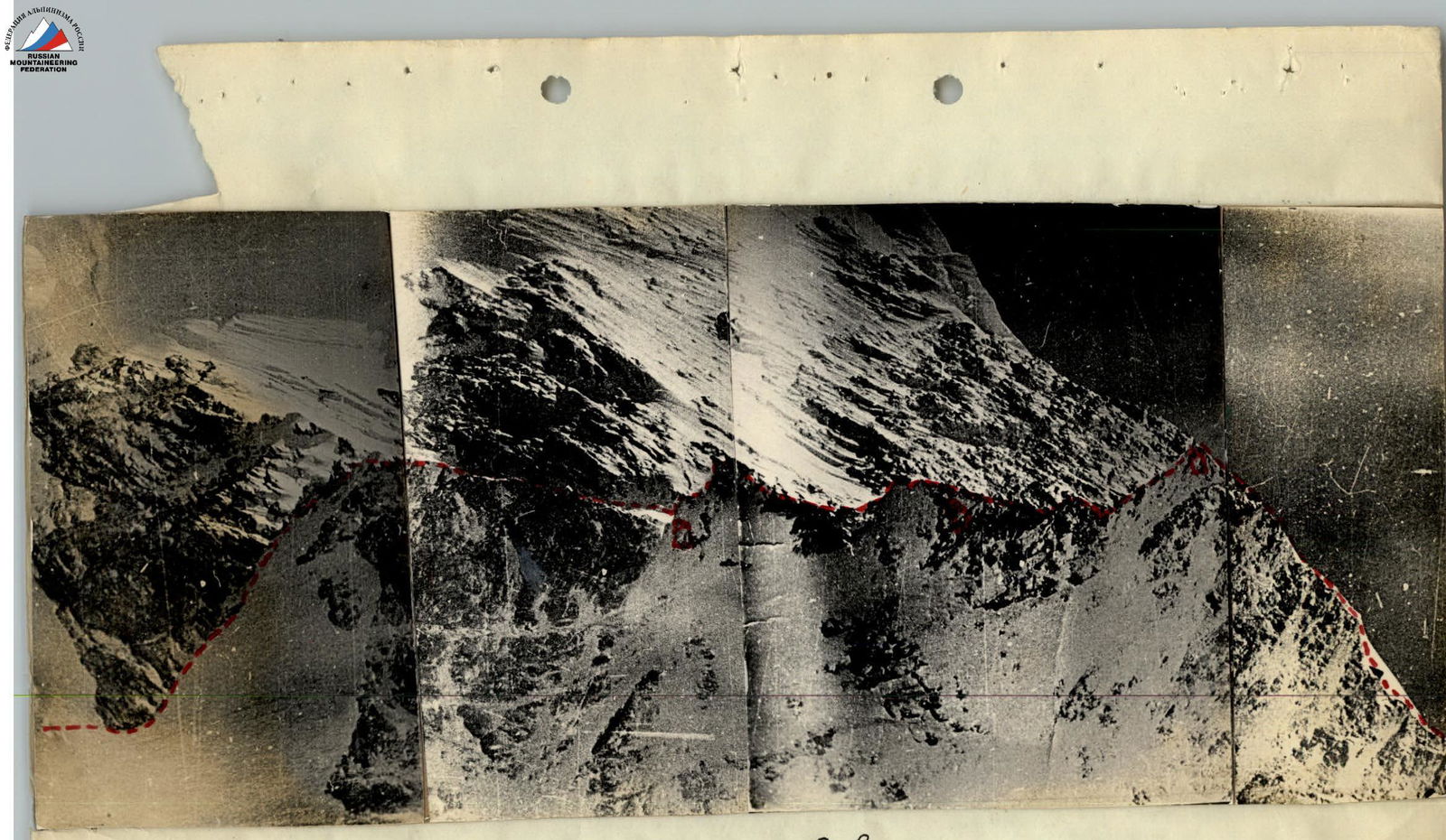
The organizational and tactical plan for the assault is as follows:
- Preliminary processing of the first and second triangles.
- Rest and preparation for the assault.
- Assault.
- Evacuation of the camp.
During the assault, a second team remained below, serving as a kind of rescue team. An observation group was designated. Radio communication with Daraut-Kurgan was stable, with twice-daily updates via the observatory. Later, climbers from Chelyabinsk arrived in our area, and the teams from our camp were in interaction with them until the end of the expedition.
On August 4, the section R1–R2 was processed, with an average steepness of 45° and a length of about 300 m. From the assault camp, we crossed the glacier and reached the bergschrund in 30–40 minutes, which was overcome relatively easily. We ascended directly to the rocks and along the right edge of the triangle, moving upwards to the left. The rocks were of medium difficulty, interspersed with ice and snow. Then we moved up a rocky ridge for about 40 m, with a steep ice couloir to the left. Further, 2 ropes straight up the ice slope to a rocky ridge, heavily destroyed. We exited onto a small platform to the first steep rock wall. The processing ended here on August 4. On the same day, the second team of 4 people led by Parkhomenko went to scout the route to Peak 26 Baku Commissars. Those remaining below in the assault camp worked on preparing equipment and food supplies.
August 5. Two pairs went out for processing: Nekrasov – Nazarov, Bitny – Demchenko.
We quickly passed the sections processed the day before. The first wall was climbed directly with hook belay. We reached a narrow shelf extending to the right. We found traces of processing by Myshlyaev's group. To the left in the couloir hung a rope. At the top of the overhang, a tangled ladder was seen.
Further along the route, we frequently encountered ropes, broken in several places by stones. The path was marked, which naturally facilitated the group's choice of ascent route. Sections R5 and R6 proved to be the most challenging. We had to use ladders and a large number of hooks. In a day, 180 m of the path were processed to section R7. The narrow, steep couloir-c chimney was difficult to pass. On section R6, we had to pull up backpacks. Over two days of processing, sections R1–R7 were processed, with a total length of about 500 m.
Processing with descents took 20 hours. Used:
- 34 sleeping bags
- 5 ice hooks.
August 6–8. Days of rest and preparation for the assault. The group returned from scouting the route to Peak 26 Baku Commissars.
August 8. A group of climbers from Chelyabinsk led by A. Kuznetsov arrived at the camp, made a drop of food and some equipment. The Chelyabinsk climbers planned to ascend Peak Revolyutsii, just like us.
At a coaches' council, the composition of the assault group was decided to be 6 people, with the remaining comrades to ascend Peak 26 Baku Commissars after the main group passed the wall. MS Solodnikov G.K. was left in charge of the assault camp. 7 people remained below.
August 9. The day of the assault began. The group departed in the following composition:
| Surname | I.O. | Rank |
|---|---|---|
| Nekrasov | V.P. | — MS |
| Bitny | A.V. | — MS |
| Demchenko | A.S. | — p.m.s. |
| Logvinov | V.I. | — MS |
| Staroseltsev | E.V. | — KMS |
| Nazarov | I.U. | — KMS |
Departure was at 8:30. The triangle was passed by 11:00. Section R8, representing the left part of the couloir, was reached by 18:00. The remaining path to the night's bivouac consisted of icy steep rocks, with movement proceeding directly upwards, slightly deviating to the left. Careful hook belay was used. At 20:00, they reached a platform. The platform was ready, with a bivouac previously established by the first ascenders. From a control post, specifically a bucket attached with an expanding hook, they retrieved a note dated August 11, 1962.
They signaled down with a green flare. Movement on the route proceeded alternately in pairs: Nekrasov – Nazarov, Bitny – Demchenko, Logvinov – Staroseltsev.

Section R8. Ascent to the first night's bivouac.
August 10. Departure at 11:00. Fatigue from the previous difficult day was evident. According to the plan, they needed to pass only the ridge under R3 ascent.
To the left, an osypnaya shelf deviated, bypassing a sentinel, leading to a narrow, steep ridge. The ascent was 20 m straight up to a rocky ridge, then along a couloir to the right into a depression, from which the ascent proceeded up a narrow chimney. This section was quite difficult and required careful hook belay. Then followed a snow-covered rocky ridge, which led to a steep, black rock wall (section R11). Initially, they moved left-upwards (6 m), then transferred right into an internal angle and straight up to a small platform. At 16:00, snow began to fall, with strong winds. They decided to set up a bivouac. They stopped at 17:00. The working day was 6 hours.
August 11. Departure at 8:30 from the night's bivouac, left-upwards along a rocky slab (40 m).
Hook belay was used. They reached a shelf and followed it left to a wall (8 m) – section R14.
Further, a vertical wall with an external angle followed (section R15). The wall was climbed without backpacks. At the top of the wall, there was a small platform, from which movement proceeded right-upwards along an internal angle, leading to a rocky slab.
They reached a rocky counterfort, sharply turned left, and followed the counterfort to an osypnoye ridge and then to the eastern ridge of Peak Revolyutsii (section R18). This concluded the wall section of the route. They stopped for a bivouac at 18:00. The altitude was approximately 6350 m.
August 12. Departure at 9:00. Sections R19–R21 represented a rocky ridge with snow and ice. The steepness gradually decreased, and at an altitude of 6700 m, there was a flat, wide platform where they set up a night's bivouac. The ascent route from the Grum-Grжимайло Glacier via route 5A also led to this platform. They stopped for a bivouac at 17:00.
Pre-summit ridge
August 13. Departure at 9:00. They traveled lightly. Movement proceeded along a snow-ice ridge (sections R22–R25), then crossed right along an osypnaya shelf and reached an osypnaya flat platform. They descended into a depression and ascended along a rocky ridge to the saddle between the main and southeastern peaks.
The saddle was wide and transitioned into a large plateau bounded by 3 peaks of Peak Revolyutsii. They turned right and followed the pre-summit ridge to the summit of Peak Revolyutsii at 12:00.
They retrieved a note from Chelyabinsk climbers from 1964, who had traversed Peaks: Paris Commune, 26 Baku Commissars, Revolyutsii, and A. Grin.
At 12:30, they began their descent, initially following the ascent route to the tent at 6700 m, then right down into a large snow-ice depression and along it to the plateau towards the eastern peak.
The descent route entirely followed route 5A. From the plateau, they descended right down a steep ice slope (4 ropes) to the Grum-Grжимайlo Glacier. They set up a bivouac on the glacier at an altitude of about 5300 m. They stopped for a bivouac at 18:00.
August 14. Departure at 9:00. They traversed the center of the glacier, passed the icefall, and descended down to the ascent to the Zimovskhikov pass, which led to the upper reaches of the Vitkovsky Glacier.
At 15:00, they reached the pass, then crossed the glacier to the saddle between Uzlovaya and Peak Omar-Khayyam. Under the saddle, they stopped for the night.
August 15. Departure at 9:00. The ascent to the saddle and descent from the assault camp took 2 hours.
From August 16 to 21:
- Evacuation of the camp
- Return to Osh
34 days were spent.
Conclusion on the route
The ascent route to Peak Oktyabrskoy Revolyutsii via the northwestern wall is a combined wall route of the highest category of difficulty. The classification of the route corresponds to 6B cat. cl. The route is safe, although it requires significant caution during movement, as the rocks are destroyed on most sections of the wall. The team spent 37 hours of climbing time to reach the summit, not counting the 20 hours spent processing the first two triangles.
From the assault camp to the summit took 55 hours of climbing time. During the passage of the route, the following were used:
- rock hooks — 79
- ice hooks — 9
4 ice hooks were used during the descent. The usual standard mountaineering equipment was used during the ascent. Boots were taken a size larger to use fur socks.
The group had one pair of "Vibram" boots, which facilitated work on several sections.
The expedition was provided with food supplies in sufficient quantity and variety. Sublimated products fully justified themselves and should be widely used by climbers in the future. There were no injuries or frostbite among the participants.
Meteorological conditions were good. No illnesses were observed during the expedition.
Participants of the assault group
The participants of the assault group during the ascent demonstrated themselves to be disciplined, organized, and competent climbers. The division into pairs was correct. The planned tactical plan for the assault was executed.
The following performed particularly well:
- p.m.s. Demchenko
- MS Bitny
- KMS Staroseltsev
MS Nazarov I. needs to pay more attention to technical preparation and improve rock climbing technique.
Overall, the group successfully coped with the task, and its participants can be recommended for any high-altitude ascents.
Senior coach of the combined team of the Armed Forces of the USSR
Team captain
MS USSR V. Nekrasov

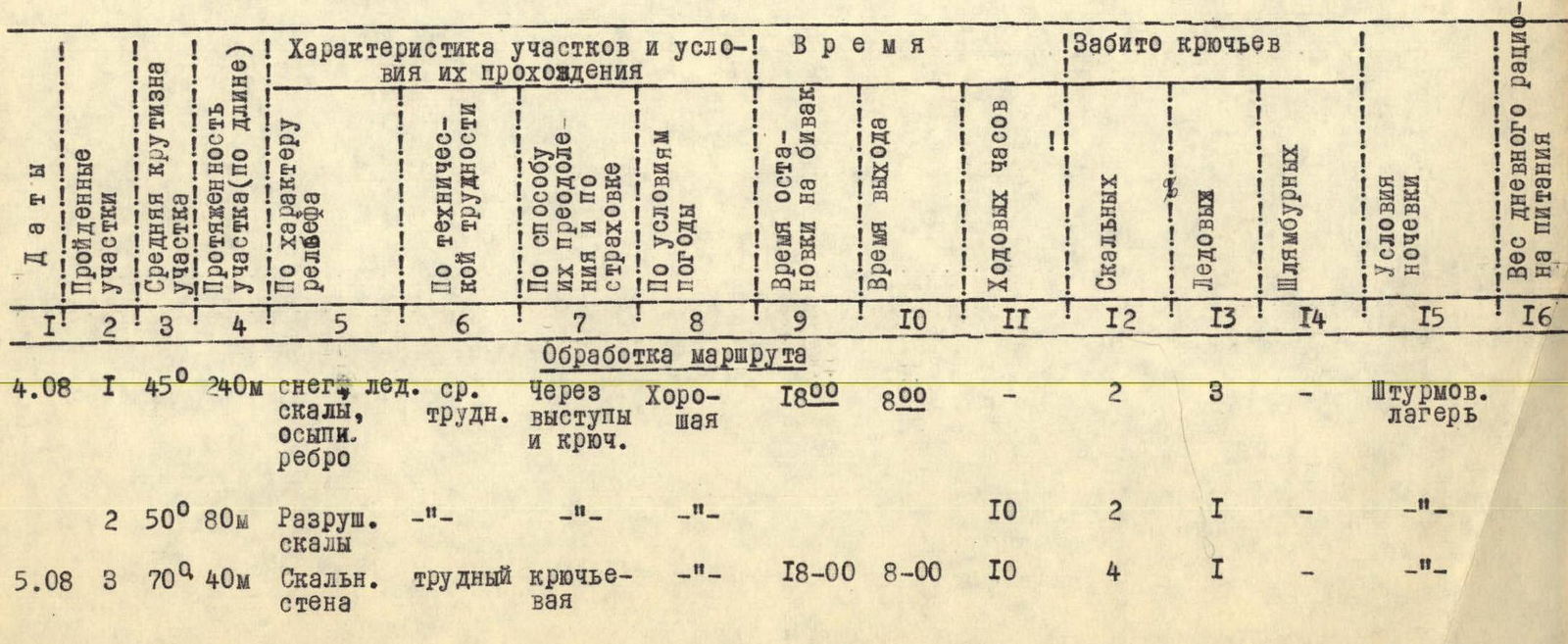
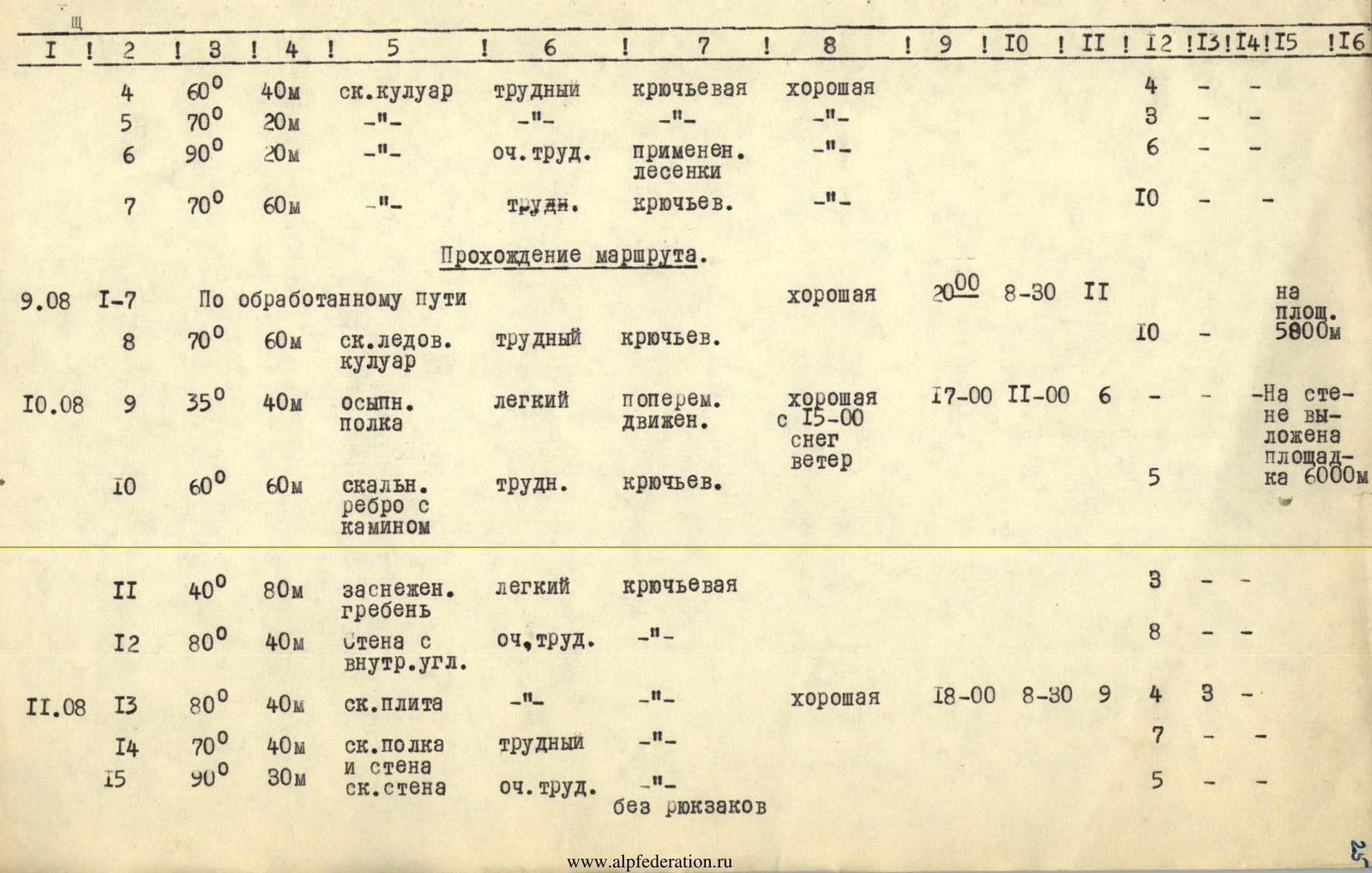
Table
of the main characteristics of the ascent route
Ascent route: northwestern wall of Peak Revolyutsii.
Route height difference: 1700 m. Including complex sections — 400 m.
Route steepness — 65°.
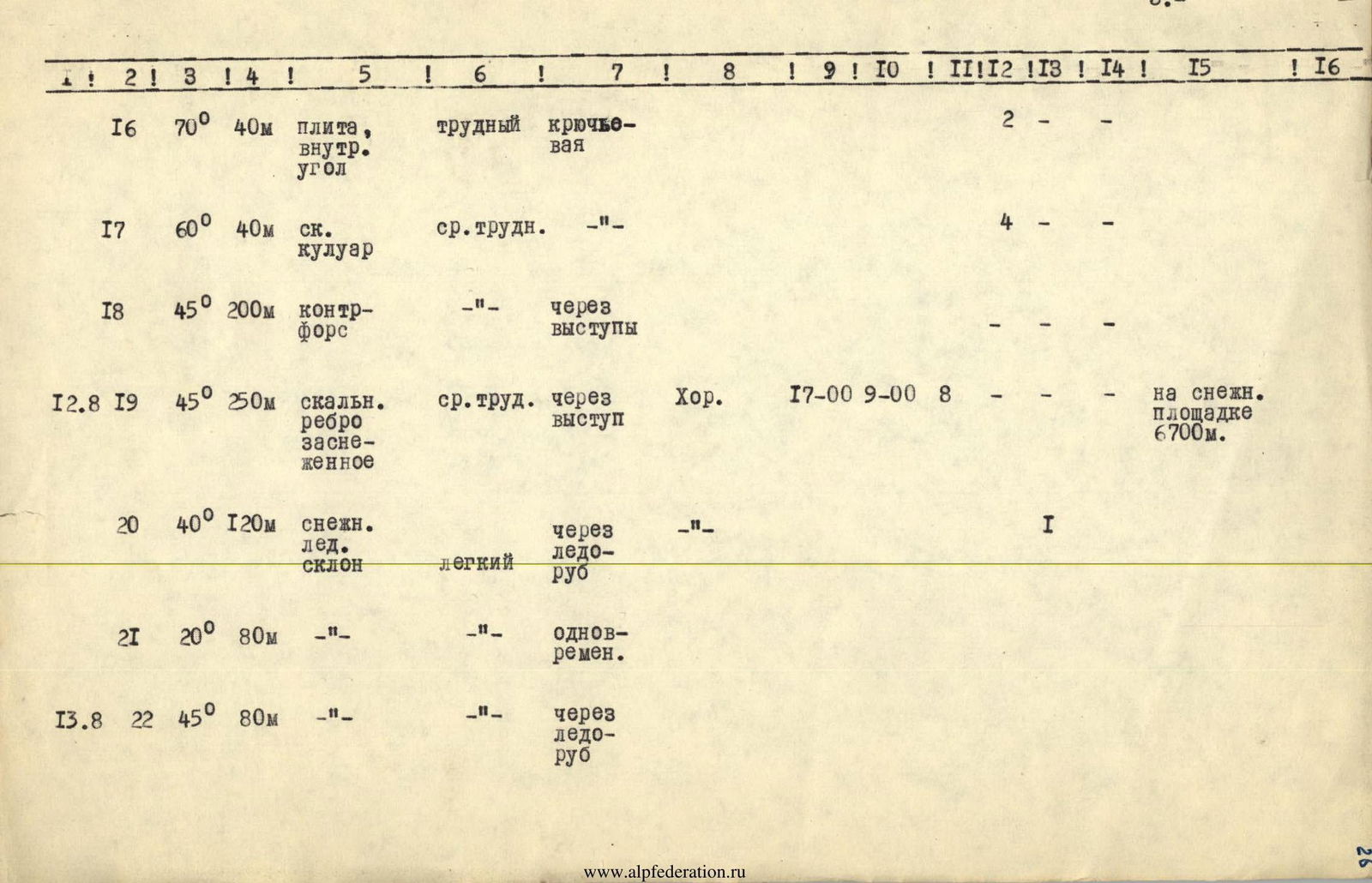
| Dates | Section | Steepness | Length | Characteristics of sections | Climbing conditions | Time (start) | Time (end) | Hooks used (rock) | Hooks used (ice) | Notes | Weight of daily ration |
|---|---|---|---|---|---|---|---|---|---|---|---|
| Route processing | |||||||||||
| August 4 | R1 | 45° | 240 m | snow, ice, rocks, ledges, and hooks | medium difficulty, good | 18:00 | 8:00 | 2 | 3 | Assault camp | |
| R2 | 50° | 80 m | destroyed rocks | — | — | — | 0 | 2 | — | ||
| August 5 | R3 | 70° | 40 m | rock wall | difficult, hook belay | 18:00 | 8:00 | 4 | 1 | — | |
| R4 | 60° | 40 m | rocky couloir | difficult, hook belay, good | — | — | 4 | — | — | ||
| R5 | 70° | 20 m | — | — | — | — | 3 | — | — | ||
| R6 | 90° | 20 m | — | very difficult, ladders used | — | — | 6 | — | — | ||
| R7 | 70° | 60 m | — | difficult, hook belay | — | — | 10 | — | — | ||
| Route passage | |||||||||||
| August 9 | R1–R7 | — | — | along the processed route | good | 20:00 | 8:30 | 11 | — | on the 5800 m platform | |
| R8 | 70° | 60 m | rocky-ice couloir | difficult, hook belay | — | — | 10 | — | — | ||
| August 10 | R9 | 35° | 40 m | osypnaya shelf | easy, alternating movement, good | 17:00 | 11:00 | 6 | — | on the 6000 m wall platform | |
| R10 | 60° | 60 m | rocky ridge with a chimney | difficult, hook belay | — | — | 5 | — | — | ||
| R11 | 40° | 80 m | snow-covered ridge | easy, hook belay | — | — | 3 | — | — | ||
| R12 | 80° | 40 m | wall with an internal angle | very difficult | — | — | 8 | — | — | ||
| August 11 | R13 | 80° | 40 m | rocky slab | — | 18:00 | 8:30 | 9 | 4 | — | |
| R14 | 70° | 40 m | rocky shelf and wall | difficult | — | — | 7 | — | — | ||
| R15 | 90° | 30 m | rocky wall | very difficult, without backpacks | — | — | 5 | — | — | ||
| R16 | 70° | 40 m | slab, internal angle | difficult, hook belay | — | — | 2 | — | — | ||
| R17 | 60° | 40 m | rocky couloir | medium difficulty | — | — | 4 | — | — | ||
| R18 | 45° | 200 m | counterfort | destroyed, via ledges | — | — | 0 | — | — | ||
| August 12 | R19 | 45° | 250 m | rocky snow-covered ridge | medium difficulty, via ledges, good | 17:00 | 9:00 | 8 | — | on the 6700 m snow platform | |
| R20 | 40° | 120 m | snow-ice slope | easy, via ice axe | — | — | 1 | — | — | ||
| R21 | 20° | 80 m | snow-ice ridge | simultaneous movement | — | — | — | — | — | ||
| August 13 | R22 | 45° | 80 m | snow-ice ridge | via ice axe | — | — | — | — | — | |
| R23 | descent | 40 m | snow-ice slope | easy, simultaneous movement | — | — | — | — | — | ||
| R24 | 45° | 80 m | snow-ice ridge | via ice axe | — | — | — | — | — | ||
| R25 | 30° | 60 m | osypnaya shelf | easy, simultaneous movement | — | — | — | — | — | ||
| R26 | 20° | 60 m | snow slope | simultaneous movement | — | — | — | — | — | Weight of daily ration during assault was 800 g. | |
| R27 | descent | 40 m | snow-ice slope | — | — | — | — | — | — | ||
| R28 | 10° | 60 m | snow slope | — | — | — | — | — | — | ||
| R29 | 45° | 100 m | rocky-ice slope, snow | medium difficulty, via ice axe and ledges | — | — | — | — | — | ||
| R30 | 30° | 200 m | snow slope | easy, simultaneous movement | — | — | — | — | — | ||
| R31 | 10° | 40 m | snow ridge | simultaneous movement | — | — | — | — | Summit |
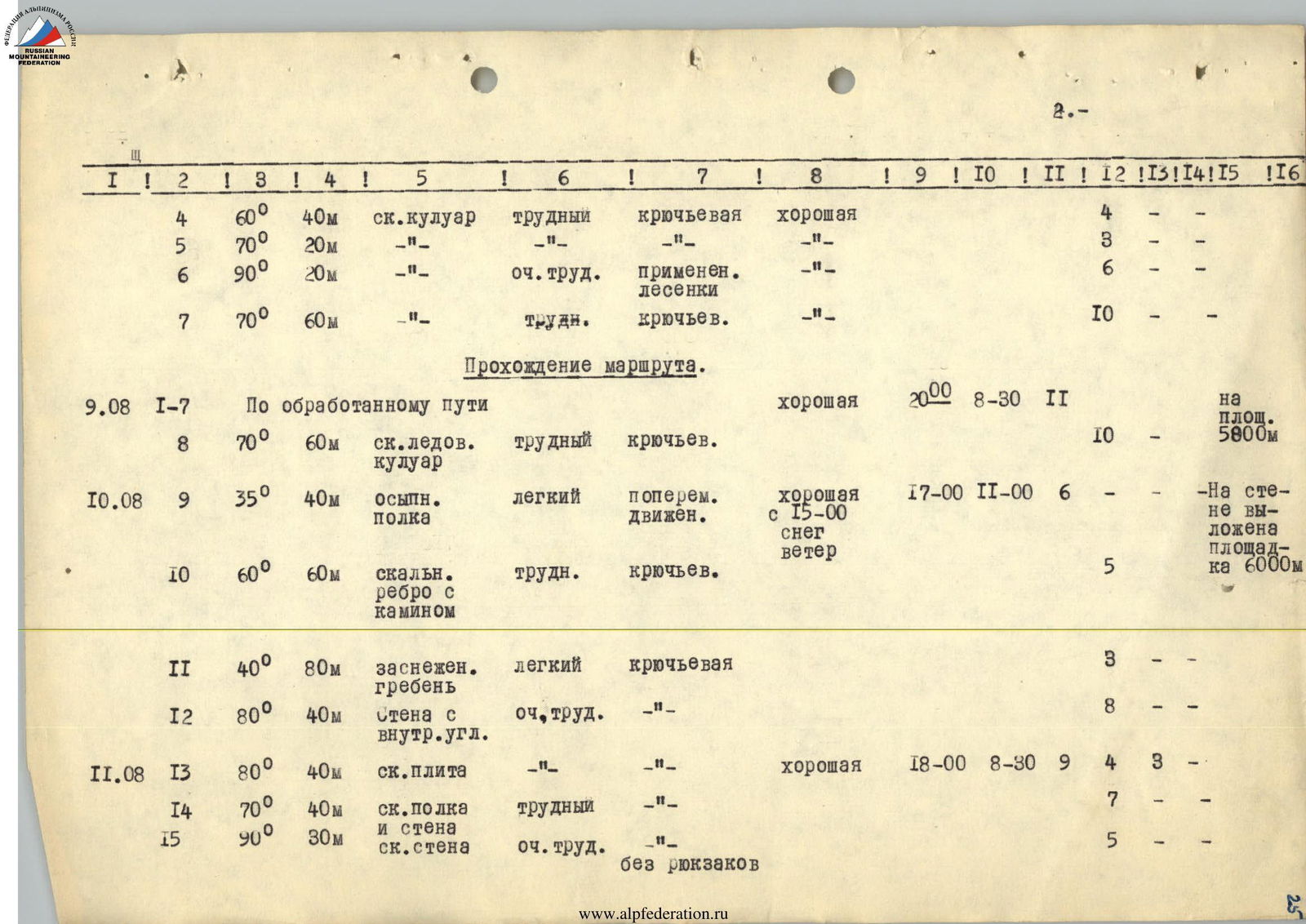
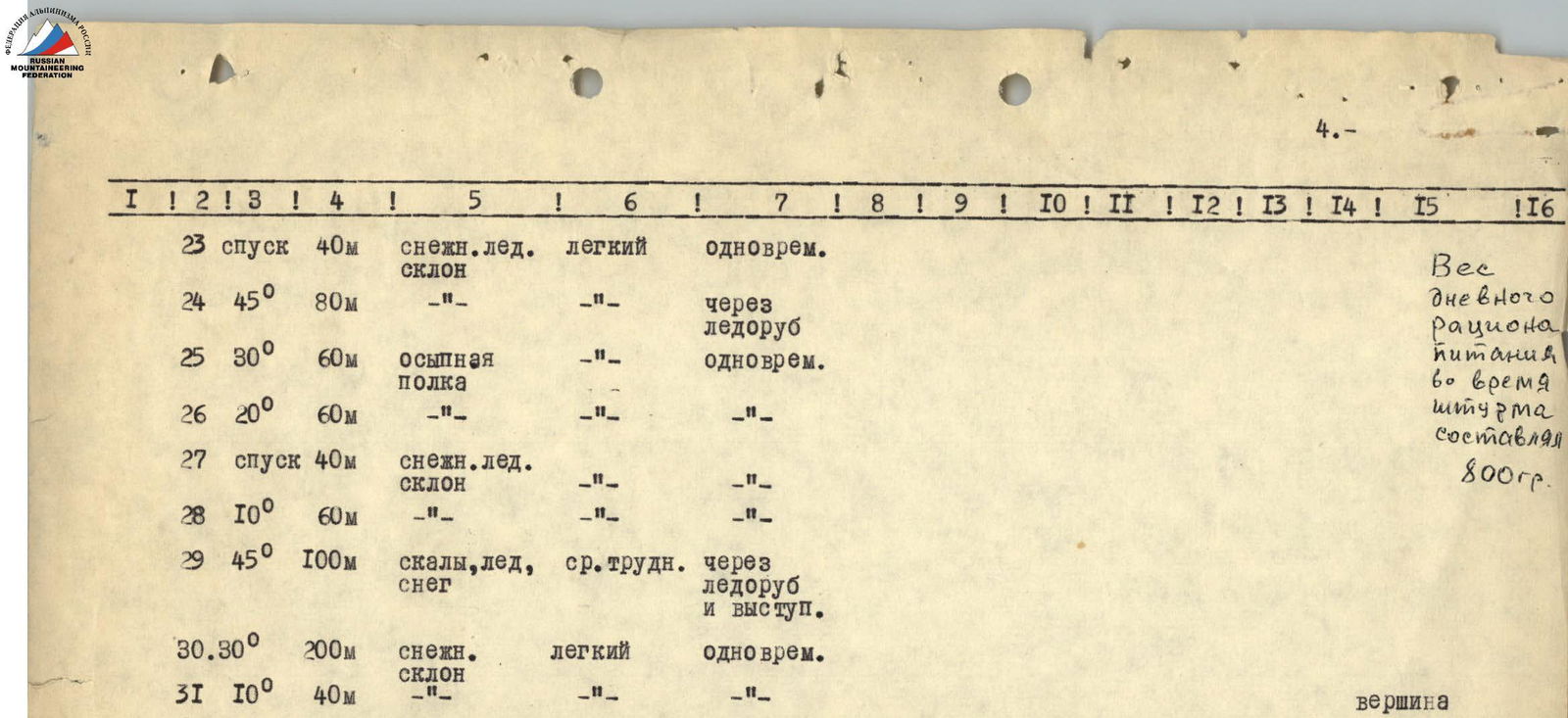
Descent was made to 6700 m along the ascent route, then via route 5A. 4 ice hooks were used.
Total hooks used: 79 (rock), 13 (ice).

Comments
Sign in to leave a comment