

Georgian Alpine Club named after A. Japaridze
Tadj. G.U. eastern edge ridge of the southern sub-peak (First ascent report)
Team captain G. Kartvelishvili
Team coach T. Berishvili
Tbilisi – 1979
863
21/26
Brief characteristics of the area and the ascent object
Peak named after Tajik State University, 6183 m, is located in the spur of the Shakhdarin ridge in the South-West Pamir.
The spur, branching off from the nodal peak of Peak K. Marx, stretches in a south-south-easterly direction, separating the Zughvand valley from the system of glaciers and valleys - Nishgar and Drij.
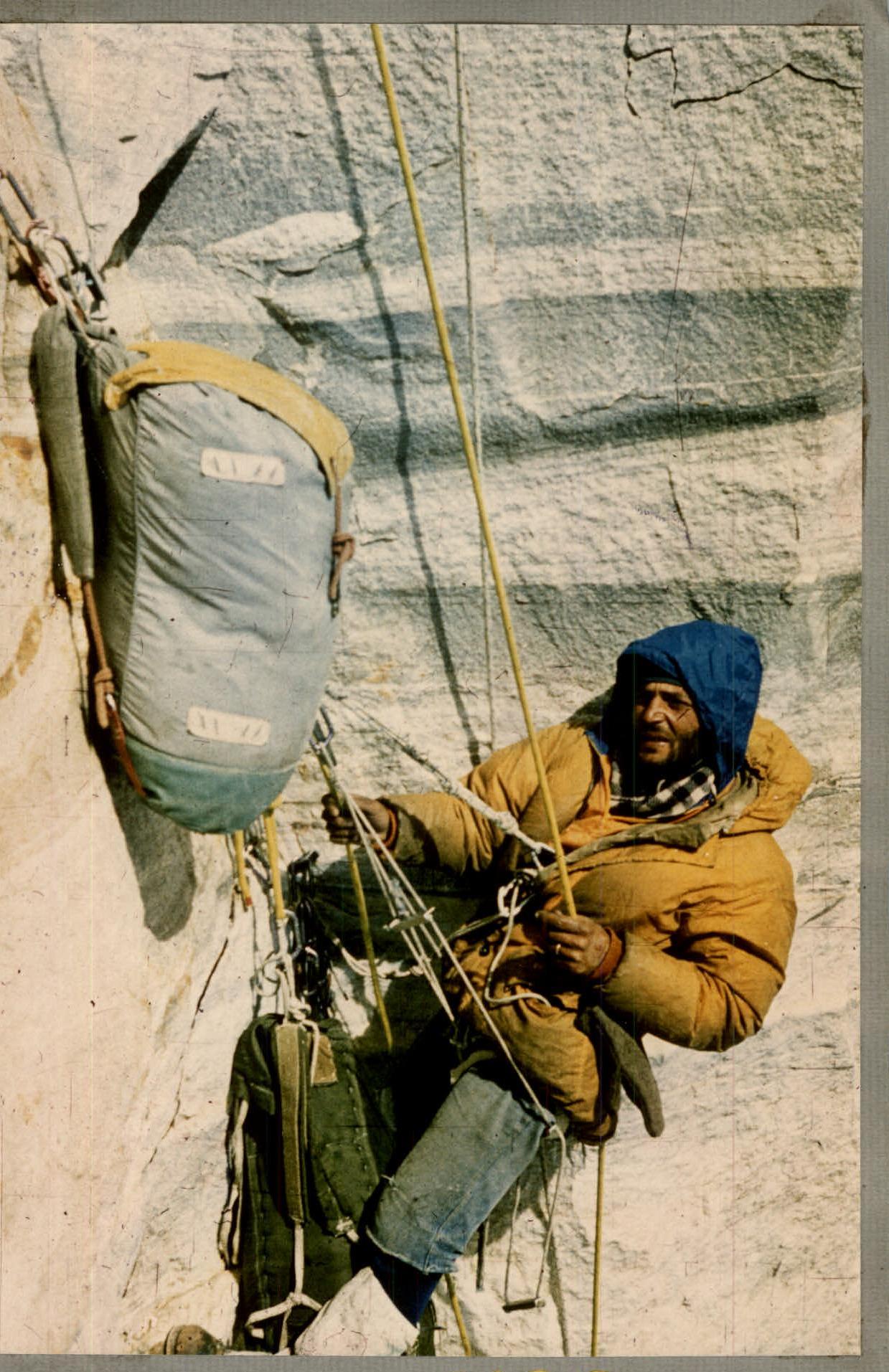
A characteristic feature of the spur is that to the north-east, for almost its entire length, it breaks off with sheer kilometer-high walls into the Zughvand valley, thus representing an extremely interesting mountaineering object with majestic peaks:
- LGU
- Tajikistan
- Tajik G.U.
- Nikoladze and others.
This explains the great popularity of various routes to these peaks, most of which are among the most challenging.
However, despite such popularity, the highlight of the area - the pronounced edge of the eastern ridge of the southern sub-peak of Taj. G.U. - was considered a route for the future.
The rocks composing the eastern wall of Taj. G.U. are diverse:
- The lower bastions are composed of sandstones and shales,
- The middle ones are a very chaotic mixture of granites, marble belts, and sandstones,
- The upper ones are an alternation of wide smooth granite and marble belts.
From the village of Langar, a trail goes up the Kishty-Jerob valley. A green meadow (4200 m) is usually used as a base camp.
From here, along the orographic left side of the glacier, the trail leads to the so-called "dusty nights" - 3-4 hours walk.
Further:
- Cross the glacier
- Cross the "5200" pass between the peaks of Moscow Pravda and Engels into the Zughvand valley - 4-5 hours
- Cross the Zughvand glacier in 1 hour
- Approach the foot of the eastern wall of p. Taj. G.U.
Table of main characteristics of the ascent route
| Date | Designation | Average steepness in degrees | Length in m | Terrain character | Difficulty | Condition | Weather conditions | Rock hooks | Bolt hooks |
|---|---|---|---|---|---|---|---|---|---|
| 21.07 | R0–R1 | 90 | 40 | Steep rocks, occasional short overhangs, few holds. | 6 | Monolithic. Large longitudinal cracks. | Clear | 12; 2 | - |
| R1–R2 | 80 | 20 | Steep rocks. Few holds. | 6 | Monolithic. Blocks detached from the wall. | —"— | 5 | - | |
| R2–R3 | 90 | 20 | —"— | 6 | Monolithic. Few cracks. | —"— | 7 | - | |
| R3–R4 | 75 | 40 | Steep rocks. Slabs. Blocks. Few holds. | 6 | Monolithic. Cracks present. Rockfall hazard. | —"— | 9 | - | |
| Day of processing. | Departure - 7:00. Stop for the night - 19:00. Number of climbing hours - 12. | Total hooks hammered in per day - 35. Overnight stay sitting for three. |
Continuation of the table
| I | 2 | 3 | 4 | 5 | 6 | 7 | 8 | 9 | 10 |
|---|---|---|---|---|---|---|---|---|---|
| 22.07 | R4–R5 | 80 | 75 | Steep rocks. Holds in sufficient quantity. | 6 | Monolithic. Cracks present. Rockfall hazard. | Clear | 14 | - |
| R5–R6 | 40 | 80 | Scree shelf. | 4 | Broken rocks. местами мокрые. Ice patches. Rockfall hazard. | —"— | 4 | - | |
| Departure - 13:00. Stop for the night - 19:00. Number of climbing hours - 6. | Total hooks hammered in per day - 18. Semi-reclining overnight stay. | ||||||||
| 23.07 | R6–R7 | 80 | 75 | Rock wall. Holds sufficient. | 6 | Disjointed rocks with large cracks. | Clear | 12 | - |
| R7–R8 | 65 | 125 | Rock wall. Calcasporas. | 6 | Disjointed, broken rocks. | —"— | 12 | - | |
| R8–R9 | 85 | 35 | Rock wall. Large longitudinal cracks. Few holds. | 6 | Monolithic. Large slabs. | —"— | 11 | - | |
| Departure - 13:00. Stop for the night - 20:00. Number of climbing hours - 7. | Total hooks hammered in per day - 35. |
Continuation of the table
| I | 2 | 3 | 4 | 5 | 6 | 7 | 8 | 9 | 10 |
|---|---|---|---|---|---|---|---|---|---|
| 24.07 | R9–R10 | 93 | 40 | Convex rock wall. Very few holds. Cornices. | 6 | Monolithic. Alternating different rocks. Few cracks. | Weather deteriorating. Cirrus. | 19; 4 | - |
| R10–R11 | 90 | 40 | Rock wall. Very few holds. Internal angle. | 6 | —"— | —"— | 15; 3 | - | |
| Departure - 10:00. Stop for the night - 21:00. Number of climbing hours - 11. | Total hooks hammered in per day - 41. Semi-reclining overnight stay. Two sitting. | ||||||||
| 25.07 | R11–R12 | 90 | 25 | Rock wall. Very few holds. | 6 | —"— | Bad weather. Strong wind. Fog. | 8 | - |
| R12–R13 | 65 | 110 | Steep rocky ridge. Occasional 3-5 m rock walls. | 6 | Broken rocks. | —"— | 15 | - | |
| R13–R14 | 75 | 25 | Steep rocks with ledges. | 6 | Slightly broken rocks. | Strong wind. Sleet. | 4 | - | |
| Departure - 7:00. Stop for the night - 20:00. Number of climbing hours - 13. | Total hooks hammered in per day - 27. Semi-reclining overnight stay in a tent for four. Two - separately. |
 Continuation of the table
| I | 2 | 3 | 4 | 5 | 6 | 7 | 8 | 9 | 10 |
|---|---|---|---|---|---|---|---|---|---|
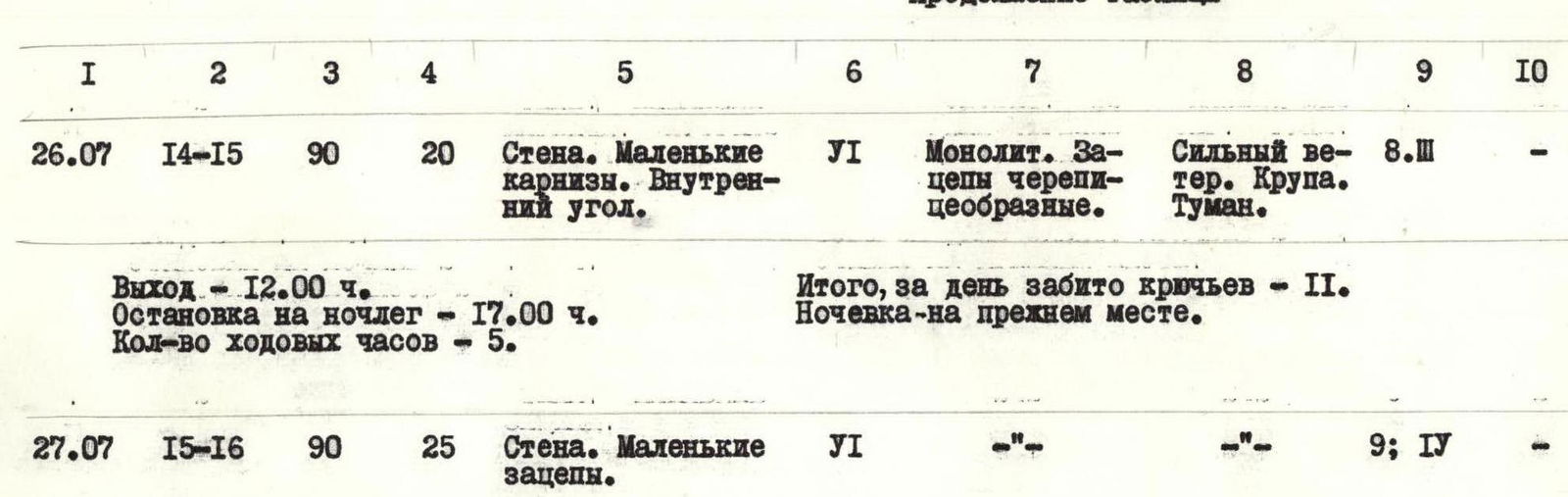
| 26.07 | R14–R15 | 90 | 20 | Wall. Small cornices. Internal angle. | 6 | Monolithic. Tile-like holds. | Strong wind. Sleet. Fog. | 8; 3 | - |
| Departure - 12:00. Stop for the night - 17:00. Number of climbing hours - 5. | Total hooks hammered in per day - 11. Overnight stay - at the same place. | ||||||||
| 27.07 | R15–R16 | 90 | 25 | Wall. Small holds. | 6 | —"— | —"— | 9; 4 | - |
| Departure - 10:00. Stop for the night - 18:00. Number of climbing hours - 8. | Total hooks hammered in per day - 13. Overnight stay - at the same place. |
Continuation of the table
| I | 2 | 3 | 4 | 5 | 6 | 7 | 8 | 9 | 10 |
|---|---|---|---|---|---|---|---|---|---|
| 28–31.07 | R16–R17 | 92 | 20 | Smooth wall. Thin, flaking slabs. Few holds. | 6 | Monolithic. Very limited number of cracks. | Strong wind. Fog. | 3; 2 | - |
| R17–R18 | 95 | 25 | Absolutely smooth wall. Thin, flaking slabs. | 6 | Monolithic. | —"— | - | 19 | |
| R18–R19 | 95 | 55 | Absolutely smooth wall. Overhang with internal angle. | 6 | Monolithic. Very limited number of cracks. | Storm subsiding. Weather improving. 31 July - good. | 4; 9 | 17 |
Total climbing hours - 42. Total hooks hammered in for these days - 54.
Overnight stays:
- 28-30 July - sitting, two - in hammocks
- 31 July - sitting, two - in hammocks, three - at the previous location
Continuation of the table
| I | 2 | 3 | 4 | 5 | 6 | 7 | 8 | 9 | 10 |
|---|---|---|---|---|---|---|---|---|---|
| 1.08 | R19–R20 | 92 | 20 | Smooth wall. Very few holds. Cascade of cornices. | 6 | Monolithic. Few cracks. | Clear. | 10; 2 | 1 |
| R20–R21 | 120 | 1 | Cornice. | 6 | —"— | —"— | 2; 2 | - | |
| R21–R22 | 100 | 30 | Overhang with smoothed holds. | 6 | —"— | —"— | 7; 9 | - | |
| Departure - 8:00. Stop for the night - 19:00. Number of climbing hours - 11. | Total hooks hammered in per day - 33. Overnight stay - sitting for two. Hanging in a hammock - for another pair. | ||||||||
| 2.08 | R22–R23 | 90 | 45 | Wall. Few holds. Internal angle. | 6 | Monolithic. Cracks present. | Clear. | 19; 3 | - |
| R23–R24 | 150 | 1 | Cornice. | 6 | —"— | —"— | 3 | - | |
| R24–R25 | 92 | 45 | Wall. Holds present. | 6 | —"— | —"— | 19; 6 | 1 | |
| Departure - 8:00. Stop for the night - 21:00. Number of climbing hours - 13. | Total hooks hammered in per day - 51. Semi-reclining, in a niche. |
Continuation of the table
| I | 2 | 3 | 4 | 5 | 6 | 7 | 8 | 9 | 10 |
|---|---|---|---|---|---|---|---|---|---|
| 3.08 | R25–R26 | 90 | 65 | Disjointed wall. Holds present | 6 | Broken rocks. Cracks present. | Clear. | 21 | - |
| R26–R27 | 85 | 15 | —"— | 6 | —"— | —"— | 4 | - | |
| R27–R28 | 120 | 1 | Snow cornice. | 6 | Hard firn. | —"— | - | - | |
| R28–R29 | 15 | 450 | Snow-firn slope. | 3 | —"— | —"— | - | - |
Departure - 9:00. Ascent to the summit - 16:00. Number of climbing hours - 7.
Total hooks hammered in:
- rock hooks for belay - 253,
- rock hooks for i.t.o. - 52,
- bolt hooks for belay - 1,
- bolt hooks for i.t.o. - 37.
Total - 343. Total number of climbing hours - 135. Route length - 1115 m, including:
- 5B - 425 m
- 6B - 610 m
In addition to the hammered hooks for belay and i.t.p., we used wedges and "sky hooks" approximately 50-60 times. The entire route, except for sections R7-R8 and R12-R13, was first traversed in galoshes.
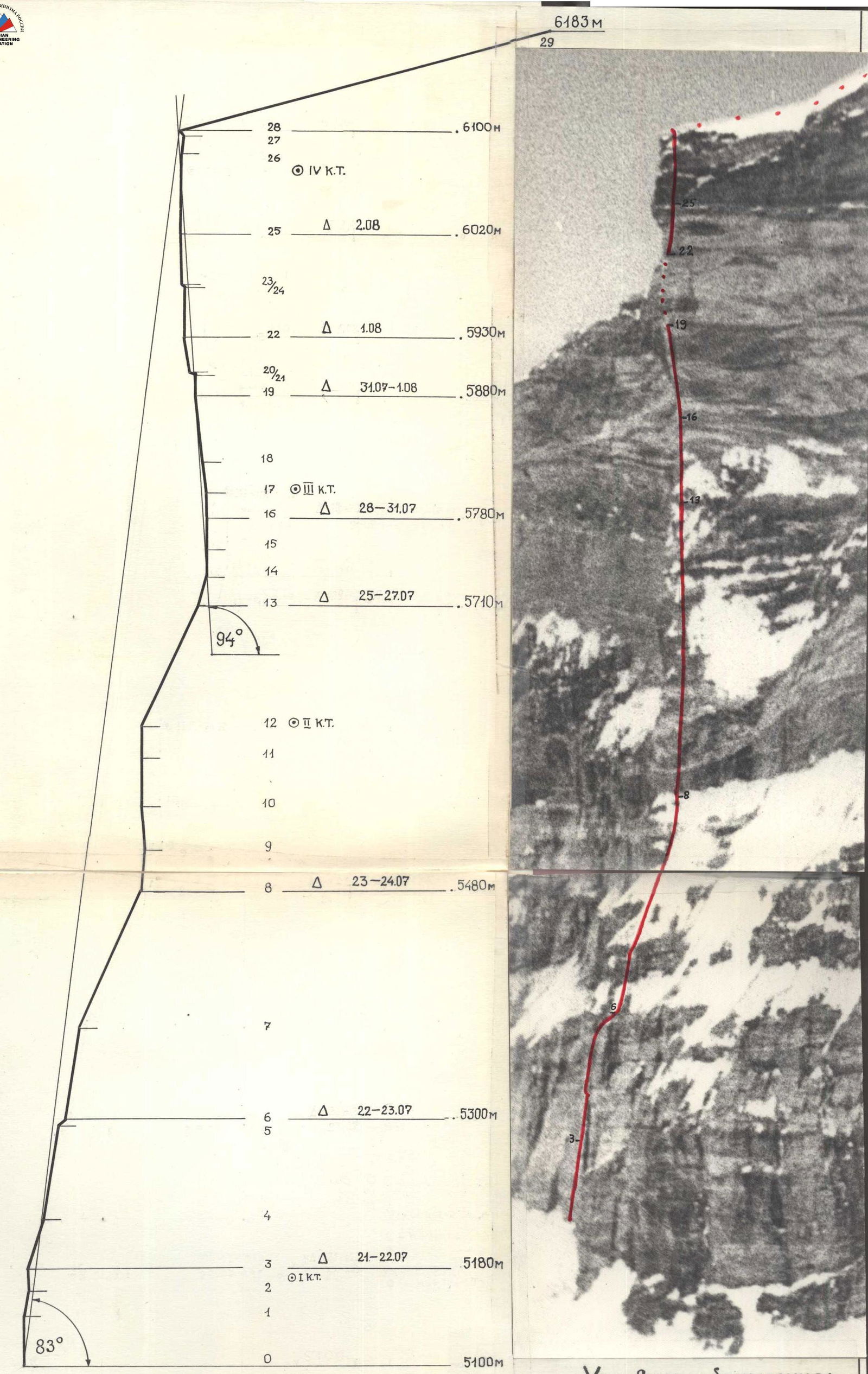
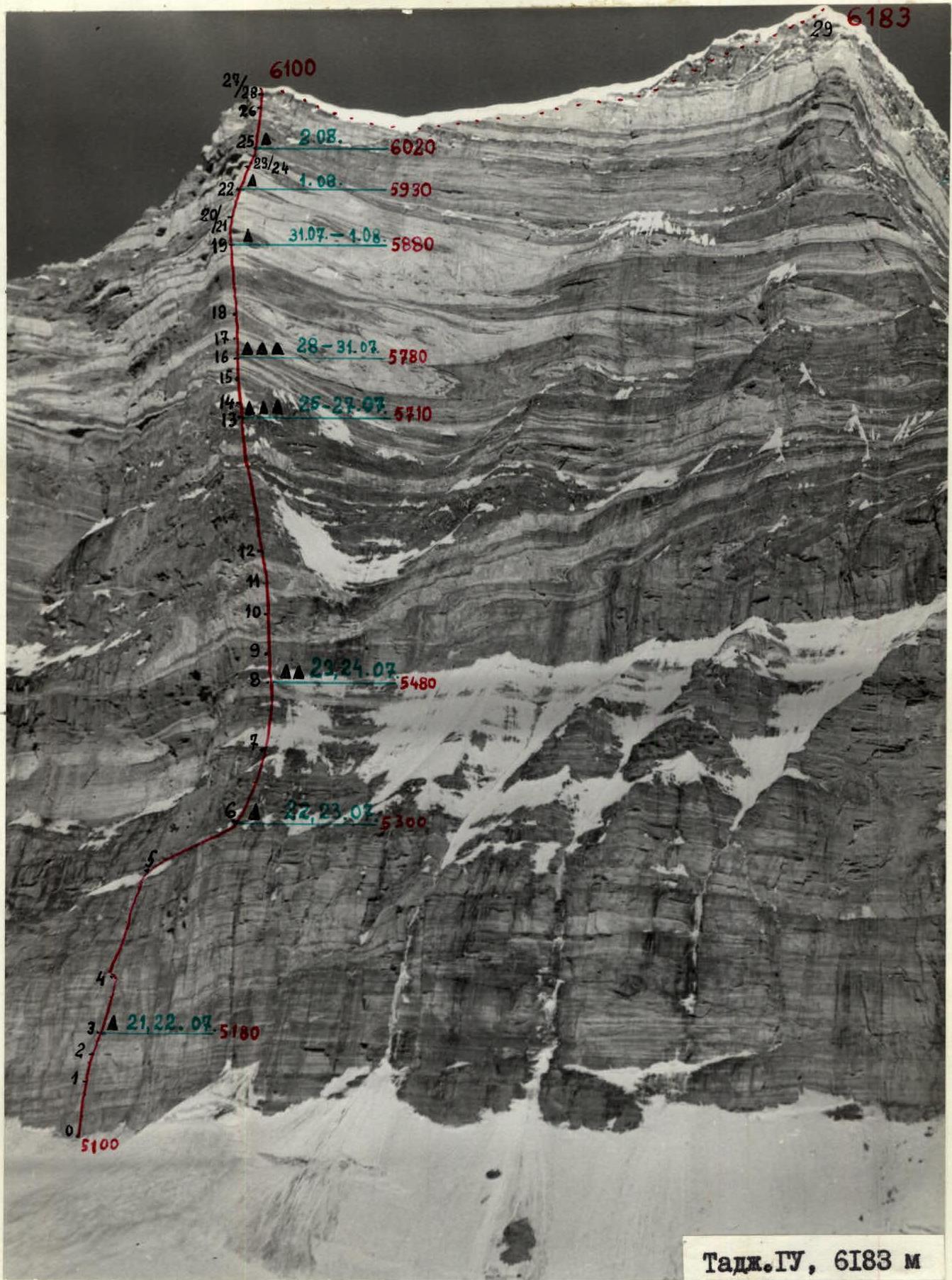
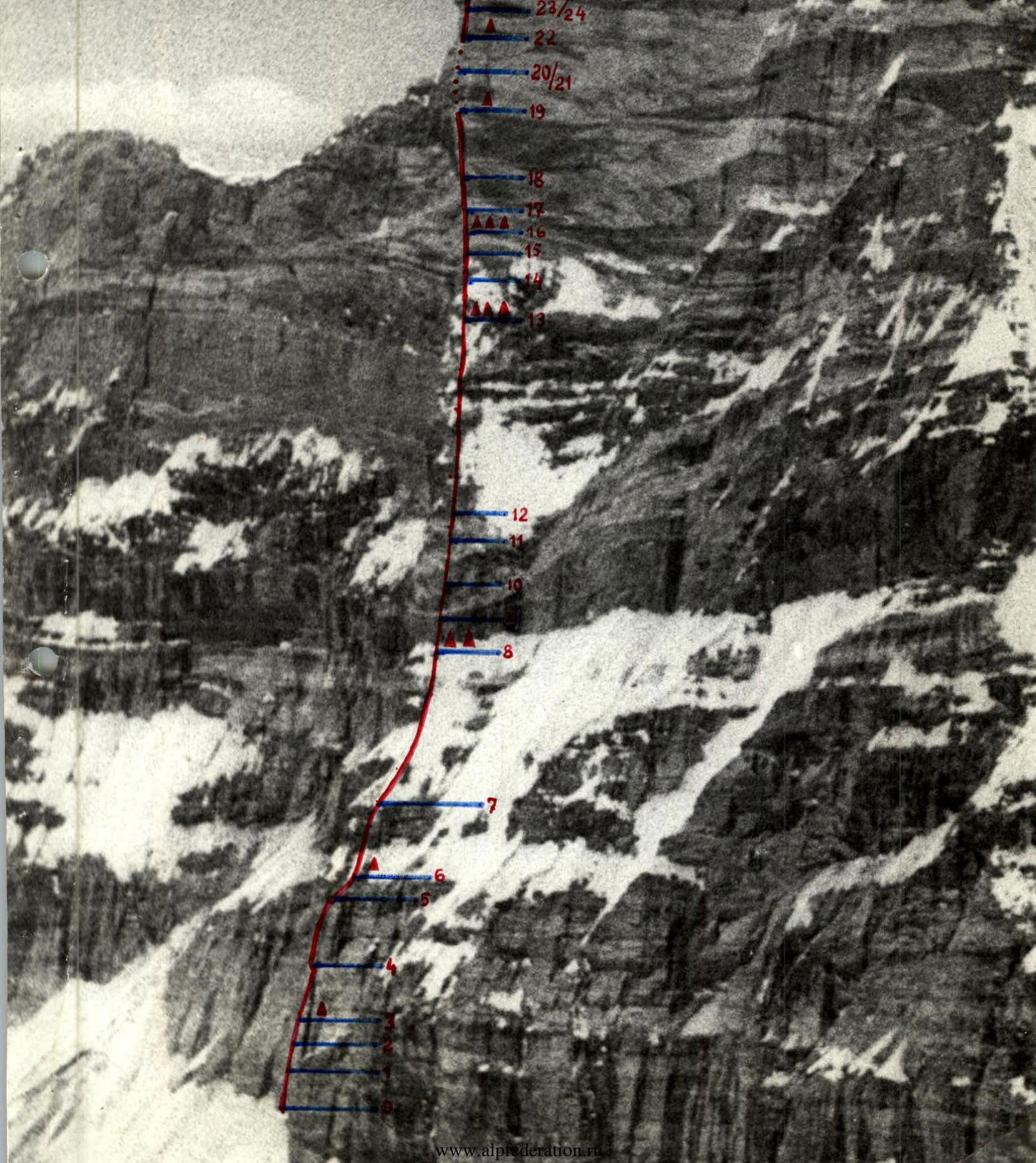
Profile scheme of the route
Explanation of the table
July 19. A group of 10 people (assault team and observers) left the base camp at 4200 m. Bypassing the "dusty nights" and the 5200 m ridge between the peaks of Moscow Pravda and Engels, the group descended to the Zughvand glacier, where they set up the first intermediate camp on the orographic left side.
July 20. A "Pamirka" tent is set up in the immediate vicinity of the wall (within 20-30 minutes walk), where part of the equipment necessary for the first assault trio is transferred.
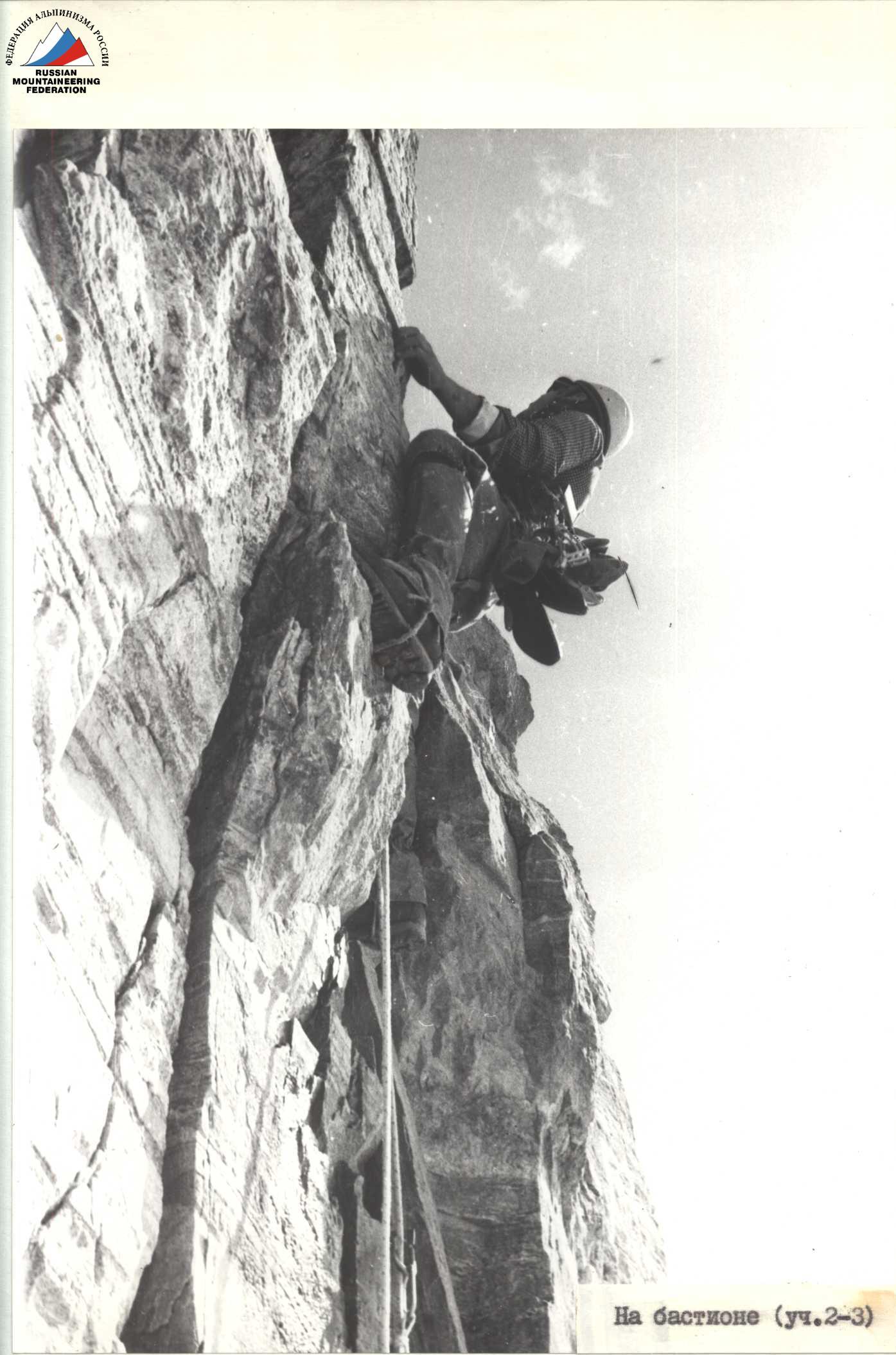
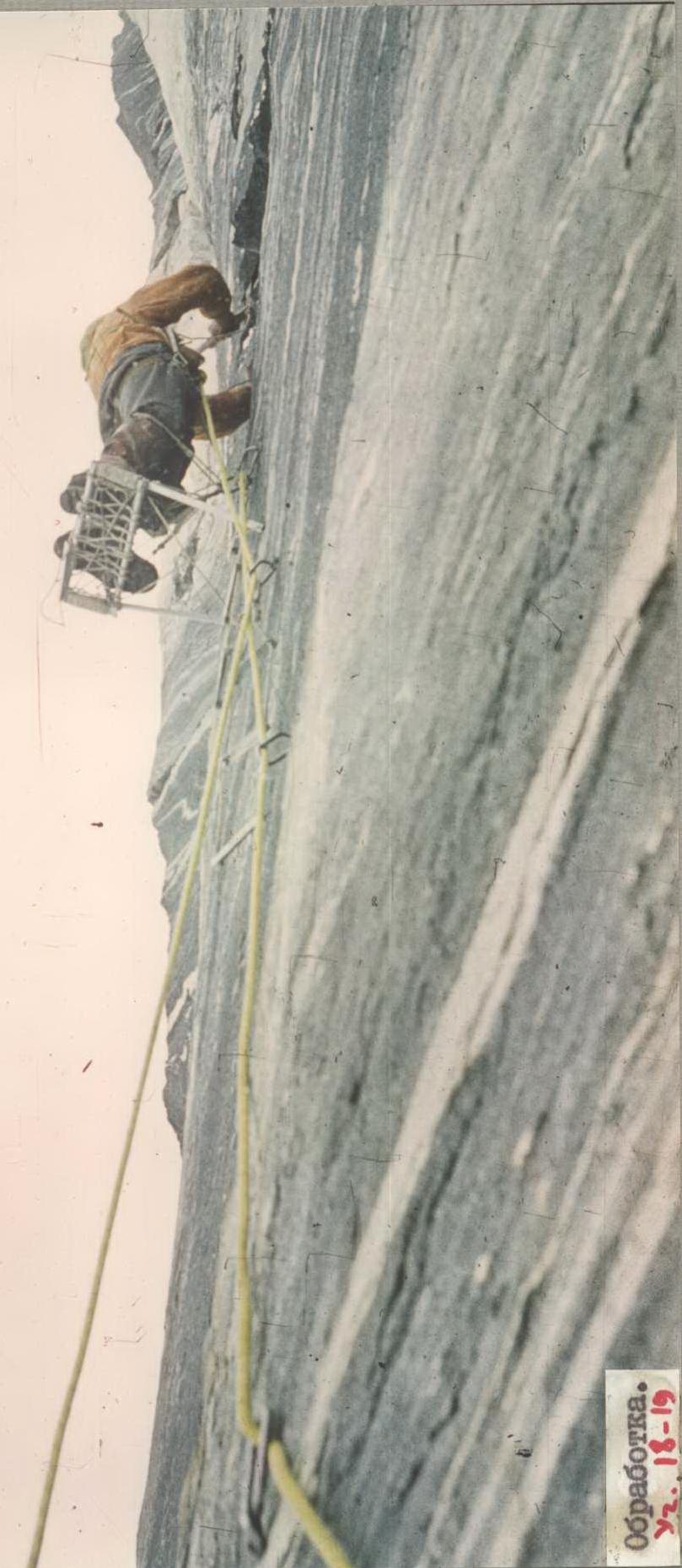
July 21. Early departure. Quickly reaching the base of the wall along the firm snow (25°), the pair began work, while the third team member organized the equipment and ropes. From the very first meters, difficult climbing in galoshes (R0-R1).
July 22. The second assault trio, consisting of Kartvelishvili, Giuashvili, and Gheldiashvili, approaches the route at 8:00. They climb to the site along the fixed ropes, relieving the working team of pulling the load.
July 23. Due to rockfall hazard, departure at 13:00. The front trio continues to move upward.
July 24. The first trio descends to the overnight stay under the overhang, from where the entire six-person team transfers equipment to the base of the "belly".
July 25. The same pair, having passed the fixed ropes, continues on. 25 m of very difficult climbing (section R11-R12) leads them above the "belly", where a load reception point is organized.
July 26. Overcast. Cold. Wind. Four people work in shifts, transferring the load to the overnight stay left yesterday under the "belly".
July 27. Cold, strong wind. Sleet at times.
July 28. Bad weather. Wind. Fog. Cold.
July 31. Weather improves, but still very cold.
August 1. The pair Gheldiashvili-Lukashvili departs at 8:00.
August 2. From the ledge, along the overhanging inner angle (45 m), straight up.
August 3. From the gap, left upward 15 m of difficult climbing, then straight up (30 m) to a ledge.
Information on reconnaissance exits and tactics of the ascent
The organization and tactical plan of the ascent were based on the study of the specific features of the route and the area conducted by the team in the 1978 and 1979 seasons.
The tactical plan included:
- Choosing the time for the gathering in the ascent area, organizing the base and intermediate camps.
- Physical and psychological preparation of the team for the route.
- Material and technical equipment of the team.
From last year's experience, it was known that the intensity of rockfalls in the first days of August in this area increases sharply. Therefore, it was decided to carry out the ascent as early as possible in the summer, as allowed by the Championship regulations.
The team flew out of Tbilisi on June 15 and set up a base camp in the Kish ty-Jerob valley at an altitude of 4200 m above sea level on June 23.
The training and reconnaissance cycle consisted of two main stages: a) year-round training before the start of the season, including two gatherings - in winter and spring; b) training and acclimatization ascents before approaching the declared route.
The year-round training was conducted on a climbing wall in Tbilisi and aimed at achieving athletic form, testing special equipment, and practicing techniques and tactics for passing complex rock sections.
The team conducted two training gatherings:
- in winter - in Bakuriani;
- in spring - in Terskol.
Most of the training and acclimatization ascents were chosen with the possibility of simultaneous reconnaissance of the declared route.
On July 2, a group consisting of G. Kartvelishvili (leader), D. Sharasdze, T. Bakanidze, R. Giuashvili, T. Lukashvili, D. Kelekhsa shvili, I. Gheldiashvili, and O. Erkomaishvili ascended the North Peak of Moscow Pravda.
On July 7, a group consisting of G. Kartvelishvili (leader), D. Sharasdze, T. Bakanidze, M. Chinchinadze, G. Zumbadze, and T. Sharasdze ascended Peak Engels via the Western wall (5B category of difficulty) and returned to the base camp on July 12.
These exits, along with the 1978 ascents to the North Peak of Moscow Pravda and Peak Nikoladze via the north-eastern edge, provided exhaustive information about the route.
General characteristics of the route and conclusions
The eastern facade of Peak Tajik State University is a sheer rock wall over a kilometer long. The most challenging part of this wall is its left edge, traversed by the team.
The specifics of the route include:
- High technical difficulty, manifested in the length and continuity of steep and overhanging sections at a significant height; increasing difficulty requiring climbers to be in perfect physical, technical, and psychological shape.
- The absence of snow and ice on the last 350-meter section, forcing climbers to carry ice for water, significantly increasing the labor intensity of the ascent.
- Features of the geological structure of the wall: large blocks, thin flaking slabs detached from the wall, unsuitable for holds and organization of artificial points of support, alternation of granite, marble, and shale belts, which overhang in the form of a cascade of cornices.
All this requires the application of the entire known arsenal of mountaineering techniques and equipment.
Moreover, this wall, and especially the edge of the eastern ridge of the southern sub-peak, is completely exposed to the wind. After sunset, it is constantly blown by wind from the firn plateau between Peaks Marx and Engels, making the route quite cold.
The study of the route in 1978 and 1979, and the experience of partially traversing it in 1978, showed that when ascending Peak TGU, the team would face a "high-altitude siege" tactic - processing the route from a well-provided base camp directly adjacent to the section being processed.
In our opinion, without highly skilled rock climbers, it is impossible to traverse this route within a reasonable timeframe. Only a combination of high free climbing technique and extensive mountaineering experience should allow for a successful ascent.
The fact that the team correctly assessed the features and difficulty of the route and found the right tactical solution to the problem is demonstrated by the almost complete coincidence of the preliminary tactical plan with the actual passage of the route day by day.
This route, with its complexity, is qualitatively different from all previously traversed routes of 6B category of difficulty by the team and its participants at different times.
Team composition for the assignment
- Sharasdze D.B., Master of Sports - coach.
- Erkomaishvili O.N., Master of Sports - head of the rescue team.
- Zumbadze G.Sh., Master of Sports - participant.
- Kelekhsa shvili D.L., Candidate for Master of Sports - participant.
- Sharasdze T.Sh., 1st sports category - participant.
- Shengelia R.M., 2nd sports category - doctor.
30 Kenny


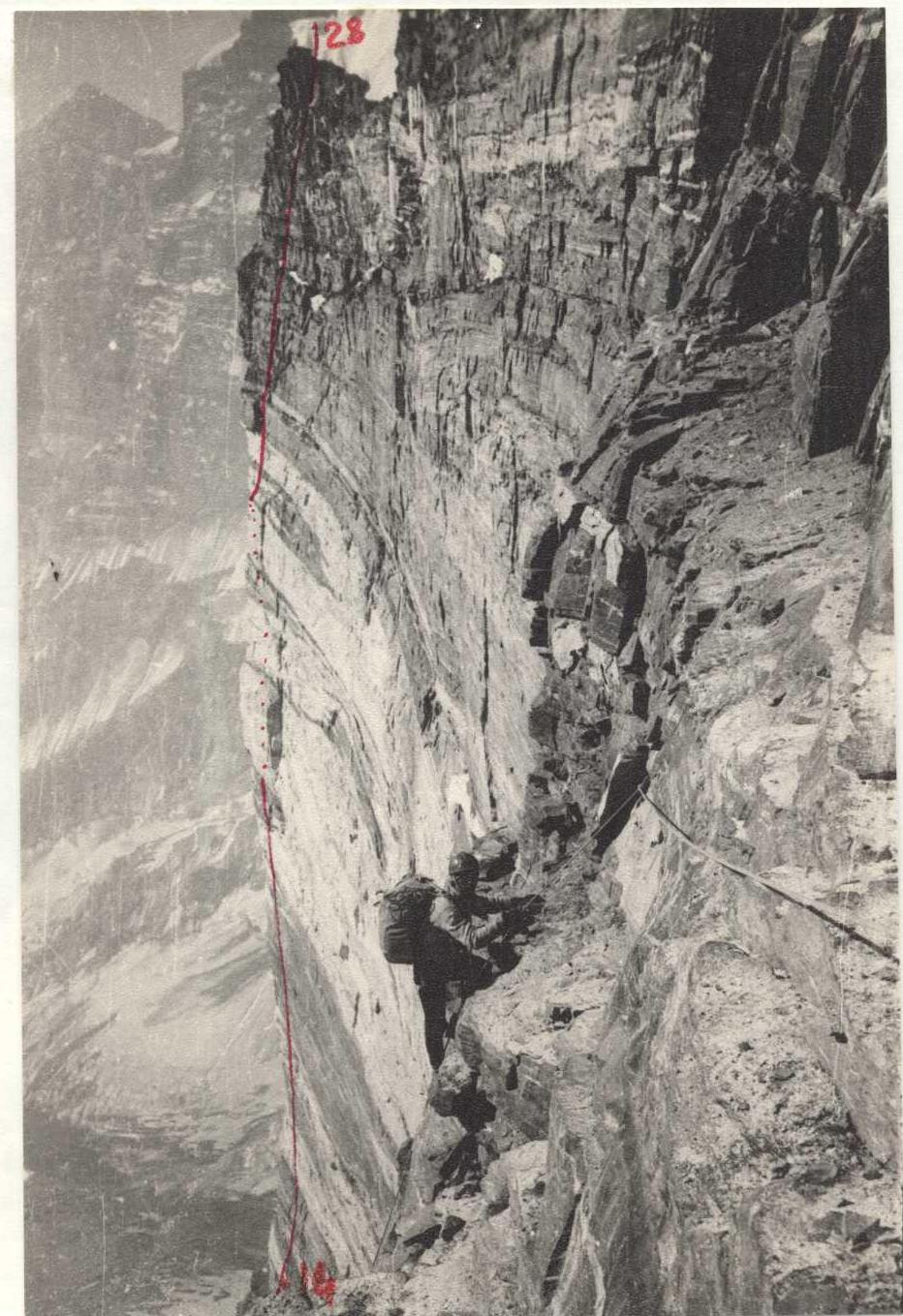 section R14-R28
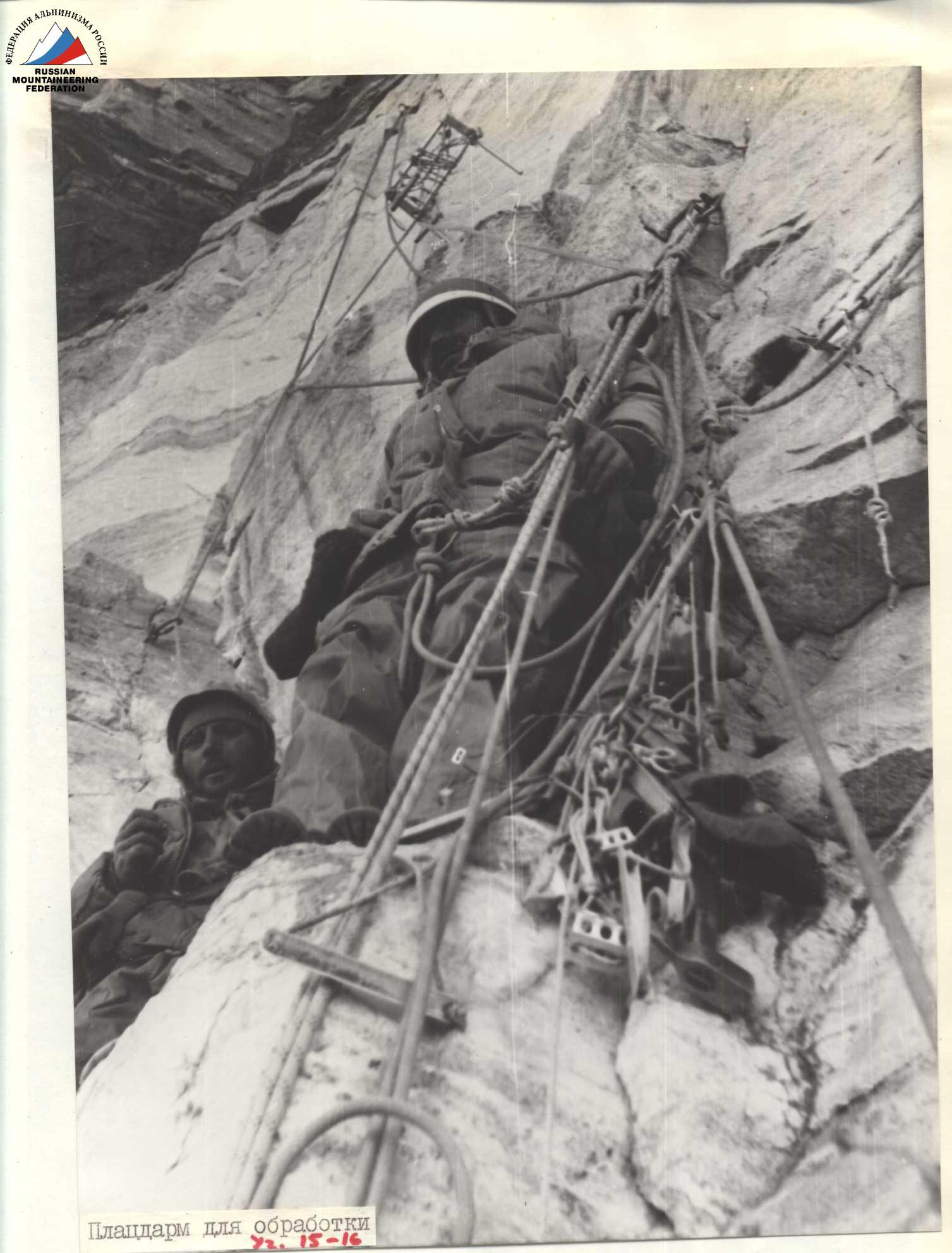


 ![img-16.jpeg",