

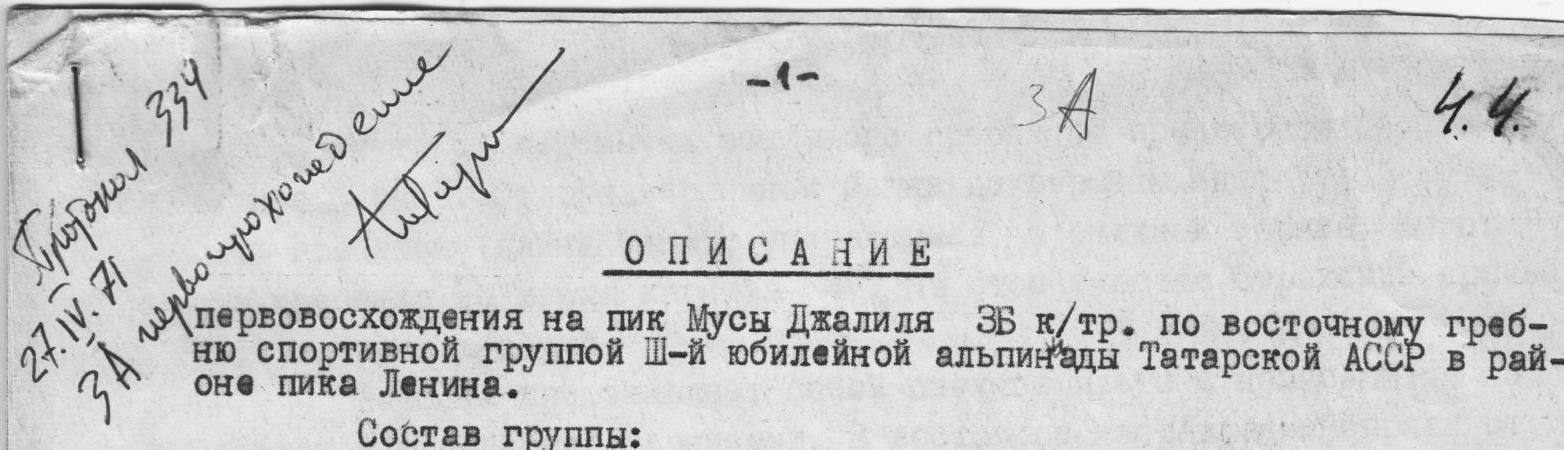
Description
First ascent of Musa Jalil Peak, category 38, via the eastern ridge by the sports group of the 3rd Anniversary Alpinada of the Tatar ASSR in the Lenin Peak area.
Group composition:
-
Yagafarov V.P.
-
Krylov V.N.
-
Faseev K.S.
-
Penkov G.A.
-
Yagafarov I.K.
-
Labutina T.E.
-
Mavitova G.F. 3rd sports rank
-
F
-
Port. rank
-
Port. rank 3rd sports rank 3rd sports rank 3rd sports rank 3rd sports rank
- leader
- participant
- participant
- participant
- participant
- participant
- participant
- trainer-observer
Date of ascent — July 7, 1970. Musa Jalil Peak is located in the central part of the Trans-Alay Range in a lateral ridge running north from the Ravdel'naya peak, southwest of Petrovsky Peak. The height of Musa Jalil Peak is 4800 m.
The path from the "Vysochnik" alpine camp goes through the "Onion Glade" to the Travelers' Pass. Reaching the foot of the pass, one needs to cross the river and organize a bivouac on the moraine.
From the bivouac, traversing the main and snowy slopes, one reaches the saddle 14 — a small ridge located from east to west between the massif of Petrovsky Peak and the ridge where the tent rock and Travelers' Pass are located.
From saddle 14, the route goes along the ridge to the west, bypassing the destroyed rocks on the right, then — an ascent to an elevation on the ridge and a descent to saddle 2 of the main ridge (leading to Musa Jalil Peak).
The path between the two saddles of the ridges takes about 3 hours, with simultaneous insurance.
Immediately after saddle 14, a steep snowy slope begins in the northeast direction, 300 m long (steepness 40–45°), with ice outcrops in the upper part. Insurance is alternating via ice axe; the upper part of the slope is traversed in crampons with piton insurance. Then follows an ascent to the destroyed rocks and further, a second snowy-icy slope, 150 m long and with a steepness of 45–50°, which is traversed in crampons with piton insurance; after the slope, upon exiting to the rocks — there is flow ice. Further, the path goes along the ridge in the direction of a rocky "tooth". From the rocky "tooth", an ascent along the icy slope leads to the base of the pre-summit tower (insurance via ledges or rock pitons). The exit to the pre-summit tower is done by bypassing it on the right through a cleft and traversing a steep (55°) icy wall, with piton insurance, in the cleft. An exit to the pre-summit is possi-