
Report
On ascending Lenin Peak via the Southwest Ridge from the Malaia Sauk-Dara valley. First ascent - approximately Category 5B difficulty.
Climbing category — high-altitude.
Team leader: Yushin N.P. Coach: Honored Master of Sports Kuzmin K.K.
Moscow, 1969

Pre-Climb Preparation
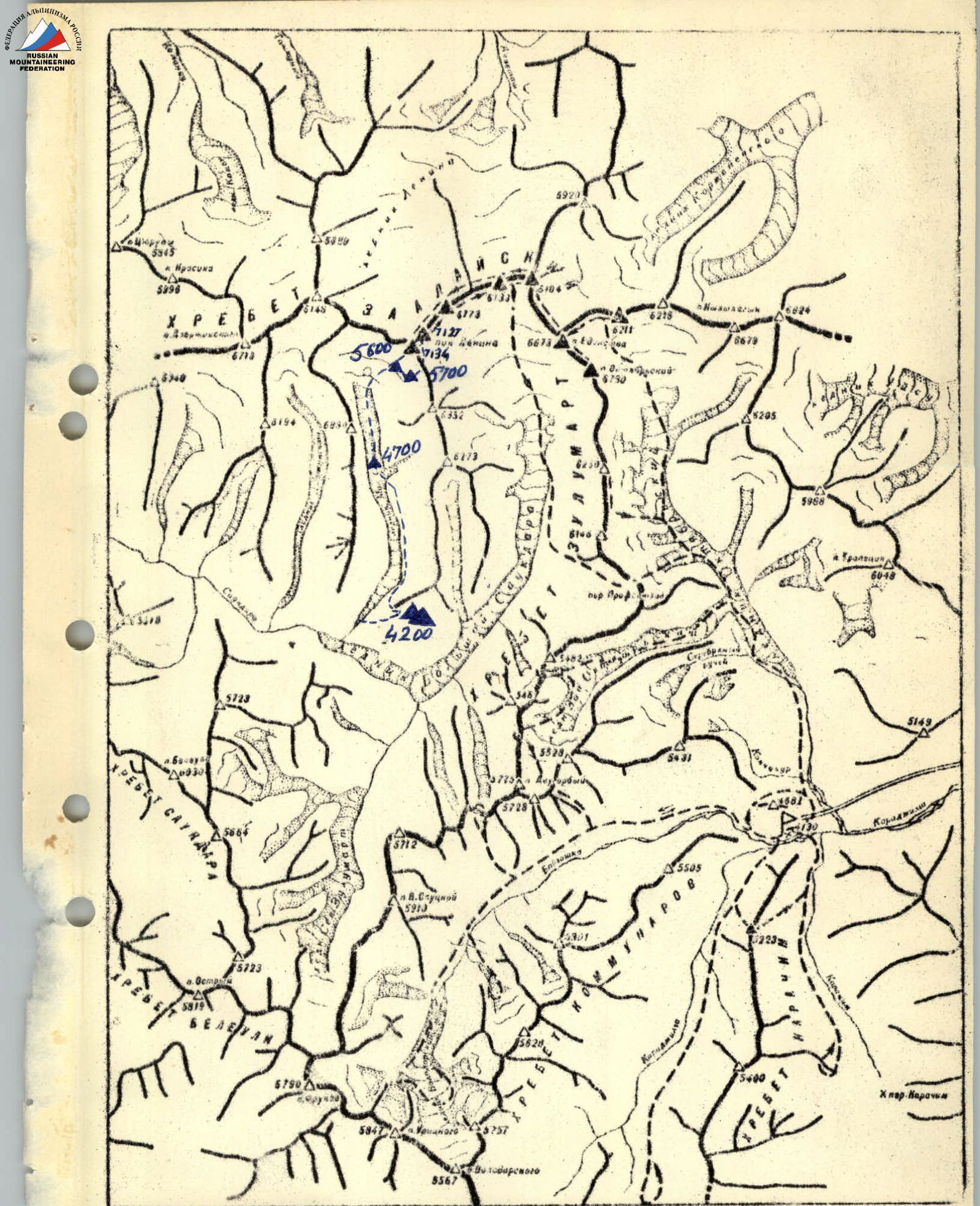
All team members have been training year-round for several years and go to the mountains every summer. This ascent was planned at the beginning of 1969. The final team composition was determined just before the climb. Before heading to the mountains, available photographs were studied, but the route was ultimately chosen upon the team's arrival at the ascent location in the upper reaches of the Malaia Sauk-Dara glacier. The route is the shortest and safest of the five possible routes to Lenin Peak from this glacier. In July, members of this group completed several ascents in the Fortambek glacier area, including:
- Pik Parashyutistov
- Pik Suloeva
- Pik Krupskoi
- Pik Korzhenevskoi
as part of different teams, achieving good high-altitude acclimatization, which was particularly necessary given the main task of the group: to descend from Lenin Peak with the bodies of four parachutists who died in the summer of 1968.
Equipment and Provisions
The group was fully equipped with high-quality standard and specialized gear:
- Participants had insulated shekltouns or high-altitude double Vibram boots
- Woolen underwear
- Lightweight down and windproof suits
- Down sleeping bags
A specially made high-altitude tent weighing 3.5 kg was available.
The group had high-quality, high-calorie food products:
- salmon
- cod liver
- honey
- freeze-dried meat
- dried milk
- vitamins, etc.
Ascent
August 8. The group left the base camp at 13:30. The weather was excellent. After crossing a small ridge, they moved along the left orographic moraine of the Malaia Sauk-Dara glacier, then onto the glacier and stopped for the night on the median moraine after 1.5 hours. An hour earlier, the Maksimov group had left the base camp for an acclimatization sortie and had carried the team's ropes, ironware, and cans to their cache on the glacier.
August 9. Departure at 10:00. After 1.5 hours, they reached the cache, collected their equipment from the Maksimov group, and packed their backpacks. The path from the base camp (4300 m) to the cache (4900 m) had been previously marked by the Artyukhin group's acclimatization and reconnaissance sortie. From here, they moved onto the open glacier and continued into the area of lakes in its middle part. Backpacks weighing 25–26 kg allowed them to maintain good physical form. The glacier was heavily crevassed. After 1.5 hours, they entered a closed glacier section, roped up, and continued, navigating through closed and sometimes very wide and long crevasses. During a rest stop in the upper reaches of the glacier, they roughly planned their route and by 18:30 reached the intended ridge and stopped for the night (5400 m).
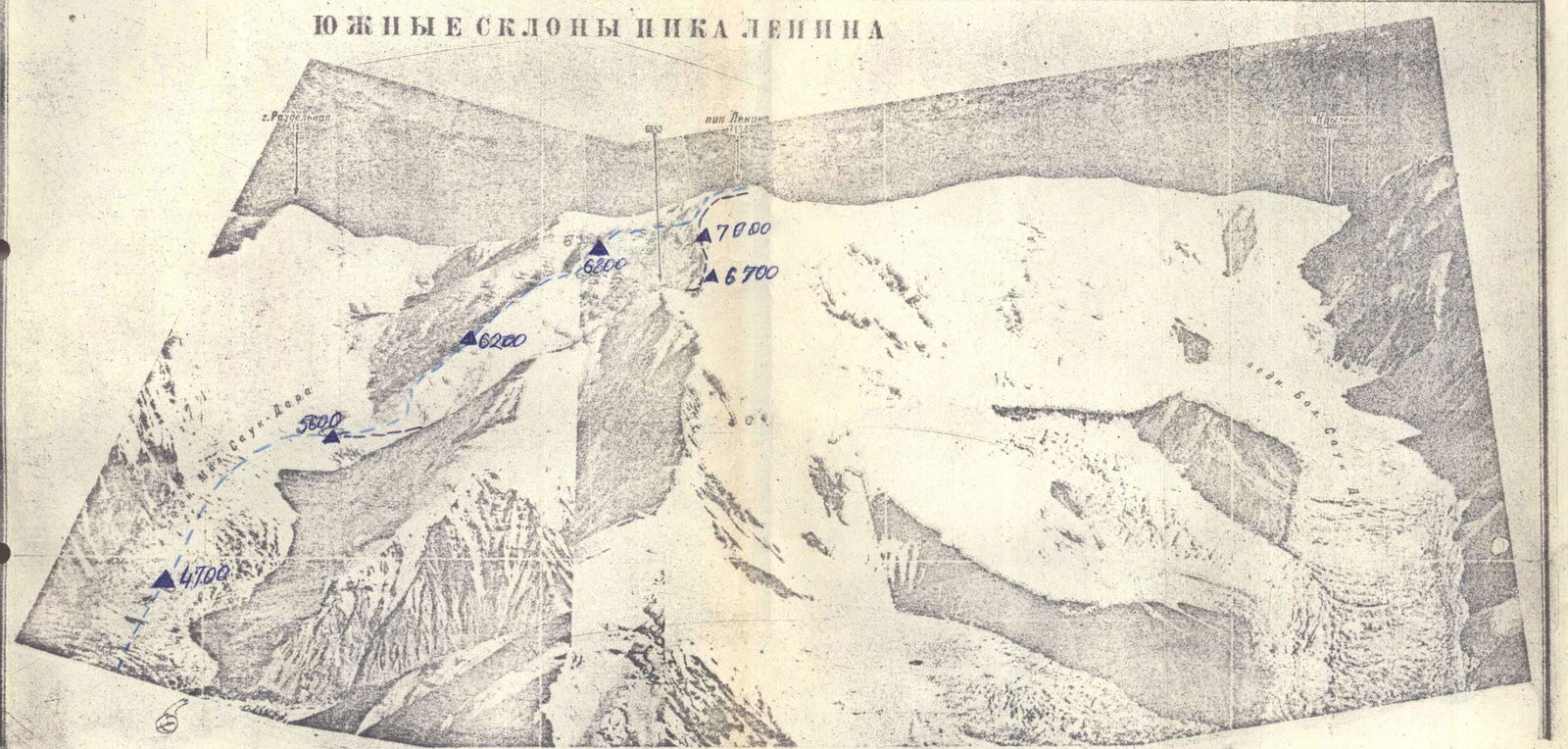
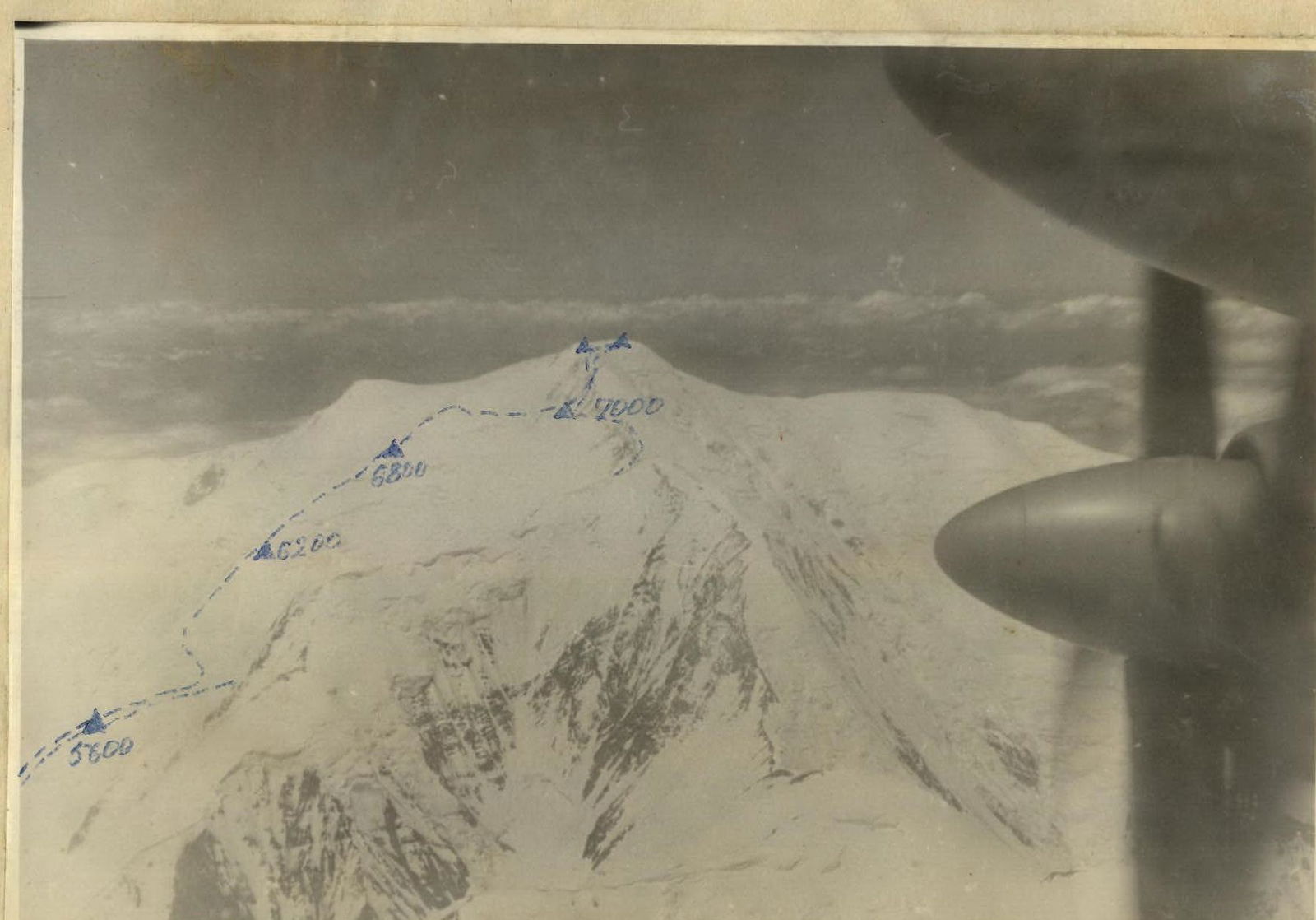
August 10. Departure at 10:00. Ropes: Zakharov–Oshin–Bogachev–Zasetsky and Vustin–Shindyaikin–Kuzmin. They ascended 150 m on the glacier, then moved left up a techno-ice slope of 40–45 degrees towards rocky outcrops. They then proceeded along the ridge, alongside rocky outcrops, for 6 ropes on rugged ice with protection on the rocks. Since the group had only 10 pairs of crampons, the first climber (Zakharov) went the full rope length, while the others followed in sport climbing style. By 14:30, they reached a more gentle section. Here, on a scree slope of 30 degrees, they took a break as there was water available. They then continued up a techno-ice slope of average steepness (400–450 m) simultaneously. Ascends of up to 40 m with steepness up to 35–40 degrees alternated with gentler sections. The snow was loose, 10–15 cm deep, and lay on ice. Further on, they ascended about 300 m at a similar steepness, but mostly on scree, which significantly eased the ascent. They reached a gentle scree platform and spent 30 minutes preparing a site for the tent. The altitude of the bivouac was about 6200 m.
August 11. Departure at 10:30. They continued along the ridge. The weather was clear, but with strong winds. The ridge was mostly snowy, with deep snow, especially on the ascends, where they sank up to their waists at times.
Two ascends:
- 40 m, up to 60 degrees
- 70 m, up to 60 degrees
required the use of alternate protection.
In the middle section of the ridge, it narrowed. Here, a rocky outcrop 45–50 m high and up to 40 degrees steep was overcome with alternate protection. For the rest of the path, they moved simultaneously, changing the lead. Ascends were not steeper than 40 degrees.
By 18:00, they stopped for the night on a gentle right-hand slope of the ridge due to strong winds on the ridge. They had to cut out a platform. The altitude was about 6800 m.
August 12. Departure at 10:30. They overcame a rocky (35 degrees) ascent and then the last steep (45 degrees) snowy ascent (30 m). Further on, the ridge was scree with a steepness of 25–30 degrees. At an altitude of 7000 m, they traversed a firn slope for 250 m and reached the rocks of the south ridge. Here, they left their backpacks and ascended a not too steep (20 degrees) first rocky, then snowy slope to reach 7134 by 15:00, where they left a note.
After resting and taking photos:
- They went to the cairn on 7127 and left a note there as well;
- Then they returned to 7134 and began their descent to their backpacks, and further down with them for 4.5 rope lengths.
Here, at an altitude of about 7000 m, was a good spot for the night. They prepared a platform for the tent, and Kuzmin, Zakharov, and Soustin found and wrapped the body of Tomarovich.
August 13. The group's main task began. The descent was planned along the south ridge to a saddle and then straight down the slope. Observations during the ascent showed that this path was safe at the time. Due to its greater steepness, the descent path was about one and a half times shorter, which was particularly valuable given the transportation work. Moreover, all the bodies were located on the south ridge.
Departure at 10:00. It took 3.5 hours to traverse along the slope about 100 m to the south ridge to Tomarovich's body and lift it 25 m up to bypass rocks.
Further descent was down a snowy (20 degrees) slope to 6800 m. Here, they wrapped the bodies of Mekaeva, Glagoleva, and Imatov for 2 hours. The continuously blowing wind, significantly exceeding comfort levels, hindered their work, knocking them off their feet. Further down, there was a snowy slope with scree outcrops, averaging about 30 degrees in steepness, but the progress was hampered by wavy hard firn drifts.
Each descent was accompanied by a guide. Protection was through 2 ice axes. Three ropes were tied together, and they descended in turns for 120 m.
At an altitude of about 6700 m, under a large rock protecting them from the wind, they set up a tent.
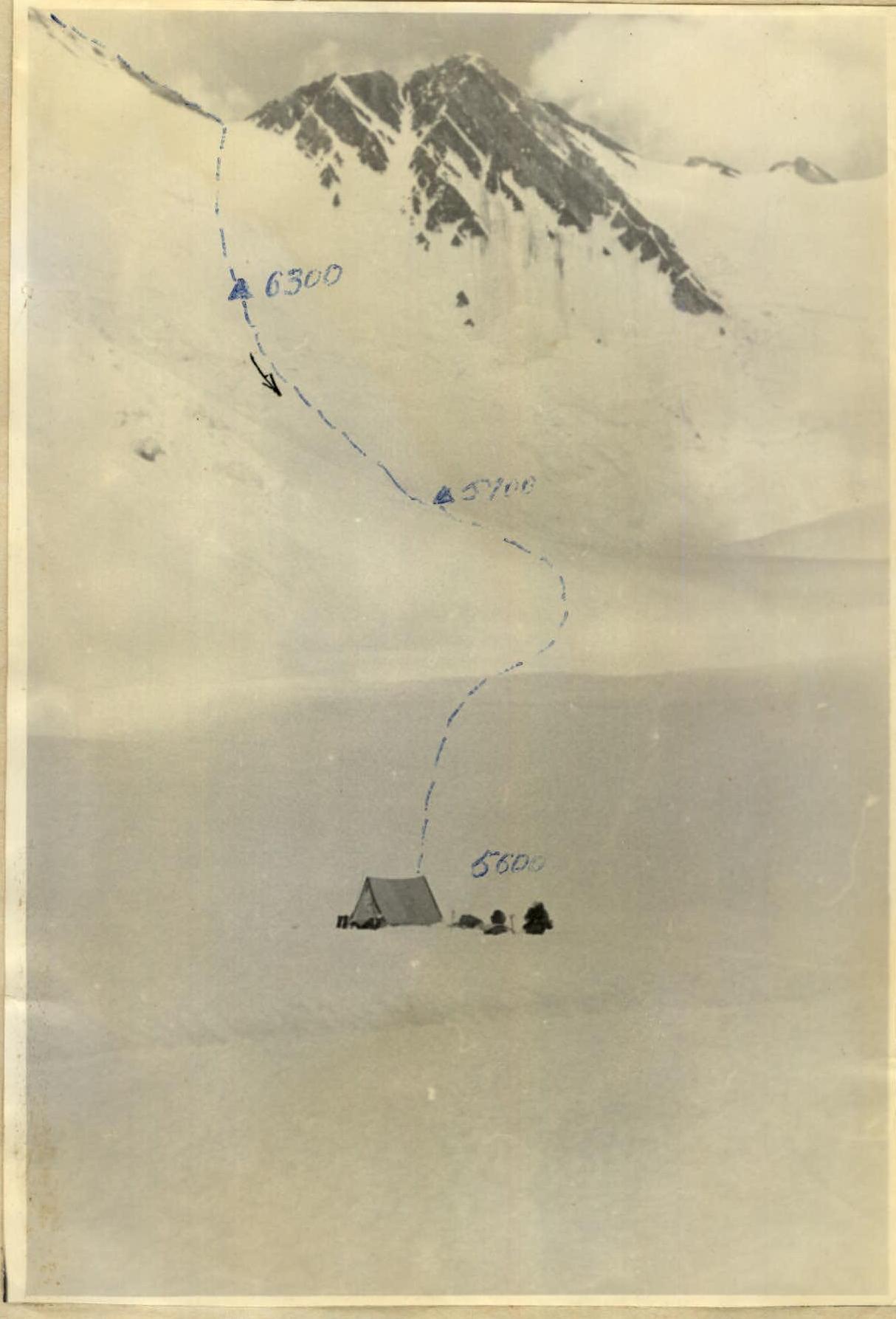
August 14. Departure at 10:30. Descent of 2×120 m down a snowy slope of 30 degrees, then a traverse with the transfer of bodies on hands across a scree slope, and further down a snowy slope to a saddle (6300 m). From the saddle, a 3×120 m descent down a 45-degree slope to a bergschrund, avoiding two crevasses. The bergschrund was overhanging, 2 m high. They jumped over it in a narrow part and, as there was nothing better nearby, set up a tent in its snow-filled part. They had to cut out part of the ice, but the tent was protected by the overhanging ice wall from rocks and ice chunks that could fall from above. Only here, at 6200 m, did the fierce wind that had raged for the last five days finally cease.
August 15. Departure at 11:30. They continued their descent down a snowy 45-degree slope. They had to traverse around two large crevasses. Kuzmin went ahead and scouted the most convenient path for the descent to ease the work. The snow was loose, making the work difficult. Fatigue was starting to show.
However, at 18:30, a helicopter flew by and dropped a container onto the glacier, which was only 200 m below them in altitude. The container was a good stimulant. The descent pace quickened.
After 120 m, an ice section appeared (25 m, 50 degrees). They had to drive in three ice screws.
Below was a gentle snowy slope (25 degrees, 100 m), where they sank waist-deep in places.
Finally, in the middle of this slope, they left the bodies and descended to the last ice wall. The wall was 45 degrees, 50 m, followed by a flattening snowy ridge. They drove in two ice screws and descended 120 m in sport climbing style.
They reached the flat glacier by 21:30, set up a tent, and found the container in the dark, which contained:
- a canister of gasoline,
- a variety of products for them and the transportation team,
- 10 kg of apples, which caused particular delight.
Half of the apples were eaten immediately. They went to bed around midnight.
August 16. They got up at 9:00. The Zakharov–Soustin pair ascended and, on the snow hardened overnight, descended with the bodies to the tent on their own and removed the ropes. The Yushin–Zasetsky pair dragged the container to the tent. After breakfast, they buried the bodies under an ice boulder until the transportation team arrived, also transferring and leaving all the products in a visible place, marking the spot with a makeshift flag.
After this, they rested and prepared to descend. They departed at 14:30 and half an hour later approached the start of the ridge they had ascended. Here, they met two transportation groups. At 17:00, they began their descent along the path trodden by these groups. A lot of snow had fallen during the ascent, and many crevasses had opened. They had to jump over them frequently. By 19:00, they descended to a bivouac on the median moraine and set up a tent. Another transportation group was also staying here for the night.
August 17. They got up at 7:00 and at 7:30, without breakfast, headed to the base camp, arriving safely at 10:30.
Conclusion on the Route
The route was completed in fairly good meteorological conditions. The success of the ascent and the descent operations was facilitated by:
- thorough preparation,
- availability of good equipment,
- the vast experience of their coach, K.K. Kuzmin,
- the significant high-altitude experience of most team members.
The route was completed more slowly than possible under the given conditions, due to the specific nature of the descent and the tasks set before the group.
This route is a first ascent and, according to the assessment of experienced high-altitude climbers K.K. Kuzmin, I.D. Bogachev, and B.P. Soustin, fully corresponds to a high-altitude route of Category 5B difficulty.
Table of Main Route Sections
Ascent
- Snow-ice slope, 45 degrees, 150 m.
- Ice slope, 45 degrees, 240 m.
- Snow-ice slope, average steepness 30 degrees, 450 m.
- Scree slope, 300 m.
- Snow slope, 1800 m.
- Traverse of snow slope, 20 degrees, 250 m.
- Snow slope, 20 degrees, 250 m.
Descent
- Snow slope, average steepness 20 degrees, 300 m.
- 30 degrees, 1400 m.
- Snow-ice slope, 45 degrees, 1200 m.


